
Czesław Miłosz
Czesław Miłosz was a Nobel Prize winning poet and author of Polish-Lithuanian heritage. He memorialised his Lithuanian childhood in a 1955 novel, The Issa Valley , and in the 1959 memoir Native Realm . After graduating from Sigismund Augustus Gymnasium in Vilnius, he studied law at Stefan Batory University and in 1931 he travelled to Paris, where he was influenced by his distant cousin Oscar Milosz, a French poet of Lithuanian descent and a Swedenborgian. His first volume of poetry was published in 1934. After receiving his law degree that year, he again spent a year in Paris on a fellowship. Upon returning, he worked as a commentator at Radio Wilno, but was dismissed, an action described as stemming from either his leftist views or for views overly sympathetic to Lithuania. Miłosz wrote all his poetry, fiction, and essays in Polish and translated the Old Testament Psalms into Polish. Awarded the 1980 Nobel Prize in Literature for being an author "who with uncompromising clear-sightedness voices man's exposed condition in a world of severe conflicts."
28 Books Written

The Captive Mind begins with a discussion of the novel Insatiability by Stanisław Ignacy Witkiewicz and its plot device of Murti-Bing pills, which are used as a metaphor for dialectical materialism, but also for the deadening of the intellect caused by consumerism in Western society. The second chapter considers the way in which the West was seen at the time by residents of Central and Eastern Europe, while the third outlines the practice of Ketman, the act of paying lip service to authority while concealing personal opposition, describing seven forms applied in the people's democracies of mid-20th century Europe.The four chapters at the heart of the book then follow, each a portrayal of a gifted Polish man who capitulated, in some fashion, to the demands of the Communist state. They are identified only as Alpha, the Moralist; Beta, The Disappointed Lover; Gamma, the Slave of History; and Delta, the Troubadour. However, each of the four portraits were easily identifiable: Alpha is Jerzy Andrzejewski, Beta is Tadeusz Borowski, Gamma is Jerzy Putrament and Delta is Konstanty Ildefons Gałczyński.The book moves toward its climax with an elaboration of "enslavement through consciousness" in the penultimate chapter and closes with a pained and personal assessment of the fate of the Baltic nations in particular.

Selected Poems: 1931 - 2004 celebrates Czeslaw Milosz's lifetime of poetry. Widely regarded as one of the greatest poets of our time, Milosz is a master of expression and probing inquiry. Life opened for Czeslaw Milosz at a crossroads of civilizations in northeastern Europe. This was less a melting pot than a torrent of languages and ideas, where old folk traditions met Catholic, Protestant, Judaic, and Orthodox rites. What unfolded next around him was a century of catastrophe and madness: two world wars, revolutions, invasions, and the murder of tens of millions, all set to a cacophony of hymns, gunfire, national anthems, and dazzling lies. In the thick of this upheaval, wide awake and in awe of living, dodging shrapnel, imprisonment, and despair, Milosz tried to understand both history and the moment, with humble respect for the suffering of each individual. He read voraciously in many languages and wrote masterful poetry that, even in translation, is infused with a tireless spirit and a penetrating insight into fundamental human dilemmas and the staggering yet simple truth that "to exist on the earth is beyond any power to name." Unflinching, outspoken, timeless, and unsentimental, Milosz digs through the rubble of the past, forging a vision -- and a warning -- that encompasses both pain and joy. "His intellectual life," writes Seamus Heaney, "could be viewed as a long single combat with shape-shifting untruth."
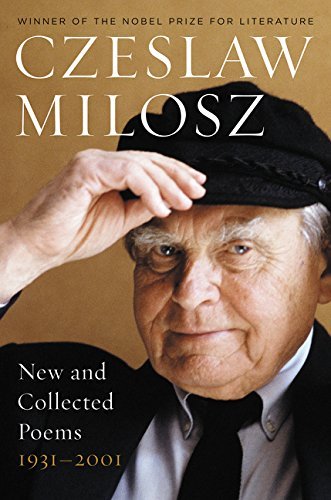
New and Collected Poems: 1931—2001 celebrates seven decades of Czeslaw Milosz’s exceptional career. Widely regarded as one of the greatest poets of our time, Milosz is a master of probing inquiry and graceful expression. His poetry is infused with a tireless spirit and penetrating insight into fundamental human dilemmas and the staggering yet simple truth that “to exist on the earth is beyond any power to name.”Czeslaw Milosz worked with the Polish Resistance movement in Warsaw during World War II and defected to France in 1951. His work brings to bear the political awareness of an exile—most notably in A Treatise on Poetry, a forty-page exploration of the world wars that rocked the first half of the twentieth century. His later poems also reflect the sharp political focus through which this Nobel Laureate never fails to bear witness to the events that stir the world.Digging among the rubble of the past, Milosz forges a vision that encompasses pain as well as joy. His work, wrote Edward Hirsch in the New York Times Book Review, is “one of the monumental splendors of poetry in our age.” With more than fifty poems from the end of Milosz’s career, this is an essential collection from one of the most important voices in contemporary poetry.

Thomas, the child-protagonist of The Issa Valley , is subject to both the contradictions of nature in this severe northern setting and sometimes enchanting, sometimes brutal timbre of village life. There are the deep pine and spruce forests, the grouse and the deer, and the hunter's gun. There is Magdalena, the beautiful mistress of the village priest, whose suicide unleashes her ghost to haunt the parish. There are also the loving grandparents with whom Thomas lives, who provide a balance of the not-quite-Dostoevskian devils that visit the villagers. In the end, Thomas is severed from his childhood and the Issa River, and leaves prepared for adventures beyond his valley. Poetic and richly imagined, The Issa Valley is a masterful work of fiction from one of our greatest living poets.

The autobiography of the Nobel laureateBefore he emigrated to the United States, Czeslaw Milosz lived through many of the social upheavals that defined the first half of the twentieth century. Here, in this compelling account of his early life, the author sketches his moral and intellectual history from childhood to the early fifties, providing the reader with a glimpse into a way of life that was radically different from anything an American or even a Western European could know.Using the events of his life as a starting point, Native Realm sets out to explore the consciousness of a writer and a man, examining the possibility of finding glimmers of meaning in the midst of chaos while remaining true to oneself.In this beautifully written and elegantly translated work, Milosz is at his very best.

"I went on a journey in order to acquaint myself with my province, in a two-horse wagon with a lot of fodder and a tin bucket rattling in the back. The bucket was required for the horses to drink from. I traveled through a country of hills and pine groves that gave way to woodlands, where swirls of smoke hovered over the roofs of houses, as if they were on fire, for they were chimneyless cabins; I crossed districts of fields and lakes. It was so interesting to be moving, to give the horses their rein, and wait until, in the next valley, a village slowly appeared, or a park with the white spot of a manor in it. And always we were barked at by a dog, assiduous in its duty. That was the beginning of the century; this is its . I have been thinking not only of the people who lived there once but also of the generations of dogs accompanying them in their everyday bustle, and one night-I don't know where it came from-in a pre-dawn sleep, that funny and tender phrase composed a road-side dog." -- Road-Side Dog

Nobel laureate Czeslaw Milosz's most recent collection Second Space marks a new stage in one of the great poetic pilgrimages of our time. Few poets have inhabited the land of old age as long or energetically as Milosz, for whom this territory holds both openings and closings, affirmations as well as losses. "Not soon, as late as the approach of my ninetieth year, / I felt a door opening in me and I entered / the clarity of early morning," he writes in "Late Ripeness." Elsewhere he laments the loss of his voracious vision -- "My wondrously quick eyes, you saw many things, / Lands and cities, islands and oceans" -- only to discover a new light that defies the limits of physical sight: "Without eyes, my gaze is fixed on one bright point, / That grows large and takes me in." Second Space is typically capacious in the range of voices, forms, and subjects it embraces. It moves seamlessly from dramatic monologues to theological treatises, from philosophy and history to epigrams, elegies, and metaphysical meditations. It is unified by Milosz's ongoing quest to find the bond linking the things of this world with the order of a "second space," shaped not by necessity, but grace. Second Space invites us to accompany a self-proclaimed "apprentice" on this extraordinary quest. In "Treatise on Theology," Milosz calls himself "a one day's master." He is, of course, far more than this. Second Space reveals an artist peerless both in his capacity to confront the world's suffering and in his eagerness to embrace its joys: "Sun. And sky. And in the sky white clouds. / Only now everything cried to him: Eurydice! / How will I live without you, my consoling one! / But there was a fragrant scent of herbs, the low humming of bees, / And he fell asleep with his cheek on the sun-warmed earth."

To find my home in one sentence, concise, as if hammered in metal. No to enchant anybody. Not to earn a lasting name in posterity. An unnamed need for order, for rhythm, for form, which three words are opposed to chaos and nothingness.-- Czeslaw Milosz

Presents a collection of musings on a variety of subjects, listed alphabetically, including literary characters, historical figures, and real and imagined places.

A comprehensive selection of essays--some never before translated into English--by the Nobel Laureate.To Begin Where I Am brings together a rich sampling of poet Czeslaw Milosz's prose writings. Spanning more than a half century, from an impassioned essay on human nature, wartime atrocities, and their challenge to ethical beliefs, written in 1942 in the form of a letter to his friend Jerzy Andrzejewski, to brief biographical sketches and poetic prose pieces from the late 1990s, this volume presents Milosz the prose writer in all his multiple, beguiling guises. The incisive, sardonic analyst of the seductive power of communism is also the author of tender, elegiac portraits of friends famous and obscure; the witty commentator on Polish complexes writes lyrically of the California landscape. Two great themes predominate in these essays, several of which have never appeared before in English: Milosz's personal struggle to sustain his religious faith, and his unswerving allegiance to a poetry that is "on the side of man."

Czeslaw Milosz did not believe he would ever return to the river valley in which he grew up. But in the spring of 1989, exactly fifty years after he left, the new government of independent Lithuania welcomed him back to that magical region of his childhood. Many of the poems in Facing the River record his experiences there, where the river of the Issa Valley symbolizes the river of time as well as the river of mythology, over which one cannot step twice. This is the river Milosz faces while exploring ancient themes. He reflects upon the nature of imagination, human experience, good and evil--and celebrates the wonders of life on earth. In these later poems, the poems of older age, this Nobel laureate takes a long look back at the catastrophic upheavals of the twentieth century; yet despite the soberness of his themes, he writes with the lightness of touch found only in the great masters.

Hardcover with unclipped dust jacket. Jacket is shelf and edgeworn, including a tear to front upper edge. Ink stamps to FEP, all other pages clean and unmarked. AD

Czeslaw Milosz, winner of the 1980 Nobel Prize for Literature, reflects upon poetry’s testimony to the events of our tumultuous time. From the special perspectives of “my corner of Europe,” a classical and Catholic education, a serious encounter with Marxism, and a life marked by journeys and exiles, Milosz has developed a sensibility at once warm and detached, flooded with specific memory yet never hermetic or provincial.Milosz addresses many of the major problems of contemporary poetry, beginning with the pessimism and negativism prompted by reductionist interpretations of man’s animal origins. He examines the tendency of poets since Mallarmé to isolate themselves from society, and stresses the need for the poet to make himself part of the great human family. One chapter is devoted to the tension between classicism and realism; Milosz believes poetry should be “a passionate pursuit of the real.” In “Ruins and Poetry” he looks at poems constructed from the wreckage of a civilization, specifically that of Poland after the horrors of World War II. Finally, he expresses optimism for the world, based on a hoped-for better understanding of the lessons of modern science, on the emerging recognition of humanity’s oneness, and on mankind’s growing awareness of its own history.

A selection of insightful and moving poems examines self, history, and the human character through the expression and translation of personal as well as historical experience. Reprint.

This major prose work, originally published in English in 1985, is both a moving spiritual self-portrait and an unflinching inquiry into the genesis of our modern afflictions. A man who was raised a Catholic in rural Lithuania, lived through the Nazi occupation of Poland, and emerged, first in Europe and then in America, as one of our most important men of letters, speaks here of the inherited dilemmas of our civilization in a voice recognizable for its honesty and passion.

Poems, journallike entries, and musings--by turn lyrical, meditative, and philosophical--make up this new collection by the Polish poet, essayist, novelist and winner of the Nobel Prize for Literature

Interrelated essays by the Nobel Laureate on his adopted home of California, which Lewis Hyde, writing in The Nation , called "remarkable, morally serious and thought-provoking essays, which strive to lay aside the barren categories by which we have understood and judged our state . . . Their subject is the frailty of modern civilization."

Pierwszy po sześciu latach (latach, dodajmy, niezwykle płodnych, które przyniosły wiele ważnych książek, by wspomnieć tylko Pieska przydrożnego, Abecadło Miłosza, Dwudziestolecie międzywojenne czy Zaraz po wojnie) nowy tom wierszy Miłosza - jest wydarzeniem o znaczeniu szczególnym.Nie tylko dlatego, że dla samego poety naprawdę najważniejsza była zawsze właśnie poezja. Także dlatego, że zarówno artystycznym wymiarem, jak i niezwykle osobistym tonem wznosi się na wyżyny, jakie twórczość poetycka - nie tylko w Polsce - odwiedza niezwykle rzadko. Miłosz jest tu porażająco szczery, ale nie ma w tym ani krzty ekshibicjonizmu, przeciwnie - szczególnie dramatyczne są wyznania ujawniające świadomość, że nawet pragnąc dokonać najuczciwszego rozrachunku z samym sobą, nigdy nie przekroczymy granicy, za którą rzeczy najbardziej bolesne i wstydliwe skrywać będzie maska, udawanie, za którą pozostanie samotność i wyrzuty sumienia. Wśród wielu wspaniałych wierszy w tej książce są i takie, które - znowu jak dawniej - podyktował poecie Dajmonion, które dla niego samego pozostają w jakiejś mierze zaskoczeniem i tajemnicą. To "opukiwanie ciemności", próby dotknięcia, nazwania - i egzorcyzmowania - Zła świata są tutaj najbardziej fascynujące. I - mimo wszystko - krzepiące, bo jednak kończąc tę niezwykłą lekturę, ma się poczucie, że To: ciemność, okrucieństwo i cierpienie pokonane zostało przez coraz bliższe "Jasności promieniste".

Nowe, uzupelnione wydanie Wierszy wszystkich Czeslawa Milosza pozwala przesledzic ewolucje twórcza poety. Przede wszystkim jednak daje mozliwosc podziwiania wielosci gatunków i tonacji, nastrojów i stylów. Takim bogactwem nie obdarzyl literatury polskiej nikt poza to wiersze religijne obok utworów przesyconych zmyslowoscia i opiewajacych urode swiata, ocalane od zapomnienia portrety ludzi obok traktatów poetyckich i teologicznych, piosenki i elegijne medytacje obok haiku i zapisów olsnien. W pieknej i madrej poezji Milosza rozczytywac sie beda pokolenia.Teraz, jak nigdy przedtem, widzimy, ze jest równy najlepszym w XX wieku. Jest ichtrzech albo czterech - poza Miloszem to Eliot, Kawafis, Mandelsztam. Pisali w bardzozlych czasach, ale potrafili skondensowac tragiczne doswiadczenia swojej epokiaz do niewidzialnego punktu, w którym rodzi sie nadzieja.Tomas VenclovaDzien taki szczesliwy.Mgla opadla wczesnie, pracowalem w ogrodzie.Kolibry przystawaly nad kwiatem kaprifolium.Nie bylo na ziemi rzeczy, która chcialbym miec.Nie znalem nikogo, komu warto byloby zazdroscic.Co przydarzylo sie zlego, zapomnialem.Nie wstydzilem sie myslec, ze bylem, kim jestem.Nie czulem w ciele zadnego bólu.Prostujac sie, widzialem niebieskie morze i zagle.Czeslaw Milosz, Dar

The Nobel Prize-winning poet Czeslaw Milosz began his remarkable A Treatise on Poetry in the winter of 1955 and finished it in the spring of 1956. It was published originally in parts in the Polish émigré journal Kultura. Now it is available in English for the first time in this expert translation by the award-winning American poet Robert Hass.A Treatise on Poetry is a great poem about some of the most terrible events in the twentieth century. Divided into four sections, the poem begins at the end of the nineteenth century as a comedy of manners and moves with a devastating momentum through World War I to the horror of World War II. Then it takes on directly and plainly the philosophical abyss into which the European cultures plunged."Author's Notes" on the poem appear at the end of the volume. A stunning literary composition, these notes stand alone as brilliant miniature portraits that magically re-create the lost world of prewar Europe.A Treatise on Poetry evokes the European twentieth century, its comedy and terror and grief, with the force and expressiveness of a great novel. A tone poem to a lost time, a harrowing requiem for the century's dead, and a sober meditation on history, consciousness, and art: here is a masterwork that confronts the meaning of the twentieth century with a directness and vividness that are without parallel.

The Nobel laureate’s unfinished science fiction novel—available in English for the first time everAwarded the Nobel Prize in literature in 1980, Czeslaw Milosz was one of the twentieth century’s most esteemed poets and essayists. This outstanding translation of his only hitherto unavailable work is classic Milosz and a necessary companion volume for scholars and general readers seeking a deeper understanding of his themes. Written in the 1970s and published posthumously in Polish in 2012, Milosz’s deliberately unfinished novel is set in a dystopian future where hierarchy, patriarchy, and religion no longer exist. Echoing the structure of The Captive Mind and written in an experimental, postmodern style, Milosz’s sole work of science fiction follows four individuals: Karel, a disaffected young rebel; Lino, an astronaut who abandons his life of privilege; Petro, a cardinal racked with doubt; and Ephraim, a potential prophet in exile.

This book is a survey of Polish letters and culture from its beginnings to modern times. Czeslaw Milosz updated this edition in 1983 and added an epilogue to bring the discussion up to date.

Poems explore the themes of youth and mortality, the redemptive power of language, and the borders that divide the past and the present


نبذة النيل والفرات:في هذا الكتاب قصائد مختارة للشاعر البولندي "جيسواف ميووش" المولود في سنة 1911 في ليتوانيا في عائلة بولندية ذات تقاليد تمتد بأصولها -حسب اعتراف الشاعر- إلى القرن السادس عشر. كان والداه مثقفين وكان يتكلم في البيت بالبولندية وخارجه بالروسية وأحياناً بالليتوانية والبيلوروسيا ولد في بيئة متعددة المشارب واللغات تتكون من روس وبولنديين وليتوانيين وبيلوروسيين وأوكرانيين ويهود. درس الحقوق في جامعة فيلنوس وتعلم خلالها اللاتينية. وساهم أثناء الدراسة في تشكيل جماعة أدبية أطلقت على نفسها "زاغاري"، أصدر ديوانه الشعري الأول "قصيدة حول الزمن المتجمد"، عام 1946، نضم إلى السلك الدبلوماسي ليعمل في سفارة بلادة في واشنطن، وفي باريس، وفي 1960، انتقل إلى جامعة بيركلي في الولايات المتحدة الأميركية، حيث جرى تثبيته كأستاذ الأدب البولندي في بيركلي. إلى جانب ميوش الشاعر تمت حضور متميز ومتواصل لميووش المترجم. لقد ترجم أعمالاً عديدة ومتميزة منها "كتاب المزامير"، و"سفر أيوب"، ترجمهما من العبرية وترجم بعض أعمال قريبة ومعلمة "أوسكار ميلوش"، وفي سنة 1996 جميع فيوش في كتابه الأرض اللامتناهية "خليطاً من النصوص والأشكال، فبالإضافة إلى قصائده ثمة نصوص "لوالت ويتمان" و"أوسكار ميلوش" إضافة إلى عبارات مقتبسة من هنا وهناك، وكأنه قد ضاق ذرعاً يشكل القصيدة المعهودة وحتى بطريقة التأليف المتعارف عليها بحيث يكون النقد نقداً والشعر شعراً والنثر نثراً وهكذا. وإذا ما عدنا لما بين يدينا نقول: الكتاب الذي نتحدث عنه هو عبارة عن صفحات من أهم وأجمل ما كتب جيسواف ميوش من قصائد انتقاها المترجم من مراحل مختلفة متباينة من مسيرة ميوش الشعرية التي تجاوزت الستين عاماً.

Proud to be a Mammal (1942-97) is Czeslaw Milosz’s moving and diverse collection of essays. Among them, he covers his passion for poetry, his love of the Polish language that was so nearly wiped out by the violence of the twentieth century, and his happy childhood. Milosz also includes a letter to his friend in which he voices his concern about the growing indifference to murder and the true value of freedom of thought, as well as a verbal map of Wilno, with each street revealing both a rich local history and intricate, poignant personal memories.This collection contains 15 essays, some of which were first published in English in Native Realm (1968) and some in To Begin Where I Am: Selected Essays (2001).

Zbiór wierszy, gromadzi utwory powstałe w latach 1932-39 (przedruki z czasopism i pierwszych tomików) oraz w czasie wojny. Tytuł odnosi się do „wybawczego celu" prawdziwej poezji, która nie jest ,wspólnictwem urzędowych kłamstw' ani, ,czytanką z panieńskiego pokoju' lecz przynosi poznanie i oczyszczenie. Tom uznany został za najcelniejszy poet. zapis doświadczeń całego narodu w epoce wojennego kataklizmu. Obok utworów będących przejmującym, a zarazem powściągliwym w wyrazie świadectwem tych czasów, zawiera wiersze pisane w przeczuciu nieuchronnie nadciągającej katastrofy (...)

Polish Wilno―now Vilnius, in Lithuania―was the city of Czeslaw Milosz's youth and adolescence. In this collection of essays and reminiscences, written over a span of three decades, the Nobel Prize–winning poet traces an informal autobiography against the street map of an extraordinary city―a crossroads of languages, cultures, and beliefs―that lies at the very heart of his internal geography.Beginning with My Streets , available for the first time in paperback, gathers portraits of the writers Aleksander Wat, Dwight MacDonald, and Fyodor Dostoevsky, as well as the great Swedish scientist Emanuel Swedenborg; an exchange of letters from the 1950s with the novelist and diarist Witold Gombrowicz; and a selection of speeches delivered between 1967 and 1987, including Milosz's Nobel Lecture. These diffuse reckonings, distinguished throughout by the flavor of personality and the aura of place, have a cumulative power―they are quintessential Milosz.