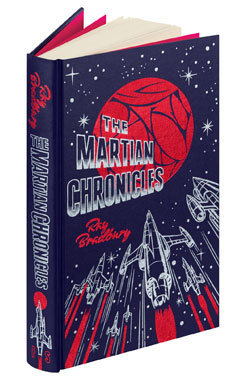
The Martian Chronicles
About this book
Published in 1950, Ray Bradbury’s dark short stories of Martian colonisation appeared when the idea of life on the Red Planet was very real. Space travel was still a fantasy, but with the destruction of Nagasaki and Hiroshima fresh in his mind, and new rocket technology offering untold possibilities, Bradbury, like many science-fiction writers, turned his thoughts to the sky. However, instead of a new and distant utopia, he imagined how humanity’s failings would follow us into space, and how our clumsy notions of manifest destiny are doomed to repeat themselves, no matter how far we journey.Drawn from the horrors of colonisation in the United States, the Chronicles focus on the experiences of the ordinary men and women who leave a troubled Earth for a new life on Mars. What follows is the inevitable deterioration from naive pioneering spirit to destructive avarice, played out among the ruins of a decimated indigenous civilisation. Beginning with the first expeditions, the stories explore each stage of Mars’ doomed conquest. We meet deluded priests, determined to convert the strange aboriginals to a foreign and redundant god; we flee on crystal sandships with an ignorant hot-dog vendor, terrified he will be robbed of his claim; and in ‘– and the Moon Be Still as Bright’ two colonists clash, torn between duty and the realisation that the men who follow them will tear the planet apart.In his brilliant introduction, the celebrated Canadian astronaut Chris Hadfield asks why generations of scientists and dreamers continue to be inspired by the beauty of Bradbury’s ‘delightful impossibility’. He gives fascinating insight into the training here on Earth for future Martian expeditions, and what the hope for a new life on Mars gives us, ‘in spite of ourselves’. Artist Mick Brownfield’s colourful illustrations, inspired by 1950s sci-fi, vividly portray this quest to be Martian, along with the ghostly splendour of Bradbury’s alien landscapes.[Bound in buckram, blocked with a design by Mick Brownfield; Set in Adobe Caslon Pro with Railroad Gothic display; 256 pages; Frontispiece and 8 colour illustrations; 9½" x 5¾"]
