
Thomas Frank
Thomas Frank is the author of Pity the Billionaire, The Wrecking Crew, and What's the Matter with Kansas? A former columnist for The Wall Street Journal and Harper's, Frank is the founding editor of The Baffler and writes regularly for Salon. He lives outside Washington, D.C.
21 Books Written

The Conquest of Cool: Business Culture, Counterculture, and the Rise of Hip Consumerism
by Thomas Frank
Rating: 3.9 ⭐
While the youth counterculture remains the most evocative and best-remembered symbol of the cultural ferment of the 1960s, the revolution that shook American business during those boom years has gone largely unremarked. In this fascinating and revealing study, Thomas Frank shows how the youthful revolutionaries were joined—and even anticipated —by such unlikely allies as the advertising industry and the men's clothing business."[Thomas Frank is] perhaps the most provocative young cultural critic of the moment."—Gerald Marzorati, New York Times Book Review"An indispensable survival guide for any modern consumer."— Publishers Weekly , starred review"Frank makes an ironclad case not only that the advertising industry cunningly turned the countercultural rhetoric of revolution into a rallying cry to buy more stuff, but that the process itself actually predated any actual counterculture to exploit."—Geoff Pevere, Toronto Globe and Mail" The Conquest of Cool helps us understand why, throughout the last third of the twentieth century, Americans have increasingly confused gentility with conformity, irony with protest, and an extended middle finger with a populist manifesto. . . . His voice is an exciting addition to the soporific public discourse of the late twentieth century."—T. J. Jackson Lears, In These Times"An invaluable argument for anyone who has ever scoffed at hand-me-down counterculture from the '60s. A spirited and exhaustive analysis of the era's advertising."—Brad Wieners, Wired Magazine"Tom Frank is . . . not only old-fashioned, he's anti-fashion, with a place in his heart for that ultimate social faux pas, leftist politics."—Roger Trilling, Details

What's the Matter with Kansas? How Conservatives Won the Heart of America
by Thomas Frank
Rating: 3.8 ⭐
With a New Afterword by the AuthorThe New York Times bestseller, praised as "hilariously funny . . . the only way to understand why so many Americans have decided to vote against their own economic and political interests" (Molly Ivins)Hailed as "dazzlingly insightful and wonderfully sardonic" (Chicago Tribune), "very funny and very painful" (San Francisco Chronicle), and "in a different league from most political books" (The New York Observer), What's the Matter with Kansas? unravels the great political mystery of our day: Why do so many Americans vote against their economic and social interests? With his acclaimed wit and acuity, Thomas Frank answers the riddle by examining his home state, Kansas-a place once famous for its radicalism that now ranks among the nation's most eager participants in the culture wars. Charting what he calls the "thirty-year backlash"-the popular revolt against a supposedly liberal establishment-Frank reveals how conservatism, once a marker of class privilege, became the creed of millions of ordinary Americans.A brilliant analysis-and funny to boot-What's the Matter with Kansas? is a vivid portrait of an upside-down world where blue-collar patriots recite the Pledge while they strangle their life chances; where small farmers cast their votes for a Wall Street order that will eventually push them off their land; and where a group of frat boys, lawyers, and CEOs has managed to convince the country that it speaks on behalf of the People.

From the bestselling author of What's the Matter With Kansas, a scathing look at the standard-bearers of liberal politics -- a book that asks: what's the matter with Democrats?It is a widespread belief among liberals that if only Democrats can continue to dominate national elections, if only those awful Republicans are beaten into submission, the country will be on the right course.But this is to fundamentally misunderstand the modern Democratic Party. Drawing on years of research and first-hand reporting, Frank points out that the Democrats have done little to advance traditional liberal goals: expanding opportunity, fighting for social justice, and ensuring that workers get a fair deal. Indeed, they have scarcely dented the free-market consensus at all. This is not for lack of opportunity: Democrats have occupied the White House for sixteen of the last twenty-four years, and yet the decline of the middle class has only accelerated. Wall Street gets its bailouts, wages keep falling, and the free-trade deals keep coming.With his trademark sardonic wit and lacerating logic, Frank's Listen, Liberal lays bare the essence of the Democratic Party's philosophy and how it has changed over the years. A form of corporate and cultural elitism has largely eclipsed the party's old working-class commitment, he finds. For certain favored groups, this has meant prosperity. But for the nation as a whole, it is a one-way ticket into the abyss of inequality. In this critical election year, Frank recalls the Democrats to their historic goals-the only way to reverse the ever-deepening rift between the rich and the poor in America.

From the author of the landmark bestseller What's the Matter with Kansas?, a jaw-dropping investigation of the decades of deliberate―and lucrative―conservative misruleIn his previous book, Thomas Frank explained why working America votes for politicians who reserve their favors for the rich. Now, in The Wrecking Crew, Frank examines the blundering and corrupt Washington those politicians have given us. Casting his eyes from the Bush administration's final months of plunder to the earliest days of the Republican revolution, Frank describes the rise of a ruling coalition dedicated to dismantling government. But rather than cutting down the big government they claim to hate, conservatives have simply sold it off, deregulating some industries, defunding others, but always turning public policy into a private-sector bidding war. Washington itself has been remade into a golden landscape of super-wealthy suburbs and gleaming lobbyist headquarters―the wages of government-by-entrepreneurship practiced so outrageously by figures such as Jack Abramoff.It is no coincidence, Frank argues, that the same politicians who guffaw at the idea of effective government have installed a regime in which incompetence is the rule. Nor will the country easily shake off the consequences of deliberate misgovernment through the usual election remedies. Obsessed with achieving a lasting victory, conservatives have taken pains to enshrine the free market as the permanent creed of state.Stamped with Thomas Frank's audacity, analytic brilliance, and wit, The Wrecking Crew is his most revelatory work yet―and his most important.

Pity the Billionaire: The Hard-Times Swindle and the Unlikely Comeback of the Right
by Thomas Frank
Rating: 3.8 ⭐
From the bestselling author of What's the Matter with Kansas?, comes this insightful and sardonic look at why the worst economy since the 1930s has brought about the revival of conservatism.Economic catastrophe usually brings social protest and demands for financial reform—or at least it was commonly assumed that it would. But when Thomas Frank set out in 2009 to look for expressions of American discontent, all he found were loud demands that the economic system be made even harsher on the recession's victims and that society's traditional winners receive even grander prizes. The American Right, which had seemed moribund after the election of 2008, had been reinvigorated by the arrival of hard times. The Tea Party movement demanded not that we question the failed system but that we reaffirm our commitment to it as Republicans in Congress took the opportunity to dismantle what they could of the remaining liberal state and Glenn Beck demonstrated the commercial potential of fueling the national angst, while each promoted the libertarian/Randian economics which arch Randian, Alan Greenspan, had already admitted produced exactly the opposite results than those expected.In Pity the Billionaire, Frank, the chronicler of American paradox, examines the peculiar mechanism by which dire economic circumstances have delivered the current set of seemingly unexpected political results. Using firsthand reporting, a deep knowledge of the American Right, and a wicked sense of humor, he gives us a diagnosis of the cultural malady that has transformed collapse into profit, reconceived the Founding Fathers as heroes from an Ayn Rand novel, and enlisted the powerless in a fan club for the prosperous.

From the prophetic author of the now-classic What's the Matter with Kansas? and Listen, Liberal, an eye-opening account of populism, the most important--and misunderstood--movement of our time. Rarely does a work of history contain startling implications for the present, but in The People, No Thomas Frank pulls off that explosive effect by showing us that everything we think we know about populism is wrong. Today "populism" is seen as a frightening thing, a term pundits use to describe the racist philosophy of Donald Trump and European extremists. But this is a mistake.The real story of populism is an account of enlightenment and liberation; it is the story of American democracy itself, of its ever-widening promise of a decent life for all. Taking us from the tumultuous 1890s, when the radical left-wing Populist Party--the biggest mass movement in American history--fought Gilded Age plutocrats to the reformers' great triumphs under Franklin Roosevelt and Harry Truman, Frank reminds us how much we owe to the populist ethos. Frank also shows that elitist groups have reliably detested populism, lashing out at working-class concerns. The anti-populist vituperations by the Washington centrists of today are only the latest expression.Frank pummels the elites, revisits the movement's provocative politics, and declares true populism to be the language of promise and optimism. The People, No is a ringing affirmation of a movement that, Frank shows us, is not the problem of our times, but the solution for what ails us.

One Market Under God: Extreme Capitalism, Market Populism, and the End of Economic Democracy
by Thomas Frank
Rating: 3.9 ⭐
In a book that has been raising hackles far and wide, the social critic Thomas Frank skewers one of the most sacred cows of the go-go '90s: the idea that the new free-market economy is good for everyone. Frank's target is "market populism"--the widely held belief that markets are a more democratic form of organization than democratically elected governments. Refuting the idea that billionaire CEOs are looking out for the interests of the little guy, he argues that "the great euphoria of the late nineties was never as much about the return of good times as it was the giddy triumph of one America over another." Frank is a latter-day Mencken, as readers of his journal The Baffler and his book The Conquest of Cool know. With incisive analysis, passionate advocacy, and razor-sharp wit, he asks where we?re headed-and whether we're going to like it when we get there.
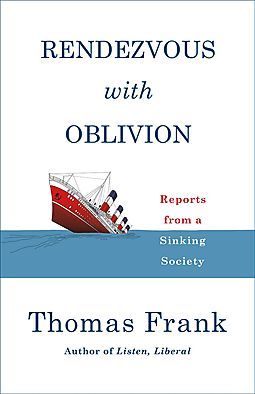
From the acclaimed author of Listen, Liberal and What's the Matter with Kansas, a scathing collection of his incisive commentary on our cruel times--perfect for this political momentWhat does a middle-class democracy look like when it comes apart? When, after forty years of economic triumph, America's winners persuade themselves that they owe nothing to the rest of the country?With his sharp eye for detail, Thomas Frank takes us on a wide-ranging tour through present-day America, showing us a society in the late stages of disintegration and describing the worlds of both the winners and the losers--the sprawling mansion districts as well as the lives of fast-food workers.Rendezvous with Oblivion is a collection of interlocking essays examining how inequality has manifested itself in our cities, in our jobs, in the way we travel--and of course in our politics, where in 2016, millions of anxious ordinary people rallied to the presidential campaign of a billionaire who meant them no good.These accounts of folly and exploitation are here brought together in a single volume unified by Frank's distinctive voice, sardonic wit, and anti-orthodox perspective. They capture a society where every status signifier is hollow, where the allure of mobility is just another con game, and where rebellion too often yields nothing.For those who despair of the future of our country and of reason itself, Rendezvous with Oblivion is a booster shot of energy, reality, and moral outrage.

« Ce que désire la classe des professionnels bien diplômés, c’est une méritocratie plus parfaite : un système où ceux qui ont du talent peuvent s’élever. Quand on est parvenus à la diversité et que les gens brillants de toutes races et de tous sexes ont été dûment qualifiés, cette espèce de libéral ne peut pas vraiment concevoir d’autres griefs contre le système. Les revendications des travailleurs ordinaires ne les touchent pas : les vigiles, les serveurs de fast-foods, les aides à domicile et les gardes d’enfant – dont la plupart sont des femmes et des personnes de couleur – qui n’ont pas de diplôme universitaire. » Ce livre analyse l’abandon par les « nouveaux démocrates » des classes populaires et des syndicats au profit des classes aisées et cultivées. Il rappelle ce que cette « économie de la connaissance » a coûté aux travailleurs manuels et aux catégories peu diplômées, condamnées à la relégation sociale et à une forme de plus en plus agressive de mépris culturel. Dépréciées par le parti qui leur servait autrefois de véhicule politique, elles sont devenues plus attentives aux thématiques identitaires de démagogues réactionnaires. Comme celui qui vit à la Maison-Blanche.

Thomas Frank has been sending wake-up calls to just about everyone within reach over the past decade, in venues from The Village Voice to Harper's . His takes on labor politics, advertising, the virtues of the Midwest, and how un-cool you really are have won him a wide audience, and in this piece, Frank gives us a reading of cultural studies—viewed by some as an important new perspective in the academy, but by others as an unwieldy theoretical fad.

Issue #13, "the Backlash Retrospective Part 1: The Classical Years," is the first installment of The Baffler's long-awaited set of issues focusing on the Right. Baffler writers heap sarcasm and scorn on the founding fathers of organized resentment Issue #14, "Part 2: Meltdown," examines the waning of the American century and an impending dark age. Enjoy savage analysis, bitter tales, incisive essays, trenchant reviews, and acerbic writing by their cast of young -- Robert Nedelkoff, David Rieff, Owen Hatteras, Pepsy Spengler, and others.

Hello, friends. “The None and the Many,” our silver jubilee issue, starts off with a proverbial bang with “Pistols for Two,” an exchange between David Graeber and Thomas Piketty on capital, debt, and the future. Thomas Frank looks the Masons and Rotarians in the eye, and Natasha Vargas-Cooper considers the meaning of a president’s posterior. Nicholson Baker provides us with a meta-review of more than a dozen JFK-assassination books, and emerges from all his reading with his own arresting theory intact. Jacob Silverman travels back in time to visit some like-minded subversives from the cusp of the Information Revolution, and Jason Linkins does us the favor of immersing himself in countless hours of cable TV news, so we don’t have to, thank heavens. Tom Gogola reports from Baton Rouge, Louisiana’s segregation movement, and Astra Taylor from a worker-owned manufacturing plant in Chicago, while Helaine Olen sends updates from Venice, California’s “coolest block in America,” and Daniel Brook experiences the gospel of wealth from the perspective of the direst slums of India. There are also salvos on politics, economics, and education policy from the formidable brains of Todd VanDerWerff, Chris Bray, Chris Lehmann, Lee Fang, and Jennifer C. Berkshire. Plus excerpts, interviews, and archival treats from Barbara Ehrenreich, Matt Roth, and Hugh McGraw; fiction by Ludmilla Petrushevskaya and Melina Kamerić; and poetry by Peter Payack, Edwin Frank, Joshua Moses, Melissa Monroe, and Elise Partridge. Wait, that’s not all: there are full-color photographs and original illustrations by Michael Northrup, Lewis Koch, Henrik Drescher, Katherine Streeter, and more. Finally, we pay tribute to the dear, departed, and prolific genius that was Baffler artist David McLimans. It’s our friendship issue, believe it or not, and we invite you to join us. Contents: Isolatoes Friends in Low Places John Summers Veiled Pensioners of the Mystic Sofa Thomas Frank Brown Noser Natasha Vargas-Cooper Zapped by the Invisible World Barbara Ehrenreich Dreams Incorporated: Living the delayed life with Amway Matt Roth Earth Liberation Stunt Hugh McGraw Photo Graphic Sizing Up Michael Northrup Politics by Other Memes World Processor Jacob Silverman Noise from Nowhere: The cable news jihad against human intelligence Jason Linkins Tip and Gip Sip and Quip: The politics of never Chris Bray The None and the Many Dallas Killers Club: How JFK got shot Nicholson Baker Looks Like a Duck, Quacks Like Reality TV Todd VanDerWerff The Jim Crow Soft-Shoe Segregationists of St.

Pourquoi les pauvres votent à droite: Comment les Conservateurs Ont Gagne... (Elements)
by Thomas Frank
Rating: 4.0 ⭐
À la fin des années 1960, la concurrence internationale et la peur du déclassement transforment un populisme de gauche (rooseveltien, conquérant, égalitaire) en un « populisme » de droite faisant son miel de la crainte de millions d’ouvriers et d’employés d’être rattrapés par plus déshérités qu’eux. C’est alors que la question de l’insécurité resurgit. Elle va embourgeoiser l’identité de la gauche, perçue comme laxiste, efféminée, intellectuelle, et prolétariser celle de la droite, jugée plus déterminée, plus masculine, moins « naïve ». Cette métamorphose s’accomplit à mesure que l’inflation resurgit, que les usines ferment et que l’« élite », jadis associée aux grandes familles de l’industrie et de la banque, devient identifiée à une « nouvelle gauche » friande d’innovations sociales, sexuelles et raciales. Les médias conservateurs n’ont plus qu’à se déchaîner contre une oligarchie radical-chic protégée d’une insécurité qu’elle conteste avec l’insouciance de ceux que cette violence épargne. Au reste, n’est-elle pas entretenue dans ses aveuglements par une ménagerie de juges laxistes, d’intellectuels jargonnants et autres boucs émissaires rêvés du ressentiment populaire ? « Progressistes en limousine » là-bas ; « gauche caviar » chez nous. Extrait de la préface de Serge Halimi


Le populisme, voilà l’ennemi !: Brève histoire de la haine du peuple et de la peur de la démocratie, des années 1890 à nos jours
by Thomas Frank
Rating: 4.0 ⭐
Les dénonciations inquiètes du populisme sont monnaie courante depuis longtemps. Mais elles ont tourné à la panique générale lorsque le populisme a été perçu comme l’arme secrète derrière l’improbable candidature présidentielle du milliardaire télégénique Donald Trump. Le populisme passait aussi pour la mystérieuse force expliquant les succès d’audience de Bernie Sanders ou d’autres leaders de gauche. « Populisme » était également le nom du délire collectif qui avait infligé le Brexit au Royaume-Uni. En fait, dès qu’on prenait la peine de regarder, on voyait un peu partout dans le monde les classes dirigeantes se faire étriller par des trublions sans qualification. Les populistes trompaient les gens sur la mondialisation. Les populistes disaient du mal des élites. Les populistes bouleversaient les institutions politiques traditionnelles. Et les démocraties prenaient fin parce qu’elles étaient trop démocratiques. Il était temps pour les élites de se lever contre les masses ignorantes...Reprenant plus d’un siècle d’histoire du populisme et de l’antipopulisme, Thomas Frank montre ce que cette opposition révèle : la défiance des classes cultivées pour la démocratie dès lors qu’elle ne fait plus barrage à l'expression des intérêts d’un peuple qui ne reste pas à sa place.Journaliste et essayiste, Thomas Frank écrit régulièrement pour Le Monde diplomatique et Harper’s des articles d’analyse sociale et politique de la situation américaine. Cofondateur et rédacteur en chef du magazine The Baffler, il est l’auteur d’une demi-douzaine d’ouvrages, dont, aux éditions Agone Pourquoi les riches votent à gauche, Pourquoi les pauvres votent à droite et Le Marché de droit divin.

Wie konnte es dazu kommen, dass die Millionen verunsicherter Amerikaner einen Milliardär zum Präsidenten gewählt haben, von dem sie wussten, dass er letztlich nichts für sie tun würde? Was ist los mit Amerika? Thomas Frank verfolgt seit Jahren die Veränderungen der amerikanischen Gesellschaft, das Abdriften großer Teile der Bevölkerung in prekäre Verhältnisse, das Erstarken fundamentalistischer Bewegungen, die Erosion der politischen Parteien. Seine Artikel aus den letzten zehn Jahren erzählen die politische Geschichte eines Landes, in dem der amerikanische Traum zu Ende geträumt ist, der Verlust geregelter Arbeit, Schulden, Armut große Teile der Bevölkerung betreffen, die Eliten und die politische Klasse sich vor allem mit sich selbst beschäftigen. Vom Skandal des Energiekonzerns Enron, durch den Tausende von Angestellten ihre Rente verloren, über die Finanzkrise 2008, durch die die Standards der Mittelklasse für die meisten unerreichbar geworden sind, bis zum Versagen der Demokratischen Partei: Am Beispiel Amerikas zeigt Thomas Frank eine gesellschaftliche Entwicklung auf, die – bei allen Unterschieden – ein Warnsignal auch für Europa, auch für Deutschland ist.

George Bernard Shaw als Musikkritiker
by Thomas Frank
Studienarbeit aus dem Jahr 2005 im Fachbereich Musik - Sonstiges, 2, Johannes Gutenberg-Universität Mainz (Musikwissenschaftliches Institut), Hauptseminar, 6 Quellen im Literaturverzeichnis, Deutsch, Einleitung Gegenstand der vorliegenden Seminararbeit sind die Übersetzungen der nachfolgend aufgeführten Texte von George Bernard Shaw1 (1856-1950). Diese sind dem Werk "Shaw's Music - The complete musical criticism of Bernard Shaw" (Max Reinhardt, The Bodley Head Ltd., London 1981). entnommen. Diese Sammlung von Schriften wurde in drei Bänden veröffentlicht. Die Schriften des ersten Bandes stammen aus den Jahren 1876-1890, George Bernard Shaw die des zweiten Bandes aus den Jahren 1890-1893 und die des dritten Bandes aus den Jahren 1893-1950. Es folgt eine Übersicht über die Fundstellen der Texte innerhalb der drei Bände des Werkes von Text I Hans Richter Band II Seite 102-107 Text II Hermann Levi Band III Seite 346-351 Text III Wagner's Birthday Band II Seite 358-361 Text IV The Manchester Orchestra Band II Seite 221-223 Text V The Manchester Orchestra Band II Seite 231-233 Text VI Mischievous Patti Band II Seite 208-213
Marché de droit divin Le
by Thomas Frank
Le " populisme de march " est la pice centrale du nouveau consensus amricain. Il revendique grands cris sa nature dmocratique et pourtant les institutions, dmocratiques formelles n'ont jamais sembl plus lointaines et plus dplaces que sous son rgne. Il discute avec ferveur de la justice conomique et pourtant, dans les annes 1990, l'conomie amricaine a enrichi les riches et nglig les plus pauvres dans des proportions qu'on n'avait plus connues depuis les annes 1920. Il critique l'" litisme " tout en transformant la classe des dirigeants d'entreprise en une des lites les plus riches de tous les temps. Il s'en prend la hirarchie mais il fait de l'entreprise la plus puissante institution du monde. Il clbre l'autonomisation accrue de l'individu mais considre pourtant ceux qui en usent pour dfier les marchs comme des automates. Il acclame la libert de choix tout en proclamant que le triomphe des marchs est invitable. Mais en dpit de toutes ces contradictions, le populisme de march constitue une doctrine tonnamment vivace, qui peut survivre ses dfauts, parce qu'il s'est lui-mme inocul sa propre opposition. Aussi, ce qu'il nous faut, c'est un vritable contrepouvoir, une force qui rsiste aux impratifs du profit au nom de la dmocratie conomique. C'est--dire, au bout du compte, ce que rclamaient autrefois les vrais Populistes. Ce livre raconte comment, dans les annes 1990, la communaut des affaires a fini par acqurir cette lgitimit tant convoite en persuadant le reste du monde que la voie du laissez faire n'tait pas seulement la meilleure et la seule possible mais galement la plus soucieuse de rpondre la volont et aux intrts populaires. Il montre comment " dtruire l'ancien monde " pour difier un nouveau, plus sr, l'usage des milliardaires fut une entreprise la fois politique, culturelle et conomique

HOW TO BE A BETTER STUDENT: TIPS EXECUTIVE QUALITY, CHARACTERISTICS, SECRET OF A GOOD STUDENT.
by Thomas Frank
✓Here is a secret. Most top students are not necessarily gifted with superior intellect or extraordinary talent, but rather they are normal people who apply specific skills and systems to their learning. Skills and systems that can be acquired and honed to maximize performance. A number of strategies have been shown not to work; the three biggest culprits are re-reading notes, re-writing notes, and re-reading the chapter. ✓How to be a Better Student is a book for college-level students, as well as older and returning students, which offers a clear set of strategies and routines for overcoming classroom challenges. Written by one of the nation's top academic support coaches, and supported by the latest research, the book is filled with clear, practical advice for improving a student's academic skills infrastructure. This methodology has been used successfully with students and student-athletes for more than 20 years and is a methodology that will pay dividends quickly. In the book, you will learn to develop the mindset that will get you results, and how to embed information using a proven flashcard methodology. You will also learn to decipher the command words that professors like to use, discover an essay structure that radically improves your efficiency, and understand how to get time back on your side. Plus much more! By the end of the book, you will Clearly understand how best to remember the content you have learned. Know how to save time and energy through the use of a set of routines which clarify what to do before, during, and after class. Discover an effective and efficient structure for crafting an essay or research paper which will significantly reduce your anxiety. Understand how to break down an exam question you have never seen before, enabling you to handle just about any question the professor poses. Find out what it takes to become the best student you can be, plus how to achieve this. Although written for a student audience, How to be a Better Student is also of enormous benefit to parents, teachers, and other educators who want to improve educational environments and processes for their independent learners. About the Author Thomas Frank is a student success author, YouTuber, and speaker who has been helping college students achieve their goals since 2010. He is the founder of College Info Geek, a blog, YouTube channel, and podcast that reaches over 600,000 students each month, and has been featured on U.S. News, FOX Business' The Willis Report, Business Insider, and more. Thomas graduated from Iowa State University with a degree in MIS. He spends his days making videos, skateboarding, and resisting the temptation to buy a trampoline. Scroll up and click the buy button to get the tips secret!!!!
Rare Thomas Frank - 1st edit/ 1st print The Baffler #6-14 First Edition 1994 [Paperback] Frank, Thomas [Paperback] Frank, Thomas
by Thomas Frank
This rare and vintage book is a perfect addition to any bibliophile's collection