
Peter De Vries
Peter De Vries is responsible for contributing to the cultural vernacular such witticisms as "Nostalgia ain't what it used to be" and "Deep down, he's shallow." He was, according to Kingsley Amis, "the funniest serious writer to be found on either side of the Atlantic." “Quick with quips so droll and witty, so penetrating and precise that you almost don’t feel them piercing your pretensions, Peter De Vries was perhaps America’s best comic novelist not named Mark Twain. . .” (Sam McManis, Sacramento Bee). His achievement seemed best appreciated by his fellow writers. Harper Lee, naming the great American writers, said, “Peter De Vries . . . is the Evelyn Waugh of our time". Anthony Burgess called De Vries “surely one of the great prose virtuosos of modern America.” Peter De Vries was a radio actor in the 1930s, and editor for Poetry magazine from 1938 to 1944. During World War II he served in the U.S. Marines attaining the rank of Captain, and was seconded to the O.S.S., predecessor to the CIA. He joined the staff of The New Yorker magazine at the insistence of James Thurber and worked there from 1944 to 1987. A prolific writer, De Vries wrote short stories, reviews, poetry, essays, a play, novellas, and twenty-three novels, several of which were made into films. De Vries met his wife, Katinka Loeser, while at Poetry magazine. They married and moved to Westport, Connecticut, where they raised 4 children. The death of his 10-year-old daughter Emily from leukemia inspired The Blood of the Lamb, the most poignant and the most autobiographical of De Vries's novels. In Westport, De Vries formed a lifelong friendship with the young J. D. Salinger, who later described the writing process as "opening a vein and bleeding onto the page." The two writers clearly "understood each other very well” (son Derek De Vries in "The Return of Peter De Vries", Westport Magazine, April 2006). De Vries received an honorary degree in 1979 from Susquehanna University, and was elected to the American Academy of Arts and Letters in May 1983. His books were sadly out of print by the time of his death. After the New Yorker published a critical reappraisal of De Vries’ work however (“Few writers have understood literary comedy as well as De Vries, and few comic novelists have had his grasp of tragedy”), The University of Chicago Press began reissuing his works in 2005, starting with The Blood of the Lamb and Slouching Toward Kalamazoo.
30 Books Written

The most poignant of all De Vries's novels, The Blood of the Lamb is also the most autobiographical. It follows the life of Don Wanderhop from his childhood in an immigrant Calvinist family living in Chicago in the 1950s through the loss of a brother, his faith, his wife, and finally his daughter-a tragedy drawn directly from De Vries's own life. Despite its foundation in misfortune, The Blood of the Lamb offers glimpses of the comic sensibility for which De Vries was famous. Engaging directly with the reader in a manner that buttresses the personal intimacy of the story, De Vries writes with a powerful blend of grief, love, wit, and fury.
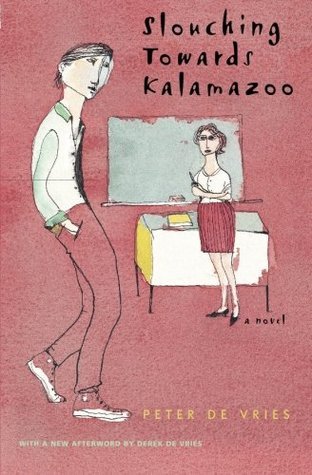
It is 1963 in an unnamed town in North Dakota, and Anthony Thrasher is languishing for a second year in eighth grade. Prematurely sophisticated, young Anthony spends too much time reading Joyce, Eliot, and Dylan Thomas but not enough time studying the War of 1812 or obtuse triangles. A tutor is hired, and this "modern Hester Prynne" offers Anthony lessons that ultimately free him from eighth grade and situate her on the cusp of the American sexual revolution. Anthony's restless adolescent voice is perfectly suited to De Vries's blend of erudite wit and silliness—not to mention his fascination with both language and female anatomy—and it propels Slouching Towards Kalamazoo through theological debates and quandaries both dermatological and ethical, while soaring on the De Vriesian hallmark of scrambling conventional wisdom for comic effect.

An irresistible comedy about faith, desire, and middle-class morality from the man described by Kingsley Amis as “the funniest serious writer to be found on either side of the Atlantic.”Pity the poor reverend Andrew Mackerel of the People’s Liberal Church of Avalon, Connecticut. His is the first split-level church in America, a bastion of modern thought and sophisticated virtue, yet even his prosperous parishioners are not immune to the backsliding evangelism infecting other parts of the country. One misguided congregant wants to sing hymns to hospital patients. Another goes so far as to put up a billboard with the message “Jesus Saves” written in phosphorescent green-and-orange letters. How is Mackerel supposed to write sermons with a vulgarity like that staring him in the face?Worse yet, the recently widowed pastor has fallen in love with Molly Calico, a former actress turned city hall clerk, well before the church is ready to stop mourning Mackerel’s saintly wife. Plans are under way for a shopping mall and memorial plaza commemorating the dear departed, and Mackerel must go to ever-greater lengths to keep his new romance a secret and his new paramour happy. Meanwhile, it is becoming clear that his devoted sister-in-law, Hester, has plans of her own when it comes to the reverend’s matrimonial future.As Mackerel twists and turns to get what he wants and avoid what he does not, the plot of this rollicking portrait of suburban piety kicks into high—and hilarious—gear.

Clifton Fadiman says of Peter De Vries, “There is something wrong with the world, and this man . . . knows. He expresses his knowledge, not by caterwauling, but through farce, parody, language-play and a kind of commedia dell'arte manipulation of absurd characters and situations. His wacky art reflects the fact that our condition is as preposterous as it is terrifying." A world in which "nobody knows how to live" is "hilariously and classically recorded in the comic morality plays that are his novels." In this one, nobody knows how to love. "The human botch of mating," as one character calls it, is the central theme of an intimate closeup of several interlocking romances, both sacred and profane. The setting is again that swatch of eastern seaboard De Vries has made his own, but this time seen through the eyes of three a Connecticut chicken farmer helplessly bewitched by the invading New York culture; a visiting Scotch poet named McGland, whose quenchless amorous thirst is as sad as it is funny; and a handsome young Englishman named Mopworth who falls in love with the farmer's granddaughter, thus bringing the action full circle. The follies of our de-romanticized time are perhaps best satirized in the woes of poor Mopworth, whose zest for women leaves his intellectual friends no conclusion but that he must be fighting inversion. Minor characters include a doctor without a car who hitchhikes to his patients, and a man known as C.B.S., a communications tycoon who can't communicate, at least with his wife, one of McGland's mistresses. Reuben, Reuben is certainly the mature best of one who, ruefully as he views a world of increasing sexual isolation, in which "the Individual prospers at the expense of the Pair," always makes his point with mirth. We may see ourselves as we watch a few of our fellow mortals paint themselves into a corner while the door to love stands open.

A magazine art editor becomes involved in the personal life of one of his cartoonists, Augie Poole, when an adoption agency requests a character reference

In this famous, bestselling novel Peter De Vries focuses in upon a man and a woman facing love in all its forms and furies -- from the rites of adolescent initiation to the early days of wedded bliss and the lengthening shadow of discontent and discord to the treacheries and traps of illicit passion. Prepare for a golden harvest of razor-sharp wit and deeply probing human insight.

Ted Peachum's increasingly erotic involvement with police woman Kathy Arpeggio, sumptuous brewery heiress Snooky von Sickle, and his best friend's virginal younger sister climaxes in a riotous hotel affair with the Peppermint Sisters--triplets

This book is brand new and sealed, never read or used in any way, PERFECT!!

Earl Peckham, frustrated because his novel has sold only three copies, sets out for America's heartland to find the three readers who bought his book

A brilliant, fiercely funny novel that ponders the eternal question: is it better to laugh or cry? Joe Sandwich is a clown. Not literally, but what else do you call an eleven-year-old who goes to church to confess his good deeds: "I did my homework without being told"? A stockbroker who gets seasick watching the market tape and claims the gross national product is "deodorants"? A father who mows curse words into his lawn and names his son Hamilton because, well, who can resist a Ham Sandwich?Prankster, punster, cut-up, card--Joe needs to crack wise about everything. Has he figured out the secret to embracing the inherent absurdity of life, or is there some terrible anxiety at the root of his compulsion? Lots of people want to know, including his wife, Naughty, who is anything but; his mistress, Gloria Bunshaft; and her husband, Wally Hines, a humorless professor who specializes is the philosophy of humor."If you look back," says Joe, "you turn into a pillar of salt. If you look ahead, you turn into a pillar of society." He prefers to live in the moment, from one gag to the next, but the joke he doesn't see coming may get the biggest laugh of all.

From the The Tents of Wickedness By Peter De Vries. Charles Swallow fancies himself a Marquand sort of hero, but the flashback touched off by the reappearance of an old girl friend turns out to be pure Faulkner. It concerns a childhood incident in a coalbin, too obvious for words, but related with hilarious obscurity. To get Sweetie Appleyard off his moral doorstep, he tries another literary tack, the Scott Fitzgerald; but she goes a little farther as a Free Spirit than he had intended, when he undertook her re-education, and before he knows it she is persuading him to father a child for her out of wedlock. Proust, Graham Greene, Dreiser, Thurber, Hemingway are all sent in in turn, like substitutes from a bench, to save the day - but it's no good. Pregnant, the rebel folds in the stretch, leaving our hero holding the bag in a fine Kafka nightmare indeed. A Joycean delirium climaxes a literary revel also strewn with mimicries of modern poets from Emily Dickinson to Dylan Thomas, in the form of samples of the rather derivative verse Sweetie writes. Written in a dozen styles, this is a gem of parody as well as another narrative treat by "the most reliably funny comic novelist now at large" (ORVILLE PRESCOTT, New York Times). In addition to being a riotous satire of Symbolism and "advanced literature," THE TENTS OF WICKEDNESS packs a sly that nonconformists, rather than transcending convention, aren't quite up to it. Peter De Vries's new novel employs four of the main characters of COMFORT ME WITH APPLES in a work which not only is the author's finest and funniest to date, but, in its rotation of major contemporary styles, brings off a refreshing experiment in form.

This is the story of man who thinks he's Groucho Marx. Delusions of grandeur? Well, not exactly. Middle-aged, middle-class, freelance writer Bob Swirling has a rather poor opinion of himself, as a matter of fact, and after a series of bruising events under progressively more deflating circumstances, he fetches up at Silver Slopes sanatarium, happily bustling about in the adopted guise of his favorite comedian, of whom he has been doing imitations for years. He just stays inside the impersonation.How all this came about if the subject of Peter De Vries's new comedy, Madder Music. When Swirling mistakenly believes himself to be terminally ill, he calls for madder music - particularly that of a sexual nature. Unfortunately, he is trapped by the mentality of the "bohemian bourgeoisie," and discovers, along with the rest of us, that the road to "liberation" is littered with surprises...and some happy misunderstandings. Swirling copes by retreating into the identity of Groucho, on whom he can pin all the unexpected hostilities that have for so long kept the puritanically raised hero racked with guilt. Off Groucho's tart tongue can be bounced all the pent-up antagonism toward fellow men no better than might be expected. As Swirling's surrogate Groucho faces squarely up to the cockeyed world - making a merry shambles of Silver Slopes into the bargain. Even when Swirling is at last lured out of Groucho's shell back into his own, with the help of a ravishing black girl who has been one of his major complications to begin with, his troubles aren't over, and neither is the fun.

In good condition although on bottom page edge , there is a stamp that reads " westside food bank donated not for resale surprise Az. location 61 Peter DeVries

The sins of the father are hilariously visited on the son in this witty and profound novel about the meaning of it allStanley Waltz is a Polish American piano mover and pugnacious atheist married to a born-again believer. His heroes are H. L. Mencken and Clarence Darrow, and if he confuses "illusion" with "allusion" and thinks a certain style of egg is "bedeviled," that does not mean his reasoning is any less sound. Unfortunately, his wife is immune to his intellect and insists not just on saving his soul but on taking their son, Tom, to the local gospel mission every chance she gets. It is enough to drive a man into the arms of a mistress "funny as a crutch and twice as perceptive"--and that is exactly where Stan goes.This leaves Tom twice as mixed up as the average son. In the second section of this side-splitting and thought-provoking comedy, he is a professor of English at the local college, his questions about faith, doubt, and morality as unresolved as they are inescapable. As an undergraduate, he stumbled from girl to girl, breaking up with one because she was a nonbeliever, another because she was too pious. His marriage to a beautiful professor of comparative religion is no solution. In short order, he has an affair, breaks his leg, leads a funeral procession hopelessly astray, and suffers a nervous breakdown. Only a miracle can save him--if he can figure out what one might look like.Stanley and Tom Waltz are a father-son duo unlike any other, and Let Me Count the Ways is Peter De Vries at his insightful, brilliant, lightning-witted best.

While struggling to hold on to his sanity, Stew Smackenfelt, a former Dutch Reformed Calvinist, becomes infatuated with his mother-in-law

Twin tales of middle-class hilarity and despair from the writer who was dubbed "America's preeminent comic novelist" by the New York TimesWhen college professor Hank Tattersall sees his former flame, Lucy Stiles, at a campus concert, it sets off a chain reaction that results in one of the funniest and most unforgettable exit scenes in American literature--involving a locked door, an alcoholic dog, and a punning doppelg�nger. The Cat's Pajamas is the story of how Tattersall, a scrupulous self-reflector, falls from point A to point Z, rushing through a host of identities and indignities along the way. The unexamined life may not be worth living, he discovers, but the examined one is hardly a bed of roses.In Witch's Milk, Tillie Seltzer has her own trials to attend to. Chief among them is her marriage to Pete, the kind of guy who tucks a cigarette behind his ear and calls everybody Frisbee. When they first met, Tillie had more sophisticated tastes--dark strangers, homburg hats--but she was also a thirtysomething virgin whose prospects weren't getting any better. When she cracked a joke about the honeymoon being over, Pete believed her. Now stuck in suburbia with a sick child and a philandering husband, Tillie takes a hard look in the rearview mirror. Her search for an escape route will lead her to the most unexpected place of all.These short novels are linked by Tillie's cameo appearance in Hank's narrative and by the thrilling blend of satire, tragedy, and philosophy that defines the one-of-a-kind fiction of Peter De Vries.

Bound in the publisher's original black boards with the spine stamped in red. Previous owner's bookplate on the front free endpaper.

"Fiction by satirical American novelist Peter De Vries "

Without a Stitch in Time: A Selection of the Best Humorous Short Pieces
by Peter De Vries
Rating: 3.5 ⭐
Harking from the golden age of fiction set in American suburbia—the school of John Updike and Cheever—this work from the great American humorist Peter De Vries looks with laughter upon its lawns, its cocktails, and its slightly unreal feeling of comfort. Without a Stitch in Time , a selection of forty-six articles and stories written for the New Yorker between 1943 and 1973, offers pun-filled autobiographical vignettes that reveal the source of De Vries’s nervous the cognitive dissonance between his Calvinist upbringing in 1920s Chicago and the all-too-perfect postwar world. Noted as much for his verbal fluidity and wordplay as for his ability to see humor through pain, De Vries will delight both new readers and old in this uproarious modern masterpiece.

Dust jacket design by Paul Bacon. His 16th book about an Indiana boy who hungers to be courted by the beautiful people.

In a Mylar dj cover. A superb copy, with price intact on dj.

Fiction Humor The main character in this novel is a carry over from a couple other novels. Her chance to settle the score is oppportune. Chain of Custody Document comes with the sale.Transfer from the Estate of Wheeler Sammons private library collection to new owner. Memorabilia for the bibliophile and English PH.D.'s out there. Wheeler Sammons was published of Who's Who in America and also Lakeside Press .

Hapless bachelor gets embroiled in situations with his tenants and girlfriend.


Onderzoek laat zien dat leerlingen zich beter ontwikkelen en betere resultaten halen als hun ouders betrokken zijn bij school. Ouderbetrokkenheid is dus een belangrijk thema. Het ‘Handboek Ouderbetrokkenheid 3.0’ helpt scholen en leraren om de samenwerking met ouders vorm te geven op een manier die bij de school past. Het beschrijft de rol van ouders op school en geeft uitleg over hun gedrag. Ook bevat het veel voorbeelden uit de dagelijkse onderwijspraktijk en praktische tips over uiteenlopende onderwerpen, van professionele communicatie en effectieve gesprekken met ouders, tot een alternatief voor oudertevredenheidsonderzoeken. Om het ‘Handboek Ouderbetrokkenheid 3.0’ compleet te maken, zijn direct bruikbare bijlagen opgenomen, zoals formats, checklijsten, stappenplannen en voorbeeldbrieven. ‘Handboek Ouderbetrokkenheid 3.0’ is een toegankelijk en overzichtelijk standaardwerk voor elke school in het primair en voortgezet onderwijs die effectief wil samenwerken met ouders. Het is bedoeld voor directeuren en leraren die al in het onderwijs werken en studenten die nog met de pabo of de lerarenopleiding bezig zijn.

The Handsome Heart
by Peter De Vries

Angels Can't Do Better
by Peter De Vries
Anthony Burgess called Peter De Vries “surely one of the great prose virtuosos of modern America.”

Retail Price List of High Grade Nursery Stock
by Peter De Vries
Excerpt from Retail Price List of High Grade Nursery StockOur salesmen are requested not to 'vary from these prices but to hold strictly to list. There is no surplus of good nursery stock and is not likely to be for some years to come. No nursery stock can be imported from abroad as formerly, and labor costs are excessively high. Our prices are as low as any other concern doing business through salesmen on the same grades and sizes stock.

The Vale of Laughter
by Peter De Vries
First Edition stated. LITTLE, BROWN AND COMPANY, BOSTON 1967. There is a six digit code stamped on the back endpaper indicating this may have been a library copy, but there are no other indications. COMPETITIVE PRICING! Once paid, books will ship immediately without email notification to customer (it’s on the way), you are welcomed to email about shipment date! All ViewFair books, prints, and manuscript items are 100% refundable up to 14 business days after item is received. InvCodePrc 40 E H V VIEWFAIR 005709