
Matthew Stewart
30 Books Written

The Management Myth: Why the Experts Keep Getting it Wrong
by Matthew Stewart
Rating: 3.9 ⭐
• 2 recommendations ❤️
Don’t go to business school. Study philosophy.Fresh from Oxford with a degree in philosophy & no particular interest in business, Matthew Stewart might not have seemed a likely candidate to become a consultant. But soon he was telling veteran managers how to run their companies. Striking fear into the hearts of clients with his sharp analytical tools, Stewart lived in hotel rooms & got fat on expense account cuisine—until, finally, he decided to turn the consultant’s merciless, penetrating eye on the management industry itself. Alongside his devastating critique of management “philosophy” from Frederick Taylor to Tom Peters, Stewart provides a bitingly funny account of his own days in a management consulting firm. Combining hands-on experience with the theoretical underpinnings of contemporary fads in efficiency improvement, empowerment & strategy, Stewart knows his stuff, & thus he lays bare how little consultants have really done for the business of others—while making a killing for themselves.

The Courtier and the Heretic: Leibniz, Spinoza & the Fate of God in the Modern World
by Matthew Stewart
Rating: 4.0 ⭐
From Publisher's Weekly Starred Review. According to Nietzsche, "Every great philosophy is... a personal confession of its creator and a kind of involuntary and unperceived memoir.". Stewart affirms this maxim in his colorful reinterpretation of the lives and works of 17th-century philosophers Spinoza and Leibniz. In November 1676, the foppish courtier Leibniz, "the ultimate insider... an orthodox Lutheran from conservative Germany," journeyed to The Hague to visit the self-sufficient, freethinking Spinoza, "a double exile... an apostate Jew from licentious Holland." A prodigious polymath, Leibniz understood Spinoza's insight that "science was in the process of rendering the God of revelation obsolete; that it had already undermined the special place of the human individual in nature." Spinoza embraced this new world. Seeing the orthodox God as a "prop for theocratic tyranny," he articulated the basic theory for the modern secular state. Leibniz, on the other hand, spent the rest of his life championing God and theocracy like a defense lawyer defending a client he knows is guilty. He elaborated a metaphysics that was, at bottom, a reaction to Spinoza and collapses into Spinozism, as Stewart deftly shows. For Stewart, Leibniz's reaction to Spinoza and modernity set the tone for "the dominant form of modern philosophy"—a category that includes Kant, Hegel, Bergson, Heidegger and "the whole 'postmodern' project of deconstructing the phallogocentric tradition of western thought." Readers of philosophy may find much to disagree with in these arguments, but Stewart's wit and profluent prose make this book a fascinating read.

America’s founders intended to liberate us not just from one king but from the ghostly tyranny of supernatural religion. Drawing deeply on the study of European philosophy, Matthew Stewart brilliantly tracks the ancient, pagan, and continental ideas from which America’s revolutionaries drew their inspiration. In the writings of Spinoza, Lucretius, and other great philosophers, Stewart recovers the true meanings of “Nature’s God,” “the pursuit of happiness,” and the radical political theory with which the American experiment in self-government began.

The 9.9 Percent: The New Aristocracy That Is Entrenching Inequality and Warping Our Culture
by Matthew Stewart
Rating: 3.7 ⭐
A “brilliant” (The Washington Post), “clear-eyed and incisive” (The New Republic) analysis of how the wealthiest group in American society is making life miserable for everyone—including themselves.In 21st-century America, the top 0.1% of the wealth distribution have walked away with the big prizes even while the bottom 90% have lost ground. What’s left of the American Dream has taken refuge in the 9.9% that lies just below the tip of extreme wealth. Collectively, the members of this group control more than half of the wealth in the country—and they are doing whatever it takes to hang on to their piece of the action in an increasingly unjust system. They log insane hours at the office and then turn their leisure time into an excuse for more career-building, even as they rely on an underpaid servant class to power their economic success and satisfy their personal needs. They have segregated themselves into zip codes designed to exclude as many people as possible. They have made fitness a national obsession even as swaths of the population lose healthcare and grow sicker. They have created an unprecedented demand for admission to elite schools and helped to fuel the dramatic cost of higher education. They channel their political energy into symbolic conflicts over identity in order to avoid acknowledging the economic roots of their privilege. And they have created an ethos of “merit” to justify their advantages. They are all around us. In fact, they are us—or what we are supposed to want to be. In this “captivating account” (Robert D. Putnam, author of Bowling Alone), Matthew Stewart argues that a new aristocracy is emerging in American society and it is repeating the mistakes of history. It is entrenching inequality, warping our culture, eroding democracy, and transforming an abundant economy into a source of misery. He calls for a regrounding of American culture and politics on a foundation closer to the original promise of America.

An Emancipation of the Mind: Radical Philosophy, the War over Slavery, and the Refounding of America
by Matthew Stewart
Rating: 4.2 ⭐
How a band of antislavery leaders recovered the radical philosophical inspirations of the first American Revolution to defeat the slaveholders’ oligarchy in the Civil War. This is a story about a dangerous idea―that all men are created equal―which ignited revolutions in America, France, and Haiti; burst across Europe in the revolutions of 1848; and returned to inflame a new generation of intellectuals to lead the abolition movement.Frederick Douglass’s unusual interest in radical German philosophers and Abraham Lincoln’s odd, buried allusions to the same rationalist, secularist, and essentially atheist thinkers are but a few of the clues that underlie this propulsive philosophical detective story. With fresh takes on forgotten thinkers like Theodore Parker (a minister too radical even for the Unitarians, whose work provided some of Lincoln’s most famous lines) and a feisty band of German refugees, Matthew Stewart’s vivid storytelling and piercing insights forge a significant revision in our understanding of the origins and meaning of the struggle over slavery in America―and offer a fresh perspective on struggles between democracy and elite power today.

The Truth About Everything: An Irreverent History of Philosophy with Illustrations
by Matthew Stewart
Rating: 4.0 ⭐
Throughout history, well-known theories of reality, knowledge, mind, and most particularly the "professional" philosophers who rely on them for their intellectual existence, have sought to isolate universal truths and structure the history of philosophy to distinguish schools and movements that seek a comprehensive understanding of our world. But in this well-intended pursuit of truth, have we lost sight of what philosophy is? Matthew Stewart believes we have.His rowdy guided tour of the search for truth romps through traditional histories of philosophy using parables, imaginary dialogues, and illustrations to demonstrate that knowing theories, recognizing revered schools, and distinguishing the views of the great philosophers isn't what philosophy should be about. Once removed from the clutches of historicism, the compulsion for universal answers, and the perception that reason is a peculiarly Western possession, the nature of philosophy can be seen as a genuine human disposition to love and respect knowledge coupled with a desire for critical thinking.

Monturiol's Dream: The Extraordinary Story of the Submarine Inventor Who Wanted to Save the World
by Matthew Stewart
Rating: 4.2 ⭐
A marvelous the compelling story of the strange and noble life—and dream—of nineteenth-century utopian social revolutionary and self-taught engineer Narcís Monturiol, who invented the world’s first fully operational steam-powered submarine, not as a weapon of war but as a means of saving human life and spreading democracy.Matthew Stewart tells the story of Monturiol from his childhood to his years living the dangerous life of a revolutionary. We see him at the bloody barricades and fleeing—one step ahead of the Barcelona police—to the remote coastline of northern Catalonia. On that shore, watching teams of divers risk their lives gathering coral from the water’s depths for use in the making of jewels, candelabras, and crimson pigment, he finds the true purpose of his life. He saves a man presumed dead from drowning and conceives of a craft that will protect the divers who harvest coral—a safe, hermetically sealed underwater vessel that will make the ocean’s bounty available to the common man.Stewart writes about the building of Monturiol’s how, without scientific education (he was a lawyer by training), Monturiol read books on physics, chemistry, and biology; how he launched a hand-powered prototype submarine capable of reaching depths of sixty feet; how his efforts to gain government support for building a larger submarine were thwarted (his invention was dismissed by one official as having “no useful applications”). We see Monturiol, unwilling to give up on his dream, turn to the artists, poets, and musicians of Barcelona to help him mobilize the public to fund his project, and how he launched his second, much larger vessel five years the most advanced submarine of its day; at more than fifty feet long it displaced seventy-two tons and navigated reliably at depths of up to one hundred feet, with a unique system for eliminating carbon dioxide, replenishing oxygen in the interior cabin, and enabling its crew to remain underwater indefinitely. It had a steam engine for propulsion, a chemical furnace to heat the engine as it generated oxygen for the crew, external lights, portholes, and pincers for harvesting coral and other objects from the deep. It was the first true submarine; the world would not see its equal for another twenty years.And we watch as Monturiol’s revolutionary friends, making use of his utopian ideals and notions of urban planning (a term he originated), forge a new culture for Catalonia and its capital city and create the radical design that resulted in an entirely new Barcelona.


Poetry. Twenty years in the writing, THE KNIVES OF VILLALEJO is Matthew Stewart's first full collection. Stretching from suburban Surrey to the vineyards of Extremadura, Spain, its poems' delicate syllablic structures belie the vast wells of emotion beneath. Throughout the collection, brevity and apparent simplicity pack an unexpected punch — each line, each poem, a perfectly poised, discrete drop, held together by the tensions of home and exile, then and now, before and after. Together, they form a pent-up storm.

The Courtier and the Heretic: Leibniz, Spinoza, and the Fate of God in the Modern World
by Matthew Stewart
Rating: 5.0 ⭐
Once upon a time, philosophy was a dangerous business-and for no one more so than for Baruch Spinoza, the seventeenth-century philosopher vilified by theologians and political authorities everywhere as "the atheist Jew." As his inflammatory manuscripts circulated underground, Spinoza lived a humble existence in The Hague, grinding optical lenses to make ends meet. Meanwhile, in the glittering salons of Paris, Gottfried Wilhelm Leibniz was climbing the ladder of courtly success. In between trips to the opera and groundbreaking work in mathematics, philosophy, and jurisprudence, he took every opportunity to denounce Spinoza, relishing his self-appointed role as "God's attorney."In this exquisitely written philosophical romance of attraction and repulsion, greed and virtue, religion and heresy, Matthew Stewart gives narrative form to an epic contest of ideas that shook the seventeenth century—and continues today.
![The distance of the sun from the earth determined by the theory of gravity ... By Dr. Matthew Stewart ... Being a supplement to Tracts physical and mathematical ... 1763 [Leather Bound]](https://m.media-amazon.com/images/S/compressed.photo.goodreads.com/books/1694921870i/141302599.jpg)
The distance of the sun from the earth determined by the theory of gravity ... By Dr. Matthew Stewart ... Being a supplement to Tracts physical and mathematical ... 1763 [Leather Bound]
by Matthew Stewart
Rating: 5.0 ⭐
Leather Binding on Spine and Corners with Golden Leaf Printing on round Spine (extra customization on request like complete leather, Golden Screen printing in Front, Color Leather, Colored book etc.) Reprinted in 2018 with the help of original edition published long back [1763]. This book is printed in black & white, sewing binding for longer life, printed on high quality Paper, re-sized as per Current standards, professionally processed without changing its contents. As these are old books, we processed each page manually and make them readable but in some cases some pages which are blur or missing or black spots. If it is multi volume set, then it is only single volume, if you wish to order a specific or all the volumes you may contact us. We expect that you will understand our compulsion in these books. We found this book important for the readers who want to know more about our old treasure so we brought it back to the shelves. Hope you will like it and give your comments and suggestions. Pages 114. EXTRA 10 DAYS APART FROM THE NORMAL SHIPPING PERIOD WILL BE REQUIRED FOR LEATHER BOUND BOOKS. COMPLETE LEATHER WILL COST YOU EXTRA US$ 25 APART FROM THE LEATHER BOUND BOOKS. {FOLIO EDITION IS ALSO AVAILABLE.}
![Some remarks on the present state of affairs, respectfully addresses to the Marquis of Lansdowne. 1830 [Leather Bound]](https://m.media-amazon.com/images/S/compressed.photo.goodreads.com/books/1697928715i/151346662.jpg)
Some remarks on the present state of affairs, respectfully addresses to the Marquis of Lansdowne. 1830 [Leather Bound]
by Matthew Stewart
Leather Binding on Spine and Corners with Golden Leaf Printing on round Spine (extra customization on request like complete leather, Golden Screen printing in Front, Color Leather, Colored book etc.) Reprinted in 2018 with the help of original edition published long back [1830]. This book is printed in black & white, sewing binding for longer life, printed on high quality Paper, re-sized as per Current standards, professionally processed without changing its contents. As these are old books, we processed each page manually and make them readable but in some cases some pages which are blur or missing or black spots. If it is multi volume set, then it is only single volume, if you wish to order a specific or all the volumes you may contact us. We expect that you will understand our compulsion in these books. We found this book important for the readers who want to know more about our old treasure so we brought it back to the shelves. Hope you will like it and give your comments and suggestions. - eng, Pages 160. EXTRA 10 DAYS APART FROM THE NORMAL SHIPPING PERIOD WILL BE REQUIRED FOR LEATHER BOUND BOOKS. COMPLETE LEATHER WILL COST YOU EXTRA US$ 25 APART FROM THE LEATHER BOUND BOOKS. {FOLIO EDITION IS ALSO AVAILABLE.}

The Breaking Point: Hemingway, Dos Passos, and the Murder of Jose Robles.(Book Review): An article from: The Hemingway Review
by Matthew Stewart

EL HEREJE Y EL CORTESANO
by Matthew Stewart

Nightfever 1st edition by Stewart, Matthew (2005) Hardcover
by Matthew Stewart

Propositiones Geometricæ: More Veterum Demonstratæ, Ad Geometriam Antiquam Illustrandam et Promovemdam Idoneæ.
by Matthew Stewart

Supēr Whý Coloring Book: Over 100 Coloring Pages of Supēr Whý - Great Coloring Books for Kids and Adults
by Matthew Stewart
About The Supēr Whý Coloring Book: The Coloring Book is filled with iconic scenes, characters and especially The MASHUPS for kids & adults. For those who love coloring and Supēr Whý, the book is another way to enjoy this great movie. This coloring book is so helpful to relax and relieve stress yourself or spend time with your friends and beloved ones. Get this copy now and enjoy the amazing adventure with bunch of different Illustrations. Book • Premium Material & Book High quality pages with reasonable size of 8.5x11 inches• Eye-catching All pretty images and even covers can satisfy your dream to be a talented artist ever.• Unlimited Color to be Use whatever vibrant and lively colors to fill your picture and enjoy your masterpiece• The best gift for All of ages cannot deny this amazing book. They can deep into the Artist world at any time.

A solution of Kepler's problem; by Matthew Stewart, Professor of Mathematics in the University of Edinburgh.
by Matthew Stewart
The 18th century was a wealth of knowledge, exploration and rapidly growing technology and expanding record-keeping made possible by advances in the printing press. In its determination to preserve the century of revolution, Gale initiated a revolution of its digitization of epic proportions to preserve these invaluable works in the largest archive of its kind. Now for the first time these high-quality digital copies of original 18th century manuscripts are available in print, making them highly accessible to libraries, undergraduate students, and independent scholars.Medical theory and practice of the 1700s developed rapidly, as is evidenced by the extensive collection, which includes descriptions of diseases, their conditions, and treatments. Books on science and technology, agriculture, military technology, natural philosophy, even cookbooks, are all contained here.++++The below data was compiled from various identification fields in the bibliographic record of this title. This data is provided as an additional tool in helping to insure edition ++++Bodleian Library (Oxford)T160162Edinburgh : printed by Hamilton, Balfour, & Neill, 1756. [2],40p.,plate ; 8°

Propositiones geometricæ, more veterum demonstratæ, ... Auctore Matthæo Stewart, ...
by Matthew Stewart
The 18th century was a wealth of knowledge, exploration and rapidly growing technology and expanding record-keeping made possible by advances in the printing press. In its determination to preserve the century of revolution, Gale initiated a revolution of its digitization of epic proportions to preserve these invaluable works in the largest archive of its kind. Now for the first time these high-quality digital copies of original 18th century manuscripts are available in print, making them highly accessible to libraries, undergraduate students, and independent scholars.Medical theory and practice of the 1700s developed rapidly, as is evidenced by the extensive collection, which includes descriptions of diseases, their conditions, and treatments. Books on science and technology, agriculture, military technology, natural philosophy, even cookbooks, are all contained here.++++The below data was compiled from various identification fields in the bibliographic record of this title. This data is provided as an additional tool in helping to insure edition ++++British LibraryT145778With a half-title.Edinburgi : typis Sands, Murray, et Cochran. Prostant venales apud A. Millar, J. Nourse, et D. Wilson, Londini; et W. Sands, et A. Kincaid & J. Bell, Edinburgi, 1763. viii,218p.,XXI plates ; 8°

Propositiones Geometricæ,: More Veterum Demonstratæ, Ad Geometriam Antiquam Illustrandam Et Promovendam Idoneæ
by Matthew Stewart
This is a reproduction of a book published before 1923. This book may have occasional imperfections such as missing or blurred pages, poor pictures, errant marks, etc. that were either part of the original artifact, or were introduced by the scanning process. We believe this work is culturally important, and despite the imperfections, have elected to bring it back into print as part of our continuing commitment to the preservation of printed works worldwide. We appreciate your understanding of the imperfections in the preservation process, and hope you enjoy this valuable book. ++++ The below data was compiled from various identification fields in the bibliographic record of this title. This data is provided as an additional tool in helping to ensure edition identification: ++++ Propositiones Geometric�: More Veterum Demonstrat�, Ad Geometriam Antiquam Illustrandam Et Promovendam Idone� Matthew Stewart null Typis Sands, Murray, et Cochran. Prostant venales apud A. Millar, J. Nourse, et D. Wilson, Londini; et W. Sands, et A. Kincaid & J. Bell, Edinburgi., 1763 Mathematics; Geometry; General; Geometry; Mathematics / Geometry / General

Collection of Poetry
by Matthew Stewart
These poems are the author s observations as well as his experiences in life, his struggles with addictions, and his hopes for recovery.
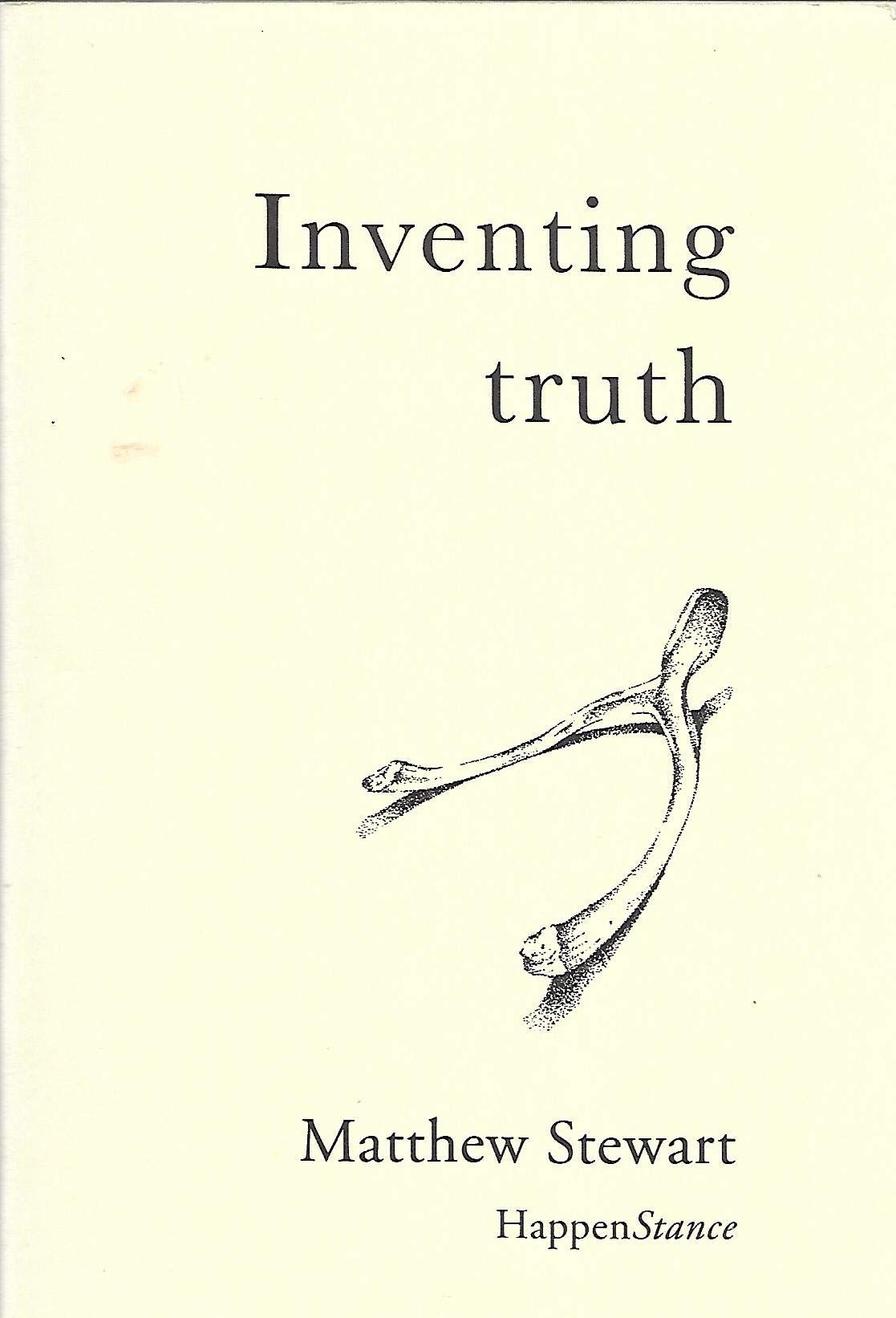
Inventing Truth
by Matthew Stewart

1859年の潜水艇―天才発明家モントゥリオールの数奇な人生
by Matthew Stewart
Rhetoric 101 and 102 - A Reader
by Matthew Stewart
Probably Problematic: Huemer’s Ontological Proof of Moral Realism
by Matthew Stewart
Michael Huemer has constructed what he believes to be an ontological proof of moral realism. Roughly speaking, he thinks that given that it’s possible moral realism is true, and thus possible we have objective moral reasons to do certain actions, then we do have objective moral reasons to do certain actions. This essay sets out to critique Huemer’s Argument. The first section discusses the relevant background theory in meta-ethics and reasons. The second section states Huemer’s argument and explains how it works. The third section highlights some problems for the Probabilistic Reasons Principle that Huemer bases his argument on, in particular the complications surrounding the interrelation of factors when determining the existence and strength of reasons. The fourth section explains why Huemer must deal with the interrelation of factors or face a reductio ad absurdum against his argument. The fifth section points out some of the counter-intuitive reasons that are generated from the premises of Huemer’s argument. Finally, section six delivers a verdict on Huemer’s argument.

Excerpt from An Examination of the Principles and Tendency of the Ministerial Plan of ReformIf it is intended to intimate, by the restoration of the confidence of the people in the legislature, that the promoters of the present measure of reform have had in view the introduction of a closer connection, and more perfect identification of the people with their representatives and the aristocracy, the degree in which this is likely to be effectual must depend on the means that have been proposed for accomplishing the purpose. The vagueness of such phrases, when applied to questions of government, renders it neces sary to define with some degree of accuracy the idea that those who use them may most reasonably be supposed to intend to convey by them. Language is the medium of thought, and, as philosophers have ex plained to us, the ins/rmncnt of all general reasoning.

This work has been selected by scholars as being culturally important, and is part of the knowledge base of civilization as we know it. This work was reproduced from the original artifact, and remains as true to the original work as possible. Therefore, you will see the original copyright references, library stamps (as most of these works have been housed in our most important libraries around the world), and other notations in the work.This work is in the public domain in the United States of America, and possibly other nations. Within the United States, you may freely copy and distribute this work, as no entity (individual or corporate) has a copyright on the body of the work.As a reproduction of a historical artifact, this work may contain missing or blurred pages, poor pictures, errant marks, etc. Scholars believe, and we concur, that this work is important enough to be preserved, reproduced, and made generally available to the public. We appreciate your support of the preservation process, and thank you for being an important part of keeping this knowledge alive and relevant.

Tracts, Physical And Mathematical,
by Matthew Stewart
This work has been selected by scholars as being culturally important, and is part of the knowledge base of civilization as we know it. This work was reproduced from the original artifact, and remains as true to the original work as possible. Therefore, you will see the original copyright references, library stamps (as most of these works have been housed in our most important libraries around the world), and other notations in the work.This work is in the public domain in the United States of America, and possibly other nations. Within the United States, you may freely copy and distribute this work, as no entity (individual or corporate) has a copyright on the body of the work.As a reproduction of a historical artifact, this work may contain missing or blurred pages, poor pictures, errant marks, etc. Scholars believe, and we concur, that this work is important enough to be preserved, reproduced, and made generally available to the public. We appreciate your support of the preservation process, and thank you for being an important part of keeping this knowledge alive and relevant.