
James Fenton
James Fenton was born in Lincoln in 1949 and educated at Magdalen College, Oxford where he won the Newdigate Prize for poetry. He has worked as political journalist, drama critic, book reviewer, war correspondent, foreign correspondent and columnist. He is a Fellow of the Royal Society of Literature and was Oxford Professor of Poetry for the period 1994-99. In 2007, Fenton was awarded the Queen's Gold Medal for Poetry.
30 Books Written

Fenton's work is elegant, highly finished, reticent, witty. Disturbing and deeply affecting, Children in Exile remains an exhilarating and memorable performance."Quite simply, Fenton's poems are frightening." - The New York Times Book Review


Listen to what they did.Don't listen to what they said.What was written in bloodHas been set up in lead.―from "Blood and Lead"The leading poet of his generation, James Fenton has over the course of his career built a body of work breathtaking in its range and sensibility. From the passionate political poems that launched him into fame to the intimate illuminations of love―and loss of love―in his later work, Fenton's poetry has always been marked by formal daring, wit, and an abiding empathy for the victims of war and political oppression. With selections from all of his published work since The Memory of War , the entire text of his libretto The Love Bomb , and new, previously uncollected poems, Selected Poems is an imaginative and formal tour de force.

This rare and vintage book is a perfect addition to any bibliophile's collection

A wise, absorbing, and surprising introduction to poetry written in English, from one of England's leading poets James Fenton is that rare scholar "not ashamed to admit that he mostly reads for pleasure" (Charles Simic, The New York Review of Books ). In this eminently readable guide to his abiding passion, he has distilled the essense of a library's--and a lifetime's--worth of delight. The pleasures of his own verse can be found in abundance economy, a natural ease, and most of all, surprise. What is English poetry? Fenton argues that it includes any recited words in English that marshall rhythm for their meaning--among them prisoners's work songs, Broadway show tunes, and the cries of street vendors captured in verse. From these beginnings, Fenton describes the rudiments of--and, most important, the inspiration for--the musical verse we find in books, and concludes with an illuminating discussion of operas and songs. Fenton illustrates his comments with verse from all over the English-speaking world. Catholic in his taste, shrewd in his distinctions, and charmingly frank, Fenton is an ideal guide to everything to do with poetry, from the temperament of poets to their accomplishment, in all its variety. In all his writing, prose or verse, Fenton has always had the virtue of saying, in a way that seems effortless, precisely what lies at the heart of the matter. In this vein, An Introduction to English Poetry is one of his highest accomplishments.

Yellow Tulips is a gathering from four decades of work by a writer described by the Observer as 'the most talented poet of his generation'.Winner of both the Queen's Gold Medal and the Whitbread Prize for Poetry, James Fenton has given readers some of the most memorable lyric verse of the past decades, from the formal skill that marked his debut, Terminal Moraine, to the dramatic and political monologues of The Memory of War and Children in Exile, through to the unforgettable love poems of Out of Danger.This assembly, made by the author himself, includes a generous offering of his most recent, uncollected work: it is an essential selection by, as Stephen Spender put it, 'a brilliant poet of technical virtuosity'.

Now for the new millennium comes an entirely new edition, personally selected and introduced by James Fenton, a Whitbread-winning poet himself, rightly famed for his own love poetry. Organised according to poets, rather than subjects, the edition celebrates love poetry originating in the English language, from Wyatt to the present day. It includes blues lyrics, American folk poetry, Elizabethan lyrics, Broadway songs, and a full range of poetic styles from the aristocratic to the popular. Eminently readable and engaging, "The New Faber Book of Love Poetry" presents some of the most emotive and memorable lyric poems produced in the English language from the Renaissance to the present day.

Out of Danger (1994) was Fenton's first collection of poems in ten years, and the poems in it renew and amplify the qualities of unflinching observation and freewheeling verbal play that made his earlier Children in Exile so distinctive and distinguished. The poems in this book's title sequence address the dangers of love, and the love of danger; Fenton proposes that in love, politics, and poetry alike the truth is "something you say at your peril" and yet "something you shouldn't contain." Part II of the book, "Out of the East," is a series of ironical fight songs about political violence-- in Manila, the Middle East, Tiananmen Square, and elsewhere. Part III, "Maski Paps," reveals again Fenton's celebrated talents for light-verse nonsense. And in "The Manila Manifesto" he turns his gifts loose upon the world of poetry itself in ways that will both enrage and delight. Out of Danger is refined and daring, jocular and deeply challenging.

James Fenton is the right man in the wrong place in dangerous times. This journalist, poet, and critic is almost always at the center of a revolution. Fenton was one of the last journalists in Saigon, and his reporting from the abandoned American embassy, “where the looting had just begun,” is unlike any Vietnam coverage you’ve ever read. “Some people gave me suspicious looks; I was after all the only one there with a white face—so I began to do a little looting myself . . . .Two things I could not take were reproduction of an 1873 map of Hanoi and a framed quotation by Lawrence of Arabia, which read ‘Better to let them do it imperfectly than do it perfectly yourself, for it is their country, their way, and your time is short.’” Reporting from war-ravaged Cambodia, Fenton lived for a while in a monastery, where the monks, certain he was a CIA agent, were fixated with his bout of constipation. In “The Snap Revolution,” Fenton chronicles Corazon Aquino's assumption of power in the Philippines, from a vantage point so close “I could even tell you what perfume Imelda Marcos was wearing.” Fenton's most recent posting is Korea, where he reports, in his inimitable fashion, on the recent riots and election in that complex country on the brink of civil convulsion. All the Wrong Places is a visceral and unforgettable view from the Pacific Rim.
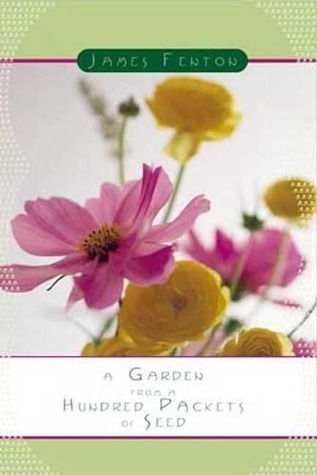
"An engaging mix of the serious and the playful, and Fenton writes with a lightness of touch perfectly suited to the subject." --Alexander Urquhart, T he Times Literary SupplementForget structure. Forget trees, shrubs, and perennials. As James Fenton writes, "This is not a book about huge projects. It is about thinking your way toward the essential flower garden, by the most traditional of planting some seeds and seeing how they grow."In this light hearted, instructive, original "game of lists," Fenton selects one hundred plants he would choose to grow from seed. Flowers for color, size, and exotic interest; herbs and meadow flowers; climbing vines, tropical species--Fenton describes readily available varieties, and tells how to acquire and grow them.Here is a happy, stylish, unpretentious, and thought-provoking gardening book that will beguile and inspire both novice and expert alike.

In this collection of Oxford lectures, devout literary critic James Fenton makes sense of the last century in poetry and explores its antecedents and legacies, covering Philip Larkin's laments for the British Empire, Heaney's rebellion against it, Robert Frost's celebrations of American conquest, and much more.

James Fenton, one of England's most gifted poets, has in recent years been looking closely at works of art and writing incisively and inventively about them and their creators. This collection of fifteen writings discusses a wide range of painting and sculpture, from the mummy portraits of ancient Egypt to the works of Robert Rauschenberg and Jasper Johns."Ingenious. . . . Intrigued by emerging and unstable reputations, [Fenton] introduces us to Leonardo da Vinci's half-brother's son a precocious sculptor celebrated by Vasari but virtually forgotten since."— Publishers Weekly"Not surprisingly, Fenton displays throughout the passionate attentiveness of a scholar, the enthusiasm of an amateur, and the urbane cleverness of an English journalist."— Washington Post Book World"[Fenton] is not, like Baudelaire, a poet moonlighting as art critic; he is something else again—a poetic art historian." —Karen Wright, Observer"These essays educate, enlighten, surprise and thrill, unfailingly."—Robin Lippincott, New York Times Book Review

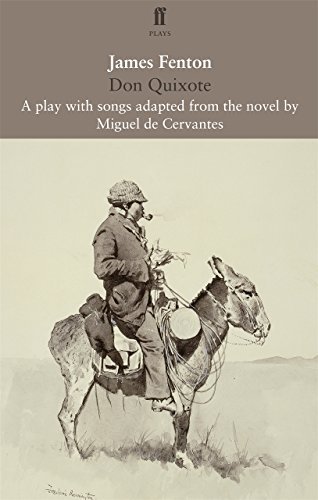
After a lifetime of reading books on chivalry, Don Quixote decides to embark on a quest of his own. Taking up a lance and sword, he sets out to become a wandering knight, defending the helpless and vanquishing the wicked.Hopelessly unprepared and increasingly losing his grip on reality, he travels across Spain accompanied by his faithful and equally ill-suited squire, each calamitous adventure widening the gap between reality and the romantic ideal of Quixote's books.Cervantes' comic novel is widely regarded as one of the foundation stones of modern fiction. James Fenton's stage adaptation of Don Quixote marks the 400th anniversary of Cervantes' death. It premiered at the Swan Theatre, Stratford-upon-Avon, with the Royal Shakespeare Company in March 2016.This playtext contains song lyrics by James Fenton. The music was composed by Grant Olding.

. 1982, bright clean copy, with dustjacket, no markings, Professional booksellers since 1981

The Love Bomb: and Other Musical Pieces; Haroun and the Sea of Stories; The Fall of Jerusalem
by James Fenton
Rating: 4.4 ⭐
Three Libretti―Ranging In Setting From Ancient Jerusalem To Pre-Apocalyptic London―From An Acclaimed PoetThis volume of libretti marks new work―and new terrain―for James Fenton. Commissioned by companies in New York and England, these musical pieces make the most of the poet's poignant, witty, and characteristically lyrical verse. Whether evoking modern-day London on the edge of apocalypse in The Love Bomb , a timeless land beyond the moon in this version of Salman Rushdie's children's novel Haroun and the Sea of Stories , or ancient Jerusalem in his stirring oratorio The Fall of Jerusalem, which was composed to mark the millennium, Fenton's lucid storytelling and stylish wordplay bring these pieces vividly to life―with equal power in performance or on the page.Haroun and the Sea of Stories was commissioned by the New York City Opera and had its premiere at Lincoln Center in September 2003."[James Fenton] writes as no one else dares to--with clarity, wit, and the simplest of rhymes."-- Voice Literary Supplement

The Hamely Tongue has been widely acclaimed as the authoritative record of contemporary (surviving) Ulster-Scots in its heartland of County Antrim where James Fenton faithfully recorded his dictionary items among a network of other native speakers over a 30-year period. This fourth edition, published almost twenty years after the first, includes further supplementary material and a new foreword by Dr Philip Robinson.

The Scottish Highlands have a strong appeal to the public imagination. Indeed, as a result of the writings of Sir Walter Scott, they are now symbolic of Scotland as a a land of mountains, glens and lochs, of golden eagles and red deer; a land with a rich cultural history of clans and clanship, of kilts and castles, of crofts, crofting, Highland cows and sheep, of music and dance. But does this imagined landscape relate to the actuality? Is it in fact a wild landscape which has escaped the pressures of the modern world, or does such untrammelled wildness only reside in the mind? The aim of this book is to answer this last question by taking an objective look at the history of the Highland landscape, how it has changed over the centuries and how it is still changing.It challenges the view that the Highlands are a landscape damaged by centuries of overgrazing and human exploitation. Instead it points out that the evidence suggests that the traditional unwooded Highland landscape of open hill and moor is one of the most natural remaining in northwest Europe, showing only minimal signs of human impact over the millennia; apart, that is, from the areas of human settlement. It is not only reforesting and peatland restoration which is destroying the naturalness of the Highland landscape, but also the continuing encroachment of infrastructure, whether hill tracks, wind turbines, dams, phone masts, ski development, fences, and commercial forestry plantations. Why can we not just let the hills be? After all, this is how they were for thousands of years until landownership entered the Highlands following the Battle of Culloden. Author Oban

This landmark publication is a meticulously researched and highly illustrated portrait of the Royal Academy of Arts, London, a unique institution that is both museum and art school, and is run entirely by and for artists. With unlimited access to the wonderful archives in the Royal Academy Library, and interviews with members of the Academy, author James Fenton provides a scholarly yet accessible and entertaining history of the institution, whose first president was Sir Joshua Reynolds.As an objective onlooker, Fenton interweaves colorful Academy characters and intrigues with hard facts, shifts in policy, and changes in direction that anticipate or respond to events of the time. In particular he looks at the Academy over the 20th the storms the Academy has weathered, its successes and failures, and its hopes and plans for the future.



Hardcover. Very good condition. First edition. First print. Pages tanned. Dust jacket, sunned on spine. RB

James Fenton, born in 1931, grew up in north Antrim, in the adjoining townlands of Drumadarragh and Ballinaloob. Educated at Stranmillis College and Queen’s University, Belfast, he spent his working life as a teacher and principal in Belfast, and now lives in Glengormley. He is the author of The Hamely A personal record of Ulster-Scots in County Antrim (1995; new editions, 2000, 2007, 2014). The Hamely Tongue gave us a comprehensive record of contemporary Ulster-Scots; now, in the poems and prose of On Slaimish , the writer’s native language comes vividly alive. From this vantage point he stands, and takes his stand, ‘On the hoovin hairt o Antrim’.

. with dustjacket, clean bright copy

Se durante le notti invernali (quelle in cui la primavera sembra un miraggio) avessi di fronte una pila di cataloghi di semi da sfogliare, quali sceglieresti per creare il giardino perfetto? Questa la domanda che si è posto il poeta, critico d’arte e giardiniere James Fenton, il quale ha selezionato cento semi e descritto con stile ammaliante le piante che ne nasceranno. Accompagnandoci nel suo giardino ideale, ricco delle suggestioni più disparate, di colori e di incredibile arguzia, l’autore ci regala un libro ottimista ed elegante che ci seduce grazie all’infinita varietà e bellezza delle piante.

New volume in the Frick Diptych series focuses on a remarkable Renaissance lamp, pairing an essay by Frick director Ian Wardropper with a new poem by James Fenton. The form of this extraordinary bronze lamp, the most elaborate of several produced by Riccio (Andrea Briosco), is based on a Roman sandal, and its surface is covered with intricate reliefs modelled with a goldsmith's refinement and crisp detail. The subjects evoke the populace of classical art and poetry, including a Nereid and Triton, Pan, harpies and innumerable putti, along with goats, musical instruments, shells, masks and garlands. Inspired by the Roman half-boot, the lamp is designed as a bizarre shoe balanced on a pyramidal base, and, as Ian Wardropper discusses in his essay, it would have provided its owner with much pleasure and intellectual stimulation. Early in its history, the lamp is known to have belonged to a series of distinguished Paduan collectors. Paired with Wardropper's essay is a beautiful poem by James Fenton.

Three friends are on expedition in Greenland, planning to ski coast to coast across the ice sheet – a classic journey first undertaken by Nansen in 1888. However they are immediately caught up in the misfortunes of a scientific expedition which is there to research global warming. They discover the expedition snocat stuck down a crevasse and witness one of the scientists being attacked by a polar bear. The start of their trip is put off so they can help out, during which time one of them falls in love with the only female scientist, creating tension in the group. However they eventually get away and successfully complete their ice cap crossing, which is not without its own misadventures in the snow and ice. But on return their fate remains entangled with that of the scientists, who have reported that the girl has gone missing. Once more they help out – and suspicions arise that the accidents are more than mere misfortune.
