
Helen Macdonald
Helen Macdonald is a writer, poet, and naturalist. They are the author of the bestselling H Is for Hawk and Vesper Flights along with Shaler’s Fish, a history of falconry, and two other books of poetry. They've written and presented award-winning TV documentaries for PBS and the BBC. Prophet is their first novel.
13 Books Written

As a child, Helen Macdonald was determined to become a falconer. She learned the arcane terminology and read all the classic books, including T.H. White's tortured masterpiece, "The Goshawk," which describes White's struggle to train a hawk as a spiritual contest.When her father dies and she is knocked sideways by grief, she becomes obsessed with the idea of training her own goshawk. She buys Mabel for £800 on a Scottish quayside and takes her home to Cambridge. Then she fills the freezer with hawk food and unplugs the phone, ready to embark on the long, strange business of trying to train this wildest of animals.Destined to be a classic of nature writing, "H is for Hawk" is a record of a spiritual journey - an unflinchingly honest account of Macdonald's struggle with grief during the difficult process of the hawk's taming and her own untaming. At the same time, it's a kaleidoscopic biography of the brilliant and troubled novelist T. H. White, best known for "The Once and Future King." It's a book about memory, nature and nation, and how it might be possible to try to reconcile death with life and love.

Animals don't exist in order to teach us things, but that is what they have always done, and most of what they teach us is what we think we know about ourselves. Helen Macdonald's bestselling debut H is for Hawk brought the astonishing story of her relationship with goshawk Mabel to global critical acclaim and announced Macdonald as one of this century's most important and insightful nature writers. H is for Hawk won the Samuel Johnson Prize for Nonfiction and the Costa Book Award, and was a finalist for the National Book Critics Circle Award and the Kirkus Prize for Nonfiction, launching poet and falconer Macdonald as our preeminent nature essayist, with a semi-regular column in the New York Times Magazine.In Vesper Flights Helen Macdonald brings together a collection of her best loved essays, along with new pieces on topics ranging from nostalgia for a vanishing countryside to the tribulations of farming ostriches to her own private vespers while trying to fall asleep. Meditating on notions of captivity and freedom, immigration and flight, Helen invites us into her most intimate experiences: observing songbirds from the Empire State Building as they migrate through the Tribute of Light, watching tens of thousands of cranes in Hungary, seeking the last golden orioles in Suffolk's poplar forests. She writes with heart-tugging clarity about wild boar, swifts, mushroom hunting, migraines, the strangeness of birds' nests, and the unexpected guidance and comfort we find when watching wildlife. By one of this century's most important and insightful nature writers, Vesper Flights is a captivating and foundational book about observation, fascination, time, memory, love and loss and how we make sense of the world around us.

A sacred god, a military tool, an erotic the falcon is a natural wonder of speed, power, beauty, and ferocity that has become embedded in human cultures in myriad ways. Helen Macdonald's Falcon examines the diverse symbolism and roles attached to the falcon throughout the centuries.Macdonald presents a cultural and natural history of the falcon that spans the globe and several millennia. Her wide-ranging survey considers the many facets of the falcon, including conservation efforts; the sport of falconry; and the use of falcons in secret military projects by the Third Reich and the U.S. space program. Falcon also explores the rich imagery of the falcon over history, including the veneration of falcons as gods in ancient Egypt, their role in erotic stories, and even the use of falcons in advertising to promote photocopiers and jet planes.Filled with illustrations and a wealth of fascinating facts, Falcon will be an enjoyable guide for ornithologists, amateur birdwatchers, and nature lovers alike.

'The poems are particular, discrete responses to particular events & objects, often places. They play with the tension between a high lyric voice...orienting the reader in a field populated by different versions of the self & its relation to the natural world.'"Helen Macdonald offers one of the most sustained explorations of avian imagery in recent lyric poetry, & this extends to speculative commentary on the human domination of the airwaves for purposes of danger-signalling, sexual display & territorial assertion, from the radio telescope of Jodrell Bank to CNN." (Drew Milne)

The hawk was everything I wanted to be: solitary, self-possessed, free from grief, and numb to the hurts of human life. How do we carry on when someone close to us dies? Is it simply a case of putting one foot in front of the other in a bleak new world or do we need something more? Reeling with grief after the sudden death of her father, Helen Macdonald found herself turning to the wild for comfort. With breathtaking honesty and insight, she recounts her months spent taming a goshawk and how, finally, this strange kinship led her to the first tentative steps to recovery. Selected from H is for Hawk VINTAGE MINIS: GREAT MINDS. BIG IDEAS. LITTLE BOOKS. A series of short books by the world’s greatest writers on the experiences that make us human. Discover the Vintage Minis ‘Head Space’ series: Therapy by Stephen Grosz Family by Mark Haddon

Helen Macdonald is a falconer and poet. She keeps a goshawk called Mabel. As a child she fell in love with a rare book of intense nature writing, J.A. Baker's The Peregrine, which records a winter watching wild peregrines on the Essex coast. Her new play brings her birds and his together. Baker tramps the bleak coastal marshes scanning the skies for fleeting moments of bloody drama as a peregrine stoops at immense speed after a plover or a pigeon. Helen woos her captive-bred goshawk in her spare bedroom - acclimatising it to human noise and human movement. Baker crouches over a half-dead pigeon and finishes it off for the wild falcon; Helen walks the city street with a goshawk on her fist. The stories begin to fly closer to one one another.J. A. Baker: David Birrell; Young Helen: Gemma Lawrence; Helen: herself.Part recorded on location on The Bird of Prey Centre at Newent, Gloucestershire. Producer: Tim Dee.
Helen Macdonald's drama documentary tells the story of the British POWs who survived incarceration in German camps in World War Two by studying the birds that flew freely all around them.
Midway
by Helen Macdonald
The atoll has inspired her next book, Midway, which will again bring together the political and personal. It explores our collective environmental shame – “If you are going to write about guilt you write about albatrosses, Baudelaire’s albatross, Coleridge’s albatross” – and the “dubious cultural shame” of being a middle-aged woman on her own, “the whole crazy cat lady thing”, although in her case the cat is a parrot. “Even though I feel my life is very fulfilled and I feel creatively fulfilled and have the deepest friendships, I still feel somehow I didn’t do it properly,” she reflects. “So I want to interrogate that a bit.”Above all, the book is going to be nothing less than a contemplation on the end of the world, “in a proper eschatological sense”. Hopefully, she says, there will be some jokes in there too. As she learned as a historian: “If you are going to write about something huge the only way to do it is to focus on something tiny and then spool out from that place.”
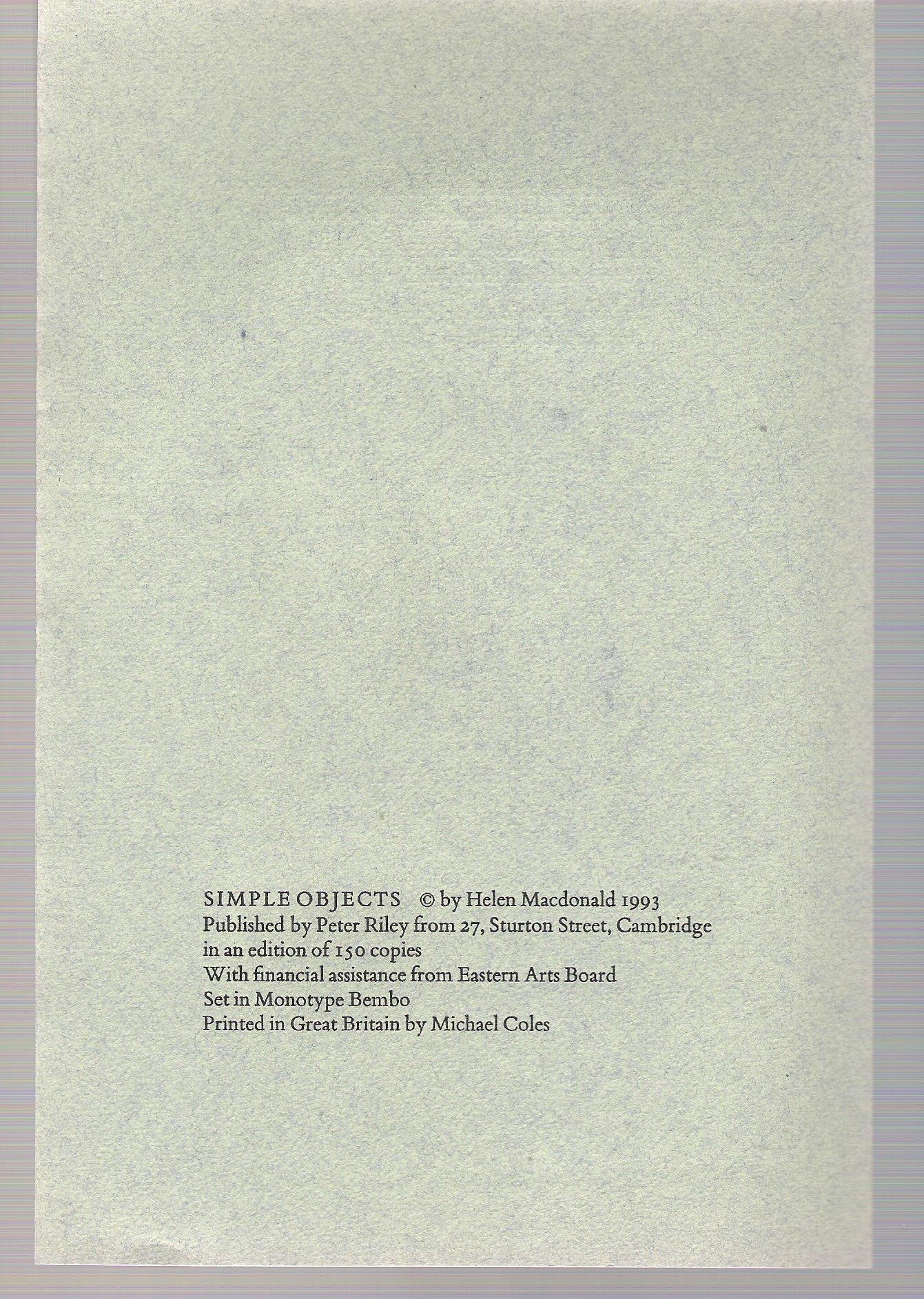
Simple Objects
by Helen Macdonald
Place to Call Your Own
by Helen Macdonald
Gann family group sheets
by Helen Macdonald
350 Original Fashion Figures and How to Draw Them
by Helen Macdonald