
Frans de Waal
Frans de Waal has been named one of Time magazine’s 100 Most Influential People. The author of Are We Smart Enough to Know How Smart Animals Are?, among many other works, he is the C. H. Candler Professor in Emory University’s Psychology Department and director of the Living Links Center at the Yerkes National Primate Research Center. He lives in Atlanta, Georgia.
19 Books Written

The first edition of Frans de Waal's Chimpanzee Politics was acclaimed not only by primatologists for its scientific achievement but also by politicians, business leaders, and social psychologists for its remarkable insights into the most basic human needs and behaviors. Still considered a classic, this updated edition is a detailed and thoroughly engrossing account of rivalries and coalitions―actions governed by intelligence rather than instinct. As we watch the chimpanzees of Arnhem behave in ways we recognize from Machiavelli (and from the nightly news), de Waal reminds us again that the roots of politics are older than humanity.

The Ape and the Sushi Master: Reflections of a Primatologist
by Frans de Waal
Rating: 4.0 ⭐
• 1 recommendation ❤️
From the New York Times bestselling author of Mama's Last Hug and Are We Smart Enough to Know How Smart Animals Are? , a provocative argument that apes have created their own distinctive culturesIn The Ape and the Sushi Master , eminent primatologist Frans de Waal corrects our arrogant assumption that humans are the only creatures to have made the leap from the natural to the cultural domain. The book's title derives from an analogy de Waal draws between the way behavior is transmitted in ape society and the way sushi-making skills are passed down from sushi master to apprentice. Like the apprentice, young apes watch their group mates at close range, absorbing the methods and lessons of each of their elders' actions. Responses long thought to be instinctive are actually learned behavior, de Waal argues, and constitute ape culture. A delightful mix of intriguing anecdote, rigorous clinical study, adventurous field work, and fascinating speculation, The Ape and the Sushi Master shows that apes are not human caricatures but members of our extended family with their own resourcefulness and dignity.
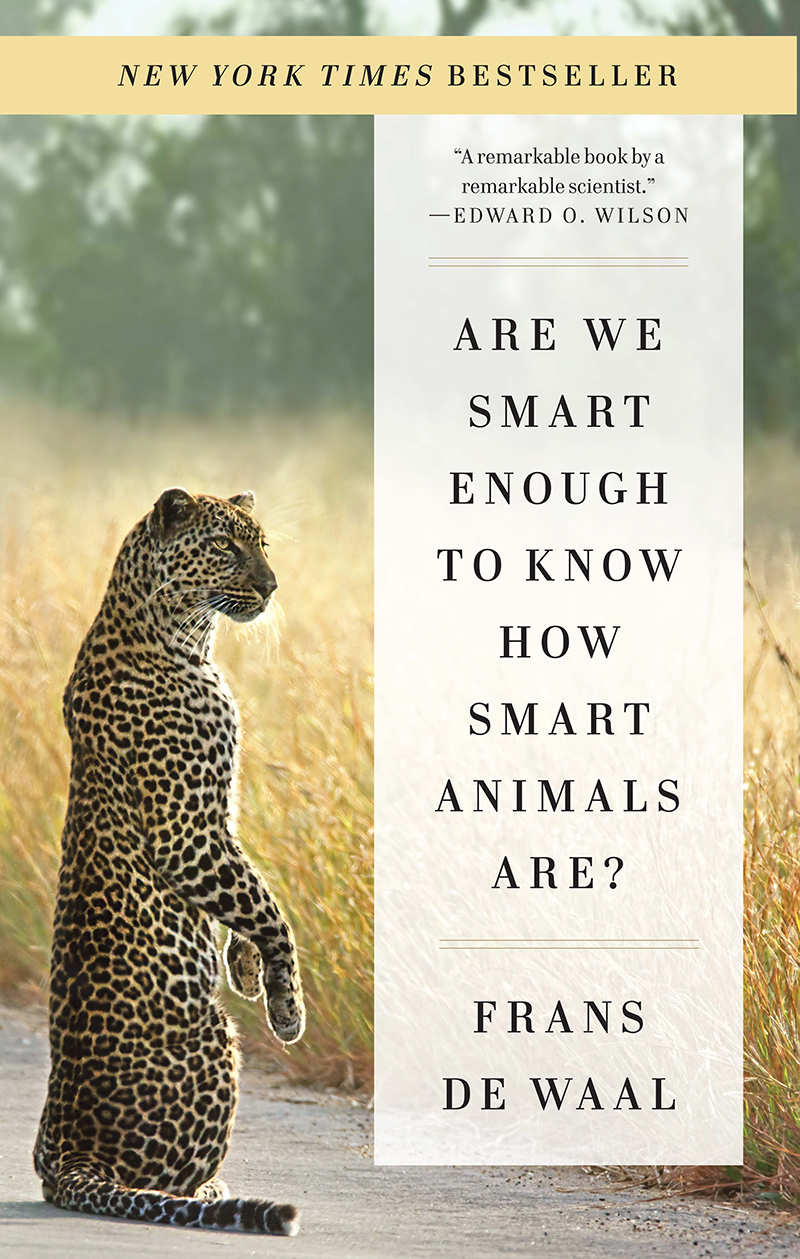
Hailed as a classic, Are We Smart Enough to Know How Smart Animals Are? explores the oddities and complexities of animal cognition―in crows, dolphins, parrots, sheep, wasps, bats, chimpanzees, and bonobos―to reveal how smart animals really are, and how we’ve underestimated their abilities for too long. Did you know that octopuses use coconut shells as tools, that elephants classify humans by gender and language, and that there is a young male chimpanzee at Kyoto University whose flash memory puts that of humans to shame? Fascinating, entertaining, and deeply informed, de Waal’s landmark work will convince you to rethink everything you thought you knew about animal―and human―intelligence.

Mama’s Last Hug is a fascinating exploration of the rich emotional lives of animals, beginning with Mama, a chimpanzee matriarch who formed a deep bond with biologist Jan van Hooff. Her story and others like it―from dogs “adopting” the injuries of their companions, to rats helping fellow rats in distress, to elephants revisiting the bones of their loved ones―show that humans are not the only species with the capacity for love, hate, fear, shame, guilt, joy, disgust, and empathy. Frans de Waal opens our hearts and minds to the many ways in which humans and other animals are connected.16 pages of black and white illustrations

In this lively and illuminating discussion of his landmark research, esteemed primatologist Frans de Waal argues that human morality is not imposed from above but instead comes from within. Moral behavior does not begin and end with religion but is in fact a product of evolution.For many years, de Waal has observed chimpanzees soothe distressed neighbors and bonobos share their food. Now he delivers fascinating fresh evidence for the seeds of ethical behavior in primate societies that further cements the case for the biological origins of human fairness. Interweaving vivid tales from the animal kingdom with thoughtful philosophical analysis, de Waal seeks a bottom-up explanation of morality that emphasizes our connection with animals. In doing so, de Waal explores for the first time the implications of his work for our understanding of modern religion. Whatever the role of religious moral imperatives, he sees it as a “Johnny-come-lately” role that emerged only as an addition to our natural instincts for cooperation and empathy.But unlike the dogmatic neo-atheist of his book’s title, de Waal does not scorn religion per se. Instead, he draws on the long tradition of humanism exemplified by the painter Hieronymus Bosch and asks reflective readers to consider these issues from a positive perspective: What role, if any, does religion play for a well-functioning society today? And where can believers and nonbelievers alike find the inspiration to lead a good life?Rich with cultural references and anecdotes of primate behavior, The Bonobo and the Atheist engagingly builds a unique argument grounded in evolutionary biology and moral philosophy. Ever a pioneering thinker, de Waal delivers a heartening and inclusive new perspective on human nature and our struggle to find purpose in our lives.

From a scientist and writer E.O. Wilson has called "the world authority on primate social behavior" comes a fascinating look at the most provocative aspects of human nature through our two closest cousins in the ape family. From "one of the world's greatest experts on primate behavior" (Desmond Morris) comes a look at the most provocative aspects of human nature-power, sex, violence, kindness, and morality-through our closest cousins. For nearly twenty years, Frans De Waal has studied both the famously aggressive chimpanzee and the egalitarian, matriarchal bonobo, two species whose DNA is nearly identical to ours. The result is an engrossing narrative that reveals what their behavior can teach us about ourselves.

"An important and timely message about the biological roots of human kindness."—Desmond Morris, author of The Naked ApeAre we our brothers' keepers? Do we have an instinct for compassion? Or are we, as is often assumed, only on earth to serve our own survival and interests? In this thought-provoking book, the acclaimed author of Our Inner Ape examines how empathy comes naturally to a great variety of animals, including humans.By studying social behaviors in animals, such as bonding, the herd instinct, the forming of trusting alliances, expressions of consolation, and conflict resolution, Frans de Waal demonstrates that animals–and humans–are "preprogrammed to reach out." He has found that chimpanzees care for mates that are wounded by leopards, elephants offer "reassuring rumbles" to youngsters in distress, and dolphins support sick companions near the water's surface to prevent them from drowning. From day one humans have innate sensitivities to faces, bodies, and voices; we've been designed to feel for one another.De Waal's theory runs counter to the assumption that humans are inherently selfish, which can be seen in the fields of politics, law, and finance, and whichseems to be evidenced by the current greed-driven stock market collapse. But he cites the public's outrage at the U.S. government's lack of empathy in the wake of Hurricane Katrina as a significant shift in perspective–one that helped Barack Obama become elected and ushered in what may well become an Age of Empathy. Through a better understanding of empathy's survival value in evolution, de Waal suggests, we can work together toward a more just society based on a more generous and accurate view of human nature.Written in layman's prose with a wealth of anecdotes, wry humor, and incisive intelligence, The Age of Empathy is essential reading for our embattled times.

New York Times best-selling author and world-renowned primatologist Frans de Waal explores sex and gender in both humans and other animals.Though many scholars now argue that gender differences are purely a product of socialization, primatologist Frans de Waal illustrates in Different the scientific, evolutionary basis for gender differences in humans, drawing on his decades of experience working with our closest ape relatives: chimpanzees and bonobos. De Waal illuminates their behavioral and biological differences, and compares and contrasts them with human behavior: male domination and territoriality in chimpanzees and the female-led pacific society of bonobos.In his classic conversational style and a narrative rich in anecdotes and wry observations, de Waal tackles topics including gender identity, sexuality, gender-based violence, same-sex rivalry, homosexuality, friendship, and nurturance. He reveals how evolutionary biology can inform a more nuanced—and equitable—cultural understanding of gender. Ultimately, he argues, our two nearest primate relatives are equally close to us, and equally relevant. Considering all available evidence, we can learn much about ourselves and embrace our similarities as well as our differences.

"It's the animal in us," we often hear when we've been bad. But why not when we're good? Primates and Philosophers tackles this question by exploring the biological foundations of one of humanity's most valued traits: morality.In this provocative book, primatologist Frans de Waal argues that modern-day evolutionary biology takes far too dim a view of the natural world, emphasizing our "selfish" genes. Science has thus exacerbated our reciprocal habits of blaming nature when we act badly and labeling the good things we do as "humane." Seeking the origin of human morality not in evolution but in human culture, science insists that we are moral by choice, not by nature.Citing remarkable evidence based on his extensive research of primate behavior, de Waal attacks "Veneer Theory," which posits morality as a thin overlay on an otherwise nasty nature. He explains how we evolved from a long line of animals that care for the weak and build cooperation with reciprocal transactions. Drawing on both Darwin and recent scientific advances, de Waal demonstrates a strong continuity between human and animal behavior. In the process, he also probes issues such as anthropomorphism and human responsibilities toward animals.Based on the Tanner Lectures de Waal delivered at Princeton University's Center for Human Values in 2004, Primates and Philosophers includes responses by the philosophers Peter Singer, Christine M. Korsgaard, and Philip Kitcher and the science writer Robert Wright. They press de Waal to clarify the differences between humans and other animals, yielding a lively debate that will fascinate all those who wonder about the origins and reach of human goodness.The University Center for Human Values Series.

This remarkable primate with the curious name is challenging established views on human evolution. The bonobo, least known of the great apes, is a female-centered, egalitarian species that has been dubbed the "make-love-not-war" primate by specialists. In bonobo society, females form alliances to intimidate males, sexual behavior (in virtually every partner combination) replaces aggression and serves many social functions, and unrelated groups mingle instead of fighting. The species's most striking achievement is not tool use or warfare but sensitivity to others.In the first book to combine and compare data from captivity and the field, Frans de Waal, a world-renowned primatologist, and Frans Lanting, an internationally acclaimed wildlife photographer, present the most up-to-date perspective available on the bonobo. Focusing on social organization, de Waal compares the bonobo with its better-known relative, the chimpanzee. The bonobo's relatively nonviolent behavior and the tendency for females to dominate males confront the evolutionary models derived from observing the chimpanzee's male power politics, cooperative hunting, and intergroup warfare. Further, the bonobo's frequent, imaginative sexual contacts, along with its low reproduction rate, belie any notion that the sole natural purpose of sex is procreation. Humans share over 98 percent of their genetic material with the bonobo and the chimpanzee. Is it possible that the peaceable bonobo has retained traits of our common ancestor that we find hard to recognize in ourselves?Eight superb full-color photo essays offer a rare view of the bonobo in its native habitat in the rain forests of Zaire as well as in zoos and research facilities. Additional photographs and highlighted interviews with leading bonobo experts complement the text. This book points the way to viable alternatives to male-based models of human evolution and will add considerably to debates on the origin of our species. Anyone interested in primates, gender issues, evolutionary psychology, and exceptional wildlife photography will find a fascinating companion in Bonobo: The Forgotten Ape .

For more than three decades Frans de Waal, the author of best-sellers such as Chimpanzee Politics and The Forgotten Ape, has studied monkeys and apes in zoos, research parks, and field settings. Photographing his subjects over the years, de Waal has compiled a unique family album of our closest animal relatives. To capture the social life of primates, and their natural communication, requires intimate knowledge, which is abundantly present here, in the work of one of the world's foremost primatologists. Culled from the thousands of images de Waal has taken, these photographs capture social interaction in bonobos, chimpanzees, capuchin monkeys, baboons, and macaques showing the subtle gestures, expressions, and movements that elude most nature photographers or casual observers.De Waal supplies extended captions discussing each photograph, offering descriptions that range from personal observations and impressions to professional interpretation. The result is a view of our primate family that is both intensely moving and personal, also richly evocative of all that science can tell us of primate society. In his introduction, de Waal elaborates on his work, his mission in this volume, and the particular challenges of animal action photography.

Разные. Мужское и женское глазами приматолога
by Frans de Waal
В мире людей, как и в мире животных, представители разных полов ведут себя неодинаково. Всемирно известный приматолог Франс де Вааль более сорока лет наблюдает за обезьянами и в дикой природе, и в исследовательских центрах. На страницах книги он задается вопросами, которые лежат в основе любой дискуссии о гендерной идентичности. Проводя аналогии между животными и людьми, ученый ставит под сомнение многие общественные стереотипы в отношении мужчин и женщин. В частности, всегда ли мужскую агрессию или склонность к доминированию можно объяснить биологией? Или это больше навязано социумом? Автор противопоставляет жестокости шимпанзе миролюбивость бонобо, лидерству самцов одного вида обезьян — матриархат другого. Опираясь на научные данные, де Вааль доказывает: чтобы понимать природу, обусловливающую разницу между мужским и женским началом, надо увидеть все разнообразие качеств приматов и других млекопитающих, не отдавая предпочтения какому-либо гендеру. Мы разные, чтобы жить вместе.
![[poket-seriya] Poslednee obyatie Mamy: CHemu nas uchat emocii zhivotnyh](/placeholder.svg?height=400&width=300)
Ispytyvajut li zhivotnye gordost, styd, vinu ili otvraschenie, kak i my, ljudi? Est li u nikh chuvstvo spravedlivosti i blagodarnosti? Mogut li sobaki smejatsja i skorbet, sposobny li slony uteshat drug druga, a obezjany zavidovat, plesti intrigi i vystraivat plany mesti? Chuvstvujut li bol ryby i umejut li ljubit ptitsy? Chto obschego v povedenii alfa-samtsov shimpanze i sovremennykh politikov? V etoj dobroj i umnoj knige, pomimo trogatelnoj istorii shimpanze po imeni Mama, izvestnyj primatolog Frans de Vaal rasskazyvaet o svoikh mnogochislennykh nabljudenijakh i eksperimentakh, posvjaschennykh izucheniju emotsij samykh raznykh zhivotnykh. Narjadu s gnevom i nenavistju, privodjaschimi dazhe k prednamerennomu ubijstvu sebe podobnykh, zhivotnye obnaruzhivajut udivitelnuju sposobnost k sostradaniju, primireniju i proscheniju. Oni, kak i my, sposobny k empatii, vzaimopomoschi i tesnomu sotsialnomu vzaimodejstviju. Avtor rassmatrivaet chuvstva cheloveka v evoljutsionnom kontekste kak prjamoe prodolzhenie emotsij zhivotnykh i prizyvaet nas osoznat nashu nerazryvnuju svjaz so vsemi suschestvami na planete i v konechnom schete luchshe ponjat samikh sebja.
Chimpanzee Politics, Power and Sex among Apes
by Frans de Waal
(Ape And The Sushi Master Reflections Of A Primatologist) [By: F. B. M. De Waal] [Jan, 2001]
by Frans de Waal

Mama. Ultima îmbrățișare
by Frans de Waal
"O carte captivantă și generoasă, plină de compasiune și de revelații despre viaţa animalelor, dar şi despre viaţa oamenilor." — YUVAL NOAH HARARI În Mama. Ultima îmbrățișare, Frans de Waal explorează bogăția emoțională a vieții animalelor – începând cu Mama, o venerabilă femelă-cimpanzeu care s-a atașat profund de biologul Jan van Hooff. Poveștile ei și ale altor animale dovedesc că oamenii nu sunt singura specie capabilă de iubire, ură, teamă, rușine, vinovăție, dezgust sau empatie, și ne deschid sufletul și mintea pentru a descoperi legăturile dintre noi și alte fiinţe. Studiind intens comportamentul animal și înțelegându-l cu o rară finețe, Frans de Waal a lărgit mult orizontul unei științe, etologia, și în același timp ne-a schimbat perspectiva asupra naturii umane. "Posibilitatea ca animalele să trăiască emoțiile la fel ca noi îi face pe mulți oameni de știință riguroși să nu se simtă în apele lor, pe de o parte pentru că animalele nu declară nici un fel de senzații, iar pe de alta pentru că existența senzațiilor presupune un nivel de conștiință pe care acești oameni de știință nu vor să-l recunoască în cazul animalelor. Dar având în vedere cât de asemănător cu noi acționează animalele, că împărtășesc reacțiile noastre fiziologice, au aceleași expresii faciale și posedă același tip de creier, n-ar fi oare cu adevărat straniu dacă experiențele noastre interne ar fi radical diferite?" — FRANS DE WAAL

Suntem îndeajuns de inteligenți pentru a înțelege inteligența animalelor? ne poartă într-o călătorie fascinantă prin lumea surprinzătoare a cogniției animalelor, care nu sunt niște simple mașinării ce răspund la stimuli și reacționează mânate numai de instinct. Autorul ne arată felul în care cercetările din ultimele decenii au descoperit că primatele își pot face planuri pentru viitor și pot folosi unelte, că delfinii sunt capabili de empatie și se pot striga pe nume, că unele păsări au o memorie vizuală uimitoare și chiar se pot recunoaște în oglindă, sau că elefanții își pot da seama ce sex au oamenii cu care interacționează. Cartea lui Frans de Waal ne va face astfel să reexaminăm tot ceea ce credeam că știm atât despre inteligența animalelor, cât și despre a oamenilor. "De ce e omenirea atât de înclinată să subestimeze inteligența animalelor? Le negăm în mod con-stant capacități pe care le considerăm de la sine înțelese în ceea ce ne privește. Ce se ascunde în spatele acestei atitudini? În încercarea de a înțelege la ce nivel mental operează celelalte specii, trebuie să admitem că adevăratele provocări nu vin numai din partea animalelor, ci și din partea noastră. [...] Înainte de a ne întreba dacă animalele posedă un anumit tip de inteligență, în special una de care suntem atât de atașați, trebuie să depășim măcar rezistența internă de a recunoaște această posibilitate. De aici și întrebarea centrală a acestei cărț «Suntem îndeajuns de inteligenți pentru a înțelege inteligența animalelor?»" — FRANS DE WAAL "Pe lângă faptul că este plină de informații și provocatoare, cartea lui Frans de Waal se dovedește o lectură cât se poate de plăcută." — The Washington Post