
Edgar Snow
Edgar P. Snow was an American journalist known for his books and articles on Communism in China and the Chinese Communist revolution. He is believed to be the first Western journalist to interview Chinese Communist leader Mao Zedong, and is best known for Red Star Over China (1937) an account of the Chinese Communist movement from its foundation until the late 1930s.
28 Books Written

Red Star Over China: The Classic Account of the Birth of Chinese Communism
by Edgar Snow
Rating: 4.1 ⭐
• 2 recommendations ❤️
The first Westerner to meet Mao Tse-tung and the Chinese Communist leaders in 1936, Edgar Snow came away with the first authorized account of Mao’s life, as well as a history of the famous Long March and the men and women who were responsible for the Chinese revolution. Out of that experience came Red Star Over China, a classic work that remains one of the most important books ever written about the birth of the Communist movement in China. This edition includes extensive notes on military and political developments in China, further interviews with Mao Tse-tung, a chronology covering 125 years of Chinese revolution, and nearly a hundred detailed biographies of the men and women who were instrumental in making China what it is today.

Snow was the premier outsider to be part of the Chinese revolution. He told his story when nobody else would

Combines firsthand narratives, interviews and personal insights in this sweeping contemporary portrait of Communist China
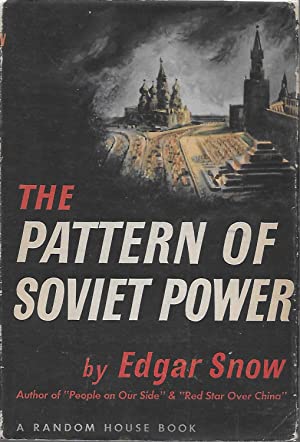
World War, 1939-1945 > Soviet Union.Soviet Union > Politics and government > 1936-1953.Soviet Union > Foreign relations.


Must reading for every liberal who wants to understand the problems, the question marks of India, Soviet Russia, China and their integral parts. Edgar Snow's known sympathies (Red Star Over China) are with the people's parties whether in China or Russia. He has however kept the book extraordinarily objective, informative and fresh in fact and viewpoint. The text combines excellent background and analysis with personal experience, illustrative anecdote and interviews. These interviews are very revealing, some with well known key figures, some of no importance-strategically -- but illustrative of the forces behind the front. Some of the newest material deals with Siberia, Mongolia, etc. He clarifies many points at issue; he answers often voiced questions. He supports India's demand for a chance to rule, or misrule, herself; of Russia's right to expect security on her borders; of Communist and partisan China to have equal acceptance and aid with the Nationalist Government; of Asia to expect to take the road to freedom.

Cover, of 291 Pages. Chinese-English....


The Japanese entered Nanking on December 12th, as Chinese troops and civilians were still trying to withdraw to the north bank of the Yangtze River, debouching through the one remaining gate. Scenes of utmost confusion ensued. Hundreds of people were machine-gunned by Japanese planes or drowned while trying to cross the river; hundreds more were caught in the bottleneck which developed at Hsiakuan gate, where bodies piled up four feet high.Anything female between the ages of 10 and 70 was raped. Discards were often bayoneted by drunken soldiers. Frequently mothers had to watch their babies beheaded, and then submit to raping. One mother told of being raped by a soldier who, becoming annoyed at the cries of her baby, put a quilt over its head, and smothered it to death, finishing his performance in peace. Some officers, who led these forays, turned their quarters into harems and fell into bed each night with a new captive. Open-air copulation was not uncommon. Some 50,000 troops in the city were let loose for over a month in an orgy of rape, murder, looting and general debauchery which has nowhere been equalled in modern times.Twelve thousand stores and houses were stripped of all their stocks and furnishings, and then set ablaze. Civilians were relieved of all personal belongings, and individual Japanese soldiers and officers stole motor-cars and rickshaws and other conveyances in which to haul their loot to Shanghai. The homes of foreign diplomats were entered and their servants murdered..."Practically every building in the city", wrote one of the foreign observers, "has been robbed repeatedly by soldiers, including the American, British and German Embassies... Most of the shops, after-free-for-all breaking and pilfering, were systematically stripped by gangs of soldiers working with trucks, often under the observed direction of officers."International "Safety Zone" became in reality a danger zone for non-combatants and a boomerang for its well-meaning organizers. Day after day Japanese entered the zone to seize women for the pacification of the lusty heroes. Young girls were dragged from American and British missionary schools, installed in brothels for the troops, and heard from no more. One day in a letter written by one of the missionaries in the Zone I read about a strange act of patriotism, concerning a number of singing-girls who had sought refuge with their virtuous sisters. Knowing of their presence in the camp, and urged on by some of the matrons, the missionary asked them if any would volunteer to serve the Japanese, so that non-professional women might be spared. They despised the enemy as much as the rest; but after some deliberation nearly all of them stepped forth. Surely they must have redeemed whatever virtue such women may be held to have lost, and some of them gave their lives in this way, but as far as I know they never received posthumous recognition or even the Order of the Brilliant Jade.In Shanghai a few Japanese deeply felt the shame and the humiliation. I remember, for example, talking one evening to a Japanese friend, a liberal-minded newspaper man who survived by keeping his views to himself, and whose name I withhold for his own protection. "Yes, they are all true," he unexpectedly admitted when I asked him about some atrocity reports, "only the facts are actually worse than any story yet published." There were tears in his eyes and I took his sorrow to be genuine

Hardcover non-fiction book in dust-jacket. Random House, 1947. 176 pages.


A lendária história dos revolucionários que mudaram para sempre a China. Edgar Snow foi o primeiro ocidental a entrar no soviete de Yan'an, a fantástica área revolucionária chinesa nascida da Longa Marcha. Foi de lá que ele recolheu os relatos que resultaram na primeira biografia de Mao Zedong, bem como nas conversas inéditas com líderes como Zhou Enlai, Peng Dehuai e outros tantos homens e mulheres responsáveis pela Revolução Chinesa. Além disso, este livro é permeado de análises históricas, políticas e sociológicas da China dos anos 1930, que passa pelo envolvimento do movimento comunista no processo, a reação fascista, a relação com as minorias cristãs, muçulmanas e étnicas – tudo feito pelo olhar de uma atenta testemunha histórica. De todas essas experiências radicais surgiu o livro A estrela vermelha brilha sobre a China, uma obra que já nasceu clássica e que continua cada vez mais como um dos livros mais importantes já escritos sobre o nascimento do movimento comunista chinês. Esta edição inclui todas essas narrativas épicas, acompanhadas de extensas notas de contextualização. Leitura fundamental para entender o que é China contemporânea.


Noen bøker skaper historie. Samtidshistoriske beretninger kan være med på å forme de begivenheter de skildrer. Omkring vårt århundres to store sosialistiske revolusjoner er det skrevet to slike bøker. Den russiske revolusjon ble skildret av John Reed i Ti dager som rystet verden. Den kinesiske revolusjon ble tatt på pulsen av Edgar Snow, i hans berømte øyenvitneskildring av den kinesiske revolusjon fra 1937. Dette er ingen analyse av en revolusjon som er ført vellykket til ende, men en rapport fra en revolusjon som er underveis, skrevet like etter Den lange marsjen og 12 år før de kinesiske kommunister tok makten over hele Kina. Boka ble meget raskt oversatt til kinesisk og fikk en enorm betydning for utbredelsen av kommunismen i Kina. Hvis en historiker skal kunne forene teori og praksis må det være slik Edgar Snow har gjort det i denne boka, som på samme tid beskriver og påvirker de begivenheter som omslutter den.Boka er utstyrt med en epilog fra 1944, og et etterord av Harald Munthe-Kaas som trekker opp hovedlinjene i Kinas utvikling fra 1944 til i dag.

Noen bøker skaper historie. Samtidshistoriske beretninger kan være med på å forme de begivenheter de skildrer. Omkring vårt århundres to store sosialistiske revolusjoner er det skrevet to slike bøker. Den russiske revolusjon ble skildret av John Reed i Ti dager som rystet verden. Den kinesiske revolusjon ble tatt på pulsen av Edgar Snow, i hans berømte øyenvitneskildring av den kinesiske revolusjon fra 1937. Dette er ingen analyse av en revolusjon som er ført vellykket til ende, men en rapport fra en revolusjon som er underveis, skrevet like etter Den lange marsjen og 12 år før de kinesiske kommunister tok makten over hele Kina. Boka ble meget raskt oversatt til kinesisk og fikk en enorm betydning for utbredelsen av kommunismen i Kina. Hvis en historiker skal kunne forene teori og praksis må det være slik Edgar Snow har gjort det i denne boka, som på samme tid beskriver og påvirker de begivenheter som omslutter den.Boka er utstyrt med en epilog fra 1944, og et etterord av Harald Munthe-Kaas som trekker opp hovedlinjene i Kinas utvikling fra 1944 til i dag.
The Battle for Asia
by Edgar Snow


抗日解放の中国―エドガー・スノーの革命アルバム
by Edgar Snow

中国の赤い星〈下〉
by Edgar Snow

中国の赤い星〈上〉
by Edgar Snow

目ざめへの旅―エドガー・スノー自伝
by Edgar Snow