
Daniel J. Levitin
Daniel J. Levitin runs the Laboratory for Musical Perception, Cognition and Expertise at McGill University, where he holds the Bell Chair in the Psychology of Electronic Communication. Before becoming a neuroscientist, he worked as a session musician, sound engineer and record producer. He has written extensively both in scientific journals and music trade magazines such as Grammy and Billboard. http://daniellevitin.com/levitinlab/L... http://daniellevitin.com/publicpage/b...
14 Books Written

This Is Your Brain on Music: The Science of a Human Obsession
by Daniel J. Levitin
Rating: 3.7 ⭐
• 2 recommendations ❤️
Whether you load your iPod with Bach or Bono, music has a significant role in your life—even if you never realized it. Why does music evoke such powerful moods? The answers are at last be- coming clear, thanks to revolutionary neuroscience and the emerging field of evolutionary psychology. Both a cutting-edge study and a tribute to the beauty of music itself, This Is Your Brain on Music unravels a host of mysteries that affect everything from pop culture to our understanding of human nature, including:• Are our musical preferences shaped in utero?• Is there a cutoff point for acquiring new tastes in music?• What do PET scans and MRIs reveal about the brain’s response to music?• Is musical pleasure different from other kinds of pleasure?This Is Your Brain on Music explores cultures in which singing is considered an essential human function, patients who have a rare disorder that prevents them from making sense of music, and scientists studying why two people may not have the same definition of pitch. At every turn, this provocative work unlocks deep secrets about how nature and nurture forge a uniquely human obsession.

Neuroscientist and New York Times best-selling author of This Is Your Brain on Music Daniel J. Levitin reveals the deep connections between music and healing.Music is one of humanity’s oldest medicines. From the Far East to the Ottoman Empire, Europe to Africa and the pre-colonial Americas, many cultures have developed their own rich traditions for using sound and rhythm to ease suffering, promote healing, and calm the mind.In his latest work, neuroscientist and New York Times best-selling author Daniel J. Levitin (This Is Your Brain on Music) explores the curative powers of music, showing us how and why it is one of the most potent therapies today. He brings together, for the first time, the results of numerous studies on music and the brain, demonstrating how music can contribute to the treatment of a host of ailments, from neurodegenerative diseases such as Parkinson’s and Alzheimer’s, to cognitive injury, depression, and pain.Levitin is not your typical scientist—he is also an award-winning musician and composer, and through lively interviews with some of today’s most celebrated musicians, from Sting to Kent Nagano and Mari Kodama, he shares their observations as to why music might be an effective therapy, in addition to plumbing scientific case studies, music theory, and music history. The result is a work of dazzling ideas, cutting-edge research, and jubilant celebration. I Heard There Was a Secret Chord highlights the critical role music has played in human biology, illuminating the neuroscience of music and its profound benefits for those both young and old.
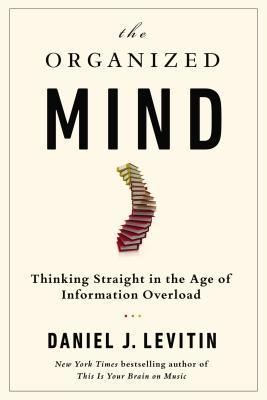
The Organized Mind: Thinking Straight in the Age of Information Overload
by Daniel J. Levitin
Rating: 3.6 ⭐
New York Times bestselling author and neuroscientist Daniel J. Levitin shifts his keen insights from your brain on music to your brain in a sea of details.The information age is drowning us with an unprecedented deluge of data. At the same time, we’re expected to make more—and faster—decisions about our lives than ever before. No wonder, then, that the average American reports frequently losing car keys or reading glasses, missing appointments, and feeling worn out by the effort required just to keep up.But somehow some people become quite accomplished at managing information flow. In The Organized Mind , Daniel J. Levitin, PhD, uses the latest brain science to demonstrate how those people excel—and how readers can use their methods to regain a sense of mastery over the way they organize their homes, workplaces, and time.With lively, entertaining chapters on everything from the kitchen junk drawer to health care to executive office workflow, Levitin reveals how new research into the cognitive neuroscience of attention and memory can be applied to the challenges of our daily lives. This Is Your Brain on Music showed how to better play and appreciate music through an understanding of how the brain works. The Organized Mind shows how to navigate the churning flood of information in the twenty-first century with the same neuroscientific perspective.

Winner of the National Business Book AwardFrom the New York Times bestselling author of The Organized Mind and This Is Your Brain on Music , a primer to the critical thinking that is more necessary now than ever We are bombarded with more information each day than our brains can process—especially in election season. It's raining bad data, half-truths, and even outright lies. New York Times bestselling author Daniel J. Levitin shows how to recognize misleading announcements, statistics, graphs, and written reports, revealing the ways lying weasels can use them.It's becoming harder to separate the wheat from the digital chaff. How do we distinguish misinformation, pseudo-facts, and distortions from reliable information? Levitin groups his field guide into two categories—statistical information and faulty arguments—ultimately showing how science is the bedrock of critical thinking. Infoliteracy means understanding that there are hierarchies of source quality and bias that variously distort our information feeds via every media channel, including social media. We may expect newspapers, bloggers, the government, and Wikipedia to be factually and logically correct, but they so often aren't. We need to think critically about the words and numbers we encounter if we want to be successful at work, at play, and in making the most of our lives. This means checking the plausibility and reasoning—not passively accepting information, repeating it, and making decisions based on it. Readers learn to avoid the extremes of passive gullibility and cynical rejection. Levitin's charming, entertaining, accessible guide can help anyone wake up to a whole lot of things that aren't so. And catch some weasels in their tracks!

Successful Aging: A Neuroscientist Explores the Power and Potential of Our Lives
by Daniel J. Levitin
Rating: 3.9 ⭐
Debunks the idea that aging inevitably brings infirmity and unhappiness and instead offers a trove of practical, evidence-based guidance for living longer and better.--Daniel H. Pink, author of When and Drive SUCCESSFUL AGING delivers powerful insights: - Debunking the myth that memory always declines with age - Confirming that health span--not life span--is what matters - Proving that sixty-plus years is a unique and newly recognized developmental stage - Recommending that people look forward to joy, as reminiscing doesn't promote health Levitin looks at the science behind what we all can learn from those who age joyously, as well as how to adapt our culture to take full advantage of older people's wisdom and experience. Throughout his exploration of what aging really means, using research from developmental neuroscience and the psychology of individual differences, Levitin reveals resilience strategies and practical, cognitive enhancing tricks everyone should do as they age.Successful Aging inspires a powerful new approach to how readers think about our final decades, and it will revolutionize the way we plan for old age as individuals, family members, and citizens within a society where the average life expectancy continues to rise.

The author of the New York Times bestseller and Los Angeles Times Book Award Finalist This Is Your Brain on Music tunes us in to six evolutionary musical forms that brought about the evolution of human culture. An unprecedented blend of science and art, Daniel Levitin's debut, This Is Your Brain on Music, delighted readers with an exuberant guide to the neural impulses behind those songs that make our heart swell. Now he showcases his daring theory of "six songs," illuminating how the brain evolved to play and listen to music in six fundamental forms—for knowledge, friendship, religion, joy, comfort, and love. Preserving the emotional history of our lives and of our species, from its very beginning music was also allied to dance, as the structure of the brain confirms; developing this neurological observation, Levitin shows how music and dance enabled the social bonding and friendship necessary for human culture and society to evolve. Blending cutting-edge scientific findings with his own sometimes hilarious experiences as a musician and music-industry professional, Levitin's sweeping study also incorporates wisdom gleaned from interviews with icons ranging from Sting and Paul Simon to Joni Mitchell, and David Byrne, along with classical musicians and conductors, historians, anthropologists, and evolutionary biologists. The result is a brilliant revelation of the prehistoric yet elegant systems at play when we sing and dance at a wedding or cheer at a concert—or tune out quietly with an iPod.

FROM THE BESTSELLING AUTHOR OF THIS IS YOUR BRAIN ON MUSIC AND THE ORGANISED MIND Music insinuates itself into our earliest memories; it is intimately connected to our emotional regulation and cognition; its shared rhythms and sounds are essential to our social behaviours. That is why we can remember songs word for word years later, or why certain music has the power to uplift us almost instantly. Music is more than a vehicle for entertainment and it's also a powerful tool for lifelong health.In Music and Medicine, bestselling author and neuroscientist Daniel Levitin delves into the latest research on the interaction of music, mood, health, and the biology of our brain. In it, he explains how music can lead to lasting improvements in our brain and body, increasing brain function and connectivity, boosting neuroplasticity and even strengthening our immune system. From promoting relaxation when we're stressed and supporting stroke victims to recover the ability to walk, improving memory for those suffering with Alzheimers’ Disease and helping manage chronic pain, music has an extraordinary therapeutic potential that is yet to be fully realised.A work of dazzling ideas, cutting-edge research, and joyful celebration of the human mind, Music as Medicine will explain to you what we know, and how we can harness music to heal – helping us look forward and reimagine our lives.

No Description provided.

Please Note That The Following Individual Books As Per Original ISBN and Cover Image In this Listing shall be Dispatched Collectively: The Organized Mind, The Power of Habit, Thinking Fast and Slow 3 Books Collection Set: The Organized Mind: Thought-provoking and practical... Good advice based on sound neuroscientific principles' Sunday Times.Impressively wide-ranging and thoughtful. There are fascinating facts and examples throughout' Wall Street Journal. The Power of Habit: We can always change. In The Power of Habit, award-winning New York Times business reporter Charles Duhigg translates cutting-edge behavioural science into practical self-improvement action, distilling advanced neuroscience into fascinating narratives of transformation. Thinking Fast and Slow: Why is there more chance we'll believe something if it's in a bold type face? Why are judges more likely to deny parole before lunch? Why do we assume a good-looking person will be more competent? The answer lies in the two ways we make choices.


Please Note That The Following Individual Books As Per Original ISBN and Cover Image In this Listing shall be Dispatched Daniel Levitin 3 Books Collection Set (The Changing Mind, This is Your Brain on Music & The Organized Mind): The Changing In The Changing Mind (published in America as Successful Aging), neuroscientist and internationally bestselling author Daniel Levitin invites us to dramatically shift our understanding of aging, demonstrating the many benefits of growing older. He draws on cutting-edge research to offer realistic guidelines and practical tips for readers to follow during every decade of life, showing us we all can learn from those who age joyously. This is Your Brain on From Mozart to the Beatles, neuroscientist, psychologist and internationally-bestselling author Daniel Levitin reveals the role of music in human evolution, shows how our musical preferences begin to form even before we are born and explains why music can offer such an emotional experience.In This Is Your Brain On Music Levitin offers nothing less than a new way to understand music, and what it can teach us about ourselves. The Organized Modern society is in a state of information overload. Neuroscientist Daniel J. Levitin investigates how and why our brains are struggling to keep up with the demands of the digital age.Why is email so addictive? Is multitasking really possible? And what do successful people keep in their junk drawer? The Organized Mind debunks myth and presents one simple idea - storing information in the physical world instead of the mind - to revolutionize twenty-first century living. 9780241379400/9780241987353/9780241965788

The Organized Mind, How to Break Up with Your Phone, Hyperfocus, One Thing 4 Books Collection Set
by Daniel J. Levitin
Rating: 4.5 ⭐
Please Note That The Following Individual Books As Per Original ISBN and Cover Image In this Listing shall be Dispatched The Organized Mind, How to Break Up with Your Phone, Hyperfocus, One Thing 4 Books Collection The Organized The information age is drowning us with an unprecedented deluge of data. At the same time, we’re expected to make more—and faster—decisions about our lives than ever before. No wonder, then, that the average American reports frequently losing car keys or reading glasses, missing appointments, and feeling worn out by the effort required just to keep up. How to Break Up with Your Is your phone the first thing you reach for in the morning and the last thing you touch before bed? Do you frequently pick it up “just to check,” only to look up forty-five minutes later wondering where the time has gone? Do you say you want to spend less time on your phone—but have no idea how to do so without giving it up completely? If so, this book is your solution. In Hyperfocus, Chris Bailey provides profound insights into how we can best manage our attention. He reveals how the brain switches between two mental modes – hyperfocus, our deep concentration mode, and scatterfocus, our creative, reflective mode – and how the surest path to being our most creative and efficient selves at work is to combine them both. One You want fewer distractions and less on your plate. The daily barrage of e-mails, texts, tweets, messages, and meetings distract you and stress you out. The simultaneous demands of work and family are taking a toll. And what's the cost? Second-rate work, missed deadlines, smaller pay cheques, fewer promotions-and lots of stress..

The Organized Mind, Hyperfocus, Eat That Frog!, How to Talk to Anyone 4 Books Collection Set
by Daniel J. Levitin
Rating: 4.0 ⭐
Please Note That The Following Individual Books As Per Original ISBN and Cover Image In this Listing shall be Dispatched The Organized Mind, Hyperfocus, Eat That Frog!, How to Talk to Anyone 4 Books Collection The Organized The information age is drowning us with an unprecedented deluge of data. At the same time, we’re expected to make more—and faster—decisions about our lives than ever before. No wonder, then, that the average American reports frequently losing car keys or reading glasses, missing appointments, and feeling worn out by the effort required just to keep up. How to Work Less to Achieve More. Eat That Frog!: It’s time to stop procrastinating and get more of the important things done! After all, successful people don’t try to do everything. They focus on their most important tasks and get those done. They eat their frogs. There’s an old saying that if the first thing you do each morning is eat a live frog, you’ll have the satisfaction of knowing. How to Talk to "The lost art of verbal communication may be revitalized by Leil Lowndes." Harvey McKay, author of “How to Swim with the Sharks Without Being Eaten Alive” What is that magic quality makes some people instantly loved and respected? Everyone wants to be their friend (or, if single, their lover!) In business, they rise swiftly to the top of the corporate ladder. What is their "Midas touch?"

Almost everyone experiences stress on a daily basis, so learning good coping mechanisms to lessen and manage its effects is essential. Even though stress might occasionally feel overwhelming, once you know what causes it, you can manage it.Stress triggers an innate response in the brain. Stressful events, such a monthly work meeting, a traffic jam, or a doctor's appointment, are likely to occur because of past experiences. By altering your response to these circumstances (stressors), you can reduce the amount of stress they create.learn how to cope and manager stress in everyday activities