Loading themes...
Explore the best books about Microhistory theme.


New York Public Library Book for the TeenagerNew York Public Library Book to RememberPSLA Young Adult Top 40 Nonfiction Titles of the Year"Engaging...a lively, informative compendium of facts, theories, and musings."-Michiko Kakutani, New York TimesBehold the rat, dirty and disgusting! Robert Sullivan turns the lowly rat into the star of this most perversely intriguing, remarkable, and unexpectedly elegant New York Times bestseller.Love them or loathe them, rats are here to stay-they are city dwellers as much as (or more than) we are, surviving on the effluvia of our society. In Rats , the critically acclaimed bestseller, Robert Sullivan spends a year investigating a rat-infested alley just a few blocks away from Wall Street. Sullivan gets to know not just the beast but its friends and foes: the exterminators, the sanitation workers, the agitators and activists who have played their part in the centuries-old war between human city dweller and wild city rat.Sullivan looks deep into the largely unrecorded history of the city and its masses-its herds-of-rats-like mob. Funny, wise, sometimes disgusting but always compulsively readable, Rats earns its unlikely place alongside the great classics of nature writing.With an all-new Afterword by the author

“Fascinating, strange, sad, funny, and entirely engrossing, The Great Beanie Baby Bubble is a smart, engaging book that’s as much about the odd saga of these plush toys as it is about the nature of obsession and desire.”—SUSAN ORLEAN, author of Rin Tin Tin New York Times bestselling author Zac Bissonnette explores what happened when a $5 stuffed animal took over America and turned a college dropout into a billionaire. Now a major motion picture starring Elizabeth Banks and Zach Galifianakis, The Great Beanie Baby Bubble tells the story of the most extraordinary craze of the 1990s. In the history of consumer crazes, nothing compares to Beanie Babies. With no advertising or big-box distribution, creator Ty Warner – an eccentric college dropout – became a billionaire in just three years. But the end of the fad was just as swift and extremely devastating, with "rare" Beanie Babies deemed worthless as quickly as they'd once been deemed priceless. Bissonnette explains how and why the Beanie Baby craze rose and fell, and explores the rise of ecommerce and eBay. Through first-ever interviews with former Ty Inc. employees, Warner's sister, and the two ex-girlfriends who were by his side as he became the richest man in the history of toys, The Great Beanie Baby Bubble tells the inspiring yet tragic story of one of America's most enigmatic self-made tycoons. Perfect for collectors, investors, and fans of marketing and business books, The Great Beanie Baby Bubble explores the mass hysteria that captivated America.

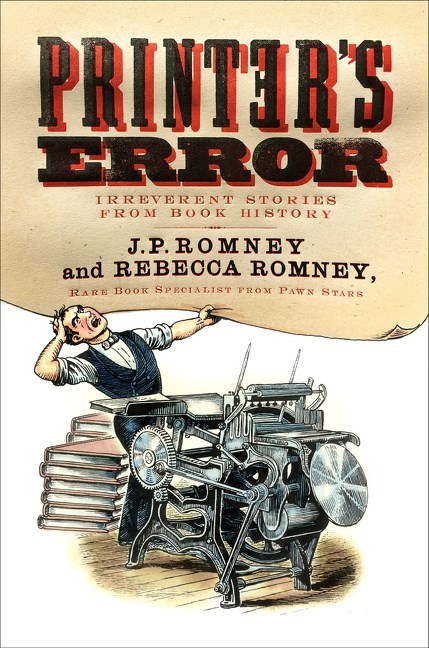
A funny and entertaining history of printed books as told through absurd moments in the lives of authors and printers, collected by television’s favorite rare-book expert from HISTORY’s hit series Pawn Stars.Since the Gutenberg Bible first went on sale in 1455, printing has been viewed as one of the highest achievements of human innovation. But the march of progress hasn’t been smooth; downright bizarre is more like it. Printer’s Error chronicles some of the strangest and most humorous episodes in the history of Western printing, and makes clear that we’ve succeeded despite ourselves. Rare-book expert Rebecca Romney and author J. P. Romney take us from monasteries and museums to auction houses and libraries to introduce curious episodes in the history of print that have had a profound impact on our world.Take, for example, the Gutenberg Bible. While the book is regarded as the first printed work in the Western world, Gutenberg’s name doesn’t appear anywhere on it. Today, Johannes Gutenberg is recognized as the father of Western printing. But for the first few hundred years after the invention of the printing press, no one knew who printed the first book. This long-standing mystery took researchers down a labyrinth of ancient archives and libraries, and unearthed surprising details, such as the fact that Gutenberg’s financier sued him, repossessed his printing equipment, and started his own printing business afterward. Eventually the first printed book was tracked to the library of Cardinal Mazarin in France, and Gutenberg’s forty-two-line Bible was finally credited to him, thus ensuring Gutenberg’s name would be remembered by middle-school students worldwide.

The gripping story of the most important overlooked commodity in the world--sand--and the crucial role it plays in our lives.Except for water and air, sand is the natural resource that we consume more than any other--more than oil, more than natural gas. Every concrete building and paved road on Earth, every computer screen and silicon chip, exists because of sand. From Egypt's pyramids to the Hubble telescope, from the world's tallest skyscraper to the sidewalk below it, from Chartres' stained-glass windows to Chihuly sculptures to your iPhone, sand shelters us, empowers us, engages us, and inspires us. It's the ingredient that makes possible our cities, our science, our lives--and our future.And we're running out of it.The World in a Grain is the compelling true story of the hugely important and diminishing natural resource that grows more important every day, and some of the people who use it, sell it, recycle it, and destroy it. It's also a provocative examination of the serious human and environmental costs surrounding sand and the profound global significance, which has received little public attention. Award-winning journalist Vince Beiser delves deep into this world, explaining why sand is so crucial to modern life. Along the way, readers encounter sand pirates, become aware of child sand miners, and learn that not all sand is created Some of the easiest sand to get to is the least useful. The result is an entertaining and eye-opening work, one that is both unexpected and involving, full of fascinating detail and populated by surprising people.

"The intertwined histories of booze and medicine, from internationally-renowned cocktail expert Camper English. Alcohol and medicine have an inextricably intertwined history, with innovations in each altering the path of the other. The story stretches back to the ancient world, when beer and wine were used to provide nutrition, hydration, and act as solvents for healing botanicals. Over time, alchemists distilled elixirs designed to cure all diseases, monastic apothecaries developed mystical botanical liqueurs, travelling physicians concocted dubious intoxicating nostrums, and the drinks we're familiar with today began to take form. In turn, scientists studied fermentation and formed the germ theory of disease, and developed an understanding of elemental gasses and anesthetics. Modern cocktails like the Gimlet, Gin & Tonic, and Old Fashioned were born as delicious remedies for diseases and discomforts. In Doctors and Distillers, cocktail expert Camper English reveals how and why the contents of our medicine and liquor cabinets were, until surprisingly recently, one and the same"--