
Vladimir Tenev Recommended Books
Bulgarian-American entrepreneur and co-founder of Robinhood, a US-based financial services company
6 Books Recommended

The Republic by Plato is a landmark achievement in Ancient Greek philosophy - this edition combines an authoritative translation with affordability.The Republic is the most famous text written by Plato, which takes the form of a philosophical dialogue. The text is part conversation between a group of friends active in the Athens intellectual community, and part monologue from various participants in the discussion. The narrator and lead character is Socrates, Plato's friend and mentor, who appears in most of his pupil's dialogues and acts as surrogate to Plato's ideas. Throughout the text the 'Socratic method', whereby Socrates feigns ignorance and questions an adversary to receive insight on a given subject, is demonstrated.Ten books in total comprise The Republic , the divisions thought to have been made due to the length of a roll of papyrus in Ancient Greece. The discussion begins with an attempt to find a definition for justice, wherein a disagreement between Thrasymachus - who believes justice is what is good for who is strongest at a given place and time - and Socrates, who believes that all members of society should, for the highest benefit of all, conform to just action.In Book II, the discussion expands to include justice in the sense of a social contract. Whether or not justice happens only due to fear of reprisal, and whether justice is truly a high virtue of itself, are among the questions considered. Eventually the discussion expands further into the idea of a just city ideas of how such a society, embodying justice and order, might work commences with Socrates proposing an educated 'guardian' class of able-bodied men and women who would uphold order and defend such a city against threats from outside.After expanding their ideas on the guardians, the dialogue proceeds onto other classes. It is here that Plato's famous idea of the philosopher king arises - the notion of a ruler who is appointed for holding the highest understanding of good and just rule, imparted to him at an early age by capable educators.Plato as Socrates eventually proposes that the essence of justice is fulfilling one's role in society. The correct assignment of an occupation to each citizen, to which they can happily commit, will result in a just and capable society. Further stipulations upon this ideal society are given; that education be strictly regulated and human reproduction made a matter for the state, with no offspring knowing their parents.The Republic then covers four forms of injustice manifested in systems of government - timocracy, oligarchy, democracy, and finally tyranny. How these unjust societies occur is talked about at length, with examples from Ancient society cited as Socrates/Plato develops theories on how societies go astray. The most unjust ruler - the tyrant - is discussed at length, and determined to be among the most unhappy, unfree and unfulfilled types of man owing to his thrall to passions, and friendless owing to his commitment to hierarchy. Such malfeasant politics are excoriated; in the end, Socrates says, all are harmed and none benefit from tyranny.Between books VII and VIII Socrates establishes the famous Allegory of the Cave as a way of demonstrating education's effects upon the human mind. By using the image of people who have only lived in a dark caves their whole lives, he illustrates how mere shadows against the walls are the closest such individuals come to seeing reality. Philosophy, Socrates argues, is the way by which humans are freed from this cave of ignorance and propelled to an enlightenment.Socrates concludes the discussion of city politics and rulers, and commences to focus upon the nature of art and its place in the just and ideal city. He also discusses reincarnation, the indestructible nature of the human soul, concluding the epic text on a spiritual note.
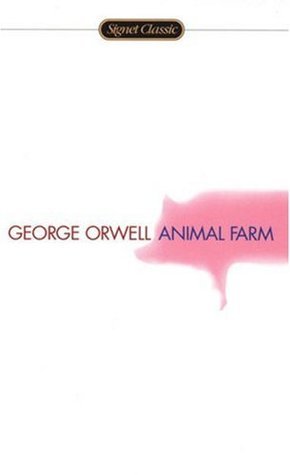
Librarian's note: There is an Alternate Cover Edition for this edition of this book here.A farm is taken over by its overworked, mistreated animals. With flaming idealism and stirring slogans, they set out to create a paradise of progress, justice, and equality. Thus the stage is set for one of the most telling satiric fables ever penned –a razor-edged fairy tale for grown-ups that records the evolution from revolution against tyranny to a totalitarianism just as terrible. When Animal Farm was first published, Stalinist Russia was seen as its target. Today it is devastatingly clear that wherever and whenever freedom is attacked, under whatever banner, the cutting clarity and savage comedy of George Orwell’s masterpiece have a meaning and message still ferociously fresh.

Twenty-Five Hundred years ago, Sun Tzu wrote this classic book of military strategy based on Chinese warfare and military thought. Since that time, all levels of military have used the teaching on Sun Tzu to warfare and civilization have adapted these teachings for use in politics, business and everyday life. The Art of War is a book which should be used to gain advantage of opponents in the boardroom and battlefield alike.

In this candid and riveting memoir, for the first time ever, Nike founder and CEO Phil Knight shares the inside story of the company’s early days as an intrepid start-up and its evolution into one of the world’s most iconic, game-changing, and profitable brands.In 1962, fresh out of business school, Phil Knight borrowed $50 from his father and created a company with a simple mission: import high-quality, low-cost athletic shoes from Japan. Selling the shoes from the trunk of his lime green Plymouth Valiant, Knight grossed $8,000 his first year. Today, Nike’s annual sales top $30 billion. In an age of startups, Nike is the ne plus ultra of all startups, and the swoosh has become a revolutionary, globe-spanning icon, one of the most ubiquitous and recognizable symbols in the world today.But Knight, the man behind the swoosh, has always remained a mystery. Now, for the first time, in a memoir that is candid, humble, gutsy, and wry, he tells his story, beginning with his crossroads moment. At 24, after backpacking around the world, he decided to take the unconventional path, to start his own business—a business that would be dynamic, different.Knight details the many risks and daunting setbacks that stood between him and his dream—along with his early triumphs. Above all, he recalls the formative relationships with his first partners and employees, a ragtag group of misfits and seekers who became a tight-knit band of brothers. Together, harnessing the transcendent power of a shared mission, and a deep belief in the spirit of sport, they built a brand that changed everything.
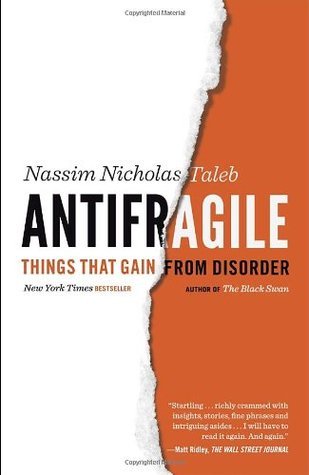
Antifragile: Things That Gain from Disorder
by Nassim Nicholas Taleb
Rating: 4.2 ⭐
• 23 recommendations ❤️
Antifragile is a standalone book in Nassim Nicholas Taleb’s landmark Incerto series, an investigation of opacity, luck, uncertainty, probability, human error, risk, and decision-making in a world we don’t understand. The other books in the series are Fooled by Randomness, The Black Swan, Skin in the Game, and The Bed of Procrustes .Nassim Nicholas Taleb, the bestselling author of The Black Swan and one of the foremost thinkers of our time, reveals how to thrive in an uncertain world.Just as human bones get stronger when subjected to stress and tension, and rumors or riots intensify when someone tries to repress them, many things in life benefit from stress, disorder, volatility, and turmoil. What Taleb has identified and calls “antifragile” is that category of things that not only gain from chaos but need it in order to survive and flourish. In The Black Swan, Taleb showed us that highly improbable and unpredictable events underlie almost everything about our world. In Antifragile, Taleb stands uncertainty on its head, making it desirable, even necessary, and proposes that things be built in an antifragile manner. The antifragile is beyond the resilient or robust. The resilient resists shocks and stays the same; the antifragile gets better and better.Furthermore, the antifragile is immune to prediction errors and protected from adverse events. Why is the city-state better than the nation-state, why is debt bad for you, and why is what we call “efficient” not efficient at all? Why do government responses and social policies protect the strong and hurt the weak? Why should you write your resignation letter before even starting on the job? How did the sinking of the Titanic save lives? The book spans innovation by trial and error, life decisions, politics, urban planning, war, personal finance, economic systems, and medicine. And throughout, in addition to the street wisdom of Fat Tony of Brooklyn, the voices and recipes of ancient wisdom, from Roman, Greek, Semitic, and medieval sources, are loud and clear.Antifragile is a blueprint for living in a Black Swan world.Erudite, witty, and iconoclastic, Taleb’s message is revolutionary: The antifragile, and only the antifragile, will make it.Praise for Antifragile“Ambitious and thought-provoking . . . highly entertaining.” — The Economist“A bold book explaining how and why we should embrace uncertainty, randomness, and error . . . It may just change our lives.” — Newsweek

Born on a farm and named in a field by her parents--artist Chrisann Brennan and Steve Jobs--Lisa Brennan-Jobs's childhood unfolded in a rapidly changing Silicon Valley. When she was young, Lisa's father was a mythical figure who was rarely present in her life. As she grew older, her father took an interest in her, ushering her into a new world of mansions, vacations, and private schools. His attention was thrilling, but he could also be cold, critical and unpredictable. When her relationship with her mother grew strained in high school, Lisa decided to move in with her father, hoping he'd become the parent she'd always wanted him to be.Small Fry is Lisa Brennan-Jobs's poignant story of a childhood spent between two imperfect but extraordinary homes. Scrappy, wise, and funny, young Lisa is an unforgettable guide through her parents' fascinating and disparate worlds. Part portrait of a complex family, part love letter to California in the seventies and eighties, Small Fry is an enthralling book by an insightful new literary voice.