
34 Books Recommended

Only the Paranoid Survive: How to Exploit the Crisis Points That Challenge Every Company
by Andrew S. Grove
Rating: 4.0 ⭐
• 17 recommendations ❤️
Andy Grove, founder and former CEO of Intel shares his strategy for success as he takes the reader deep inside the workings of a major company in Only the Paranoid Survive .Under Andy Grove's leadership, Intel became the world's largest chip maker and one of the most admired companies in the world. In Only the Paranoid Survive , Grove reveals his strategy for measuring the nightmare moment every leader dreads--when massive change occurs and a company must, virtually overnight, adapt or fall by the wayside--in a new way.Grove calls such a moment a Strategic Inflection Point, which can be set off by almost mega-competition, a change in regulations, or a seemingly modest change in technology. When a Strategic Inflection Point hits, the ordinary rules of business go out the window. Yet, managed right, a Strategic Inflection Point can be an opportunity to win in the marketplace and emerge stronger than ever.Grove underscores his message by examining his own record of success and failure, including how he navigated the events of the Pentium flaw, which threatened Intel's reputation in 1994, and how he has dealt with the explosions in growth of the Internet. The work of a lifetime, Only the Paranoid Survive is a classic of managerial and leadership skills.

This Is Your Brain on Music: The Science of a Human Obsession
by Daniel J. Levitin
Rating: 3.7 ⭐
• 2 recommendations ❤️
Whether you load your iPod with Bach or Bono, music has a significant role in your life—even if you never realized it. Why does music evoke such powerful moods? The answers are at last be- coming clear, thanks to revolutionary neuroscience and the emerging field of evolutionary psychology. Both a cutting-edge study and a tribute to the beauty of music itself, This Is Your Brain on Music unravels a host of mysteries that affect everything from pop culture to our understanding of human nature, including:• Are our musical preferences shaped in utero?• Is there a cutoff point for acquiring new tastes in music?• What do PET scans and MRIs reveal about the brain’s response to music?• Is musical pleasure different from other kinds of pleasure?This Is Your Brain on Music explores cultures in which singing is considered an essential human function, patients who have a rare disorder that prevents them from making sense of music, and scientists studying why two people may not have the same definition of pitch. At every turn, this provocative work unlocks deep secrets about how nature and nurture forge a uniquely human obsession.

Wear on edges of covers and spine. Bookstore stamp on first page.

McMafia: A Journey Through the Global Criminal Underworld
by Misha Glenny
Rating: 3.7 ⭐
• 2 recommendations ❤️
Misha Glenny's groundbreaking study of global organized crime is now the inspiration for an 8-part AMC crime drama starring James Norton ( War and Peace ), Juliet Rylance, and David Strathairn. With the collapse of the Soviet Union, the fall of the Berlin Wall, and the deregulation of international financial markets in 1989, governments and entrepreneurs alike became intoxicated by dreams of newly opened markets. But no one could have foreseen that the greatest success story to arise from these events would be the worldwide rise of organized crime. Today, it is estimated that illegal trade accounts for one-fifth of the global GDP.In this fearless and wholly authoritative investigation of the seemingly insatiable demand for illegal wares, veteran reporter Misha Glenny travels across five continents to speak with participants from every level of the global underworld--police, victims, politicians, and even the criminals themselves. What follows is a groundbreaking, propulsive look at an unprecedented phenomenon from a savvy, street-wise guide.

The Score Takes Care of Itself: My Philosophy of Leadership
by Bill Walsh
Rating: 4.3 ⭐
• 16 recommendations ❤️
The last lecture on leadership by the NFL's greatest coach: Bill Walsh Bill Walsh is a towering figure in the history of the NFL. His advanced leadership transformed the San Francisco 49ers from the worst franchise in sports to a legendary dynasty. In the process, he changed the way football is played.Prior to his death, Walsh granted a series of exclusive interviews to bestselling author Steve Jamison. These became his ultimate lecture on leadership.Additional insights and perspective are provided by Hall of Fame quarterback Joe Montana and others.Bill Walsh taught that the requirements of successful leadership are the same whether you run an NFL franchise, a fortune 500 company, or a hardware store with 12 employees. These final words of 'wisdom by Walsh' will inspire, inform, and enlighten leaders in all professions.

In his latest bestseller, Atul Gawande shows what the simple idea of the checklist reveals about the complexity of our lives and how we can deal with it. The modern world has given us stupendous know-how. Yet avoidable failures continue to plague us in health care, government, the law, the financial industry—in almost every realm of organized activity. And the reason is the volume and complexity of knowledge today has exceeded our ability as individuals to properly deliver it to people—consistently, correctly, safely. We train longer, specialize more, use ever-advancing technologies, and still we fail. Atul Gawande makes a compelling argument that we can do better, using the simplest of the checklist. In riveting stories, he reveals what checklists can do, what they can’t, and how they could bring about striking improvements in a variety of fields, from medicine and disaster recovery to professions and businesses of all kinds. And the insights are making a difference. Already, a simple surgical checklist from the World Health Organization designed by following the ideas described here has been adopted in more than twenty countries as a standard for care and has been heralded as “the biggest clinical invention in thirty years” ( The Independent ).

The Invisible Gorilla: How Our Intuitions Deceive Us
by Christopher Chabris
Rating: 4.0 ⭐
• 5 recommendations ❤️
Reading this book will make you less sure of yourself—and that’s a good thing. In The Invisible Gorilla, Christopher Chabris and Daniel Simons, creators of one of psychology’s most famous experiments, use remarkable stories and counterintuitive scientific findings to demonstrate an important truth: Our minds don’t work the way we think they do. We think we see ourselves and the world as they really are, but we’re actually missing a whole lot. Chabris and Simons combine the work of other researchers with their own findings on attention, perception, memory, and reasoning to reveal how faulty intuitions often get us into trouble. In the process, they explain: • Why a company would spend billions to launch a product that its own analysts know will fail• How a police officer could run right past a brutal assault without seeing it• Why award-winning movies are full of editing mistakes• What criminals have in common with chess masters• Why measles and other childhood diseases are making a comeback• Why money managers could learn a lot from weather forecasters Again and again, we think we experience and understand the world as it is, but our thoughts are beset by everyday illusions. We write traffic laws and build criminal cases on the assumption that people will notice when something unusual happens right in front of them. We’re sure we know where we were on 9/11, falsely believing that vivid memories are seared into our minds with perfect fidelity. And as a society, we spend billions on devices to train our brains because we’re continually tempted by the lure of quick fixes and effortless self-improvement. The Invisible Gorilla reveals the myriad ways that our intuitions can deceive us, but it’s much more than a catalog of human failings. Chabris and Simons explain why we succumb to these everyday illusions and what we can do to inoculate ourselves against their effects. Ultimately, the book provides a kind of x-ray vision into our own minds, making it possible to pierce the veil of illusions that clouds our thoughts and to think clearly for perhaps the first time.

As it was in Anna Karenina, Madame Bovary, and Othello, so it is in life. Most forms of private vice and public evil are kindled and sustained by lies. Acts of adultery and other personal betrayals, financial fraud, government corruption—even murder and genocide—generally require an additional moral defect: a willingness to lie.In Lying , best-selling author and neuroscientist Sam Harris argues that we can radically simplify our lives and improve society by merely telling the truth in situations where others often lie. He focuses on "white" lies—those lies we tell for the purpose of sparing people discomfort—for these are the lies that most often tempt us. And they tend to be the only lies that good people tell while imagining that they are being good in the process.

A Summer Reading Pick for President Barack Obama, Bill Gates, and Mark Zuckerberg From a renowned historian comes a groundbreaking narrative of humanity’s creation and evolution—a #1 international bestseller—that explores the ways in which biology and history have defined us and enhanced our understanding of what it means to be “human.”One hundred thousand years ago, at least six different species of humans inhabited Earth. Yet today there is only one—homo sapiens. What happened to the others? And what may happen to us?Most books about the history of humanity pursue either a historical or a biological approach, but Dr. Yuval Noah Harari breaks the mold with this highly original book that begins about 70,000 years ago with the appearance of modern cognition. From examining the role evolving humans have played in the global ecosystem to charting the rise of empires, Sapiens integrates history and science to reconsider accepted narratives, connect past developments with contemporary concerns, and examine specific events within the context of larger ideas.Dr. Harari also compels us to look ahead, because over the last few decades humans have begun to bend laws of natural selection that have governed life for the past four billion years. We are acquiring the ability to design not only the world around us, but also ourselves. Where is this leading us, and what do we want to become?Featuring 27 photographs, 6 maps, and 25 illustrations/diagrams.
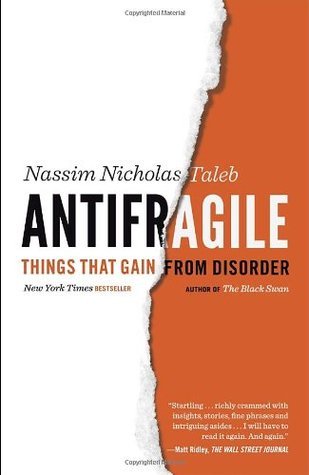
Antifragile: Things That Gain from Disorder
by Nassim Nicholas Taleb
Rating: 4.2 ⭐
• 23 recommendations ❤️
Antifragile is a standalone book in Nassim Nicholas Taleb’s landmark Incerto series, an investigation of opacity, luck, uncertainty, probability, human error, risk, and decision-making in a world we don’t understand. The other books in the series are Fooled by Randomness, The Black Swan, Skin in the Game, and The Bed of Procrustes .Nassim Nicholas Taleb, the bestselling author of The Black Swan and one of the foremost thinkers of our time, reveals how to thrive in an uncertain world.Just as human bones get stronger when subjected to stress and tension, and rumors or riots intensify when someone tries to repress them, many things in life benefit from stress, disorder, volatility, and turmoil. What Taleb has identified and calls “antifragile” is that category of things that not only gain from chaos but need it in order to survive and flourish. In The Black Swan, Taleb showed us that highly improbable and unpredictable events underlie almost everything about our world. In Antifragile, Taleb stands uncertainty on its head, making it desirable, even necessary, and proposes that things be built in an antifragile manner. The antifragile is beyond the resilient or robust. The resilient resists shocks and stays the same; the antifragile gets better and better.Furthermore, the antifragile is immune to prediction errors and protected from adverse events. Why is the city-state better than the nation-state, why is debt bad for you, and why is what we call “efficient” not efficient at all? Why do government responses and social policies protect the strong and hurt the weak? Why should you write your resignation letter before even starting on the job? How did the sinking of the Titanic save lives? The book spans innovation by trial and error, life decisions, politics, urban planning, war, personal finance, economic systems, and medicine. And throughout, in addition to the street wisdom of Fat Tony of Brooklyn, the voices and recipes of ancient wisdom, from Roman, Greek, Semitic, and medieval sources, are loud and clear.Antifragile is a blueprint for living in a Black Swan world.Erudite, witty, and iconoclastic, Taleb’s message is revolutionary: The antifragile, and only the antifragile, will make it.Praise for Antifragile“Ambitious and thought-provoking . . . highly entertaining.” — The Economist“A bold book explaining how and why we should embrace uncertainty, randomness, and error . . . It may just change our lives.” — Newsweek

En toda actividad que desarrollemos los resultados son iguales a las habilidades más la suerte. Hay un componente de previsibilidad y de imprevisibilidad en todo lo que hacemos. El autor busca a través de la ecuación del éxito medir la proporción que la suerte y los elementos imprevisibles tienen en la consecución de un resultado. Si logramos saber esto, podremos analizar con eficiencia la calidad de las acciones que tomamos en relación a los resultados obtenidos. De esta forma podemos adoptar mejores decisiones y mejorar nuestra productividad y el retorno de nuestras inversiones, logrando disminuir considerablemente la importancia de la suerte y demás imprevistos en los resultados obtenidos.

Other People's Money: Inside the Housing Crisis and the Demise of the Greatest Real Estate Deal Ever Made
by Charles V. Bagli
Rating: 4.1 ⭐
• 2 recommendations ❤️
A veteran New York Times reporter dissects the most spectacular failure in real estate history Real estate giant Tishman Speyer and its partner, BlackRock, lost billions of dollars when their much-vaunted purchase of Stuyvesant Town–Peter Cooper Village in New York City failed to deliver the expected profits. But how did Tishman Speyer walk away from the deal unscathed, while others took the financial hit—and MetLife scored a $3 billion profit? Illuminating the world of big real estate the way Too Big to Fail did for banks, Other People’s Money is a riveting account of politics, high finance, and the hubris that ultimately led to the nationwide real estate meltdown.

Drunk Tank Pink: And Other Unexpected Forces That Shape How We Think, Feel, and Behave
by Adam Alter
Rating: 3.8 ⭐
• 4 recommendations ❤️
A revelatory look at how our environment unconsciously yet dramatically shapes the judgments and decisions we make every dayMost of us go through life believing that we are in control of the choices we make—that we think and behave almost independently from the world around us. But as Drunk Tank Pink illustrates, the truth is our environment shapes our thoughts and actions in myriad ways without our permission or even our knowledge. Armed with surprising data and endlessly fascinating examples, Adam Alter addresses the subtle but substantial ways in which outside forces influence us—such as color’s influence on mood, our bias in favor of names with which we identify, and how sunny days can induce optimism as well as aggression. Drunk Tank Pink proves that the truth behind our feelings and actions goes much deeper than the choices we take for granted every day.
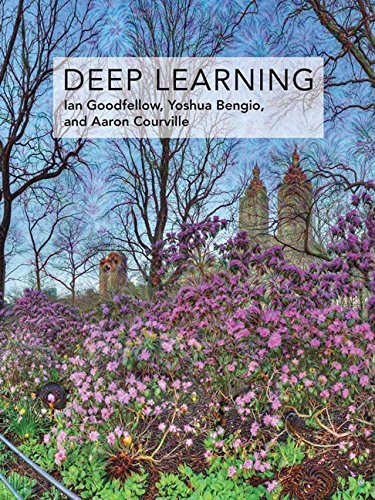
An introduction to a broad range of topics in deep learning, covering mathematical and conceptual background, deep learning techniques used in industry, and research perspectives.Deep learning is a form of machine learning that enables computers to learn from experience and understand the world in terms of a hierarchy of concepts. Because the computer gathers knowledge from experience, there is no need for a human computer operator to formally specify all the knowledge that the computer needs. The hierarchy of concepts allows the computer to learn complicated concepts by building them out of simpler ones; a graph of these hierarchies would be many layers deep. This book introduces a broad range of topics in deep learning.The text offers mathematical and conceptual background, covering relevant concepts in linear algebra, probability theory and information theory, numerical computation, and machine learning. It describes deep learning techniques used by practitioners in industry, including deep feedforward networks, regularization, optimization algorithms, convolutional networks, sequence modeling, and practical methodology; and it surveys such applications as natural language processing, speech recognition, computer vision, online recommendation systems, bioinformatics, and videogames. Finally, the book offers research perspectives, covering such theoretical topics as linear factor models, autoencoders, representation learning, structured probabilistic models, Monte Carlo methods, the partition function, approximate inference, and deep generative models.Deep Learning can be used by undergraduate or graduate students planning careers in either industry or research, and by software engineers who want to begin using deep learning in their products or platforms. A website offers supplementary material for both readers and instructors.
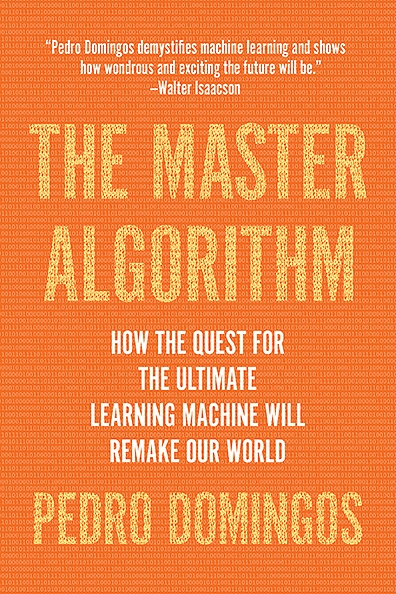
The Master Algorithm: How the Quest for the Ultimate Learning Machine Will Remake Our World
by Pedro Domingos
Rating: 3.8 ⭐
• 4 recommendations ❤️
Recommended by Bill GatesA thought-provoking and wide-ranging exploration of machine learning and the race to build computer intelligences as flexible as our own In the world's top research labs and universities, the race is on to invent the ultimate learning one capable of discovering any knowledge from data, and doing anything we want, before we even ask. In The Master Algorithm , Pedro Domingos lifts the veil to give us a peek inside the learning machines that power Google, Amazon, and your smartphone. He assembles a blueprint for the future universal learner--the Master Algorithm--and discusses what it will mean for business, science, and society. If data-ism is today's philosophy, this book is its bible.

Official U.S. edition with full color illustrations throughout. NEW YORK TIMES BESTSELLER Yuval Noah Harari, author of the critically-acclaimed New York Times bestseller and international phenomenon Sapiens , returns with an equally original, compelling, and provocative book, turning his focus toward humanity’s future, and our quest to upgrade humans into gods. Over the past century humankind has managed to do the impossible and rein in famine, plague, and war. This may seem hard to accept, but, as Harari explains in his trademark style—thorough, yet riveting—famine, plague and war have been transformed from incomprehensible and uncontrollable forces of nature into manageable challenges. For the first time ever, more people die from eating too much than from eating too little; more people die from old age than from infectious diseases; and more people commit suicide than are killed by soldiers, terrorists and criminals put together. The average American is a thousand times more likely to die from binging at McDonalds than from being blown up by Al Qaeda. What then will replace famine, plague, and war at the top of the human agenda? As the self-made gods of planet earth, what destinies will we set ourselves, and which quests will we undertake? Homo Deus explores the projects, dreams and nightmares that will shape the twenty-first century—from overcoming death to creating artificial life. It asks the fundamental Where do we go from here? And how will we protect this fragile world from our own destructive powers? This is the next stage of evolution. This is Homo Deus. With the same insight and clarity that made Sapiens an international hit and a New York Times bestseller, Harari maps out our future.

The Seventh Sense: Power, Fortune, and Survival in the Age of Networks
by Joshua Cooper Ramo
Rating: 3.6 ⭐
• 6 recommendations ❤️
Endless terror. Refugee waves. An unfixable global economy. Surprising election results. New billion-dollar fortunes. Miracle medical advances. What if they were all connected? What if you could understand why?The Seventh Sense is the story of what all of today's successful figures see and the forces that are invisible to most of us but explain everything from explosive technological change to uneasy political ripples. The secret to power now is understanding our new age of networks. Not merely the Internet, but also webs of trade, finance, and even DNA. Based on his years of advising generals, CEOs, and politicians, Ramo takes us into the opaque heart of our world's rapidly connected systems and teaches us what the losers are not yet seeing -- and what the victors of this age already know.

Negotiating the Impossible: How to Break Deadlocks and Resolve Ugly Conflicts
by Deepak Malhotra
Rating: 4.1 ⭐
• 6 recommendations ❤️
Negotiating the ImpossibleHow to Break Deadlocks and Resolve Ugly Conflicts (without Money or Muscle) Some negotiations are easy. Others are more difficult. And then there are situations that seem hopeless. Conflict is escalating, people are getting aggressive, and no one is willing to back down. And to top it off, you have little power, money, or other resources to work with. Harvard professor (and negotiation consultant advisor to organizations around the world) Deepak Malhotra shows how to defuse even the most potentially explosive situations and to find success when things seem impossible. Malhotra illustrates key lessons using behind-the-scenes stories of fascinating real-life negotiations, including drafting the US Constitution, resolving the Cuban Missile Crisis, bringing peace to Northern Ireland, ending bitter disputes in the NFL and NHL, and beating the odds in complex business situations. But he also shows how these same principles and tactics can be applied in everyday life as well, from making corporate deals, negotiating job offers, and resolving business disputes to tackling obstacles in personal relationships and even negotiating with children.

New York, 1888. Gas lamps still flicker in the city streets, but the miracle of electric light is in its infancy. The person who controls the means to turn night into day will make history--and a vast fortune. A young untested lawyer named Paul Cravath, fresh out of Columbia Law School, takes a case that seems impossible to win. Paul's client, George Westinghouse, has been sued by Thomas Edison over a billion-dollar question: Who invented the light bulb and holds the right to power the country? The case affords Paul entry to the heady world of high society--the glittering parties in Gramercy Park mansions, and the more insidious dealings done behind closed doors. The task facing him is beyond daunting. Edison is a wily, dangerous opponent with vast resources at his disposal--private spies, newspapers in his pocket, and the backing of J. P. Morgan himself. Yet this unknown lawyer shares with his famous adversary a compulsion to win at all costs. How will he do it?In obsessive pursuit of victory, Paul crosses paths with Nikola Tesla, an eccentric, brilliant inventor who may hold the key to defeating Edison, and with Agnes Huntington, a beautiful opera singer who proves to be a flawless performer on stage and off. As Paul takes greater and greater risks, he'll find that everyone in his path is playing their own game, and no one is quite who they seem.

New York Post Best Book of 2016. We often think of our capacity to experience the suffering of others as the ultimate source of goodness. Many of our wisest policy-makers, activists, scientists, and philosophers agree that the only problem with empathy is that we don’t have enough of it. Nothing could be farther from the truth, argues Yale researcher Paul Bloom. In Against Empathy, Bloom reveals empathy to be one of the leading motivators of inequality and immorality in society. Far from helping us to improve the lives of others, empathy is a capricious and irrational emotion that appeals to our narrow prejudices. It muddles our judgment and, ironically, often leads to cruelty. We are at our best when we are smart enough not to rely on it, but to draw instead upon a more distanced compassion. Basing his argument on groundbreaking scientific findings, Bloom makes the case that some of the worst decisions made by individuals and nations—who to give money to, when to go to war, how to respond to climate change, and who to imprison—are too often motivated by honest, yet misplaced, emotions. With precision and wit, he demonstrates how empathy distorts our judgment in every aspect of our lives, from philanthropy and charity to the justice system; from medical care and education to parenting and marriage. Without empathy, Bloom insists, our decisions would be clearer, fairer, and—yes—ultimately more moral. Brilliantly argued, urgent and humane, Against Empathy shows us that, when it comes to both major policy decisions and the choices we make in our everyday lives, limiting our impulse toward empathy is often the most compassionate choice we can make.

From the best-selling author of Why We Get Fat, a groundbreaking, eye-opening exposé that makes the convincing case that sugar is the tobacco of the new backed by powerful lobbies, entrenched in our lives, and making us very sick.Among Americans, diabetes is more prevalent today than ever; obesity is at epidemic proportions; nearly 10% of children are thought to have nonalcoholic fatty liver disease. And sugar is at the root of these, and other, critical society-wide, health-related problems. With his signature command of both science and straight talk, Gary Taubes delves into Americans' history with its uses as a preservative, as an additive in cigarettes, the contemporary overuse of high-fructose corn syrup. He explains what research has shown about our addiction to sweets. He clarifies the arguments against sugar, corrects misconceptions about the relationship between sugar and weight loss; and provides the perspective necessary to make informed decisions about sugar as individuals and as a society.
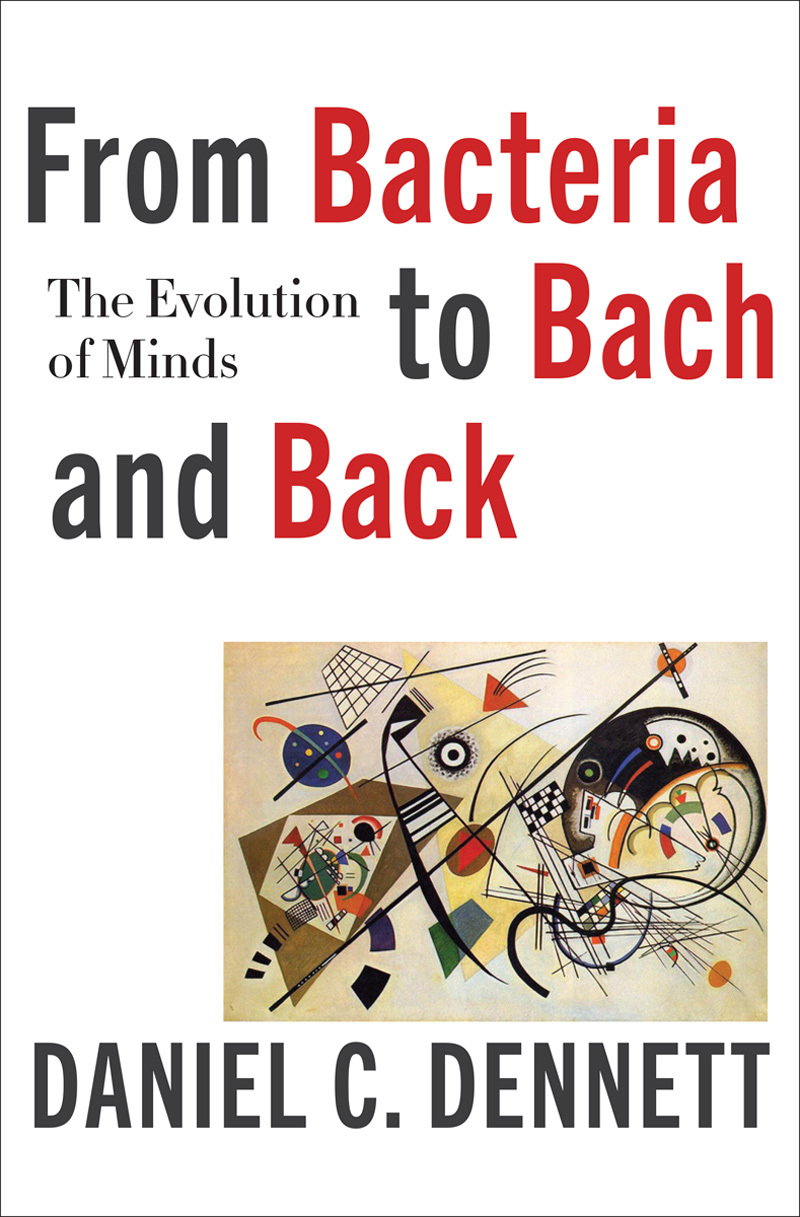
From Bacteria to Bach and Back: The Evolution of Minds
by Daniel C. Dennett
Rating: 3.7 ⭐
• 7 recommendations ❤️
How did we come to have minds?For centuries, this question has intrigued psychologists, physicists, poets, and philosophers, who have wondered how the human mind developed its unrivaled ability to create, imagine, and explain. Disciples of Darwin have long aspired to explain how consciousness, language, and culture could have appeared through natural selection, blazing promising trails that tend, however, to end in confusion and controversy. Even though our understanding of the inner workings of proteins, neurons, and DNA is deeper than ever before, the matter of how our minds came to be has largely remained a mystery.That is now changing, says Daniel C. Dennett. In From Bacteria to Bach and Back, his most comprehensive exploration of evolutionary thinking yet, he builds on ideas from computer science and biology to show how a comprehending mind could in fact have arisen from a mindless process of natural selection. Part philosophical whodunit, part bold scientific conjecture, this landmark work enlarges themes that have sustained Dennett’s legendary career at the forefront of philosophical thought.In his inimitable style—laced with wit and arresting thought experiments—Dennett explains that a crucial shift occurred when humans developed the ability to share memes, or ways of doing things not based in genetic instinct. Language, itself composed of memes, turbocharged this interplay. Competition among memes—a form of natural selection—produced thinking tools so well-designed that they gave us the power to design our own memes. The result, a mind that not only perceives and controls but can create and comprehend, was thus largely shaped by the process of cultural evolution.An agenda-setting book for a new generation of philosophers, scientists, and thinkers, From Bacteria to Bach and Back will delight and entertain anyone eager to make sense of how the mind works and how it came about.
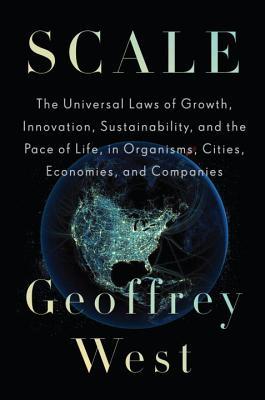
Scale: The Universal Laws of Growth, Innovation, Sustainability, and the Pace of Life in Organisms, Cities, Economies, and Companies
by Geoffrey B. West
Rating: 4.1 ⭐
• 10 recommendations ❤️
The former head of the Sante Fe Institute, visionary physicist Geoffrey West is a pioneer in the field of complexity science, the science of emergent systems and networks. The term “complexity” can be misleading, however, because what makes West’s discoveries so beautiful is that he has found an underlying simplicity that unites the seemingly complex and diverse phenomena of living systems, including our bodies, our cities and our businesses. Fascinated by issues of aging and mortality, West applied the rigor of a physicist to the biological question of why we live as long as we do and no longer. The result was astonishing, and changed science, creating a new understanding of energy use and metabolism: West found that despite the riotous diversity in the sizes of mammals, they are all, to a large degree, scaled versions of each other. If you know the size of a mammal, you can use scaling laws to learn everything from how much food it eats per day, what its heart-rate is, how long it will take to mature, its lifespan, and so on. Furthermore, the efficiency of the mammal’s circulatory systems scales up precisely based on weight: if you compare a mouse, a human and an elephant on a logarithmic graph, you find with every doubling of average weight, a species gets 25% more efficient—and lives 25% longer. This speaks to everything from how long we can expect to live to how many hours of sleep we need. Fundamentally, he has proven, the issue has to do with the fractal geometry of the networks that supply energy and remove waste from the organism's body. West's work has been game-changing for biologists, but then he made the even bolder move of exploring his work's applicability to cities. Cities, too, are constellations of networks and laws of scalability relate with eerie precision to them. For every doubling in a city's size, the city needs 15% less road, electrical wire, and gas stations to support the same population. More amazingly, for every doubling in size, cities produce 15% more patents and more wealth, as well as 15% more crime and disease. This broad pattern lays the groundwork for a new science of cities. Recently, West has applied his revolutionary work on cities and biological life to the business world. This investigation has led to powerful insights into why some companies thrive while others fail. The implications of these discoveries are far-reaching, and are just beginning to be explored. Scale is a thrilling scientific adventure story about the elemental natural laws that bind us together in simple but profound ways. Through the brilliant mind of Geoffrey West, we can envision how cities, companies and biological life alike are dancing to the same simple, powerful tune, however diverse and unrelated they are to each other.From the Hardcover edition.

What is the nature of space and time? How do we fit within the universe? How does the universe fit within us? There’s no better guide through these mind-expanding questions than acclaimed astrophysicist and best-selling author Neil deGrasse Tyson.But today, few of us have time to contemplate the cosmos. So Tyson brings the universe down to Earth succinctly and clearly, with sparkling wit, in tasty chapters consumable anytime and anywhere in your busy day.

Why We Sleep: Unlocking the Power of Sleep and Dreams
by Matthew Walker
Rating: 4.4 ⭐
• 16 recommendations ❤️
“Why We Sleep is an important and fascinating book…Walker taught me a lot about this basic activity that every person on Earth needs. I suspect his book will do the same for you.” —Bill Gates A New York Times bestseller and international sensation, this “stimulating and important book” (Financial Times) is a fascinating dive into the purpose and power of slumber.With two appearances on CBS This Morning and Fresh Air's most popular interview of 2017, Matthew Walker has made abundantly clear that sleep is one of the most important but least understood aspects of our life. Until very recently, science had no answer to the question of why we sleep, or what good it served, or why we suffer such devastating health consequences when it is absent. Compared to the other basic drives in life—eating, drinking, and reproducing—the purpose of sleep remains more elusive. Within the brain, sleep enriches a diversity of functions, including our ability to learn, memorize, and make logical decisions. It recalibrates our emotions, restocks our immune system, fine-tunes our metabolism, and regulates our appetite. Dreaming creates a virtual reality space in which the brain melds past and present knowledge, inspiring creativity. In this “compelling and utterly convincing” (The Sunday Times) book, preeminent neuroscientist and sleep expert Matthew Walker provides a revolutionary exploration of sleep, examining how it affects every aspect of our physical and mental well-being. Charting the most cutting-edge scientific breakthroughs, and marshalling his decades of research and clinical practice, Walker explains how we can harness sleep to improve learning, mood and energy levels, regulate hormones, prevent cancer, Alzheimer’s and diabetes, slow the effects of aging, and increase longevity. He also provides actionable steps towards getting a better night’s sleep every night. Clear-eyed, fascinating, and accessible, Why We Sleep is a crucial and illuminating book. Written with the precision of Atul Gawande, Andrew Solomon, and Sherwin Nuland, it is “recommended for night-table reading in the most pragmatic sense” (The New York Times Book Review).

The narrative of the Silicon Valley generation that launched five major high-tech industries in seven years, laying the foundation for today’s technology-driven world.At a time when the five most valuable companies on the planet are high-tech firms and nearly half of Americans say they cannot live without their cell phones, Troublemakers reveals the untold story of how we got here. This is the gripping tale of seven exceptional men and women, pioneers of Silicon Valley in the 1970s and early 1980s. Together, they worked across generations, industries, and companies to bring technology from Pentagon offices and university laboratories to the rest of us. In doing so, they changed the world. In Troublemakers, historian Leslie Berlin introduces the people and stories behind the birth of the Internet and the microprocessor, as well as Apple, Atari, Genentech, Xerox PARC, ROLM, ASK, and the iconic venture capital firms Sequoia Capital and Kleiner Perkins Caufield & Byers. In the space of only seven years and thirty-five miles, five major industries—personal computing, video games, biotechnology, modern venture capital, and advanced semiconductor logic—were born.During these same years, the first ARPANET transmission came into a Stanford lab, the university began licensing faculty innovations to businesses, and the Silicon Valley tech community began mobilizing to develop the lobbying clout and influence that have become critical components of modern American politics. In other words, these were the years when one of the most powerful pillars of our modern innovation and political systems was first erected.Featured among well-known Silicon Valley innovators like Steve Jobs, Regis McKenna, Larry Ellison, and Don Valentine are Mike Markkula, the underappreciated chairman of Apple who owned one-third of the company; Bob Taylor, who kick-started the Arpanet and masterminded the personal computer; software entrepreneur Sandra Kurtzig, the first woman to take a technology company public; Bob Swanson, the cofounder of Genentech; Al Alcorn, the Atari engineer behind the first wildly successful video game; Fawn Alvarez, who rose from an assembler on a factory line to the executive suite; and Niels Reimers, the Stanford administrator who changed how university innovations reach the public. Together, these troublemakers rewrote the rules and invented the future.

From the New York Times bestselling author of The Black Swan, a bold new work that challenges many of our long-held beliefs about risk and reward, politics and religion, finance and personal responsibility In his most provocative and practical book yet, one of the foremost thinkers of our time redefines what it means to understand the world, succeed in a profession, contribute to a fair and just society, detect nonsense, and influence others. Citing examples ranging from Hammurabi to Seneca, Antaeus the Giant to Donald Trump, Nassim Nicholas Taleb shows how the willingness to accept one’s own risks is an essential attribute of heroes, saints, and flourishing people in all walks of life. As always both accessible and iconoclastic, Taleb challenges long-held beliefs about the values of those who spearhead military interventions, make financial investments, and propagate religious faiths. Among his insights: • For social justice, focus on symmetry and risk sharing. You cannot make profits and transfer the risks to others, as bankers and large corporations do. You cannot get rich without owning your own risk and paying for your own losses. Forcing skin in the game corrects this asymmetry better than thousands of laws and regulations. • Ethical rules aren’t universal. You’re part of a group larger than you, but it’s still smaller than humanity in general. • Minorities, not majorities, run the world. The world is not run by consensus but by stubborn minorities imposing their tastes and ethics on others. • You can be an intellectual yet still be an idiot. “Educated philistines” have been wrong on everything from Stalinism to Iraq to low-carb diets. • Beware of complicated solutions (that someone was paid to find). A simple barbell can build muscle better than expensive new machines. • True religion is commitment, not just faith. How much you believe in something is manifested only by what you’re willing to risk for it.The phrase “skin in the game” is one we have often heard but rarely stopped to truly dissect. It is the backbone of risk management, but it’s also an astonishingly rich worldview that, as Taleb shows in this book, applies to all aspects of our lives. As Taleb says, “The symmetry of skin in the game is a simple rule that’s necessary for fairness and justice, and the ultimate BS-buster,” and “Never trust anyone who doesn’t have skin in the game. Without it, fools and crooks will benefit, and their mistakes will never come back to haunt them.”

In Sapiens, he explored our past. In Homo Deus, he looked to our future. Now, one of the most innovative thinkers on the planet turns to the present to make sense of today's most pressing issues.How do computers and robots change the meaning of being human? How do we deal with the epidemic of fake news? Are nations and religions still relevant? What should we teach our children?Yuval Noah Harari's 21 Lessons for the 21st Century is a probing and visionary investigation into today's most urgent issues as we move into the uncharted territory of the future. As technology advances faster than our understanding of it, hacking becomes a tactic of war, and the world feels more polarized than ever, Harari addresses the challenge of navigating life in the face of constant and disorienting change and raises the important questions we need to ask ourselves in order to survive.In twenty-one accessible chapters that are both provocative and profound, Harari builds on the ideas explored in his previous books, untangling political, technological, social, and existential issues and offering advice on how to prepare for a very different future from the world we now live in: How can we retain freedom of choice when Big Data is watching us? What will the future workforce look like, and how should we ready ourselves for it? How should we deal with the threat of terrorism? Why is liberal democracy in crisis?Harari's unique ability to make sense of where we have come from and where we are going has captured the imaginations of millions of readers. Here he invites us to consider values, meaning, and personal engagement in a world full of noise and uncertainty. When we are deluged with irrelevant information, clarity is power. Presenting complex contemporary challenges clearly and accessibly, 21 Lessons for the 21st Century is essential reading.

The Coddling of the American Mind: How Good Intentions and Bad Ideas Are Setting Up a Generation for Failure
by Greg Lukianoff
Rating: 4.3 ⭐
• 16 recommendations ❤️
A timely investigation into the campus assault on free speech and what it means for students, education, and our democracy.The generation now coming of age has been taught three Great Untruths: their feelings are always right; they should avoid pain and discomfort; and they should look for faults in others and not themselves. These three Great Untruths are part of a larger philosophy that sees young people as fragile creatures who must be protected and supervised by adults. But despite the good intentions of the adults who impart them, the Great Untruths are harming kids by teaching them the opposite of ancient wisdom and the opposite of modern psychological findings on grit, growth, and antifragility. The result is rising rates of depression and anxiety, along with endless stories of college campuses torn apart by moralistic divisions and mutual recriminations.This is a book about how we got here. First Amendment expert Greg Lukianoff and social psychologist Jonathan Haidt take us on a tour of the social trends stretching back to the 1980s that have produced the confusion and conflict on campus today, including the loss of unsupervised play time and the birth of social media, all during a time of rising political polarization.This is a book about how to fix the mess. The culture of "safety" and its intolerance of opposing viewpoints has left many young people anxious and unprepared for adult life, with devastating consequences for them, for their parents, for the companies that will soon hire them, and for a democracy that is already pushed to the brink of violence over its growing political divisions. Lukianoff and Haidt offer a comprehensive set of reforms that will strengthen young people and institutions, allowing us all to reap the benefits of diversity, including viewpoint diversity.This is a book for anyone who is confused by what's happening on college campuses today, or has children, or is concerned about the growing inability of Americans to live and work and cooperate across party lines.

Winners Take All: The Elite Charade of Changing the World
by Anand Giridharadas
Rating: 4.1 ⭐
• 10 recommendations ❤️
An insider's groundbreaking investigation of how the global elite's efforts to "change the world" preserve the status quo and obscure their role in causing the problems they later seek to solve.Former New York Times columnist Anand Giridharadas takes us into the inner sanctums of a new gilded age, where the rich and powerful fight for equality and justice any way they can--except ways that threaten the social order and their position atop it. We see how they rebrand themselves as saviors of the poor; how they lavishly reward "thought leaders" who redefine "change" in winner-friendly ways; and how they constantly seek to do more good, but never less harm. We hear the limousine confessions of a celebrated foundation boss; witness an American president hem and haw about his plutocratic benefactors; and attend a cruise-ship conference where entrepreneurs celebrate their own self-interested magnanimity.Giridharadas asks hard questions: Why, for example, should our gravest problems be solved by the unelected upper crust instead of the public institutions it erodes by lobbying and dodging taxes? He also points toward an answer: Rather than rely on scraps from the winners, we must take on the grueling democratic work of building more robust, egalitarian institutions and truly changing the world. A call to action for elites and everyday citizens alike.

Blitzscaling: The Lightning-Fast Path to Building Massively Valuable Companies
by Reid Hoffman
Rating: 3.9 ⭐
• 16 recommendations ❤️
Foreword by Bill GatesLinkedIn cofounder, legendary investor, and host of the award-winning Masters of Scale podcast reveals the secret to starting and scaling massively valuable companies.What entrepreneur or founder doesn’t aspire to build the next Amazon, Facebook, or Airbnb? Yet those who actually manage to do so are exceedingly rare. So what separates the startups that get disrupted and disappear from the ones who grow to become global giants?The secret is a set of techniques for scaling up at a dizzying pace that blows competitors out of the water. The objective of Blitzscaling is not to go from zero to one, but from one to one billion –as quickly as possible.When growing at a breakneck pace, getting to next level requires very different strategies from those that got you to where you are today. In a book inspired by their popular class at Stanford Business School, Hoffman and Yeh reveal how to navigate the necessary shifts and weather the unique challenges that arise at each stage of a company’s life cycle, such how to design business models for igniting and sustaining relentless growth; strategies for hiring and managing; how the role of the founder and company culture must evolve as the business matures, and more. Whether your business has ten employees or ten thousand, Blitzscaling is the essential playbook for winning in a world where speed is the only competitive advantage that matters.

The Uninhabitable Earth: Life After Warming
by David Wallace-Wells
Rating: 4.2 ⭐
• 4 recommendations ❤️
It is worse, much worse, than you think. If your anxiety about global warming is dominated by fears of sea-level rise, you are barely scratching the surface of what terrors are possible—food shortages, refugee emergencies, climate wars and economic devastation. An “epoch-defining book” (The Guardian) and “this generation’s Silent Spring” (The Washington Post), The Uninhabitable Earth is both a travelogue of the near future and a meditation on how that future will look to those living through it—the ways that warming promises to transform global politics, the meaning of technology and nature in the modern world, the sustainability of capitalism and the trajectory of human progress. The Uninhabitable Earth is also an impassioned call to action. For just as the world was brought to the brink of catastrophe within the span of a lifetime, the responsibility to avoid it now belongs to a single generation—today’s.

An Elegant Defense: The Extraordinary New Science of the Immune System: A Tale in Four Lives
by Matt Richtel
Rating: 4.0 ⭐
• 6 recommendations ❤️
A magnificently reported and soulfully crafted exploration of the human immune system–the key to health and wellness, life and death. An epic, first-of-its-kind book, entwining leading-edge scientific discovery with the intimate stories of four individual lives, by the Pulitzer Prize–winning New York Times journalist.A terminal cancer patient rises from the grave. A medical marvel defies HIV. Two women with autoimmunity discover their own bodies have turned against them. Matt Richtel's An Elegant Defense uniquely entwines these intimate stories with science’s centuries-long quest to unlock the mysteries of sickness and health, and illuminates the immune system as never before.The immune system is our body’s essential defense network, a guardian vigilantly fighting illness, healing wounds, maintaining order and balance, and keeping us alive. Its legion of microscopic foot soldiers—from T cells to “natural killers”—patrols our body, linked by a nearly instantaneous communications grid. It has been honed by evolution over millennia to face an almost infinite array of threats.For all its astonishing complexity, however, the immune system can be easily compromised by fatigue, stress, toxins, advanced age, and poor nutrition—hallmarks of modern life—and even by excessive hygiene. Paradoxically, it is a fragile wonder weapon that can turn on our own bodies with startling results, leading today to epidemic levels of autoimmune disorders.Richtel effortlessly guides readers on a scientific detective tale winding from the Black Plague to twentieth-century breakthroughs in vaccination and antibiotics, to the cutting-edge laboratories that are revolutionizing immunology—perhaps the most extraordinary and consequential medical story of our time. The foundation that Richtel builds makes accessible revelations about cancer immunotherapy, the microbiome, and autoimmune treatments that are changing millions of lives. An Elegant Defense also captures in vivid detail how these powerful therapies, along with our behavior and environment, interact with the immune system, often for the good but always on a razor’s edge that can throw this remarkable system out of balance.Drawing on his groundbreaking reporting for the New York Times and based on extensive new interviews with dozens of world-renowned scientists, Matt Richtel has produced a landmark book, equally an investigation into the deepest riddles of survival and a profoundly human tale that is movingly brought to life through the eyes of his four main characters, each of whom illuminates an essential facet of our “elegant defense.”

What You Do Is Who You Are: How to Create Your Business Culture
by Ben Horowitz
Rating: 4.0 ⭐
• 10 recommendations ❤️
Ben Horowitz, a leading venture capitalist, modern management expert, and New York Times bestselling author, combines lessons both from history and from modern organizational practice with practical and often surprising advice to help executives build cultures that can weather both good and bad times. Ben Horowitz has long been fascinated by history, and particularly by how people behave differently than you’d expect. The time and circumstances in which they were raised often shapes them—yet a few leaders have managed to shape their times. In What You Do Is Who You Are, he turns his attention to a question crucial to every organization: how do you create and sustain the culture you want?To Horowitz, culture is how a company makes decisions. It is the set of assumptions employees use to resolve everyday problems: should I stay at the Red Roof Inn, or the Four Seasons? Should we discuss the color of this product for five minutes or thirty hours? If culture is not purposeful, it will be an accident or a mistake.What You Do Is Who You Are explains how to make your culture purposeful by spotlighting four models of leadership and culture-building—the leader of the only successful slave revolt, Haiti’s Toussaint Louverture; the Samurai, who ruled Japan for seven hundred years and shaped modern Japanese culture; Genghis Khan, who built the world’s largest empire; and Shaka Senghor, a man convicted of murder who ran the most formidable prison gang in the yard and ultimately transformed prison culture.Horowitz connects these leadership examples to modern case-studies, including how Louverture’s cultural techniques were applied (or should have been) by Reed Hastings at Netflix, Travis Kalanick at Uber, and Hillary Clinton, and how Genghis Khan’s vision of cultural inclusiveness has parallels in the work of Don Thompson, the first African-American CEO of McDonalds, and of Maggie Wilderotter, the CEO who led Frontier Communications. Horowitz then offers guidance to help any company understand its own strategy and build a successful culture.What You Do Is Who You Are is a journey through culture, from ancient to modern. Along the way, it answers a question fundamental to any organization: who are we? How do people talk about us when we’re not around? How do we treat our customers? Are we there for people in a pinch? Can we be trusted?Who you are is not the values you list on the wall. It’s not what you say in company-wide meeting. It’s not your marketing campaign. It’s not even what you believe. Who you are is what you do. This book aims to help you do the things you need to become the kind of leader you want to be—and others want to follow.