
15 Books Recommended

Slow Days, Fast Company: The World, the Flesh, and L.A.
by Eve Babitz
Rating: 4.1 ⭐
• 2 recommendations ❤️
No one burned hotter than Eve Babitz. Possessing skin that radiated “its own kind of moral laws,” spectacular teeth, and a figure that was the stuff of legend, she seduced seemingly everyone who was anyone in Los Angeles for a long stretch of the 1960s and ’70s. One man proved elusive, however, and so Babitz did what she did best: she wrote him a book.Slow Days, Fast Company is a full-fledged and full-bodied evocation of a bygone Southern California that far exceeds its mash-note premise. In ten sun-baked, Santa Ana wind–swept sketches, Babitz re-creates a Los Angeles of movie stars distraught over their success, socialites on three-day drug binges holed up in the Chateau Marmont, soap-opera actors worried that tomorrow’s script will kill them off, Italian femmes fatales even more fatal than Babitz. And she even leaves LA now and then, spending an afternoon at the house of flawless Orange County suburbanites, a day among the grape pickers of the Central Valley, a weekend in Palm Springs where her dreams of romance fizzle and her only solace is Virginia Woolf. In the end it doesn’t matter if Babitz ever gets the guy—she seduces us.

The Story of Adele H.: The Complete Script of the Film
by François Truffaut
Rating: 3.9 ⭐
• 2 recommendations ❤️
An English version of the filmscript of Truffaut's motion-picture treatment of the obsessive romantic passion of Victor Hugo's younger daughter, with stills from the completed film

Here is the story of the inimitable twelve-year-old Frankie, who is utterly, hopelessly bored with life until she hears about her older brother's wedding. Bolstered by lively conversations with her house servant, Berenice, and her six-year-old male cousin—not to mention her own unbridled imagination—Frankie takes on an overly active role in the wedding, hoping even to go, uninvited, on the honeymoon, so deep is her desire to be the member of something larger, more accepting than herself. The novel that became an award-winning play and a major motion picture and that has charmed generations of readers, Carson McCullers's classic The Member of the Wedding is now available in small-format trade paperback for the first time. "A marvelous study of the agony of adolescence" (Detroit Free Press), The Member of the Wedding showcases Carson McCullers at her most sensitive, astute, and lasting best.An alternate-cover edition for this ISBN can be found here.

Staring unflinchingly into the abyss of slavery, this spellbinding novel transforms history into a story as powerful as Exodus and as intimate as a lullaby. Sethe, its protagonist, was born a slave and escaped to Ohio, but eighteen years later she is still not free. She has too many memories of Sweet Home, the beautiful farm where so many hideous things happened. And Sethe’s new home is haunted by the ghost of her baby, who died nameless and whose tombstone is engraved with a single Beloved. Filled with bitter poetry and suspense as taut as a rope, Beloved is a towering achievement.From the Trade Paperback edition.

The National Bestseller from the Pulitzer Prize-Winning Author of Middlesex and The Marriage Plot With a New IntroductionFirst published in 1993, The Virgin Suicides announced the arrival of a major new American novelist. In a quiet suburb of Detroit, the five Lisbon sisters--beautiful, eccentric, and obsessively watched by the neighborhood boys--commit suicide one by one over the course of a single year. As the boys observe them from afar, transfixed, they piece together the mystery of the family's fatal melancholy, in this hypnotic and unforgettable novel of adolescent love, disquiet, and death. Jeffrey Eugenides evokes the emotions of youth with haunting sensitivity and dark humor and creates a coming-of-age story unlike any of our time. Adapted into a critically acclaimed film by Sofia Coppola, The Virgin Suicides is a modern classic, a lyrical and timeless tale of sex and suicide that transforms and mythologizes suburban middle-American life.

When Chris Kraus, an unsuccessful artist pushing 40, spends an evening with a rogue academic named Dick, she falls madly and inexplicably in love, enlisting her husband in her haunted pursuit. Dick proposes a kind of game between them, but when he fails to answer their letters Chris continues alone, transforming an adolescent infatuation into a new form of philosophy.Blurring the lines of fiction, essay and memoir, Chris Kraus's novel was a literary sensation when it was first published in 1997. Widely considered to be the most important feminist novel of the past two decades, I Love Dick is still essential reading; as relevant, fierce and funny as ever.

The most famous and controversial novel from one of the greatest writers of the twentieth century tells the story of Humbert Humbert’s obsessive, devouring, and doomed passion for the nymphet Dolores Haze.Awe and exhilaration—along with heartbreak and mordant wit—abound in Lolita, which tells the story of the aging Humbert Humbert’s obsession for the nymphet Dolores Haze. Lolita is also the story of a hypercivilized European colliding with the cheerful barbarism of postwar America.Most of all, it is a meditation on love—love as outrage and hallucination, madness and transformation.
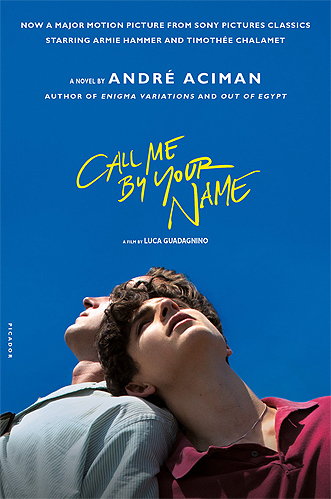
Call Me by Your Name is the story of a sudden and powerful romance that blossoms between an adolescent boy and a summer guest at his parents' cliffside mansion on the Italian Riviera. Each is unprepared for the consequences of their attraction when, during the restless summer weeks, unrelenting currents of obsession, fascination, and desire intensify their passion and test the charged ground between them. Recklessly, the two verge toward the one thing both fear they may never truly find again: total intimacy.

Now a Netflix SeriesIt’s here, in the first volume of Patricia Highsmith’s five-book Ripley series, that we are introduced to the suave Tom Ripley, a young striver seeking to leave behind his past as an orphan bullied for being a “sissy.” Newly arrived in the heady world of Manhattan, Ripley meets a wealthy industrialist who hires him to bring his playboy son, Dickie Greenleaf, back from gallivanting in Italy. Soon Ripley’s fascination with Dickie’s debonair lifestyle turns obsessive as he finds himself enraged by Dickie’s ambivalent affections for Marge, a charming American dilettante, and Ripley begins a deadly game.“Sinister and strangely alluring,” (Mark Harris, Entertainment Weekly) The Talented Mr. Ripley serves as an unforgettable introduction to this smooth confidence man, whose talent for self-invention is as unnerving—and unnervingly revealing of the American psyche—as ever.

In the stories that make up Oblivion, David Foster Wallace joins the rawest, most naked humanity with the infinite involutions of self-consciousness—a combination that is dazzlingly, uniquely his. These are worlds undreamt-of by any other mind. Only David Foster Wallace could convey a father's desperate loneliness by way of his son's daydreaming through a teacher's homicidal breakdown ("The Soul Is Not a Smithy"). Or could explore the deepest and most hilarious aspects of creativity by delineating the office politics surrounding a magazine profile of an artist who produces miniature sculptures in an anatomically inconceivable way ("The Suffering Channel"). Or capture the ache of love's breakdown in the painfully polite apologies of a man who believes his wife is hallucinating the sound of his snoring ("Oblivion"). Each of these stories is a complete world, as fully imagined as most entire novels, at once preposterously surreal and painfully immediate. Oblivion is an arresting and hilarious creation from a writer "whose best work challenges and reinvents the art of fiction" (Atlanta Journal-Constitution).Mister squishy --The soul is not a smithy --Incarnations of burned children --Another pioneer --Good old neon --Philosophy and the mirror of nature --Oblivion --The suffering channel

With 8 Pages of Black-and-White PhotographsIn this captivating history of stardom, Boston Globe film critic Ty Burr traces our obsession with fame from the dawn of cinema through the age of the Internet. Why do we obsess over the individuals we come to call stars? How has both the image of stardom and our stars' images changed over the past hundred years? What does celebrity mean if people can now become famous simply for being famous? With brilliant insight and entertaining examples, Burr reveals the blessings and the curses of celebrity for the star and the stargazer alike. From Mary Pickford and Charlie Chaplin, to Archie Leach (a.k.a. Cary Grant), Tom Cruise, and Julia Roberts, to such no-cal stars of today as the Kardashians and the new online celebrity, Gods Like Us is a journey through the fame game at its flashiest, most indulgent, occasionally most tragic, and ultimately it's most culturally revealing.

'I defy you to read this book and come away with a mind unchanged' John Jeremiah Sullivan 'Als has a serious claim to be regarded as the next James Baldwin' Observer 'I see how we are all the same, that none of us are white women or black men; rather, we're a series of mouths, and that every mouth needs with something wet or dry, like love, or unfamiliar and savory, like love' White Girls is about, among other things, blackness, queerness, movies, Brooklyn, love (and the loss of love), AIDS, fashion, Basquiat, Capote, philosophy, porn, Louise Brooks and Michael Jackson. Freewheeling and dazzling, tender and true, it is one of the most highly acclaimed essay collections in years. 'A voice that's new, that comes as if from a different room. I defy you to read this book and come away with a mind unchanged' John Jeremiah Sullivan, author of Pulphead 'Effortless, honest and fearless' Rich Benjamin, The New York Times 'Als is one of the most consistently unpredictable and surprising essayists out there, an author who confounds our expectations virtually every time he writes' David L. Ulin, Los Angeles Times 'A comprehensive and utterly lovely collection of one of the best writers around' Eugenia Williamson, Boston Globe

“Annie Baker’s John is so good on so many levels that it casts a unique and brilliant light… By not rushing things—by letting the characters develop as gradually and inevitably as rain or snowfall—Baker returns us to the naturalistic but soulful theatre that many of her contemporaries and near-contemporaries have disavowed in their rush to be 'postmodern.'”– New Yorker“ John , like any great play, raises a lot of questions–not just about the human experience, but also about the state of contemporary theater, it doesn’t provide many answers; it is not the playwright’s responsibility to do so.… In John she co-opts the viewer for her own aesthetic use, heightening the tension onstage and deepening the quiet relationships between her characters. Through John, she displays an understanding that the audience is part of the theatrical experience, an inevitability as certain as a Chekhovian gun.” – SlateThe week after Thanksgiving. A bed & breakfast in Gettysburg, Pennsylvania. A cheerful innkeeper. A young couple struggling to stay together. Thousands of inanimate objects, watching.The description by the playwright of the setting is simple, but Annie Baker’s compelling new work is revolutionary in theme and structure and challenges the boundaries of what theatre can be. A kind of magical super-realism permeates throughout this quietly evolving tale, with both the actors and the audience fully vested together in a mesmerizing exploration of the frailty and loneliness of human experience.

Exuberant, poignant, perceptive, and full of grace, these sixteen stories by Kathleen Collins explore deep, far-reaching issues — relating to race, gender, family, and sexuality — that shape the ordinary moments in our lives. Collins's work masterfully blends the quotidian and the profound in a personal, intimate way, seamlessly integrating the African American experience into her characters' lives and creating rich and devastatingly familiar characters who transcend symbolism.In "The Uncle," a young girl who idolizes her handsome uncle and his beautiful wife makes a haunting discovery about their lives. In "Only Once," a woman reminisces about her charming daredevil of a lover and his ultimate — and final — act of foolishness. And in the title story, a recent college graduate realizes the limits of the civil rights movement — and the personal and romantic consequences it holds for her.Both contemporary and timeless, Whatever Happened to Interracial Love? is a major and long-overdue addition to our literary canon.

An entirely original portrait of a young writer shutting out the din in order to find her own voiceOn April 11, 1931, Virginia Woolf ended her entry in A Writer’s Diary with the words “too much and not the mood.” She was describing how tired she was of correcting her own writing, of the “cramming in and the cutting out” to please other readers, wondering if she had anything at all that was truly worth saying.The character of that sentiment, the attitude of it, inspired Durga Chew-Bose to write and collect her own work. The result is a lyrical and piercingly insightful collection of essays, letters (to her grandmother, to the basketball star Michael Jordan, to Death), and her own brand of essay-meets-prose poetry about identity and culture. Inspired by Maggie Nelson’s Bluets, Lydia Davis’s short prose, and Vivian Gornick’s exploration of interior life, Chew-Bose captures the inner restlessness that keeps her always on the brink of creative expression.Too Much and Not the Mood is a beautiful and surprising exploration of what it means to be a first-generation, creative young woman working today.