
Steven Pressfield Recommended Books
American screenwriter and novelist (1943-)
29 Books Recommended

Some of the most rewarding pages in Henry Miller's books concern his self-education as a writer. He tells, as few great writers ever have, how he set his goals, how he discovered the excitement of using words, how the books he read influenced him, and how he learned to draw on his own experience.

An assemblage of reflections on the nature of writing and the writer from one the greatest American writers of the twentieth century.Throughout Hemingway’s career as a writer, he maintained that it was bad luck to talk about writing—that it takes off “whatever butterflies have on their wings and the arrangement of hawk’s feathers if you show it or talk about it.”Despite this belief, by the end of his life he had done just what he intended not to do. In his novels and stories, in letters to editors, friends, fellow artists, and critics, in interviews and in commissioned articles on the subject, Hemingway wrote often about writing. And he wrote as well and as incisively about the subject as any writer who ever lived…This book contains Hemingway’s reflections on the nature of the writer and on elements of the writer’s life, including specific and helpful advice to writers on the craft of writing, work habits, and discipline. The Hemingway personality comes through in general wisdom, wit, humor, and insight, and in his insistence on the integrity of the writer and of the profession itself.—From the Preface by Larry W. Phillips

Immensely helpful and illuminating to any aspiring writer, Stephen King’s critically lauded, “one of a kind” (Wall Street Journal) classic bestseller shares the experiences, habits, and convictions that have shaped him and his work."Long live the King" hailed Entertainment Weekly upon publication of Stephen King’s On Writing. Part memoir, part master class by one of the bestselling authors of all time, this superb volume is a revealing and practical view of the writer’s craft, comprising the basic tools of the trade every writer must have. King’s advice is grounded in his vivid memories from childhood through his emergence as a writer, from his struggling early career to his widely reported, near-fatal accident in 1999—and how the inextricable link between writing and living spurred his recovery. Brilliantly structured, friendly and inspiring, On Writing will empower and entertain everyone who reads it—fans, writers, and anyone who loves a great story well told.

Creativity is not a gift from the gods, says Twyla Tharp, bestowed by some divine and mystical spark. It is the product of preparation and effort, and it's within reach of everyone who wants to achieve it. All it takes is the willingness to make creativity a habit, an integral part of your life: In order to be creative, you have to know how to prepare to be creative. In The Creative Habit, Tharp takes the lessons she has learned in her remarkable thirty-five-year career and shares them with you, whatever creative impulses you follow -- whether you are a painter, composer, writer, director, choreographer, or, for that matter, a businessperson working on a deal, a chef developing a new dish, a mother wanting her child to see the world anew. When Tharp is at a creative dead end, she relies on a lifetime of exercises to help her get out of the rut, and The Creative Habit contains more than thirty of them to ease the fears of anyone facing a blank beginning and to open the mind to new possibilities. Tharp's exercises are practical and immediately doable -- for the novice or expert. In "Where's Your Pencil?" she reminds us to observe the world -- and get it down on paper. In "Coins and Chaos," she provides the simplest of mental games to restore order and peace. In "Do a Verb," she turns your mind and body into coworkers. In "Build a Bridge to the Next Day," she shows how to clean your cluttered mind overnight. To Tharp, sustained creativity begins with rituals, self-knowledge, harnessing your memories, and organizing your materials (so no insight is ever lost). Along the way she leads you by the hand through the painful first steps of scratching for ideas, finding the spine of your work, and getting out of ruts into productive grooves. In her creative realm, optimism rules. An empty room, a bare desk, a blank canvas can be energizing, not demoralizing. And in this inventive, encouraging book, Twyla Tharp shows us how to take a deep breath and begin!

WHAT LENGTHS WILL THEY GO TO TO ACHIEVE VICTORY? 330 BC: Alexander The Great launches his bloody and brutal campaign in the Afghan Kingdoms...Among the ranks of Macedonian infantry is Matthias. The youngest of three brothers, he is eager to prove himself, but as he joins the front-line, he comes to realise that warfare has changed. The Macedonians face a new kind of enemy, and must learn to fight a new kind of war.Experiencing fear, euphoria, horror and shame, Matthias and his comrades undergo a rite of passage as they, soldiers of a Western force whose code is secular and humanist, confront a proud Eastern warrior people who possess a fervent willingness to die for their cause.Just to survive, Alexander's men must shake off the trappings of 'civilization' and adopt the same unorthodox and barbaric tactics as their foe - but is that a price worth paying?

Tides of War: A Novel of Alcibiades and the Peloponnesian War
by Steven Pressfield
Rating: 3.9 ⭐
• 1 recommendation ❤️
Brilliant at war, a master of politics, and a charismatic lover, Alcibiades was Athens’ favorite son and the city’s greatest general.A prodigal follower of Socrates, he embodied both the best and the worst of the Golden Age of Greece. A commander on both land and sea, he led his armies to victory after victory.But like the heroes in a great Greek tragedy, he was a victim of his own pride, arrogance, excess, and ambition. Accused of crimes against the state, he was banished from his beloved Athens, only to take up arms in the service of his former enemies.For nearly three decades, Greece burned with war and Alcibiades helped bring victories to both sides — and ended up trusted by neither.Narrated from death row by Alcibiades’ bodyguard and assassin, a man whose own love and loathing for his former commander mirrors the mixed emotions felt by all Athens, Tides of War tells an epic saga of an extraordinary century, a war that changed history, and a complex leader who seduced a nation.

The War of Art: Break Through the Blocks and Win Your Inner Creative Battles
by Steven Pressfield
Rating: 4.1 ⭐
• 38 recommendations ❤️
The Art of War meets "The Artist's Way" in this no-nonsense, profoundly inspiring guide to overcoming creative blocks of every kind.

Written four hundred years before the birth of Christ, this detailed contemporary account of the long life-and-death struggle between Athens and Sparta stands an excellent chance of fulfilling its author's ambitious claim. Thucydides himself (c.460-400 BC) was an Athenian and achieved the rank of general in the earlier stages of the war. He applied thereafter a passion for accuracy and a contempt for myth and romance in compiling this factual record of a disastrous conflict.

In the spring of 1957, when he was eighty-one years old, C. G. Jung undertook the telling of his life story. At regular intervals he had conversations with his colleague and friend Aniela Jaffé, and collaborated with her in the preparation of the text based on these talks. On occasion, he was moved to write entire chapters of the book in his own hand, and he continued to work on the final stages of the manuscript until shortly before his death on June 6, 1961.This edition of Memories, Dreams, Reflections includes Jung's VII Sermones ad Mortuos . It is a fully corrected edition. From the Trade Paperback edition.

At Thermopylae, a rocky mountain pass in northern Greece, the feared and admired Spartan soldiers stood three hundred strong. Theirs was a suicide mission, to hold the pass against the invading millions of the mighty Persian army.Day after bloody day they withstood the terrible onslaught, buying time for the Greeks to rally their forces. Born into a cult of spiritual courage, physical endurance, and unmatched battle skill, the Spartans would be remembered for the greatest military stand in history—one that would not end until the rocks were awash with blood, leaving only one gravely injured Spartan squire to tell the tale. . . .“A novel that is intricate and arresting and, once begun, almost impossible to put down.”—Daily News “A timeless epic of man and war . . . Pressfield has created a new classic deserving a place beside the very best of the old.”—Stephen Coonts

In 1931 Savannah, a mesmerizing 36-hole match is taking place, in which two legends face off against a troubled former war hero. The key to the outcome lies with Bagger Vance, a caddie who carries the secret of the Authentic Swing. His mysterious powers guide the play and leave a lasting imprint on everyone around him--and on someone 60 years in the future.

1970s Afghanistan: Twelve-year-old Amir is desperate to win the local kite-fighting tournament and his loyal friend Hassan promises to help him. But neither of the boys can foresee what would happen to Hassan that afternoon, an event that is to shatter their lives. After the Russians invade and the family is forced to flee to America, Amir realises that one day he must return to an Afghanistan under Taliban rule to find the one thing that his new world cannot grant him: redemption.

The Odyssey is one of two major ancient Greek epic poems attributed to Homer. It is, in part, a sequel to the Iliad, the other Homeric epic. The Odyssey is a fundamental work in the modern Western canon, being the oldest extant piece of Western literature, second to the Iliad. Scholars believe the Odyssey was composed near the end of the 8th century BC, somewhere in Ionia, the Greek coastal region of Anatolia.

Falling Upward: A Spirituality for the Two Halves of Life
by Richard Rohr
Rating: 4.2 ⭐
• 1 recommendation ❤️
In Falling Upward , Fr. Richard Rohr seeks to help readers understand the tasks of the two halves of life and to show them that those who have fallen, failed, or "gone down" are the only ones who understand "up." Most of us tend to think of the second half of life as largely about getting old, dealing with health issues, and letting go of life, but the whole thesis of this book is exactly the opposite. What looks like falling down can largely be experienced as "falling upward." In fact, it is not a loss but somehow actually a gain, as we have all seen with elders who have come to their fullness. This important book explores the counterintuitive message that we grow spiritually much more by doing wrong than by doing right--a fresh way of thinking about spirituality that grows throughout life.

Do the WorkOur enemy is not lack of preparation; it's not the difficulty of the project, or the state of the marketplace or the emptiness of our bank account.The enemy is resistance.The enemy is our chattering brain, which, if we give it so much as a nanosecond, will start producing excuses, alibis, transparent self-justifications and a million reasons why he can't/shouldn't/won't do what we know we need to do.Start before you're ready.

WARS CHANGE, WARRIORS DON'T We are all warriors. Each of us struggles every day to define and defend our sense of purpose and integrity, to justify our existence on the planet and to understand, if only within our own hearts, who we are and what we believe in. Do we fight by a code? If so, what is it? What is the Warrior Ethos? Where did it come from? What form does it take today? How do we (and how can we) use it and be true to it in our internal and external lives? The Warrior Ethos is intended not only for men and women in uniform, but artists, entrepreneurs and other warriors in other walks of life. The book examines the evolution of the warrior code of honor and "mental toughness." It goes back to the ancient Spartans and Athenians, to Caesar's Romans, Alexander's Macedonians and the Persians of Cyrus the Great (not excluding the Garden of Eden and the primitive hunting band). Sources include Herodotus, Thucydides, Plutarch, Xenophon, Vegetius, Arrian and Curtius--and on down to Gen. George Patton, Field Marshal Erwin Rommel, and Israeli Minister of Defense, Moshe Dayan.

Turning Pro: Tap Your Inner Power and Create Your Life's Work
by Steven Pressfield
Rating: 4.3 ⭐
• 5 recommendations ❤️
Turning pro is free, but it's not easy.When we turn pro, we give up a life that we may have become extremely comfortable with. We give up a self that we have come to identify with and to call our own.Turning pro is free, but it demands sacrifice.The passage from amateur to professional is often achieved via an interior odyssey whose trials are survived only at great cost, emotionally, psychologically and spiritually. We pass through a membrane when we turn pro. It's messy and it's scary. We tread in blood when we turn pro.What we get when we turn pro.What we get when we turn pro is we find our power. We find our will and our voice and we find our self-respect. We become who we always were but had, until then, been afraid to embrace and to live out.

Winter is coming. Such is the stern motto of House Stark, the northernmost of the fiefdoms that owe allegiance to King Robert Baratheon in far-off King’s Landing. There Eddard Stark of Winterfell rules in Robert’s name. There his family dwells in peace and comfort: his proud wife, Catelyn; his sons Robb, Brandon, and Rickon; his daughters Sansa and Arya; and his bastard son, Jon Snow. Far to the north, behind the towering Wall, lie savage Wildings and worse—unnatural things relegated to myth during the centuries-long summer, but proving all too real and all too deadly in the turning of the season. Yet a more immediate threat lurks to the south, where Jon Arryn, the Hand of the King, has died under mysterious circumstances. Now Robert is riding north to Winterfell, bringing his queen, the lovely but cold Cersei, his son, the cruel, vainglorious Prince Joffrey, and the queen’s brothers Jaime and Tyrion of the powerful and wealthy House Lannister—the first a swordsman without equal, the second a dwarf whose stunted stature belies a brilliant mind. All are heading for Winterfell and a fateful encounter that will change the course of kingdoms. Meanwhile, across the Narrow Sea, Prince Viserys, heir of the fallen House Targaryen, which once ruled all of Westeros, schemes to reclaim the throne with an army of barbarian Dothraki—whose loyalty he will purchase in the only coin left to him: his beautiful yet innocent sister, Daenerys.

The long-awaited guide to writing long-form nonfiction by the legendary author and teacherDraft No. 4 is a master class on the writer's craft. In a series of playful, expertly wrought essays, John McPhee shares insights he has gathered over his career and has refined while teaching at Princeton University, where he has nurtured some of the most esteemed writers of recent decades. McPhee offers definitive guidance in the decisions regarding arrangement, diction, and tone that shape nonfiction pieces, and he presents extracts from his work, subjecting them to wry scrutiny. In one essay, he considers the delicate art of getting sources to tell you what they might not otherwise reveal. In another, he discusses how to use flashback to place a bear encounter in a travel narrative while observing that "readers are not supposed to notice the structure. It is meant to be about as visible as someone's bones." The result is a vivid depiction of the writing process, from reporting to drafting to revising--and revising, and revising.Draft No. 4 is enriched by multiple diagrams and by personal anecdotes and charming reflections on the life of a writer. McPhee describes his enduring relationships with The New Yorker and Farrar, Straus and Giroux, and recalls his early years at Time magazine. Throughout, Draft No. 4 is enlivened by his keen sense of writing as a way of being in the world.

The Lion's Gate: On the Front Lines of the Six Day War
by Steven Pressfield
Rating: 4.5 ⭐
• 1 recommendation ❤️
The thrilling true story of one of the most unlikely and astonishing military victories in history.June 5, 1967. Israel is surrounded by enemies who want nothing less than her utter extinction. The Soviet-equipped Egyptian Army has massed a thousand tanks on the nation’s southern border. Syrian heavy guns are shelling her from the north. To the east, Jordan and Iraq are moving mechanized brigades and fighter squadrons into position to attack.June 10, 1967. The Arab armies have been routed, their air forces totally destroyed. Israel’s citizen-soldiers have seized the Gaza Strip and the Sinai Peninsula from Egypt, the Golan Heights from Syria, East Jerusalem and the West Bank from Jordan. Moshe Dayan has entered the Lion’s Gate of the Old City of Jerusalem to stand with the paratroopers who have liberated Judaism’s holiest site—the Western Wall.Drawing on hundreds of hours of interviews with veterans of the war—fighter and helicopter pilots, tank commanders and Recon soldiers, paratroopers, as well as women soldiers, wives, and others—bestselling author Steven Pressfield tells the story of the Six Day War as you’ve never experienced it before.
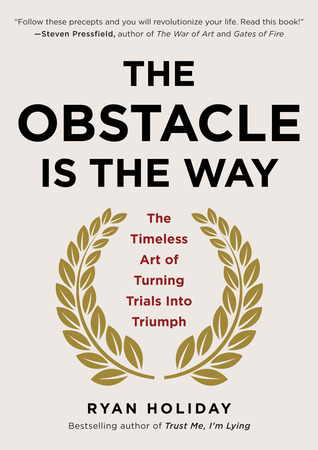
The Obstacle Is the Way: The Timeless Art of Turning Trials into Triumph
by Ryan Holiday
Rating: 4.1 ⭐
• 19 recommendations ❤️
“The impediment to action advances action. What stands in the way becomes the way.” — Marcus AureliusWe are stuck, stymied, frustrated. But it needn’t be this way. There is a formula for success that’s been followed by the icons of history—from John D. Rockefeller to Amelia Earhart to Ulysses S. Grant to Steve Jobs—a formula that let them turn obstacles into opportunities. Faced with impossible situations, they found the astounding triumphs we all seek.These men and women were not exceptionally brilliant, lucky, or gifted. Their success came from timeless philosophical principles laid down by a Roman emperor who struggled to articulate a method for excellence in any and all situations.This book reveals that formula for the first time—and shows us how we can turn our own adversity into advantage.

WHAT IS THE STORY GRID? The Story Grid is a tool developed by editor Shawn Coyne to analyze stories and provide helpful editorial comments. It's like a CT Scan that takes a photo of the global story and tells the editor or writer what is working, what is not, and what must be done to make what works better and fix what's not. The Story Grid breaks down the component parts of stories to identify the problems. And finding the problems in a story is almost as difficult as the writing of the story itself (maybe even more difficult.) The Story Grid is a tool with many applications: 1. It will tell a writer if a Story "works" or "doesn't work." 2. It pinpoints story problems but does not emotionally abuse the writer, revealing exactly where a Story (not the person creating the Story...the Story) has failed. 3. It will tell the writer the specific work necessary to fix that Story's problems. 4. It is a tool to re-envision and resuscitate a seemingly irredeemable pile of paper stuck in an attic drawer. 5. It is a tool that can inspire an original creation. Shawn Coyne is a twenty-five year book-publishing veteran. He's acquired, edited, published or represented works from James Bamford, John Brenkus, James Lee Burke, Barbara Bush, Dick Butkus, Harlan Coben, Nellie Connally, Michael Connelly, Robert Crais, Ben Crenshaw, Catherine Crier, Brett Favre, David Feherty, John Feinstein, Tyler Florence, Jim Gant, Col. David H. Hackworth, Jamie Harrison, Mo Hayder, William Hjortsberg, Stephen Graham Jones, Jon Krakauer, David Leadbetter, Alan Lomax, David Mamet, Troon McAllister, Robert McKee, Matthew Modine, Bill Murray, Joe Namath, John J. Nance, Jack Olsen, Scott Patterson, Steven Pressfield, Matthew Quirk, Anita Raghavan, Ian Rankin, Ruth Rendell, Jerry Rice, Giora Romm, Tim Rosaforte, William Safire, Dava Sobel, Michael Thomas, Nick Tosches, Ann Scott Tyson, Minette Walters, Betty White, Randy Wayne White, Steven White, and Don Winslow among many others. During his years as an editor at the Big Five publishing houses, as an independent publisher, as a literary agent both at a major Hollywood talent agency and as head of Genre Management Inc., and as a bestselling co-writer and ghostwriter, Coyne created a methodology called The Story Grid to teach the editing craft.

Nobody Wants to Read Your Sh*t: And Other Tough-Love Truths to Make You a Better Writer
by Steven Pressfield
Rating: 4.2 ⭐
• 3 recommendations ❤️
There's a mantra that real writers know but wannabe writers don’t. And the secret phrase is this:NOBODY WANTS TO READ YOUR SH*T. Recognizing this painful truth is the first step in the writer's transformation from amateur to professional. From Chapter Four: “When you understand that nobody wants to read your shit, you develop empathy. You acquire the skill that is indispensable to all artists and entrepreneurs—the ability to switch back and forth in your imagination from your own point of view as writer/painter/seller to the point of view of your reader/gallery-goer/customer. You learn to ask yourself with every sentence and every phrase: Is this interesting? Is it fun or challenging or inventive? Am I giving the reader enough? Is she bored? Is she following where I want to lead her?"

Conspiracy: Peter Thiel, Hulk Hogan, Gawker, and the Anatomy of Intrigue
by Ryan Holiday
Rating: 4.0 ⭐
• 8 recommendations ❤️
In the tradition of Janet Malcolm's THE JOURNALIST AND THE MURDERER and Robert Greene's THE 48 LAWS OF POWER, author Ryan Holiday examines the case that rocked the media world--and the billionaire mastermind behind itIn 2007, a short blogpost on Valleywag, the Silicon Valley-vertical of Gawker Media, outed PayPal founder and billionaire investor Peter Thiel as gay. Thiel's sexuality had been known to close friends and family, but he didn't consider himself a public figure, and believed the information was private.This post would be the casus belli for a meticulously plotted conspiracy that would end nearly a decade later with a $140 million dollar judgment against Gawker, its bankruptcy and with Nick Denton, Gawker's CEO and founder, out of a job. Only later would the world learn that Gawker's demise was not incidental--it had been masterminded by Thiel.For years, Thiel had searched endlessly for a solution to what he'd come to call the "Gawker Problem." When an unmarked enveloped delivered an illegally recorded sex tape of Hogan with his best friend's wife, Gawker had seen the chance for millions of pageviews and to say the things that others were afraid to say. Thiel saw their publication of the tape as the opportunity he was looking for. He would come to pit Hogan against Gawker in a multi-year proxy war through the Florida legal system, while Gawker remained confidently convinced they would prevail as they had over so many other lawsuit--until it was too late.The verdict would stun the world and so would Peter's ultimate unmasking as the man who had set it all in motion. Why had he done this? How had no one discovered it? What would this mean--for the First Amendment? For privacy? For culture?In Holiday's masterful telling of this nearly unbelievable conspiracy, informed by interviews with all the key players, this case transcends the narrative of how one billionaire took down a media empire or the current state of the free press. It's a study in power, strategy, and one of the most wildly ambitious--and successful--secret plots in recent memory.Some will cheer Gawker's destruction and others will lament it, but after reading these pages--and seeing the access the author was given--no one will deny that there is something ruthless and brilliant about Peter Thiel's shocking attempt to shake up the world.

The Artist's Journey: The Wake of the Hero's Journey and the Lifelong Pursuit of Meaning
by Steven Pressfield
Rating: 4.2 ⭐
• 1 recommendation ❤️
"No one's insights about the craft and journey of being an artist have guided me in the day-to-day struggle of this profession more than Steven Pressfield. Wherever you are, whatever you've been called to make, you need to read this book...and everything else he has written." — Ryan Holiday, Bestselling Author of Ego Is the Enemy and The Obstacle Is the Way YOU ARE AN ARTIST ... AND YOU HAVE AN ARTIST’S JOURNEY I have a theory about the Hero’s Journey. We all have one. We have many, in fact. But our primary hero’s journey is the passage we live out, in real life, before we find our calling. The hero’s journey ends when, like Odysseus, we return home to Ithaca, to the place from which we started. What then? The passage that comes next is The Artist’s Journey . On our artist’s journey, we move past Resistance and past self-sabotage. We discover our true selves and our authentic calling, and we produce the works we were born to create. You are an artist too—whether you realize it or not, whether you like it or not—and you have an artist’s journey. Will you live it out? Will you follow your Muse and do the work you were born to do? Ready or not, you are called.

Do you ever have trouble finishing what you start? Do amazing ideas come to you all the time but after the initial excitement wanes you struggle to follow through? If you're creative and ambitious, the answer is likely yes.The problem isn't you. It's not that you're not hardworking, intelligent or deserving, but that you haven't yet installed the one key belief that will change everything: Everything is figureoutable.Whether you want to leave a dead-end job, heal a relationship, grow a business, master your money, or just find two free hours in your day, Everything is Figureoutable will train your brain to think more positively and help you break down any dream into manageable steps.Inside you'll learn:- How to deal with criticism and imposter syndrome- Why it's crucial that you strive for progress not perfection- How to bounce back from failure- How to overcome a lack of time and moneyYou'll also hear triumphant stories of everyday people using the everything is figureoutable philosophy to transform their life. Everything is figureoutable is more than just a fun phrase to say. It's a practical, actionable discipline. And it's about to make you unstoppable!

"An astounding epic novel of J.R.R. Tolkien proportions!"— Steven Pressfield, Bestselling author of Gates of Fire and The War of ArtRaiders of the Lost Ark playing A Game of ThronesThe Sand Sea takes place on an alternative Earth roiled by war and conquest that mirrors our own Gilded Age. The treasure that ignites greed and folly in this parallel world is not petroleum, but beserite—a mineral of immeasurable value. Captivated by an ancient prophecy and the call of adventure, inexperienced nobleman and scholar Peter Harmon (think of a young Winston Churchill-like naif) joins an expedition to stake his nation’s claim to a global empire. Harmon’s destination is a vast and inhospitable desert halfway around the world, dominated by the iron-fisted Grand Vizer Jemojeen Jongdar. A tyrant on a mission to secure the ancient and supernatural Staff of the Ram, the Lion, and the Serpent, Jongdar knows the truth that others can only imagine: The one who controls the staff will possess the power to rule the world. Before he can seize his destiny, Jongdar must find and destroy the one person capable of thwarting his ambition, the rightful heir to the Sand Sea realm, an innocent woman named Selena Savanar. Can the brave and indomitable Selena accept her true destiny and rally her people in the eye of a gathering storm? To do so will require her to outwit the man who burned her father alive and left her an orphan and beggar a lifetime ago. Or will Peter Harmon and the cadre of opportunists he rides with conquer the divided empire?With the mythic structure of J.R.R. Tolkien’s The Lord of the Rings trilogy in a world as rich and real as George R.R. Martin’s Westeros, The Sand Sea is an immersive experience made to order for epic fantasy fans and anyone who enjoys grand-scale historical fiction.

From the acclaimed master of historical fiction comes an epic saga about a reluctant hero, the Roman Empire, and the rise of a new faith.Jerusalem and the Sinai desert, first century AD. In the turbulent aftermath of the crucifixion of Jesus, officers of the Roman Empire acquire intelligence of a pilgrim bearing an incendiary letter from a religious fanatic to insurrectionists in Corinth. The content of this letter could bring down the empire.The Romans hire a former legionary, the solitary man-at-arms, Telamon of Arcadia, to intercept the letter and capture its courier. Telamon operates by a dark code all his own, with no room for noble causes or lofty beliefs. But once he overtakes the courier, something happens that neither he nor the empire could have predicted.In his first novel of the ancient world in thirteen years, the best-selling author of Gates of Fire and Tides of War returns with a gripping saga of conquest and rebellion, bloodshed and faith.

Falling Upward: A Spirituality for the Two Halves of Life -- A Companion Journal
by Richard Rohr
Rating: 4.3 ⭐
• 2 recommendations ❤️
A valuable new companion journal for the best-selling Falling Upward In Falling Upward, Fr. Richard Rohr seeks to help readers understand the tasks of the two halves of life and to show them that those who have fallen, failed, or "gone down" are the only ones who understand "up." The Companion Journal helps those who have (and those who have not) read Falling Upward to engage more deeply with the questions the book raises. Using a blend of quotes, questions for individual and group reflection, stories, and suggestions for spiritual practices, it provides a wise guide for deepening the spiritual journey. . . at any time of life.Explains why the second half of life can and should be full of spiritual richness Offers tools for spiritual growth and greater understanding of the ideas in Falling UpwardRichard Rohr is a regular contributing writer for Sojourners and Tikkun magazines This important companion to Falling Upward is an excellent tool for exploring the counterintuitive messages of how we grow spiritually.