
Steve Kerr Recommended Books
American basketball player and coach
6 Books Recommended

Man's Search for Meaning has riveted generations of readers with its descriptions of life in Nazi death camps and its lessons for spiritual survival. Between 1942 and 1945 psychiatrist Viktor Frankl labored in four different camps, including Auschwitz, while his parents, brother, and pregnant wife perished. Based on his own experience and the stories of his many patients, Frankl argues that we cannot avoid suffering but we can choose how to cope with it, find meaning in it, and move forward with renewed purpose. Frankl's theory—known as logotherapy, from the Greek word logos ("meaning")—holds that our primary drive in life is not pleasure, as Freud maintained, but the discovery and pursuit of what we personally find meaningful. In the decades since its first publication in 1959, Man's Search for Meaning has become a classic, with more than twelve million copies in print around the world. A 1991 Library of Congress survey that asked readers to name a "book that made a difference in your life" found Man's Search for Meaning among the ten most influential books in America. At once a memoir, a meditation, a treatise, and a history, it continues to inspire us all to find significance in the very act of living.(back cover)

The New Jim Crow: Mass Incarceration in the Age of Colorblindness
by Michelle Alexander
Rating: 4.6 ⭐
• 2 recommendations ❤️
A tenth-anniversary edition of the iconic bestseller, with a new preface by the authorSeldom does a book have the impact of Michelle Alexander’s The New Jim Crow. Since it was first published in 2010, it has been cited in judicial decisions and has been adopted in campus-wide and community-wide reads; it helped inspire the creation of the Marshall Project and the new $100 million Art for Justice Fund; it has been the winner of numerous prizes, including the prestigious NAACP Image Award; and it has spent nearly 250 weeks on the New York Times bestseller list.Most important of all, it has spawned a whole generation of criminal justice reform activists and organizations motivated by Michelle Alexander’s unforgettable argument that “we have not ended racial caste in America; we have merely redesigned it.” Now, ten years after it was first published, The New Press is proud to issue a tenth-anniversary edition with a new preface by Michelle Alexander that discusses the impact the book has had and the state of the criminal justice reform movement today.

Being Mortal: Medicine and What Matters in the End
by Atul Gawande
Rating: 4.6 ⭐
• 2 recommendations ❤️
Medicine has triumphed in modern times, transforming the dangers of childbirth, injury, and disease from harrowing to manageable. But when it comes to the inescapable realities of aging and death, what medicine can do often runs counter to what it should.Through eye-opening research and gripping stories of his own patients and family, Gawande reveals the suffering this dynamic has produced. Nursing homes, devoted above all to safety, battle with residents over the food they are allowed to eat and the choices they are allowed to make. Doctors, uncomfortable discussing patients' anxieties about death, fall back on false hopes and treatments that are actually shortening lives instead of improving them.In his bestselling books, Atul Gawande, a practicing surgeon, has fearlessly revealed the struggles of his profession. Here he examines its ultimate limitations and failures―in his own practices as well as others'―as life draws to a close. Riveting, honest, and humane, Being Mortal shows how the ultimate goal is not a good death but a good life―all the way to the very end.Named a Best Book of the Year by The Washington Post , The New York Times Book Review , NPR, and Chicago Tribune, now in paperback with a new reading group guide.

NEW YORK TIMES BESTSELLER - "Comprehensive, enlightening, and terrifyingly timely."--The New York Times Book Review (Editors' Choice) WINNER OF THE GOLDSMITH BOOK PRIZE - SHORTLISTED FOR THE LIONEL GELBER PRIZE - NAMED ONE OF THE BEST BOOKS OF THE YEAR BY The Washington Post - Time - Foreign Affairs - WBUR - PasteDonald Trump's presidency has raised a question that many of us never thought we'd be asking: Is our democracy in danger? Harvard professors Steven Levitsky and Daniel Ziblatt have spent more than twenty years studying the breakdown of democracies in Europe and Latin America, and they believe the answer is yes. Democracy no longer ends with a bang--in a revolution or military coup--but with a whimper: the slow, steady weakening of critical institutions, such as the judiciary and the press, and the gradual erosion of long-standing political norms. The good news is that there are several exit ramps on the road to authoritarianism. The bad news is that, by electing Trump, we have already passed the first one.Drawing on decades of research and a wide range of historical and global examples, from 1930s Europe to contemporary Hungary, Turkey, and Venezuela, to the American South during Jim Crow, Levitsky and Ziblatt show how democracies die--and how ours can be saved.Praise for How Democracies Die"What we desperately need is a sober, dispassionate look at the current state of affairs. Steven Levitsky and Daniel Ziblatt, two of the most respected scholars in the field of democracy studies, offer just that."--The Washington Post "Where Levitsky and Ziblatt make their mark is in weaving together political science and historical analysis of both domestic and international democratic crises; in doing so, they expand the conversation beyond Trump and before him, to other countries and to the deep structure of American democracy and politics." -- Ezra Klein, Vox "If you only read one book for the rest of the year, read How Democracies Die. . . .This is not a book for just Democrats or Republicans. It is a book for all Americans. It is nonpartisan. It is fact based. It is deeply rooted in history. . . . The best commentary on our politics, no contest."--Michael Morrell, former Acting Director of the Central Intelligence Agency (via Twitter)"A smart and deeply informed book about the ways in which democracy is being undermined in dozens of countries around the world, and in ways that are perfectly legal."--Fareed Zakaria, CNN

Begin Again: James Baldwin's America and Its Urgent Lessons for Our Own
by Eddie S. Glaude Jr.
Rating: 4.4 ⭐
• 8 recommendations ❤️
We live, according to Eddie S. Glaude Jr., in a moment when the struggles of Black Lives Matter and the attempt to achieve a new America have been challenged by the election of Donald Trump, a president whose victory represents yet another failure of America to face the lies it tells itself about race. From Charlottesville to the policies of child separation at the border, his administration turned its back on the promise of Obama's presidency and refused to embrace a vision of the country shorn of the insidious belief that white people matter more than others.We have been here before: For James Baldwin, these after times came in the wake of the civil rights movement, when a similar attempt to compel a national confrontation with the truth was answered with the murders of Medgar Evers, Malcolm X, and Martin Luther King, Jr. In these years, spanning from the publication of The Fire Next Time in 1963 to that of No Name in the Street in 1972, Baldwin transformed into a more overtly political writer, a change that came at great professional and personal cost. But from that journey, Baldwin emerged with a sense of renewed purpose about the necessity of pushing forward in the face of disillusionment and despair.In the story of Baldwin's crucible, Glaude suggests, we can find hope and guidance through our own after times, this Trumpian era of shattered promises and white retrenchment. Mixing biography--drawn partially from newly uncovered interviews--with history, memoir, and trenchant analysis of our current moment, Begin Again is Glaude's endeavor, following Baldwin, to bear witness to the difficult truth of race in America today. It is at once a searing exploration that lays bare the tangled web of race, trauma, and memory, and a powerful interrogation of what we all must ask of ourselves in order to call forth a new America.
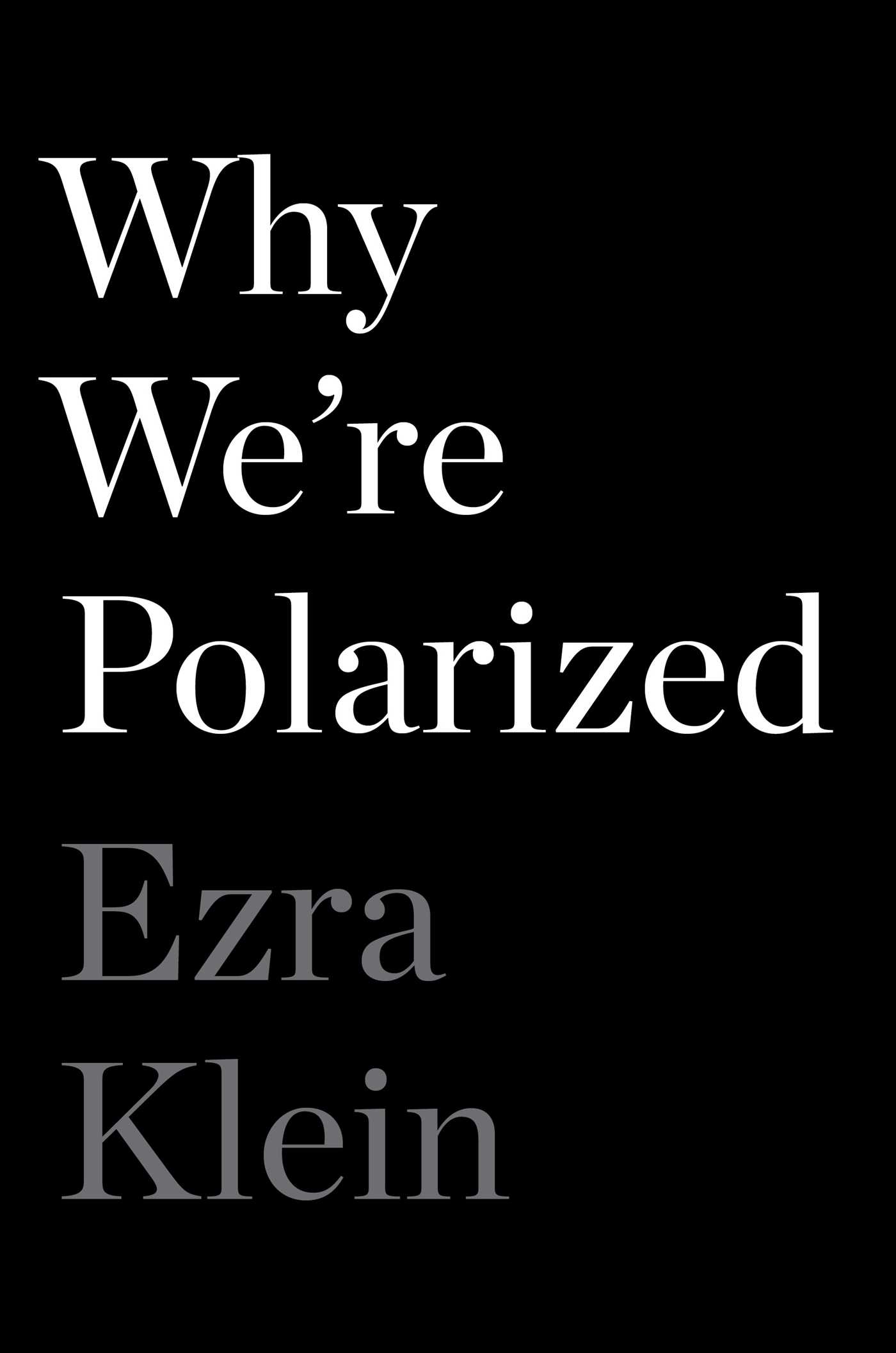
America is polarized by identity. Over the past fifty years in America, partisan identities have merged with racial, religious, geographic, ideological, and cultural identities, attaining a weight that is breaking much in politics and tearing at the bonds that hold the country together. Political analyst Ezra Klein shows how and why American politics polarized around identity in the twentieth century and what that polarization did to the way people see the world and one another. He traces the feedback loops—between polarized political identities and polarized political institutions—driving the system toward crisis.Why We’re Polarized reveals the structural and psychological forces behind America’s descent into division and dysfunction. Neither a polemic nor a lament, it offers a clear framework for understanding everything from Donald Trump’s rise to the Democratic Party’s leftward shift to the politicization of everyday culture.