
4 Books Recommended

Strategy and Structure: Chapters in the History of the Industrial Enterprise
by Alfred D. Chandler Jr.
Rating: 4.3 ⭐
• 2 recommendations ❤️
2013 Reprint of 1962 Edition. Full facsimile of the original edition, not reproduced with Optical Recognition Software. This classic text, chosen for the 1964 Thomas Newcomen Award in Business History by the editors of "Business History Review," is based on intensive studies of General Motors, Dupont, Standard Oil of New Jersey and Sears, Roebuck. Chandler shows how the seventy largest corporations in America have dealth with a single economic problem: the effective administration of an expanding business. The author summarizes the history of the expansion of the nation's largest industries during the previous hundred years and then examines in depth the modern decentralized corporate structure as it was developed independently by four companies--General Motors, Dupont, Standard Oil of New Jersey and Sears, Roebuck.

The Innovator's Dilemma: When New Technologies Cause Great Firms to Fail
by Clayton M. Christensen
Rating: 4.1 ⭐
• 39 recommendations ❤️
The bestselling classic on disruptive innovation, by renowned author Clayton M. Christensen. His work is cited by the world’s best-known thought leaders, from Steve Jobs to Malcolm Gladwell. In this classic bestseller—one of the most influential business books of all time—innovation expert Clayton Christensen shows how even the most outstanding companies can do everything right—yet still lose market leadership. Christensen explains why most companies miss out on new waves of innovation. No matter the industry, he says, a successful company with established products will get pushed aside unless managers know how and when to abandon traditional business practices. Offering both successes and failures from leading companies as a guide, The Innovator’s Dilemma gives you a set of rules for capitalizing on the phenomenon of disruptive innovation. Sharp, cogent, and provocative—and consistently noted as one of the most valuable business ideas of all time—The Innovator’s Dilemma is the book no manager, leader, or entrepreneur should be without.

Most startups fail. But many of those failures are preventable. The Lean Startup is a new approach being adopted across the globe, changing the way companies are built and new products are launched. Eric Ries defines a startup as an organization dedicated to creating something new under conditions of extreme uncertainty. This is just as true for one person in a garage or a group of seasoned professionals in a Fortune 500 boardroom. What they have in common is a mission to penetrate that fog of uncertainty to discover a successful path to a sustainable business.The Lean Startup approach fosters companies that are both more capital efficient and that leverage human creativity more effectively. Inspired by lessons from lean manufacturing, it relies on "validated learning," rapid scientific experimentation, as well as a number of counter-intuitive practices that shorten product development cycles, measure actual progress without resorting to vanity metrics, and learn what customers really want. It enables a company to shift directions with agility, altering plans inch by inch, minute by minute.Rather than wasting time creating elaborate business plans, The Lean Startup offers entrepreneurs - in companies of all sizes - a way to test their vision continuously, to adapt and adjust before it's too late. Ries provides a scientific approach to creating and managing successful startups in a age when companies need to innovate more than ever.
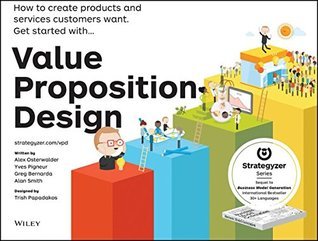
Value Proposition Design: How to Create Products and Services Customers Want
by Alexander Osterwalder
Rating: 4.3 ⭐
• 2 recommendations ❤️
If you liked "Business Model Generation," you'll love "Value Proposition Design." The sequel builds on the same visual format and practical tools that made the first one so useful. It shows you how to use the Value Proposition Canvas, a practical business tool to design, test, create, and manage products and services customers want. It compliments and perfectly integrates with the Business Model Canvasfrom "Business Model Generation" so you can succeed with great value propositions embedded in scalable and profitable business models.Practical exercises, process illustrations, and workshop suggestions help you immediately apply the tools in the book to your daily work. The book includes an online access to Strategyzer.com to complete and assess exercises interactively, learn from peers, and download pdfs, checklists, and more.You'll love "Value Proposition Design" if you've been overwhelmed by the task of true customer value creation, frustrated by unproductive product meetings and misaligned teams, involved in bold shiny projects that blew up, or simply disappointed by the failure of a good idea."Value Proposition Design" will help you successfully understand the patterns of value creation, leverage the experience and skills of your team, avoid wasting time with ideas that won't work, and guide you through the design and test of products and services that customers want.