59 Books Recommended

Michel de Montaigne was one of the most influential figures of the Renaissance, singlehandedly responsible for popularising the essay as a literary form. This Penguin Classics edition of The Complete Essays is translated from the French and edited with an introduction and notes by M.A. Screech.In 1572 Montaigne retired to his estates in order to devote himself to leisure, reading and reflection. There he wrote his constantly expanding 'assays', inspired by the ideas he found in books contained in his library and from his own experience. He discusses subjects as diverse as war-horses and cannibals, poetry and politics, sex and religion, love and friendship, ecstasy and experience. But, above all, Montaigne studied himself as a way of drawing out his own inner nature and that of men and women in general. The Essays are among the most idiosyncratic and personal works in all literature and provide an engaging insight into a wise Renaissance mind, continuing to give pleasure and enlightenment to modern readers.With its extensive introduction and notes, M.A. Screech's edition of Montaigne is widely regarded as the most distinguished of recent times.Michel de Montaigne (1533-1586) studied law and spent a number of years working as a counsellor before devoting his life to reading, writing and reflection.If you enjoyed The Complete Essays, you might like Francois Rabelais's Gargantua and Pantagruel, also available in Penguin Classics.'Screech's fine version ... must surely serve as the definitive English Montaigne'A.C. Grayling, Financial Times'A superb edition'Nicholas Wollaston, Observer

Since its hardcover publication in August of 1995, Buffett has appeared on the Wall Street Journal, New York Times, San Francisco Chronicle, Los Angeles Times, Seattle Times, Newsday and Business Week bestseller lists.Starting from scratch, simply by picking stocks and companies for investment, Warren Buffett amassed one of the epochal fortunes of the twentieth century—an astounding net worth of $10 billion, and counting. His awesome investment record has made him a cult figure popularly known for his seeming a billionaire who has a modest lifestyle, a phenomenally successful investor who eschews the revolving-door trading of modern Wall Street, a brilliant dealmaker who cultivates a homespun aura.Journalist Roger Lowenstein draws on three years of unprecedented access to Buffett’s family, friends, and colleagues to provide the first definitive, inside account of the life and career of this American original. Buffett explains Buffett’s investment strategy—a long-term philosophy grounded in buying stock in companies that are undervalued on the market and hanging on until their worth invariably surfaces—and shows how it is a reflection of his inner self.

In Praise of Slowness: Challenging the Cult of Speed
by Carl Honoré
Rating: 3.6 ⭐
• 2 recommendations ❤️
We live in the age of speed. We strain to be more efficient, to cram more into each minute, each hour, each day. Since the Industrial Revolution shifted the world into high gear, the cult of speed has pushed us to a breaking point. Consider these Americans on average spend seventy-two minutes of every day behind the wheel of a car, a typical business executive now loses sixty-eight hours a year to being put on hold, and American adults currently devote on average a mere half hour per week to making love. Living on the edge of exhaustion, we are constantly reminded by our bodies and minds that the pace of life is spinning out of control. In Praise of Slowness traces the history of our increasingly breathless relationship with time and tackles the consequences of living in this accelerated culture of our own creation. Why are we always in such a rush? What is the cure for time sickness? Is it possible, or even desirable, to slow down? Realizing the price we pay for unrelenting speed, people all over the world are reclaiming their time and slowing down the pace -- and living happier, healthier, and more productive lives as a result. A Slow revolution is taking place. Here you will find no Luddite calls to overthrow technology and seek a preindustrial utopia. This is a modern revolution, championed by cell-phone using, e-mailing lovers of sanity. The Slow philosophy can be summed up in a single word -- balance. People are discovering energy and efficiency where they may have been least expected -- in slowing down. In this engaging and entertaining exploration, award-winning journalist and rehabilitated speedaholic Carl Honoré details our perennial love affair with efficiency and speed in a perfect blend of anecdotal reportage, history, and intellectual inquiry. In Praise of Slowness is the first comprehensive look at the worldwide Slow movements making their way into the mainstream -- in offices, factories, neighborhoods, kitchens, hospitals, concert halls, bedrooms, gyms, and schools. Defining a movement that is here to stay, this spirited manifesto will make you completely rethink your relationship with time.

Written in Greek by the only Roman emperor who was also a philosopher, without any intention of publication, the Meditations of Marcus Aurelius offer a remarkable series of challenging spiritual reflections and exercises developed as the emperor struggled to understand himself and make sense of the universe. While the Meditations were composed to provide personal consolation and encouragement, Marcus Aurelius also created one of the greatest of all works of philosophy: a timeless collection that has been consulted and admired by statesmen, thinkers and readers throughout the centuries.

A Practical Guide for Policy Analysis: The Eightfold Path to More Effective Problem Solving
by Eugene Bardach
Rating: 3.3 ⭐
• 2 recommendations ❤️
Drawing on more than 40 years of experience with policy analysis, best-selling authors Eugene Bardach and Eric M. Patashnik use real-world examples to teach you how to be effective, accurate, and persuasive policy analysts. The Sixth Edition of A Practical Guide for Policy Analysis presents dozens of concrete tips, new case studies, and step-by-step strategies for the budding analyst as well as the seasoned professional.

Thinking with Type is the definitive guide to using typography in visual communication. Ellen Lupton provides clear and focused guidance on how letters, words, and paragraphs should be aligned, spaced, ordered, and shaped. The book covers all typography essentials, from typefaces and type families, to kerning and tracking, to using a grid. Visual examples show how to be inventive within systems of typographic form, including what the rules are, and how to break them.This revised edition includes forty-eight pages of new content with the latest information on:• style sheets for print and the web• the use of ornaments and captions• lining and non-lining numerals• the use of small caps and enlarged capitals• mixing typefaces• font formats and font licensingPlus, new eye-opening demonstrations of basic typography design with letters, helpful exercises, and dozens of additional illustrations.Thinking with Type is the typography book for everyone: designers, writers, editors, students, and anyone else who works with words. If you love font and lettering books, Ellen Lupton's guide reveals the way typefaces are constructed and how to use them most effectively.

Filters Against Folly: How to Survive Despite Economists, Ecologists, and the Merely Eloquent
by Garrett Hardin
Rating: 4.3 ⭐
• 2 recommendations ❤️
For 20 years Garrett Hardin has been our most hardnosed thinker about ecological problems...Filters Against Folly makes provocative reading. -- Michael CrichtonThe ecological problems facing our world present a forum for experts to offer slogans and solutions on all sides of the issue, but leave most of us confused and unsure of the future. In this bracing book, Garrett Hardin offers a plan for clear thinking about these dangers. He shows how the filters of literacy, understanding what words really mean; numeracy, being able to quantify and interpret information; and ecolacy, assessment of complex interactions over time, can allow anyone to make sensible judgments about ecological issues--even in the face of a barrage of confusing expertise.Filters Against Folly offers an antidote to some of the more perverse and dangerous irrationalities of our time: wishful self-delusion, educated incapacity, and foolhardy optimism...If ever this book were needed, it is needed today. -- Lynton K. Caldwell, School of Public Environmental Affairs, Indiana University

City of the Century: The Epic of Chicago and the Making of America
by Donald L. Miller
Rating: 4.1 ⭐
• 2 recommendations ❤️
The epic of Chicago is the story of the emergence of modern America. Here, witness Chicago's growth from a desolate fur-trading post in the 1830s to one of the world's most explosively alive cities by 1900.Donald Miller's powerful narrative embraces it all: Chicago's wild beginnings, its reckless growth, its natural calamities (especially the Great Fire of 1871), its raucous politics, its empire-building businessmen, its world-transforming architecture, its rich mix of cultures, its community of young writers and journalists, and its staggering engineering projects -- which included the reversal of the Chicago River and raising the entire city from prairie mud to save it from devastating cholera epidemics. The saga of Chicago's unresolved struggle between order and freedom, growth and control, capitalism and community, remains instructive for our time, as we seek ways to build and maintain cities that retain their humanity without losing their energy. City of the Century throbs with the pulse of the great city it brilliantly brings to life.

The Power Broker: Robert Moses and the Fall of New York
by Robert A. Caro
Rating: 4.5 ⭐
• 15 recommendations ❤️
One of the most acclaimed books of our time, winner of both the Pulitzer and the Francis Parkman prizes, The Power Broker tells the hidden story behind the shaping (and mis-shaping) of twentieth-century New York (city and state) and makes public what few have known: that Robert Moses was, for almost half a century, the single most powerful man of our time in New York, the shaper not only of the city's politics but of its physical structure and the problems of urban decline that plague us today.In revealing how Moses did it--how he developed his public authorities into a political machine that was virtually a fourth branch of government, one that could bring to their knees Governors and Mayors (from La Guardia to Lindsay) by mobilizing banks, contractors, labor unions, insurance firms, even the press and the Church, into an irresistible economic force--Robert Caro reveals how power works in all the cities of the United States. Moses built an empire and lived like an emperor. He personally conceived and completed public works costing 27 billion dollars--the greatest builder America (and probably the world) has ever known. Without ever having been elected to office, he dominated the men who were--even his most bitter enemy, Franklin D. Roosevelt, could not control him--until he finally encountered, in Nelson Rockefeller, the only man whose power (and ruthlessness in wielding it) equalled his own.

The Reluctant Mr. Darwin: An Intimate Portrait of Charles Darwin and the Making of His Theory of Evolution
by David Quammen
Rating: 4.0 ⭐
• 2 recommendations ❤️
A fresh look at Darwin's most radical idea, and the mysteriously slow process by which he revealed it.Evolution, during the early nineteenth century, was an idea in the air. Other thinkers had suggested it, but no one had proposed a cogent explanation for how evolution occurs. Then, in September 1838, a young Englishman named Charles Darwin hit upon the idea that "natural selection" among competing individuals would lead to wondrous adaptations and species diversity. Twenty-one years passed between that epiphany and publication of On the Origin of Species . The human drama and scientific basis of Darwin's twenty-one-year delay constitute a fascinating, tangled tale that elucidates the character of a cautious naturalist who initiated an intellectual revolution.The Reluctant Mr. Darwin is a book for everyone who has ever wondered about who this man was and what he said. Drawing from Darwin's secret "transmutation" notebooks and his personal letters, David Quammen has sketched a vivid life portrait of the man whose work never ceases to be controversial.

Lives of the Eminent Philosophers: Compact Edition
by Diogenes Laertius
Rating: 4.4 ⭐
• 2 recommendations ❤️
Everyone wants to live a meaningful life. Long before our own day of self-help books offering twelve-step programs and other guides to attain happiness, the philosophers of ancient Greece explored the riddle of what makes a life worth living, producing a wide variety of ideas and examples to follow. This rich tradition was recast by Diogenes Laertius into an anthology, a miscellany of maxims and anecdotes, that generations of Western readers have consulted for edification as well as entertainment ever since the Lives of the Eminent Philosophers, first compiled in the third century AD, came to prominence in Renaissance Italy. To this day, it remains a crucial source for much of what we know about the origins and practice of philosophy in ancient Greece, covering a longer period of time and a larger number of figures-from Pythagoras and Socrates to Aristotle and Epicurus-than any other ancient source.

The multi million-copy bestseller Six Thinking Hats by Edward de Bono, author of Lateral Thinking and I Am Right You Are Wrong, teaches you how to run better meetings and make better decisions. Meetings are a crucial part of all our lives, but too often they go nowhere and waste valuable time. In Six Thinking Hats, Edward de Bono shows how meetings can be transformed to produce quick, decisive results every time. The Six Hats method is a devastatingly simple technique based on the brain's different modes of thinking. The intelligence, experience and information of everyone is harnessed to reach the right conclusions quickly. These principles fundamentally change the way you work and interact. They have been adopted by businesses and governments around the world to end conflict and confusion in favour of harmony and productivity. 'An inspiring man with brilliant ideas. De Bono never ceases to amaze with his clarity of thought' Richard Branson.Edward de Bono invented the concept of lateral thinking. A world-renowned writer and philosopher, he is the leading authority in the field of creative thinking and the direct teaching of thinking as a skill. Dr de Bono has written more than 60 books, in 40 languages, with people now teaching his methods worldwide. He has chaired a special summit of Nobel Prize laureates, and been hailed as one of the 250 people who have contributed most to mankind

“This could be a very useful book for teachers and non-teachers alike. Dr. DeBono does not claim to be able to turn us all into Miltons, Davincis, and Einsteins…but his techniques provide an alternative to just sitting around waiting for the Muse to appear. The Muse never appears to most of us—hence the value of this book.”— David Cohen, Times Educational Supplement The first practical explanation of how creativity works, this results-oriented bestseller trains listeners to move beyond a “vertical” mode of thought to tap the potential of lateral thinking “The underlying argument of the book is that there are two kinds of thinking—vertical and lateral. Most of us are educated to think vertically, to go from one logical step to the next, moving all the time towards the one correct solution of our problem. We are not usually educated to be creative, to generate idea after idea…. “Dr. DeBono argues that the function of vertical, logical thinking is to argue what is wrong. It is a very useful way of thinking, but it is not the only useful way. To claim it is, is the sort of intellectual arrogance that makes creative thinking unlikely….

Here, in Margaret Jull Costa and Patricio Ferrari’s splendid new translations, are the complete poems of Alberto Caeiro, the imaginary “heteronym” coterie created by Fernando Pessoa, the Portuguese modernist master. Pessoa conceived Caeiro around 1914 and may have named him loosely after his friend, the poet Mário de Sa-Cárrneiro. What followed was a collection of some of Fernando Pessoa’s greatest poems, grouped under the titles The Keeper of Sheep, The Shepherd in Love, and Uncollected Poems. This imaginary author was a shepherd who spent most of his life in the countryside, had almost no education, and was ignorant of most literature; yet he (Pessoa) wrote some of the most beautiful and profound poems in Portuguese literature. This edition of The Complete Works of Alberto Caeiro is based on the magnificent Portuguese Tinta-da-China edition, published in Lisbon in 2016, and contains an illuminating introduction by the Portuguese editors Jerónimo Pizarro and Patricio Ferrari, some facsimiles of the original Portuguese texts, and prose excerpts about Caeiro and his work written by Fernando Pessoa well as his other heteronyms Álvaro de Campos and Ricardo Reis, and other fictitious authors such as Antonio Mora and I. I. Crosse.

President Donald J. Trump lays out his professional and personal worldview in this classic work—a firsthand account of the rise of America’s foremost deal-maker.“I like thinking big. I always have. To me it’s very simple: If you’re going to be thinking anyway, you might as well think big.”—Donald J. TrumpHere is Trump in action—how he runs his organization and how he runs his life—as he meets the people he needs to meet, chats with family and friends, clashes with enemies, and challenges conventional thinking. But even a maverick plays by rules, and Trump has formulated time-tested guidelines for success. He isolates the common elements in his greatest accomplishments; he shatters myths; he names names, spells out the zeros, and fully reveals the deal-maker’s art. And throughout, Trump talks—really talks—about how he does it. Trump: The Art of the Deal is an unguarded look at the mind of a brilliant entrepreneur—the ultimate read for anyone interested in the man behind the spotlight.Praise for Trump: The Art of the Deal“Trump makes one believe for a moment in the American dream again.” —The New York Times“Donald Trump is a deal maker. He is a deal maker the way lions are carnivores and water is wet.” —Chicago Tribune “Fascinating . . . wholly absorbing . . . conveys Trump’s larger-than-life demeanor so vibrantly that the reader’s attention is instantly and fully claimed.” —Boston Herald “A chatty, generous, chutzpa-filled autobiography.” —New York Post

How to Read a Book: The Classic Guide to Intelligent Reading
by Mortimer J. Adler
Rating: 4.2 ⭐
• 5 recommendations ❤️
With more than half a million paperback copies in print and now in this stunning hardcover keepsake edition, How to Read a Book is the classic and definitive guide to reading comprehension and retention for students of literature, scholars across disciplines, and anyone who just loves to read.Originally written in 1940 and first published by Simon & Schuster in 1972, How to Read a Book introduces and elucidates the various levels of reading and how to achieve them in order to gain the most understanding and insight from any book. From elementary reading, through systematic skimming and inspectional reading, to speed reading and beyond, readers will learn when and how to “judge a book by its cover,” perceive structure no matter the prose, read critically, and extract the author’s message from the text.Also included are specific reading techniques that work best for reading particular genres, whether they be practical books, imaginative literature, plays, poetry, history, science and mathematics, philosophy, or social science works. A recommended reading list and multiple comprehension tests are incorporated as well in order to measure progress in reading skills, speed, and understanding.As poignant and applicable today as it was nearly seventy-five years ago, this beautiful hardcover edition is the perfect way for you to discover or rediscover How to Read a Book, a rare phenomenon and the best and most successful guide to reading comprehension.

361 pages of excellent text, with many great photos. This is the true story of a gang known for its meticulous planning, lighting-quick speed, and politeness to victims. Even the FBI admitted they were the best at what they did. First Edition.

Peter Bevelin begins his fascinating book with Confucius' great "A man who has committed a mistake and doesn't correct it, is committing another mistake." Seeking Wisdom is the result of Bevelin's learning about attaining wisdom. His quest for wisdom originated partly from making mistakes himself and observing those of others but also from the philosophy of super-investor and Berkshire Hathaway Vice Chairman Charles Munger. A man whose simplicity and clarity of thought was unequal to anything Bevelin had seen. In addition to naturalist Charles Darwin and Munger, Bevelin cites an encyclopedic range of from first-century BCE Roman poet Publius Terentius to Mark Twain—from Albert Einstein to Richard Feynman—from 16th Century French essayist Michel de Montaigne to Berkshire Hathaway Chairman Warren Buffett. In the book, he describes ideas and research findings from many different fields. This book is for those who love the constant search for knowledge. It is in the spirit of Charles Munger, who says, "All I want to know is where I'm going to die so I'll never go there." There are roads that lead to unhappiness. An understanding of how and why we can "die" should help us avoid them. We can't eliminate mistakes, but we can prevent those that can really hurt us. Using exemplars of clear thinking and attained wisdom, Bevelin focuses on how our thoughts are influenced, why we make misjudgments and tools to improve our thinking. Bevelin tackles such eternal questions Why do we behave like we do? What do we want out of life? What interferes with our goals? Read and study this wonderful multidisciplinary exploration of wisdom. It may change the way you think and act in business and in life.

Walden by noted transcendentalist Henry David Thoreau, is a reflection upon simple living in natural surroundings. The work is part personal declaration of independence, social experiment, voyage of spiritual discovery, satire, and manual for self-reliance. First published in 1854, it details Thoreau's experiences over the course of two years, two months, and two days in a cabin he built near Walden Pond, amidst woodland owned by his friend and mentor Ralph Waldo Emerson, near Concord, Massachusetts. The book compresses the time into a single calendar year and uses passages of four seasons to symbolize human development.By immersing himself in nature, Thoreau hoped to gain a more objective understanding of society through personal introspection. Simple living and self-sufficiency were Thoreau's other goals, and the whole project was inspired by transcendentalist philosophy, a central theme of the American Romantic Period. As Thoreau made clear in his book, his cabin was not in wilderness but at the edge of town, about two miles (3 km) from his family home.
The Back of the Napkin: Solving Problems and Selling Ideas with Pictures
by Dan Roam
Rating: 4.0 ⭐
• 2 recommendations ❤️
The acclaimed bestseller about visual problem solving-now bigger and better"There is no more powerful way to prove that we know something well than to draw a simple picture of it. And there is no more powerful way to see hidden solutions than to pick up a pen and draw out the pieces of our problem."So writes Dan Roam in The Back of the Napkin , the international bestseller that proves that a simple drawing on a humble napkin can be more powerful than the slickest PowerPoint presentation. Drawing on twenty years of experience and the latest discoveries in vision science, Roam teaches readers how to clarify any problem or sell any idea using a simple set of tools.He reveals that everyone is born with a talent for visual thinking, even those who swear they can't draw. And he shows how thinking with pictures can help you discover and develop new ideas, solve problems in unexpected ways, and dramatically improve your ability to share your insights.Take Herb Kelleher and Rollin King, who figured out how to beat the traditional hub-and-spoke airlines with a bar napkin and a pen. Three dots to represent Dallas, Houston, and San Antonio. Three arrows to show direct flights. Problem solved, and the picture made it easy to sell Southwest Airlines to investors and customers.Now with more color, bigger pictures, and additional content, this new edition does an even better job of helping you literally see the world in a new way. Join the teachers, project managers, doctors, engineers, assembly-line workers, pilots, football coaches, marine drill instructors, financial analysts, students, parents, and lawyers who have discovered the power of solving problems with pictures.

Managing Oneself Managing Oneself

The Art Of Scientific Investigation
by William Ian Beardmore Beveridge
Rating: 5.0 ⭐
• 2 recommendations ❤️
The art of scientific investigation - Includes preparation, experimentation, chance, hypothesis, imagination, intuition and more.

A concise survey of the culture and civilization of mankind, The Lessons of History is the result of a lifetime of research from Pulitzer Prize–winning historians Will and Ariel Durant.With their accessible compendium of philosophy and social progress, the Durants take us on a journey through history, exploring the possibilities and limitations of humanity over time. Juxtaposing the great lives, ideas, and accomplishments with cycles of war and conquest, the Durants reveal the towering themes of history and give meaning to our own.

Man's Search for Meaning has riveted generations of readers with its descriptions of life in Nazi death camps and its lessons for spiritual survival. Between 1942 and 1945 psychiatrist Viktor Frankl labored in four different camps, including Auschwitz, while his parents, brother, and pregnant wife perished. Based on his own experience and the stories of his many patients, Frankl argues that we cannot avoid suffering but we can choose how to cope with it, find meaning in it, and move forward with renewed purpose. Frankl's theory—known as logotherapy, from the Greek word logos ("meaning")—holds that our primary drive in life is not pleasure, as Freud maintained, but the discovery and pursuit of what we personally find meaningful. In the decades since its first publication in 1959, Man's Search for Meaning has become a classic, with more than twelve million copies in print around the world. A 1991 Library of Congress survey that asked readers to name a "book that made a difference in your life" found Man's Search for Meaning among the ten most influential books in America. At once a memoir, a meditation, a treatise, and a history, it continues to inspire us all to find significance in the very act of living.(back cover)

Poor Charlie's Almanack: The Wit and Wisdom of Charles T. Munger
by Charles T. Munger
Rating: 4.4 ⭐
• 2 recommendations ❤️
EXPANDED THIRD EDITION includes Charlie's 2007 USC Law School Commencement address. Edited by Peter D. Kaufman. Brand New.

We live in a society that is awash with information, but few of us really understand what information is. In this Very Short Introduction, one of the world's leading authorities on the philosophy of information and on information ethics, Luciano Floridi, offers an illuminating exploration of information as it relates to both philosophy and science. He discusses the roots of the concept of information in mathematics and science, and considers the role of information in several fields, including biology. Floridi also discusses concepts such as "Infoglut" (too much information to process) and the emergence of an information society, and he addresses the nature of information as a communication process and its place as a physical phenomenon. Perhaps more important, he explores information's meaning and value, and ends by considering the broader social and ethical issues relating to information, including problems surrounding accessibility, privacy, ownership, copyright, and open source. This book helps us understand the true meaning of the concept and how it can be used to understand our world.About the Series: Combining authority with wit, accessibility, and style, Very Short Introductions offer an introduction to some of life's most interesting topics. Written by experts for the newcomer, they demonstrate the finest contemporary thinking about the central problems and issues in hundreds of key topics, from philosophy to Freud, quantum theory to Islam.

The Laws of Thermodynamics: A Very Short Introduction
by Peter Atkins
Rating: 3.9 ⭐
• 2 recommendations ❤️
The laws of thermodynamics drive everything that happens in the universe. From the sudden expansion of a cloud of gas to the cooling of hot metal--everything is moved or restrained by four simple laws. Written by Peter Atkins, one of the world's leading authorities on thermodynamics, this powerful and compact introduction explains what these four laws are and how they work, using accessible language and virtually no mathematics. Guiding the reader a step at a time, Atkins begins with Zeroth (so named because the first two laws were well established before scientists realized that a third law, relating to temperature, should precede them--hence the jocular name zeroth), and proceeds through the First, Second, and Third Laws, offering a clear account of concepts such as the availability of work and the conservation of energy. Atkins ranges from the fascinating theory of entropy (revealing how its unstoppable rise constitutes the engine of the universe), through the concept of free energy, and to the brink, and then beyond the brink, of absolute zero. About the Series: Combining authority with wit, accessibility, and style, Very Short Introductions offer an introduction to some of life's most interesting topics. Written by experts for the newcomer, they demonstrate the finest contemporary thinking about the central problems and issues in hundreds of key topics, from philosophy to Freud, quantum theory to Islam.

Most business books give you the same old advice: Write a business plan, study the competition, seek investors, yadda yadda. If you're looking for a book like that, put this one back on the shelf.Rework shows you a better, faster, easier way to succeed in business. Read it and you'll know why plans are actually harmful, why you don't need outside investors, and why you're better off ignoring the competition. The truth is, you need less than you think. You don't need to be a workaholic. You don't need to staff up. You don't need to waste time on paperwork or meetings. You don't even need an office. Those are all just excuses. What you really need to do is stop talking and start working. This book shows you the way. You'll learn how to be more productive, how to get exposure without breaking the bank, and tons more counterintuitive ideas that will inspire and provoke you.With its straightforward language and easy-is-better approach, Rework is the perfect playbook for anyone who’s ever dreamed of doing it on their own. Hardcore entrepreneurs, small-business owners, people stuck in day jobs they hate, victims of "downsizing," and artists who don’t want to starve anymore will all find valuable guidance in these pages.

Think Twice: Harnessing the Power of Counterintuition
by Michael J. Mauboussin
Rating: 3.9 ⭐
• 4 recommendations ❤️
Leaders in all fields-business, medicine, law, government-make crucial decisions every day. The harsh truth is that they mismanage many of those choices, even though they have the right intentions. These blunders take a huge toll on leaders, their organizations, and the people they serve.Why is it so hard to make sound decisions? We fall victim to simplified mental routines that prevent us from coping with the complex realities inherent in important judgment calls. Yet these cognitive errors are preventable. In Think Twice, Michael Mauboussin shows you how to recognize-and avoid-common mental missteps, including:-Misunderstanding cause-and-effect linkages-Aggregating micro-level behavior to predict macro-level behavior-Not considering enough alternative possibilities in making a decision-Relying too much on expertsSharing vivid stories from business and beyond, Mauboussin offers powerful rules for avoiding each error. And he explains how to know when it's time to think twice-to question your reasoning and adopt decision-making strategies that are far more effective, even if they seem counterintuitive.Master the art of thinking twice, and you'll start spotting dangerous mental errors-in your own decisions and in those of others. Equipped with this awareness, you'll soon begin making sounder judgment calls that benefit (rather than hurt) your organization.

Maestro: A Surprising Story About Leading by Listening
by Roger Nierenberg
Rating: 3.8 ⭐
• 2 recommendations ❤️
A conductor reveals powerful leadership lessons by explaining the inner workings of a symphony orchestraRoger Nierenberg, a veteran conductor, is the creator of The Music Paradigm, a unique program that invites people to sit INSIDE a professional symphony orchestra as the musicians and conductor solve problems together.He captures that experience in A Surprising Story about Leading by Listening , a parable about a rising executive tough challenges. The narrator befriends an orchestra conductor and is inspired to think about leadership and communication in an entirely new way.For • A maestro doesn't micromanage, but encourages others to develop their own solutions. There's a big difference between conducting and trying to play all the instruments.• A maestro helps people feel ownership of the whole piece, not just their individual parts.• A maestro leads by listening. When people sense genuine open-mindedness, they offer more of their talent. If not, they get defensive and hold back their best ideas.• Truly great leaders, whether conductors striving for perfect harmony or CEOs reaching for excellence, act with a vision of their organization at its best.For more information, www.MaestroBook.com

Système 1, système 2 : Les deux vitesses de la pensée
by Daniel Kahneman
Rating: 4.2 ⭐
• 4 recommendations ❤️
En 2002, Daniel Kahneman recevait le Nobel d'économie. Evénement exceptionnel dans l'histoire du prix, car le lauréat est avant tout un psychologue. Simplement, depuis le début des années 1970, ses travaux en psychologie de la connaissance et de la décision se sont attachés à remettre en cause la rationalité fondamentale de la pensée, fondement des théories économiques néoclassiques. Dans cet ouvrage de synthèse, il décrit les deux systèmes qui régissent notre façon de penser : ce qu'il appelle le "système 1" est rapide, intuitif et émotionnel ; le "système 2" est plus lent, plus réfléchi, plus contrôlé et plus logique. A partir de nombreux exemples et expériences, il expose les facultés extraordinaires de la pensée rapide, le rôle de l'émotion dans nos choix et nos jugements, mais aussi les défauts de la pensée intuitive et les ravages des partis pris cognitifs. Où l'on verra à quel point la peur de se tromper ou au contraire une confiance excessive influencent les stratégies d'entreprise, pourquoi nous avons tant de mal à prévoir ce qui nous rendra heureux dans le futur, et comment nos partis pris sont souvent déterminants dans tous les domaines de notre vie, du jeu en Bourse au choix de nos prochaines vacances... En explorant ainsi les limites de notre esprit, l'auteur nous apprend quand nous pouvons ou non nous appuyer sur notre intuition et quand il vaut mieux prendre le temps d'une réflexion approfondie. Une théorie éclairante sur nos façons de penser et de faire nos choix, qui a des prolongements pratiques immédiats, dans la vie quotidienne et professionnelle.

Wild: From Lost to Found on the Pacific Crest Trail
by Cheryl Strayed
Rating: 4.1 ⭐
• 10 recommendations ❤️
At twenty-two, Cheryl Strayed thought she had lost everything. In the wake of her mother’s death, her family scattered and her own marriage was soon destroyed. Four years later, with nothing more to lose, she made the most impulsive decision of her life. With no experience or training, driven only by blind will, she would hike more than a thousand miles of the Pacific Crest Trail from the Mojave Desert through California and Oregon to Washington State — and she would do it alone.Told with suspense and style, sparkling with warmth and humor, Wild powerfully captures the terrors and pleasures of one young woman forging ahead against all odds on a journey that maddened, strengthened, and ultimately healed her.

Tiny Beautiful Things: Advice on Love and Life from Dear Sugar
by Cheryl Strayed
Rating: 4.4 ⭐
• 10 recommendations ❤️
Life can be hard: your lover cheats on you; you lose a family member; you can’t pay the bills—and it can be great: you’ve had the hottest sex of your life; you get that plum job; you muster the courage to write your novel. Sugar—the once-anonymous online columnist at The Rumpus, now revealed as Cheryl Strayed, author of the bestselling memoir Wild—is the person thousands turn to for advice.Tiny Beautiful Things brings the best of Dear Sugar in one place and includes never-before-published columns and a new introduction by Steve Almond. Rich with humor, insight, compassion—and absolute honesty—this book is a balm for everything life throws our way.
The Honest Truth About Dishonesty: How We Lie to Everyone - Especially Ourselves
by Dan Ariely
Rating: 3.9 ⭐
• 2 recommendations ❤️
The New York Times bestselling author of Predictably Irrational and The Upside of Irrationality returns with thought-provoking work to challenge our preconceptions about dishonesty and urge us to take an honest look at ourselves.Does the chance of getting caught affect how likely we are to cheat? How do companies pave the way for dishonesty? Does collaboration make us more honest or less so? Does religion improve our honesty? Most of us think of ourselves as honest, but, in fact, we all cheat. From Washington to Wall Street, the classroom to the workplace, unethical behavior is everywhere. None of us is immune, whether it's the white lie to head off trouble or padding our expense reports. In The (Honest) Truth About Dishonesty, award-winning, bestselling author Dan Ariely turns his unique insight and innovative research to the question of dishonesty. Generally, we assume that cheating, like most other decisions, is based on a rational cost-benefit analysis. But Ariely argues, and then demonstrates, that it's actually the irrational forces that we don't take into account that often determine whether we behave ethically or not. For every Enron or political bribe, there are countless puffed résumés, hidden commissions, and knockoff purses. In The (Honest) Truth About Dishonesty, Ariely shows why some things are easier to lie about; how getting caught matters less than we think; and how business practices pave the way for unethical behavior, both intentionally and unintentionally. Ariely explores how unethical behavior works in the personal, professional, and political worlds, and how it affects all of us, even as we think of ourselves as having high moral standards. But all is not lost. Ariely also identifies what keeps us honest, pointing the way for achieving higher ethics in our everyday lives. With compelling personal and academic findings, The (Honest) Truth About Dishonesty will change the way we see ourselves, our actions, and others
Antifragile: Things That Gain from Disorder
by Nassim Nicholas Taleb
Rating: 4.2 ⭐
• 23 recommendations ❤️
Antifragile is a standalone book in Nassim Nicholas Taleb’s landmark Incerto series, an investigation of opacity, luck, uncertainty, probability, human error, risk, and decision-making in a world we don’t understand. The other books in the series are Fooled by Randomness, The Black Swan, Skin in the Game, and The Bed of Procrustes .Nassim Nicholas Taleb, the bestselling author of The Black Swan and one of the foremost thinkers of our time, reveals how to thrive in an uncertain world.Just as human bones get stronger when subjected to stress and tension, and rumors or riots intensify when someone tries to repress them, many things in life benefit from stress, disorder, volatility, and turmoil. What Taleb has identified and calls “antifragile” is that category of things that not only gain from chaos but need it in order to survive and flourish. In The Black Swan, Taleb showed us that highly improbable and unpredictable events underlie almost everything about our world. In Antifragile, Taleb stands uncertainty on its head, making it desirable, even necessary, and proposes that things be built in an antifragile manner. The antifragile is beyond the resilient or robust. The resilient resists shocks and stays the same; the antifragile gets better and better.Furthermore, the antifragile is immune to prediction errors and protected from adverse events. Why is the city-state better than the nation-state, why is debt bad for you, and why is what we call “efficient” not efficient at all? Why do government responses and social policies protect the strong and hurt the weak? Why should you write your resignation letter before even starting on the job? How did the sinking of the Titanic save lives? The book spans innovation by trial and error, life decisions, politics, urban planning, war, personal finance, economic systems, and medicine. And throughout, in addition to the street wisdom of Fat Tony of Brooklyn, the voices and recipes of ancient wisdom, from Roman, Greek, Semitic, and medieval sources, are loud and clear.Antifragile is a blueprint for living in a Black Swan world.Erudite, witty, and iconoclastic, Taleb’s message is revolutionary: The antifragile, and only the antifragile, will make it.Praise for Antifragile“Ambitious and thought-provoking . . . highly entertaining.” — The Economist“A bold book explaining how and why we should embrace uncertainty, randomness, and error . . . It may just change our lives.” — Newsweek

The Adventures of Henry Thoreau: A Young Man's Unlikely Path to Walden Pond
by Michael Sims
Rating: 3.8 ⭐
• 2 recommendations ❤️
Henry David Thoreau has long been an intellectual icon and folk hero. In this strikingly original profile, Michael Sims reveals how the bookish, quirky young man who kept quitting jobs evolved into the patron saint of environmentalism and nonviolent activism.Working from nineteenth-century letters and diaries by Thoreau's family, friends, and students, Sims charts Henry's course from his time at Harvard through the years he spent living in a cabin beside Walden Pond in Concord, Massachusetts.Sims uncovers a previously hidden Thoreau-the rowdy boy reminiscent of Tom Sawyer, the sarcastic college iconoclast, the devoted son who kept imitating his beloved older brother's choices in life. Thoreau was deeply influenced by his parents-his father owned a pencil factory in Concord, his mother was an abolitionist and social activist-and by Ralph Waldo Emerson, his frequent mentor. Sims relates intimate, telling moments in Thoreau's daily life-in Emerson's library; teaching his neighbor and friend, Nathaniel Hawthorne, to row a boat; exploring the natural world and Native American culture; tutoring Emerson's nephew on Staten Island and walking the streets of New York in the hope of launching a writing career.Returned from New York, Thoreau approached Emerson to ask if he could build a cabin on his mentor's land on the shores of Walden Pond, anticipating the isolation would galvanize his thoughts and actions. That it did. While at the cabin, he wrote his first book, A Week on the Concord and Merrimack Rivers , and refined the journal entries that formed the core of Walden . Resisting what he felt were unfair taxes, he spent the night in jail that led to his celebrated essay “Civil Disobedience,” which would inspire the likes of Gandhi and Martin Luther King.Chronicling Thoreau's youthful transformation, Sims reveals how this decade would resonate over the rest of his life, and thereafter throughout American literature and history.

The Emotionally Intelligent Investor: How Self-awareness, Empathy and Intuition Drive Performance
by Ravee Mehta
Rating: 4.3 ⭐
• 2 recommendations ❤️
The Emotionally Intelligent Investor challenges several long-held assumptions and beliefs, by asserting that a good investment approach starts with introspection. Too many investment gurus tell you to emulate their techniques despite the fact that you may have very different personality traits, motivations and biases. Would Shaquille O'Neal tell a short basketball player to play like him? This book provides a unique template for self-reflection and a framework for developing an investment approach that works best with who you are.Whereas the consensus opinion is that investing success comes from blocking out emotions and making purely rational decisions, the best money managers actually use their feelings. They actively sense what others in the market are thinking, and they employ gut instincts when making decisions. Nevertheless, virtually all investing text books neglect to mention how to best cultivate and utilize empathetic and intuitive realizations.In this book you will learn a process for developing an investing advantage by putting yourself in someone else's shoes. You will also discover how a stock chart is a great tool for understanding what the current holders of a security may be feeling, and you will appreciate why technical analysis works.This book demystifies intuition with respect to investing and provides a method for building and safely harnessing helpful gut instincts. Traditional security analysis is vital, but in this book you will learn why superior returns primarily depend on self-awareness, empathy and intuition. The book is complete with examples and recommendations that illuminate a path towards reaching full investing potential.
Inspired by Rainer Maria Rilke's Letters to a Young Poet, Edward O. Wilson has distilled sixty years of teaching into a book for students, young and old. Reflecting on his coming-of-age in the South as a Boy Scout and a lover of ants and butterflies, Wilson threads these twenty-one letters, each richly illustrated, with autobiographical anecdotes that illuminate his career--both his successes and his failures--and his motivations for becoming a biologist. At a time in human history when our survival is more than ever linked to our understanding of science, Wilson insists that success in the sciences does not depend on mathematical skill, but rather a passion for finding a problem and solving it. From the collapse of stars to the exploration of rain forests and the oceans' depths, Wilson instills a love of the innate creativity of science and a respect for the human being's modest place in the planet's ecosystem in his readers.

A compelling defense of the sacred from acclaimed philosopher Roger ScrutonIn The Soul of the World , renowned philosopher Roger Scruton defends the experience of the sacred against today's fashionable forms of atheism. He argues that our personal relationships, moral intuitions, and aesthetic judgments hint at a transcendent dimension that cannot be understood through the lens of science alone. To be fully alive―and to understand what we are―is to acknowledge the reality of sacred things. Rather than an argument for the existence of God, or a defense of the truth of religion, the book is an extended reflection on why a sense of the sacred is essential to human life―and what the final loss of the sacred would mean. In short, the book addresses the most important question of modernity: what is left of our aspirations after science has delivered its verdict about what we are?Drawing on art, architecture, music, and literature, Scruton suggests that the highest forms of human experience and expression tell the story of our religious need, and of our quest for the being who might answer it, and that this search for the sacred endows the world with a soul. Evolution cannot explain our conception of the sacred; neuroscience is irrelevant to our interpersonal relationships, which provide a model for our posture toward God; and scientific understanding has nothing to say about the experience of beauty, which provides a God’s-eye perspective on reality.Ultimately, a world without the sacred would be a completely different world―one in which we humans are not truly at home. Yet despite the shrinking place for the sacred in today’s world, Scruton says, the paths to transcendence remain open.

Shortcut: How Analogies Reveal Connections, Spark Innovation, and Sell Our Greatest Ideas
by John Pollack
Rating: 3.9 ⭐
• 2 recommendations ❤️
A former presidential speechwriter for Bill Clinton explores the hidden power of analogy to fuel thought, connect ideas, spark innovation, and shape outcomes.From the meatpacking plants that inspired Henry Ford’s first moving assembly line to the domino theory that led America into Vietnam to the “bicycle for the mind” that Steve Jobs envisioned as the Macintosh computer, analogies have played a dynamic role in shaping the world around us—and still do today.Analogies are far more complex than their SAT stereotype and lie at the very core of human cognition and creativity. Once we become aware of this, we start seeing them everywhere—in ads, apps, political debates, legal arguments, logos, and euphemisms, to name just a few. At their very best, analogies inspire new ways of thinking, enable invention, and motivate people to action. Unfortunately, not every analogy that rings true is true. That’s why, at their worst, analogies can deceive, manipulate, or mislead us into disaster. The challenge? Spotting the difference before it’s too late.Rich with engaging stories, surprising examples, and a practical method to evaluate the truth or effectiveness of any analogy, Shortcut will improve critical thinking, enhance creativity, and offer readers a fresh approach to resolving some of today’s most intractable challenges.

The Ten Golden Rules of Leadership: Classical Wisdom for Modern Leaders
by Michael A. Soupios
Rating: 3.5 ⭐
• 2 recommendations ❤️
Skills and experience might land you a leadership position, but they don't make you a true leader. Leadership comes from inside--and the greatest leaders first question themselves before they tackle the world around them. To aid in this critical interrogation, The Ten Golden Rules of Leadership explores ideas from Aristotle, Heraclitus, Sophocles, Hesiod, and other great thinkers, including: * Know thyself * Do not waste energy on things you cannot change * Nurture community * Always embrace the truth * Let competition reveal talent * Live life by a higher code * Understand that character is destiny Then it shows you how to take each idea--along with what you've learned about yourself--and apply it to the challenges of the modern workplace. As Aristotle tutored Alexander the Great, you too will learn what it takes to conquer all.
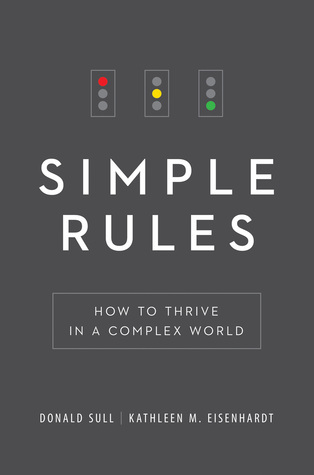
HOW SIMPLICITY TRUMPS COMPLEXITY IN NATURE, BUSINESS, AND LIFE Complexity surrounds us. We have too much email, juggle multiple remotes, and hack through thickets of regulations from phone contracts to health plans. But complexity isn’t destiny. Sull and Eisenhardt argue there’s a better way. By developing a few simple yet effective rules, people can best even the most complex problems. In Simple Rules, Sull and Eisenhardt masterfully challenge how we think about complexity and offer a new lens on how to cope. They take us on a surprising tour of what simple rules are, where they come from, and why they work. The authors illustrate the six kinds o f rules that really matter - for helping artists find creativity and the Federal Reserve set interest rates, for keeping birds on track and Zipcar members organized, and for how insomniacs can sleep and mountain climbers stay safe. Drawing on rigorous research and riveting stories, the authors ingeniously find insights in unexpected places, from the way Tina Fey codified her experience at Saturday Night Live into rules for producing 30 Rock (rule five: never tell a crazy person he’s crazy) to burglars’ rules for robbery (“avoid houses with a car parked outside”) to Japanese engineers mimicking the rules of slime molds to optimize Tokyo’s rail system. The authors offer fresh information and practical tips on fixing old rules and learning new ones. Whether you’re struggling with information overload, pursuing opportunities with limited resources, or just trying to change your bad habits, Simple Rules provides powerful insight into how and why simplicity tames complexity.

Scientific and philosophical concepts can change the way we solve problems by helping us to think more effectively about our behavior and our world. Surprisingly, despite their utility, many of these tools remain unknown to most of us.In Mindware , the world-renowned psychologist Richard E. Nisbett presents these ideas in clear and accessible detail, offering a tool kit for better thinking and wiser decisions. He has made a distinguished career of studying and teaching such powerful problem-solving concepts as the law of large numbers, statistical regression, cost-benefit analysis, sunk costs and opportunity costs, and causation and correlation, probing how best to teach others to use them effectively in their daily lives. In this groundbreaking book, he shows that a course in a given field--statistics or economics, for example--often doesn't work as well as a few minutes of more practical instruction in analyzing everyday situations. Mindware shows how to reframe common problems in such a way that these powerful scientific and statistical concepts can be applied to them. The result is an enlightening and practical guide to the most powerful tools of reasoning ever developed--tools that can easily be used to make better professional, business, and personal decisions.

Superforecasting: The Art and Science of Prediction
by Philip E. Tetlock
Rating: 4.1 ⭐
• 13 recommendations ❤️
NEW YORK TIMES BESTSELLER • NAMED ONE OF THE BEST BOOKS OF THE YEAR BY THE ECONOMIST “ The most important book on decision making since Daniel Kahneman's Thinking, Fast and Slow . ” —Jason Zweig, The Wall Street Journal Everyone would benefit from seeing further into the future, whether buying stocks, crafting policy, launching a new product, or simply planning the week’s meals. Unfortunately, people tend to be terrible forecasters. As Wharton professor Philip Tetlock showed in a landmark 2005 study, even experts’ predictions are only slightly better than chance. However, an important and underreported conclusion of that study was that some experts do have real foresight, and Tetlock has spent the past decade trying to figure out why. What makes some people so good? And can this talent be taught? In Superforecasting , Tetlock and coauthor Dan Gardner offer a masterwork on prediction, drawing on decades of research and the results of a massive, government-funded forecasting tournament. The Good Judgment Project involves tens of thousands of ordinary people—including a Brooklyn filmmaker, a retired pipe installer, and a former ballroom dancer—who set out to forecast global events. Some of the volunteers have turned out to be astonishingly good. They’ve beaten other benchmarks, competitors, and prediction markets. They’ve even beaten the collective judgment of intelligence analysts with access to classified information. They are "superforecasters." In this groundbreaking and accessible book, Tetlock and Gardner show us how we can learn from this elite group. Weaving together stories of forecasting successes (the raid on Osama bin Laden’s compound) and failures (the Bay of Pigs) and interviews with a range of high-level decision makers, from David Petraeus to Robert Rubin, they show that good forecasting doesn’t require powerful computers or arcane methods. It involves gathering evidence from a variety of sources, thinking probabilistically, working in teams, keeping score, and being willing to admit error and change course.Superforecasting offers the first demonstrably effective way to improve our ability to predict the future—whether in business, finance, politics, international affairs, or daily life—and is destined to become a modern classic.

Pebbles of Perception: How a Few Good Choices make All the Difference
by Laurence Endersen
Rating: 4.2 ⭐
• 2 recommendations ❤️
Why are we here? Pebbles of Perception is is an exploration of the more important decisions in life. Inspired by the teachings of Charlie Munger, the book is an invitation to Be Curious, Build Character and to make Better Choices. Pebbles of Perception covers a wide range of important life topics including: Lifelong Learning, Incentives, Fear, Adversity, Marriage, Negotiation, Friendship, Listening, Choosing a Career, Saving, Thinking and Kindness. The book is available in Paperback, Kindle and also as a Limited Edition (only 92 copies globally), Leather-Bound, Hard Cover (each of which is numbered and signed by the author).

Primed to Perform: How to Build the Highest Performing Cultures Through the Science of Total Motivation
by Neel Doshi
Rating: 4.1 ⭐
• 2 recommendations ❤️
The revolutionary book that teaches you how to use the cutting edge of human psychology to build high performing workplace cultures. Too often, great cultures feel like magic. While most leaders believe culture is critical to success, few know how to build one, or sustain it over time. What if you knew the science behind the magic—a science so predictive and powerful that you could transform your organization? What if you could use cutting edge psychology to unlock people’s innate desire to innovate, experiment, and adapt? In Primed to Perform, Neel Doshi and Lindsay McGregor show you how to do just that. The result: higher sales, more loyal customers, and more passionate employees. Primed to Perform explains the counter-intuitive science behind great cultures, building on over a century of academic thinking. It shares the simple, highly predictive new measurement tool—the Total Motivation (ToMo) Factor—that enables you to measure the strength of your culture, and track improvements over time. It explores the authors’ original research into how Total Motivation leads to higher performance in iconic companies, from Apple to Starbucks to Southwest Airlines. Most importantly, it teaches you to build great cultures, using a systematic and sustainable approach. High performing cultures cant be left to chance. Organizations must create systems that shape and maintain them. Whether you’re a five-person team or a startup, a school, a nonprofit or a mega-institution, Primed to Perform shows you how.

Your Survival Guide to the Hades of Wall StreetThe Devil's Financial Dictionary skewers the plutocrats and bureaucrats who gave us exploding mortgages, freakish risks, and banks too big to fail. And it distills the complexities, absurdities, and pomposities of Wall Street into plain truths and aphorisms anyone can understand.An indispensable survival guide to the hostile wilderness of today's financial markets, The Devil's Financial Dictionary delivers practical insights with a scorpion's sting. It cuts through the fads and fakery of Wall Street and clears a safe path for investors between euphoria and despair.Staying out of financial purgatory has never been this fun.

Human creativity has been one of the fundamental drivers of civilization and progress - solving immense problems, creating opportunities and overcoming enemies like no other force. Often it has baffled its sceptics by finding new and better resources, unexpected environmental technologies and genuinely amazing products that no one had predicted. However, like so many before it, Western civilization is now suffering from serious internal decay with its bloated public sectors, punitive taxes, over-regulation, marginalized citizens, stagnation, debt, unemployment and pessimism. This important and fascinating book explains why internal decay is normal. But it also shows how and why solutions can be found by countries and companies, enabling more creativity and adaptability than ever before. It's through the power of creativity that society and business can overcome the challenges and crises of today.

Charlie Munger, Berkshire Hathaway's visionary vice chairman and Warren Buffett's indispensable financial partner, has outperformed market indexes again and again, and he believes any investor can do the same. His notion of "elementary, worldly wisdom"―a set of interdisciplinary mental models involving economics, business, psychology, ethics, and management―allows him to keep his emotions out of his investments and avoid the common pitfalls of bad judgment.Munger's system has steered his investments for forty years and has guided generations of successful investors. This book presents the essential steps of Munger's investing strategy, condensed here for the first time from interviews, speeches, writings, and shareholder letters, and paired with commentary from fund managers, value investors, and business-case historians. Derived from Ben Graham's value-investing system, Munger's approach is straightforward enough that ordinary investors can apply it to their portfolios. This book is not simply about investing. It is about cultivating mental models for your whole life, but especially for your investments.

From the best-selling author of Wild, a collection of quotes--drawn from the wide range of her writings--that capture her wisdom, courage, and outspoken humor, presented in a gift-sized package that's as irresistible to give as it is to receive.Around the world, thousands of people have found inspiration in the words of Cheryl Strayed, who in her three prior books and in her "Dear Sugar" columns has shared the twists and trials of her remarkable life. Her honesty, spirit, and ample supply of tough love have enabled many of us, even in the darkest hours, to somehow put one foot in front of the other--and be brave enough.This book gathers, each on a single page, more than 100 of Strayed's indelible quotes and thoughts--"mini instruction manuals for the soul" that urge us toward the incredible capacity for love, compassion, forgiveness, and endurance that is within us all.Be brave enough to break your own heart.You can't ride to the fair unless you get on the pony.Keep walking.Acceptance is a small, quiet room.Romantic love is not a competitive sport.Forward is the direction of real life.Ask yourself: What is the best I can do? And then do that.
Providing unique, accessible lessons on engineering, this title in the bestselling 101 Things I Learned® series is a perfect resource for students, recent graduates, general readers, and even seasoned professionals. An experienced civil engineer presents the physics and fundamentals underlying the many fields of engineering. Far from a dry, nuts-and-bolts exposition, 101 Things I Learned® in Engineering School uses real-world examples to show how the engineer's way of thinking can illuminate questions from the simple to the Why shouldn't soldiers march across a bridge? Why do buildings want to float and cars want to fly? What is the difference between thinking systemically and thinking systematically? This informative resource will appeal to students, general readers, and even experienced engineers, who will discover within many provocative insights into familiar principles.

Atomic Habits: An Easy & Proven Way to Build Good Habits & Break Bad Ones
by James Clear
Rating: 4.4 ⭐
• 9 recommendations ❤️
The instant New York Times bestseller. Over 1 million copies sold! Tiny Changes, Remarkable Results No matter your goals, Atomic Habits offers a proven framework for improving--every day. James Clear, one of the world's leading experts on habit formation, reveals practical strategies that will teach you exactly how to form good habits, break bad ones, and master the tiny behaviors that lead to remarkable results.If you're having trouble changing your habits, the problem isn't you. The problem is your system. Bad habits repeat themselves again and again not because you don't want to change, but because you have the wrong system for change. You do not rise to the level of your goals. You fall to the level of your systems. Here, you'll get a proven system that can take you to new heights.Clear is known for his ability to distill complex topics into simple behaviors that can be easily applied to daily life and work. Here, he draws on the most proven ideas from biology, psychology, and neuroscience to create an easy-to-understand guide for making good habits inevitable and bad habits impossible. Along the way, readers will be inspired and entertained with true stories from Olympic gold medalists, award-winning artists, business leaders, life-saving physicians, and star comedians who have used the science of small habits to master their craft and vault to the top of their field.Learn how to: - make time for new habits (even when life gets crazy); - overcome a lack of motivation and willpower; - design your environment to make success easier; - get back on track when you fall off course;...and much more.Atomic Habits will reshape the way you think about progress and success, and give you the tools and strategies you need to transform your habits--whether you are a team looking to win a championship, an organization hoping to redefine an industry, or simply an individual who wishes to quit smoking, lose weight, reduce stress, or achieve any other goal.

The Great Mental Models: General Thinking Concepts, Vol. I
by Shane Parrish
Rating: 4.2 ⭐
• 3 recommendations ❤️
The old saying goes, "To the man with a hammer, everything looks like a nail." But anyone who has done any kind of project knows a hammer often isn't enough.The more tools you have at your disposal, the more likely you'll use the right tool for the job — and get it done right.The same is true when it comes to your thinking. The quality of your outcomes depends on the mental models in your head. And most people are going through life with little more than a hammer.Until now.The Great Mental Models: General Thinking Concepts is the first book in The Great Mental Models series designed to upgrade your thinking with the best, most useful and powerful tools so you always have the right one on hand.This volume details nine of the most versatile, all-purpose mental models you can use right away to improve your decision making, productivity, and how clearly you see the world. You will discover what forces govern the universe and how to focus your efforts so you can harness them to your advantage, rather than fight with them or worse yet— ignore them.
The Great Mental Models Volume 2: Physics, Chemistry and Biology
by Shane Parrish
Rating: 4.1 ⭐
• 1 recommendation ❤️
THE MUCH ANTICIPATED SECOND INSTALLMENT IN THE WALL STREET JOURNAL BESTSELLING SERIES ‘THE GREAT MENTAL MODELS’.Solve problems. Think with clarity. Achieve your goals.The secret to better decision-making is learning things that won’t change. Mastering a small number of versatile concepts with broad applicability enables you to rapidly grasp new areas, identify patterns, and understand how the world works. Don’t waste your time on knowledge with an expiry date - focus on the fundamentals.The Farnam Street latticework of mental models gives you the durable cognitive tools you need to avoid problems and make better decisions.A mental model is a representation of how something works. Constructing mental models helps you to navigate the world efficiently and intelligently. Time and time again, great thinkers such as Charlie Munger and Warren Buffett have found mental models indispensable in both solving problems and preventing them in the first place. Cultivating stronger mental models is one of the most powerful things you can do to become a better thinker. The Great Mental Volume 2 covers essential models from chemistry, biology, and physics. The hard sciences offer a wealth of useful tools you can use to develop critically important skills like curiosity, relationship-building, and leadership. Formal expertise in science is not necessary, though if you have it you may see parts of your discipline in a new light. This second volume of the Great Mental Models series shows you how to make connections between concepts from the sciences and your own life. You'll not only get a better understanding of the forces that influence the world around you, but you'll learn how to direct those forces to create outsized advantages in the areas of your life that matter most to you.Volume 2 will teach you how And much more... Mastering The Great Mental Models helps you thrive in an uncertain world. The right cognitive tools prepare you for any type of challenge. From parenting to healthy eating, relationships to personal productivity, and from learning to product design, this book will give you new lenses for understanding life.A wonderful resource you’ll keep returning to year after year. As you incorporate the models in this book into your mental toolbox, you’ll see the world with fresh eyes.START BUILDING YOUR LATTICEWORK TODAY!Praise for The Great Mental Models “I’m really glad this exists in the world and I can see that I will be recommending it often.”— Matt Mullenweg, co-founder of WordPress, founder and CEO of Automattic“If you’ve read Charlie Munger’s Almanack this is the book you deeply crave in its wake. … Learn the big ideas from the big disciplines and you’ll be able to twist and turn problems in interesting ways at unprecedented speeds. … You owe yourself this book.”— Simon Eskildsen“This is what non-fiction books should aspire to be like. Informative, concise, universal, practical, visual, sharing stories and examples for context. Definitely, a must-read if you’re into universal multi-disciplinary thinking.”— Carl Rannaberg“I can truly say it is one of the best books I’ve ever had the pleasure of getting lost in. I loved the book and the challenges to conventional wisdom and thinking it presents.”— Rod Berryman“Want to learn? Read This! This should be a standard text for high school and university students.”— Code Cubitt

The Almanack of Naval Ravikant: A Guide to Wealth and Happiness
by Eric Jorgenson
Rating: 4.5 ⭐
• 8 recommendations ❤️
Getting rich is not just about luck; happiness is not just a trait we are born with. These aspirations may seem out of reach, but building wealth and being happy are skills we can learn. So what are these skills, and how do we learn them? What are the principles that should guide our efforts? What does progress really look like? Naval Ravikant is an entrepreneur, philosopher, and investor who has captivated the world with his principles for building wealth and creating long-term happiness. The Almanack of Naval Ravikant is a collection of Naval's wisdom and experience from the last ten years, shared as a curation of his most insightful interviews and poignant reflections. This isn't a how-to book, or a step-by-step gimmick. Instead, through Naval's own words, you will learn how to walk your own unique path toward a happier, wealthier life.This book has been created as a public service. It is available for free download in pdf and 3-reader versions on Navalmanack.com. Naval is not earning any money on this book. Naval has essays, podcasts and more at Nav.al and is on Twitter @Naval.
The Great Mental Models Volume 3: Systems and Mathematics
by Rhiannon Beaubien
Rating: 4.2 ⭐
• 1 recommendation ❤️
The Great Mental Models: Volume 3 covers essential models from mathematics and systems. In part one, you'll learn mental models from systems, helping you see unexpected connections and avoid costly mistakes. You'll discover how these concepts govern the behaviors and interactions in your life. Part one covers topics such as how to:- Identify the right feedback loops to adjust for behavior change (your own and others')- Leverage bottlenecks to supercharge your innovative capabilities- Scale up businesses and other endeavors without damaging their longevity- Reduce risk and preventing disaster by knowing when to incorporate a margin of safety- Construct reliable algorithms in your mind for predictable success to get the results you want every timeIn part two, you'll learn mental models from mathematics that reveal logical patterns in the world. This isn't your high school math class. Part two covers topics such as how to:- Reap exponential gains by investing in knowledge, relationships, and experiences that compound- Utilize the surprising power of sample sizes to reshape your perspective and open your mind- Embrace randomness to become less predictable and more creative- Identify the fundamental components of systems that lead to failure if neglected, so you can focus your energy where it matters most

Clear Thinking: Turning Ordinary Moments into Extraordinary Results
by Shane Parrish
Rating: 4.2 ⭐
• 3 recommendations ❤️
AN INSTANT NEW YORK TIMES BESTSELLERFew things will change your trajectory in life or business as much as learning to think clearly. Yet few of us recognize opportunities to think in the first place.You might believe you’re thinking clearly in the moments that matter most. But in all likelihood, when the pressure is on, you won’t be thinking at all. And your subsequent actions will inevitably move you further from the results you ultimately seek—love, belonging, success, wealth, victory. According to Farnam Street founder Shane Parrish, we must get better at recognizing these opportunities for what they are, and deploying our cognitive ability in order to achieve the life we want.Clear Thinking gives you the tools to recognize the moments that have the potential to transform your trajectory, and reshape how you navigate the critical space between stimulus and response. As Parrish shows, we may imagine we are the protagonists in the story of our lives. But the sad truth is, most of us run on autopilot. Our behavioral defaults, groomed by biology, evolution, and culture, are primed to run the show for us if we don’t intervene. At our worst, we react to events without reasoning, not even realizing that we’ve missed an opportunity to think at all. At our best, we recognize these moments for what they are, and apply the full capacity of our reasoning and rationality to them.Through stories, mental models, and more, Parrish offers the missing link between behavioral science and real-life outcomes. The result is a must-have manual for optimizing decision-making, gaining competitive advantage, and living a more intentional life.

Pensées pour moi-même Marc Aurèle - Les 12 Livres Complets : La Nouvelle Traduction Moderne avec Analyses Approfondies de Son Stoïcisme et de Sa Philosophie (Traduit et Annoté)
by Marc Aurèle
• 2 recommendations ❤️
