8 Books Recommended

The Power Broker: Robert Moses and the Fall of New York
by Robert A. Caro
Rating: 4.5 ⭐
• 15 recommendations ❤️
One of the most acclaimed books of our time, winner of both the Pulitzer and the Francis Parkman prizes, The Power Broker tells the hidden story behind the shaping (and mis-shaping) of twentieth-century New York (city and state) and makes public what few have known: that Robert Moses was, for almost half a century, the single most powerful man of our time in New York, the shaper not only of the city's politics but of its physical structure and the problems of urban decline that plague us today.In revealing how Moses did it--how he developed his public authorities into a political machine that was virtually a fourth branch of government, one that could bring to their knees Governors and Mayors (from La Guardia to Lindsay) by mobilizing banks, contractors, labor unions, insurance firms, even the press and the Church, into an irresistible economic force--Robert Caro reveals how power works in all the cities of the United States. Moses built an empire and lived like an emperor. He personally conceived and completed public works costing 27 billion dollars--the greatest builder America (and probably the world) has ever known. Without ever having been elected to office, he dominated the men who were--even his most bitter enemy, Franklin D. Roosevelt, could not control him--until he finally encountered, in Nelson Rockefeller, the only man whose power (and ruthlessness in wielding it) equalled his own.

Phía đông vườn địa đàng là câu chuyện của những người Mỹ, khoảng những năm từ nửa cuối thế kỷ trước đến chiến tranh thế giới lần thứ nhất. Tác giả cho nó diễn ra ở chính quê hương mình. Tiểu thuyết được xuất bản năm 1952. Có thể là nhà văn đã thai nghén nó trong thời kỳ chiến tranh thế giới lần thứ hai. Phải chăng cuộc “người tàn sát người” khủng khiếp ấy đã làm cho Steinbeck băn khoăn về ý nghĩa cuộc sống, về bản chất của con người và cố tìm ra lời đáp. Phía đông vườn Địa đàng, đây là cuốn truyện về con người. Nhận vật trung tâm mang cái tên Adam, con người đầu tiên của nhân loại. Với nó nhà văn muốn đặt cơ sở cho một chủ nghĩa nhân đạo hữu hiệu. Steinbeck khẳng định niềm tin vào con người, vào cuộc sống, nhưng không phải một niềm tin lý tưởng hóa. Niềm tin ấy phải là cái cây đứng chắc, bắt rễ sâu vào miếng đất thực tế có cả đất màu mỡ lẫn sỏi đá, biết tránh sỏi đá, hút màu mỡ mà sinh trái ngọt.Trong phong trào đổi mới của ta hiện nay Phía đông vườn Địa đàng là cuốn sách nên đọc.

The searing, post-apocalyptic novel about a father and son’s fight to survive.A father and his son walk alone through burned America. Nothing moves in the ravaged landscape save the ash on the wind. It is cold enough to crack stones, and when the snow falls it is gray. The sky is dark. Their destination is the coast, although they don’t know what, if anything, awaits them there. They have nothing; just a pistol to defend themselves against the lawless bands that stalk the road, the clothes they are wearing, a cart of scavenged food—and each other.The Road is the profoundly moving story of a journey. It boldly imagines a future in which no hope remains, but in which the father and his son, “each the other’s world entire,” are sustained by love. Awesome in the totality of its vision, it is an unflinching meditation on the worst and the best that we are capable of: ultimate destructiveness, desperate tenacity, and the tenderness that keeps two people alive in the face of total devastation.
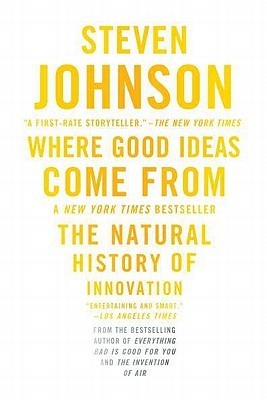
Where Good Ideas Come From: The Natural History of Innovation
by Steven Johnson
Rating: 4.1 ⭐
• 8 recommendations ❤️
A fascinating deep dive on innovation from the New York Times bestselling author of How We Got To Now and FarsightedThe printing press, the pencil, the flush toilet, the battery--these are all great ideas. But where do they come from? What kind of environment breeds them? What sparks the flash of brilliance? How do we generate the breakthrough technologies that push forward our lives, our society, our culture? Steven Johnson's answers are revelatory as he identifies the seven key patterns behind genuine innovation, and traces them across time and disciplines. From Darwin and Freud to the halls of Google and Apple, Johnson investigates the innovation hubs throughout modern time and pulls out the approaches and commonalities that seem to appear at moments of originality.

Selfish Reasons to Have More Kids: Why Being a Great Parent is Less Work and More Fun Than You Think
by Bryan Caplan
Rating: 3.7 ⭐
• 2 recommendations ❤️
We've needlessly turned parenting into an unpleasant chore. Parents invest more time and money in their kids than ever, but the shocking lesson of twin and adoption research is that upbringing is much less important than genetics in the long run. These revelations have surprising implications for how we parent and how we spend time with our kids. The big Mold your kids less and enjoy your life more. Your kids will still turn out fine.Selfish Reasons to Have More Kids is a book of practical big ideas. How can parents be happier? What can they change -- and what do they need to just accept? Which of their worries can parents safely forget? Above all, what is the right number of kids for you to have? You'll never see kids or parenthood the same way again.

The Outsiders: Eight Unconventional CEOs and Their Radically Rational Blueprint for Success
by William N. Thorndike Jr.
Rating: 4.2 ⭐
• 14 recommendations ❤️
”It is impossible to produce superior performance unless you do something different.” — John TempletonWhat makes a successful CEO? Most people call to mind a familiar definition: a seasoned manager with deep industry expertise. Others might point to the qualities of today’s so-called celebrity CEOs—charisma, virtuoso communication skills, and a confident management style. But what really matters when you run an organization? What is the hallmark of exceptional CEO performance? Quite simply, it is the returns for the shareholders of that company over the long term.In this refreshing, counterintuitive book, author Will Thorndike brings to bear the analytical wisdom of a successful career in investing, closely evaluating the performance of companies and their leaders. You will meet eight individualistic CEOs whose firms’ average returns outperformed the S&P 500 by a factor of twenty—in other words, an investment of $10,000 with each of these CEOs, on average, would have been worth over $1.5 million twenty-five years later. You may not know all their names, but you will recognize their companies: General Cinema, Ralston Purina, The Washington Post Company, Berkshire Hathaway, General Dynamics, Capital Cities Broadcasting, TCI, and Teledyne. In The Outsiders, you’ll learn the traits and methods—striking for their consistency and relentless rationality—that helped these unique leaders achieve such exceptional performance.Humble, unassuming, and often frugal, these "outsiders” shunned Wall Street and the press, and shied away from the hottest new management trends. Instead, they shared specific traits that put them and the companies they led on winning trajectories: a laser-sharp focus on per share value as opposed to earnings or sales growth; an exceptional talent for allocating capital and human resources; and the belief that cash flow, not reported earnings, determines a company’s long-term value.Drawing on years of research and experience, Thorndike tells eye-opening stories, extracting lessons and revealing a compelling alternative model for anyone interested in leading a company or investing in one—and reaping extraordinary returns.

Superforecasting: The Art and Science of Prediction
by Philip E. Tetlock
Rating: 4.1 ⭐
• 13 recommendations ❤️
NEW YORK TIMES BESTSELLER • NAMED ONE OF THE BEST BOOKS OF THE YEAR BY THE ECONOMIST “ The most important book on decision making since Daniel Kahneman's Thinking, Fast and Slow . ” —Jason Zweig, The Wall Street Journal Everyone would benefit from seeing further into the future, whether buying stocks, crafting policy, launching a new product, or simply planning the week’s meals. Unfortunately, people tend to be terrible forecasters. As Wharton professor Philip Tetlock showed in a landmark 2005 study, even experts’ predictions are only slightly better than chance. However, an important and underreported conclusion of that study was that some experts do have real foresight, and Tetlock has spent the past decade trying to figure out why. What makes some people so good? And can this talent be taught? In Superforecasting , Tetlock and coauthor Dan Gardner offer a masterwork on prediction, drawing on decades of research and the results of a massive, government-funded forecasting tournament. The Good Judgment Project involves tens of thousands of ordinary people—including a Brooklyn filmmaker, a retired pipe installer, and a former ballroom dancer—who set out to forecast global events. Some of the volunteers have turned out to be astonishingly good. They’ve beaten other benchmarks, competitors, and prediction markets. They’ve even beaten the collective judgment of intelligence analysts with access to classified information. They are "superforecasters." In this groundbreaking and accessible book, Tetlock and Gardner show us how we can learn from this elite group. Weaving together stories of forecasting successes (the raid on Osama bin Laden’s compound) and failures (the Bay of Pigs) and interviews with a range of high-level decision makers, from David Petraeus to Robert Rubin, they show that good forecasting doesn’t require powerful computers or arcane methods. It involves gathering evidence from a variety of sources, thinking probabilistically, working in teams, keeping score, and being willing to admit error and change course.Superforecasting offers the first demonstrably effective way to improve our ability to predict the future—whether in business, finance, politics, international affairs, or daily life—and is destined to become a modern classic.

1 hour and 42 minutesFrom two-time Pulitzer Prize winner and two-time National Book Award winner Robert A. Caro: a short, penetrating reflection on the evolution and workings of political power - for good and for ill. In On Power, from Audible Original Publishing, the legendary historian Robert A. Caro reflects on what drew him as a young journalist to study political power and what his half century of reporting on New York City urban planner Robert Moses and President Lyndon Johnson have taught him about the inner workings of government and democracy. Adapted by the author from two recent speeches and filled with thoughtful lessons and personal moments, On Power goes behind the scenes in the author's decades-long quest to understand how power works, often in ways he could have never imagined. Listening to On Power, narrated with emotion and humor by Caro in his unmistakable New York accent, is like having a private audience with the author often hailed as our greatest living historian. Longtime fans of Caro's books, as well as those seeking a more personal introduction to his life and work, will be treated to his trademark wit and revelatory insight. But more than anything, On Power is a timely reminder for those who want to better understand how power and government work. In Caro's words: "Why political power? Because it shapes all of our lives. It shapes your life in ways that you might never think about. Every time a young man goes to college on a federal education bill passed by Lyndon Johnson, that's political power. And so is a young man dying in Vietnam. Every time an elderly person is able to afford an MRI, that's Medicare. That's political power. It affects your life in all sorts of ways. My books are an attempt to explain this power.... Because the more America understands about political power, the better informed our votes will be, and then, hopefully, the better our democracy should be." ©2017 Robert A. Caro, Inc. (P)2017 Audible, Inc.