
Sam Harris Recommended Books
American author, philosopher and neuroscientist (born 1967)
28 Books Recommended

• Why are lovers quicker to forgive their partners for infidelity than for leaving dirty dishes in the sink? • Why will sighted people pay more to avoid going blind than blind people will pay to regain their sight? • Why do dining companions insist on ordering different meals instead of getting what they really want? • Why do pigeons seem to have such excellent aim; why can’t we remember one song while listening to another; and why does the line at the grocery store always slow down the moment we join it? In this brilliant, witty, and accessible book, renowned Harvard psychologist Daniel Gilbert describes the foibles of imagination and illusions of foresight that cause each of us to mis-conceive our tomorrows and mis-estimate our satisfactions. Vividly bringing to life the latest scientific research in psychology, cognitive neuroscience, philosophy, and behavioral economics, Gilbert reveals what scientists have discovered about the uniquely human ability to imagine the future, and about our capacity to predict how much we will like it when we get there. With penetrating insight and sparkling prose, Gilbert explains why we seem to know so little about the hearts and minds of the people we are about to become.

During the spring of 1994, in a tiny country called Rwanda, some 800,000 people were hacked to death, one by one, by their neighbors in a gruesome civil war. Several years later, journalist Jean Hatzfeld traveled to Rwanda to interview ten participants in the killings, eliciting extraordinary testimony from these men about the genocide they perpetrated. As Susan Sontag wrote in the preface, Machete Season is a document that "everyone should read . . . [because making] the effort to understand what happened in Rwanda . . . is part of being a moral adult."

If there is such a thing as reason, it has to be universal. Reason must reflect objective principles whose validity is independent of our point of view--principles that anyone with enough intelligence ought to be able to recognize as correct. But this generality of reason is what relativists and subjectivists deny in ever-increasing numbers. And such subjectivism is not just an inconsequential intellectual flourish or badge of theoretical chic. It is exploited to deflect argument and to belittle the pretensions of the arguments of others. The continuing spread of this relativistic way of thinking threatens to make public discourse increasingly difficult and to exacerbate the deep divisions of our society. In The Last Word , Thomas Nagel, one of the most influential philosophers writing in English, presents a sustained defense of reason against the attacks of subjectivism, delivering systematic rebuttals of relativistic claims with respect to language, logic, science, and ethics.He shows that the last word in disputes about the objective validity of any form of thought must lie in some unqualified thoughts about how things are--thoughts that we cannot regard from outside as mere psychological dispositions.

Thomas Nagel's Mortal Questions explores some fundamental issues concerning the meaning, nature and value of human life. Questions about our attitudes to death, sexual behaviour, social inequality, war and political power are shown to lead to more obviously philosophical problems about personal identity, consciousness, freedom, and value. This original and illuminating book aims at a form of understanding that is both theoretical and personal in its lively engagement with what are literally issues of life and death.

One of Buddhism’s foundational texts, the Visuddhimagga is a systematic examination and condensation of Buddhist doctrine and meditation technique. The various teachings of the Buddha found throughout the Pali canon are organized in a clear, comprehensive path leading to the final goal of nibbana, the state of complete purification. Originally composed in the fifth century, this new translation provides English speakers insights into this foundational text. In the course of this treatise full and detailed instructions are given on 40 subjects of meditation aimed at concentration, an elaborate account of Buddhist Abhidhamma philosophy, and explicit descriptions of the stages of insight culminating in final liberation. This replaces 9552400236.

William Miller embarks on an alluring journey into the world of disgust, showing how it brings order and meaning to our lives even as it horrifies and revolts us. Our notion of the self, intimately dependent as it is on our response to the excretions and secretions of our bodies, depends on it. Cultural identities have frequent recourse to its boundary-policing powers. Love depends on overcoming it, while the pleasure of sex comes in large measure from the titillating violation of disgust prohibitions. Imagine aesthetics without disgust for tastelessness and vulgarity; imagine morality without disgust for evil, hypocrisy, stupidity, and cruelty.Miller details our anxious relation to basic life eating, excreting, fornicating, decaying, and dying. But disgust pushes beyond the flesh to vivify the larger social order with the idiom it commandeers from the sights, smells, tastes, feels, and sounds of fleshly physicality. Disgust and contempt, Miller argues, play crucial political roles in creating and maintaining social hierarchy. Democracy depends less on respect for persons than on an equal distribution of contempt. Disgust, however, signals dangerous division. The high's belief that the low actually smell bad, or are sources of pollution, seriously threatens democracy.Miller argues that disgust is deeply grounded in our ambivalence to it distresses us that the fair is so fragile, so easily reduced to foulness, and that the foul may seem more than passing fair in certain slants of light. When we are disgusted, we are attempting to set bounds, to keep chaos at bay. Of course we fail. But, as Miller points out, our failure is hardly an occasion for despair, for disgust also helps to animate the world, and to make it a dangerous, magical, and exciting place.

This collection of the timeless teachings of one of the greatest sages of India, Sri Nisargadatta Maharaj, regarded by many as a "modern spiritual classic" is a testament to the uniqueness of the seer's life and work "I Am That" preserves Maharaj's dialogues with the followers who came from around the world seeking his guidance in destroying false identities. The sage's sole concern was with human suffering and the ending of suffering. It was his mission to guide the individual to an understanding of his true nature and the timelessness of being. He taught that mind must recognize and penetrate its own state of being, "being this or that, here or that, then or now," but just timeless being.

Humiliation: And Other Essays on Honor, Social Discomfort, and Violence
by William Ian Miller
Rating: 4.0 ⭐
• 2 recommendations ❤️
How do we feel when our friend turns up with a holiday present and we have nothing ready to give in exchange? What lies behind our small social panics and the maneuvers we use, to avoid losing face? Recognizing how much we care about how others see us, this wise and witty book tackles the complex subject of humiliation and the emotions that keep us going as self-respecting social actors.William Ian Miller writes astutely about a host of homely and seemingly banal social occasions and shows us what is buried behind them. In his view, our lives are permeated with sometimes merely uncomfortable, sometimes hair-raising rituals of shame and humiliation. Take the unwanted dinner invitation, the exchange of valentines in grade school, or the "diabolically ingenious invention of the bridal registry." Readers will have no trouble recognizing the social situations he finds indicative of our often perilous dealings with each other.Educated as a literary critic and philologist, by profession a historian of medieval Iceland, by employment a law professor, Miller ranges comfortably beyond his areas of formal expertise to talk about emotions across time and culture. His scenarios are based on incidents from his own college town and from the Iceland of the sagas. He also makes incursions into the emotional worlds represented in the Middle English poem, Sir Gawain and the Green Knight, and in some of the works of Shakespeare, Dostoyevsky, and others. Indeed, one theme that gradually becomes specific is how meaning travels from one culture to another. Ancient codes of honor, he insists, still function in contemporary American life.Some of Miller's narratives are unsettling, and he acknowledges that a certain ironical misanthropy may run through his discussions. But he succeeds in cutting through a mountain of pretensions to entertain and enlighten us.

In response to The End of Faith, Sam Harris received thousands of letters from Christians excoriating him for not believing in God. Letter to A Christian Nation is his reply. Using rational argument, Harris offers a measured refutation of the beliefs that form the core of fundamentalist Christianity. In the course of his argument, he addresses current topics ranging from intelligent design and stem-cell research to the connections between religion and violence. In Letter to a Christian Nation, Sam Harris boldly challenges the influence that faith has on public life in our nation.

One of the most influential books in the history of literature, recognized as the greatest literary masterpiece in Arabic, the Qur'an is the supreme authority and living source of all Islamic teaching, the sacred text that sets out the creed, rituals, ethics, and laws of Islam. Yet despite the growing interest in Islamic teachings and culture, there has never been a truly satisfactory English translation of the Qur'an, until now.This superb new translation of the Qur'an is written in contemporary language that remains faithful to the meaning and spirit of the original, making the text crystal clear while retaining all of this great work's eloquence. The translation is accurate and completely free from the archaisms, incoherence, and alien structures that mar existing translations. Thus, for the first time, English-speaking readers will have a text of the Qur'an which is easy to use and comprehensible. Furthermore, Haleem includes notes that explain geographical, historical, and personal allusions as well as an index in which Qur'anic material is arranged into topics for easy reference. His introduction traces the history of the Qur'an, examines its structure and stylistic features, and considers issues related to militancy, intolerance, and the subjection of women.Clearly written and filled with helpful information and guidance, this brilliant translation of the Qur'an is the best available introduction to the faith of Moslems around the world.

'Reason and imagination and all mental chatter died down... I forgot my name, my humanness, my thingness, all that could be called me or mine. Past and future dropped away... Lighter than air, clearer than glass, altogether released from myself, I was nowhere around.' Thus Douglas Harding describes his first experience of headlessness, or no self. First published in 1961, this is a classic work which conveys the experience that mystics of all times have tried to put words to.

Since its first publication in 1945 Lord Russell's A History of Western Philosophy has been universally acclaimed as the outstanding one-volume work on the subject—unparalleled in its comprehensiveness, its clarity, its erudition, its grace and wit. In seventy-six chapters he traces philosophy from the rise of Greek civilization to the emergence of logical analysis in the twentieth century. Among the philosophers considered are: Pythagoras, Heraclitus, Parmenides, Empedocles, Anaxagoras, the Atomists, Protagoras, Socrates, Plato, Aristotle, the Cynics, the Sceptics, the Epicureans, the Stoics, Plotinus, Ambrose, Jerome, Augustine, Benedict, Gregory the Great, John the Scot, Aquinas, Duns Scotus, William of Occam, Machiavelli, Erasmus, More, Bacon, Hobbes, Descartes, Spinoza, Leibniz, Locke, Berkeley, Hume, Rousseau, Kant, Hegel, Schopenhauer, Nietzsche, the Utilitarians, Marx, Bergson, James, Dewey, and lastly the philosophers with whom Lord Russell himself is most closely associated -- Cantor, Frege, and Whitehead, co-author with Russell of the monumental Principia Mathematica.

The End of Faith: Religion, Terror, and the Future of Reason
by Sam Harris
Rating: 3.9 ⭐
• 6 recommendations ❤️
In The End of Faith, Sam Harris delivers a startling analysis of the clash between reason and religion in the modern world. He offers a vivid, historical tour of our willingness to suspend reason in favor of religious beliefs—even when these beliefs inspire the worst human atrocities. While warning against the encroachment of organized religion into world politics, Harris draws on insights from neuroscience, philosophy, and Eastern mysticism to deliver a call for a truly modern foundation for ethics and spirituality that is both secular and humanistic.Winner of the 2005 PEN/Martha Albrand Award for Nonfiction.

The Flight of the Garuda: The Dzogchen Tradition of Tibetan Buddhism
by
Rating: 4.0 ⭐
• 2 recommendations ❤️
Flight of the Garuda conveys the heart advice of one of the most beloved masters of Tibet. The itinerant yogi Shabkar communicates the essence of the Dzogchen teachings through song both poetic and poignant.Along with Shabka's songs, Keith Dowman has translated four other seminal Dzogchen texts, including one by Patrul Rinpoche that is new to this edition.. Dzogchen practice brings us into direct communion with the most subtle nature of experience, the unity of samsara in nirvana as experienced within our own consciousness, bringing the mediator face to face with the nature of reality. Buddhist of all strips, including practitioners of Zen and Vipassana, will find ample sustenance in these lyrical explications of the Dzogchen view.

Challenging, with several powerful arguments, some of our deepest beliefs about rationality, morality, and personal identity, Parfit claims that we have a false view about our own nature. It is often rational to act against our own best interests, he argues, and most of us have moral views that are self-defeating. We often act wrongly, although we know there will be no one with serious grounds for complaint, and when we consider future generations it is very hard to avoid conclusions that most of us will find very disturbing.

God Is Not Great: How Religion Poisons Everything
by Christopher Hitchens
Rating: 4.1 ⭐
• 2 recommendations ❤️
In the tradition of Bertrand Russell's Why I Am Not a Christian and Sam Harris's recent bestseller, The End of Faith , Christopher Hitchens makes the ultimate case against religion. With a close and erudite reading of the major religious texts, he documents the ways in which religion is a man-made wish, a cause of dangerous sexual repression, and a distortion of our origins in the cosmos. With eloquent clarity, Hitchens frames the argument for a more secular life based on science and reason, in which hell is replaced by the Hubble Telescope's awesome view of the universe, and Moses and the burning bush give way to the beauty and symmetryof the double helix.

“If Hitchens didn't exist, we wouldn't be able to invent him.” ―Ian McEwan A stylish new paperback edition of HITCH-22, the incendiary memoir of a brilliant contrarian and one of Hitchens’ most wry and provocative works.In this timeless and candid memoir, Hitchens re-traces the footsteps of his life to date, from his childhood in Portsmouth, with his adoring, tragic mother and reserved Naval officer father; to his life in Washington DC, the base from which from he would launch fierce attacks on tyranny of all kinds. Along the way, he recalls the girls, boys and booze; the friendships and the feuds; the grand struggles and lost causes; and the mistakes and misgivings that have characterised his life.HITCH-22 is, by turns, moving and funny, charming and infuriating, enraging and inspiring. It is an indispensable companion to the life and thought of our pre-eminent political writer.

The Moral Landscape: How Science Can Determine Human Values
by Sam Harris
Rating: 4.0 ⭐
• 7 recommendations ❤️
New York Times bestselling author Sam Harris’s first book, The End of Faith , ignited a worldwide debate about the validity of religion. In the aftermath, Harris discovered that most people—from religious fundamentalists to non-believing scientists—agree on one point: science has nothing to say on the subject of human values. Indeed, our failure to address questions of meaning and morality through science has now become the primary justification for religious faith.In this highly controversial book, Sam Harris seeks to link morality to the rest of human knowledge. Defining morality in terms of human and animal well-being, Harris argues that science can do more than tell how we are; it can, in principle, tell us how we ought to be. In his view, moral relativism is simply false—and comes at an increasing cost to humanity. And the intrusions of religion into the sphere of human values can be finally repelled: for just as there is no such thing as Christian physics or Muslim algebra, there can be no Christian or Muslim morality. Using his expertise in philosophy and neuroscience, along with his experience on the front lines of our “culture wars,” Harris delivers a game-changing book about the future of science and about the real basis of human cooperation.

The New York Times bestseller: A provocative, imaginative exploration of the nature and progress of knowledge"Dazzling." - Steven Pinker, The GuardianIn this groundbreaking book, award-winning physicist David Deutsch argues that explanations have a fundamental place in the universe--and that improving them is the basic regulating principle of all successful human endeavor. Taking us on a journey through every fundamental field of science, as well as the history of civilization, art, moral values, and the theory of political institutions, Deutsch tracks how we form new explanations and drop bad ones, explaining the conditions under which progress--which he argues is potentially boundless--can and cannot happen. Hugely ambitious and highly original, The Beginning of Infinity explores and establishes deep connections between the laws of nature, the human condition, knowledge, and the possibility for progress.

As it was in Anna Karenina, Madame Bovary, and Othello, so it is in life. Most forms of private vice and public evil are kindled and sustained by lies. Acts of adultery and other personal betrayals, financial fraud, government corruption—even murder and genocide—generally require an additional moral defect: a willingness to lie.In Lying , best-selling author and neuroscientist Sam Harris argues that we can radically simplify our lives and improve society by merely telling the truth in situations where others often lie. He focuses on "white" lies—those lies we tell for the purpose of sparing people discomfort—for these are the lies that most often tempt us. And they tend to be the only lies that good people tell while imagining that they are being good in the process.

Belief in free will touches nearly everything that human beings value. It is difficult to think about law, politics, religion, public policy, intimate relationships, morality—as well as feelings of remorse or personal achievement—without first imagining that every person is the true source of his or her thoughts and actions. And yet the facts tell us that free will is an illusion.In this enlightening book, Sam Harris argues that this truth about the human mind does not undermine morality or diminish the importance of social and political freedom, but it can and should change the way we think about some of the most important questions in life.

Our Final Invention: Artificial Intelligence and the End of the Human Era
by James Barrat
Rating: 3.8 ⭐
• 6 recommendations ❤️
In as little as a decade, artificial intelligence could match, then surpass human intelligence. Corporations & government agencies around the world are pouring billions into achieving AI’s Holy Grail—human-level intelligence. Once AI has attained it, scientists argue, it will have survival drives much like our own. We may be forced to compete with a rival more cunning, more powerful & more alien than we can imagine. Thru profiles of tech visionaries, industry watchdogs & groundbreaking AI systems, James Barrat's Our Final Invention explores the perils of the heedless pursuit of advanced AI. Until now, human intelligence has had no rival. Can we coexist with beings whose intelligence dwarfs our own? Will they allow us to?

For the millions of Americans who want spirituality without religion, Sam Harris’s latest New York Times bestseller is a guide to meditation as a rational practice informed by neuroscience and psychology.From Sam Harris, neuroscientist and author of numerous New York Times bestselling books, Waking Up is for the twenty percent of Americans who follow no religion but who suspect that important truths can be found in the experiences of such figures as Jesus, the Buddha, Lao Tzu, Rumi, and the other saints and sages of history. Throughout this book, Harris argues that there is more to understanding reality than science and secular culture generally allow, and that how we pay attention to the present moment largely determines the quality of our lives.Waking Up is part memoir and part exploration of the scientific underpinnings of spirituality. No other book marries contemplative wisdom and modern science in this way, and no author other than Sam Harris—a scientist, philosopher, and famous skeptic—could write it.

“A civil but honest dialogue…As illuminating as it is fascinating.”—Ayaan Hirsi AliIs Islam a religion of peace or war? Is it amenable to reform? Why do so many Muslims seem to be drawn to extremism? And what do words like jihadism and fundamentalism really mean? In a world riven by misunderstanding and violence, Sam Harris—a famous atheist—and Maajid Nawaz—a former radical—demonstrate how two people with very different religious views can find common ground and invite you to join in an urgently needed conversation.“How refreshing to read an honest yet affectionate exchange between the Islamist-turned-liberal-Muslim Maajid Nawaz and the neuroscientist who advocates mindful atheism, Sam Harris…Their back-and-forth clarifies multiple confusions that plague the public conversation about Islam.”—Irshad Manji, New York Times Book Review“It is sadly uncommon, in any era, to find dialogue based on facts and reason—but even more rarely are Muslim and non-Muslim intellectuals able to maintain critical distance on broad questions about Islam. Which makes Islam and the Future of Tolerance something of a unicorn…Most conversations about religion are marked by the inability of either side to listen, but here, at last, is a proper debate.”—New Statesman

KJV Holy Bible, Giant Print Standard Size Faux Leather Red Letter Edition - Thumb Index & Ribbon Marker, King James Version, Dark Brown
by Anonymous
Rating: 4.7 ⭐
• 40 recommendations ❤️
New - Holy Bible: KJV Giant Print Thumb Index Edition: Brown (King James Bible). Great for gift or personal study.
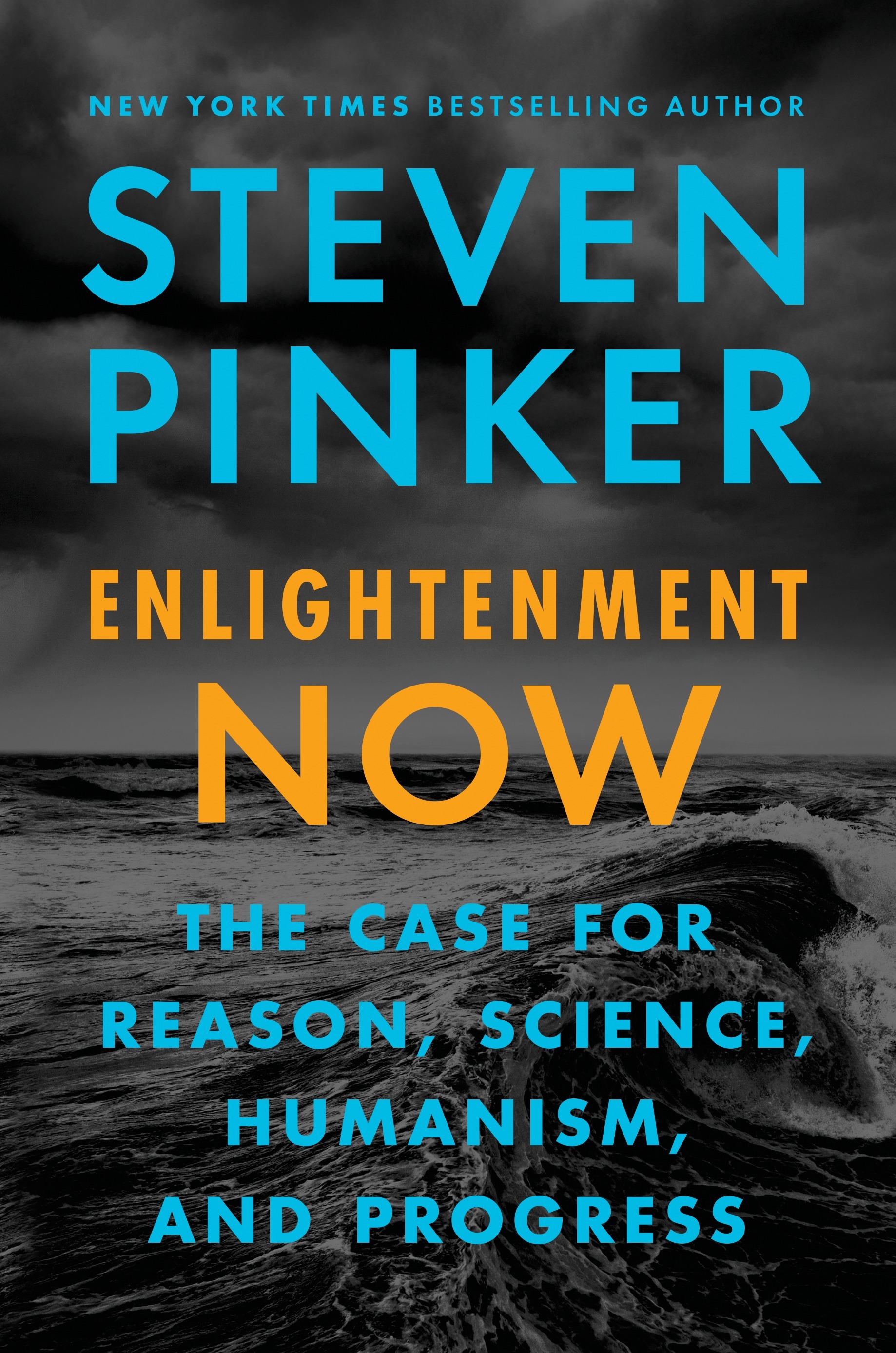
Enlightenment Now: The Case for Reason, Science, Humanism, and Progress
by Steven Pinker
Rating: 4.2 ⭐
• 18 recommendations ❤️
If you think the world is coming to an end, think again: people are living longer, healthier, freer, and happier lives, and while our problems are formidable, the solutions lie in the Enlightenment ideal of using reason and science.Is the world really falling apart? Is the ideal of progress obsolete? In this elegant assessment of the human condition in the third millennium, cognitive scientist and public intellectual Steven Pinker urges us to step back from the gory headlines and prophecies of doom, which play to our psychological biases. Instead, follow the data: In seventy-five jaw-dropping graphs, Pinker shows that life, health, prosperity, safety, peace, knowledge, and happiness are on the rise, not just in the West, but worldwide. This progress is not the result of some cosmic force. It is a gift of the Enlightenment: the conviction that reason and science can enhance human flourishing.Far from being a naïve hope, the Enlightenment, we now know, has worked. But more than ever, it needs a vigorous defense. The Enlightenment project swims against currents of human nature–tribalism, authoritarianism, demonization, magical thinking–which demagogues are all too willing to exploit. Many commentators, committed to political, religious, or romantic ideologies, fight a rearguard action against it. The result is a corrosive fatalism and a willingness to wreck the precious institutions of liberal democracy and global cooperation.With intellectual depth and literary flair, Enlightenment Now makes the case for reason, science, and humanism: the ideals we need to confront our problems and continue our progress.
![The Book of Limericks [Jan 01, 2018] Debroy, Bibek](https://m.media-amazon.com/images/S/compressed.photo.goodreads.com/books/1534782384i/41284550.jpg)
The Book of Limericks [Jan 01, 2018] Debroy, Bibek
by Bibek Debroy
Rating: 3.0 ⭐
• 13 recommendations ❤️
A compilation of witty verses based on current events, The Book of Limericks by Bibek Debroy is a brilliantly illustrated guide for anyone trying to understand what exactly happened last year.From economic issues to citizen concerns, these hilarious five-liners will take you on a roller coaster ride through the year 2017.

One Blade Of Grass: Finding the Old Road of the Heart, a Zen Memoir
by Henry Shukman
Rating: 4.2 ⭐
• 10 recommendations ❤️
One Blade of Grass tells the story of how meditation practice helped Henry Shukman to recover from the depression, anxiety, and chronic eczema he had had since childhood and to integrate a sudden spiritual awakening into his life. By turns humorous and moving, this beautifully written memoir demystifies Zen training, casting its profound insights in simple, lucid language, and takes the reader on a journey of their own, into the hidden treasures of life that contemplative practice can reveal to any of us.