
36 Books Recommended

The Inner Game of Tennis: The Classic Guide to the Mental Side of Peak Performance
by W. Timothy Gallwey
Rating: 4.2 ⭐
• 11 recommendations ❤️
The timeless guide to achieving the state of “relaxed concentration” that’s not only the key to peak performance in tennis but the secret to success in life itself—part of the bestselling Inner Game series, with more than one million copies sold!“Groundbreaking . . . the best guide to getting out of your own way . . . Its profound advice applies to many other parts of life.”—Bill Gates, GatesNotes (“Five of My All-Time Favorite Books”) This phenomenally successful guide to mastering the game from the inside out has become a touchstone for hundreds of thousands of people. Billie Jean King has called the book her tennis bible; Al Gore has used it to focus his campaign staff; and Itzhak Perlman has recommended it to young violinists. Based on W. Timothy Gallwey’s profound realization that the key to success doesn’t lie in holding the racket just right, or positioning the feet perfectly, but rather in keeping the mind uncluttered, this transformative book gives you the tools to unlock the potential that you’ve possessed all along. “The Inner Game” is the one played within the mind of the player, against the hurdles of self-doubt, nervousness, and lapses in concentration. Gallwey shows us how to overcome these obstacles by trusting the intuitive wisdom of our bodies and achieving a state of “relaxed concentration.” With chapters devoted to trusting the self and changing habits, it is no surprise then, that Gallwey’s method has had an impact far beyond the confines of the tennis court. Whether you want to play music, write a novel, get ahead at work, or simply unwind after a stressful day, Gallwey shows you how to tap into your utmost potential. No matter your goals, The Inner Game of Tennis gives you the definitive framework for long-term success.

The Way of the Superior Man: A Spiritual Guide to Mastering the Challenges of Women, Work, and Sexual Desire
by David Deida
Rating: 4.3 ⭐
• 10 recommendations ❤️
The mark of a true classic is that it becomes more relevant with the passage of time Twenty years ago, David Deida wrote The Way of the Superior Man share lessons on “how a man can grow spiritually while passionately tussling with the challenges of women, work, and sexual desire,” Today, men of all ages continue to struggle with these universal challenges, and the practical insights found in this book will help each one of us to give the gifts we were born to give. “It is time to evolve beyond the macho jerk ideal, all spine and no heart,” writes David Deida “It is also time to evolve beyond the sensitive and caring wimp ideal, all heart and no spine ” Including an all-new introduction by the author, The Way of the Superior Man invites a new generation of men to participate in the full expression of consciousness and love in the infinite openness of the present moment.

The Sovereign Individual: Mastering the Transition to the Information Age
by James Dale Davidson
Rating: 4.2 ⭐
• 14 recommendations ❤️
Two renowned investment advisors and authors of the bestseller The Great Reckoning bring to light both currents of disaster and the potential for prosperity and renewal in the face of radical changes in human history as we move into the next century.The Sovereign Individual details strategies necessary for adapting financially to the next phase of Western civilization.Few observers of the late twentieth century have their fingers so presciently on the pulse of the global political and economic realignment ushering in the new millennium as do James Dale Davidson and Lord William Rees-Mogg. Their bold prediction of disaster on Wall Street in Blood in the Streets was borne out by Black Tuesday. In their ensuing bestseller, The Great Reckoning, published just weeks before the coup attempt against Gorbachev, they analyzed the pending collapse of the Soviet Union and foretold the civil war in Yugoslavia and other events that have proved to be among the most searing developments of the past few years.In The Sovereign Individual, Davidson and Rees-Mogg explore the greatest economic and political transition in centuries—the shift from an industrial to an information-based society. This transition, which they have termed "the fourth stage of human society," will liberate individuals as never before, irrevocably altering the power of government. This outstanding book will replace false hopes and fictions with new understanding and clarified values.

The Genealogy of Morals consists of three essays exploring morality and its origins where Nietzsche makes ample use of his training as a philologist. These works contain Nietzsche's most thorough and clear expression of his psychological philosophy. This edition includes Ecce Homo, Nietzsche's review of his life and works, with the exception of The Antichrist. These two books are compiled, translated and annotated by renowned Nietzsche scholar Walter Kaufmann.

Spiritual Enlightenment, the Damnedest Thing: Book One of The Enlightenment Trilogy
by Jed McKenna
Rating: 4.4 ⭐
• 4 recommendations ❤️
From a spiritual master unlike any,a spiritual masterpiece like no other. AUTHOR, TEACHER AND SPIRITUAL MASTER Jed McKenna tells it like it's never been told before. A true American original, Jed succeeds where countless others have failed by reducing this highest of attainments — Spiritual Enlightenment — to the simplest of terms. Effectively demystifying the mystical, Jed astonishes the reader not by adding to the world's collected spiritual wisdom, but by taking the spirituality out of spiritual enlightenment. Never before has this elusive topic been treated in so engaging and accessible a manner. A masterpiece of illuminative writing, Spiritual Enlightenment is mandatory reading for anyone following a spiritual path. Part exposé and part how-to manual, this is the first book to explain why failure seems to be the rule in the search for enlightenment — and how the rule can be broken. _________________________________ Comments about Jed McKenna's Enlightenment Trilogy. “Jed McKenna is an American original.” -Lama Surya Das “Absolutely marvelous, splendid, perfect books!” -Shri Acharya “These books have profoundly changed my life.” -C. Jensen “These three books are precious gifts to humanity.” -E. De Vries “Thank you for the books. I’ve been waiting all my life for them.” -C. Vankeith “I can think of no other author I’d recommend more highly.” -M.R. Fleming "I say an eternal thank you for the Trilogy. The books continue to challenge my mind and life. I ordered my 4th complete set. Nothing compares to this writing." -J.H. "If you are ready, step into Jed's world. It is intelligent and powerful." -J. Katz Visit Wisefool Press to learn more about Jed McKenna's Enlightenment Trilogy and Dreamstate Trilogy. _________________________________

In reality, Hiro Protagonist delivers pizza for Uncle Enzo's CosoNostra Pizza Inc., but in the Metaverse he's a warrior prince. Plunging headlong into the enigma of a new computer virus that's striking down hackers everywhere, he races along the neon-lit streets on a search-and-destroy mission for the shadowy virtual villain threatening to bring about infocalypse. Snow Crash is a mind-altering romp through a future America so bizarre, so outrageous… you'll recognize it immediately.
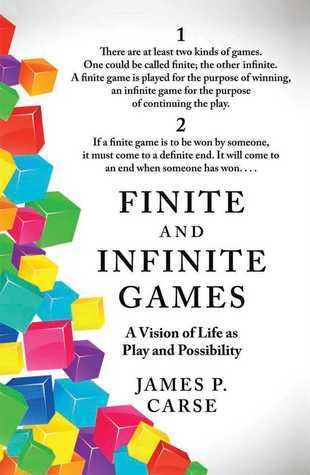
“There are at least two kinds of games,” states James P. Carse as he begins this extraordinary book. “One could be called finite; the other infinite. A finite game is played for the purpose of winning, an infinite game for the purpose of continuing the play.”Finite games are the familiar contests of everyday life; they are played in order to be won, which is when they end. But infinite games are more mysterious. Their object is not winning, but ensuring the continuation of play. The rules may change, the boundaries may change, even the participants may change—as long as the game is never allowed to come to an end.What are infinite games? How do they affect the ways we play our finite games? What are we doing when we play—finitely or infinitely? And how can infinite games affect the ways in which we live our lives?Carse explores these questions with stunning elegance, teasing out of his distinctions a universe of observation and insight, noting where and why and how we play, finitely and infinitely. He surveys our world—from the finite games of the playing field and playing board to the infinite games found in culture and religion—leaving all we think we know illuminated and transformed. Along the way, Carse finds new ways of understanding everything, from how an actress portrays a role to how we engage in sex, from the nature of evil to the nature of science. Finite games, he shows, may offer wealth and status, power and glory, but infinite games offer something far more subtle and far grander.Carse has written a book rich in insight and aphorism. Already an international literary event, Finite and Infinite Games is certain to be argued about and celebrated for years to come. Reading it is the first step in learning to play the infinite game.

The Myth of the Rational Voter: Why Democracies Choose Bad Policies
by Bryan Caplan
Rating: 3.9 ⭐
• 4 recommendations ❤️
The greatest obstacle to sound economic policy is not entrenched special interests or rampant lobbying, but the popular misconceptions, irrational beliefs, and personal biases held by ordinary voters. This is economist Bryan Caplan's sobering assessment in this provocative and eye-opening book. Caplan argues that voters continually elect politicians who either share their biases or else pretend to, resulting in bad policies winning again and again by popular demand.Boldly calling into question our most basic assumptions about American politics, Caplan contends that democracy fails precisely because it does what voters want. Through an analysis of Americans' voting behavior and opinions on a range of economic issues, he makes the convincing case that noneconomists suffer from four prevailing biases: they underestimate the wisdom of the market mechanism, distrust foreigners, undervalue the benefits of conserving labor, and pessimistically believe the economy is going from bad to worse. Caplan lays out several bold ways to make democratic government work better--for example, urging economic educators to focus on correcting popular misconceptions and recommending that democracies do less and let markets take up the slack. The Myth of the Rational Voter takes an unflinching look at how people who vote under the influence of false beliefs ultimately end up with government that delivers lousy results. With the upcoming presidential election season drawing nearer, this thought-provoking book is sure to spark a long-overdue reappraisal of our elective system.

Robert A. Heinlein was the most influential science fiction writer of his era, an influence so large that, as Samuel R. Delany notes, "modern critics attempting to wrestle with that influence find themselves dealing with an object rather like the sky or an ocean." He won the Hugo Award for best novel four times, a record that still stands. The Moon is a Harsh Mistress was the last of these Hugo-winning novels, and it is widely considered his finest work.It is a tale of revolution, of the rebellion of the former Lunar penal colony against the Lunar Authority that controls it from Earth. It is the tale of the disparate people – a computer technician, a vigorous young female agitator, and an elderly academic – who become the rebel movement's leaders. And it is the story of Mike, the supercomputer whose sentience is known only to this inner circle, and who for reasons of his own is committed to the revolution's ultimate success.The Moon is a Harsh Mistress is one of the high points of modern science fiction, a novel bursting with politics, humanity, passion, innovative technical speculation, and a firm belief in the pursuit of human freedom.Cover illustration by Bob Eggleton

Dealers of Lightning: Xerox PARC and the Dawn of the Computer Age
by Michael A. Hiltzik
Rating: 4.2 ⭐
• 8 recommendations ❤️
Dealers of Lightning is the riveting story of the legendary Xerox PARC--a collection of eccentric young inventors brought together by Xerox Corporation at a facility in Palo Alto, California, during the mind-blowing intellectual ferment of the seventies and eighties. Here for the first time Michael Hiltzik, a correspondent for the Los Angeles Times, reveals in piercing detail the true story of the extraordinary group that aimed to bring about a technological dawn that would change the world--and succeeded. Based on extensive interviews with the scientists, engineers, administrators, and corporate executives who lived the story, Dealers of Lightning takes the read on a journey from PARC's beginnings in a dusty, abandoned building at the edge of the Stanford University campus to its triumph as a hothouse of ideas that spawned not only the first personal computer, but the windows-style graphical user interface, the laser printer, much of the indispensable technology of the Internet, and a great deal more. It shows how and why Xerox, despite its willingness to grant PARC unlimited funding and the responsibility for developing breakthroughs to keep the corporation on the cutting edge of office technology, remained forever unable to grasp (and, consequently, exploit) the innovations that PARC delivered--and it details the increasing frustration of the original PARC scientists, many of whom would go on to build their fortunes upon the very ideas Xerox so rashly discarded. More than just a riveting historical narrative, Dealers of Lightning brings to life an unforgettable cast of characters. Among

As a young Florentine envoy to the courts of France and the Italian principalities, Niccolò Machiavelli (1469–1527) was able to observe firsthand the lives of people strongly united under one powerful ruler. His fascination with that political rarity and his intense desire to see the Medici family assume a similar role in Italy provided the foundation for his "primer for princes." In this classic guide to acquiring and maintaining political power, Machiavelli used a rational approach to advise prospective rulers, developing logical arguments and alternatives for a number of potential problems, among them governing hereditary monarchies, dealing with colonies and the treatment of conquered peoples.Refreshing in its directness, yet often disturbing in its cold practicality, The Prince sets down a frighteningly pragmatic formula for political fortune. Starkly relevant to the political upheavals of the 20th century, this calculating prescription for power remains today, nearly 500 years after it was written, a timely and startling lesson in the practice of autocratic rule that continues to be much read and studied by students, scholars and general readers as well.Reprint of The Prince from Vol. 36 of the Harvard Classics series, translated by N. H. Thompson and published by P. F. Collier & Son Company, New York, 1910.
Slaughterhouse-Five, or The Children's Crusade
by Kurt Vonnegut Jr.
Rating: 4.0 ⭐
• 6 recommendations ❤️
This 25th anniversary edition of Slaughterhouse-Five introduces Billy Pilgrim, a man who becomes unstuck in time after he is abducted by aliens from the planet Tralfamadore. In a plot-scrambling display of virtuosity, we follow him simultaneously thru all his life's phases, concentrating on his (& Vonnegut's) shattering experience as an prisoner of war who witnesses the Dresden firebombing. Don't let ease of reading fool you--Vonnegut's isn't a conventional or simple novel. He writes, "There are almost no characters in this story, & almost no dramatic confrontations, because most of the people in it are so sick, & so much the listless playthings of enormous forces. One of the main effects of war, after all, is that people are discouraged from being characters..." Slaughterhouse-Five, named from the building where the POWs were held, isn't only Vonnegut's most powerful book, it's as important as any written since '45. Like Catch-22, it fashions the author's WWII experiences into an eloquent plea against butchery in authority's service. It boasts the same imaginative humanity & gleeful appreciation of the absurd found in his other works, but the book's basis in fact gives it a uniquely poignant humor.

The Black Swan: The Impact of the Highly Improbable
by Nassim Nicholas Taleb
Rating: 4.0 ⭐
• 19 recommendations ❤️
A black swan is an event, positive or negative, that is deemed improbable yet causes massive consequences. In this groundbreaking and prophetic book, Taleb shows in a playful way that Black Swan events explain almost everything about our world, and yet we—especially the experts—are blind to them. In this second edition, Taleb has added a new essay, On Robustness and Fragility, which offers tools to navigate and exploit a Black Swan world.*2nd Edition, With a new essay: "On Robustness and Fragility"

On Liberty is a philosophical essay by the English philosopher John Stuart Mill. Published in 1859, it applies Mill's ethical system of utilitarianism to society and state. Mill suggests standards for the relationship between authority and liberty. He emphasizes the importance of individuality, which he considers prerequisite to the higher pleasures—the summum bonum of utilitarianism. Furthermore, Mill asserts that democratic ideals may result in the tyranny of the majority. Among the standards proposed are Mill's three basic liberties of individuals, his three legitimate objections to government intervention, and his two maxims regarding the relationship of the individual to society.On Liberty was a greatly influential and well-received work. Some classical liberals and libertarians have criticized it for its apparent discontinuity[specify] with Utilitarianism, and vagueness in defining the arena within which individuals can contest government infringements on their personal freedom of action. The ideas presented in On Liberty have remained the basis of much political thought. It has remained in print since its initial publication. A copy of On Liberty is passed to the president of the British Liberal Democrats as a symbol of office.Mill's marriage to Harriet Taylor Mill greatly influenced the concepts in On Liberty, which was published shortly after she died.

Predictably Irrational: The Hidden Forces That Shape Our Decisions
by Dan Ariely
Rating: 4.1 ⭐
• 9 recommendations ❤️
Why do our headaches persist after we take a one-cent aspirin but disappear when we take a fifty-cent aspirin? Why do we splurge on a lavish meal but cut coupons to save twenty-five cents on a can of soup? When it comes to making decisions in our lives, we think we're making smart, rational choices. But are we? In this newly revised and expanded edition of the groundbreaking New York Times bestseller, Dan Ariely refutes the common assumption that we behave in fundamentally rational ways. From drinking coffee to losing weight, from buying a car to choosing a romantic partner, we consistently overpay, underestimate, and procrastinate. Yet these misguided behaviors are neither random nor senseless. They're systematic and predictable—making us predictably irrational.
Fooled by Randomness: The Hidden Role of Chance in Life and in the Markets
by Nassim Nicholas Taleb
Rating: 4.0 ⭐
• 14 recommendations ❤️
Selected by Amazon.com and the Financial Times as one of the best business books of the year, Fooled by Randomness is an instant classic. It's uniqueness has drawn to it a wide following - from the New Yorker to the Pentagon. Already published in 14 languages, this new edition, expanded by over 80 pages, includes up-to-date advances from behavioral finance and cognitive science This book is about luck ? or more precisely how we perceive and deal with luck in life and business. It is already a landmark work and its title has entered our vocabulary. In its second edition, Fooled by Randomness is now a cornerstone for anyone interested in random outcomes. Set against the backdrop of the most conspicuous forum in which luck is mistaken for skill ? the world of trading ? Fooled by Randomness is a captivating insight into one of the least understood factors of all our lives. Writting in an entertaining and narrative style, the author succeeds in tackling three major intellectual the problem of induction, the survivorship biases, and our genetic unfitness to the modern word. In this second edition, Taleb manages to use stories and anecdotes to illustrate our overestimation of causality and the heuristics that make us view the world as far more explainable than it actually is. But no one can replicate what is obtained by chance. Are we capable of distinguishing the fortunate charlatan from the genuine visionary? Must we always try to uncover nonexistent messages in random events? It may be impossible to guard ourselves against the vagaries of the Goddess Fortuna, but after reading Fooled by Randomness we can be a little better prepared.

Since it was first published in English, in 1946, Albert Camus's first novel, THE STRANGER (L'etranger), has had a profound impact on millions of American readers. Through this story of an ordinary man who unwittingly gets drawn into a senseless murder on a sun-drenched Algerian beach, Camus explored what he termed "the nakedness of man faced with the absurd."Now, in an illuminating new American translation, extraordinary for its exactitude and clarity, the original intent of THE STRANGER is made more immediate. This haunting novel has been given a new life for generations to come.

Frank Herbert’s classic masterpiece—a triumph of the imagination and one of the bestselling science fiction novels of all time.Set on the desert planet Arrakis, Dune is the story of Paul Atreides—who would become known as Muad’Dib—and of a great family’s ambition to bring to fruition humankind’s most ancient and unattainable dream.A stunning blend of adventure and mysticism, environmentalism and politics, Dune won the first Nebula Award, shared the Hugo Award, and formed the basis of what is undoubtedly the grandest epic in science fiction.
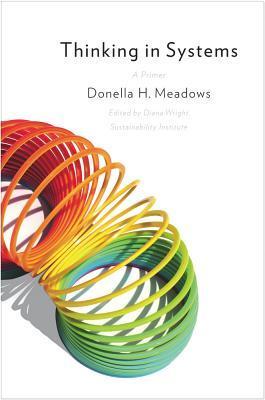
Meadows’ Thinking in Systems, is a concise and crucial book offering insight for problem solving on scales ranging from the personal to the global. Edited by the Sustainability Institute’s Diana Wright, this essential primer brings systems thinking out of the realm of computers and equations and into the tangible world, showing readers how to develop the systems-thinking skills that thought leaders across the globe consider critical for 21st-century life.Some of the biggest problems facing the world—war, hunger, poverty, and environmental degradation—are essentially system failures. They cannot be solved by fixing one piece in isolation from the others, because even seemingly minor details have enormous power to undermine the best efforts of too-narrow thinking.While readers will learn the conceptual tools and methods of systems thinking, the heart of the book is grander than methodology. Donella Meadows was known as much for nurturing positive outcomes as she was for delving into the science behind global dilemmas. She reminds readers to pay attention to what is important, not just what is quantifiable, to stay humble, and to stay a learner.In a world growing ever more complicated, crowded, and interdependent, Thinking in Systems helps readers avoid confusion and helplessness, the first step toward finding proactive and effective solutions.

In this candid and riveting memoir, for the first time ever, Nike founder and CEO Phil Knight shares the inside story of the company’s early days as an intrepid start-up and its evolution into one of the world’s most iconic, game-changing, and profitable brands.In 1962, fresh out of business school, Phil Knight borrowed $50 from his father and created a company with a simple mission: import high-quality, low-cost athletic shoes from Japan. Selling the shoes from the trunk of his lime green Plymouth Valiant, Knight grossed $8,000 his first year. Today, Nike’s annual sales top $30 billion. In an age of startups, Nike is the ne plus ultra of all startups, and the swoosh has become a revolutionary, globe-spanning icon, one of the most ubiquitous and recognizable symbols in the world today.But Knight, the man behind the swoosh, has always remained a mystery. Now, for the first time, in a memoir that is candid, humble, gutsy, and wry, he tells his story, beginning with his crossroads moment. At 24, after backpacking around the world, he decided to take the unconventional path, to start his own business—a business that would be dynamic, different.Knight details the many risks and daunting setbacks that stood between him and his dream—along with his early triumphs. Above all, he recalls the formative relationships with his first partners and employees, a ragtag group of misfits and seekers who became a tight-knit band of brothers. Together, harnessing the transcendent power of a shared mission, and a deep belief in the spirit of sport, they built a brand that changed everything.

Combining magic, mysticism, wisdom, and wonder into an inspiring tale of self-discovery, The Alchemist has become a modern classic, selling millions of copies around the world and transforming the lives of countless readers across generations.Paulo Coelho's masterpiece tells the mystical story of Santiago, an Andalusian shepherd boy who yearns to travel in search of a worldly treasure. His quest will lead him to riches far different—and far more satisfying—than he ever imagined. Santiago's journey teaches us about the essential wisdom of listening to our hearts, recognizing opportunity and learning to read the omens strewn along life's path, and, most importantly, following our dreams.

Humanity has colonized the solar system - Mars, the Moon, the Asteroid Belt and beyond - but the stars are still out of our reach.Jim Holden is XO of an ice miner making runs from the rings of Saturn to the mining stations of the Belt. When he and his crew stumble upon a derelict ship, "The Scopuli," they find themselves in possession of a secret they never wanted. A secret that someone is willing to kill for - and kill on a scale unfathomable to Jim and his crew. War is brewing in the system unless he can find out who left the ship and why.Detective Miller is looking for a girl. One girl in a system of billions, but her parents have money and money talks. When the trail leads him to "The Scopuli" and rebel sympathizer Holden, he realizes that this girl may be the key to everything.Holden and Miller must thread the needle between the Earth government, the Outer Planet revolutionaries, and secretive corporations - and the odds are against them. But out in the Belt, the rules are different, and one small ship can change the fate of the universe.

The Bed of Procrustes: Philosophical and Practical Aphorisms
by Nassim Nicholas Taleb
Rating: 3.9 ⭐
• 4 recommendations ❤️
The author of the modern classics The Black Swan, Fooled by Randomness, and Antifragile, Nassim Nicholas Taleb expresses major ideas in ways you least expect in this collection of aphorisms and meditations—now expanded with fifty percent more material than the hardcover.The Bed of Procrustes takes its title from the Greek myth of a man who made his visitors fit his bed to perfection, either by stretching them or by cutting their limbs. It represents Taleb’s view of modern civilization’s hubristic side effects—modifying humans to satisfy technology, blaming reality for not fitting economic models, inventing diseases to sell drugs, defining intelligence as what can be tested in a classroom, and convincing people that employment is not slavery. Playful and irreverent, these aphorisms will surprise you by exposing self-delusions you have been living with but never recognized. With a rare combination of pointed wit and potent wisdom, Taleb plows through human illusions, contrasting the classical values of courage, elegance, and erudition with the modern diseases of nerdiness, philistinism, and phonies.

The New York Times bestseller: A provocative, imaginative exploration of the nature and progress of knowledge"Dazzling." - Steven Pinker, The GuardianIn this groundbreaking book, award-winning physicist David Deutsch argues that explanations have a fundamental place in the universe--and that improving them is the basic regulating principle of all successful human endeavor. Taking us on a journey through every fundamental field of science, as well as the history of civilization, art, moral values, and the theory of political institutions, Deutsch tracks how we form new explanations and drop bad ones, explaining the conditions under which progress--which he argues is potentially boundless--can and cannot happen. Hugely ambitious and highly original, The Beginning of Infinity explores and establishes deep connections between the laws of nature, the human condition, knowledge, and the possibility for progress.

A Summer Reading Pick for President Barack Obama, Bill Gates, and Mark Zuckerberg From a renowned historian comes a groundbreaking narrative of humanity’s creation and evolution—a #1 international bestseller—that explores the ways in which biology and history have defined us and enhanced our understanding of what it means to be “human.”One hundred thousand years ago, at least six different species of humans inhabited Earth. Yet today there is only one—homo sapiens. What happened to the others? And what may happen to us?Most books about the history of humanity pursue either a historical or a biological approach, but Dr. Yuval Noah Harari breaks the mold with this highly original book that begins about 70,000 years ago with the appearance of modern cognition. From examining the role evolving humans have played in the global ecosystem to charting the rise of empires, Sapiens integrates history and science to reconsider accepted narratives, connect past developments with contemporary concerns, and examine specific events within the context of larger ideas.Dr. Harari also compels us to look ahead, because over the last few decades humans have begun to bend laws of natural selection that have governed life for the past four billion years. We are acquiring the ability to design not only the world around us, but also ourselves. Where is this leading us, and what do we want to become?Featuring 27 photographs, 6 maps, and 25 illustrations/diagrams.

Lee Kuan Yew: The Grand Master's Insights on China, the United States, and the World
by Graham Allison
Rating: 4.3 ⭐
• 4 recommendations ❤️
Grand strategist and founder of modern Singapore offers key insights and controversial opinions on globalization, geopolitics, economic growth, and democracy.When Lee Kuan Yew speaks, presidents, prime ministers, diplomats, and CEOs listen. Lee, the founding father of modern Singapore and its prime minister from 1959 to 1990, has honed his wisdom during more than fifty years on the world stage. Almost single-handedly responsible for transforming Singapore into a Western-style economic success, he offers a unique perspective on the geopolitics of East and West. American presidents from Richard Nixon to Barack Obama have welcomed him to the White House; British prime ministers from Margaret Thatcher to Tony Blair have recognized his wisdom; and business leaders from Rupert Murdoch to Rex Tillerson, CEO of Exxon Mobil, have praised his accomplishments. This book gathers key insights from interviews, speeches, and Lee's voluminous published writings and presents them in an engaging question and answer format.Lee offers his assessment of China's future, asserting, among other things, that "China will want to share this century as co-equals with the U.S." He affirms the United States' position as the world's sole superpower but expresses dismay at the vagaries of its political system. He offers strategic advice for dealing with China and goes on to discuss India's future, Islamic terrorism, economic growth, geopolitics and globalization, and democracy. Lee does not pull his punches, offering his unvarnished opinions on multiculturalism, the welfare state, education, and the free market. This little book belongs on the reading list of every world leader--including the one who takes the oath of office on January 20, 2013.

The Knowledge: How to Rebuild Civilization in the Aftermath of a Cataclysm
by Lewis Dartnell
Rating: 3.9 ⭐
• 5 recommendations ❤️
How would you go about rebuilding a technological society from scratch? If our technological society collapsed tomorrow, perhaps from a viral pandemic or catastrophic asteroid impact, what would be the one book you would want to press into the hands of the postapocalyptic survivors? What crucial knowledge would they need to survive in the immediate aftermath and to rebuild civilization as quickly as possible—a guide for rebooting the world? Human knowledge is collective, distributed across the population. It has built on itself for centuries, becoming vast and increasingly specialized. Most of us are ignorant about the fundamental principles of the civilization that supports us, happily utilizing the latest—or even the most basic—technology without having the slightest idea of why it works or how it came to be. If you had to go back to absolute basics, like some sort of postcataclysmic Robinson Crusoe, would you know how to re-create an internal combustion engine, put together a microscope, get metals out of rock, accurately tell time, weave fibers into clothing, or even how to produce food for yourself? Regarded as one of the brightest young scientists of his generation, Lewis Dartnell proposes that the key to preserving civilization in an apocalyptic scenario is to provide a quickstart guide, adapted to cataclysmic circumstances. The Knowledge describes many of the modern technologies we employ, but first it explains the fundamentals upon which they are built. Every piece of technology rests on an enormous support network of other technologies, all interlinked and mutually dependent. You can’t hope to build a radio, for example, without understanding how to acquire the raw materials it requires, as well as generate the electricity needed to run it. But Dartnell doesn’t just provide specific information for starting over; he also reveals the greatest invention of them all—the phenomenal knowledge-generating machine that is the scientific method itself. This would allow survivors to learn technological advances not explicitly explored in The Knowledge as well as things we have yet to discover. The Knowledge is a brilliantly original guide to the fundamentals of science and how it built our modern world as well as a thought experiment about the very idea of scientific knowledge itself.

“ On Immunity is a book I’ve recommended too many times to count―a searching, empathetic, ultimately unassailable argument, not just for vaccination but for thoroughly acknowledging our interdependence, and for all that becomes necessary and possible once we do. Written before COVID, it nonetheless speaks directly to the concerns of the pandemic era―to the fact that we are dangerous as well as vulnerable, to the way collective well-being and individual self-interest are configured at odds to one another when they are fundamentally intertwined.”―Jia TolentinoIn this bold, fascinating book, Eula Biss addresses our fear of the government, the medical establishment, and what may be in our children's air, food, mattresses, medicines, and vaccines. Reflecting on her own experience as a new mother, she suggests that we cannot immunize our children, or ourselves, against the world. As she explores the metaphors surrounding immunity, Biss extends her conversations with other mothers to meditations on the myth of Achilles, Voltaire's Candide , Bram Stoker's Dracula , Rachel Carson's Silent Spring , Susan Sontag's AIDS and Its Metaphors , and beyond. On Immunity is an inoculation against our fear and a moving account of how we are all interconnected-our bodies and our fates.

Being Mortal: Medicine and What Matters in the End
by Atul Gawande
Rating: 4.5 ⭐
• 2 recommendations ❤️
Ai rồi cũng chết! là một tuyệt phẩm đánh động lòng người được viết nên bởi bác sĩ kiêm tác giả best-seller Atul Gawande. Cuốn sách không chỉ có khả năng lay chuyển ngành y học hiện đại, mà nó còn sẽ giúp làm biến đổi hoàn toàn cuộc sống của muôn người - bao gồm chính bạn!Ngành y học thế giới đã có nhiều bước phát triển vượt bậc trong những năm giảm thiểu tỉ lệ tử vong trẻ sơ sinh, nâng cao tỉ lệ sống sót sau chấn thương, chữa trị và kiểm soát được nhiều loại bệnh tật - kể cả nhiều căn bệnh từng được xem là không có thuốc chữa trong quá khứ. Nhưng dù có bành trướng hùng mạnh đến đâu, y học vẫn muôn đời bất lực trước quy luật sinh-lão-bệnh-tử bất biến của con ngườ Mỗi khi con người phải đối diện với Tuổi Già và Cái Chết, những công cụ y học vốn dĩ quyền năng bỗng chốc phản bội lại chính lý tưởng cứu nhân độ thế mà chúng đang phục vụ.Bằng những công trình nghiên cứu khoa học giá trị và những câu chuyện sống động từ các bệnh nhân và người thân của chính mình, bác sĩ Gawande bóc trần cho chúng ta thấy những hệ lụy và nỗi đau mà con người phải gánh chịu bởi nghịch lý trên. Viện dưỡng lão vốn dĩ được lập ra với mục đích ban đầu tốt đẹp là giúp cho người cao tuổi có một cuộc sống hạnh phúc và viên mãn bất chấp tuổi già, nhưng nhiều nhà dưỡng lão ngày nay bị biến tướng thành những tòa nhà khép kín không khác gì nhà tù, nơi mà người già không được phép ăn những món ăn họ thích và không được phép làm những gì mình muốn. Nhiều bác sĩ được đào tạo xuất sắc về mặt chuyên môn, nhưng lại không biết cách làm thế nào để nói cho bệnh nhân biết sự thật về bệnh tình của họ; thay vào đó, bác sĩ lại vin vào những hy vọng hão huyền về khả năng cứu sống người bệnh của y học và đề xuất cho bệnh nhân hàng loạt biện pháp chữa trị để nuôi những hy vọng hão đó. Rốt cuộc, hành động này chỉ khiến cho người bệnh và cả thân nhân của họ thêm hao mòn khổ sở chứ không hề mang lại ích lợi gì cho họ cả về mặt thể xác lẫn tinh thần.Trong những cuốn sách của mình, bác sĩ phẫu thuật Atul Gawande đã dùng ngòi bút mạnh mẽ không chút sợ hãi của mình tiết lộ cho chúng ta biết sự thật đằng sau ngành y cũng như những cuộc chiến mà các thầy thuốc như ông phải đối mặt và tranh đấu vượt qua. Lần này, với tác phẩm Ai rồi cũng chết!, ông phơi bày cho chúng ta thấy những giới hạn và nhược điểm của ngành y - trong cả chuyên môn của ông lẫn những chuyên ngành khác - khi cuộc sống con người bị đe dọa bởi sự lão hóa và cái chết. Qua đó, ông cũng đồng thời khám phá ra rằng mọi chuyện đều có cách giải quyết, rằng chúng ta hoàn toàn có thể làm khác đi, để mang lại cuộc sống tốt đẹp hơn cho mọi người cũng như cho chính bản thân chúng ta.Để khai phá ngọn nguồn mọi vấn đề cũng như giải pháp, bác sĩ Gawande đã theo chân một nữ y tá làm công việc chăm sóc bệnh nhân tại gia, phỏng vấn nhiều người trong giới bác sĩ lão khoa và sinh hoạt cùng họ, và tiếp xúc với những nhà quản lý viện dưỡng lão có tư tưởng cấp tiến và nhân văn. Ông tìm thấy những con người biết cách nói lên sự thật và chứng minh cho cả thế giới thấy, rằng mỗi người chúng ta đều có thể và có quyền mưu cầu cho mình một cuộc sống tốt đẹp và hạnh phúc bất chấp tuổi già sức yếu mà không phải hy sinh những giá trị sống mà chúng ta yêu quý hoặc tôn thờ.Với cách kể chuyện chân thực, sống động, mê hoặc và đánh động lòng người của tác giả, quyển sách Ai rồi cũng chết!khẳng định với chúng ta rằ Mỗi con người sinh ra không phải chỉ để ăn, ngủ hay tồn tại qua ngày, mà chính là để được sống một cuộc sống đúng nghĩa; rằng mục đích cuối cùng của y học không phải để kéo dài sự tồn tại vô nghĩa của con người, mà chính là để giúp chúng ta có một cuộc sống mãi mãi đong đầy hạnh phúc - cho đến tận phút lâm chung!

The Revolt of the Public and the Crisis of Authority in the New Millennium
by Martin Gurri
Rating: 4.3 ⭐
• 4 recommendations ❤️
In the words of economist and scholar Arnold Kling, Martin Gurri saw it coming.Technology has categorically reversed the information balance of power between the public and the elites who manage the great hierarchical institutions of the industrial age government, political parties, the media.The Revolt of the Public tells the story of how insurgencies, enabled by digital devices and a vast information sphere, have mobilized millions of ordinary people around the world.Originally published in 2014, this updated edition of The Revolt of the Public includes an extensive analysis of Donald Trump's improbable rise to the presidency and the electoral triumphs of Brexit and concludes with a speculative look forward, pondering whether the current elite class can bring about a reformation of the democratic process and whether new organizing principles, adapted to a digital world, can arise out of the present political turbulence.

Ken Liu has quickly become one of the most original and thought-provoking story writers of his generation. Deftly riffing off the power of narrative, this collection is as heartbreaking as it is charming.In “Simulacrum”, the daughter of the revered inventor of augmented reality is irrevocably divided from her father by the technology that is meant to help her be closer to him. In the title story, “The Paper Menagerie”, a child loses touch with the magical paper menagerie built for him by his mother, a mail-order bride in suburban Connecticut, but then discovers as an adult that love knows no bounds. A young man struggling to preserve his culture in the face of utter annihilation finds peace in the transcendence of fleeting memory in “Mono No Aware”. As a couple explores one of the hidden atrocities of the Second World War, they try to speak for those who no longer can in “The Man Who Ended History”. And in “An Advanced Reader’s Picture Book of Comparative Cognitiony”, a mother and father who are separated by vast distances must invoke, for their children, a thousand ways love may take formThese fifteen evocative short stories and novellas tour the poignant history that always haunts immigrants, survivors of war and our consistent technological advances as they are explored through love, race, and politics. An award-winning author, Liu and his stories invoke the magical within the mundane in profound and moving ways.Contents: - Preface- The Bookmaking Habits of Select Species (2012)- State Change (2004) - The Perfect Match (2012) - Good Hunting (2012) - The Literomancer (2010)- Simulacrum (2011) - The Regular (2014)- The Paper Menagerie (2011) - An Advanced Readers' Picture Book of Comparative Cognition (2016)- The Waves (2012)- Mono no Aware (2012)- All the Flavors (2012)- A Brief History of the Trans-Pacific Tunnel (2013)- The Litigation Master and the Monkey King (2013)- The Man Who Ended History: A Documentary (2011)Cover art by Quentin Trollip

From the New York Times bestselling author of The Black Swan, a bold new work that challenges many of our long-held beliefs about risk and reward, politics and religion, finance and personal responsibility In his most provocative and practical book yet, one of the foremost thinkers of our time redefines what it means to understand the world, succeed in a profession, contribute to a fair and just society, detect nonsense, and influence others. Citing examples ranging from Hammurabi to Seneca, Antaeus the Giant to Donald Trump, Nassim Nicholas Taleb shows how the willingness to accept one’s own risks is an essential attribute of heroes, saints, and flourishing people in all walks of life. As always both accessible and iconoclastic, Taleb challenges long-held beliefs about the values of those who spearhead military interventions, make financial investments, and propagate religious faiths. Among his insights: • For social justice, focus on symmetry and risk sharing. You cannot make profits and transfer the risks to others, as bankers and large corporations do. You cannot get rich without owning your own risk and paying for your own losses. Forcing skin in the game corrects this asymmetry better than thousands of laws and regulations. • Ethical rules aren’t universal. You’re part of a group larger than you, but it’s still smaller than humanity in general. • Minorities, not majorities, run the world. The world is not run by consensus but by stubborn minorities imposing their tastes and ethics on others. • You can be an intellectual yet still be an idiot. “Educated philistines” have been wrong on everything from Stalinism to Iraq to low-carb diets. • Beware of complicated solutions (that someone was paid to find). A simple barbell can build muscle better than expensive new machines. • True religion is commitment, not just faith. How much you believe in something is manifested only by what you’re willing to risk for it.The phrase “skin in the game” is one we have often heard but rarely stopped to truly dissect. It is the backbone of risk management, but it’s also an astonishingly rich worldview that, as Taleb shows in this book, applies to all aspects of our lives. As Taleb says, “The symmetry of skin in the game is a simple rule that’s necessary for fairness and justice, and the ultimate BS-buster,” and “Never trust anyone who doesn’t have skin in the game. Without it, fools and crooks will benefit, and their mistakes will never come back to haunt them.”

The Book of Why: The New Science of Cause and Effect
by Judea Pearl
Rating: 3.9 ⭐
• 6 recommendations ❤️
A Turing Award-winning computer scientist and statistician shows how understanding causality has revolutionized science and will revolutionize artificial intelligence"Correlation is not causation." This mantra, chanted by scientists for more than a century, has led to a virtual prohibition on causal talk. Today, that taboo is dead. The causal revolution, instigated by Judea Pearl and his colleagues, has cut through a century of confusion and established causality -- the study of cause and effect -- on a firm scientific basis. His work explains how we can know easy things, like whether it was rain or a sprinkler that made a sidewalk wet; and how to answer hard questions, like whether a drug cured an illness. Pearl's work enables us to know not just whether one thing causes another: it lets us explore the world that is and the worlds that could have been. It shows us the essence of human thought and key to artificial intelligence. Anyone who wants to understand either needs The Book of Why .
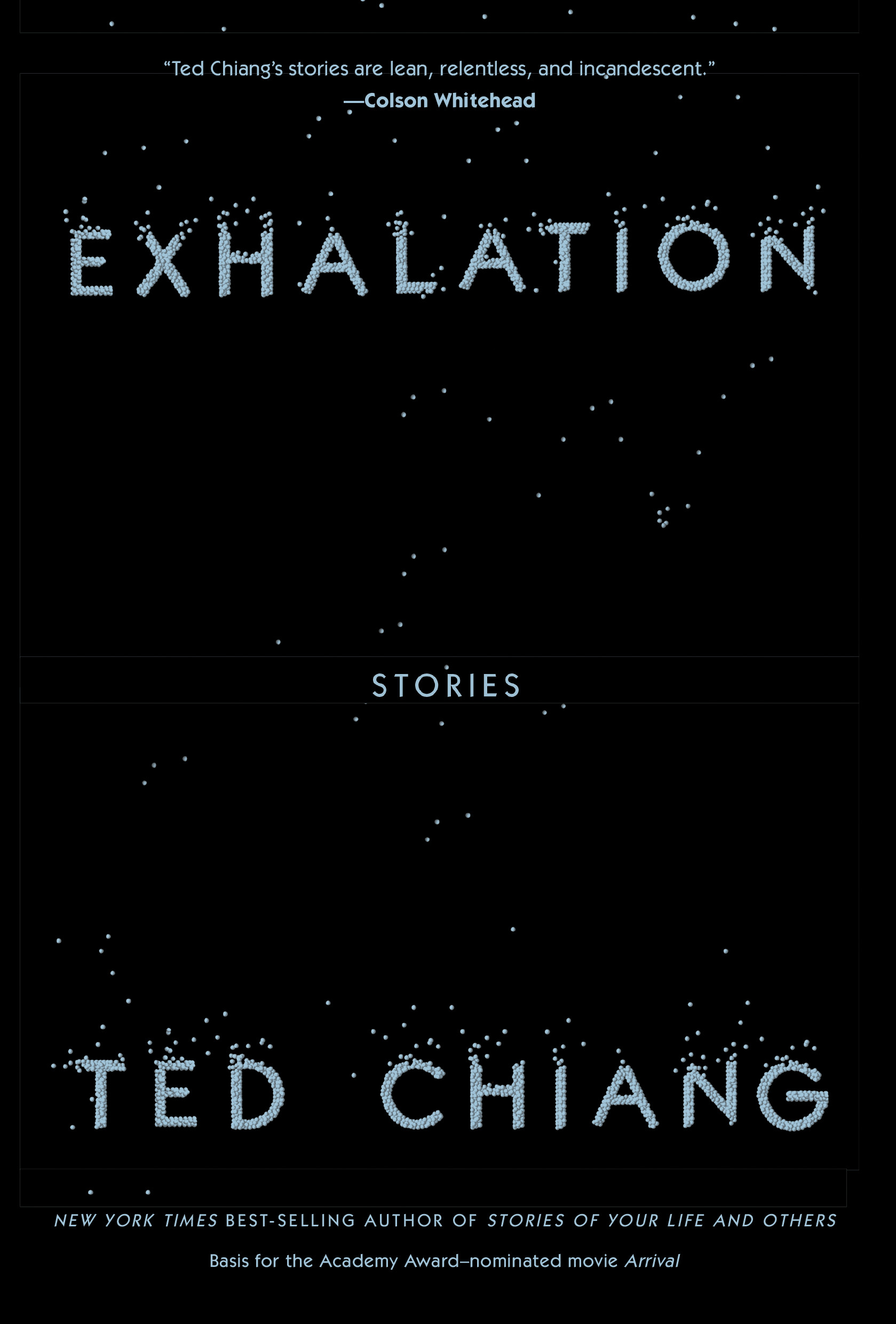
an alternate cover for this ISBN can be found hereThe universe began as an enormous breath being held.From the acclaimed author of Stories of Your Life and Others — the basis for the Academy Award-nominated film Arrival — comes a ground-breaking new collection of short fiction: nine stunningly original, provocative, and poignant stories. These are tales that tackle some of humanity's oldest questions along with new quandaries only Ted Chiang could imagine.In "The Merchant and the Alchemist's Gate", a portal through time forces a fabric seller in ancient Baghdad to grapple with past mistakes and second chances. In "Exhalation", an alien scientist makes a shocking discovery with ramifications that are literally universal. In "Anxiety Is the Dizziness of Freedom" the ability to glimpse into alternate universes necessitates a radically new examination of the concepts of choice and free will.Including stories being published for the first time as well as some of his rare and classic uncollected work, Exhalation is Ted Chiang at his best: profound, sympathetic — revelatory.Contents:- The Merchant and the Alchemist's Gate (2007)- Exhalation (2008)- What's Expected of Us (2005)- The Lifecycle of Software Objects (2010)- Dacey's Patent Automatic Nanny (2011)- The Truth of Fact, the Truth of Feeling (2013)- The Great Silence (2015)- Omphalos (2018)- Anxiety Is the Dizziness of Freedom (2018)

Empire of Pain: The Secret History of the Sackler Dynasty
by Patrick Radden Keefe
Rating: 4.7 ⭐
• 2 recommendations ❤️
The highly anticipated portrait of three generations of the Sackler family, by the prize-winning, bestselling author of Say Nothing. The Sackler name adorns the walls of many storied institutions: Harvard, the Metropolitan Museum of Art, Oxford, the Louvre. They are one of the richest families in the world, known for their lavish donations to the arts and sciences. The source of the family fortune was vague, however, until it emerged that the Sacklers were responsible for making and marketing OxyContin, a blockbuster painkiller that was a catalyst for the opioid crisis.Empire of Pain is a masterpiece of narrative reporting and writing, exhaustively documented and ferociously compelling.

Ryland Grace is the sole survivor on a desperate, last-chance mission--and if he fails, humanity and the earth itself will perish.Except that right now, he doesn't know that. He can't even remember his own name. Let alone the nature of his assignment, or how to complete it.All he knows is that he's been asleep for a very, very long time. And he's just been awakened to find himself millions of miles from home, with nothing but a computer and two corpses for company.His crewmates dead, his memories fuzzily returning, he realizes that an impossible task now confronts him. Alone on this tiny ship that's been cobbled together by every government and space agency on the planet and hurled into the depths of space, it's up to him to conquer an extinction-level threat to our species.And thanks to an unexpected ally, he just might have a chance.Part scientific mystery, part dazzling interstellar journey, The Hail Mary is a tale of discovery, speculation, and survival to rival The Martian--while taking us to places it never dreamed of going.