19 Books Recommended

This book covers the basic truths about economics in less than 200 pages.

The Origin of Wealth: The Radical Remaking of Economics and What it Means for Business and Society
by Eric D. Beinhocker
Rating: 4.3 ⭐
• 2 recommendations ❤️
Over 6.4 billion people participate in a $36.5 trillion global economy, designed and overseen by no one. How did this marvel of self-organized complexity evolve? How is wealth created within this system? And how can wealth be increased for the benefit of individuals, businesses, and society? In The Origin of Wealth , Eric D. Beinhocker argues that modern science provides a radical perspective on these age-old questions, with far-reaching implications. According to Beinhocker, wealth creation is the product of a simple but profoundly powerful evolutionary differentiate, select, and amplify. In this view, the economy is a "complex adaptive system" in which physical technologies, social technologies, and business designs continuously interact to create novel products, new ideas, and increasing wealth. Taking readers on an entertaining journey through economic history, from the Stone Age to modern economy, Beinhocker explores how "complexity economics" provides provocative insights on issues ranging from creating adaptive organizations to the evolutionary workings of stock markets to new perspectives on government policies. A landmark book that shatters conventional economic theory, The Origin of Wealth will rewire our thinking about how we came to be here--and where we are going.

The Great Wave: Price Revolutions and the Rhythm of History
by David Hackett Fischer
Rating: 4.1 ⭐
• 4 recommendations ❤️
David Hackett Fischer, one of our most prominent historians, has garnered a reputation for making history come alive--even stories as familiar as Paul Revere's ride, or as complicated as the assimilation of British culture in North America. Now, in The Great Wave, Fischer has done it again, marshaling an astonishing array of historical facts in lucid and compelling prose to outline a history of prices--"the history of change," as Fischer puts it--covering the dazzling sweep of Western history from the medieval glory of Chartres to the modern day. Going far beyond the economic data, Fischer writes a powerful history of the people of the Western world: the economic patterns they lived in, and the politics, culture, and society that they created as a result. As he did in Albion's Seed and Paul Revere's Ride, two of the most talked-about history books in recent years, Fischer combines extensive research and meticulous scholarship with wonderfully evocative writing to create a book for scholars and general readers alike.Records of prices are more abundant than any other quantifiable data, and span the entire range of history, from tables of medieval grain prices to the overabundance of modern statistics. Fischer studies this wealth of data, creating a narrative that encompasses all of Western culture. He describes four waves of price revolutions, each beginning in a period of equilibrium: the High Middle Ages, the Renaissance, the Enlightenment, and finally the Victorian Age. Each revolution is marked by continuing inflation, a widening gap between rich and poor, increasing instability, and finally a crisis at the crest of the wave that is characterized by demographic contraction, social and political upheaval, and economic collapse. The most violent of these climaxes was the catastrophic fourteenth century, in which war, famine, and the Black Death devastated the continent--the only time in Europe's history that the population actually declined.Fischer also brilliantly illuminates how these long economic waves are closely intertwined with social and political events, affecting the very mindset of the people caught in them. The long periods of equilibrium are marked by cultural and intellectual movements--such as the Renaissance, the Enlightenment, and the Victorian Age-- based on a belief in order and harmony and in the triumph of progress and reason. By contrast, the years of price revolution created a melancholy culture of despair.Fischer suggests that we are living now in the last stages of a price revolution that has been building since the turn of the century. The destabilizing price surges and declines and the diminished expectations the United States has suffered in recent years--and the famines and wars of other areas of the globe--are typical of the crest of a price revolution. He does not attempt to predict what will happen, noting that "uncertainty about the future is an inexorable fact of our condition." Rather, he ends with a brilliant analysis of where we might go from here and what our choices are now. This book is essential reading for anyone concerned about the state of the world today.

Maverick: The Success Story Behind the World's Most Unusual Workplace
by Ricardo Semler
Rating: 4.3 ⭐
• 10 recommendations ❤️
Semler turned his family's business, the aging Semco corporation of Brazil, into the most revolutionary business success story of our time. By eliminating uneeded layers of management and allowing employees unprecedented democracy in the workplace, he created a company that challenged the old ways and blazed a path to success in an uncertain economy.

More than one million hardcovers soldNow available for the first time in paperback!The Classic Text Annotated to Update Graham's Timeless Wisdom for Today's Market ConditionsThe greatest investment advisor of the twentieth century, Benjamin Graham taught and inspired people worldwide. Graham's philosophy of "value investing" -- which shields investors from substantial error and teaches them to develop long-term strategies -- has made The Intelligent Investor the stock market bible ever since its original publication in 1949.Over the years, market developments have proven the wisdom of Graham's strategies. While preserving the integrity of Graham's original text, this revised edition includes updated commentary by noted financial journalist Jason Zweig, whose perspective incorporates the realities of today's market, draws parallels between Graham's examples and today's financial headlines, and gives readers a more thorough understanding of how to apply Graham's principles.Vital and indispensable, this HarperBusiness Essentials edition of The Intelligent Investor is the most important book you will ever read on how to reach your financial goals.

A Sense of Where You Are: Bill Bradley at Princeton
by John McPhee
Rating: 4.1 ⭐
• 11 recommendations ❤️
The first book from the legendary New Yorker writer John McPhee, tells about Bill Bradley when he was the best basketball player Princeton had ever seen.When John McPhee met Bill Bradley, both were at the beginning of their careers. In A Sense of Where You Are ,McPhee delineates for the reader the training and techniques that made Bradley the extraordinary athlete he was, and this part of the book is a blueprint of superlative basketball. But athletic prowess alone would not explain Bradley's magnetism, which is in the quality of the man himself―his self-discipline, his rationality, and his sense of responsibility.Here is a portrait of Bradley as he was in college, before his time with the New York Knicks and his election to the U.S. Senate―a story that suggests the abundant beginnings of his professional careers in sport and politics.

"An excellent primer for anyone struggling to keep profits ahead of costs. . . . Double Your Profits ' 'take no prisoners' approach is refreshing." - William Byham, bestselling coauthor of Zapp! One of the nation's foremost management consultants shares seventy-eight proven ways to cut costs dramatically, send sales through the roof, and double profits in just six months. This timeless profit-boosting guide, considered a top management resource by business powerhouse Jack Welch, presents insights that are notable for their aggressive approach and contrarian perspective. Bob Fifer, former chairman and CEO of Kaiser Associates, shows us how to turn the tables on hardball-playing suppliers and competitors. He also challenges outmoded assumptions and explains Whether you're a mid-level manager, senior executive, or Fortune 500 CEO, you'll find this book is required reading for growing your company and improving your bottom line.

"If you look at Southwest Airlines, and I admire what they do, they've been the most successful airline in the industry."--Gerard Arpey, CEO, American Airlines"Through extensive research Jody Hoffer Gittell gets to the bottom of what has sustained Southwest Airlines' positive employee relations and high performance through good and bad times."--Thomas A. Kochan, professor, MIT Sloan School of Management, MIT Global Airline Industry ProgramIn an industry with losses in the billions, Southwest Airlines has an unbroken string of 31 consecutive years of profitability. The Southwest Airlines Way examines how the company uses high-performance relationships to create enormous competitive advantage in motivation, teamwork, and coordination among employees. It then goes further to show how any company can foster these powerful cooperative relationships and explains how to:Lead with credibility and caringInvest in frontline leadersHire and train for relational competenceUse conflicts to build relationshipsMake unions its partners, not its adversariesBuild relationships with its suppliers

Certain to Win: The Strategy of John Boyd, Applied to Business
by Chet Richards
Rating: 4.1 ⭐
• 2 recommendations ❤️
Certain to Win [Sun Tzu's prognosis for generals who follow his advice] develops the strategy of the late US Air Force Colonel John R. Boyd for the world of business.The success of Robert Coram's monumental biography, Boyd, the Fighter Pilot Who Changed the Art of War, rekindled interest in this obscure pilot and documented his influence on military matters ranging from his early work on fighter tactics to the USMC's maneuver warfare doctrine to the planning for Operation Desert Storm. Unfortunately Boyd's written legacy, consisting of a single paper and a four-set cycle of briefings, addresses strategy only in war. Boyd and BusinessBoyd did study business. He read everything he could find on the Toyota Production System and came to consider it as an implementation of ideas similar to his own. He took business into account when he formulated the final version of his OODA loop and in his last major briefing, Conceptual Spiral, on science and technology. He read and commented on early versions of this manuscript, but he never wrote on how business could operate more profitably by using his ideas.Other writers and business strategists have taken up the challenge, introducing Boyd's concepts and suggesting applications to business. Keith Hammonds, in the magazine Fast Company, George Stalk and Tom Hout in Competing Against Time, and Tom Peters most recently in Re-imagine! have described the OODA loop and its effects on competitors.They made significant contributions. Successful businesses, though, don t concentrate on affecting competitors but on enticing customers. You could apply Boyd all you wanted to competitors, but unless this somehow caused customers to buy your products and services, you ve wasted time and money. If this were all there were to Boyd, he would rate at most a sidebar in business strategy.Business is not WarPart of the problem has been Boyd's focus on war, where affecting competitors is the whole idea. Armed conflict was Boyd's life for nearly 50 years, first as a fighter pilot, then as a tactician and an instructor of fighter pilots, and after his retirement, as a military philosopher. Coram describes (and I know from personal experience) how his quest consumed Boyd virtually every waking hour.It was not a monastic existence, though, since John was above everything else a competitor and loved to argue over beer and cigars far into the night. During most of the 1970s and 80s he worked at the Pentagon, where he could share ideas and debate with other strategists and practitioners of the art of war. The result was the remarkable synthesis we know as Patterns of Conflict. Discussions about generals and campaigns, however, did not give Boyd much insight into competition in other areas, like businessNow you might expect, at first glance, that business is so much like war that lifting concepts from one and applying them to the other would be straightforward. But think about that for a minute. Even in its simplest description, business doesn't really look much like war. For one thing, there are always three sides to business you, customers, and competitors. Often it is vastly more complex, with a multitude of competitors who are customers of each other as well. In business, unlike war, it may even be desirable to be conquered by a competitor in a lucrative merger or acquisition. Finally, and most important, it is rarely possible to defeat the other player in the triangle, that is, to compel an unwilling customer to buy. Attempts to pressure customers into paying too much or into buying more than they need often open a window for competitors (as the US airline industry is belatedly discovering.) Generally all we can do is attract offer products and services to potential customers, whose decisions determine who wins and who loses.What this means is that the strategies and tactics of war, Boyd's included, are destructive in nature and so never apply to business. Expressions like Attack enemy weaknesses have no meaning, except as metaphors and analogies. Across different domains, such literary devices are as likely to be misleading as helpful.Boyd's Strategy Still AppliesBusiness is not war, but it is a form of conflict, a situation where one group can win only if another group loses. If you dig beneath Boyd's war-centered tactics you find a general strategy for ensuring that in most any type of conflict your group will be the one that wins.Although Boyd made a number of new and fundamental contributions, his is an ancient school, extending back in written form 2,500 years. It is built around two primary A focus on time (not speed) and specifically, using dislocations in time to shape the competitive situation. These effects, by the way, are quite different in business than they are in war.A culture with attributes that enable even impel organizations to exploit time for competitive advantage. W...

Before the Industrial Revolution: European Society and Economy, 1000-1700
by Carlo M. Cipolla
Rating: 4.2 ⭐
• 2 recommendations ❤️
The Third Edition includes substantial revisions and new material throughout the book that will secure its standing as the most useful history available of preindustrial Europe.During the seven hundred years before the Industrial Revolution, the stage was set for Europe's transformation from a backward agrarian society to a powerful industrialized society. An economic historian of international reputation, Carlo M. Cipolla explores the process that made this transformation possible. In so doing, he sheds light not only on the economic factors but on the culture surrounding them.

Twenty-Five Hundred years ago, Sun Tzu wrote this classic book of military strategy based on Chinese warfare and military thought. Since that time, all levels of military have used the teaching on Sun Tzu to warfare and civilization have adapted these teachings for use in politics, business and everyday life. The Art of War is a book which should be used to gain advantage of opponents in the boardroom and battlefield alike.

This comprehensive study guide allows beginning students to master and reinforce critical language skills at their own pace, offering a quick, practical, and simple approach to learning. Berlitz Essential Spanish features interesting dialogs and entertaining illustrations that provide a thorough introduction to the language within its cultural context. Grammar basics are taught through phrases and illustrations, with no complicated rules to memorize. Extensive practice exercises, self-tests, a pronunciation guide, and a helpful bilingual glossary make this lively guide perfect for anyone looking to tackle the basics.

Zero to One: Notes on Startups, or How to Build the Future
by Peter Thiel
Rating: 4.2 ⭐
• 48 recommendations ❤️
If you want to build a better future, you must believe in secrets.The great secret of our time is that there are still uncharted frontiers to explore and new inventions to create. In Zero to One, legendary entrepreneur and investor Peter Thiel shows how we can find singular ways to create those new things. Thiel begins with the contrarian premise that we live in an age of technological stagnation, even if we’re too distracted by shiny mobile devices to notice. Information technology has improved rapidly, but there is no reason why progress should be limited to computers or Silicon Valley. Progress can be achieved in any industry or area of business. It comes from the most important skill that every leader must master: learning to think for yourself.Doing what someone else already knows how to do takes the world from 1 to n, adding more of something familiar. But when you do something new, you go from 0 to 1. The next Bill Gates will not build an operating system. The next Larry Page or Sergey Brin won’t make a search engine. Tomorrow’s champions will not win by competing ruthlessly in today’s marketplace. They will escape competition altogether, because their businesses will be unique. Zero to One presents at once an optimistic view of the future of progress in America and a new way of thinking about innovation: it starts by learning to ask the questions that lead you to find value in unexpected places.
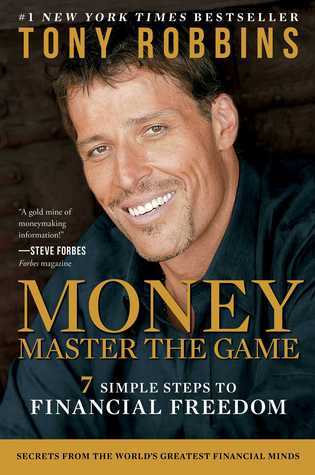
Money Master the Game: 7 Simple Steps to Financial Freedom
by Anthony Robbins
Rating: 4.0 ⭐
• 8 recommendations ❤️
Tony Robbins has coached and inspired more than 50 million people from over 100 countries. More than 4 million people have attended his live events. Oprah Winfrey calls him super-human. Now for the first time - in his first book in two decades - he's turned to the topic that vexes us all: How to secure financial freedom for ourselves and our families. Based on extensive research and one-on-one interviews with more than 50 of the most legendary financial experts in the world - from Carl Icahn and Warren Buffett, to Ray Dalio and Steve Forbes - Tony Robbins has created a simple 7-step blueprint that anyone can use for financial freedom.Robbins has a brilliant way of using metaphor and story to illustrate even the most complex financial concepts - making them simple and actionable. With expert advice on our most important financial decisions, Robbins is an advocate for the reader, dispelling the myths that often rob people of their financial dreams.Tony Robbins walks readers of every income level through the steps to become financially free by creating a lifetime income plan. This book delivers invaluable information and essential practices for getting your financial house in order. MONEY: Master the Game is the book millions of people have been waiting for.
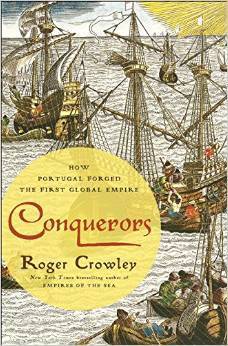
Conquerors: How Portugal Forged the First Global Empire
by Roger Crowley
Rating: 4.2 ⭐
• 2 recommendations ❤️
As remarkable as Columbus and the conquistador expeditions, the history of Portuguese exploration is now almost forgotten. But Portugal's navigators cracked the code of the Atlantic winds, launched the expedition of Vasco da Gama to India and beat the Spanish to the spice kingdoms of the East - then set about creating the first long-range maritime empire. In an astonishing blitz of thirty years, a handful of visionary and utterly ruthless empire builders, with few resources but breathtaking ambition, attempted to seize the Indian Ocean, destroy Islam and take control of world trade.Told with Roger Crowley's customary skill and verve, this is narrative history at its most vivid - an epic tale of navigation, trade and technology, money and religious zealotry, political diplomacy and espionage, sea battles and shipwrecks, endurance, courage and terrifying brutality. Drawing on extensive first-hand accounts, it brings to life the exploits of an extraordinary band of conquerors - men such as Afonso de Albuquerque, the first European since Alexander the Great to found an Asian empire - who set in motion five hundred years of European colonisation and unleashed the forces of globalisation.

Alchemy: The Dark Art and Curious Science of Creating Magic in Brands, Business, and Life
by Rory Sutherland
Rating: 4.2 ⭐
• 8 recommendations ❤️
HOW DOES MAGIC HAPPEN? The Ogilvy advertising legend—“one of the leading minds in the world of branding” (NPR)—explores the art and science of conjuring irresistible products and ideas . "Sutherland, the legendary Vice Chairman of Ogilvy, uses his decades of experience to dissect human spending behavior in an insanely entertaining way. Alchemy combines scientific research with hilarious stories and case studies of campaigns for AmEx, Microsoft and the like. This is a must-read." —Entrepreneur ("Best Books of the Year")Why is Red Bull so popular, though everyone— everyone! —hates the taste? Humans are, in a word, irrational, basing decisions as much on subtle external signals (that little blue can) as on objective qualities (flavor, price, quality). The surrounding world, meanwhile, is irreducibly complex and random. This means future success can’t be projected on any accounting spreadsheet. To strike gold, you must master the dark art and curious science of conjuring irresistible alchemy . Based on thirty years of field work inside the largest experiment in human behavior ever conceived—the forever-unfolding pageant of consumer capitalism— Alchemy, the revolutionary book by Ogilvy advertising legend Rory Sutherland, whose TED talks have been viewed nearly seven million times, decodes human behavior, blending leading-edge scientific research, absurdly entertaining storytelling, deep psychological insight, and practical case studies from his storied career working on campaigns for AmEx, Microsoft, and others. Heralded as “one of the leading minds in the world of branding” by NPR and "the don of modern advertising" by The Times , Sutherland is a unique thought leader, as comfortable exchanging ideas with Nobel Prize winners Daniel Kahneman and Richard Thaler (both interviewed in these pages) as he is crafting the next product launch. His unconventional and relentlessly curious approach has led him to discover that the most compelling secrets to human decision-making can be found in surprising What can honey bees teach us about creating a sustainable business? How could budget airlines show us how to market a healthcare system? Why is it better to be vaguely right than precisely wrong? What might soccer penalty kicks teach us about the dangers of risk-aversion? Better “branding,” Sutherland reveals, can also be employed not just to sell products, but to promote a variety of social aims, like getting people to pay taxes, improving public health outcomes, or encouraging more women to pursue careers in tech. Equally startling and profound, Sutherland’s journey through the strange world of decision making is filled with astonishing lessons for all aspects of life and business.

From the formation of the Universe to today, countless major events have changed the course of life on Earth. Aligned with the online Big History Project supported by Bill Gates, Big History puts a wide-angle lens on 13.8 billion years of remarkable history and shows you how and why we got where we are today. With stunning visual timelines and special CGI reconstructions, you can see history's greatest events. Look back to our origins in the stars, explore everything from the birth of the Sun to modern technology, and see what the future holds for humans.Weaving together multiple disciplines including physics and sociology, and with a foreword by TED speaker Professor David Christian, Big History is a truly unique look at the history of the world.
7 Powers: The Foundations of Business Strategy
by Hamilton Wright Helmer
Rating: 4.2 ⭐
• 12 recommendations ❤️
7 Powers breaks fresh ground by constructing a comprehensive strategy toolset that is easy for you to learn, communicate and quickly apply.Drawing on his decades of experience as a business strategy advisor, active equity investor and Stanford University teacher, Hamilton Helmer develops from first principles a practical theory of Strategy rooted in the notion of Power, those conditions which create the potential for persistent differential returns.Using rich real-world examples, Helmer rigorously characterizes exactly what your business must achieve to create Power. And create Power it must, for without it your business is at risk. He explains why invention always comes first and then develops the Power Progression to enable you to target when your Power must be in the origination, take-off or stability phases of your business. Every business faces a do-or-die strategy a crux directional choice made amidst swirling uncertainty. To get this right you need at your fingertips a real-time strategy compass to discern your true north. 7 Powers is that compass.

The Great CEO Within: The Tactical Guide to Company Building
by Matt Mochary
Rating: 4.5 ⭐
• 11 recommendations ❤️
Matt Mochary coaches the CEOs of many of the fastest-scaling technology companies in Silicon Valley. With The Great CEO Within , he shares his highly effective leadership and business-operating tools with any CEO or manager in the world. Learn how to efficiently scale your business from startup to corporation by implementing a system of accountability, effective problem-solving, and transparent feedback. Becoming a great CEO requires training. For a founding CEO, there is precious little time to complete that training, especially at the helm of a rapidly growing company. Now you have the guidance you need in one book.