
Rutger Bregman Recommended Books
Dutch journalist, writer and historian
7 Books Recommended

Marcus Rediker shines a light into the darkest corners of the British and American slave ships of the eighteenth century. Drawing on thirty years of research in maritime archives, court records, diaries, and firsthand accounts, The Slave Ship is riveting and sobering reconstructing in chilling detail a world nearly lost to history: the "floating dungeons" at the forefront of the birth of African American culture.

横扫各类财经图书殊荣。《华尔街日报》年度十大好书/《金融时报》及麦肯锡年度商业类佳作/世界商业图书Axiom Business大奖/《Choice》年度商业杰作…… 全球政商界精英连袖推荐。经济合合与发展组织秘书长安赫尔·古里亚,前英国央行行长默文·金,前美国白宫经济政策主任托德·布赫霍尔茨,美国经济学泰斗泰勒·柯文,高收益债券教头马丁·弗里德森,发展经济学先驱赛尔奎因,日本经济研究中心特别顾问、前任会长小岛明,《卧底经济学》作者蒂姆·哈福德,英国经济学家约翰·凯,投资分析专家约翰·莫尔丁等。强烈推荐 英国经济学巨擘、BBC副主席黛安娜·科伊尔力透纸背之作 一天读完300年发展史,让你透彻洞悉GDP如何深度影响每个人的生活随着中国经济体积的日益庞大,GDP的增长速度日益进入“L”型轨道。历史上有哪些国家曾经历过这种类似的局面,其政府...(展开全部)

How to Tame a Fox (and Build a Dog): Visionary Scientists and a Siberian Tale of Jump-Started Evolution
by Lee Alan Dugatkin
Rating: 4.1 ⭐
• 2 recommendations ❤️
Tucked away in Siberia, there are furry, four-legged creatures with wagging tails and floppy ears that are as docile and friendly as any lapdog. But, despite appearances, these are not dogs—they are foxes. They are the result of the most astonishing experiment in breeding ever undertaken—imagine speeding up thousands of years of evolution into a few decades. In 1959, biologists Dmitri Belyaev and Lyudmila Trut set out to do just that, by starting with a few dozen silver foxes from fox farms in the USSR and attempting to recreate the evolution of wolves into dogs in real time in order to witness the process of domestication. This is the extraordinary, untold story of this remarkable undertaking.Most accounts of the natural evolution of wolves place it over a span of about 15,000 years, but within a decade, Belyaev and Trut’s fox breeding experiments had resulted in puppy-like foxes with floppy ears, piebald spots, and curly tails. Along with these physical changes came genetic and behavioral changes, as well. The foxes were bred using selection criteria for tameness, and with each generation, they became increasingly interested in human companionship. Trut has been there the whole time, and has been the lead scientist on this work since Belyaev’s death in 1985, and with Lee Dugatkin, biologist and science writer, she tells the story of the adventure, science, politics, and love behind it all. In How to Tame a Fox , Dugatkin and Trut take us inside this path-breaking experiment in the midst of the brutal winters of Siberia to reveal how scientific history is made and continues to be made today.To date, fifty-six generations of foxes have been domesticated, and we continue to learn significant lessons from them about the genetic and behavioral evolution of domesticated animals. How to Tame a Fox offers an incredible tale of scientists at work, while also celebrating the deep attachments that have brought humans and animals together throughout time.

The fascinating true story of one of the most controversial psychological experiments of the modern era — a real-life Lord of the Flies.Competition. Prejudice. Discrimination. Conflict.In 1954, a group of boys attended a remote summer camp where they were split into two groups, and encouraged to bully, harass, and demonise each other. The results would make history as one of social psychology’s classic — and most controversial — studies: the Robbers Cave experiment.Conducted at the height of the Cold War, officially the experiment had a happy ending: the boys reconciled, and psychologist Muzafer Sherif demonstrated that while hatred and violence are powerful forces, so too are cooperation and harmony. Today it is proffered as proof that under the right conditions warring groups can make peace. Yet the true story of the experiments is far more complex, and more chilling.In The Lost Boys, Gina Perry explores the experiment and its consequences, tracing the story of Sherif, a troubled outsider who struggled to craft an experiment that would vanquish his personal demons. Drawing on archival material and new interviews, Perry pieces together a story of drama, mutiny, and intrigue that has never been told before.
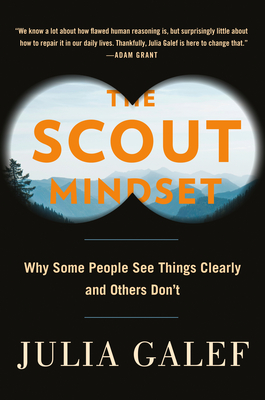
The Scout Mindset: Why Some People See Things Clearly and Others Don't
by Julia Galef
Rating: 4.1 ⭐
• 4 recommendations ❤️
When it comes to what we believe, humans see what they want to see. In other words, we have what Julia Galef calls a soldier mindset. From tribalism and wishful thinking, to rationalizing in our personal lives and everything in between, we are driven to defend the ideas we most want to believe--and shoot down those we don't. But if we want to get things right more often, argues Galef, we should train ourselves to have a scout mindset. Unlike the soldier, a scout's goal isn't to defend one side over the other. It's to go out, survey the territory, and come back with as accurate a map as possible. Regardless of what they hope to be the case, above all, the scout wants to know what's actually true. In The Scout Mindset, Galef shows that what makes scouts better at getting things right isn't that they're smarter or more knowledgeable than everyone else. It's a handful of emotional skills, habits, and ways of looking at the world--which anyone can learn. With fascinating examples ranging from how to survive being stranded in the middle of the ocean, to how Jeff Bezos avoids overconfidence, to how superforecasters outperform CIA operatives, to Reddit threads and modern partisan politics, Galef explores why our brains deceive us and what we can do to change the way we think.

The Triumph of Injustice: How the Rich Dodge Taxes and How to Make Them Pay
by Emmanuel Saez
Rating: 4.1 ⭐
• 2 recommendations ❤️
“The most important book on government policy that I’ve read in a long time.” ―David Leonhardt, New York Times Even as they have become fabulously wealthy, the ultra-rich have seen their taxes collapse to levels last seen in the 1920s. Meanwhile, working-class Americans have been asked to pay more. The Triumph of Injustice presents a forensic investigation into this dramatic transformation, written by two economists who have revolutionized the study of inequality. Blending history and cutting-edge economic analysis, Emmanuel Saez and Gabriel Zucman offer a comprehensive view of America’s tax system alongside a visionary, democratic, and practical reinvention of taxes.

Well-behaved women don’t make history: difficult women do. Feminism’s success is down to complicated, contradictory, imperfect women, who fought each other as well as fighting for equal rights. Helen Lewis argues that too many of these pioneers have been whitewashed or forgotten in our modern search for feel-good, inspirational heroines. It’s time to reclaim the history of feminism as a history of difficult women.In this book, you’ll meet the working-class suffragettes who advocated bombings and arson; the princess who discovered why so many women were having bad sex; the pioneer of the refuge movement who became a men’s rights activist; the ‘striker in a sari’ who terrified Margaret Thatcher; the wronged Victorian wife who definitely wasn’t sleeping with the prime minister; and the lesbian politician who outraged the country. Taking the story up to the present with the twenty-first-century campaign for abortion services, Helen Lewis reveals the unvarnished – and unfinished – history of women’s rights.Drawing on archival research and interviews, Difficult Women is a funny, fearless and sometimes shocking narrative history, which shows why the feminist movement has succeeded – and what it should do next. The battle is difficult, and we must be difficult too.