
Reid Hoffman Recommended Books
American Co-founder of Linkedin, venture capitalist and author
14 Books Recommended

Conscious Business: How to Build Value Through Values
by Fred Kofman
Rating: 4.2 ⭐
• 7 recommendations ❤️
Consciousness is the main source of organizational greatness. Conscious business, explains Fred Kofman, means finding your passion and expressing your essential values through your work. A conscious business seeks to promote the intelligent pursuit of happiness in all its stakeholders. It produces sustainable, exceptional performance through the solidarity of its community and the dignity of each member.Conscious Business presents breakthrough techniques to help you Unconditional responsibility―how to become the main character of your life• Unflinching integrity―how to succeed beyond success• Authentic communication―how to speak your truth, and elicit others' truths• Impeccable commitments―how to coordinate actions with accountability• Right leadership―how being, rather than doing, is the ultimate source of excellenceA conscious business fosters personal fulfillment in the individuals, mutual respect in the community, and success in the organization, teaches Fred Kofman. Conscious Business is the definitive resource for achieving what really matters in the workplace and beyond.Winner of the 2009 Nautilus Award
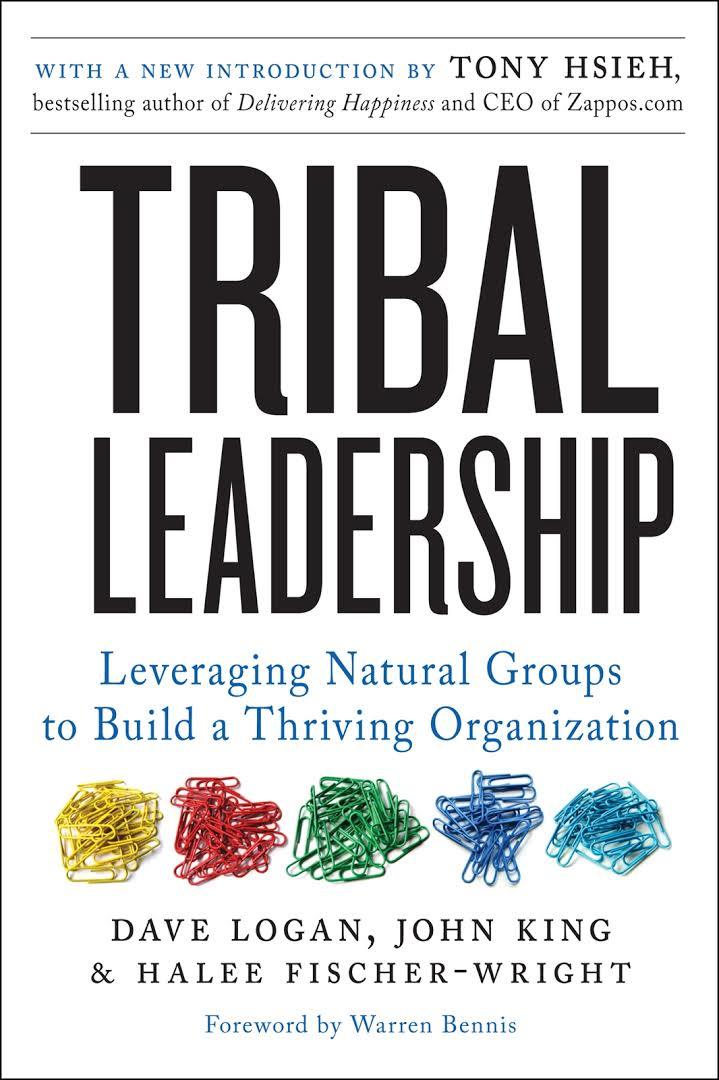
Tribal Leadership: Leveraging Natural Groups to Build a Thriving Organization
by Dave Logan
Rating: 4.0 ⭐
• 12 recommendations ❤️
It's a fact of birds flock, fish school, people "tribe." Every company, indeed every organization, is a tribe, or if it's large enough, a network of tribes—groups of 20 to 150 people in which everyone knows everyone else, or at least knows of everyone else. Tribes are more powerful than teams, companies, or even CEOs, and yet their key leverage points have not been mapped—until now. In Tribal Leadership , Dave Logan, John King, and Halee Fischer-Wright show leaders how to assess their organization's tribal culture on a scale from one to five and then implement specific tools to elevate the stage to the next. The result is unprecedented success. In a rigorous eight-year study of approximately 24,000 people in over two dozen corporations, Logan, King, and Fischer-Wright refine and define a common the success of a company depends on its tribes, the strength of its tribes is determined by the tribal culture, and a thriving corporate culture can be established by an effective tribal leader. Tribal Leadership will show leaders how to employ their companies' tribes to maximize productivity and the authors' research, backed up with interviews ranging from Brian France (CEO of NASCAR) to "Dilbert" creator Scott Adams, shows that over three quarters of the organizations they've studied have tribal cultures that are merely adequate, no better than the third of five tribal stages. Leaders, managers, and organizations that fail to understand, motivate, and grow their tribes will find it impossible to succeed in an increasingly fragmented world of business. The often counterintuitive findings of Tribal Leadership will help leaders at today's major corporations, small businesses, and nonprofits learn how to take the people in their organization from adequate to outstanding, to discover the secrets that have led the highest-level tribes (like the team at Apple that designed the iPod) to remarkable heights, and to find new ways to succeed where others have failed.

A Summer Reading Pick for President Barack Obama, Bill Gates, and Mark Zuckerberg From a renowned historian comes a groundbreaking narrative of humanity’s creation and evolution—a #1 international bestseller—that explores the ways in which biology and history have defined us and enhanced our understanding of what it means to be “human.”One hundred thousand years ago, at least six different species of humans inhabited Earth. Yet today there is only one—homo sapiens. What happened to the others? And what may happen to us?Most books about the history of humanity pursue either a historical or a biological approach, but Dr. Yuval Noah Harari breaks the mold with this highly original book that begins about 70,000 years ago with the appearance of modern cognition. From examining the role evolving humans have played in the global ecosystem to charting the rise of empires, Sapiens integrates history and science to reconsider accepted narratives, connect past developments with contemporary concerns, and examine specific events within the context of larger ideas.Dr. Harari also compels us to look ahead, because over the last few decades humans have begun to bend laws of natural selection that have governed life for the past four billion years. We are acquiring the ability to design not only the world around us, but also ourselves. Where is this leading us, and what do we want to become?Featuring 27 photographs, 6 maps, and 25 illustrations/diagrams.

Have you ever found yourself struggling with information overload?Have you ever felt both overworked and underutilised?Do you ever feel busy but not productive?If you answered yes to any of these, the way out is to become an Essentialist.In Essentialism, Greg McKeown, CEO of a Leadership and Strategy agency in Silicon Valley who has run courses at Apple, Google and Facebook, shows you how to achieve what he calls the disciplined pursuit of less. Being an Essentialist is about a disciplined way of thinking. It means challenging the core assumption of ‘We can have it all’ and ‘I have to do everything’ and replacing it with the pursuit of ‘the right thing, in the right way, at the right time'.By applying a more selective criteria for what is essential, the pursuit of less allows us to regain control of our own choices so we can channel our time, energy and effort into making the highest possible contribution toward the goals and activities that matter.Using the experience and insight of working with the leaders of the most innovative companies and organisations in the world, McKeown shows you how to put Essentialism into practice in your own life, so you too can achieve something great.

More Human: Designing a World Where People Come First
by Steve Hilton
Rating: 3.6 ⭐
• 4 recommendations ❤️
People feel angry and let down by their leaders, as well as by the institutions that dominate their political parties, government bureaucracy, and corporations. Yet the cause of this malaise, according to political -- advisor -- turned -- tech -- CEO Steve Hilton, is not being addressed by politicians on the left or the right.Hilton argues that much of our daily experience -- from the food we eat, to the governments we elect, to the economy on which our wealth depends, to the way we care for our health and well -- being -- has become too big, too bureaucratic, and too distant from the human scale.More Human sets out a radical manifesto for change, aimed at the root causes of our problems rather than just the symptoms. Whether it's using the latest advances in neuroscience to inform the fight against poverty and inequality, or applying lessons from America's most radical schools to transform our children's education, this book is an agenda for rethinking and redesigning the outdated systems and structures of our politics, government, economy, and society to make them more suited to the way we want to live our lives today. To make them more human .

The Inner Lives of Markets: How People Shape Them - And They Shape Us
by Ray Fisman
Rating: 3.7 ⭐
• 2 recommendations ❤️
What is a market? To most people it is a shopping center or an abstract space in which stock prices vary minutely. In reality, a market is something much more fundamental to being human, and it affects not just the price of tomatoes but the boundaries of everything we value.Reading the newspapers these days, you could be forgiven for thinking that markets are getting ever more efficient - and better. But as Tim Sullivan and Ray Fisman argue in this insightful book, that view is far from complete. For one thing, efficiency isn't always a good thing - illegal markets are very often more efficient than legal ones, because they are free of concern for laws and human rights. But even more importantly, the chatter about efficiency has obscured a much broader conversation about what kind of economic exchange we actually want. Every regulation, every sticker price, and every sale is part of an ever-changing ecosystem - one that affects us as much as we affect it.By tracing 50 years of economic thought on this subject, Fisman and Sullivan show how markets have evolved - and how we can keep making them better. This leads to fascinating and surprising insights, such as:- Why your £10,000 used car is likely to sell for £2,000 or less;- Why you should think twice before buying batteries on Amazon; and- Why it's essential that healthy people buy medical insurance.In the end, The Inner Lives of Markets argues for a new way of thinking about how you spend your money - it shows that every transaction you make is part of a grand social experiment. We are all guinea pigs running through a lab maze, and the sooner we realize it, the more effectively we can navigate the path we want.

The story of the gene begins in an obscure Augustinian abbey in Moravia in 1856 where a monk stumbles on the idea of a ‘unit of heredity’. It intersects with Darwin’s theory of evolution, and collides with the horrors of Nazi eugenics in the 1940s. The gene transforms post-war biology. It reorganizes our understanding of sexuality, temperament, choice and free will. This is a story driven by human ingenuity and obsessive minds – from Charles Darwin and Gregor Mendel to Francis Crick, James Watson and Rosalind Franklin, and the thousands of scientists still working to understand the code of codes.This is an epic, moving history of a scientific idea coming to life, by the author of The Emperor of All Maladies. But woven through The Gene, like a red line, is also an intimate history – the story of Mukherjee’s own family and its recurring pattern of mental illness, reminding us that genetics is vitally relevant to everyday lives. These concerns reverberate even more urgently today as we learn to “read” and “write” the human genome – unleashing the potential to change the fates and identities of our children.--front flap

The Seventh Sense: Power, Fortune, and Survival in the Age of Networks
by Joshua Cooper Ramo
Rating: 3.6 ⭐
• 6 recommendations ❤️
Endless terror. Refugee waves. An unfixable global economy. Surprising election results. New billion-dollar fortunes. Miracle medical advances. What if they were all connected? What if you could understand why?The Seventh Sense is the story of what all of today's successful figures see and the forces that are invisible to most of us but explain everything from explosive technological change to uneasy political ripples. The secret to power now is understanding our new age of networks. Not merely the Internet, but also webs of trade, finance, and even DNA. Based on his years of advising generals, CEOs, and politicians, Ramo takes us into the opaque heart of our world's rapidly connected systems and teaches us what the losers are not yet seeing -- and what the victors of this age already know.

This Brave New World: India, China, and the United States
by Anja Manuel
Rating: 4.2 ⭐
• 2 recommendations ❤️
“Incisive...lively and accessible...Manuel shows us that an optimistic path is we can bring China and India along as partners.” — San Francisco ChronicleIn the next decade and a half, China and India will become two of the world’s indispensable powers—whether they rise peacefully or not. During that time, Asia will surpass the combined strength of North America and Europe in economic might, population size, and military spending.Both India and China will have vetoes over many international decisions, from climate change to global trade, human rights, and business standards.From her front row view of this colossal shift, first at the State Department and now as an advisor to American business leaders, Anja Manuel escorts the reader on an intimate tour of the corridors of power in Delhi and Beijing. Her encounters with political and business leaders reveal how each country’s history and politics influences their conduct today. Through vibrant stories, she reveals how each country is working to surmount enormous challenges—from the crushing poverty of Indian slum dwellers and Chinese factory workers, to outrageous corruption scandals, rotting rivers, unbreathable air, and managing their citizens’ discontent.We wring our hands about China, Manuel writes, while we underestimate India, which will be the most important country outside the West to shape China’s rise. Manuel shows us that a different path is possible—we can bring China and India along as partners rather than alienating one or both, and thus extend our own leadership in the world.

The Airbnb Story: How Three Ordinary Guys Disrupted an Industry, Made Billions . . . and Created Plenty of Controversy
by Leigh Gallagher
Rating: 4.1 ⭐
• 6 recommendations ❤️
This is the remarkable behind-the-scenes story of the creation and growth of Airbnb, the online hotel platform that has become, in under a decade, the largest provider of accommodations in the world. At first just the whacky idea of co-founder CEO Brian Chesky, Airbnb has disrupted the $500 billion hotel industry, its $25.5 billion valuation is now equal to Hilton and larger than Marriott. Airbnb is beloved by the 80,000 million members of its host community and the travelers they shelter every night. And yet, even as it has blazed such an unexpected path, this is the first book solely dedicated to the phenomenon of Airbnb.Fortune editor Leigh Gallagher explores the success of Airbnb along with the darker side of the story. Regulators want to shut it down; hotel industry leaders wrestle with copying or killing it; residents resent the constant parade of travelers; some hosts see property damage; and some analysts feel Airbnb is dangerously overvalued. This is also the first in depth study of Airbnb's leader, Brian Chesky, the quirky and curious young CEO, as he steers the company through increasingly uncharted waters.

New Power: How Anyone Can Persuade, Mobilize, and Succeed in Our Chaotic, Connected Age
by Jeremy Heimans
Rating: 3.8 ⭐
• 12 recommendations ❤️
NOW A NATIONAL BESTSELLER The definitive guide to spreading ideas, building movements, and leaping ahead in our chaotic, connected age. Get the book New York Times columnist David Brooks calls "the best window I've seen into this new world."Why do some leap ahead while others fall behind in our chaotic, connected age? In New Power, Jeremy Heimans and Henry Timms confront the biggest stories of our time--the rise of mega-platforms like Facebook and Uber; the out-of-nowhere victories of Obama and Trump; the unexpected emergence of movements like #MeToo--and reveal what's really behind them: the rise of "new power." For most of human history, the rules of power were clear: power was something to be seized and then jealously guarded. This "old power" was out of reach for the vast majority of people. But our ubiquitous connectivity makes possible a different kind of power. "New power" is made by many. It is open, participatory, and peer-driven. It works like a current, not a currency--and it is most forceful when it surges. The battle between old and new power is determining who governs us, how we work, and even how we think and feel. New Power shines fresh light on the cultural phenomena of our day, from #BlackLivesMatter to the Ice Bucket Challenge to Airbnb, uncovering the new power forces that made them huge. Drawing on examples from business, activism, and pop culture, as well as the study of organizations like Lego, NASA, Reddit, and TED, Heimans and Timms explain how to build new power and channel it successfully. They also explore the dark side of these forces: the way ISIS has co-opted new power to monstrous ends, and the rise of the alt-right's "intensity machine." In an era increasingly shaped by new power, this groundbreaking book offers us a new way to understand the world--and our role in it.

LinkedIn co-founder, legendary investor and author of the NYT Bestseller The Start-up of You reveals the secret to starting and scaling massively valuable companies.For most of the world, the terms "Silicon Valley" and "startup" are synonymous. Indeed, Silicon Valley is home to a disproportionate number of companies that have grown from garage startups into global giants. But what is the secret to these startups' extraordinary success? Contrary to the popular narrative, it's not their superhuman founders or savvy venture capitalists. Rather, it's that they have learned how to Blitzscale. Blitzscaling is a specific set of practices for igniting and managing dizzying growth; an accelerated path to the stage in a startup's life-cycle where the most value is created. It prioritizes speed over efficiency in an environment of uncertainty, and allows a company to go from "startup" to "scaleup" at a furious pace that captures the market. Drawing on their experiences scaling startups into billion-dollar businesses, Hoffman and Yeh offer a framework for blitzscaling that can be replicated in any region or industry. Readers will learn how to design business models that support lightning-fast growth, navigate necessary shifts in strategy at each level of scale, and weather the management challenges that arise as their company grows.

Alpha Girls: The Women Upstarts Who Took On Silicon Valley's Male Culture and Made the Deals of a Lifetime
by Julian Guthrie
Rating: 3.9 ⭐
• 8 recommendations ❤️
An unforgettable story of four women who, through grit and ingenuity, became stars in the cutthroat, high-stakes, male dominated world of venture capital in Silicon Valley, and helped build some of the foremost companies of our time.In Alpha Girls , award-winning journalist Julian Guthrie takes readers behind the closed doors of venture capital, an industry that transforms economies and shapes how we live. We follow the lives and careers of four women who were largely written out of history - until now.Magdalena Yesil, who arrived in America from Turkey with $43 to her name, would go on to receive her electrical engineering degree from Stanford, found some of the first companies to commercialize internet access, and help Marc Benioff build Salesforce. Mary Jane Elmore went from the corn fields of Indiana to Stanford and on to the storied venture capital firm IVP - where she was one of the first women in the U.S. to make partner - only to be pulled back from the glass ceiling by expectations at home. Theresia Gouw, an overachieving first-generation Asian American from a working-class town, dominated the foosball tables at Brown (she would later reluctantly let Sergey Brin win to help Accel Partners court Google), before she helped land and build companies including Facebook, Trulia, Imperva, and ForeScout. Sonja Hoel, a Southerner who became the first woman investing partner at white-glove Menlo Ventures, invested in McAfee, Hotmail, Acme Packet, and F5 Networks. As her star was still rising at Menlo, a personal crisis would turn her into an activist overnight, inspiring her to found an all-women's investment group and a national nonprofit for girls.These women, juggling work and family, shaped the tech landscape we know today while overcoming unequal pay, actual punches, betrayals, and the sexist attitudes prevalent in Silicon Valley and in male-dominated industries everywhere. Despite the setbacks, they would rise again to rewrite the rules for an industry they love. In Alpha Girls , Guthrie reveals their untold stories.

La Déferlante: Technologie, pouvoir et le dilemme majeur du XXIe siècle
by Mustafa Suleyman
Rating: 3.6 ⭐
• 2 recommendations ❤️
Imaginez un monde où quiconque, muni d’un synthétiseur d’ADN à 20 000 dollars, pourrait développer et propager un virus mortel ; où la vidéo deepfake d’un président en train de tenir des propos racistes ferait le tour d’Internet la veille d’une élection ; où des organisations terroristes stockeraient des armes autonomes.En tant que cofondateur de DeepMind, le pionnier de l’IA racheté par Google, Mustafa Suleyman a été un témoin privilégié de la rapidité de nos progrès technologiques – et de l’insuffisante compréhension que nous en avons. En s’appuyant sur son expérience et sur une analyse historique des révolutions techniques, il montre comment les prochaines décennies seront caractérisées par une vague d’innovations inévitable qui touchera des secteurs aussi variés que la biologie synthétique, l’intelligence artificielle ou l’informatique quantique. Ces avancées, stimulées par de fortes incitations stratégiques et financières, résoudront d’immenses défis et enrichiront le monde – mais elles le déstabiliseront aussi, et compromettront le principe même d’État-nation.Tandis que nos gouvernements fragilisés se dirigent aveuglément vers la catastrophe, Mustafa Suleyman prouve que le « problème de l’endiguement », c’est-à-dire le défi de garder les technologies dangereuses sous le contrôle de l’humanité, sera le dilemme central de notre époque.