129 Books Recommended
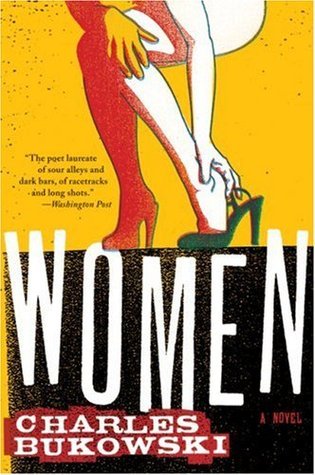
Low-life writer and unrepentant alcoholic Henry Chinaski was born to survive. After decades of slacking off at low-paying dead-end jobs, blowing his cash on booze and women, and scrimping by in flea-bitten apartments, Chinaski sees his poetic star rising at last. Now, at fifty, he is reveling in his sudden rock-star life, running three hundred hangovers a year, and maintaining a sex life that would cripple Casanova.

The True Believer: Thoughts on the Nature of Mass Movements
by Eric Hoffer
Rating: 4.2 ⭐
• 16 recommendations ❤️
A stevedore on the San Francisco docks in the 1940s, Eric Hoffer wrote philosophical treatises in his spare time while living in the railroad yards. The True Believer -- the first and most famous of his books -- was made into a bestseller when President Eisenhower cited it during one of the earliest television press conferences. Completely relevant and essential for understanding the world today, The True Believer is a visionary, highly provocative look into the mind of the fanatic and a penetrating study of how an individual becomes one.

One of the greatest philosophers of the nineteenth century, Schopenhauer (1788-1860) believed that human action is determined not by reason but by 'will' - the blind and irrational desire for physical existence. This selection of his writings on religion, ethics, politics, women, suicide, books and many other themes is taken from Schopenhauer's last work, Parerga and Paralipomena, which he published in 1851. These pieces depict humanity as locked in a struggle beyond good and evil, and each individual absolutely free within a Godless world, in which art, morality and self-awareness are our only salvation. This innovative - and pessimistic - view has proved powerfully influential upon philosophy and art, directly affecting the work of Nietzsche, Wittgenstein and Wagner among others.

Let My People Go Surfing: The Education of a Reluctant Businessman--Including 10 More Years of Business Unusual
by Yvon Chouinard
Rating: 4.3 ⭐
• 5 recommendations ❤️
In his long-awaited memoir, Yvon Chouinard-legendary climber, businessman, environmentalist, and founder of Patagonia, Inc.-shares the persistence and courage that have gone into being head of one of the most respected and environmentally responsible companies on earth. From his youth as the son of a French Canadian blacksmith to the thrilling, ambitious climbing expeditions that inspired his innovative designs for the sport's equipment, Let My People Go Surfing is the story of a man who brought doing good and having grand adventures into the heart of his business life-a book that will deeply affect entrepreneurs and outdoor enthusiasts alike.

Influence, the classic book on persuasion, explains the psychology of why people say "yes"—and how to apply these understandings. Dr. Robert Cialdini is the seminal expert in the rapidly expanding field of influence and persuasion. His thirty-five years of rigorous, evidence-based research along with a three-year program of study on what moves people to change behavior has resulted in this highly acclaimed book.You'll learn the six universal principles, how to use them to become a skilled persuader—and how to defend yourself against them. Perfect for people in all walks of life, the principles of Influence will move you toward profound personal change and act as a driving force for your success.
The now-classic Metaphors We Live By changed our understanding of metaphor and its role in language and the mind. Metaphor, the authors explain, is a fundamental mechanism of mind, one that allows us to use what we know about our physical and social experience to provide understanding of countless other subjects. Because such metaphors structure our most basic understandings of our experience, they are "metaphors we live by", metaphors that can shape our perceptions and actions without our ever noticing them.In this updated edition of Lakoff and Johnson's influential book, the authors supply an afterword surveying how their theory of metaphor has developed within the cognitive sciences to become central to the contemporary understanding of how we think and how we express our thoughts in language.

Boyd: The Fighter Pilot Who Changed the Art of War
by Robert Coram
Rating: 4.1 ⭐
• 4 recommendations ❤️
John Boyd may be the most remarkable unsung hero in all of American military history. Some remember him as the greatest U.S. fighter pilot ever -- the man who, in simulated air-to-air combat, defeated every challenger in less than forty seconds. Some recall him as the father of our country's most legendary fighter aircraft -- the F-15 and F-16. Still others think of Boyd as the most influential military theorist since Sun Tzu. They know only half the story.Boyd, more than any other person, saved fighter aviation from the predations of the Strategic Air Command. His manual of fighter tactics changed the way every air force in the world flies and fights. He discovered a physical theory that forever altered the way fighter planes were designed. Later in life, he developed a theory of military strategy that has been adopted throughout the world and even applied to business models for maximizing efficiency. And in one of the most startling and unknown stories of modern military history, the Air Force fighter pilot taught the U.S. Marine Corps how to fight war on the ground. His ideas led to America's swift and decisive victory in the Gulf War and foretold the terrorist attacks of September 11, 2001.On a personal level, Boyd rarely met a general he couldn't offend. He was loud, abrasive, and profane. A man of daring, ferocious passion and intractable stubbornness, he was that most American of heroes -- a rebel who cared not for his reputation or fortune but for his country. He was a true patriot, a man who made a career of challenging the shortsighted and self-serving Pentagon bureaucracy. America owes Boyd and his disciples -- the six men known as the "Acolytes" -- a great debt.Robert Coram finally brings to light the remarkable story of a man who polarized all who knew him, but who left a legacy that will influence the military -- and all of America -- for decades to come . . .

Herzog was once hailed by Francois Truffaut as the most important director alive. Famous for his frequent collaborations with mercurial actor Klaus Kinski - including the epics Aguirre, the Wrath of God and Fitzcarraldo, and the terrifying Nosferatu - and more recently with documentaries such as Grizzly Man, Cave of Forgotten Dreams and Into the Abyss, Herzog has built a body of work that is one of the most vital in post-war German cinema. Here, he reflects on his legendary and inspiring career.
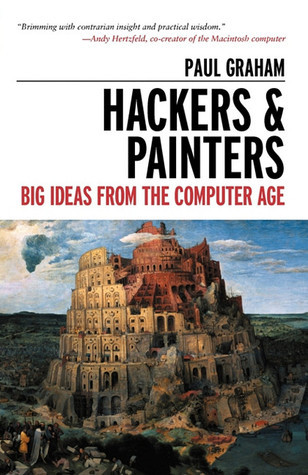
Hackers & Painters: Big Ideas from the Computer Age
by Paul Graham
Rating: 4.2 ⭐
• 14 recommendations ❤️
"The computer world is like an intellectual Wild West, in which you can shoot anyone you wish with your ideas, if you're willing to risk the consequences. " --from Hackers & Big Ideas from the Computer Age , by Paul Graham We are living in the computer age, in a world increasingly designed and engineered by computer programmers and software designers, by people who call themselves hackers. Who are these people, what motivates them, and why should you care? Consider these Everything around us is turning into computers. Your typewriter is gone, replaced by a computer. Your phone has turned into a computer. So has your camera. Soon your TV will. Your car was not only designed on computers, but has more processing power in it than a room-sized mainframe did in 1970. Letters, encyclopedias, newspapers, and even your local store are being replaced by the Internet. Hackers & Big Ideas from the Computer Age , by Paul Graham, explains this world and the motivations of the people who occupy it. In clear, thoughtful prose that draws on illuminating historical examples, Graham takes readers on an unflinching exploration into what he calls "an intellectual Wild West." The ideas discussed in this book will have a powerful and lasting impact on how we think, how we work, how we develop technology, and how we live. Topics include the importance of beauty in software design, how to make wealth, heresy and free speech, the programming language renaissance, the open-source movement, digital design, internet startups, and more.

Creativity: Flow and the Psychology of Discovery and Invention
by Mihály Csíkszentmihályi
Rating: 4.1 ⭐
• 4 recommendations ❤️
The classic study of the creative process from the bestselling author of FlowCreativity is about capturing those moments that make life worth living. Legendary psychologist Mihaly Csikszentmihalyi (“The leading researcher into ‘flow states.’” — Newsweek ) reveals what leads to these moments—be it the excitement of the artist at the easel or the scientist in the lab—so that this knowledge can be used to enrich people's lives. Drawing on nearly one hundred interviews with exceptional people, from biologists and physicists, to politicians and business leaders, to poets and artists, as well as his thirty years of research on the subject, Csikszentmihalyi uses his famous flow theory to explore the creative process. He discusses such ideas as why creative individuals are often seen as selfish and arrogant, and why the "tortured genius" is largely a myth. Most important, he explains why creativity needs to be cultivated and is necessary for the future of our country, if not the world.

Coleman Barks has played a central role in making the Sufi mystic Rumi the most popular poet in the world. A Year with Rumi brings together 365 of Barks's elegant and beautiful translations of Rumi's greatest poems, including fifteen never-before-published poems.Barks includes an Introduction that sets Rumi in his context and an Afterword musing on poetry of the mysterious and the sacred. Join Coleman Barks and Rumi for a year-long journey into the mystical and sacred within and without. Join them in recognizing and embracing the divine in the sublime, in the ordinary, and in us all.

Let Your Life Speak: Listening for the Voice of Vocation
by Parker J. Palmer
Rating: 4.1 ⭐
• 5 recommendations ❤️
With wisdom, compassion, and gentle humor, Parker J. Palmer invites us to listen to the inner teacher and follow its leadings toward a sense of meaning and purpose. Telling stories from his own life and the lives of others who have made a difference, he shares insights gained from darkness and depression as well as fulfillment and joy, illuminating a pathway toward vocation for all who seek the true calling of their lives.

Mastery: The Keys to Success and Long-Term Fulfillment
by George Leonard
Rating: 4.1 ⭐
• 8 recommendations ❤️
"The pracitcal wisdom in George Leonard's book will have a great influence for many years to come." —Michael Murphy, author of Golf in the Kingdom and The Future of the BodyDrawing on Zen philosophy and his expertise in the martial art of aikido, bestselling author Gorge Leonard shows how the process of mastery can help us attain a higher level of excellence and a deeper sense of satisfaction and fulfillment in our daily lives. Whether you're seeking to improve your career or your intimate relationships, increase self-esteem or create harmony within yourself, this inspiring prescriptive guide will help you master anything you choose and achive success in all areas of your life.In Mastery, you'll discover:The 5 Essential Keys to MasteryTools for MasteryHow to Master Your Athletic PotentialThe 3 Personality Types That Are Obstacles to MasteryHow to Avoid Pitfalls Along the Path. . . and more

The Sovereign Individual: Mastering the Transition to the Information Age
by James Dale Davidson
Rating: 4.2 ⭐
• 14 recommendations ❤️
Two renowned investment advisors and authors of the bestseller The Great Reckoning bring to light both currents of disaster and the potential for prosperity and renewal in the face of radical changes in human history as we move into the next century.The Sovereign Individual details strategies necessary for adapting financially to the next phase of Western civilization.Few observers of the late twentieth century have their fingers so presciently on the pulse of the global political and economic realignment ushering in the new millennium as do James Dale Davidson and Lord William Rees-Mogg. Their bold prediction of disaster on Wall Street in Blood in the Streets was borne out by Black Tuesday. In their ensuing bestseller, The Great Reckoning, published just weeks before the coup attempt against Gorbachev, they analyzed the pending collapse of the Soviet Union and foretold the civil war in Yugoslavia and other events that have proved to be among the most searing developments of the past few years.In The Sovereign Individual, Davidson and Rees-Mogg explore the greatest economic and political transition in centuries—the shift from an industrial to an information-based society. This transition, which they have termed "the fourth stage of human society," will liberate individuals as never before, irrevocably altering the power of government. This outstanding book will replace false hopes and fictions with new understanding and clarified values.

Devil Take the Hindmost: A History of Financial Speculation
by Edward Chancellor
Rating: 4.0 ⭐
• 2 recommendations ❤️
A lively and authoritative look at speculation from early modern times to the present.Focusing on speculation as it developed in the world's leading stock markets, Edward Chancellor's story starts with the tulipomania in seventeenth-century Holland, then moves to Britain with accounts of speculative manias such as the South Sea Bubble and the Railway Mania. From the mid-nineteenth century, the narrative turns to the United States, with chapters on the Gilded Age, the Roaring Twenties, and the revival of speculation since the early 1970s, then portrays the disastrous Bubble Economy of Japan in the 1980s. Chancellor shows that the impulses that have shaped speculative behavior are at odds with the orthodox theory of efficient markets. His comprehensive history is interspersed with trenchant commentary on speculation in the 1990s, including such current issues as emerging markets, Internet and foreign-currency speculation, rogue traders, the great U.S. bull market, and our current financial predicament.

In his most widely appealing book yet, one of today's leading authors of popular anthropology looks at the intriguing history and peculiar nature of money, tracing our relationship with it from the time when primitive men exchanged cowrie shells to the imminent arrival of the all-purpose electronic cash card.

Against the Gods: The Remarkable Story of Risk
by Peter L. Bernstein
Rating: 4.0 ⭐
• 8 recommendations ❤️
With the stock market breaking records almost daily, leaving longtime market analysts shaking their heads and revising their forecasts, a study of the concept of risk seems quite timely. Peter Bernstein has written a comprehensive history of man's efforts to understand risk and probability, beginning with early gamblers in ancient Greece, continuing through the 17th-century French mathematicians Pascal and Fermat and up to modern chaos theory. Along the way he demonstrates that understanding risk underlies everything from game theory to bridge-building to winemaking.

Now in its fifth edition, Diffusion of Innovations is a classic work on the spread of new ideas. It has sold 30,000 copies in each edition and will continue to reach a huge academic audience.In this renowned book, Everett M. Rogers, professor and chair of the Department of Communication & Journalism at the University of New Mexico, explains how new ideas spread via communication channels over time. Such innovations are initially perceived as uncertain and even risky. To overcome this uncertainty, most people seek out others like themselves who have already adopted the new idea. Thus the diffusion process consists of a few individuals who first adopt an innovation, then spread the word among their circle of acquaintances--a process which typically takes months or years. But there are exceptions: use of the Internet in the 1990s, for example, may have spread more rapidly than any other innovation in the history of humankind. Furthermore, the Internet is changing the very nature of diffusion by decreasing the importance of physical distance between people. The fifth edition addresses the spread of the Internet, and how it has transformed the way human beings communicate and adopt new ideas.

The Essays of Warren Buffett: Lessons for Corporate America
by Lawrence A. Cunningham
Rating: 4.4 ⭐
• 4 recommendations ❤️
The fifth edition of The Essays of Warren Lessons for Corporate America continues a 25-year tradition of collating Warren Buffett's philosophy in a historic collaboration between Mr. Buffett and Prof. Lawrence Cunningham. As the book Buffett autographs most, its popularity and longevity attest to the widespread appetite for this unique compilation of Mr. Buffett's thoughts that is at once comprehensive, non-repetitive, and digestible. New and experienced readers alike will gain an invaluable informal education by perusing this classic arrangement of Mr. Buffett's best writings.

Easwaran's best-selling translation of the ancient wisdom texts called the Upanishads is reliable, readable, and profound.In the Upanishads, illumined sages share flashes of insight, the results of their investigation into consciousness itself. In extraordinary visions, they have direct experience of a transcendent Reality which is the essence, or Self, of each created being. They teach that each of us, each Self, is eternal, deathless, one with the power that created the universe.Easwaran's translation of the principal Upanishads and five others includes an overview of the cultural and historical setting, with chapter introductions, notes, and a Sanskrit glossary. But it is Easwaran's understanding of the wisdom of the Upanishads that makes this edition truly outstanding.Each sage, each Upanishad, appeals in a different way to the reader's head and heart. In the end, Easwaran writes, "The Upanishads are part of India's precious legacy, not just to Hinduism but to humanity, and in that spirit they are offered here."

Winner of the Pulitzer Prize and hailed as “the best history of oil ever written” by Business Week, Daniel Yergin’s “spellbinding…irresistible” ( The New York Times ) account of the global pursuit of oil, money, and power addresses the ongoing energy crisis.Now with an epilogue that speaks directly to the current energy crisis, The Prize recounts the panoramic history of the world’s most important resource—oil. Daniel Yergin’s timeless book chronicles the struggle for wealth and power that has surrounded oil for decades and that continues to fuel global rivalries, shake the world economy, and transform the destiny of men and nations. This updated edition categorically proves the unwavering significance of oil throughout the twentieth century and into the twenty-first by tracing economic and political clashes over precious “black gold.”With his far-reaching insight and in-depth research, Yergin is uniquely positioned to address the present battle over energy which undoubtedly ranks as one of the most vital issues of our time. The canvas of his narrative history is enormous—from the drilling of the first well in Pennsylvania through two great world wars to the Iraqi invasion of Kuwait, Operation Desert Storm, and both the Iraq War and current climate change. The definitive work on the subject of oil, The Prize is a book of extraordinary breadth, riveting excitement, and great value—crucial to our understanding of world politics and the economy today—and tomorrow.

Setting the Table: The Transforming Power of Hospitality in Business
by Danny Meyer
Rating: 4.2 ⭐
• 15 recommendations ❤️
The bestselling business book from award-winning restauranteur Danny Meyer, of Union Square Cafe, Gramercy Tavern, and Shake ShackSeventy-five percent of all new restaurant ventures fail, and of those that do stick around, only a few become icons. Danny Meyer started Union Square Cafe when he was 27, with a good idea and hopeful investors. He is now the co-owner of a restaurant empire. How did he do it? How did he beat the odds in one of the toughest trades around? In this landmark book, Danny shares the lessons he learned developing the dynamic philosophy he calls Enlightened Hospitality. The tenets of that philosophy, which emphasize strong in-house relationships as well as customer satisfaction, are applicable to anyone who works in any business. Whether you are a manager, an executive, or a waiter, Danny’s story and philosophy will help you become more effective and productive, while deepening your understanding and appreciation of a job well done. Setting the Table is landmark a motivational work from one of our era’s most gifted and insightful business leaders.

The Song of the Dodo: Island Biogeography in an Age of Extinction
by David Quammen
Rating: 4.3 ⭐
• 2 recommendations ❤️
David Quammen's book, The Song of the Dodo, is a brilliant, stirring work, breathtaking in its scope, far-reaching in its message -- a crucial book in precarious times, which radically alters the way in which we understand the natural world and our place in that world. It's also a book full of entertainment and wonders.In The Song of the Dodo, we follow Quammen's keen intellect through the ideas, theories, and experiments of prominent naturalists of the last two centuries. We trail after him as he travels the world, tracking the subject of island biogeography, which encompasses nothing less than the study of the origin and extinction of all species. Why is this island idea so important? Because islands are where species most commonly go extinct -- and because, as Quammen points out, we live in an age when all of Earth's landscapes are being chopped into island-like fragments by human activity.Through his eyes, we glimpse the nature of evolution and extinction, and in so doing come to understand the monumental diversity of our planet, and the importance of preserving its wild landscapes, animals, and plants. We also meet some fascinating human characters. By the book's end we are wiser, and more deeply concerned, but Quammen leaves us with a message of excitement and hope.

"An excellent primer for anyone struggling to keep profits ahead of costs. . . . Double Your Profits ' 'take no prisoners' approach is refreshing." - William Byham, bestselling coauthor of Zapp! One of the nation's foremost management consultants shares seventy-eight proven ways to cut costs dramatically, send sales through the roof, and double profits in just six months. This timeless profit-boosting guide, considered a top management resource by business powerhouse Jack Welch, presents insights that are notable for their aggressive approach and contrarian perspective. Bob Fifer, former chairman and CEO of Kaiser Associates, shows us how to turn the tables on hardball-playing suppliers and competitors. He also challenges outmoded assumptions and explains Whether you're a mid-level manager, senior executive, or Fortune 500 CEO, you'll find this book is required reading for growing your company and improving your bottom line.

In this landmark work Keith Johnstone provides a revelatory guide to rediscovering and unlocking the imagination. Admired for its clarity and zest, Impro lays bare the techniques and exercises used to foster spontaneity and narrative skill for actors. These techniques and exercises were evolved in the actors' studio, when he was Associate Director of the Royal Court and then in demonstrations to schools and colleges and ultimately in the founding of a company of performers called The Theatre Machine.Divided into four sections, 'Status', 'Spontaneity', 'Narrative Skills' and 'Masks and Trance', arranged more or less in the order a group might approach them, the book sets out the specific approaches which Johnstone has himself found most useful and most stimulating. The result is a fascinating exploration of the nature of spontaneous creativity.

As One Is: To Free the Mind from All Conditioning
by J. Krishnamurti
Rating: 4.4 ⭐
• 2 recommendations ❤️
In this series of 8 talks, given in Ojai, California in 1955, Krishnamurti confronts the confusion, habits, and assumptions of the human mind, and claims these lie at the root of all violence and suffering in the world. While these reflections were offered over 50 years ago, their meaning is as fresh and as relevant heard today. Krishnamurti discusses a world in which booming productivity and scientific advancement promise a happy future, but don't provide it. He points to the ongoing escalation of war, competition, envy and territoriality despite gains in education, religious ecumenism and the technologies of self-improvement. Ultimately and throughout, he asks his listeners to consider that all apparent progress of the self is not progress toward freedom, but a treadmill of illusion. Knowing one's mind, he asserts, through diligent self-observation, is the only way to freedom.

From Pulitzer Prize-winning Annie Dillard, a collection that illuminates the dedication and daring that characterizes a writer's life.In these short essays, Annie Dillard—the author of Pilgrim at Tinker Creek and An American Childhood—illuminates the dedication, absurdity, and daring that characterize the existence of a writer. A moving account of Dillard’s own experiences while writing her works, The Writing Life offers deep insight into one of the most mysterious professions.

A technique for producing ideas: A simple five step formula for producing ideas
by James Webb Young
Rating: 3.9 ⭐
• 2 recommendations ❤️
This concise and powerful book lifts the lid on the creative process and eloquently details the steps needed to create exciting new ideas.Advertising copywriters, engineers, poets, painters and scientists have all benefited from its text to make creative breakthroughs.Advertising trailblazer William Bernbach wrote, ""James Webb Young conveys in his little book something more valuable than the most learned and detailed texts on the subject of advertising. Mr. Young is in the tradition of some of our greatest thinkers when he describes the workings of the creative process.""Table of contents How it started The formula of experience The Pareto theory Training the mind Combining old elements Ideas are new combinations The Mental digestive process "Constantly thinking about it" The final stage Some after-thoughts

Join author Douglas Adams and zoologist Mark Carwardine as they take off around the world in search of exotic, endangered creatures.

The Systems Bible: The Beginner's Guide to Systems Large and Small
by John Gall
Rating: 3.9 ⭐
• 2 recommendations ❤️
Book is in Good condition

The (Mis)Behaviour of Markets: A Fractal View of Risk, Ruin and Reward
by Benoît B. Mandelbrot
Rating: 4.1 ⭐
• 4 recommendations ❤️
This international bestseller, which foreshadowed a market crash, explains why it could happen again if we don't act now. Fractal geometry is the mathematics of roughness: how to reduce the outline of a jagged leaf or static in a computer connection to a few simple mathematical properties. With his fractal tools, Mandelbrot has got to the bottom of how financial markets really work. He finds they have a shifting sense of time and wild behaviour that makes them volatile, dangerous - and beautiful. In his models, the complex gyrations of the FTSE 100 and exchange rates can be reduced to straightforward formulae that yield a much more accurate description of the risks involved.
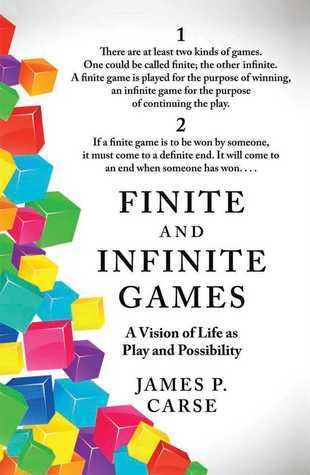
“There are at least two kinds of games,” states James P. Carse as he begins this extraordinary book. “One could be called finite; the other infinite. A finite game is played for the purpose of winning, an infinite game for the purpose of continuing the play.”Finite games are the familiar contests of everyday life; they are played in order to be won, which is when they end. But infinite games are more mysterious. Their object is not winning, but ensuring the continuation of play. The rules may change, the boundaries may change, even the participants may change—as long as the game is never allowed to come to an end.What are infinite games? How do they affect the ways we play our finite games? What are we doing when we play—finitely or infinitely? And how can infinite games affect the ways in which we live our lives?Carse explores these questions with stunning elegance, teasing out of his distinctions a universe of observation and insight, noting where and why and how we play, finitely and infinitely. He surveys our world—from the finite games of the playing field and playing board to the infinite games found in culture and religion—leaving all we think we know illuminated and transformed. Along the way, Carse finds new ways of understanding everything, from how an actress portrays a role to how we engage in sex, from the nature of evil to the nature of science. Finite games, he shows, may offer wealth and status, power and glory, but infinite games offer something far more subtle and far grander.Carse has written a book rich in insight and aphorism. Already an international literary event, Finite and Infinite Games is certain to be argued about and celebrated for years to come. Reading it is the first step in learning to play the infinite game.

Tragedy and Hope: A History of the World in Our Time
by Carroll Quigley
Rating: 4.3 ⭐
• 2 recommendations ❤️
TRAGEDY AND HOPE shows the years 1895-1950 as a period of transition from the world dominated by Europe in the nineteenth century to the world of three blocs in the twentieth century. With clarity, perspective, and cumulative impact, Professor Quigley examines the nature of that transition through two world wars and a worldwide economic depression. As an interpretative historian, he tries to show each event in the full complexity of its historical context. The result is a unique work, notable in several ways. It gives a picture of the world in terms of the influence of different cultures and outlooks upon each other; it shows, more completely than in any similar work, the influence of science and technology on human life; and it explains, with unprecedented clarity, how the intricate financial and commercial patterns of the West prior to 1914 influenced the development of today's world.

“This could be a very useful book for teachers and non-teachers alike. Dr. DeBono does not claim to be able to turn us all into Miltons, Davincis, and Einsteins…but his techniques provide an alternative to just sitting around waiting for the Muse to appear. The Muse never appears to most of us—hence the value of this book.”— David Cohen, Times Educational Supplement The first practical explanation of how creativity works, this results-oriented bestseller trains listeners to move beyond a “vertical” mode of thought to tap the potential of lateral thinking “The underlying argument of the book is that there are two kinds of thinking—vertical and lateral. Most of us are educated to think vertically, to go from one logical step to the next, moving all the time towards the one correct solution of our problem. We are not usually educated to be creative, to generate idea after idea…. “Dr. DeBono argues that the function of vertical, logical thinking is to argue what is wrong. It is a very useful way of thinking, but it is not the only useful way. To claim it is, is the sort of intellectual arrogance that makes creative thinking unlikely….

In a malarial outpost in the South American rain forest, two misplaced gringos converge and clash. Martin Quarrier has come to convert the fearful and elusive Niaruna Indians to his brand of Christianity. Lewis Moon, a stateless mercenary who is himself part Indian, has come to kill them on behalf of the local commandant. Out of their struggle Peter Matthiessen has created an electrifying moral thriller, a novel of Conradian richness that explores both the varieties of spiritual experience and the politics of cultural genocide.
"Unique among survival books…stunning…enthralling. Deep Survival makes compelling, and chilling, reading." ― Denver Post Laurence Gonzales’s bestselling Deep Survival has helped save lives from the deepest wildernesses, just as it has improved readers’ everyday lives. Its mix of adventure narrative, survival science, and practical advice has inspired everyone from business leaders to military officers, educators, and psychiatric professionals on how to take control of stress, learn to assess risk, and make better decisions under pressure.
"Fante was my god." —Charles Bukowski, in his introduction to Ask the DustArturo Bandini, a young, struggling Italian-American writer living in a seedy hotel in 1930s Los Angeles, falls hard for the elusive, mocking, unstable Camilla Lopez, a Mexican waitress. The pair embark on a strange and strained love-hate relationship, which slowly, but inexorably, descends into the realm of madness.Ask the Dust is one of the truly great, yet unsung, American novels of the twentieth century. A tough and unsentimental story with a soft and tender heart, it remains as fresh and affecting as the day it was written.

Tom Wolfe began The Right Stuff at a time when it was unfashionable to contemplate American heroism. Nixon had left the White House in disgrace, the nation was reeling from the catastrophe of Vietnam, and in 1979--the year the book appeared--Americans were being held hostage by Iranian militants. Yet it was exactly the anachronistic courage of his subjects that captivated Wolfe. In his foreword, he notes that as late as 1970, almost one in four career Navy pilots died in accidents. "The Right Stuff," he explains, "became a story of why men were willing--willing?--delighted!--to take on such odds in this, an era literary people had long since characterized as the age of the anti-hero." Wolfe's roots in New Journalism were intertwined with the nonfiction novel that Truman Capote had pioneered with In Cold Blood. As Capote did, Wolfe tells his story from a limited omniscient perspective, dropping into the lives of his "characters" as each in turn becomes a major player in the space program. After an opening chapter on the terror of being a test pilot's wife, the story cuts back to the late 1940s, when Americans were first attempting to break the sound barrier. Test pilots, we discover, are people who live fast lives with dangerous machines, not all of them airborne. Chuck Yeager was certainly among the fastest, and his determination to push through Mach 1--a feat that some had predicted would cause the destruction of any aircraft--makes him the book's guiding spirit. Yet soon the focus shifts to the seven initial astronauts. Wolfe traces Alan Shepard's suborbital flight and Gus Grissom's embarrassing panic on the high seas (making the controversial claim that Grissom flooded his Liberty capsule by blowing the escape hatch too soon). The author also produces an admiring portrait of John Glenn's apple-pie heroism and selfless dedication. By the time Wolfe concludes with a return to Yeager and his late-career exploits, the narrative's epic proportions and literary merits are secure. Certainly The Right Stuff is the best, the funniest, and the most vivid book ever written about America's manned space program. --Patrick O'Kelley

In what is widely hailed as the best of his many novels, Charles Bukowski details the long, lonely years of his own hardscrabble youth in the raw voice of alter ego Henry Chinaski. From a harrowingly cheerless childhood in Germany through acne-riddled high school years and his adolescent discoveries of alcohol, women, and the Los Angeles Public Library's collection of D. H. Lawrence, "Ham on Rye" offers a crude, brutal, and savagely funny portrait of an outcast's coming-of-age during the desperate days of the Great Depression.

The Power Of Myth launched an extraordinary resurgence of interest in Joseph Campbell and his work. A preeminent scholar, writer, and teacher, he has had a profound influence on millions of people. To him, mythology was the "song of the universe, the music of the spheres." With Bill Moyers, one of America's most prominent journalists, as his thoughtful and engaging interviewer, The Power Of Myth touches on subjects from modern marriage to virgin births, from Jesus to John Lennon, offering a brilliant combination of intelligence and wit.

The River of Doubt: Theodore Roosevelt's Darkest Journey
by Candice Millard
Rating: 4.2 ⭐
• 6 recommendations ❤️
At once an incredible adventure narrative and a penetrating biographical portrait, The River of Doubt is the true story of Theodore Roosevelt’s harrowing exploration of one of the most dangerous rivers on earth.The River of Doubt—it is a black, uncharted tributary of the Amazon that snakes through one of the most treacherous jungles in the world. Indians armed with poison-tipped arrows haunt its shadows; piranhas glide through its waters; boulder-strewn rapids turn the river into a roiling cauldron.After his humiliating election defeat in 1912, Roosevelt set his sights on the most punishing physical challenge he could find, the first descent of an unmapped, rapids-choked tributary of the Amazon. Together with his son Kermit and Brazil’s most famous explorer, Cândido Mariano da Silva Rondon, Roosevelt accomplished a feat so great that many at the time refused to believe it. In the process, he changed the map of the western hemisphere forever.Along the way, Roosevelt and his men faced an unbelievable series of hardships, losing their canoes and supplies to punishing whitewater rapids, and enduring starvation, Indian attack, disease, drowning, and a murder within their own ranks. Three men died, and Roosevelt was brought to the brink of suicide. The River of Doubt brings alive these extraordinary events in a powerful nonfiction narrative thriller that happens to feature one of the most famous Americans who ever lived.From the soaring beauty of the Amazon rain forest to the darkest night of Theodore Roosevelt’s life, here is Candice Millard’s dazzling debut.

The First Crash: Lessons from the South Sea Bubble
by Richard Dale
Rating: 3.0 ⭐
• 2 recommendations ❤️
For nearly three centuries the spectacular rise and fall of the South Sea Company has gripped the public imagination as the most graphic warning to investors of the dangers of unbridled speculation. Yet history repeats itself and the same elemental forces that drove up the price of South Sea shares to dizzying heights in 1720 have in recent years produced the global crash of 1987, the Japanese stock market bubble of the 1980s/90s, and the international dot.com boom of the 1990s.The First Crash throws light on the current debate about investor rationality by re-examining the story of the South Sea Bubble from the standpoint of investors and commentators during and preceding the fateful Bubble year. In absorbing prose, Richard Dale describes the trading techniques of London's Exchange Alley (which included 'modern' transactions such as derivatives) and uses new data, as well as the hitherto neglected writings of a brilliant contemporary financial analyst, to show how investors lost their bearings during the Bubble period in much the same way as during the dot.com boom.The events of 1720, as presented here, offer insights into the nature of financial markets that, being independent of place and time, deserve to be considered by today's investors everywhere. This book is therefore aimed at all those with an interest in the behavior of stock markets.

In Success Martin Amis pens a mismatched pair of foster brothers--one "a quivering condom of neurosis and ineptitude," the other a "bundle of contempt, vanity and stock-response"--in a single London flat. He binds them with ties of class hatred, sexual rivalry, and disappointed love, and throws in a disloyal girlfriend and a spectacularly unstable sister to create a modern-day Jacobean revenge comedy that soars with malicious poetry.

What Works on Wall Street, Fourth Edition: The Classic Guide to the Best-Performing Investment Strategies of All Time
by James P. O'Shaughnessy
Rating: 4.1 ⭐
• 2 recommendations ❤️
Historically tested long-term strategies that always outperform the market “O’Shaughnessy’s conclusion that some strategies do produce consistently strong results while others underperform could shake up the investment business.”― Barron’s “ What Works on Wall Street is indisputably a major contribution to empirical research on the behavior of common stocks in the United States. . . . Conceivably, the influence of What Works on Wall Street will prove immense.”― The Financial Analysts’ Journal “O’Shaughnessy’s latest, What Works on Wall Street , is a serious inquiry into the investment strategies that stand up under long-term scrutiny and is refreshing research for every investor.”― Stocks and Commodities “A bible for investment strategies. . .”―Seeking Alpha About the Recent history has witnessed one of the worst stock market beatings ever. As a result, abysmal returns are being called “the new normal,” financial “experts” are ringing the death knell of buy-and-hold, and investors’ faith in equities has hit an all-time low. You have two choices. You can abandon the stock market based on what is happening today. Or you can invest today based on what will happen in the future. Containing all new data, What Works on Wall Street , Fourth Edition, is the only investing guide that lets you see today’s market in its proper context― as part of the historical ebb and flow of the stock market. And when you see the data, you’ll see there is no Stocks work. Now in its second decade of helping investors succeed with stocks, What Works on Wall Street continues to provide the most effective investing strategies, presenting incontrovertible data on what works and what doesn’t. Updated with current statistics and brand-new features, What Works on Wall Street offers data on almost 90 years of market performance,

Shadow Divers: The True Adventure of Two Americans Who Risked Everything to Solve One of the Last Mysteries of World War II
by Robert Kurson
Rating: 4.5 ⭐
• 4 recommendations ❤️
In the fall of 1991, in the frigid Atlantic waters sixty miles off the coast of New Jersey, weekend scuba divers John Chatterton and Richied Kohler made a startling discovery under decades of accumulated sediment: a World War II German U-boat, its interior a maze of twisted metal and human bones. Equally astonishing: All the official records agreed that there simply could not be a sunken U-boat at that location. Over the next six years, an elite team of divers embarked on a quest to solve the mystery. Some of them would not live to see its end. Chatterton and Kohler, at first bitter rivals, were drawn into a deep bond of friendship. As the men's marriages frayed under the pressure of a shared obsession, their diver grew more daring, and each realized that he was hunting for more than the identities of a lost U-boat and its nameless crew.(back cover)

The Origin of Consciousness in the Breakdown of the Bicameral Mind
by Julian Jaynes
Rating: 4.3 ⭐
• 8 recommendations ❤️
At the heart of this classic, seminal book is Julian Jaynes's still-controversial thesis that human consciousness did not begin far back in animal evolution but instead is a learned process that came about only three thousand years ago and is still developing. The implications of this revolutionary scientific paradigm extend into virtually every aspect of our psychology, our history and culture, our religion -- and indeed our future.

The Dragons of Eden: Speculations on the Evolution of Human Intelligence
by Carl Sagan
Rating: 4.1 ⭐
• 2 recommendations ❤️
قدم كارل ساجان في كتابه تأملات عن تطور ذكاء الإنسان ( تنينات عدن)، دراسة رائعة عن نظرية التطور، موضحاً الدور المهم الذي لعبته هذه النظرية في تقدم علوم البيولوجيا التي نعيش اليوم ازدهارها، وقدم دراسة عن قوانين الوراثة وعن الكروموسومات والجينات وشرائط الوراثة، بل قدم مفهوماً مبسطاً عن البعد الرابع لأينشتاين، وعن إمكانية وجود أبعاد خامسة وسادسة، وقدم مثالا بديعا عن المعيشة في بعدين فقط، وتحدث عن «انحناء الفراغ»، وقدم تبسيطا لمكونات الذرة وللعناصر المختلفة، وقدم كذلك دراسة وافية ورائعة عن المخ البشري وطريقة عمله واختزانه للمعلومات، كما قدم تصوره لصور الحياة - إن وجدت - على الكواكب الأخرى.

Inside the Investor's Brain: The Power of Mind Over Money
by Richard L. Peterson
Rating: 3.8 ⭐
• 2 recommendations ❤️
Unique insights into how the mind of an investor operates and how developing emotional awareness leads to long-term success Inside the Investor's Brain provides readers with specific techniques for understanding their financial psychology, so that they can improve their own performance and learn how to outsmart other investors. Chapter by chapter, author Richard Peterson addresses various mental traps and how they play a role in investing. Through examples, such as a gambling experiment with playing cards, the author shows readers how being aware of the subconscious can separate the smart investors from the average ones. This book also contains descriptions of the work of neuroscientists, financial practitioners, and psychologists, offering an expert's view into the mind of the market. Innovative and accessible, Inside the Investor's Brain gives investors the tools they need to better understand how emotions and mental biases affect the way they manage money and react to market moves.

At the center of Mountains Beyond Mountains stands Paul Farmer. Doctor, Harvard professor, renowned infectious-disease specialist, anthropologist, the recipient of a MacArthur "genius" grant, world-class Robin Hood, Farmer was brought up in a bus and on a boat, and in medical school found his life’s to diagnose and cure infectious diseases and to bring the lifesaving tools of modern medicine to those who need them most.Mountains Beyond Mountains takes us from Harvard to Haiti, Peru, Cuba, and Russia as Farmer changes minds and practices through his dedication to the philosophy that "the only real nation is humanity"—a philosophy that is embodied in the small public charity he founded, Partners in Health. He enlists the help of the Gates Foundation, George Soros, the U.N.’s World Health Organization, and others in his quest to cure the world. At the heart of this book is the example of a life based on hope, and on an understanding of the truth of the Haitian proverb "Beyond mountains there are mountains": as you solve one problem, another problem presents itself, and so you go on and try to solve that one too.

"I wish to speak a word for Nature, for absolute freedom and wildness, as contrasted with a freedom and culture merely civil--to regard man as an inhabitant, or a part and parcel of Nature, rather than a member of society. I wish to make an extreme statement, if so I may make an emphatic one, for there are enough champions of the minister and the school committee and every one of you will take care of that." Henry David Thoreau, noted transcendentalist, wrote Walking as a message of the battle between the importance of nature and the pull of the demands of society, while at the same time writing his other environmental work, Walden. First delivered by Thoreau in 1851, Walking, or also known as The Wild, this essay was not only popular with the public, but also considered by Thoreau himself as, "... a sort of introduction to all that I may write hereafter."

A modern classic, Einstein's Dreams is a fictional collage of stories dreamed by Albert Einstein in 1905, when he worked in a patent office in Switzerland. As the defiant but sensitive young genius is creating his theory of relativity, a new conception of time, he imagines many possible worlds. In one, time is circular, so that people are fated to repeat triumphs and failures over and over. In another, there is a place where time stands still, visited by lovers and parents clinging to their children. In another, time is a nightingale, sometimes trapped by a bell jar.Now translated into thirty languages, Einstein's Dreams has inspired playwrights, dancers, musicians, and painters all over the world. In poetic vignettes, it explores the connections between science and art, the process of creativity, and ultimately the fragility of human existence.

In 1973, Peter Matthiessen and field biologist George Schaller traveled high into the remote mountains of Nepal to study the Himalayan blue sheep and possibly glimpse the rare and beautiful snow leopard. Matthiessen, a student of Zen Buddhism, was also on a spiritual quest to find the Lama of Shey at the ancient shrine on Crystal Mountain. As the climb proceeds, Matthiessen charts his inner path as well as his outer one, with a deepening Buddhist understanding of reality, suffering, impermanence, and beauty. This Penguin Classics edition features an introduction by acclaimed travel writer and novelist Pico Iyer.For more than seventy years, Penguin has been the leading publisher of classic literature in the English-speaking world. With more than 1,700 titles, Penguin Classics represents a global bookshelf of the best works throughout history and across genres and disciplines. Readers trust the series to provide authoritative texts enhanced by introductions and notes by distinguished scholars and contemporary authors, as well as up-to-date translations by award-winning translators.

Peter Drucker's classic book on This is the first book to present innovation and entrepreneurship as a purposeful and systematic discipline that explains and analyzes the challenges and opportunities of America's new entrepreneurial economy. Superbly practical, Innovation and Entrepreneurship explains what established businesses, public service institutions, and new ventures need to know and do to succeed in today's economy.

Dr Jacob Bronowksi's The Ascent of Man traces the development of human society through our understanding of science. First published in 1973 to accompany the groundbreaking BBC television series, it is considered one of the first works of 'popular science', illuminating the historical and social context of scientific development for a generation of readers. In his highly accessible style, Dr Bronowski discusses human invention from the flint tool to geometry, agriculture to genetics, and from alchemy to the theory of relativity, showing how they all are expressions of our ability to understand and control nature. In this new paperback edition, The Ascent of Man inspires, influences and informs as profoundly as ever.

Larry Darrell is a young American in search of the absolute. The progress of this spiritual odyssey involves him with some of Maugham's most brillant characters - his fiancee Isabel, whose choice between love and wealth have lifelong repercussions, and Elliot Templeton, her uncle, a classic expatriate American snob. The most ambitious of Maugham's novels, this is also one in which Maugham himself plays a considerable part as he wanders in and out of the story, to observe his characters struggling with their fates.
Amusing Ourselves to Death: Public Discourse in the Age of Show Business
by Neil Postman
Rating: 4.2 ⭐
• 13 recommendations ❤️
Television has conditioned us to tolerate visually entertaining material measured out in spoonfuls of time, to the detriment of rational public discourse and reasoned public affairs. In this eloquent, persuasive book, Neil Postman alerts us to the real and present dangers of this state of affairs, and offers compelling suggestions as to how to withstand the media onslaught. Before we hand over politics, education, religion, and journalism to the show business demands of the television age, we must recognize the ways in which the media shape our lives and the ways we can, in turn, shape them to serve out highest goals.

Managing Oneself Managing Oneself
The Act of Creation begins where this view ceases to be true. Koestler affirms that all creatures have the capacity for creative activity, frequently suppressed by the automatic routines of thought and behavior that dominate their lives. The study of psychology has offered little in the way of an explanation of the creative process, and Koestler suggests that we are at our most creative when rational thought is suspended - for example in dreams and trance-like states. Then the mind is capable of receiving inspiration and insight.Taking humor as his starting point, Koestler examines what he terms 'bisociative' thinking - the creative leap made by the mind that gives rise to new and startling perceptions and glimpses of reality. From here he assesses the workings of the mind of the scientific or artistic genius. The general reader as well as the reader with a deeper knowledge of the topics covered will find this richly documented study of creativity both illuminating and compelling.

Claude C. Hopkins (1866-1932) was one of the great advertising pioneers. He believed advertising existed only to sell something and should be measured and justified by the results it produced. He worked for various advertisers, including Bissell Carpet Sweeper Company, Swift & Company and Dr. Shoop's patent medicine company. At the age of 41, he was hired by Albert Lasker owner of Lord & Thomas advertising in 1907 at a salary of $185,000 a year, Hopkins insisted copywriters research their clients' products and produce "reason-why" copy. He believed that a good product and the atmosphere around it was often its own best salesperson, and as such he was a great believer in sampling. To track the results of his advertising, he used key-coded coupons and then tested headlines, offers and propositions against one another. He used the analysis of these measurements to continually improve his ad results, driving responses and the cost effectiveness of his clients' advertising spend. Hopkins is one of the father's of modern day marketing. While working for the Bissel Carpet Sweeper Company, at Hopkins' sent out five thousand letters offering carpet sweepers as Christmas presents - one thousand people sent in orders. He also convinced Bissel manufacturers to offer more variety of carpet sweepers, such as making them with twelve different types of wood. Immediately after these changes, Bissel sold two hundred fifty thousand in three weeks. His book Scientific Advertising was published in 1923, following his retirement from Lord & Thomas, where he finished his career as president and chairman. This book was followed, in 1927, by his autobiographical work My Life in Advertising. He died in 1932. Charles Duhigg credits Hopkins with popularizing tooth brushing, as a result of Hopkins' campaigns for Pepsodent. (wikipedia.org)

First published in 1931, The Robert Collier Letter Book is by far the top book on writing sales letters. But it goes beyond that. As every great copywriter knows, these techniques are directly transferable to the Internet, whether through web copy or email or whatever. This book earned Robert Collier the distinction of being one of the greatest marketing minds in history. Robert Collier sales letters were successful because he wrote to his readers' needs. As an expert in marketing, his sales savvy and writing expertise placed hundreds of millions of dollars in his clients' pockets.

This brilliant, readable synthesis of the history of mythology and the function it serves to humanity is the launch title of the groundbreaking publishing event, The Myths . “Human beings have always been mythmakers.” So begins Karen Armstrong’s concise yet compelling investigation into what it is, how it has evolved, and why we still so desperately need it. She takes us from the Paleolithic period and the myths of the hunters right up to the “Great Western Transformation” of the last five hundred years and the discrediting of myth by science. The history of myth is the history of humanity, our stories and beliefs, our curiosity and attempts to understand the world, which link us to our ancestors and each other. Myths help us make sense of the universe. Heralding a major series of retellings of international myths by authors from around the world, Armstrong’s characteristically insightful and eloquent book serves as a brilliant and thought-provoking introduction to myth in the broadest sense -- and explains why if we dismiss it, we do so at our peril.

"This is a modern classic." —Paul A. Samuelson, First American Nobel Prize Winner in Economics"The best book there is about the stock market and all that goes with it." — The New York Times Book Review"Anyone whose orientation is toward where the action is, where the happenings happen, should buy a copy of The Money Game and read it with due diligence." — Book World" 'Adam Smith' is a veteran observer and commentator on the events and people of Wall Street.... His thorough knowledge of financial affairs gives his observations a great degree of authenticity. But the joy of reading this book comes from his delightful sense of humor. He is a lively and ingeniously witty writer who never stoops to acerbity. None of the solemn, sacred cows of Wall Street escapes debunking." — Library Journal
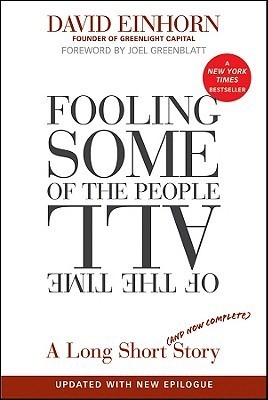
Fooling Some of the People All of the Time, A Long Short (and Now Complete) Story, Updated with New Epilogue
by David Einhorn
Rating: 4.0 ⭐
• 4 recommendations ❤️
A revealing look at Wall Street, the financial media, and financial regulators by David Einhorn, the President of Greenlight CapitalCould 2008's credit crisis have been minimized or even avoided? In 2002, David Einhorn-one of the country's top investors-was asked at a charity investment conference to share his best investment advice. Short sell Allied Capital. At the time, Allied was a leader in the private financing industry. Einhorn claimed Allied was using questionable accounting practices to prop itself up. Sound familiar? At the time of the original version of "Fooling Some of the People All of the Time: A Long Short Story" the outcome of his advice was unknown. Now, the story is complete and we know Einhorn was right. In 2008, Einhorn advised the same conference to short sell Lehman Brothers. And had the market been more open to his warnings, yes, the market meltdown might have been avoided, or at least minimized.Details the gripping battle between Allied Capital and Einhorn's Greenlight CapitalIlluminates how questionable company practices are maintained and, at times, even protected by Wall StreetDescribes the failings of investment banks, analysts, journalists, and government regulatorsDescribes how many parts of the Allied Capital story were replayed in the debate over Lehman Brothers"Fooling Some of the People All of the Time" is an important call for effective government regulation, free speech, and fair play.
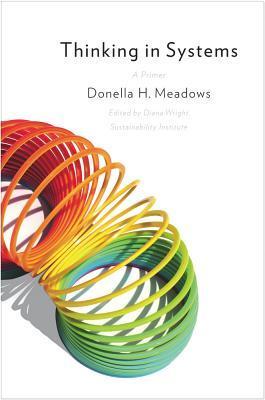
Meadows’ Thinking in Systems, is a concise and crucial book offering insight for problem solving on scales ranging from the personal to the global. Edited by the Sustainability Institute’s Diana Wright, this essential primer brings systems thinking out of the realm of computers and equations and into the tangible world, showing readers how to develop the systems-thinking skills that thought leaders across the globe consider critical for 21st-century life.Some of the biggest problems facing the world—war, hunger, poverty, and environmental degradation—are essentially system failures. They cannot be solved by fixing one piece in isolation from the others, because even seemingly minor details have enormous power to undermine the best efforts of too-narrow thinking.While readers will learn the conceptual tools and methods of systems thinking, the heart of the book is grander than methodology. Donella Meadows was known as much for nurturing positive outcomes as she was for delving into the science behind global dilemmas. She reminds readers to pay attention to what is important, not just what is quantifiable, to stay humble, and to stay a learner.In a world growing ever more complicated, crowded, and interdependent, Thinking in Systems helps readers avoid confusion and helplessness, the first step toward finding proactive and effective solutions.

In this candid and riveting memoir, for the first time ever, Nike founder and CEO Phil Knight shares the inside story of the company’s early days as an intrepid start-up and its evolution into one of the world’s most iconic, game-changing, and profitable brands.In 1962, fresh out of business school, Phil Knight borrowed $50 from his father and created a company with a simple mission: import high-quality, low-cost athletic shoes from Japan. Selling the shoes from the trunk of his lime green Plymouth Valiant, Knight grossed $8,000 his first year. Today, Nike’s annual sales top $30 billion. In an age of startups, Nike is the ne plus ultra of all startups, and the swoosh has become a revolutionary, globe-spanning icon, one of the most ubiquitous and recognizable symbols in the world today.But Knight, the man behind the swoosh, has always remained a mystery. Now, for the first time, in a memoir that is candid, humble, gutsy, and wry, he tells his story, beginning with his crossroads moment. At 24, after backpacking around the world, he decided to take the unconventional path, to start his own business—a business that would be dynamic, different.Knight details the many risks and daunting setbacks that stood between him and his dream—along with his early triumphs. Above all, he recalls the formative relationships with his first partners and employees, a ragtag group of misfits and seekers who became a tight-knit band of brothers. Together, harnessing the transcendent power of a shared mission, and a deep belief in the spirit of sport, they built a brand that changed everything.

Siddhartha : An Indian TaleHermann HESSE (1877 - 1962),Translator: Gunther Olesch, Anke Dreher, Amy Coulter, Stefan Langer and Semyon ChaichenetsSiddhartha is one of the great philosophical novels. Profoundly insightful, it is also a beautifully written story that begins as Siddhartha, son of an Indian Brahman, leaves his family and begins a lifelong journey towards Enlightenment. On the way he faces the entire range of human experience and emotion: he lives with ascetics, meets Gotama the Buddha, learns the art of love from Kamala the courtesan, and is transformed by the simple philosophy of the ferryman Vasudeva whose wisdom comes not from learned teachings but from observing the River. Herman Hesse (1877-1962) was a German-Swiss novelist, poet, and painter. He was awarded the Nobel Prize in Literature in 1946.

A leading evolutionary psychologist probes the unconscious instincts behind American consumer cultureIlluminating the hidden reasons for why we buy what we do, Spent applies evolutionary psychology to the sensual wonderland of marketing and perceived status that is American consumer culture. Geoffrey Miller starts with the theory that we purchase things to advertise ourselves to others, and then examines other factors that dictate what we spend money on. With humor and insight, Miller analyzes an array of product choices and deciphers what our decisions say about ourselves, giving us access to a new way of understanding-and improving-our behaviors to become happier consumers.

The Wayfinders: Why Ancient Wisdom Matters in the Modern World
by Wade Davis
Rating: 4.2 ⭐
• 2 recommendations ❤️
Every culture is a unique answer to a fundamental question: What does it mean to be human and alive? In The Wayfinders, renowned anthropologist, winner of the prestigious Samuel Johnson Prize, and National Geographic Explorer-in-Residence Wade Davis leads us on a thrilling journey to celebrate the wisdom of the world's indigenous cultures. In Polynesia we set sail with navigators whose ancestors settled the Pacific ten centuries before Christ. In the Amazon we meet the descendants of a true lost civilization, the Peoples of the Anaconda. In the Andes we discover that the earth really is alive, while in Australia we experience Dreamtime, the all-embracing philosophy of the first humans to walk out of Africa. We then travel to Nepal, where we encounter a wisdom hero, a Bodhisattva, who emerges from forty-five years of Buddhist retreat and solitude. And finally we settle in Borneo, where the last rain forest nomads struggle to survive. Understanding the lessons of this journey will be our mission for the next century. For at risk is the human legacy--a vast archive of knowledge and expertise, a catalog of the imagination. Rediscovering a new appreciation for the diversity of the human spirit, as expressed by culture, is among the central challenges of our time.

Prada stores carry a few obscenely expensive items in order to boost sales for everything else (which look like bargains in comparison). People used to download music for free, then Steve Jobs convinced them to pay. How? By charging 99 cents. That price has a hypnotic the profit margin of the 99 Cents Only store is twice that of Wal-Mart. Why do text messages cost money, while e-mails are free? Why do jars of peanut butter keep getting smaller in order to keep the price the "same"? The answer is prices are a collective hallucination.In Priceless , the bestselling author William Poundstone reveals the hidden psychology of value. In psychological experiments, people are unable to estimate "fair" prices accurately and are strongly influenced by the unconscious, irrational, and politically incorrect. It hasn't taken long for marketers to apply these findings. "Price consultants" advise retailers on how to convince consumers to pay more for less, and negotiation coaches offer similar advice for businesspeople cutting deals. The new psychology of price dictates the design of price tags, menus, rebates, "sale" ads, cell phone plans, supermarket aisles, real estate offers, wage packages, tort demands, and corporate buyouts. Prices are the most pervasive hidden persuaders of all. Rooted in the emerging field of behavioral decision theory, Priceless should prove indispensable to anyone who negotiates.

Value Investing: Tools and Techniques for Intelligent Investment
by James Montier
Rating: 4.0 ⭐
• 2 recommendations ❤️
"As with his weekly column, James Montier's Value Investing is a must read for all students of the financial markets. In short order, Montier shreds the 'efficient market hypothesis', elucidates the pertinence of behavioral finance, and explains the crucial difference between investment process and investment outcomes. Montier makes his arguments with clear insight and spirited good humor, and then backs them up with cold hard facts. Buy this book for yourself, and for anyone you know who cares about their capital!"―Seth Klarman , President, The Baupost Group LLC The seductive elegance of classical finance theory is powerful, yet value investing requires that we reject both the precepts of modern portfolio theory (MPT) and pretty much all of its tools and techniques. In this important new book, the highly respected and controversial value investor and behavioural analyst, James Montier explains how value investing is the only tried and tested method of delivering sustainable long-term returns. James shows you why everything you learnt at business school is wrong; how to think properly about valuation and risk; how to avoid the dangers of growth investing; how to be a contrarian; how to short stocks; how to avoid value traps; how to hedge ignorance using cheap insurance. Crucially he also gives real time examples of the principles outlined in the context of the 2008/09 financial crisis. In this book James shares his tried and tested techniques and provides the latest and most cutting edge tools you will need to deploy the value approach successfully. It provides you with the tools to start thinking in a different fashion about the way in which you invest, introducing the ways of over-riding the emotional distractions that will bedevil the pursuit of a value approach and ultimately think and act differently from the herd.

The Lights in the Tunnel: Automation, Accelerating Technology and the Economy of the Future
by Martin Ford
Rating: 3.7 ⭐
• 2 recommendations ❤️
What will the economy of the future look like? Where will advancing technology, job automation, outsourcing and globalization lead? This groundbreaking book by a Silicon Valley computer engineer explores these questions and shows how accelerating technology is likely to have a highly disruptive influence on our economy in the near future--and may well already be a significant factor in the current global crisis. THE LIGHTS IN THE TUNNEL employs a powerful thought experiment to explore the economy of the future. An imaginary "tunnel of lights" is used to visualize the economic implications of the new technologies that are likely to appear in the coming years and decades. The book directly challenges conventional views of the future and illuminates the danger that lies ahead if we do not plan for the impact of rapidly advancing technology. It also shows how the economic realities of the future might offer solutions to issues such as poverty and climate change.

In his breakout bestseller, The Perfect Storm, Sebastian Junger created "a wild ride that brilliantly captures the awesome power of the raging sea and the often futile attempts of humans to withstand it" ( Los Angeles Times Book Review).Now, Junger turns his brilliant and empathetic eye to the reality of combat--the fear, the honor, and the trust among men in an extreme situation whose survival depends on their absolute commitment to one another. His on-the-ground account follows a single platoon through a 15-month tour of duty in the most dangerous outpost in Afghanistan's Korengal Valley. Through the experiences of these young men at war, he shows what it means to fight, to serve, and to face down mortal danger on a daily basis.

The Tiger: A True Story of Vengeance and Survival
by John Vaillant
Rating: 4.1 ⭐
• 4 recommendations ❤️
NATIONAL BESTSELLER • A gripping story of man pitted against nature’s most fearsome and efficient predator. This "travelogue about tiger poaching in Russia’s far east opens up a new genre ... [the] conservation thriller" ( Nature ).Outside a remote village in Russia’s Far East a man-eating tiger is on the prowl. The tiger isn’t just killing people, it’s murdering them, almost as if it has a vendetta. A team of trackers is dispatched to hunt down the tiger before it strikes again. They know the creature is cunning, injured, and starving, making it even more dangerous. As John Vaillant re-creates these extraordinary events, he gives us an unforgettable and masterful work of narrative nonfiction that combines a riveting portrait of a stark and mysterious region of the world and its people, with the natural history of nature’s most deadly predator.

From the earliest days of his thirty-four-year military career, Victor "Brute" Krulak displayed a remarkable facility for applying creative ways of fighting to the Marine Corps. He went on daring spy missions, was badly wounded, pioneered the use of amphibious vehicles, and masterminded the invasion of Okinawa. In Korea, he was a combat hero and invented the use of helicopters in warfare. In Vietnam, he developed a holistic strategy in stark contrast to the Army's "Search and Destroy" methods -- but when he stood up to LBJ to protest, he was punished.And yet it can be argued that all of his these accomplishments pale in comparison to what he did after World War II and again after Krulak almost single-handedly stopped the U.S. government from abolishing the Marine Corps.

The 10th anniversary edition of the bestselling foundational business training manual for ambitious readers, featuring new concepts and mental models: updated, expanded, and revised.Many people assume they need to attend business school to learn how to build a successful business or advance in their career. That's not true. The vast majority of modern business practice requires little more than common sense, simple arithmetic, and knowledge of a few very important ideas and principles.The Personal MBA 10th Anniversary Edition provides a clear overview of the essentials of every major business topic: entrepreneurship, product development, marketing, sales, negotiation, accounting, finance, productivity, communication, psychology, leadership, systems design, analysis, and operations management...all in one comprehensive volume.Inside you'll learn concepts such as:- The 5 Parts of Every Business You can understand and improve any business, large or small, by focusing on five fundamental topics. - The 12 Forms of Value Products and services are only two of the twelve ways you can create value for your customers. - 4 Methods to Increase Revenue There are only four ways for a business to bring in more money. Do you know what they are?Business degrees are often a poor investment, but business skills are always useful, no matter how you acquire them.The Personal MBA will help you do great work, make good decisions, and take full advantage of your skills, abilities, and available opportunities--no matter what you do (or would like to do) for a living.

In this groundbreaking book, Tim Harford, the Undercover Economist, shows us a new and inspiring approach to solving the most pressing problems in our lives. When faced with complex situations, we have all become accustomed to looking to our leaders to set out a plan of action and blaze a path to success. Harford argues that today’s challenges simply cannot be tackled with ready-made solutions and expert opinion; the world has become far too unpredictable and profoundly complex. Instead, we must adapt. Deftly weaving together psychology, evolutionary biology, anthropology, physics, and economics, along with the compelling story of hard-won lessons learned in the field, Harford makes a passionate case for the importance of adaptive trial and error in tackling issues such as climate change, poverty, and financial crises—as well as in fostering innovation and creativity in our business and personal lives. Taking us from corporate boardrooms to the deserts of Iraq, Adapt clearly explains the necessary ingredients for turning failure into success. It is a breakthrough handbook for surviving—and prospering— in our complex and ever-shifting world.

The Most Important Thing: Uncommon Sense for the Thoughtful Investor
by Howard Marks
Rating: 4.3 ⭐
• 10 recommendations ❤️
"This is that rarity, a useful book."--Warren BuffettHoward Marks, the chairman and cofounder of Oaktree Capital Management, is renowned for his insightful assessments of market opportunity and risk. After four decades spent ascending to the top of the investment management profession, he is today sought out by the world's leading value investors, and his client memos brim with insightful commentary and a time-tested, fundamental philosophy. Now for the first time, all readers can benefit from Marks's wisdom, concentrated into a single volume that speaks to both the amateur and seasoned investor.Informed by a lifetime of experience and study, The Most Important Thing explains the keys to successful investment and the pitfalls that can destroy capital or ruin a career. Utilizing passages from his memos to illustrate his ideas, Marks teaches by example, detailing the development of an investment philosophy that fully acknowledges the complexities of investing and the perils of the financial world. Brilliantly applying insight to today's volatile markets, Marks offers a volume that is part memoir, part creed, with a number of broad takeaways.Marks expounds on such concepts as "second-level thinking," the price/value relationship, patient opportunism, and defensive investing. Frankly and honestly assessing his own decisions--and occasional missteps--he provides valuable lessons for critical thinking, risk assessment, and investment strategy. Encouraging investors to be "contrarian," Marks wisely judges market cycles and achieves returns through aggressive yet measured action. Which element is the most essential? Successful investing requires thoughtful attention to many separate aspects, and each of Marks's subjects proves to be the most important thing.

Saving Capitalism From Short-Termism: How to Build Long-Term Value and Take Back Our Financial Future
by Alfred Rappaport
Rating: 3.7 ⭐
• 2 recommendations ❤️
“As Rappaport keeps on speaking out for the realities surrounding investment and speculation, our society will profit as it builds on his keen insights.”―from the Foreword by John C. Bogle, founder of the Vanguard Group “Al Rappaport brings insight and wisdom to the short-termism debate, fully demonstrating the way perverse incentives are undermining public companies and capital markets.”―John Plender, Financial Times "In this rigorous, useful, and delightful book, Rappaport undresses short-term financial incentives for what they parasites that draw the value-creating innovation out of companies. And he shows how executives can align long-term value-creating investments with the right investors' expectations."―Clayton Christensen, Harvard Business School “How to make managers focus on the long-run is one of the most consequential and difficult questions in corporate governance and is the subject of much debate and disagreement. Professor Alfred Rappaport’s insightful book is a valuable contribution to this important debate.”―Lucian Bebchuk, Professor, Harvard Law School, and coauthor of Pay Without Performance “ Saving Capitalism from Short-Termism insightfully exposes the contradictions by which we incentivize money managers to require short-term focus by company managers. Again and again in rereading this book, I am struck with the author’s felicitous style in raising subject after subject in which I have long been interested―but, until this read, have not been able to resolve. Buy it, read it, and enjoy.”―Robert A.G. Monks, founder ISS (Institutional Shareholder Services), Lens Governance Advisors, and The Corporate Library “Capitalism fails when corporate managers and professional investors prefer their own interests to those the true owners of businesses. In Saving Capitalism from Short-Termism , Al Rappaport shows how new incentives schemes can deliver shareholder value for the 21st century.”―Edward Chancellor, author of Devil Take the A History of Financial Speculation and member of GMO's Asset Allocation team About the Book Business leaders today obsess over quarterly earnings and the current stock price―and for good reason. Corporate incentives typically focus on short-term profits rather than long-term value creation. Nothing is more harmful to businesses―and to the broader economy. Few business thinkers in recent decades have contributed more to this subject than Alfred Rappaport. As an author and educator, Rappaport is a pioneer in developing the principles of values-based management and is an acknowledged authority on how to make long-term shareholder value the essential driver of corporate strategy. His latest work, Saving Capitalism from Short-Termism , is a clarion call for conquering the addiction to short-term profit―and getting on the path to building long-term value. Rappaport’s solution to short-termism is simple but business leaders must align the interests of corporate and investment managers with those of their shareholders and beneficiaries. His plan

Sex, Murder, and the Meaning of Life: A Psychologist Investigates How Evolution, Cognition, and Complexity are Revolutionizing our View of Human Nature
by Douglas T. Kenrick
Rating: 3.5 ⭐
• 2 recommendations ❤️
What do sex and murder have to do with the meaning of life? Everything.In Sex, Murder, and the Meaning of Life, social psychologist Douglas Kenrick exposes the selfish animalistic underside of human nature, and shows how it is intimately connected to our greatest and most selfless achievements. Masterfully integrating cognitive science, evolutionary psychology, and complexity theory, this intriguing book paints a comprehensive picture of the principles that govern our lives. As Kenrick divulges, beneath our civilized veneer, human beings are a lot like howling hyenas and barking baboons, with heads full of homicidal tendencies and sexual fantasies. But, in his view, many ingrained, apparently irrational behaviors—such as inclinations to one-night stands, racial prejudices, and conspicuous consumption—ultimately manifest what he calls “Deep Rationality.”Although our heads are full of simple selfish biases that evolved to help our ancestors survive, modern human beings are anything but simple and selfish cavemen. Kenrick argues that simple and selfish mental mechanisms we inherited from our ancestors ultimately give rise to the multifaceted social lives that we humans lead today, and to the most positive features of humanity, including generosity, artistic creativity, love, and familial bonds. And out of those simple mechanisms emerge all the complexities of society, including international conflicts and global economic markets. By exploring the nuance of social psychology and the surprising results of his own research, Kenrick offers a detailed picture of what makes us caring, creative, and complex — that is, fully human. Illuminated with stories from Kenrick’s own colorful experiences — from his criminally inclined shantytown Irish relatives, his own multiple high school expulsions, broken marriages, and homicidal fantasies, to his eventual success as an evolutionary psychologist and loving father of two boys separated by 26 years — this book is an exploration of our mental biases and failures, and our mind’s great successes. Idiosyncratic, controversial, and fascinating, Sex, Murder, and the Meaning of Life uncovers the pitfalls and promise of our biological inheritance.

WARS CHANGE, WARRIORS DON'T We are all warriors. Each of us struggles every day to define and defend our sense of purpose and integrity, to justify our existence on the planet and to understand, if only within our own hearts, who we are and what we believe in. Do we fight by a code? If so, what is it? What is the Warrior Ethos? Where did it come from? What form does it take today? How do we (and how can we) use it and be true to it in our internal and external lives? The Warrior Ethos is intended not only for men and women in uniform, but artists, entrepreneurs and other warriors in other walks of life. The book examines the evolution of the warrior code of honor and "mental toughness." It goes back to the ancient Spartans and Athenians, to Caesar's Romans, Alexander's Macedonians and the Persians of Cyrus the Great (not excluding the Garden of Eden and the primitive hunting band). Sources include Herodotus, Thucydides, Plutarch, Xenophon, Vegetius, Arrian and Curtius--and on down to Gen. George Patton, Field Marshal Erwin Rommel, and Israeli Minister of Defense, Moshe Dayan.

The Etymologicon: A Circular Stroll Through the Hidden Connections of the English Language
by Mark Forsyth
Rating: 4.2 ⭐
• 2 recommendations ❤️
This perfect gift for readers, writers, and literature majors alike unearths the quirks of the English language. For example, do you know why a mortgage is literally a “death pledge”? Why guns have girls’ names? Why “salt” is related to “soldier”? Discover the answers to all of these etymological questions and more in this fascinating book for fans of of Eats, Shoots & Leaves.The Etymologicon is a completely unauthorized guide to the strange underpinnings of the English language. It explains how you get from “gruntled” to “disgruntled”; why you are absolutely right to believe that your meager salary barely covers “money for salt”; how the biggest chain of coffee shops in the world connects to whaling in Nantucket; and what, precisely, the Rolling Stones have to do with gardening. This witty book will awake the linguist in you and illuminate the hidden meanings behind common words and phrases, tracing their evolution through all of their surprising paths throughout history.

The Shareholder Value Myth: How Putting Shareholders First Harms Investors, Corporations, and the Public
by Lynn Stout
Rating: 3.8 ⭐
• 4 recommendations ❤️
“Shareholder value is the dumbest idea in the world.”—Jack WelchExecutives, investors, and the business press routinely chant the mantra that corporations are required to “maximize shareholder value.” In this pathbreaking book, renowned corporate expert Lynn Stout debunks the myth that corporate law mandates shareholder primacy. Stout shows how shareholder value thinking endangers not only investors but the rest of us as well, leading managers to focus myopically on short-term earnings; discouraging investment and innovation; harming employees, customers, and communities; and causing companies to indulge in reckless, sociopathic, and irresponsible behaviors. And she looks at new models of corporate purpose that better serve the needs of investors, corporations, and society.

The Fish That Ate the Whale: The Life and Times of America's Banana King
by Rich Cohen
Rating: 4.2 ⭐
• 10 recommendations ❤️
Named a Best Book of the Year by the San Francisco Chronicle and The Times-Picayune The fascinating untold tale of Samuel Zemurray, the self-made banana mogul who went from penniless roadside banana peddler to kingmaker and capitalist revolutionary When Samuel Zemurray arrived in America in 1891, he was tall, gangly, and penniless. When he died in the grandest house in New Orleans sixty-nine years later, he was among the richest, most powerful men in the world. Working his way up from a roadside fruit peddler to conquering the United Fruit Company, Zemurray became a symbol of the best and worst of the United States: proof that America is the land of opportunity, but also a classic example of the corporate pirate who treats foreign nations as the backdrop for his adventures.Zemurray lived one of the great untold stories of the last hundred years. Starting with nothing but a cart of freckled bananas, he built a sprawling empire of banana cowboys, mercenary soldiers, Honduran peasants, CIA agents, and American statesmen. From hustling on the docks of New Orleans to overthrowing Central American governments and precipitating the bloody thirty-six-year Guatemalan civil war, the Banana Man lived a monumental and sometimes dastardly life. Rich Cohen's brilliant historical profile The Fish That Ate the Whale unveils Zemurray as a hidden power broker, driven by an indomitable will to succeed.

Hig somehow survived the flu pandemic that killed everyone he knows. Now his wife is gone, his friends are dead, and he lives in the hangar of a small abandoned airport with his dog, Jasper, and a mercurial, gun-toting misanthrope named Bangley.But when a random transmission beams through the radio of his 1956 Cessna, the voice ignites a hope deep inside him that a better life exists outside their tightly controlled perimeter. Risking everything, he flies past his point of no return and follows its static-broken trail, only to find something that is both better and worse than anything he could ever hope for.

A Summer Reading Pick for President Barack Obama, Bill Gates, and Mark Zuckerberg From a renowned historian comes a groundbreaking narrative of humanity’s creation and evolution—a #1 international bestseller—that explores the ways in which biology and history have defined us and enhanced our understanding of what it means to be “human.”One hundred thousand years ago, at least six different species of humans inhabited Earth. Yet today there is only one—homo sapiens. What happened to the others? And what may happen to us?Most books about the history of humanity pursue either a historical or a biological approach, but Dr. Yuval Noah Harari breaks the mold with this highly original book that begins about 70,000 years ago with the appearance of modern cognition. From examining the role evolving humans have played in the global ecosystem to charting the rise of empires, Sapiens integrates history and science to reconsider accepted narratives, connect past developments with contemporary concerns, and examine specific events within the context of larger ideas.Dr. Harari also compels us to look ahead, because over the last few decades humans have begun to bend laws of natural selection that have governed life for the past four billion years. We are acquiring the ability to design not only the world around us, but also ourselves. Where is this leading us, and what do we want to become?Featuring 27 photographs, 6 maps, and 25 illustrations/diagrams.
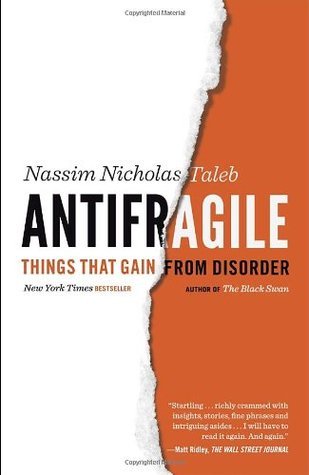
Antifragile: Things That Gain from Disorder
by Nassim Nicholas Taleb
Rating: 4.2 ⭐
• 23 recommendations ❤️
Antifragile is a standalone book in Nassim Nicholas Taleb’s landmark Incerto series, an investigation of opacity, luck, uncertainty, probability, human error, risk, and decision-making in a world we don’t understand. The other books in the series are Fooled by Randomness, The Black Swan, Skin in the Game, and The Bed of Procrustes .Nassim Nicholas Taleb, the bestselling author of The Black Swan and one of the foremost thinkers of our time, reveals how to thrive in an uncertain world.Just as human bones get stronger when subjected to stress and tension, and rumors or riots intensify when someone tries to repress them, many things in life benefit from stress, disorder, volatility, and turmoil. What Taleb has identified and calls “antifragile” is that category of things that not only gain from chaos but need it in order to survive and flourish. In The Black Swan, Taleb showed us that highly improbable and unpredictable events underlie almost everything about our world. In Antifragile, Taleb stands uncertainty on its head, making it desirable, even necessary, and proposes that things be built in an antifragile manner. The antifragile is beyond the resilient or robust. The resilient resists shocks and stays the same; the antifragile gets better and better.Furthermore, the antifragile is immune to prediction errors and protected from adverse events. Why is the city-state better than the nation-state, why is debt bad for you, and why is what we call “efficient” not efficient at all? Why do government responses and social policies protect the strong and hurt the weak? Why should you write your resignation letter before even starting on the job? How did the sinking of the Titanic save lives? The book spans innovation by trial and error, life decisions, politics, urban planning, war, personal finance, economic systems, and medicine. And throughout, in addition to the street wisdom of Fat Tony of Brooklyn, the voices and recipes of ancient wisdom, from Roman, Greek, Semitic, and medieval sources, are loud and clear.Antifragile is a blueprint for living in a Black Swan world.Erudite, witty, and iconoclastic, Taleb’s message is revolutionary: The antifragile, and only the antifragile, will make it.Praise for Antifragile“Ambitious and thought-provoking . . . highly entertaining.” — The Economist“A bold book explaining how and why we should embrace uncertainty, randomness, and error . . . It may just change our lives.” — Newsweek

The Outsiders: Eight Unconventional CEOs and Their Radically Rational Blueprint for Success
by William N. Thorndike Jr.
Rating: 4.2 ⭐
• 14 recommendations ❤️
”It is impossible to produce superior performance unless you do something different.” — John TempletonWhat makes a successful CEO? Most people call to mind a familiar definition: a seasoned manager with deep industry expertise. Others might point to the qualities of today’s so-called celebrity CEOs—charisma, virtuoso communication skills, and a confident management style. But what really matters when you run an organization? What is the hallmark of exceptional CEO performance? Quite simply, it is the returns for the shareholders of that company over the long term.In this refreshing, counterintuitive book, author Will Thorndike brings to bear the analytical wisdom of a successful career in investing, closely evaluating the performance of companies and their leaders. You will meet eight individualistic CEOs whose firms’ average returns outperformed the S&P 500 by a factor of twenty—in other words, an investment of $10,000 with each of these CEOs, on average, would have been worth over $1.5 million twenty-five years later. You may not know all their names, but you will recognize their companies: General Cinema, Ralston Purina, The Washington Post Company, Berkshire Hathaway, General Dynamics, Capital Cities Broadcasting, TCI, and Teledyne. In The Outsiders, you’ll learn the traits and methods—striking for their consistency and relentless rationality—that helped these unique leaders achieve such exceptional performance.Humble, unassuming, and often frugal, these "outsiders” shunned Wall Street and the press, and shied away from the hottest new management trends. Instead, they shared specific traits that put them and the companies they led on winning trajectories: a laser-sharp focus on per share value as opposed to earnings or sales growth; an exceptional talent for allocating capital and human resources; and the belief that cash flow, not reported earnings, determines a company’s long-term value.Drawing on years of research and experience, Thorndike tells eye-opening stories, extracting lessons and revealing a compelling alternative model for anyone interested in leading a company or investing in one—and reaping extraordinary returns.

NAMED ONE OF THE BEST BOOKS OF THE YEAR BY KIRKUS REVIEWSGood Prose is an inspiring book about writing—about the creation of good prose—and the record of a warm and productive literary friendship. The story begins in 1973, in the offices of The Atlantic Monthly, in Boston, where a young freelance writer named Tracy Kidder came looking for an assignment. Richard Todd was the editor who encouraged him. From that article grew a lifelong association. Before long, Kidder’s The Soul of a New Machine, the first book the two worked on together, had won the Pulitzer Prize. It was a heady moment, but for Kidder and Todd it was only the beginning of an education in the art of nonfiction. Good Prose explores three major nonfiction narratives, essays, and memoirs. Kidder and Todd draw candidly, sometimes comically, on their own experience—their mistakes as well as accomplishments—to demonstrate the pragmatic ways in which creative problems get solved. They also turn to the works of a wide range of writers, novelists as well as nonfiction writers, for models and instruction. They talk about narrative strategies (and about how to find a story, sometimes in surprising places), about the ethical challenges of nonfiction, and about the realities of making a living as a writer. They offer some tart and emphatic opinions on the current state of language. And they take a clear stand against playing loose with the facts. Their advice is always grounded in the practical world of writing and publishing. Good Prose —like Strunk and White’s The Elements of Style— is a succinct, authoritative, and entertaining arbiter of standards in contemporary writing, offering guidance for the professional writer and the beginner alike. This wise and useful book is the perfect companion for anyone who loves to read good books and longs to write one.Praise for Good Prose “Smart, lucid, and entertaining.” — The Boston Globe “You are in such good company—congenial, ironic, a bit old-school—that you’re happy to follow [Kidder and Todd] where they lead you.” — The Wall Street Journal “[A] well-structured, to-the-point, genuinely useful, and fun-to-read guide to writing narrative nonfiction, essays, and memoir . . . Crisp, informative, and mind-expanding.” — Booklist “A gem . . . The finer points of creative nonfiction are molded into an inspiring read that will affect the would-be writer as much as Anne Lamott’s Bird by Bird or Stephen King’s On Writing. . . . This is a must read for nonfiction writers.” — Library Journal “As approachable and applicable as any writing manual available.” —Associated Press

The Value Investors: Lessons from the World's Top Fund Managers
by Ronald W. Chan
Rating: 4.0 ⭐
• 2 recommendations ❤️
In The Value Investors, readers discovered that value investing is not a staid and old-fashioned investment strategy, but is dynamic and ever-evolving. And most especially, they learned how 12 leading investors, each of whom has a unique value perspective, have consistently beaten the stock market over the years - all these investors come from different walks of life, yet they share the same investment mindset.Chapters 1 to 4 covered four US value investors: Walter Schloss of Walter & Edwin Schloss Associates; Irving Kahn of Kahn Brothers Group; Thomas Kahn, also of Kahn Brothers Group; and William Browne of Tweedy, Browne Company. Chapters 5 to 7 featured three European investors: Jean-Marie Eveillard of First Eagle Funds, Francisco Garc�a Param�s who was formerly with Bestinver Asset Management, and Anthony Nutt of Jupiter Asset Management. In chapters 8 to 12, the author discussed five investors in Asia: Mark Mobius of Templeton Emerging Markets Group, Teng Ngiek Lian of Target Asset Management, Shuhei Abe of SPARX Group, V-Nee Yeh of Value Partners Group, and Cheah Cheng Hye, also of Value Partners Group.The Second Edition will include updates to all the chapters - these investors' whereabouts, their current professional and personal endeavors and their experiences in the investment world since the first edition was published. It will also feature new fund managers:Howard Marks (Oaktree Capital Management, US)�lvaro Guzm�n de L�zaro (azValor Asset Management, Spain)Fernando Bernad (azValor Asset Management, Spain)A top investor based in Australia

Drunk Tank Pink: And Other Unexpected Forces That Shape How We Think, Feel, and Behave
by Adam Alter
Rating: 3.8 ⭐
• 4 recommendations ❤️
A revelatory look at how our environment unconsciously yet dramatically shapes the judgments and decisions we make every dayMost of us go through life believing that we are in control of the choices we make—that we think and behave almost independently from the world around us. But as Drunk Tank Pink illustrates, the truth is our environment shapes our thoughts and actions in myriad ways without our permission or even our knowledge. Armed with surprising data and endlessly fascinating examples, Adam Alter addresses the subtle but substantial ways in which outside forces influence us—such as color’s influence on mood, our bias in favor of names with which we identify, and how sunny days can induce optimism as well as aggression. Drunk Tank Pink proves that the truth behind our feelings and actions goes much deeper than the choices we take for granted every day.

The Dao of Capital: Austrian Investing in a Distorted World
by Mark Spitznagel
Rating: 4.0 ⭐
• 8 recommendations ❤️
As today's preeminent doomsday investor Mark Spitznagel describes his Daoist and roundabout investment approach, “one gains by losing and loses by gaining.” This is Austrian Investing , an archetypal, counterintuitive, and proven approach, gleaned from the 150-year-old Austrian School of economics, that is both timeless and exceedingly timely. In The Dao of Capital , hedge fund manager and tail-hedging pioneer Mark Spitznagel―with one of the top returns on capital of the financial crisis, as well as over a career―takes us on a gripping, circuitous journey from the Chicago trading pits, over the coniferous boreal forests and canonical strategists from Warring States China to Napoleonic Europe to burgeoning industrial America, to the great economic thinkers of late 19th century Austria. We arrive at his central investment methodology of Austrian Investing , where victory comes not from waging the immediate decisive battle, but rather from the roundabout approach of seeking the intermediate positional advantage (what he calls shi ), of aiming at the indirect means rather than directly at the ends. The monumental challenge is in seeing time differently, in a whole new intertemporal dimension, one that is so contrary to our wiring. Spitznagel is the first to condense the theories of Ludwig von Mises and his Austrian School of economics into a cohesive and―as Spitznagel has shown―highly effective investment methodology. From identifying the monetary distortions and non-randomness of stock market routs (Spitznagel's bread and butter) to scorned highly-productive assets, in Ron Paul's words from the foreword, Spitznagel “brings Austrian economics from the ivory tower to the investment portfolio.” The Dao of Capital provides a rare and accessible look through the lens of one of today's great investors to discover a profound harmony with the market process―a harmony that is so essential today.

It's Earnings That Count : Finding Stocks with Earnings Power for Long-term Profits
by Hewitt Heiserman
Rating: 3.9 ⭐
• 2 recommendations ❤️
An innovative way to see through a company's published numbers to discover its true investment potential This book gives you a blueprint for finding a great growth stock for the next decade without taking on a lot of risk in the process. Inspired by the writings of Benjamin Graham, It's Earnings That Count examines a firm’s earnings quality from the perspective of a “defensive” investor who wants to avoid committing ruinous mistakes as well as the “enterprising” investor who seeks Wall Street’s next great opportunities. Unfortunately, as recent market history has shown, the traditional income statement is ill-suited to meeting the needs of these sometimes opposing viewpoints. As a result, investors can buy shares of a seemingly profitable company that, in fact, has poor earnings quality. However, the author’s trademarked Earnings Power Chart combines Graham’s two personalities to reveal, in picture form, whether a company possesses authentic earnings power for long-term growth. Using the world-famous William Wrigley Jr. Company gum-maker as a case study, you will learn how to build these two alternate profit-and-loss statements to protect yourself. Since this book is written in plain English, you do not need to be an MBA or accountant to follow these step-by-step instructions. Giving investors the tools they need to turn the tables in their favor, It's Earnings That Count

The Everything Store: Jeff Bezos and the Age of Amazon
by Brad Stone
Rating: 4.3 ⭐
• 12 recommendations ❤️
The definitive story of Amazon.com, one of the most successful companies in the world, and of its driven, brilliant founder, Jeff Bezos.Amazon.com started off delivering books through the mail. But its visionary founder, Jeff Bezos, wasn't content with being a bookseller. He wanted Amazon to become the everything store, offering limitless selection and seductive convenience at disruptively low prices. To do so, he developed a corporate culture of relentless ambition and secrecy that's never been cracked. Until now. Brad Stone enjoyed unprecedented access to current and former Amazon employees and Bezos family members, giving readers the first in-depth, fly-on-the-wall account of life at Amazon. Compared to tech's other elite innovators -- Jobs, Gates, Zuckerberg -- Bezos is a private man. But he stands out for his restless pursuit of new markets, leading Amazon into risky new ventures like the Kindle and cloud computing, and transforming retail in the same way Henry Ford revolutionized manufacturing.The Everything Store will be the revealing, definitive biography of the company that placed one of the first and largest bets on the Internet and forever changed the way we shop and read.

The Accidental Universe: The World You Thought You Knew
by Alan Lightman
Rating: 3.8 ⭐
• 2 recommendations ❤️
From the acclaimed author of Einstein's Dreams and Mr g, a meditation on the unexpected ways in which recent scientific findings have shaped our understanding of ourselves and our place in the cosmos.With all the passion, curiosity, and precise yet lyrical prose that have marked his previous books, Alan Lightman here explores the emotional and philosophical questions raised by discoveries in science, focusing most intently on the human condition and the needs of humankind. He looks at the difficult dialogue between science and religion; the conflict between our human desire for permanence and the impermanence of nature; the possibility that our universe is simply an accident; the manner in which modern technology has separated us from direct experience of the world; and our resistance to the view that our bodies and minds can be explained by scientific logic and laws. And behind all of these considerations is the suggestion—at once haunting and exhilarating—that what we see and understand of the world is only a tiny piece of the extraordinary, perhaps unfathomable whole.
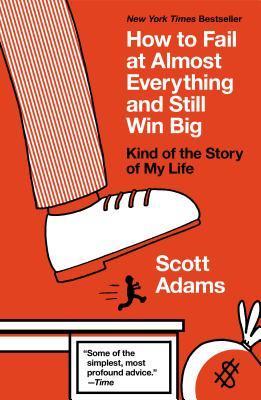
How to Fail at Almost Everything and Still Win Big: Kind of the Story of My Life
by Scott Adams
Rating: 4.2 ⭐
• 6 recommendations ❤️
Scott Adams has likely failed at more things than anyone you’ve ever met or anyone you’ve even heard of. So how did he go from hapless office worker and serial failure to the creator of Dilbert, one of the world’s most famous syndicated comic strips, in just a few years? In How to Fail at Almost Everything and Still Win Big, Adams shares the strategy he has used since he was a teen to invite failure in, to embrace it, then pick its pocket. No career guide can offer advice for success that works for everyone. As Adams explains, your best bet is to study the ways of others who made it big and try to glean some tricks and strategies that make sense for you. Adams pulls back the covers on his own unusual life and shares what he learned for turning one failure after another into something good and lasting. Adams reveals that he failed at just about everything he’s tried, including his corporate career, his inventions, his investments, and his two restaurants. But there’s a lot to learn from his personal story, and a lot of humor along the way. While it’s hard for anyone to recover from a personal or professional failure, Adams discovered some unlikely truths that helped to propel him forward. For instance:• Goals are for losers. Systems are for winners.• "Passion" is bull. What you need is personal energy.• A combination of mediocre skills can make you surprisingly valuable.• You can manage your odds in a way that makes you look lucky to others.

Thai Stick: Surfers, Scammers, and the Untold Story of the Marijuana Trade
by Peter Maguire
Rating: 4.0 ⭐
• 2 recommendations ❤️
Located on the left bank of the Chao Phya River, Thailand's capital, Krungthep, known as Bangkok to Westerners and "the City of Angels" to Thais, has been home to smugglers and adventurers since the late eighteenth century. During the 1970s, it became a modern Casablanca to a new generation of treasure seekers, from surfers looking to finance their endless summers to wide-eyed hippie true believers and lethal marauders left over from the Vietnam War.Moving a shipment of Thai sticks from northeast Thailand farms to American consumers meant navigating one of the most complex smuggling channels in the history of the drug trade. Many forget that until the mid-1970s, the vast majority of marijuana consumed in the United States was imported, and there was little to no domestic production.Peter Maguire and Mike Ritter are the first historians to document this underground industry, the only record of its existence rooted in the fading memories of its elusive participants. Drawing on hundreds of interviews with smugglers and law enforcement agents, the authors recount the buy, delivery, voyage home, and product offload. They capture the eccentric personalities of the men and women who transformed the Thai marijuana trade from a GI cottage industry into a professionalized business moving the world's most lucrative commodities, unraveling a rare history from the smugglers' perspective.

Zero to One: Notes on Startups, or How to Build the Future
by Peter Thiel
Rating: 4.2 ⭐
• 48 recommendations ❤️
If you want to build a better future, you must believe in secrets.The great secret of our time is that there are still uncharted frontiers to explore and new inventions to create. In Zero to One, legendary entrepreneur and investor Peter Thiel shows how we can find singular ways to create those new things. Thiel begins with the contrarian premise that we live in an age of technological stagnation, even if we’re too distracted by shiny mobile devices to notice. Information technology has improved rapidly, but there is no reason why progress should be limited to computers or Silicon Valley. Progress can be achieved in any industry or area of business. It comes from the most important skill that every leader must master: learning to think for yourself.Doing what someone else already knows how to do takes the world from 1 to n, adding more of something familiar. But when you do something new, you go from 0 to 1. The next Bill Gates will not build an operating system. The next Larry Page or Sergey Brin won’t make a search engine. Tomorrow’s champions will not win by competing ruthlessly in today’s marketplace. They will escape competition altogether, because their businesses will be unique. Zero to One presents at once an optimistic view of the future of progress in America and a new way of thinking about innovation: it starts by learning to ask the questions that lead you to find value in unexpected places.

Creativity, Inc.: an inspiring look at how creativity can - and should - be harnessed for business success by the founder of Pixar
by Ed Catmull
Rating: 4.3 ⭐
• 16 recommendations ❤️
As a young man, Ed Catmull had a dream: to make the world’s first computer-animated movie. He nurtured that dream first as a Ph.D. student at the University of Utah, where many computer science pioneers got their start, and then forged an early partnership with George Lucas that led, indirectly, to his founding Pixar with Steve Jobs and John Lasseter in 1986. Nine years later and against all odds, Toy Story was released, changing animation forever.Since then, Pixar has dominated the world of animation, producing such beloved films as Monsters, Inc., Finding Nemo, The Incredibles, Up, and WALL-E, which have gone on to set box-office records and garner twenty-seven Academy Awards. The joyousness of the storytelling, the inventive plots, the emotional authenticity: In some ways, Pixar movies are an object lesson in what creativity really is. Now, in this book, Catmull reveals the ideals and techniques, honed over years, that have made Pixar so widely admired—and so profitable.Creativity, Inc. is a book for managers who want to lead their employees to new heights, a manual for anyone who strives for originality, and the first-ever, all-access trip into the nerve center of Pixar Animation Studios—into the story meetings, the postmortems, and the ‘Braintrust’ sessions where art is born. It is, at heart, a book about how to build and sustain a creative culture—but it is also, as Pixar co-founder and president Ed Catmull writes, ‘an expression of the ideas that I believe make the best in us possible.’
A Few Lessons from Sherlock Holmes is a book for those who want to improve their thinking. It is a practical and enjoyable book that tells in a short-easy-to-read way about what we all can learn from Sherlock Holmes. Peter Bevelin has distilled Arthur Conan Doyle's Sherlock Holmes into bite-sized principles and key quotes. This book will appeal to both Sherlock fans as well as those who want to think better. It contains useful and timeless methods and questions applicable to a variety of important issues in life and business. We could all benefit from 'A few lessons from Sherlock Holmes'.

The Fourth Revolution: The Global Race to Reinvent the State
by John Micklethwait
Rating: 3.7 ⭐
• 2 recommendations ❤️
From the bestselling authors of The Right Nation , a visionary argument that our current crisis in government is nothing less than the fourth radical transition in the history of the nation-stateDysfunctional It’s become a cliché, and most of us are resigned to the fact that nothing is ever going to change. As John Micklethwait and Adrian Wooldridge show us, that is a seriously limited view of things. In fact, there have been three great revolutions in government in the history of the modern world. The West has led these revolutions, but now we are in the midst of a fourth revolution, and it is Western government that is in danger of being left behind.Now, things really are different. The West’s debt load is unsustainable. The developing world has harvested the low-hanging fruits. Industrialization has transformed all the peasant economies it had left to transform, and the toxic side effects of rapid developing world growth are adding to the bill. From Washington to Detroit, from Brasilia to New Delhi, there is a dual crisis of political legitimacy and political effectiveness.The Fourth Revolution crystallizes the scope of the crisis and points forward to our future. The authors enjoy extraordinary access to influential figures and forces the world over, and the book is a global tour of the innovators in how power is to be wielded. The age of big government is over; the age of smart government has begun. Many of the ideas the authors discuss seem outlandish now, but the center of gravity is moving quickly.This tour drives home a powerful that countries’ success depends overwhelmingly on their ability to reinvent the state. And that much of the West—and particularly the United States—is failing badly in its task. China is making rapid progress with government reform at the same time as America is falling badly behind. Washington is gridlocked, and America is in danger of squandering its huge advantages from its powerful economy because of failing government. And flailing democracies like India look enviously at China’s state-of-the-art airports and expanding universities.The race to get government right is not just a race of efficiency. It is a race to see which political values will triumph in the twenty-first century—the liberal values of democracy and liberty or the authoritarian values of command and control. The stakes could not be higher.

The Body Keeps the Score: Brain, Mind, and Body in the Healing of Trauma
by Bessel van der Kolk
Rating: 4.5 ⭐
• 7 recommendations ❤️
A pioneering researcher transforms our understanding of trauma and offers a bold new paradigm for healing in this New York Times bestseller. Trauma is a fact of life. Veterans and their families deal with the painful aftermath of combat; one in five Americans has been molested; one in four grew up with alcoholics; one in three couples have engaged in physical violence. Dr. Bessel van der Kolk, one of the world’s foremost experts on trauma, has spent over three decades working with survivors. In The Body Keeps the Score, he uses recent scientific advances to show how trauma literally reshapes both body and brain, compromising sufferers’ capacities for pleasure, engagement, self-control, and trust. He explores innovative treatments—from neurofeedback and meditation to sports, drama, and yoga—that offer new paths to recovery by activating the brain’s natural neuroplasticity. Based on Dr. van der Kolk’s own research and that of other leading specialists, The Body Keeps the Score exposes the tremendous power of our relationships both to hurt and to heal—and offers new hope for reclaiming lives.

Successful Investing Is a Process: Structuring Efficient Portfolios for Outperformance
by Jacques Lussier
Rating: 5.0 ⭐
• 2 recommendations ❤️
A process-driven approach to investment management that lets you achieve the same high gains as the most successful portfolio managers, but at half the cost What do you pay for when you hire a portfolio manager? Is it his or her unique experience and expertise, a set of specialized analytical skills possessed by only a few? The truth, according to industry insider Jacques Lussier, is that, despite their often grandiose claims, most successful investment managers, themselves, can't properly explain their successes. In this book Lussier argues convincingly that most of the gains achieved by professional portfolio managers can be accounted for not by special knowledge or arcane analytical methodologies, but proper portfolio management processes whether they are aware of this or not. More importantly, Lussier lays out a formal process-oriented approach proven to consistently garner most of the excess gains generated by traditional analysis-intensive approaches, but at a fraction of the cost since it could be fully implemented internally.

Asset Management: A Systematic Approach to Factor Investing
by Andrew Ang
Rating: 4.3 ⭐
• 2 recommendations ❤️
In Asset A Systematic Approach to Factor Investing , Professor Andrew Ang presents a comprehensive, new approach to the age-old problem of where to put your money. Years of experience as a finance professor and a consultant have led him to see that what matters aren't asset class labels, but instead the bundles of overlapping risks they represent. Factor risks must be the focus of our attention if we are to weather market turmoil and receive the rewards that come with doing so.Clearly written yet full of the latest research and data, Asset Management is indispensable reading for trustees, professional money managers, smart private investors, and business students who want to understand the economics behind factor risk premiums, to harvest them efficiently in their portfolios, and to embark on the search for true alpha.

Rational Expectations: Asset Allocation for Investing Adults
by William J. Bernstein
Rating: 4.2 ⭐
• 2 recommendations ❤️
Rational Expectations is a clean sheet of paper in the wonky world of quantitatively based asset allocation aimed at small investors. Continuing the theme of the Investing for Adults series, this full-length finance title is not for beginners, but rather assumes a fair degree of quantitative ability and finance knowledge. If you think you can time the market or pick stocks and mutual fund managers, or even if you think that you can formulate an optimally efficient mean-variance asset allocation with a black box, then learn some basic finance and come back in a few years. On the other hand, if you know your way around risk premiums and standard deviations and know who Irving Fisher and Benjamin Graham were, and if you want to sharpen your asset class skills, you've come to the right place.

The Professor in the Cage: Why Men Fight and Why We Like to Watch
by Jonathan Gottschall
Rating: 4.0 ⭐
• 4 recommendations ❤️
An English professor begins training in the sport of mixed martial arts and explores the science and history behind the violence of men.When a mixed martial arts (MMA) gym moves in across the street from his office, Jonathan Gottschall sees a challenge, and an opportunity. Pushing forty, out of shape, and disenchanted with his job as an adjunct English professor, part of him yearns to cross the street and join up. The other part is terrified. Gottschall eventually works up his nerve, and starts training for a real cage fight. He’s fighting not only as a personal test but also to answer questions that have intrigued him for years: Why do men fight? And why do so many seemingly decent people like to watch?In The Professor in the Cage, Gottschall’s unlikely journey from the college classroom to the fighting cage drives an important new investigation into the science and history of violence. Mixed martial arts is a full-contact hybrid sport in which fighters punch, choke, and kick each other into submission. MMA requires intense strength, endurance, and skill; the fights are bloody, brutal, and dangerous. Yet throughout the last decade, cage fighting has evolved from a small-time fringe spectacle banned in many states to the fastest-growing spectator sport in America.But the surging popularity of MMA, far from being new, is just one more example of our species’ insatiable interest not just in violence but in the rituals that keep violence contained. From duels to football to the roughhousing of children, humans are masters of what Gottschall calls the monkey dance: a dizzying variety of rule-bound contests that establish hierarchies while minimizing risk and social disorder. In short, Gottschall entered the cage to learn about the violence in men, but learned instead how men keep violence in check.Gottschall endures extremes of pain, occasional humiliation, and the incredulity of his wife to take us into the heart of fighting culture—culminating, after almost two years of grueling training, in his own cage fight. Gottschall’s unsparing personal journey crystallizes in his epiphany, and ours, that taming male violence through ritualized combat has been a hidden key to the success of the human race. Without the restraining codes of the monkey dance, the world would be a much more chaotic and dangerous place.

Natural Born Heroes: Mastering the Lost Secrets of Strength and Endurance
by Christopher McDougall
Rating: 4.0 ⭐
• 4 recommendations ❤️
NATIONAL BESTSELLER • From the bestselling author of Born to Run comes a book that inspires us to unleash the extraordinary potential of the human body and climb, swim, skip, throw, and jump our way to heroic feats."Redefines the heroic ideal, establishing heroism as a skill set rather than a virtue."— NPR BooksChristopher McDougall’s journey begins with a story of remarkable athletic prowess: On the treacherous mountains of Crete, a motley band of World War II Resistance fighters—an artist, a shepherd, and a poet—abducted a German commander from the heart of the Axis occupation.To understand how, McDougall retraces their steps across the island that birthed Herakles and Odysseus, and discovers ancient techniques for endurance, sustenance, and natural movement that have been preserved in unique communities around the world.His search takes us scrambling over rooftops with a Parkour crew in London, foraging for greens with a ballerina in Brooklyn, tossing heavy pieces of driftwood on a Brazilian beach with the creator of MovNat—and, finally, to our own backyards. “McDougall traveled to Crete to examine the physical and mental capacity of Greek war heroes [and] studied natural movement, endurance, and nutrition to understand how regular people are capable of extraordinary athletic feats.... We can all adapt the tools of the athletes featured.” — Real SimpleLook for Christopher McDougall's new book, Born to Run 2, coming in December!

Big Data Baseball: Math, Miracles, and the End of a 20-Year Losing Streak
by Travis Sawchik
Rating: 4.1 ⭐
• 2 recommendations ❤️
New York Times BestsellerAfter twenty consecutive losing seasons for the Pittsburgh Pirates, team morale was low, the club’s payroll ranked near the bottom of the sport, game attendance was down, and the city was becoming increasingly disenchanted with its team. Big Data Baseball is the story of how the 2013 Pirates, mired in the longest losing streak in North American pro sports history, adopted drastic big-data strategies to end the drought, make the playoffs, and turn around the franchise’s fortunes.Big Data Baseball is Moneyball for a new generation. Award-winning journalist Travis Sawchik takes you behind the scenes to expertly weave together the stories of the key figures who changed the way the Pirates played the game, revealing how a culture of collaboration and creativity flourished as whiz-kid analysts worked alongside graybeard coaches to revolutionize the sport and uncover groundbreaking insights for how to win more games without spending a dime. From pitch framing to on-field shifts, this entertaining and enlightening underdog story closely examines baseball’s burgeoning big data movement and demonstrates how the millions of data points which aren’t immediately visible to players and spectators, are the bit of magic that led the Pirates to finish the 2013 season in second place and brought an end to a twenty-year losing streak.
Rise of the Robots: Technology and the Threat of a Jobless Future
by Martin Ford
Rating: 4.0 ⭐
• 2 recommendations ❤️
What are the jobs of the future? How many will there be? And who will have them? As technology continues to accelerate and machines begin taking care of themselves, fewer people will be necessary. Artificial intelligence is already well on its way to making “good jobs” obsolete: many paralegals, journalists, office workers, and even computer programmers are poised to be replaced by robots and smart software. As progress continues, blue and white collar jobs alike will evaporate, squeezing working- and middle-class families ever further. At the same time, households are under assault from exploding costs, especially from the two major industries—education and health care—that, so far, have not been transformed by information technology. The result could well be massive unemployment and inequality as well as the implosion of the consumer economy itself. The past solutions to technological disruption, especially more training and education, aren't going to work. We must decide, now, whether the future will see broad-based prosperity or catastrophic levels of inequality and economic insecurity. Rise of the Robots is essential reading to understand what accelerating technology means for our economic prospects—not to mention those of our children—as well as for society as a whole.

Deep Value: How Shareholder Activist Hedge Funds Battle for Control of the World's Leading Corporations
by Tobias E. Carlisle
Rating: 4.3 ⭐
• 2 recommendations ❤️
The economic climate is ripe for another golden age of shareholder activismDeep Value: How Shareholder Activist Hedge Funds Battle for Control of The World's Leading Corporations is a must-read exploration of deep value investment strategy, describing the evolution of the theories of valuation and shareholder activism from Graham to Icahn and beyond. The book combines engaging anecdotes with industry research to illustrate the principles and methods of this complex strategy, and explains the reasoning behind seemingly incomprehensible activist maneuvers. Written by an active value investor, Deep Value provides an insider's perspective on shareholder activist strategies in a format accessible to both professional investors and laypeople.The Deep Value investment philosophy as described by Graham initially identified targets by their discount to liquidation value. This approach was extremely effective, but those opportunities are few and far between in the modern market, forcing activists to adapt. Current activists assess value from a much broader palate, and exploit a much wider range of tools to achieve their goals. Deep Value enumerates and expands upon the resources and strategies available to value investors today, and describes how the economic climate is allowing value investing to re-emerge. Topics include: Target identification, and determining the most advantageous ends Strategies and tactics of effective activism Unseating management and fomenting change Eyeing conditions for the next M&A boom Activist hedge funds have been quiet since the early 2000s, but economic conditions, shareholder sentiment, and available opportunities are creating a fertile environment for another golden age of activism. Deep Value: How Shareholder Activist Hedge Funds Battle for Control of The World's Leading Corporations provides the in-depth information investors need to get up to speed before getting left behind.

Contrarian Investment Strategies: The Psychological Edge
by David Dreman
Rating: 3.7 ⭐
• 2 recommendations ❤️
In this major revision of his investment classic, one of the premier investment managers introduces vitally important new findings in psychology that show why most investment strategies are fatally flawed and his contrarian strategies are the best way to beat the market. The need to switch to a new approach for investing has never been more urgent. The Crash of 2007 revealed in dramatic fashion that there are glaring flaws in the theory that underlies all of the prevailing investment strategies—efficient market theory. This theory, and all of the most popular investing strategies, fail to account for major, systematic errors in human judgment that the powerful new research in psychology David Dreman introduces has revealed, such as emotional over-reactions and a host of mental shortcuts in judgment that lead to wild over and under-valuations of stocks, bonds, and commodities and to bubbles and crashes. It also leads to horribly flawed assessments of risk. Dreman shows exactly how the new psychological findings definitively refute those strategies and reveals how his alternative contrarian strategies do a powerful job of accounting for them. He shows readers how by being aware of these new findings, they can become saavy psychological investors, crash-proofing their portfolios and earning market beating long-term returns. He also introduces a new theory of risk and substantially updates his core contrarian strategies with a number of highly effective methods for facing the most pressing challenges in the coming years, such as greatly increased volatility and the prospect of inflation. This is every investor’s essential guide to optimal investing.

Consolations: The Solace, Nourishment and Underlying Meaning of Everyday Words
by David Whyte
Rating: 4.5 ⭐
• 2 recommendations ❤️
After many years of revising the essays, author David Whyte has published this revised edition of his well loved book. In addition to sharper versions of many of the essays, it contains an additional piece, To consciously become close is a form of unilateral disarmament, a chancing of our arm and our love, a willingness to hazard our affections and an unconscious declaration that we might be equal to the inevitable loss that the vulnerability of being close will bring.With the imagery of a poet and the reflection of a philosopher, David Whyte turns his attention to 52 ordinary words, each its own particular doorway into the underlying currents of human life.

Everything you wanted to know about chopping, stacking and drying wood.

#1 NEW YORK TIMES BESTSELLER • PULITZER PRIZE FINALIST • OVER TWO MILLION COPIES SOLDThis inspiring, exquisitely observed memoir finds hope and beauty in the face of insurmountable odds as an idealistic young neurosurgeon attempts to answer the question, What makes a life worth living?“Unmissable . . . Finishing this book and then forgetting about it is simply not an option.”—Janet Maslin, The New York TimesONE OF THE BEST BOOKS OF THE YEAR: The New York Times Book Review, People, NPR, The Washington Post, Slate, Harper’s Bazaar, Time Out New York, Publishers Weekly, BookPageAn Oprah Daily Best Nonfiction Book of the Past Two Decades • A Kirkus Reviews Best Nonfiction Book of the CenturyAt the age of thirty-six, on the verge of completing a decade’s worth of training as a neurosurgeon, Paul Kalanithi was diagnosed with stage IV lung cancer. One day he was a doctor treating the dying, and the next he was a patient struggling to live. And just like that, the future he and his wife had imagined evaporated. When Breath Becomes Air chronicles Kalanithi’s transformation from a naïve medical student “possessed,” as he wrote, “by the question of what, given that all organisms die, makes a virtuous and meaningful life” into a neurosurgeon at Stanford working in the brain, the most critical place for human identity, and finally into a patient and new father confronting his own mortality.What makes life worth living in the face of death? What do you do when the future, no longer a ladder toward your goals in life, flattens out into a perpetual present? What does it mean to have a child, to nurture a new life as another fades away? These are some of the questions Kalanithi wrestles with in this profoundly moving, exquisitely observed memoir.Paul Kalanithi died in March 2015, while working on this book, yet his words live on as a guide and a gift to us all. “I began to realize that coming face to face with my own mortality, in a sense, had changed nothing and everything,” he wrote. “Seven words from Samuel Beckett began to repeat in my head: ‘I can’t go on. I’ll go on.’” When Breath Becomes Air is an unforgettable, life-affirming reflection on the challenge of facing death and on the relationship between doctor and patient, from a brilliant writer who became both.Finalist for the PEN Center USA Literary Award in Creative Nonfiction and the Books for a Better Life Award in Inspirational Memoir

Dear Chairman: Boardroom Battles and the Rise of Shareholder Activism
by Jefferson Gramm
Rating: 4.1 ⭐
• 2 recommendations ❤️
A sharp and illuminating history of one of capitalism’s longest running tensions—the conflicts of interest among public company directors, managers, and shareholders—told through entertaining case studies and original letters from some of our most legendary and controversial investors and activists. Recent disputes between shareholders and major corporations, including Apple and DuPont, have made headlines. But the struggle between management and those who own stock has been going on for nearly a century. Mixing never-before-published and rare, original letters from Wall Street icons—including Benjamin Graham, Warren Buffett, Ross Perot, Carl Icahn, and Daniel Loeb—with masterful scholarship and professional insight, Dear Chairman traces the rise in shareholder activism from the 1920s to today, and provides an invaluable and unprecedented perspective on what it means to be a public company, including how they work and who is really in control. Jeff Gramm analyzes different eras and pivotal boardroom battles from the last century to understand the factors that have caused shareholders and management to collide. Throughout, he uses the letters to show how investors interact with directors and managers, how they think about their target companies, and how they plan to profit. Each is a fascinating example of capitalism at work told through the voices of its most colorful, influential participants. A hedge fund manager and an adjunct professor at Columbia Business School, Gramm has spent as much time evaluating CEOs and directors as he has trying to understand and value businesses. He has seen public companies that are poorly run, and some that willfully disenfranchise their shareholders. While he pays tribute to the ingenuity of public company investors, Gramm also exposes examples of shareholder activism at its very worst, when hedge funds engineer stealthy land-grabs at the expense of a company’s long term prospects. Ultimately, he provides a thorough, much-needed understanding of the public company/shareholder relationship for investors, managers, and everyone concerned with the future of capitalism.

Capital Returns: Investing Through the Capital Cycle: A Money Manager’s Reports 2002-15
by
Rating: 4.4 ⭐
• 2 recommendations ❤️
We live in an age of serial asset bubbles and spectacular busts. Economists, policymakers, central bankers and most people in the financial world have been blindsided by these busts, while investors have lost trillions. Economists argue that bubbles can only be spotted after they burst and that market moves are unpredictable. Yet Marathon Asset Management, a London-based investment firm managing over $50 billion of assets has developed a relatively simple method for identifying and potentially avoiding them: follow the money, or rather the trail of investment. Bubbles whether they affect a whole economy or merely a single industry, tend to attract a splurge of capital spending. Excessive investment drives down returns and leads inexorably to a bust. This was the case with both the technology bubble at the turn of the century and the US housing bubble which followed shortly after. More recently, vast sums have been invested in mining and energy. From an investor's perspective, the trick is to avoid investing in sectors, or markets, where investment spending is unduly elevated and competition is fierce, and to put one's money to work where capital expenditure is depressed, competitive conditions are more favourable and, as a result, prospective investment returns are higher. This capital cycle strategy encourages investors to eschew the simple 'growth' and 'value' dichotomy and identify firms that can deliver superior returns either because capital has been taken out of an industry, or because the business has strong barriers to entry (what Warren Buffett refers to as a 'moat'). Some of Marathon's most successful investments have come from obscure, sometimes niche operations whose businesses are protected from the destructive forces of the capital cycle. Capital Returns is a comprehensive introduction to the theory and practical implementation of the capital cycle approach to investment. Edited and with an introduction by Edward Chancellor, the book brings together 60 of the most insightful reports written between 2002 and 2014 by Marathon portfolio managers. Capital Returns provides key insights into the capital cycle strategy, all supported with real life examples from global brewers to the semiconductor industry - showing how this approach can be usefully applied to different industry conditions and how, prior to 2008, it helped protect assets from financial catastrophe. This book will be a welcome reference for serious investors who looking to maximise portfolio returns over the long run.

Modern Monopolies: What It Takes to Dominate the 21st Century Economy
by Alex Moazed
Rating: 4.0 ⭐
• 2 recommendations ❤️
In Modern Monopolies , Alex Moazed and Nicholas L. Johnson tell the definitive story of what has changed, what it means for businesses today, and how managers, entrepreneurs, and business owners can adapt and thrive in this new era.What do Google, Snapchat, Tinder, Amazon, and Uber have in common, besides soaring market share? They're platforms - a new business model that has quietly become the only game in town, creating vast fortunes for its founders while dominating everyone's daily life. A platform, by definition, creates value by facilitating an exchange between two or more interdependent groups. So, rather that making things, they simply connect people.The Internet today is awash in platforms - Facebook is responsible for nearly 25 percent of total Web visits, and the Google platform crash in 2013 took about 40 percent of Internet traffic with it. Representing the ten most trafficked sites in the U.S., platforms are also prominent over the globe; in China, they hold the top eight spots in web traffic rankings.The advent of mobile computing and its ubiquitous connectivity have forever altered how we interact with each other, melding the digital and physical worlds and blurring distinctions between "offline" and "online." These platform giants are expanding their influence from the digital world to the whole economy. Yet, few people truly grasp the radical structural shifts of the last ten years.

For the past 500 years, gamblers-led by mathematicians and scientists-have been trying to figure out how to pull the rug out from under Lady Luck. In The Perfect Bet, mathematician and award-winning writer Adam Kucharski tells the astonishing story of how the experts have succeeded, revolutionizing mathematics and science in the process. The house can seem unbeatable. Kucharski shows us just why it isn't. Even better, he demonstrates how the search for the perfect bet has been crucial for the scientific pursuit of a better world.

Negotiating the Impossible: How to Break Deadlocks and Resolve Ugly Conflicts
by Deepak Malhotra
Rating: 4.1 ⭐
• 6 recommendations ❤️
Negotiating the ImpossibleHow to Break Deadlocks and Resolve Ugly Conflicts (without Money or Muscle) Some negotiations are easy. Others are more difficult. And then there are situations that seem hopeless. Conflict is escalating, people are getting aggressive, and no one is willing to back down. And to top it off, you have little power, money, or other resources to work with. Harvard professor (and negotiation consultant advisor to organizations around the world) Deepak Malhotra shows how to defuse even the most potentially explosive situations and to find success when things seem impossible. Malhotra illustrates key lessons using behind-the-scenes stories of fascinating real-life negotiations, including drafting the US Constitution, resolving the Cuban Missile Crisis, bringing peace to Northern Ireland, ending bitter disputes in the NFL and NHL, and beating the odds in complex business situations. But he also shows how these same principles and tactics can be applied in everyday life as well, from making corporate deals, negotiating job offers, and resolving business disputes to tackling obstacles in personal relationships and even negotiating with children.

“My predominant feeling is one of gratitude. I have loved and been loved. I have been given much and I have given something in return. Above all, I have been a sentient being, a thinking animal, on this beautiful planet, and that in itself has been an enormous privilege and adventure.”—Oliver SacksNo writer has succeeded in capturing the medical and human drama of illness as honestly and as eloquently as Oliver Sacks. During the last few months of his life, he wrote a set of essays in which he movingly explored his feelings about completing a life and coming to terms with his own death.“It is the fate of every human being,” Sacks writes, “to be a unique individual, to find his own path, to live his own life, to die his own death.”Together, these four essays form an ode to the uniqueness of each human being and to gratitude for the gift of life.“Oliver Sacks was like no other clinician, or writer. He was drawn to the homes of the sick, the institutions of the most frail and disabled, the company of the unusual and the ‘abnormal.’ He wanted to see humanity in its many variants and to do so in his own, almost anachronistic way—face to face, over time, away from our burgeoning apparatus of computers and algorithms. And, through his writing, he showed us what he saw.”—Atul Gawande, author of Being Mortal
This first Library of America volume of Emerson’s writing covers the most productive period of his life, 1832–1860. Our most eloquent champion of individualism, Emerson acknowledges at the same time the countervailing pressures of society in American life. Even as he extols what he called “the great and crescive self,” he dramatizes and records its vicissitudes.Here are the indispensable and most renowned works, including “The American Scholar” (“our intellectual Declaration of Independence,” as Oliver Wendell Holmes called it), “The Divinity School Address,” considered atheistic by many of his listeners, the summons to “Self-Reliance,” along with the more embattled realizations of “Circles” and, especially, “Experience.” Here, too, are his wide-ranging portraits of Montaigne, Shakespeare, and other “representative men,” and his astute observations on the habits, lives, and prospects of the English and American people.This volume includes Emerson’s well-known Nature; Addresses, and Lectures (1849), his Essays: First Series (1841) and Essays: Second Series (1844), plus Representative Men (1850), English Traits (1856), and his later book of essays, The Conduct of Life (1860). These are the works that established Emerson’s colossal reputation in America and found him admirers abroad as diverse as Carlyle, Nietzsche, and Proust.Emerson’s enduring power is apparent everywhere in American literature: in those, like Whitman and some of the major twentieth-century poets, who seek to corroborate his vision, and among those, like Hawthorne and Melville, who questioned, qualified, and struggled with it. Emerson’s vision reverberates also in the tradition of American philosophy, notably in the writings of William James and John Dewey, in the works of his European admirers, such as Nietzsche, and in the avant-garde theorists of our own day who write on the nature and function of language. The reasons for Emerson’s durability will be obvious to any reader who follows the exhilarating, exploratory movements of his mind in this uniquely full gathering of his work.Not merely another selection of his essays, this volume includes all his major books in their rich entirety. No other volume conveys so comprehensively the exhilaration and exploratory energy of perhaps America’s greatest writer.

The Hidden Life of Trees: What They Feel, How They Communicate: Discoveries from a Secret World
by Peter Wohlleben
Rating: 4.1 ⭐
• 8 recommendations ❤️
In The Hidden Life of Trees, Peter Wohlleben shares his deep love of woods and forests and explains the amazing processes of life, death, and regeneration he has observed in the woodland and the amazing scientific processes behind the wonders of which we are blissfully unaware. Much like human families, tree parents live together with their children, communicate with them, and support them as they grow, sharing nutrients with those who are sick or struggling and creating an ecosystem that mitigates the impact of extremes of heat and cold for the whole group. As a result of such interactions, trees in a family or community are protected and can live to be very old. In contrast, solitary trees, like street kids, have a tough time of it and in most cases die much earlier than those in a group. Drawing on groundbreaking new discoveries, Wohlleben presents the science behind the secret and previously unknown life of trees and their communication abilities; he describes how these discoveries have informed his own practices in the forest around him. As he says, a happy forest is a healthy forest, and he believes that eco-friendly practices not only are economically sustainable but also benefit the health of our planet and the mental and physical health of all who live on Earth.

Chaos Monkeys: Obscene Fortune and Random Failure in Silicon Valley
by Antonio García Martínez
Rating: 4.0 ⭐
• 4 recommendations ❤️
The instant New York Times bestseller, now available in paperback and featuring a new afterword from the author--the insider's guide to the Facebook/Cambridge Analytica scandal, the inner workings of the tech world, and who really runs Silicon Valley“Incisive.... The most fun business book I have read this year.... Clearly there will be people who hate this book — which is probably one of the things that makes it such a great read.”— Andrew Ross Sorkin, New York TimesImagine a chimpanzee rampaging through a datacenter powering everything from Google to Facebook. Infrastructure engineers use a software version of this “chaos monkey” to test online services’ robustness—their ability to survive random failure and correct mistakes before they actually occur. Tech entrepreneurs are society’s chaos monkeys. One of Silicon Valley’s most audacious chaos monkeys is Antonio García Martínez.After stints on Wall Street and as CEO of his own startup, García Martínez joined Facebook’s nascent advertising team. Forced out in the wake of an internal product war over the future of the company’s monetization strategy, García Martínez eventually landed at rival Twitter. In Chaos Monkeys, this gleeful contrarian unravels the chaotic evolution of social media and online marketing and reveals how it is invading our lives and shaping our future.

Quality Investing: Owning the best companies for the long term
by Lawrence A. Cunningham
Rating: 4.2 ⭐
• 2 recommendations ❤️
Quality. We all make judgments about it every day. Yet articulating a clear definition of quality in an investing context is challenging. This book addresses the challenge, and distills years of practical investing experience into a definitive account of this under-explored investment philosophy. Finance theory has it that abnormal outcomes do not persist, that exceptional performance will soon enough become average performance. Quality investing involves seeking companies with the right attributes to overcome these forces of mean reversion and, crucially, owning these outstanding companies for the long term. This book pinpoints and explains the characteristics that increase the probability of a company prospering over time - as well as those that hinder such chances. Throughout, a series of fascinating real-life case studies illustrate the traits that signify quality, as well as some that flatter to deceive. The authors' firm, AKO Capital, has a strong track record of finding and investing in quality companies - helping it deliver a compound annual growth rate more than double that of the market since inception. "Quality Investing" sheds light on the investment philosophy, processes and tough lessons that have contributed to this consistent outperformance.

Pre-Suasion: A Revolutionary Way to Influence and Persuade
by Robert B. Cialdini
Rating: 4.1 ⭐
• 10 recommendations ❤️
The acclaimed New York Times and Wall Street Journal bestseller from Robert Cialdini—“the foremost expert on effective persuasion” (Harvard Business Review)—explains how it’s not necessarily the message itself that changes minds, but the key moment before you deliver that message.What separates effective communicators from truly successful persuaders? With the same rigorous scientific research and accessibility that made his Influence an iconic bestseller, Robert Cialdini explains how to prepare people to be receptive to a message before they experience it. Optimal persuasion is achieved only through optimal pre-suasion. In other words, to change “minds” a pre-suader must also change “states of mind.” Named a “Best Business Books of 2016” by the Financial Times, and “compelling” by The Wall Street Journal, Cialdini’s Pre-Suasion draws on his extensive experience as the most cited social psychologist of our time and explains the techniques a person should implement to become a master persuader. Altering a listener’s attitudes, beliefs, or experiences isn’t necessary, says Cialdini—all that’s required is for a communicator to redirect the audience’s focus of attention before a relevant action. From studies on advertising imagery to treating opiate addiction, from the annual letters of Berkshire Hathaway to the annals of history, Cialdini outlines the specific techniques you can use on online marketing campaigns and even effective wartime propaganda. He illustrates how the artful diversion of attention leads to successful pre-suasion and gets your targeted audience primed and ready to say, “Yes.” His book is “an essential tool for anyone serious about science based business strategies…and is destined to be an instant classic. It belongs on the shelf of anyone in business, from the CEO to the newest salesperson” (Forbes).

Concentrated Investing: Strategies of the World's Greatest Concentrated Value Investors
by Allen C. Benello
Rating: 4.0 ⭐
• 2 recommendations ❤️
Discover the secrets of the world's top concentrated value investors Concentrated Investing: Strategies of the World's Greatest Concentrated Value Investors chronicles the virtually unknown--but wildly successful--value investors who have regularly and spectacularly blown away the results of even the world's top fund managers. Sharing the insights of these top value investors, expert authors Allen Benello, Michael van Biema, and Tobias Carlisle unveil the strategies that make concentrated value investing incredibly profitable, while at the same time showing how to mitigate risk over time. Highlighting the history and approaches of four top value investors, the authors tell the fascinating story of the investors who dare to tread where few others have, and the wildly-successful track records that have resulted.Turning the notion of diversification on its head, concentrated value investors pick a small group of undervalued stocks and hold onto them through even the lean years. The approach has been championed by Warren Buffett, the best known value investor of our time, but a small group of lesser-known investors has also used this approach to achieve outstanding returns.Discover the success of Lou Simpson, a former GEICO investment manager and eventual successor to Warren Buffett at Berkshire Hathaway Read about Kristian Siem, described as -Norway's Warren Buffett, - and the success he has had at Siem Industries Concentrated Investing will quickly have you re-thinking the conventional wisdom related to diversification and learning from the top concentrated value investors the world has never heard of.

Streaming, Sharing, Stealing: Big Data and the Future of Entertainment
by Michael D. Smith
Rating: 3.9 ⭐
• 2 recommendations ❤️
Traditional network television programming has always followed the same script: executives approve a pilot, order a trial number of episodes, and broadcast them, expecting viewers to watch a given show on their television sets at the same time every week. But then came Netflix's "House of Cards." Netflix gauged the show's potential from data it had gathered about subscribers' preferences, ordered two seasons without seeing a pilot, and uploaded the first thirteen episodes all at once for viewers to watch whenever they wanted on the devices of their choice.In this book, Michael Smith and Rahul Telang, experts on entertainment analytics, show how the success of "House of Cards" upended the film and TV industries -- and how companies like Amazon and Apple are changing the rules in other entertainment industries, notably publishing and music. We're living through a period of unprecedented technological disruption in the entertainment industries. Just about everything is affected: pricing, production, distribution, piracy. Smith and Telang discuss niche products and the long tail, product differentiation, price discrimination, and incentives for users not to steal content. To survive and succeed, businesses have to adapt rapidly and creatively. Smith and Telang explain how.How can companies discover who their customers are, what they want, and how much they are willing to pay for it? Data. The entertainment industries, must learn to play a little "moneyball." The bottom line: follow the data.

Nobody Wants to Read Your Sh*t: And Other Tough-Love Truths to Make You a Better Writer
by Steven Pressfield
Rating: 4.2 ⭐
• 3 recommendations ❤️
There's a mantra that real writers know but wannabe writers don’t. And the secret phrase is this:NOBODY WANTS TO READ YOUR SH*T. Recognizing this painful truth is the first step in the writer's transformation from amateur to professional. From Chapter Four: “When you understand that nobody wants to read your shit, you develop empathy. You acquire the skill that is indispensable to all artists and entrepreneurs—the ability to switch back and forth in your imagination from your own point of view as writer/painter/seller to the point of view of your reader/gallery-goer/customer. You learn to ask yourself with every sentence and every phrase: Is this interesting? Is it fun or challenging or inventive? Am I giving the reader enough? Is she bored? Is she following where I want to lead her?"

Ray Dalio, one of the world’s most successful investors and entrepreneurs, shares the unconventional principles that he’s developed, refined, and used over the past forty years to create unique results in both life and business—and which any person or organization can adopt to help achieve their goals.In 1975, Ray Dalio founded an investment firm, Bridgewater Associates, out of his two-bedroom apartment in New York City. Forty years later, Bridgewater has made more money for its clients than any other hedge fund in history and grown into the fifth most important private company in the United States, according to Fortune magazine. Dalio himself has been named to Time magazine’s list of the 100 most influential people in the world. Along the way, Dalio discovered a set of unique principles that have led to Bridgewater’s exceptionally effective culture, which he describes as “an idea meritocracy that strives to achieve meaningful work and meaningful relationships through radical transparency.” It is these principles, and not anything special about Dalio—who grew up an ordinary kid in a middle-class Long Island neighborhood—that he believes are the reason behind his success.In Principles, Dalio shares what he’s learned over the course of his remarkable career. He argues that life, management, economics, and investing can all be systemized into rules and understood like machines. The book’s hundreds of practical lessons, which are built around his cornerstones of “radical truth” and “radical transparency,” include Dalio laying out the most effective ways for individuals and organizations to make decisions, approach challenges, and build strong teams. He also describes the innovative tools the firm uses to bring an idea meritocracy to life, such as creating “baseball cards” for all employees that distill their strengths and weaknesses, and employing computerized decision-making systems to make believability-weighted decisions. While the book brims with novel ideas for organizations and institutions, Principles also offers a clear, straightforward approach to decision-making that Dalio believes anyone can apply, no matter what they’re seeking to achieve.Here is a rare opportunity to gain proven advice unlike anything you’ll find in the conventional business press.

One Up: Creativity, Competition, and the Global Business of Video Games
by Joost van Dreunen
Rating: 4.1 ⭐
• 2 recommendations ❤️
What explains the massive worldwide success of video games such as Fortnite , Minecraft , and Pokémon Go ? Game companies and their popularity are poorly understood and often ignored from the standpoint of traditional business strategy. Yet this industry generates billions in revenue by thinking creatively about digital distribution, free-to-play content, and phenomena like e-sports and live streaming. What lessons can we draw from its major successes and failures about the future of entertainment?One Up offers a pioneering empirical analysis of innovation and strategy in the video game industry to explain how it has evolved from a fringe activity to become a mainstream form of entertainment. Joost van Dreunen, a widely recognized industry expert with over twenty years of experience, analyzes how game makers, publishers, and platform holders have tackled strategic challenges to make the video game industry what it is today. Using more than three decades of rigorously compiled industry data, he demonstrates that video game companies flourish when they bring the same level of creativity to business strategy that they bring to game design. Filled with case studies of companies such as Activision Blizzard, Apple, Electronic Arts, Epic Games, Microsoft, Nexon, Sony, Take-Two Interactive, Tencent, and Valve, this book forces us to rethink common misconceptions around the emergence of digital and mobile gaming. One Up is required reading for investors, creatives, managers, and anyone looking to learn about the major drivers of change and growth in contemporary entertainment.