
122 Books Recommended

From the inventor of the PalmPilot comes a new and compelling theory of intelligence, brain function, and the future of intelligent machinesJeff Hawkins, the man who created the PalmPilot, Treo smart phone, and other handheld devices, has reshaped our relationship to computers. Now he stands ready to revolutionize both neuroscience and computing in one stroke, with a new understanding of intelligence itself.Hawkins develops a powerful theory of how the human brain works, explaining why computers are not intelligent and how, based on this new theory, we can finally build intelligent machines.The brain is not a computer, but a memory system that stores experiences in a way that reflects the true structure of the world, remembering sequences of events and their nested relationships and making predictions based on those memories. It is this memory-prediction system that forms the basis of intelligence, perception, creativity, and even consciousness.In an engaging style that will captivate audiences from the merely curious to the professional scientist, Hawkins shows how a clear understanding of how the brain works will make it possible for us to build intelligent machines, in silicon, that will exceed our human ability in surprising ways.Written with acclaimed science writer Sandra Blakeslee, On Intelligence promises to completely transfigure the possibilities of the technology age. It is a landmark book in its scope and clarity.

The Inner Game of Tennis: The Classic Guide to the Mental Side of Peak Performance
by W. Timothy Gallwey
Rating: 4.2 ⭐
• 11 recommendations ❤️
The timeless guide to achieving the state of “relaxed concentration” that’s not only the key to peak performance in tennis but the secret to success in life itself—part of the bestselling Inner Game series, with more than one million copies sold!“Groundbreaking . . . the best guide to getting out of your own way . . . Its profound advice applies to many other parts of life.”—Bill Gates, GatesNotes (“Five of My All-Time Favorite Books”) This phenomenally successful guide to mastering the game from the inside out has become a touchstone for hundreds of thousands of people. Billie Jean King has called the book her tennis bible; Al Gore has used it to focus his campaign staff; and Itzhak Perlman has recommended it to young violinists. Based on W. Timothy Gallwey’s profound realization that the key to success doesn’t lie in holding the racket just right, or positioning the feet perfectly, but rather in keeping the mind uncluttered, this transformative book gives you the tools to unlock the potential that you’ve possessed all along. “The Inner Game” is the one played within the mind of the player, against the hurdles of self-doubt, nervousness, and lapses in concentration. Gallwey shows us how to overcome these obstacles by trusting the intuitive wisdom of our bodies and achieving a state of “relaxed concentration.” With chapters devoted to trusting the self and changing habits, it is no surprise then, that Gallwey’s method has had an impact far beyond the confines of the tennis court. Whether you want to play music, write a novel, get ahead at work, or simply unwind after a stressful day, Gallwey shows you how to tap into your utmost potential. No matter your goals, The Inner Game of Tennis gives you the definitive framework for long-term success.

How do great writers do it? From James M. Cain's hard-nosed observation that "writing a novel is like working on foreign policy. There are problems to be solved. It's not all inspirational," to Joan Didion's account of how she composes a book--"I constantly retype my own sentences. Every day I go back to page one and just retype what I have. It gets me into a rhythm"--The Paris Review has elicited some of the most revelatory and revealing thoughts from the literary masters of our age. For more than half a century, the magazine has spoken with most of our leading novelists, poets, and playwrights, and the interviews themselves have come to be recognized as classic works of literature, an essential and definitive record of the writing life. They have won the coveted George Polk Award and have been a contender for the Pulitzer Prize. Now, Paris Review editor Philip Gourevitch introduces an entirely original selection of sixteen of the most celebrated interviews. Often startling, always engaging, these encounters contain an immense scope of intelligence, personality, experience, and wit from the likes of Elizabeth Bishop, Ernest Hemingway, Truman Capote, Rebecca West, and Billy Wilder. This is an indispensable book for all writers and readers.

This is a remarkable book about a man (perhaps the most important and original philosopher of our age), a society (the corrupt Austro-Hungarian Empire on the eve of dissolution), and a city (Vienna, with its fin-de siecle gaiety and corrosive melancholy). The central figure in this study of a crumbling society that gave birth to the modern world is Wittgenstein, the brilliant and gifted young thinker. With others, including Freud, Viktor Adler, and Arnold Schoenberg, he forged his ideas in a classical revolt against the stuffy, doomed, and moralistic lives of the old regime. As a portrait of Wittgenstein, the book is superbly realized; it is even better as a portrait of the age, with dazzling and unusual parallels to our own confused society. Allan Janik and Stephen Toulmin have acted on a striking premise: an understanding of prewar Vienna, Wittgenstein s native city, will make it easier to comprehend both his work and our own problems .This is an independent work containing much that is challenging, new, and useful. New York Times Book Review."

The Billion Dollar Molecule: One Company's Quest for the Perfect Drug
by Barry Werth
Rating: 3.9 ⭐
• 2 recommendations ❤️
Join journalist Barry Werth as he pulls back the curtain on Vertex, a start-up pharmaceutical company, and witness firsthand the intense drama being played out in the pioneering and hugely profitable field of drug research.Founded by Joshua Boger, a dynamic Harvard- and Merck-trained scientific whiz kid, Vertex is dedicated to designing—atom by atom—both a new life-saving immunosuppressant drug, and a drug to combat the virus that causes AIDS.You will be hooked from start to finish, as you go from the labs, where obsessive, fiercely competitive scientists struggle for a breakthrough, to Wall Street, where the wheeling and dealing takes on a life of its own, as Boger courts investors and finally decides to take Vertex public. Here is a fascinating no-holds-barred account of the business of science, which includes an updated epilogue about the most recent developments in the quest for a drug to cure AIDS.
Hackers & Painters: Big Ideas from the Computer Age
by Paul Graham
Rating: 4.2 ⭐
• 14 recommendations ❤️
"The computer world is like an intellectual Wild West, in which you can shoot anyone you wish with your ideas, if you're willing to risk the consequences. " --from Hackers & Big Ideas from the Computer Age , by Paul Graham We are living in the computer age, in a world increasingly designed and engineered by computer programmers and software designers, by people who call themselves hackers. Who are these people, what motivates them, and why should you care? Consider these Everything around us is turning into computers. Your typewriter is gone, replaced by a computer. Your phone has turned into a computer. So has your camera. Soon your TV will. Your car was not only designed on computers, but has more processing power in it than a room-sized mainframe did in 1970. Letters, encyclopedias, newspapers, and even your local store are being replaced by the Internet. Hackers & Big Ideas from the Computer Age , by Paul Graham, explains this world and the motivations of the people who occupy it. In clear, thoughtful prose that draws on illuminating historical examples, Graham takes readers on an unflinching exploration into what he calls "an intellectual Wild West." The ideas discussed in this book will have a powerful and lasting impact on how we think, how we work, how we develop technology, and how we live. Topics include the importance of beauty in software design, how to make wealth, heresy and free speech, the programming language renaissance, the open-source movement, digital design, internet startups, and more.

Starting in the 1980s, Lisp began to be used in several large systems, including Emacs, Autocad, and Interleaf. On Lisp explains the reasons behind Lisp's growing popularity as a mainstream programming language. On Lisp is a comprehensive study of advanced Lisp techniques, with bottom-up programming as the unifying theme. It gives the first complete description of macros and macro applications. The book also covers important subjects related to bottom-up programming, including functional programming, rapid prototyping, interactive development, and embedded languages. The final chapter takes a deeper look at object-oriented programming than previous Lisp books, showing the step-by-step construction of a working model of the Common Lisp Object System (CLOS). As well as an indispensable reference, On Lisp is a source of software. Its examples form a library of functions and macros that readers will be able to use in their own Lisp programs.

Asimov tells the stories behind the science: the men and women who made the important discoveries and how they did it. Ranging from Galilei, Achimedes, Newton and Einstein, he takes the most complex concepts and explains it in such a way that a first-time reader on the subject feels confident on his/her understanding.
Incompleteness: The Proof and Paradox of Kurt Godel
by Rebecca Goldstein
Rating: 3.9 ⭐
• 2 recommendations ❤️
"A gem…An unforgettable account of one of the great moments in the history of human thought." —Steven PinkerProbing the life and work of Kurt Gödel, Incompleteness indelibly portrays the tortured genius whose vision rocked the stability of mathematical reasoning—and brought him to the edge of madness.

These excerpts from the writings of Sir Karl Popper are an outstanding introduction to one of the most controversial of living philosophers, known especially for his devastating criticisms of Plato and Marx and for his uncompromising rejection of inductive reasoning. David Miller, a leading expositor and critic of Popper's work, has chosen thirty selections that illustrate the profundity and originality of his ideas and their applicability to current intellectual and social problems. Miller's introduction demonstrates the remarkable unity of Popper's thought and briefly describes his philosophy of critical rationalism, a philosophy that is distinctive in its emphasis on the way in which we learn through the making and correcting of mistakes.Popper has relentlessly challenged both the authority and the appeal to authority of the most fashionable philosophies of our time. This book of selections from his nontechnical writings on the theory of knowledge, the philosophy of science, metaphysics, and social philosophy is imbued with his emphasis on the role and by reason in exposing and eliminating the errors among them.
A Pattern Language: Towns, Buildings, Construction
by Christopher W. Alexander
Rating: 4.4 ⭐
• 11 recommendations ❤️
At the core of A Pattern Language is the philosophy that in designing their environments people always rely on certain ‘languages,’ which, like the languages we speak, allow them to articulate and communicate an infinite variety of designs within a formal system which gives them coherence.This book provides a language of this kind. It will enable making a design for almost any kind of building, or any part of the built environment. ‘Patterns,’ the units of this language, are answers to design problems: how high should a window sill be?; how many stories should a building have?; how much space in a neighborhood should be devoted to grass and trees?More than 250 of the patterns in this language are outlined, each consisting of a problem statement, a discussion of the problem with an illustration, and a solution. As the authors say in their introduction, many of the patterns are archetypal, so deeply rooted in the nature of things that it seems likely that they will be a part of human nature and human action as much in five hundred years as they are today.A Pattern Language is related to Alexander’s other works in the Center for Environmental Structure series: The Timeless Way of Building (introductory volume) and The Oregon Experiment.
Paradigms of Artificial Intelligence Programming: Case Studies in Common Lisp
by Peter Norvig
Rating: 4.3 ⭐
• 3 recommendations ❤️
Paradigms of AI Programming is the first text to teach advanced Common Lisp techniques in the context of building major AI systems. By reconstructing authentic, complex AI programs using state-of-the-art Common Lisp, the book teaches students and professionals how to build and debug robust practical programs, while demonstrating superior programming style and important AI concepts. The author strongly emphasizes the practical performance issues involved in writing real working programs of significant size. Chapters on troubleshooting and efficiency are included, along with a discussion of the fundamentals of object-oriented programming and a description of the main CLOS functions. This volume is an excellent text for a course on AI programming, a useful supplement for general AI courses and an indispensable reference for the professional programmer.

Expert Political Judgment: How Good Is It? How Can We Know?
by Philip E. Tetlock
Rating: 4.0 ⭐
• 6 recommendations ❤️
The intelligence failures surrounding the invasion of Iraq dramatically illustrate the necessity of developing standards for evaluating expert opinion. This book fills that need. Here, Philip E. Tetlock explores what constitutes good judgment in predicting future events, and looks at why experts are often wrong in their forecasts.Tetlock first discusses arguments about whether the world is too complex for people to find the tools to understand political phenomena, let alone predict the future. He evaluates predictions from experts in different fields, comparing them to predictions by well-informed laity or those based on simple extrapolation from current trends. He goes on to analyze which styles of thinking are more successful in forecasting. Classifying thinking styles using Isaiah Berlin's prototypes of the fox and the hedgehog, Tetlock contends that the fox--the thinker who knows many little things, draws from an eclectic array of traditions, and is better able to improvise in response to changing events--is more successful in predicting the future than the hedgehog, who knows one big thing, toils devotedly within one tradition, and imposes formulaic solutions on ill-defined problems. He notes a perversely inverse relationship between the best scientific indicators of good judgement and the qualities that the media most prizes in pundits--the single-minded determination required to prevail in ideological combat.Clearly written and impeccably researched, the book fills a huge void in the literature on evaluating expert opinion. It will appeal across many academic disciplines as well as to corporations seeking to develop standards for judging expert decision-making.

Mumford explains the forces that have shaped technology since prehistoric times and shaped the modern world. He shows how tools developed because of significant parallel inventions in ritual, language, and social organization. “It is a stimulating volume, informed both with an enormous range of knowledge and empathetic spirit” (Eliot Fremont-Smith, New York Times). Index; photographs.

In Medieval Technology and Social Change, Lynn White considers the effects of technological innovation on the societies of medieval Europe: the slow collapse of feudalism with the development of machines and tools that introduced factories in place of cottage industries, and the development of the manorial system with the introduction of new kinds of plows and new methods of crop rotation. One invention of particular import, writes White, was the stirrup, which in turn introduced heavy, long-range cavalry to the medieval battlefield. The development thus escalated small-scale conflict to "shock combat." Cannons and flamethrowers followed, as did more peaceful inventions, such as watermills and reapers.

Modern Operating Systems, Fourth Edition, is intended for introductory courses in Operating Systems in Computer Science, Computer Engineering, and Electrical Engineering programs.The widely anticipated revision of this worldwide best-seller incorporates the latest developments in operating systems (OS) technologies. The Fourth Edition includes up-to-date materials on relevant OS. Tanenbaum also provides information on current research based on his experience as an operating systems researcher.Modern Operating Systems, Third Edition was the recipient of the 2010 McGuffey Longevity Award. The McGuffey Longevity Award recognizes textbooks whose excellence has been demonstrated over time. http://taaonline.net/index.htmlTeaching and Learning ExperienceThis program will provide a better teaching and learning experience–for you and your students. It will help:* Provide Practical Detail on the Big Picture Concepts: A clear and entertaining writing style outlines the concepts every OS designer needs to master.* Keep Your Course Current: This edition includes information on the latest OS technologies and developments* Enhance Learning with Student and Instructor Resources: Students will gain hands-on experience using the simulation exercises and lab experiments.

Captain Cleve Connell has already made a name for himself among pilots when he arrives in Korea during the war there to fly the newly operational F-86 fighters against the Soviet MIGs. His goal, like that of every fighter pilot, is to chalk up enough kills to become an ace.But things do not turn out as expected. Mission after mission proves fruitless, and Connell finds his ability and his stomach for combat questioned by his fellow the brash wing commander, Imil; Captain Robey, an ace whose record is suspect; and finally, Lieutenant Pell, a cocky young pilot with an uncanny amount of skill and luck.Disappointment and fear gradually erode Connell's faith in himself, and his dream of making ace seems to slip out of reach. Then suddenly, one dramatic mission above the Yalu River reveals the depth of his courage and honor.Originally published in 1956, The Hunters was James Salter's first novel. Based on his own experiences as a fighter pilot in the Korean War, it is a classic of wartime fiction. Now revised by the author and back in print on the sixty-fifth anniversary of the Air Force, the story of Cleve Connell's war flies straight into the heart of men's rivalries and fears.

If the Universe Is Teeming with Aliens ... WHERE IS EVERYBODY?: Seventy-Five Solutions to the Fermi Paradox and the Problem of Extraterrestrial Life
by Stephen Webb
Rating: 4.1 ⭐
• 5 recommendations ❤️
Given the fact that there are perhaps 400 billion stars in our Galaxy alone, and perhaps400 billion galaxies in the Universe, it stands to reason that somewhere out there, in the14-billion-year-old cosmos, there is or once was a civilization at least as advanced as ourown. The sheer enormity of the numbers almost demands that we accept the truth of thishypothesis. Why, then, have we encountered no evidence, no messages, no artifacts ofthese extraterrestrials? In this second, significantly revised and expanded edition of his widely popular book,Webb discusses in detail the (for now!) 75 most cogent and intriguing solutions toFermi's famous paradox: If the numbers strongly point to the existence of extraterrestrialcivilizations, why have we found no evidence of them?
Metamagical Themas: Questing for the Essence of Mind and Pattern
by Douglas R. Hofstadter
Rating: 4.2 ⭐
• 3 recommendations ❤️
Hofstadter's collection of quirky essays is unified by its primary concern: to examine the way people perceive and think.

This collection of literature attempts to compile many of the classic works that have stood the test of time and offer them at a reduced, affordable price, in an attractive volume so that everyone can enjoy them.

Masters of Doom: How Two Guys Created an Empire and Transformed Pop Culture
by David Kushner
Rating: 4.3 ⭐
• 15 recommendations ❤️
Masters of Doom is the amazing true story of the Lennon and McCartney of video John Carmack and John Romero. Together, they ruled big business. They transformed popular culture. And they provoked a national controversy. More than anything, they lived a unique and rollicking American Dream, escaping the broken homes of their youth to co-create the most notoriously successful game franchises in history—Doom and Quake—until the games they made tore them apart.Americans spend more money on video games than on movie tickets. Masters of Doom is the first book to chronicle this industry’s greatest story, written by one of the medium’s leading observers. David Kushner takes readers inside the rags-to-riches adventure of two rebellious entrepreneurs who came of age to shape a generation. The vivid portrait reveals why their games are so violent and why their immersion in their brilliantly designed fantasy worlds offered them solace. And it shows how they channeled their fury and imagination into products that are a formative influence on our culture, from MTV to the Internet to Columbine. This is a story of friendship and betrayal, commerce and artistry—a powerful and compassionate account of what it’s like to be young, driven, and wildly creative.“To my taste, the greatest American myth of cosmogenesis features the maladjusted, antisocial, genius teenage boy who, in the insular laboratory of his own bedroom, invents the universe from scratch. Masters of Doom is a particularly inspired rendition. Dave Kushner chronicles the saga of video game virtuosi Carmack and Romero with terrific brio. This is a page-turning, mythopoeic cyber-soap opera about two glamorous geek geniuses—and it should be read while scarfing down pepperoni pizza and swilling Diet Coke, with Queens of the Stone Age cranked up all the way.”—Mark Leyner, author of I Smell Esther Williams

What if men built a tower from Earth to Heaven-and broke through to Heaven's other side? What if we discovered that the fundamentals of mathematics were arbitrary and inconsistent? What if there were a science of naming things that calls life into being from inanimate matter? What if exposure to an alien language forever changed our perception of time? What if all the beliefs of fundamentalist Christianity were literally true, and the sight of sinners being swallowed into fiery pits were a routine event on city streets? These are the kinds of outrageous questions posed by the stories of Ted Chiang. Stories of your life . . . and others.
Structure and Interpretation of Classical Mechanics
by Gerald Jay Sussman
Rating: 4.4 ⭐
• 2 recommendations ❤️
This textbook takes an innovative approach to the teaching of classical mechanics, emphasizing the development of general but practical intellectual tools to support the analysis of nonlinear Hamiltonian systems. The development is organized around a progressively more sophisticated analysis of particular natural systems and weaves examples throughout the presentation. Explorations of phenomena such as transitions to chaos, nonlinear resonances, and resonance overlap to help the student to develop appropriate analytic tools for understanding. Computational algorithms communicate methods used in the analysis of dynamical phenomena. Expressing the methods of mechanics in a computer language forces them to be unambiguous and computationally effective. Once formalized as a procedure, a mathematical idea also becomes a tool that can be used directly to compute results.The student actively explores the motion of systems through computer simulation and experiment. This active exploration is extended to the mathematics. The requirement that the computer be able to interpret any expression provides strict and immediate feedback as to whether an expression is correctly formulated. The interaction with the computer uncovers and corrects many deficiencies in understanding.
Spacetime and Geometry: An Introduction to General Relativity
by Sean Carroll
Rating: 4.3 ⭐
• 2 recommendations ❤️
Spacetime and Geometry: An Introduction to General Relativity provides a lucid and thoroughly modern introduction to general relativity. With an accessible and lively writing style, it introduces modern techniques to what can often be a formal and intimidating subject. Readers are led from the physics of flat spacetime (special relativity), through the intricacies of differential geometry and Einstein's equations, and on to exciting applications such as black holes, gravitational radiation, and cosmology.

Robert Jackall's Moral Mazes offers an eye-opening account of how corporate managers think the world works, and how big organizations shape moral consciousness. Based on extensive interviews with managers at every level of two industrial firms and of a large public relations agency, Moral Mazes takes the reader inside the intricate world of the corporation. Jackall reveals a world where hard work does not necessarily lead to success, but where sharp talk, self-promotion, powerful patrons, and sheer luck might. Cheerfully-bland public faces mask intense competition in this world where people hide their intentions, and accountability often depends on the ability to outrun mistakes. In this topsy-turvy world, managers must bring often unforgiving technology and always difficult people together to make money, an uncompromising task demanding continual compromises with conventional truths. Moral questions become merely practical concerns and issues of public relations. Sooner or later, managers find themselves wondering how to act in such a world and still maintain a sense of personal integrity. This brilliant, sometimes disturbing, often wildly funny study of corporate thinking, decision-making, and morality presents compelling real life stories of the men and women charged with running the businesses of America. It will interest anyone concerned with how big organizations actually function, or with the current moral malaise in our public life.

Possibly no comparable area on earth displays as many varieties of weather simultaneously as the San Francisco Bay Region. Harold Gilliam explains the atmospheric forces and geologic formations that come together in this region's unique confluence of wind, river, ocean, bay, and hills. The fully revised and updated edition of this best-selling book incorporates the latest scientific information--much of it gathered from satellite technology--that has greatly improved our understanding of the weather in the years since the book was first published. Writing in a delightfully engaging style, Gilliam provides the tools necessary for understanding the grand show of nature that takes place around the San Francisco Bay--from Napa Valley in the north to San Jose in the south.Using nontechnical language to define weather terms and the general principles needed to understand weather patterns, Gilliam explains such phenomena as the jet stream, the famous summer fog that pours over the Golden Gate Bridge, and the often dangerous winter tule fog. This edition also includes a discussion of the planetary influences that may cause long-term changes in the local Gilliam explains the "greenhouse effect" and what global warming could mean for the San Francisco Bay Area, looks at the local effects of the El Niño and La Niña phenomena, and considers the thinning of the ozone layer.This fascinating book, enhanced with informative maps, diagrams, and color illustrations, is liberally sprinkled with references to Bay Area neighborhoods and geographic features, giving the book a lively sense of local color.

Perspective on McKinsey & Company, the World's Top Strategic Consulting Firm
by Marvin Bower
Rating: 4.0 ⭐
• 2 recommendations ❤️
Marvin Bower worked for and led McKinsey & Company for 45 years. He succeeded Jim McKinseys untimely death. He wrote Perspectives on McKinsey for McKinsey employees, and it is not available to the general public as it contains trade secrets. This account is his own unique view on the development of McKinsey & Company. Bower outlines the eleven key factors of success for McKinsey, the three needs for success in consulting, how to create better organizations, and how to ensure each client gets a 10-to-1 return on each consulting dollar spent with McKinsey. Chapters Years of Shaping Purpose; The Firm's Early Years; Merging and Unmerging; Building a Distinctive National Firm; Becoming an International Firm; Building our Clientele; Professionalism - The Firm's Secret Strength; Development of Our Consulting Staff Philosophy; Developing Our Managing Philosophy and System; Perspective from the Sidelines; and Gearing the Firm to a Successful Future.

"Surely You're Joking, Mr. Feynman!": Adventures of a Curious Character
by
Rating: 4.3 ⭐
• 25 recommendations ❤️
A New York Times bestseller—the outrageous exploits of one of this century's greatest scientific minds and a legendary American original.Richard Feynman, winner of the Nobel Prize in physics, thrived on outrageous adventures. Here he recounts in his inimitable voice his experience trading ideas on atomic physics with Einstein and Bohr and ideas on gambling with Nick the Greek; cracking the uncrackable safes guarding the most deeply held nuclear secrets; accompanying a ballet on his bongo drums; painting a naked female toreador. In short, here is Feynman's life in all its eccentric—a combustible mixture of high intelligence, unlimited curiosity, and raging chutzpah.

The Long Way is Bernard Moitessier's own incredible story of his participation in the first Golden Globe Race, a solo, non-stop circumnavigation rounding the three great Capes of Good Hope, Leeuwin, and the Horn. For seven months, the veteran seafarer battled storms, doldrums, gear-failures, knock-downs, as well as overwhelming fatigue and loneliness. Then, nearing the finish, Moitessier pulled out of the race and sailed on for another three months before ending his 37,455-mile journey in Tahiti. Not once had he touched land.

The Scramble for Africa: The White Man's Conquest of the Dark Continent from 1876 to 1912
by Thomas Pakenham
Rating: 4.2 ⭐
• 2 recommendations ❤️
From the rear cover of this 738 page "A phenomenal achievement, clear, authoritative and compelling......Thomas Pakenham's fine book tells the story of this particular gold rush with admirable and judicious poise....Contains some of the best-known episodes of 19th-Century history as well as some of the most mythologized and colorful characters the world has ever seen.....Livingstone and Stanley, Brazza and Rhodes, Kitchener and Gordon, Lugard and Jameson.....Highly readable." and "Taking the entire continent as his canvas, Pakenham has painted a picture of heroism and horror. He writes both with compassion and with an effective combination of detachment and judgement. A splendid book."

Hard Landing: The Epic Contest for Power and Profits That Plunged the Airlines into Chaos
by Thomas Petzinger Jr.
Rating: 4.4 ⭐
• 7 recommendations ❤️
In this updated paperback edition of a "rich, readable, and authoritative" Fortune) book, Wall Street Journal reporter Petzinger tells the dramatic story of how a dozen men, including Robert Crandall of American Airlines, Frank Borman of Eastern, and Richard Ferris of United, battled for control of the world's airlines. 416 pp. Radio drive-time pubilcity. 20,000 print.

Walter J. Ong’s classic work provides a fascinating insight into the social effects of oral, written, printed and electronic technologies, and their impact on philosophical, theological, scientific and literary thought. This thirtieth anniversary edition – coinciding with Ong’s centenary year – reproduces his best-known and most influential book in full and brings it up to date with two new exploratory essays by cultural writer and critic John Hartley. Hartley These illuminating essays contextualize Ong within recent intellectual history, and display his work’s continuing force in the ongoing study of the relationship between literature and the media, as well as that of psychology, education and sociological thought.

I Didn't Do It for You: How the World Betrayed a Small African Nation
by Michela Wrong
Rating: 4.0 ⭐
• 2 recommendations ❤️
Scarred by decades of conflict and occupation, the craggy African nation of Eritrea has weathered the world's longest-running guerrilla war. The dogged determination that secured victory against Ethiopia, its giant neighbor, is woven into the national psyche, the product of a series of cynical foreign interventions. Fascist Italy wanted Eritrea as the springboard for a new, racially pure Roman empire, Britain sold off its industry for scrap, the United States needed a base for its state-of-the-art spy station, and the Soviet Union used it as a pawn in a proxy war. Michela Wrong reveals the breathtaking abuses this tiny nation has suffered and, with the sharp eye for detail and taste for the incongruous that was the hallmark of her account of Mobutu's Congo, tells the story of colonialism itself. Along the way, we meet a formidable African emperor, a pigheaded English suffragette, and a guerrilla fighter who taught himself French cuisine in the bush. Michela Wrong tells this devastating but important story with exemplary clarity. The way international power politics can play havoc with a country's destiny gives the story of Eritrea a resonance and a tragic dimension beyond imagining.
The Art of Doing Science and Engineering: Learning to Learn
by Richard Hamming
Rating: 4.1 ⭐
• 7 recommendations ❤️
Highly effective thinking is an art that engineers and scientists can be taught to develop. By presenting actual experiences and analyzing them as they are described, the author conveys the developmental thought processes employed and shows a style of thinking that leads to successful results is something that can be learned. Along with spectacular successes, the author also conveys how failures contributed to shaping the thought processes.Provides the reader with a style of thinking that will enhance a person's ability to function as a problem-solver of complex technical issues. Consists of a collection of stories about the author's participation in significant discoveries, relating how those discoveries came about and, most importantly, provides analysis about the thought processes and reasoning that took place as the author and his associates progressed through engineering problems.

The Chip: How Two Americans Invented the Microchip and Launched a Revolution
by T.R. Reid
Rating: 4.3 ⭐
• 2 recommendations ❤️
Traces the innovative development of the monolithic integrated circuit, or silicon chip, discussing the scientists who created it, its structure and functions, the evolution of the semiconductor industry, and the vast implications of the silicon chip

The City in History: Its Origins, Its Transformations, and Its Prospects
by Lewis Mumford
Rating: 4.1 ⭐
• 4 recommendations ❤️
The city’s development from ancient times to the modern age. Winner of the National Book Award. “One of the major works of scholarship of the twentieth century” (Christian Science Monitor). Index; illustrations.

Tuxedo Park: A Wall Street Tycoon and the Secret Palace of Science That Changed the Course of World War II
by Jennet Conant
Rating: 3.8 ⭐
• 5 recommendations ❤️
A New York Times bestseller! The untold story of the eccentric Wall Street tycoon and the circle of scientific geniuses who helped build the atomic bomb and defeat the Nazis—changing the course of history.Legendary financier, philanthropist, and society figure Alfred Lee Loomis gathered the most visionary scientific minds of the twentieth century—Albert Einstein, Werner Heisenberg, Niels Bohr, Enrico Fermi, and others—at his state-of-the-art laboratory in Tuxedo Park, New York, in the late 1930s. He established a top-secret defense laboratory at MIT and personally bankrolled pioneering research into new, high-powered radar detection systems that helped defeat the German Air Force and U-boats. With Ernest Lawrence, the Nobel Prize–winning physicist, he pushed Franklin Delano Roosevelt to fund research in nuclear fission, which led to the development of the atomic bomb.Jennet Conant, the granddaughter of James Bryant Conant, one of the leading scientific advisers of World War II, enjoyed unprecedented access to Loomis’ papers, as well as to people intimately involved in his life and work. She pierces through Loomis’ obsessive secrecy and illuminates his role in assuring the Allied victory.

First published in 1719, Daniel Defoe’s “Robinson Crusoe” is a pioneering work of realist fiction and one of the most popular adventure novels ever written. When it first appeared it was widely believed to be a true account of actual events. While it is thought to have been inspired by the real life story of Alexander Selkirk, a castaway who lived on an island in the Pacific for four years, the story is in fact completely fictional. At the beginning of the novel we find Robinson Crusoe desiring a life at sea, despite the wishes of his parents for him to pursue a more sensible career. Despite numerous disasters and misadventures at sea he is not to be deterred from his life choice. Ultimately he finds himself stranded on a deserted island when his ship is destroyed in a storm. Having only his wits and faith to help him survive, he makes do with the supplies that he has salvaged from the wreckage and the resources he finds on the island. Despite its relatively simple plot, “Robinson Crusoe” remains to this day as an enduring tale of maritime life. This edition is illustrated by N. C. Wyeth and is printed on premium acid-free paper.

The Educated Mind: How Cognitive Tools Shape Our Understanding
by Kieran Egan
Rating: 4.2 ⭐
• 2 recommendations ❤️
The Educated Mind offers a bold and revitalizing new vision for today's uncertain educational system. Kieran Egan reconceives education, taking into account how we learn. He proposes the use of particular "intellectual tools"—such as language or literacy—that shape how we make sense of the world. These mediating tools generate successive kinds of somatic, mythic, romantic, philosophical, and ironic. Egan's account concludes with practical proposals for how teaching and curriculum can be changed to reflect the way children learn."A carefully argued and readable book. . . . Egan proposes a radical change of approach for the whole process of education. . . . There is much in this book to interest and excite those who discuss, research or deliver education."—Ann Fullick, New Scientist"A compelling vision for today's uncertain educational system."— Library Journal"Almost anyone involved at any level or in any part of the education system will find this a fascinating book to read."—Dr. Richard Fox, British Journal of Educational Psychology"A fascinating and provocative study of cultural and linguistic history, and of how various kinds of understanding that can be distinguished in that history are recapitulated in the developing minds of children."—Jonty Driver, New York Times Book Review

Mindstorms: Children, Computers, and Powerful Ideas
by Seymour Papert
Rating: 4.3 ⭐
• 3 recommendations ❤️
Computers have completely changed the way we teach children. We have Mindstorms to thank for that. In this book, pioneering computer scientist Seymour Papert uses the invention of LOGO, the first child-friendly programming language, to make the case for the value of teaching children with computers. Papert argues that children are more than capable of mastering computers, and that teaching computational processes like de-bugging in the classroom can change the way we learn everything else. He also shows that schools saturated with technology can actually improve socialization and interaction among students and between students and teachers.

Behind every great revolution is a vision and behind perhaps the greatest revolution of our time, personal computing, is the vision of J.C.R. Licklider. He did not design the first personal computers or write the software that ran on them, nor was he involved in the legendary early companies that brought them to the forefront of our everyday experience. He was instead a relentless visionary that saw the potential of the way individuals could interact with computers and software. At a time when computers were a short step removed from mechanical data processors, Licklider was writing treatises on "human-computer symbiosis", "computers as communication devices", and a now not-so-unfamiliar "Intergalactic Network." His ideas became so influential, his passion so contagious, that Waldrop called him "computing's Johnny Appleseed. In a simultaneously compelling personal narrative and comprehensive historical exposition, Waldrop tells the story of the man who not only instigated the work that led to the internet, but also shifted our understanding of what computers were and could be. Included in this edition are also the original texts of Licklider's three most influential writings: 'Man-computer symbiosis' (1960), which outlines the vision that inspired the personal computer revolution of the 1970s; his 'Intergalactic Network' memo (1963), which outlines the vision that inspired the internet; and "The computer as a communication device" (1968, co-authored with Robert Taylor), which amplifies his vision for what the network could become.
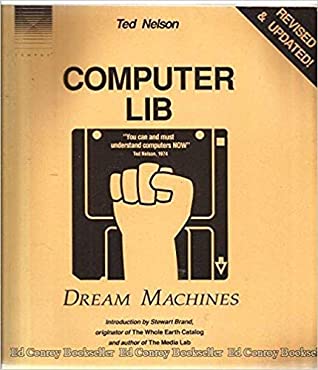
Nelson writes passionately about the need for people to understand computers deeply, more deeply than was generally promoted as computer literacy, which he considers a superficial kind of familiarity with particular hardware and software. His rallying cry "Down with Cybercrud" is against the centralization of computers such as that performed by IBM at the time, as well as against what he sees as the intentional untruths that "computer people" tell to non-computer people to keep them from understanding computers. In Dream Machines, Nelson covers the flexible media potential of the computer, which was shockingly new at the time.

Used successfully by thousands of business managers, educators, and government leaders around the world, Six Thinking Hats offers a practical and uniquely positive approach to making decisions and exploring new ideas.Your success in business depends on how you think. "The main difficulty of thinking is confusion," writes Edward de Bono, long recognized as the foremost international authority on conceptual thinking and on the teaching of thinking as a skill. "We try to do too much at once. Emotions, information, logic, hope, and creativity all crowd in on us. It is like juggling with too many balls." The solution? De Bono unscrambles the thinking process with his "six thinking hats":WHITE HAT: neutral and objective, concerned with facts and figuresRED HAT: the emotional viewBLACK HAT: careful and cautious, the "devil's advocate" hatYELLOW HAT: sunny and positiveGREEN HAT: associated with fertile growth, creativity, and new ideasBLUE HAT: cool, the color of the sky, above everything else-the organizing hatThrough case studies and real-life examples, Dr. de Bono reveals the often surprising ways in which deliberate role playing can make you a better thinker. He offers a powerfully simple tool that you--and your business, whether it's a start-up or a major corporation--can use to create a climate of clearer thinking, improved communication, and greater creativity. His book is an instructive and inspiring text for anyone who makes decisions, in business or in life.

Technics and Civilization first presented its compelling history of the machine and critical study of its effects on civilization in 1934—before television, the personal computer, and the Internet even appeared on our periphery. Drawing upon art, science, philosophy, and the history of culture, Lewis Mumford explained the origin of the machine age and traced its social results, asserting that the development of modern technology had its roots in the Middle Ages rather than the Industrial Revolution. Mumford sagely argued that it was the moral, economic, and political choices we made, not the machines that we used, that determined our then industrially driven economy. Equal parts powerful history and polemic criticism, Technics and Civilization was the first comprehensive attempt in English to portray the development of the machine age over the last thousand years—and to predict the pull the technological still holds over us today. “ The questions posed in the first paragraph of Technics and Civilization still deserve our attention, nearly three quarters of a century after they were written.”— Journal of Technology and Culture

A seminal work and examination of the psychopathology of journalism. Using a strange and unprecedented lawsuit by a convicted murder againt the journalist who wrote a book about his crime, Malcolm delves into the always uneasy, sometimes tragic relationship that exists between journalist and subject.Featuring the real-life lawsuit of Jeffrey MacDonald, a convicted murderer, against Joe McGinniss, the author of Fatal Vision.In Malcolm's view, neither journalist nor subject can avoid the moral impasse that is built into the journalistic situation. When the text first appeared, as a two-part article in The New Yorker , its thesis seemed so radical and its irony so pitiless that journalists across the country reacted as if stung.Her book is a work of journalism as well as an essay on it at once exemplifies and dissects its subject. In her interviews with the leading and subsidiary characters in the MacDonald-McGinniss case -- the principals, their lawyers, the members of the jury, and the various persons who testified as expert witnesses at the trial -- Malcolm is always aware of herself as a player in a game that, as she points out, she cannot lose. The journalist-subject encounter has always troubled journalists, but never before has it been looked at so unflinchingly and so ruefully. Hovering over the narrative -- and always on the edge of the reader's consciousness -- is the MacDonald murder case itself, which imparts to the book an atmosphere of anxiety and uncanniness.The Journalist and the Murderer derives from and reflects many of the dominant intellectual concerns of our time, and it will have a particular appeal for those who cherish the odd, the off-center, and the unsolved.

"If you’ve never read it, read it now." ―Arianna Huffington, O, The Oprah Magazine Landmark, groundbreaking, classic―these adjectives barely do justice to the pioneering vision and lasting impact of The Feminine Mystique . Published in 1963, it gave a pitch-perfect description of “the problem that has no name”: the insidious beliefs and institutions that undermined women’s confidence in their intellectual capabilities and kept them in the home. Writing in a time when the average woman first married in her teens and 60 percent of women students dropped out of college to marry, Betty Friedan captured the frustrations and thwarted ambitions of a generation and showed women how they could reclaim their lives. Part social chronicle, part manifesto, The Feminine Mystique is filled with fascinating anecdotes and interviews as well as insights that continue to inspire. This 50th–anniversary edition features an afterword by best-selling author Anna Quindlen as well as a new introduction by Gail Collins.

“This could be a very useful book for teachers and non-teachers alike. Dr. DeBono does not claim to be able to turn us all into Miltons, Davincis, and Einsteins…but his techniques provide an alternative to just sitting around waiting for the Muse to appear. The Muse never appears to most of us—hence the value of this book.”— David Cohen, Times Educational Supplement The first practical explanation of how creativity works, this results-oriented bestseller trains listeners to move beyond a “vertical” mode of thought to tap the potential of lateral thinking “The underlying argument of the book is that there are two kinds of thinking—vertical and lateral. Most of us are educated to think vertically, to go from one logical step to the next, moving all the time towards the one correct solution of our problem. We are not usually educated to be creative, to generate idea after idea…. “Dr. DeBono argues that the function of vertical, logical thinking is to argue what is wrong. It is a very useful way of thinking, but it is not the only useful way. To claim it is, is the sort of intellectual arrogance that makes creative thinking unlikely….
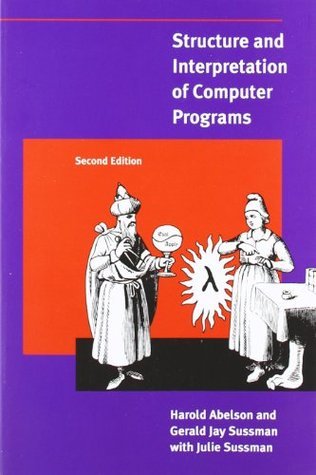
Structure and Interpretation of Computer Programs
by Harold Abelson
Rating: 4.5 ⭐
• 6 recommendations ❤️
Structure and Interpretation of Computer Programs has had a dramatic impact on computer science curricula over the past decade. This long-awaited revision contains changes throughout the text. There are new implementations of most of the major programming systems in the book, including the interpreters and compilers, and the authors have incorporated many small changes that reflect their experience teaching the course at MIT since the first edition was published. A new theme has been introduced that emphasizes the central role played by different approaches to dealing with time in computational models: objects with state, concurrent programming, functional programming and lazy evaluation, and nondeterministic programming. There are new example sections on higher-order procedures in graphics and on applications of stream processing in numerical programming, and many new exercises. In addition, all the programs have been reworked to run in any Scheme implementation that adheres to the IEEE standard.

Organizing Genius: The Secrets of Creative Collaboration
by Warren Bennis
Rating: 3.7 ⭐
• 2 recommendations ❤️
Uncovers the elements of creative collaboration by examining six of the century's most extraordinary groups and distill their successful practices into lessons that virtually any organization can learn and commit to in order to transform its own management into a collaborative and successful group of leaders. Paper. DLC: Organizational effectiveness - Case studies.

Dealers of Lightning: Xerox PARC and the Dawn of the Computer Age
by Michael A. Hiltzik
Rating: 4.2 ⭐
• 8 recommendations ❤️
Dealers of Lightning is the riveting story of the legendary Xerox PARC--a collection of eccentric young inventors brought together by Xerox Corporation at a facility in Palo Alto, California, during the mind-blowing intellectual ferment of the seventies and eighties. Here for the first time Michael Hiltzik, a correspondent for the Los Angeles Times, reveals in piercing detail the true story of the extraordinary group that aimed to bring about a technological dawn that would change the world--and succeeded. Based on extensive interviews with the scientists, engineers, administrators, and corporate executives who lived the story, Dealers of Lightning takes the read on a journey from PARC's beginnings in a dusty, abandoned building at the edge of the Stanford University campus to its triumph as a hothouse of ideas that spawned not only the first personal computer, but the windows-style graphical user interface, the laser printer, much of the indispensable technology of the Internet, and a great deal more. It shows how and why Xerox, despite its willingness to grant PARC unlimited funding and the responsibility for developing breakthroughs to keep the corporation on the cutting edge of office technology, remained forever unable to grasp (and, consequently, exploit) the innovations that PARC delivered--and it details the increasing frustration of the original PARC scientists, many of whom would go on to build their fortunes upon the very ideas Xerox so rashly discarded. More than just a riveting historical narrative, Dealers of Lightning brings to life an unforgettable cast of characters. Among

In the Footsteps of Mr. Kurtz: Living on the Brink of Disaster in Mobutu's Congo
by Michela Wrong
Rating: 4.0 ⭐
• 2 recommendations ❤️
He was known as "the Leopard," and for the thirty-two years of his reign Mobutu Sese Seko, president of Zaire, showed all the cunning of his namesake, seducing Western powers, buying up the opposition, and dominating his people with a devastating combination of brutality and charm. While the population was pauperized, he plundered the country's copper and diamond resources, downing pink champagne in his jungle palace like some modern-day reincarnation of Joseph Conrad's crazed station manager. Michela Wrong, a correspondent who witnessed firsthand Mobutu's last days, traces the rise and fall of the idealistic young journalist who became the stereotype of an African despot. Engrossing, highly readable, and as funny as it is tragic, her book assesses how Belgium's King Leopold, the CIA, and the World Bank all helped to bring about the disaster that is now the Democratic Republic of Congo. If, in this poignant account, the villains are the "Big Vegetables" ( les Grosses légumes ) -- the fat cats who benefited from Mobutu's largesse -- the heroes are the ordinary citizens trapped in a parody of a state. Living in the shadow of a disintegrating nuclear reactor, where banknotes are not worth the paper they are printed on, they have turned survival into an art form. For all its valuable insights into Africa's colonial heritage and the damage done by Western intervention, In the Footsteps of Mr. Kurtz is ultimately a celebration of the irrepressible human spirit.

Upon its original publication, Plagues and Peoples was an immediate critical and popular success, offering a radically new interpretation of world history as seen through the extraordinary impact--political, demographic, ecological, and psychological--of disease on cultures. From the conquest of Mexico by smallpox as much as by the Spanish, to the bubonic plague in China, to the typhoid epidemic in Europe, the history of disease is the history of humankind. With the identification of AIDS in the early 1980s, another chapter has been added to this chronicle of events, which William McNeill explores in his new introduction to this updated editon.Thought-provoking, well-researched, and compulsively readable, Plagues and Peoples is that rare book that is as fascinating as it is scholarly, as intriguing as it is enlightening. "A brilliantly conceptualized and challenging achievement" (Kirkus Reviews), it is essential reading, offering a new perspective on human history.From the Trade Paperback edition.

Generally society has been moving towards electronic payment systems since the 1970s, but it is only the arrival of the Internet and its vertiginous growth, that has made possible the recent advances in this area.

Exupery was a prize-winning novelist, professional mail pilot, airborne adventurer, war correspondent, commercial test pilot, and the author of a popular children's book The Little Prince. Wind, Sand, and Stars more than all the others is a synthesis of his skill as a writer and his life as a flier. It is a collage of anecdotes, speculations and peotic reflections the earth and its inhabitants as seen from the air, all glued together by one basic them: that the airplane has broght man into confrontation with the elemnets of the univeerse, and thus has given him a new perspective on his own nature.

"So it we are not given a short life but we are wasteful of it... Life is long if you know how to use it." "But life is very short and anxious for those who forget the past, neglect the present, and fear the future." "We must indulge the mind and from time to time allow it the leisure which is its food and strength." "Often a very old man has no other proof of his long life than his age." On the Shortness of Life is Seneca's best-known work. It offers piercing and profound insights into human nature, and a vision of the good life, summarised in his aphorism, "Life is long, if you know how to use it." Seneca elucidates many of the principles of modern productivity manuals, including the wise valuing of " People are frugal in guarding their personal property; but as soon as it comes to squandering time they are most wasteful of the one thing in which it is right to be stingy," living in the "The greatest obstacle to living is expectancy, which hangs upon tomorrow and loses today," "There is nothing the busy man is less busied with than living," and rest and "We must go for walks out of doors, so that the mind can be strengthened and invigorated by a clear sky and plenty of fresh air. At times it will acquire fresh energy from a journey by carriage and a change of scene, or from socializing and drinking freely." Lucius Annaeus Seneca (4 BC - AD 65), also known as Seneca the Younger, was a Roman philosopher, statesman and dramatist. He was the leading intellectual in the mid-first century and was a trusted advisor to the Emperor Nero. Seneca's books are among the most important primary texts of Stoic philosophy. His literary style and ideas were renowned and influential in his time, and ever since. The reformer Calvin published a commentary on one of Seneca's works, while the Catholic philosopher, Erasmus, edited a volume of Seneca. In today's uncertain world, there is a resurgence of interest in Stoic philosophy and Seneca's body of work. The Shortness of Life , a brief, accessible and carefully argued guide to a wise and full life is an essential classic. Stoic philosophy is, above all, practical. It uses reason and the careful observation of human life to address the problems of daily life. It is also universal-the emperor Marcus Aurelius and the freed slave Epictetus were both prominent Stoic philosophers. In recent years, Stoic philosophy has provided invaluable life lessons to people in all spheres of life including prisoners of war and Holocaust survivors, psychiatrists, and those in the business world. Indeed, modern Stoic thought "hold[s] fascinating promise for business and government leaders tackling global problems in a turbulent, post-recession slump," ( Forbes) .

This book originated as lectures for a course on political philosophy that Rawls taught regularly at Harvard in the 1980s. In time the lectures became a restatement of his theory of justice as fairness, revised in light of his more recent papers and his treatise Political Liberalism (1993). As Rawls writes in the preface, the restatement presents "in one place an account of justice as fairness as I now see it, drawing on all [my previous] works." He offers a broad overview of his main lines of thought and also explores specific issues never before addressed in any of his writings.Rawls is well aware that since the publication of A Theory of Justice in 1971, American society has moved farther away from the idea of justice as fairness. Yet his ideas retain their power and relevance to debates in a pluralistic society about the meaning and theoretical viability of liberalism. This book demonstrates that moral clarity can be achieved even when a collective commitment to justice is uncertain.

In the heart of China's Sichuan province lies the small city of Fuling. Surrounded by the terraced hills of the Yangtze River valley, Fuling has long been a place of continuity, far from the bustling political centers of Beijing and Shanghai. But now Fuling is heading down a new path, and gradually, along with scores of other towns in this vast and ever-evolving country, it is becoming a place of change and vitality, tension and reform, disruption and growth. As the people of Fuling hold on to the China they know, they are also opening up and struggling to adapt to a world in which their fate is uncertain.Fuling's position at the crossroads came into remarkably sharp focus when Peter Hessler arrived as a Peace Corps volunteer in 1996, marking the first time in more than half a century that the city had an American resident. He found himself teaching English and American literature at the local college, discovering how Shakespeare and other classics look when seen through the eyes of students who have been raised in the Sichuan countryside and educated in Communist Party doctrine. His students, though, are the ones who taught him about the ways of Fuling — and about the complex process of understanding that takes place when one is immersed in a radically different society.As he learns the language and comes to know the people, Hessler begins to see that it is indeed a unique moment for Fuling. In its past is Communist China's troubled history — the struggles of land reform, the decades of misguided economic policies, and the unthinkable damage of the Cultural Revolution — and in the future is the Three Gorges Dam, which upon completion will partly flood thecity and force the resettlement of more than a million people. Making his way in the city and traveling by boat and train throughout Sichuan province and beyond, Hessler offers vivid descriptions of the people he meets, from priests to prostitutes and peasants to professors, and gives voice to their views. This is both an intimate personal story of his life in Fuling and a colorful, beautifully written account of the surrounding landscape and its history. Imaginative, poignant, funny, and utterly compelling, River Town is an unforgettable portrait of a city that, much like China itself, is seeking to understand both what it was and what it someday will be.
This country’s most challenging writer on education presents here a distillation, for the general reader, of half a decade’s research and reflection. His theme is how children learn, and how they can best be helped to learn―how they can be brought to the fullest realization of their capacities.Jerome Bruner, Harper’s reports, has “stirred up more excitement than any educator since John Dewey.” His explorations into the nature of intellectual growth and its relation to theories of learning and methods of teaching have had a catalytic effect upon educational theory. In this new volume the subjects dealt with in The Process of Education are pursued further, probed more deeply, given concrete illustration and a broader context.“One is struck by the absence of a theory of instruction as a guide to pedagogy,” Mr. Bruner observes; “in its place there is principally a body of maxims.” The eight essays in this volume, as varied in topic as they are unified in theme, are contributions toward the construction of such a theory. What is needed in that enterprise is, inter alia , “the daring and freshness of hypotheses that do not take for granted as true what has merely become habitual,” and these are amply evidenced here.At the conceptual core of the book is an illuminating examination of how mental growth proceeds, and of the ways in which teaching can profitably adapt itself to that progression and can also help it along. Closely related to this is Mr. Bruner’s “evolutionary instrumentalism,” his conception of instruction as the means of transmitting the tools and skills of a culture, the acquired characteristics that express and amplify man’s powers―especially the crucial symbolic tools of language, number, and logic. Revealing insights are given into the manner in which language functions as an instrument of thought.The theories presented are anchored in practice, in the empirical research from which they derive and in the practical applications to which they can be put. The latter are exemplified incidentally throughout and extensively in detailed descriptions of two courses Mr. Bruner has helped to construct and to teach―an experimental mathematics course and a multifaceted course in social studies. In both, the students’ encounters with the material to be mastered are structured and sequenced in such a way as to work with, and to reinforce, the developmental process.Written with all the style and élan that readers have come to expect of Mr. Bruner, Toward a Theory of Instruction is charged with the provocative suggestions and inquiries of one of the great innovators in the field of education.

This book first covers exact and approximate analytical techniques (ordinary differential and difference equations, partial differential equations, variational principles, stochastic processes); numerical methods (finite differences for ODE's and PDE's, finite elements, cellular automata); model inference based on observations (function fitting, data transforms, network architectures, search techniques, density estimation); as well as the special role of time in modeling (filtering and state estimation, hidden Markov processes, linear and nonlinear time series). Each of the topics in the book would be the worthy subject of a dedicated text, but only by presenting the material in this way is it possible to make so much material accessible to so many people. Each chapter presents a concise summary of the core results in an area, providing an orientation to what they can (and cannot) do, enough background to use them to solve typical problems, and pointers to access the literature for particular applications.

Alternative cover edition for this isbn here Anyone alive in the eighteenth century would have known that "the longitude problem" was the thorniest scientific dilemma of the day--and had been for centuries. Lacking the ability to measure their longitude, sailors throughout the great ages of exploration had been literally lost at sea as soon as they lost sight of land. Thousands of lives and the increasing fortunes of nations hung on a resolution. One man, John Harrison, in complete opposition to the scientific community, dared to imagine a mechanical solution--a clock that would keep precise time at sea, something no clock had ever been able to do on land. Longitude is the dramatic human story of an epic scientific quest and of Harrison's forty-year obsession with building his perfect timekeeper, known today as the chronometer. Full of heroism and chicanery, it is also a fascinating brief history of astronomy, navigation, and clockmaking, and opens a new window on our world.

Anthropic Bias explores how to reason when you suspect that your evidence is biased by "observation selection effects"--that is, evidence that has been filtered by the precondition that there be some suitably positioned observer to "have" the evidence. This conundrum--sometimes alluded to as "the anthropic principle," "self-locating belief," or "indexical information"--turns out to be a surprisingly perplexing and intellectually stimulating challenge, one abounding with important implications for many areas in science and philosophy.There are the philosophical thought experiments and paradoxes: the Doomsday Argument; Sleeping Beauty; the Presumptuous Philosopher; Adam & Eve; the Absent-Minded Driver; the Shooting Room.And there are the applications in contemporary science: cosmology ("How many universes are there?," "Why does the universe appear fine-tuned for life?"); evolutionary theory ("How improbable was the evolution of intelligent life on our planet?"); the problem of time's arrow ("Can it be given a thermodynamic explanation?"); quantum physics ("How can the many-worlds theory be tested?"); game-theory problems with imperfect recall ("How to model them?"); even traffic analysis ("Why is the 'next lane' faster?").Anthropic Bias argues that the same principles are at work across all these domains. And it offers a synthesis: a mathematically explicit theory of observation selection effects that attempts to meet scientific needs while steering clear of philosophical paradox.

Men, Machines, and Modern Times, though ultimately concerned with a positive alternative to an Orwellian 1984, offers an entertaining series of historical accounts taken from the nineteenth century to highlight a main theme: the nature of technological change, the fission brought about in society by such change, and society's reaction to that change. Beginning with a remarkable illustration of resistance to innovation in the U.S. Navy following an officer's discovery of a more accurate way to fire a gun at sea, Elting Morison goes on to narrate the strange history of the new model steamship, the Wapanoag, in the 1860s. He then continues with the difficulties confronting the introduction of the pasteurization process for milk; he traces the development of the Bessemer process; and finally, he considers the computer. While the discussions are liberally sprinkled with amusing examples and anecdotes, all are related to the more profound and current problem of how to organize and manage system of ideas, energies, and machinery so that it will conform to the human dimension.
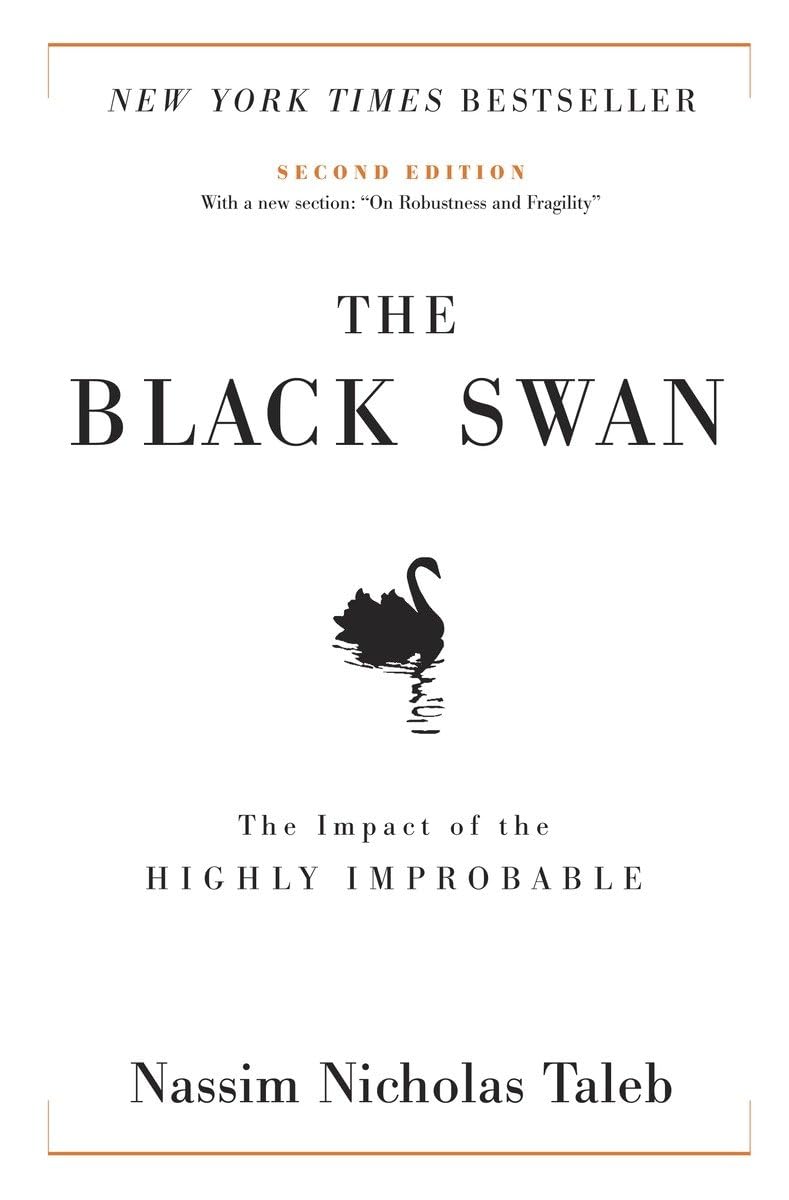
The Black Swan: The Impact of the Highly Improbable
by Nassim Nicholas Taleb
Rating: 4.0 ⭐
• 3 recommendations ❤️
The most influential book of the past seventy-five years: a groundbreaking exploration of everything we know about what we don’t know, now with a new section called “On Robustness and Fragility.”A black swan is a highly improbable event with three principal characteristics: It is unpredictable; it carries a massive impact; and, after the fact, we concoct an explanation that makes it appear less random, and more predictable, than it was. The astonishing success of Google was a black swan; so was 9/11. For Nassim Nicholas Taleb, black swans underlie almost everything about our world, from the rise of religions to events in our own personal lives. Why do we not acknowledge the phenomenon of black swans until after they occur? Part of the answer, according to Taleb, is that humans are hardwired to learn specifics when they should be focused on generalities. We concentrate on things we already know and time and time again fail to take into consideration what we don’t know. We are, therefore, unable to truly estimate opportunities, too vulnerable to the impulse to simplify, narrate, and categorize, and not open enough to rewarding those who can imagine the “impossible.” For years, Taleb has studied how we fool ourselves into thinking we know more than we actually do. We restrict our thinking to the irrelevant and inconsequential, while large events continue to surprise us and shape our world. In this revelatory book, Taleb will change the way you look at the world, and this second edition features a new philosophical and empirical essay, “On Robustness and Fragility,” which offers tools to navigate and exploit a Black Swan world.Taleb is a vastly entertaining writer, with wit, irreverence, and unusual stories to tell. He has a polymathic command of subjects ranging from cognitive science to business to probability theory. Elegant, startling, and universal in its applications, The Black Swan is a landmark book—itself a black swan.

When Renee Feuer goes to college, one of the first lessons she tries to learn is how to liberate herself from the restrictions of her orthodox Jewish background. As she discovers the pleasures of the body, Renee also learns about the excitements of the mind. She enrolls as a philosophy graduate student, then marries Noam Himmel, the world-renowned mathematician. But Renee discovers that being married to a genius is a less elevating experience than expected. The story of her quest for a solution to the mind-body problem involves the prickly contemporary dilemmas of sex and love, of doubt and belief.
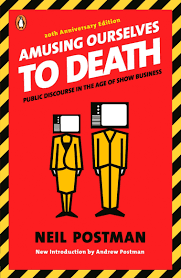
Amusing Ourselves to Death: Public Discourse in the Age of Show Business
by Neil Postman
Rating: 4.2 ⭐
• 13 recommendations ❤️
Television has conditioned us to tolerate visually entertaining material measured out in spoonfuls of time, to the detriment of rational public discourse and reasoned public affairs. In this eloquent, persuasive book, Neil Postman alerts us to the real and present dangers of this state of affairs, and offers compelling suggestions as to how to withstand the media onslaught. Before we hand over politics, education, religion, and journalism to the show business demands of the television age, we must recognize the ways in which the media shape our lives and the ways we can, in turn, shape them to serve out highest goals.

Nixonland: The Rise of a President and the Fracturing of America
by Rick Perlstein
Rating: 4.2 ⭐
• 2 recommendations ❤️
Politically insightful, Nixonland recaptures the turbulent 60s & early 70s, revealing how Dick Nixon rose from the political grave to seize and hold the presidency. Perlstein's account begins with the '65 Watts riots, nine months after Johnson's landslide victory over Goldwater appeared to herald a permanent liberal consensus. Yet the next year, scores of liberals were tossed from Congress, America was more divided than ever and a disgraced politician was on his way to a shocking comeback.Between 1965 and 1972, America experienced a second civil war. From its ashes, today's political world was born. It was the era not only of Nixon, Johnson, Agnew, Humphrey, McGovern, Daley and Wallace; but Abbie Hoffman, Ronald Reagan, Angela Davis, Ted Kennedy, Charles Manson, John Lindsay and Jane Fonda. There are glimpses of Jimmy Carter, George H.W. Bush, Jesse Jackson, John Kerry and even of two ambitious young men named Karl Rove and Bill Clinton--and an unambitious young man named George W. Bush.Filled with prodigious research, driven by a powerful narrative, Perlstein's account of how America divided confirms his place as one of our country's most celebrated historians.

Out of Mao's Shadow: The Struggle for the Soul of a New China
by Philip P. Pan
Rating: 4.3 ⭐
• 3 recommendations ❤️
Now in paperback, an intimate, elegant account of a society in the most important book in a generation about the Chinese people and their long, heartbreaking battle for political freedom.Out of Mao’s Shadow offers a startling perspective on China and its remarkable transformation, challenging conventional wisdom about the political apathy of the Chinese people and the notion that prosperity leads automatically to freedom. Like David Remnick’s Lenin’s Tomb, this is a moving story of a nation in transition, of a people coming to terms with their past and struggling to take control of their future.

A global catastrophic risk is one with the potential to wreak death and destruction on a global scale. In human history, wars and plagues have done so on more than one occasion, and misguided ideologies and totalitarian regimes have darkened an entire era or a region. Advances in technology are adding dangers of a new kind. It could happen again. In Global Catastrophic Risks 25 leading experts look at the gravest risks facing humanity in the 21st century, including asteroid impacts, gamma-ray bursts, Earth-based natural catastrophes, nuclear war, terrorism, global warming, biological weapons, totalitarianism, advanced nanotechnology, general artificial intelligence, and social collapse. The book also addresses over-arching issues - policy responses and methods for predicting and managing catastrophes.This is invaluable reading for anyone interested in the big issues of our time; for students focusing on science, society, technology, and public policy; and for academics, policy-makers, and professionals working in these acutely important fields.

Challenging, with several powerful arguments, some of our deepest beliefs about rationality, morality, and personal identity, Parfit claims that we have a false view about our own nature. It is often rational to act against our own best interests, he argues, and most of us have moral views that are self-defeating. We often act wrongly, although we know there will be no one with serious grounds for complaint, and when we consider future generations it is very hard to avoid conclusions that most of us will find very disturbing.

From one of America's most distinguished historians comes this classic analysis of Richard Nixon. By considering some of the president's opinions, Wills comes to the controversial conclusion that Nixon was actually a liberal. Both entertaining and essential, Nixon Agonistes captures a troubled leader and a struggling nation mired in a foolish Asian war, forfeiting the loyalty of its youth, puzzled by its own power, and looking to its cautious president for confidence. In the end, Nixon Agonistes reaches far beyond its assessment of the thirty-seventh president to become an incisive and provocative analysis of the American political machine.

From 1983 to 1986, the legendary physicist and teacher Richard Feynman gave a course at Caltech called “Potentialities and Limitations of Computing Machines.”Although the lectures are over ten years old, most of the material is timeless and presents a “Feynmanesque” overview of many standard and some not-so-standard topics in computer science. These include computability, Turing machines (or as Feynman said, “Mr. Turing's machines”), information theory, Shannon's Theorem, reversible computation, the thermodynamics of computation, the quantum limits to computation, and the physics of VLSI devices. Taken together, these lectures represent a unique exploration of the fundamental limitations of digital computers.Feynman's philosophy of learning and discovery comes through strongly in these lectures. He constantly points out the benefits of playing around with concepts and working out solutions to problems on your own-before looking at the back of the book for the answers. As Feynman says in the lectures: “If you keep proving stuff that others have done, getting confidence, increasing complexities of your solutions-for the fun of it-then one day you'll turn around and discovers that nobody actually did that one! And that's the way to become a computer scientist.”

Bram Stoker's vampire novel Dracula, which paved the way for vampire lore in popular culture, was published today in 1897. Here are 10 facts about the former Daily Telegraph journalist.Bram Stoker wrote 12 novels, including Dracula and The Jewel of Seven Stars, and also published collections of short stories. Dracula was originally titled The Undead. As Dracula “My revenge is just begun! I spread it over centuries, and time is on my side.” To date, more than 1000 novels and 200 films have been made about the vampire Dracula.Stoker, who had been an occasional freelance contributor to The Daily Telegraph in the 1890s, began working regularly for the paper as part of the literary staff from 1905 until 1910, during which time he also wrote theatre reviews for the paper. During this period, he was also working on The Lair of the White Worm.Born in Dublin on 8 November 1847, Stoker had an ancient, colourful lineage on his mother's side – including the legendary sheriff of Galway, who hanged his own son. It was material the writer mined in his fiction.A key inspiration for Dracula was always said to have been Vlad the Impaler, the 15th-century Transylvanian-born prince also known as Vlad III Dracula of Wallachia. However, historian Fiona Fitzsimons “Stoker did not use overtly Irish references in Dracula, but his main theme is taken from Irish history – the history, we now learn, of his own family – recast in the writer’s imagination. Manus the Magnificent (Manus O’Donnell,who once ruled much of Ireland) was Stoker’s direct ancestor and was an influence on the book."

Poor Charlie's Almanack: The Wit and Wisdom of Charles T. Munger
by Charles T. Munger
Rating: 4.6 ⭐
• 37 recommendations ❤️
EXPANDED THIRD EDITION includes Charlie's 2007 USC Law School Commencement address. Edited by Peter D. Kaufman. Brand New.
This book is meant to help the reader learn how to program in C. It is the definitive reference guide, now in a second edition. Although the first edition was written in 1978, it continues to be a worldwide best-seller. This second edition brings the classic original up to date to include the ANSI standard. From the Preface: We have tried to retain the brevity of the first edition. C is not a big language, and it is not well served by a big book. We have improved the exposition of critical features, such as pointers, that are central to C programming. We have refined the original examples, and have added new examples in several chapters. For instance, the treatment of complicated declarations is augmented by programs that convert declarations into words and vice versa. As before, all examples have been tested directly from the text, which is in machine-readable form. As we said in the first preface to the first edition, C "wears well as one's experience with it grows." With a decade more experience, we still feel that way. We hope that this book will help you to learn C and use it well.

The internationally bestselling definitive history of the Arab world, named a best book of the year by the Financial Times, the Economist, and the Atlantic -- now updated to cover the latest developments in the Middle East In this groundbreaking and comprehensive account of the Middle East, award-winning historian Eugene Rogan draws extensively on five centuries of Arab sources to place the Arab experience in its crucial historical context. This landmark book covers the Arab world from North Africa through the Arabian Peninsula, exploring every facet of modern Arab history. Starting with the Ottoman conquests of the sixteenth century, Rogan follows the story of the Arabs through the era of European imperialism and the superpower rivalries of the Cold War to the present age of American hegemony, charting the evolution of Arab identity and the struggles for national sovereignty throughout. In this updated edition, Rogan untangles the latest geopolitical developments of the region. The Arabs is essential reading for anyone seeking to understand the modern Arab world.

At once funny, wistful and unsettling, Sum is a dazzling exploration of unexpected afterlives—each presented as a vignette that offers a stunning lens through which to see ourselves in the here and now. In one afterlife, you may find that God is the size of a microbe and unaware of your existence. In another version, you work as a background character in other people’s dreams. Or you may find that God is a married couple, or that the universe is running backward, or that you are forced to live out your afterlife with annoying versions of who you could have been. With a probing imagination and deep understanding of the human condition, acclaimed neuroscientist David Eagleman offers wonderfully imagined tales that shine a brilliant light on the here and now.

Postcards from Tomorrow Square: Reports from China
by James M. Fallows
Rating: 3.9 ⭐
• 2 recommendations ❤️
“Americans need not be hostile toward China's rise, but they should be wary about its eventual effects. The United States is the only nation with the scale and power to try to set the terms of its interaction with China rather than just succumb. So starting now, Americans need to consider the economic, environmental, political, and social goals they care about defending as Chinese influence grows.” —from “China Makes, the World Takes”Since December 2006, The Atlantic Magazine's James Fallows has been writing some of the most discerning accounts of the economic and political transformation occurring in China. The ten essays collected here cover a wide-range of topics: from visionary tycoons and TV-battling entrepreneurs, to environmental pollution and how China subsidizes our economy. Fallows expertly and lucidly explains the economic, political, social, and cultural forces at work turning China into a world superpower at breakneck speed. This eye-opening and cautionary account is essential reading for all concerned not only with China's but America's future role in the world.

Something Incredibly Wonderful Happens: Frank Oppenheimer and His Astonishing Exploratorium
by K.C. Cole
Rating: 4.4 ⭐
• 3 recommendations ❤️
How do we reclaim our innate enchantment with the world? And how can we turn our natural curiosity into a deep, abiding love for knowledge? Frank Oppenheimer, the younger brother of the physicist J. Robert Oppenheimer, was captivated by these questions, and used his own intellectual inquisitiveness to found the Exploratorium, a powerfully influential museum of human awareness in San Francisco, that encourages play, creativity, and discovery—all in the name of understanding. In this elegant biography, K. C. Cole investigates the man behind the museum with sharp insight and deep sympathy. The Oppenheimers were a family with great wealth and education, and Frank, like his older brother, pursued a career in physics. But while Robert was unceasingly ambitious, and eventually came to be known for his work on the atomic bomb, Frank’s path as a scientist was much less conventional. His brief fling with the Communist Party cost him his position at the University of Minnesota, and he subsequently spent a decade ranching in Colorado before returning to teaching. Once back in the lab, however, Frank found himself moved to create something to make the world meaningful after the bombing of Hiroshima and Nagasaki. He was inspired by European science museums , and he developed a dream of teaching Americans about science through participatory museums. Thus was born the magical world of the Exploratorium, forever revolutionizing not only the way we experience museums, but also science education for years to come. Cole has brought this charismatic and dynamic figure to life with vibrant prose and rich insight into Oppenheimer as both a scientist and an individual.

A big, powerful saga of men in combat, written over the course of thirty-five years by a highly decorated Vietnam veteran.Intense, powerful, and compelling, Matterhorn is an epic war novel in the tradition of Norman Mailer's The Naked and the Dead and James Jones's The Thin Red Line. It is the timeless story of a young Marine lieutenant, Waino Mellas, and his comrades in Bravo Company, who are dropped into the mountain jungle of Vietnam as boys and forced to fight their way into manhood. Standing in their way are not merely the North Vietnamese but also monsoon rain and mud, leeches and tigers, disease and malnutrition. Almost as daunting, it turns out, are the obstacles they discover between each other: racial tension, competing ambitions, and duplicitous superior officers. But when the company finds itself surrounded and outnumbered by a massive enemy regiment, the Marines are thrust into the raw and all-consuming terror of combat. The experience will change them forever.Written over the course of thirty years by a highly decorated Vietnam veteran, Matterhorn is a visceral and spellbinding novel about what it is like to be a young man at war. It is an unforgettable novel that transforms the tragedy of Vietnam into a powerful and universal story of courage, camaraderie, and sacrifice: a parable not only of the war in Vietnam but of all war, and a testament to the redemptive power of literature.A graduate of Yale University and a Rhodes Scholar at Oxford University, Karl Marlantes served as a Marine in Vietnam, where he was awarded the Navy Cross, the Bronze Star, two Navy Commendation Medals for valor, two Purple Hearts, and ten air medals. This is his first novel. He lives in rural Washington State.

Whole Earth Discipline: Why Dense Cities, Nuclear Power, Transgenic Crops, Restored Wildlands, and Geoengineering Are Necessary
by Stewart Brand
Rating: 4.2 ⭐
• 10 recommendations ❤️
“Incredible book . . . Best I’ve read this year.” —Jack Dorsey, via TwitterThis eye-opening book by the legendary author of the National Book Award-winning Whole Earth Catalog persuasively details a new approach to our stewardship of the planet. Lifelong ecologist and futurist Stewart Brand relies on scientific rigor to shatter myths concerning nuclear energy, urbanization, genetic engineering, and other controversial subjects, showing exactly where the sources of our dilemmas lie and offering a bold, inventive set of policies and design- based solutions for shaping a more sustainable society. Thought- provoking and passionately argued, this is a pioneering book on one of the hottest issues facing humanity today.

Bored with their work, three Milanese editors cook up "the Plan," a hoax that connects the medieval Knights Templar with other occult groups from ancient to modern times. This produces a map indicating the geographical point from which all the powers of the earth can be controlled--a point located in Paris, France, at Foucault's Pendulum. But in a fateful turn the joke becomes all too real, and when occult groups, including Satanists, get wind of the Plan, they go so far as to kill one of the editors in their quest to gain control of the earth.Orchestrating these and other diverse characters into his multilayered semiotic adventure, Eco has created a superb cerebral entertainment.

A Vast Machine: Computer Models, Climate Data, and the Politics of Global Warming
by Paul N. Edwards
Rating: 3.9 ⭐
• 4 recommendations ❤️
Global warming skeptics often fall back on the argument that the scientific case for global warming is all model predictions, nothing but simulation; they warn us that we need to wait for real data, "sound science." In "A Vast Machine" Paul Edwards has news for these skeptics: without models, there are no data. Today, no collection of signals or observations -- even from satellites, which can "see" the whole planet with a single instrument -- becomes global in time and space without passing through a series of data models. Everything we know about the world's climate we know through models. Edwards offers an engaging and innovative history of how scientists learned to understand the atmosphere -- to measure it, trace its past, and model its future.

Dancing in the Glory of Monsters: The Collapse of the Congo and the Great War of Africa
by Jason K. Stearns
Rating: 4.2 ⭐
• 3 recommendations ❤️
“The best account [of the conflict in the Congo] so far….The task facing anyone who tries to tell this whole story is formidable, but Stearns by and large rises to it.” —Adam Hochschild, New York Times Book Review “[A] tour de force, though not for the squeamish.” — Washington Post “This is a serious book about the social and political forces behind one of the most violent clashes of modern times—as well as a damn good read.” — Economist “[P]erhaps the best account of the most recent conflict in the Congo.” — Foreign Policy “A serious, admirably balanced account of the crisis and the political and social forces behind it… perhaps the most accessible, meticulously researched, and comprehensive overview of the Congo crisis yet.” — Financial Times

The New York Times bestseller: A provocative, imaginative exploration of the nature and progress of knowledge"Dazzling." - Steven Pinker, The GuardianIn this groundbreaking book, award-winning physicist David Deutsch argues that explanations have a fundamental place in the universe--and that improving them is the basic regulating principle of all successful human endeavor. Taking us on a journey through every fundamental field of science, as well as the history of civilization, art, moral values, and the theory of political institutions, Deutsch tracks how we form new explanations and drop bad ones, explaining the conditions under which progress--which he argues is potentially boundless--can and cannot happen. Hugely ambitious and highly original, The Beginning of Infinity explores and establishes deep connections between the laws of nature, the human condition, knowledge, and the possibility for progress.

A Great Leap Forward: 1930s Depression and U.S. Economic Growth
by Alexander J. Field
Rating: 3.5 ⭐
• 2 recommendations ❤️
This bold re-examination of the history of U.S. economic growth is built around a novel claim, that productive capacity grew dramatically across the Depression years (1929-1941) and that this advance provided the foundation for the economic and military success of the United States during the Second World War as well as for the golden age (1948-1973) that followed. Alexander J. Field takes a fresh look at growth data and concludes that, behind a backdrop of double-digit unemployment, the 1930s actually experienced very high rates of technological and organizational innovation, fueled by the maturing of a privately funded research and development system and the government-funded build-out of the country's surface road infrastructure. This significant new volume in the Yale Series in Economic and Financial History invites new discussion of the causes and consequences of productivity growth over the last century and a half and on our current prospects.
The Idea Factory: Bell Labs and the Great Age of American Innovation
by Jon Gertner
Rating: 4.4 ⭐
• 9 recommendations ❤️
The definitive history of America’s greatest incubator of innovation and the birthplace of some of the 20th century’s most influential technologies“Filled with colorful characters and inspiring lessons . . . The Idea Factory explores one of the most critical issues of our What causes innovation?” —Walter Isaacson, The New York Times Book Review“Compelling . . . Gertner's book offers fascinating evidence for those seeking to understand how a society should best invest its research resources.” — The Wall Street JournalFrom its beginnings in the 1920s until its demise in the 1980s, Bell Labs-officially, the research and development wing of AT&T-was the biggest, and arguably the best, laboratory for new ideas in the world. From the transistor to the laser, from digital communications to cellular telephony, it's hard to find an aspect of modern life that hasn't been touched by Bell Labs. In The Idea Factory , Jon Gertner traces the origins of some of the twentieth century's most important inventions and delivers a riveting and heretofore untold chapter of American history. At its heart this is a story about the life and work of a small group of brilliant and eccentric men-Mervin Kelly, Bill Shockley, Claude Shannon, John Pierce, and Bill Baker-who spent their careers at Bell Labs. Today, when the drive to invent has become a mantra, Bell Labs offers us a way to enrich our understanding of the challenges and solutions to technological innovation. Here, after all, was where the foundational ideas on the management of innovation were born.
Season of the Witch: Enchantment, Terror and Deliverance in the City of Love
by David Talbot
Rating: 4.3 ⭐
• 2 recommendations ❤️
In a kaleidoscopic narrative, bestselling David Talbot recounts the gripping story of San Francisco in the turbulent years between 1967 & 1982—& of the extraordinary persons who led to the city’s ultimate rebirth & triumph. Season of the Witch is the first book to fully capture the dark magic of San Francisco in this breathtaking period, when the city radically changed itself & then revolutionized the world. The cool gray city of love was the epicenter of the 60s cultural revolution. But by the early 70s, San Francisco’s ecstatic experiment came crashing down from its starry heights. The city was rocked by savage murder sprees, mysterious terror campaigns, political assassinations, street riots & finally a terrifying sexual epidemic. No other city endured so many calamities in such a short time span. Talbot goes deep into the riveting story of his city’s ascent, decline & heroic recovery. He draws intimate portraits of San Francisco’s legendary demons & saviors: Charles Manson, Patty Hearst & the Symbionese Liberation Army, Jerry Garcia, Janis Joplin, Bill Graham, Herb Caen, the Cockettes, Harvey Milk, Jim Jones & the Peoples Temple, Joe Montana & the Super Bowl 49ers. He reveals how the city emerged from the trials of this period with a new brand of “San Francisco values,” including gay marriage, medical marijuana, immigration sanctuary, universal health care, recycling, renewable energy, consumer safety & a living wage mandate. Considered radical when they were first introduced, these ideas have become the bedrock of decent society in many parts of the country & exemplify the ways that the city now inspires a live-and-let-live tolerance, a shared sense of humanity & an openness to change. As a new generation of activists & dreamers seeks its own path to a more enlightened future, Season of the Witch—with its epic tale of the wild & bloody birth of San Francisco values—offers both inspiration & cautionary wisdom.

The Old Way: A Story of the First People
by Elizabeth Marshall Thomas
Rating: 4.2 ⭐
• 6 recommendations ❤️
Elizabeth Marshall Thomas was nineteen when her father took his family to live among the Bushmen of the Kalahari. Fifty years later, after a life of writing and study, Thomas returns to her experiences with the Bushmen, one of the last hunter-gatherer societies on earth, and discovers among them an essential link to the origins of all human society.Humans lived for 1,500 centuries as roving clans, adapting daily to changes in environment and food supply, living for the most part like their animal ancestors. Those origins are not so easily abandoned, Thomas suggests, and our modern society has plenty still to learn from the Bushmen.Through her vivid, empathic account, Thomas reveals a template for the lives and societies of all humankind.

In the fall of 1980, Genentech, Inc., a little-known California genetic engineering company, became the overnight darling of Wall Street, raising over $38 million in its initial public stock offering. Lacking marketed products or substantial profit, the firm nonetheless saw its share price escalate from $35 to $89 in the first few minutes of trading, at that point the largest gain in stock market history. Coming at a time of economic recession and declining technological competitiveness in the United States, the event provoked banner headlines and ignited a period of speculative frenzy over biotechnology as a revolutionary means for creating new and better kinds of pharmaceuticals, untold profit, and a possible solution to national economic malaise. Drawing from an unparalleled collection of interviews with early biotech players, Sally Smith Hughes offers the first book-length history of this pioneering company, depicting Genentech’s improbable creation, precarious youth, and ascent to immense prosperity. Hughes provides intimate portraits of the people significant to Genentech’s science and business, including cofounders Herbert Boyer and Robert Swanson, and in doing so sheds new light on how personality affects the growth of science. By placing Genentech’s founders, followers, opponents, victims, and beneficiaries in context, Hughes also demonstrates how science interacts with commercial and legal interests and university research, and with government regulation, venture capital, and commercial profits. Integrating the scientific, the corporate, the contextual, and the personal, Genentech tells the story of biotechnology as it is not often told, as a risky and improbable entrepreneurial venture that had to overcome a number of powerful forces working against it.

More than two-thirds of the new airports under construction today are being built in China. Chinese airlines expect to triple their fleet size over the next decade and will account for the fastest-growing market for Boeing and Airbus. But the Chinese are determined to be more than customers. In 2011, China announced its Twelfth Five-Year Plan, which included the commitment to spend a quarter of a trillion dollars to jump-start its aerospace industry. Its goal is to produce the Boeings and Airbuses of the future. Toward that end, it acquired two American companies: Cirrus Aviation, maker of the world’s most popular small propeller plane, and Teledyne Continental, which produces the engines for Cirrus and other small aircraft. In China Airborne, James Fallows documents, for the first time, the extraordinary scale of this project and explains why it is a crucial test case for China’s hopes for modernization and innovation in other industries. He makes clear how it stands to catalyze the nation’s hyper-growth and hyper- urbanization, revolutionizing China in ways analogous to the building of America’s transcontinental railroad in the nineteenth century. Fallows chronicles life in the city of Xi’an, home to more than 250,000 aerospace engineers and assembly workers, and introduces us to some of the hucksters, visionaries, entrepreneurs, and dreamers who seek to benefit from China’s pursuit of aerospace supremacy. He concludes by examining what this latest demonstration of Chinese ambition means for the United States and the rest of the world—and the right ways to understand it.

Freedom's Forge: How American Business Produced Victory in World War II
by Arthur Herman
Rating: 4.4 ⭐
• 4 recommendations ❤️
SELECTED BY THE ECONOMIST AS ONE OF THE BEST BOOKS OF THE YEARRemarkable as it may seem today, there once was a time when the president of the United States could pick up the phone and ask the president of General Motors to resign his position and take the reins of a great national enterprise. And the CEO would oblige, no questions asked, because it was his patriotic duty. In Freedom’s Forge, bestselling author Arthur Herman takes us back to that time, revealing how two extraordinary American businessmen—automobile magnate William Knudsen and shipbuilder Henry J. Kaiser—helped corral, cajole, and inspire business leaders across the country to mobilize the “arsenal of democracy” that propelled the Allies to victory in World War II. “Knudsen? I want to see you in Washington. I want you to work on some production matters.” With those words, President Franklin D. Roosevelt enlisted “Big Bill” Knudsen, a Danish immigrant who had risen through the ranks of the auto industry to become president of General Motors, to drop his plans for market domination and join the U.S. Army. Commissioned a lieutenant general, Knudsen assembled a crack team of industrial innovators, persuading them one by one to leave their lucrative private sector positions and join him in Washington, D.C. Dubbed the “dollar-a-year men,” these dedicated patriots quickly took charge of America’s moribund war production effort. Henry J. Kaiser was a maverick California industrialist famed for his innovative business techniques and his can-do management style. He, too, joined the cause. His Liberty ships became World War II icons—and the Kaiser name became so admired that FDR briefly considered making him his vice president in 1944. Together, Knudsen and Kaiser created a wartime production behemoth. Drafting top talent from companies like Chrysler, Republic Steel, Boeing, Lockheed, GE, and Frigidaire, they turned auto plants into aircraft factories and civilian assembly lines into fountains of munitions, giving Americans fighting in Europe and Asia the tools they needed to defeat the Axis. In four short years they transformed America’s army from a hollow shell into a truly global force, laying the foundations for a new industrial America—and for the country’s rise as an economic as well as military superpower. Featuring behind-the-scenes portraits of FDR, George Marshall, Henry Stimson, Harry Hopkins, Jimmy Doolittle, and Curtis LeMay, as well as scores of largely forgotten heroes and heroines of the wartime industrial effort, Freedom’s Forge is the American story writ large. It vividly re-creates American industry’s finest hour, when the nation’s business elites put aside their pursuit of profits and set about saving the world.Praise for Freedom’s Forge “A rambunctious book that is itself alive with the animal spirits of the marketplace.”—The Wall Street Journal “A rarely told industrial saga, rich with particulars of the growing pains and eventual triumphs of American industry . . . Arthur Herman has set out to right an injustice: the loss, down history’s memory hole, of the epic achievements of American business in helping the United States and its allies win World War II.”—The New York Times Book Review “Magnificent . . . It’s not often that a historian comes up with a fresh approach to an absolutely critical element of the Allied victory in World War II, but Pulitzer finalist Herman . . . has done just that.”—Kirkus Reviews (starred review)From the Hardcover edition.

A Silent Spring for oceans, written by "the Rachel Carson of the fish world" (The New York Times)Who can forget the sense of wonder with which they discovered the creatures of the deep? In this vibrant hymn to the sea, Callum Roberts—one of the world’s foremost conservation biologists—leads readers on a fascinating tour of mankind’s relationship to the sea, from the earliest traces of water on earth to the oceans as we know them today. In the process, Roberts looks at how the taming of the oceans has shaped human civilization and affected marine life.We have always been fish eaters, from the dawn of civilization, but in the last twenty years we have transformed the oceans beyond recognition. Putting our exploitation of the seas into historical context, Roberts offers a devastating account of the impact of modern fishing techniques, pollution, and climate change, and reveals what it would take to steer the right course while there is still time. Like Four Fish and The Omnivore’s Dilemma, The Ocean of Life takes a long view to tell a story in which each one of us has a role to play.


How Asia Works: Success and Failure in the World's Most Dynamic Region
by Joe Studwell
Rating: 4.2 ⭐
• 7 recommendations ❤️
An Economist Best Book of the Year from a reporter who has spent two decades in the region, and who the Financial Times said “should be named chief myth-buster for Asian business.”In How Asia Works, Joe Studwell distills his extensive research into the economies of nine countries—Japan, South Korea, Taiwan, Indonesia, Malaysia, Thailand, the Philippines, Vietnam, and China—into an accessible, readable narrative that debunks Western misconceptions, shows what really happened in Asia and why, and for once makes clear why some countries have boomed while others have languished.Studwell’s in-depth analysis focuses on three main areas: land policy, manufacturing, and finance. Land reform has been essential to the success of Asian economies, giving a kick-start to development by utilizing a large workforce and providing capital for growth. With manufacturing, industrial development alone is not sufficient, Studwell argues. Instead, countries need “export discipline,” a government that forces companies to compete on the global scale. And in finance, effective regulation is essential for fostering, and sustaining growth. To explore all of these subjects, Studwell journeys far and wide, drawing on fascinating examples from a Philippine sugar baron’s stifling of reform to the explosive growth at a Korean steel mill.“Provocative . . . How Asia Works is a striking and enlightening book . . . A lively mix of scholarship, reporting and polemic.” —The Economist

Scientific Freedom: The Elixir of Civilization
by Donald W. Braben
Rating: 3.3 ⭐
• 2 recommendations ❤️
A radical and timely proposal for reinvigorating transformative scientific discovery.So rich was the scientific harvest of the early 20th century that it transformed entire industries and economies. Max Planck laid the foundation for quantum physics, Barbara McClintock for modern genetics, Linus Pauling for chemistry—the list goes on.In the 1970s, the nature of scientific work started to change. Increases in public funding for scientific research brought demands that spending be justified, a system of peer review that selected only the research proposals promising the greatest returns, and a push for endless short-term miracles instead of in-depth, boundary-pushing research. A vicious spiral of decline began.In Scientific Freedom , Donald W. Braben presents a framework to find and support cutting-edge, much-needed scientific innovation. Braben—who led British Petroleum’s Venture Research initiative, which aimed to identify and aid researchers challenging current scientific thinking—Even in the earliest stages, transformative and groundbreaking research can look unrecognizable to those who are accustomed to the patterns established by the past. Support for this research can, in fact, be low risk and offer rich rewards, but it requires rethinking the processes used to discover and sponsor scientists with groundbreaking ideas—and then giving those innovators the freedom to explore.First published in 2008, this new edition of Scientific Freedom includes over 30 redesigned charts and figures and a new foreword by Donald Braben.
Written by noted quantum computing theorist Scott Aaronson, this book takes readers on a tour through some of the deepest ideas of maths, computer science and physics. Full of insights, arguments and philosophical perspectives, the book covers an amazing array of topics. Beginning in antiquity with Democritus, it progresses through logic and set theory, computability and complexity theory, quantum computing, cryptography, the information content of quantum states and the interpretation of quantum mechanics. There are also extended discussions about time travel, Newcomb's Paradox, the anthropic principle and the views of Roger Penrose. Aaronson's informal style makes this fascinating book accessible to readers with scientific backgrounds, as well as students and researchers working in physics, computer science, mathematics and philosophy.

Since the 1950s, the death rate from heart attacks has plunged from 35 percent to about 5 percent--and fatalistic attitudes toward this disease and many others have faded into history. Much of the improved survival and change in attitudes can be traced to the work of Eugene Braunwald, MD. In the 1960s, he proved that myocardial infarction was not a "bolt from the blue" but a dynamic process that plays out over hours and thus could be altered by treatment. By redirecting cardiology from passive, risk-averse observation to active intervention, he helped transform not just his own field but the culture of American medicine.Braunwald's personal story demonstrates how the forces of history affected the generation of researchers responsible for so many medical advances in the second half of the twentieth century. In 1938 Nazi occupiers forced his family to flee Vienna for Brooklyn. Because of Jewish quotas in medical schools, he was the last person admitted to his class, but went on to graduate number one. When the Doctor Draft threatened to interrupt his medical training during the Korean War, he joined the National Institutes of Health instead of the Navy, and there he began the research that made him the most influential cardiologist of his time.In Eugene Braunwald and the Rise of Modern Medicine, Thomas H. Lee offers insights that only authoritative firsthand interviews can provide, to bring us closer to this iconic figure in modern medicine.

Stuff Matters: Exploring the Marvelous Materials That Shape Our Man-Made World
by Mark Miodownik
Rating: 4.2 ⭐
• 6 recommendations ❤️
Why is glass see-through? What makes elastic stretchy? Why does any material look and behave the way it does? These are the sorts of questions that renowned materials scientist Mark Miodownik constantly asks himself. Miodownik studies objects as ordinary as an envelope and as unexpected as concrete cloth, uncovering the fascinating secrets that hold together our physical world. In Stuff Matters, Miodownik explores the materials he encounters in a typical morning, from the steel in his razor to the foam in his sneakers. Full of enthralling tales of the miracles of engineering that permeate our lives, Stuff Matters will make you see stuff in a whole new way.
Plato at the Googleplex: Why Philosophy Won't Go Away
by Rebecca Goldstein
Rating: 3.8 ⭐
• 2 recommendations ❤️
Is philosophy obsolete? Are the ancient questions still relevant in the age of cosmology and neuroscience, not to mention crowd-sourcing and cable news? The acclaimed philosopher and novelist Rebecca Newberger Goldstein provides a dazzlingly original plunge into the drama of philosophy, revealing its hidden role in today’s debates on religion, morality, politics, and science. At the origin of Western philosophy stands Plato, who got about as much wrong as one would expect from a thinker who lived 2,400 years ago. But Plato’s role in shaping philosophy was pivotal. On her way to considering the place of philosophy in our ongoing intellectual life, Goldstein tells a new story of its origin, re-envisioning the extraordinary culture that produced the man who produced philosophy. But it is primarily the fate of philosophy that concerns her. Is the discipline no more than a way of biding our time until the scientists arrive on the scene? Have they already arrived? Does philosophy itself ever make progress? And if it does, why is so ancient a figure as Plato of any continuing relevance? Plato at the Googleplex is Goldstein’s startling investigation of these conundra. She interweaves her narrative with Plato’s own choice for bringing ideas to life—the dialogue. Imagine that Plato came to life in the twenty-first century and embarked on a multicity speaking tour. How would he handle the host of a cable news program who denies there can be morality without religion? How would he mediate a debate between a Freudian psychoanalyst and a tiger mom on how to raise the perfect child? How would he answer a neuroscientist who, about to scan Plato’s brain, argues that science has definitively answered the questions of free will and moral agency? What would Plato make of Google, and of the idea that knowledge can be crowd-sourced rather than reasoned out by experts? With a philosopher’s depth and a novelist’s imagination and wit, Goldstein probes the deepest issues confronting us by allowing us to eavesdrop on Plato as he takes on the modern world.(With black-and-white photographs throughout.)

Age of Ambition: Chasing Fortune, Truth, and Faith in the New China
by Evan Osnos
Rating: 4.3 ⭐
• 3 recommendations ❤️
Pulitzer Prize in General Nonfiction finalistWinner of the 2014 National Book Award in nonfictionAs the Beijing correspondent for The New Yorker , Evan Osnos was on the ground in China for years, witness to profound political, economic, and cultural upheaval.Age of Ambition provides a vibrant, colorful, and revelatory inner history of China during a moment of profound transformation.From abroad, we often see China as a a nation of pragmatic plutocrats and ruthlessly dedicated students destined to rule the global economy-or an addled Goliath, riddled with corruption and on the edge of stagnation. What we don't see is how both powerful and ordinary people are remaking their lives as their country dramatically changes.In Age of Ambition , Osnos describes the greatest collision taking place in that the clash between the rise of the individual and the Communist Party's struggle to retain control. He asks probing Why does a government with more success lifting people from poverty than any civilization in history choose to put strict restraints on freedom of expression? Why do millions of young Chinese professionals-fluent in English and devoted to Western pop culture-consider themselves "angry youth," dedicated to resisting the West's influence? How are Chinese from all strata finding meaning after two decades of the relentless pursuit of wealth?Writing with great narrative verve and a keen sense of irony, Osnos follows the moving stories of everyday people and reveals life in the new China to be a battleground between aspiration and authoritarianism, in which only one can prevail.An Economist Best Book of 2014Winner of the bronze medal for the Council on Foreign Relations’ 2015 Arthur Ross Book Award

It is twenty years since the events of La Belle Sauvage: The Book of Dust Volume One unfolded and saw the baby Lyra Belacqua begin her life-changing journey.It is seven years since readers left Lyra and the love of her young life, Will Parry, on a park bench in Oxford's Botanic Gardens at the end of the ground-breaking, bestselling His Dark Materials sequence.Now, in The Secret Commonwealth, we meet Lyra Silvertongue. And she is no longer a child . . .The second volume of Sir Philip Pullman's The Book of Dust sees Lyra, now twenty years old, and her daemon Pantalaimon, forced to navigate their relationship in a way they could never have imagined, and drawn into the complex and dangerous factions of a world that they had no idea existed.Pulled along on his own journey too is Malcolm; once a boy with a boat and a mission to save a baby from the flood, now a man with a strong sense of duty and a desire to do what is right.Theirs is a world at once familiar and extraordinary, and they must travel far beyond the edges of Oxford, across Europe and into Asia, in search for what is lost - a city haunted by daemons, a secret at the heart of a desert, and the mystery of the elusive Dust.

Hieroglyph-Inspired by New York Times bestselling author Neal Stephenson, an anthology of stories, set in the near future that reignites the iconic and optimistic visions of the golden age of science fiction. A remarkable anthology uniting twenty of today's leading thinkers, writers, and visionaries, among them Cory Doctorow, Gregory Benford, Elizabeth Bear, Bruce Sterling, and Neal Stephenson, to contribute works of "techno-optimism" that challenge us to dream boldly and do Big Stuff. Engaging, mind-bending, provocative, and imaginative, Hieroglyph offers a forward-thinking approach to the intersection of art and technology that has the power to change our world.Contents:Foreword (Hieroglyph: Stories and Visions for a Better Future) • essay by Lawrence M. KraussPreface: Innovation Starvation (Hieroglyph: Stories and Visions for a Better Future) • essay by Neal StephensonIntroduction: A Blueprint for Better Dreams • essay by Kathryn Cramer and Ed FinnAtmosphaera Incognita (2013) / novelette by Neal StephensonGirl in Wave: Wave in Girl (2014) / novelette by Kathleen Ann GoonanBy the Time We Get to Arizona (2014) / novelette by Madeline AshbyThe Man Who Sold the Moon (2014) / novella by Cory DoctorowJohnny Appledrone vs. the FAA (2014) / novelette by Lee KonstantinouDegrees of Freedom (2014) / novelette by Karl SchroederTwo Scenarios for the Future of Solar Energy (2014) / short story by Annalee NewitzA Hotel in Antarctica (2014) / novelette by Geoffrey A. LandisPeriapsis (2014) / novelette by James L. CambiasThe Man Who Sold the Stars (2013) / novelette by Gregory BenfordEntanglement (2014) / novella by Vandana SinghElephant Angels (2014) / novelette by Brenda CooperCovenant (2014) / short story by Elizabeth BearQuantum Telepathy (2014) / novelette by Rudy RuckerTransition Generation (2014) / short story by David BrinThe Day It All Ended (2014) / short story by Charlie Jane AndersTall Tower (2014) / novelette by Bruce SterlingScience and Science Fiction: An Interview with Paul Davies • interview of Paul Davies (1946-) • interview by uncredited.

Bestselling author Simon Winchester offers an enthralling biography of the Pacific Ocean and its role in the modern world, exploring our relationship with this imposing force of nature.As the Mediterranean shaped the classical world, and the Atlantic connected Europe to the New World, the Pacific Ocean defines our tomorrow. With China on the rise, so, too, are the American cities of the West coast, including Seattle, San Francisco, and the long cluster of towns down the Silicon Valley.Today, the Pacific is ascendant. Its geological history has long transformed us—tremendous earthquakes, volcanoes, and tsunamis—but its human history, from a Western perspective, is quite young, beginning with Magellan’s sixteenth-century circumnavigation. It is a natural wonder whose most fascinating history is currently being made.In telling the story of the Pacific, Simon Winchester takes us from the Bering Strait to Cape Horn, the Yangtze River to the Panama Canal, and to the many small islands and archipelagos that lie in between. He observes the fall of a dictator in Manila, visits aboriginals in northern Queensland, and is jailed in Tierra del Fuego, the land at the end of the world. His journey encompasses a trip down the Alaska Highway, a stop at the isolated Pitcairn Islands, a trek across South Korea and a glimpse of its mysterious northern neighbor.Winchester’s personal experience is vast and his storytelling second to none. And his historical understanding of the region is formidable, making Pacific a paean to this magnificent sea of beauty, myth, and imagination that is transforming our lives.

The Cowshed: Memories of the Chinese Cultural Revolution
by Ji Xianlin
Rating: 4.0 ⭐
• 2 recommendations ❤️
The Chinese Cultural Revolution began in 1966 and led to a ten-year-long reign of Maoist terror throughout China, in which millions died or were sent to labor camps in the country or subjected to other forms of extreme discipline and humiliation. Ji Xianlin was one of them. The Cowshed is Ji’s harrowing account of his imprisonment in 1968 on the campus of Peking University and his subsequent disillusionment with the cult of Mao. As the campus spirals into a political frenzy, Ji, a professor of Eastern languages, is persecuted by lecturers and students from his own department. His home is raided, his most treasured possessions are destroyed, and Ji himself must endure hours of humiliation at brutal “struggle sessions.” He is forced to construct a cowshed (a makeshift prison for intellectuals who were labeled class enemies) in which he is then housed with other former colleagues. His eyewitness account of this excruciating experience is full of sharp irony, empathy, and remarkable insights into a central event in Chinese history.In contemporary China, the Cultural Revolution remains a delicate topic, little discussed, but if a Chinese citizen has read one book on the subject, it is likely to be Ji’s memoir. When The Cowshed was published in China in 1998, it quickly became a bestseller. The Cultural Revolution had nearly disappeared from the collective memory. Prominent intellectuals rarely spoke openly about the revolution, and books on the subject were almost nonexistent. By the time of Ji’s death in 2009, little had changed, and despite its popularity, The Cowshed remains one of the only testimonies of its kind. As Zha Jianying writes in the introduction, “The book has sold well and stayed in print. But authorities also quietly took steps to restrict public discussion of the memoir, as its subject continues to be treated as sensitive. The present English edition, skillfully translated by Chenxin Jiang, is hence a welcome, valuable addition to the small body of work in this genre. It makes an important contribution to our understanding of that period.”

The Planet Remade: How Geoengineering Could Change the World
by Oliver Morton
Rating: 3.7 ⭐
• 2 recommendations ❤️
The risks of global warming are pressing and potentially vast. The difficulty of doing without fossil fuels is daunting, possibly even insurmountable. So there is an urgent need to rethink our responses to the crisis. To meet that need, a small but increasingly influential group of scientists is exploring proposals for planned human intervention in the climate system: a stratospheric veil against the sun, the cultivation of photosynthetic plankton, fleets of unmanned ships seeding the clouds. These are the technologies of geoengineerin--and as Oliver Morton argues in this visionary book, it would be as irresponsible to ignore them as it would be foolish to see them as a simple solution to the problem."The Planet Remade" explores the history, politics, and cutting-edge science of geoengineering. Morton weighs both the promise and perils of these controversial strategies and puts them in the broadest possible context. The past century's changes to the planet--to the clouds and the soils, to the winds and the seas, to the great cycles of nitrogen and carbon--have been far more profound than most of us realize. Appreciating those changes clarifies not just the scale of what needs to be done about global warming, but also our relationship to nature.Climate change is not just one of the twenty-first century's defining political challenges. Morton untangles the implications of our failure to meet the challenge of climate change and reintroduces the hope that we might. He addresses the deep fear that comes with seeing humans as a force of nature, and asks what it might mean--and what it might require of us--to try and use that force for good.
This is the most authoritative and accessible single-volume reference book on applied mathematics. Featuring numerous entries by leading experts and organized thematically, it introduces readers to applied mathematics and its uses; explains key concepts; describes important equations, laws, and functions; looks at exciting areas of research; covers modeling and simulation; explores areas of application; and more.Modeled on the popular Princeton Companion to Mathematics, this volume is an indispensable resource for undergraduate and graduate students, researchers, and practitioners in other disciplines seeking a user-friendly reference book on applied mathematics.Features nearly 200 entries organized thematically and written by an international team of distinguished contributorsPresents the major ideas and branches of applied mathematics in a clear and accessible wayExplains important mathematical concepts, methods, equations, and applicationsIntroduces the language of applied mathematics and the goals of applied mathematical researchGives a wide range of examples of mathematical modelingCovers continuum mechanics, dynamical systems, numerical analysis, discrete and combinatorial mathematics, mathematical physics, and much moreExplores the connections between applied mathematics and other disciplinesIncludes suggestions for further reading, cross-references, and a comprehensive index

The Rise and Fall of American Growth: The U.S. Standard of Living since the Civil War
by Robert J. Gordon
Rating: 4.2 ⭐
• 11 recommendations ❤️
How America's high standard of living came to be and why future growth is under threatIn the century after the Civil War, an economic revolution improved the American standard of living in ways previously unimaginable. Electric lighting, indoor plumbing, motor vehicles, air travel, and television transformed households and workplaces. But has that era of unprecedented growth come to an end? Weaving together a vivid narrative, historical anecdotes, and economic analysis, The Rise and Fall of American Growth challenges the view that economic growth will continue unabated, and demonstrates that the life-altering scale of innovations between 1870 and 1970 cannot be repeated. Gordon contends that the nation's productivity growth will be further held back by the headwinds of rising inequality, stagnating education, an aging population, and the rising debt of college students and the federal government, and that we must find new solutions. A critical voice in the most pressing debates of our time, The Rise and Fall of American Growth is at once a tribute to a century of radical change and a harbinger of tougher times to come.
A Decade of Research: Xerox Palo Alto Research Center, 1970-1980
by
Rating: 3.0 ⭐
• 2 recommendations ❤️
A series of papers showing the early research of Xerox regarding computers. Includes the first reference of the term "windows" in computer nomenclature.
This work has been selected by scholars as being culturally important, and is part of the knowledge base of civilization as we know it. This work was reproduced from the original artifact, and remains as true to the original work as possible. Therefore, you will see the original copyright references, library stamps (as most of these works have been housed in our most important libraries around the world), and other notations in the work. This work is in the public domain in the United States of America, and possibly other nations. Within the United States, you may freely copy and distribute this work, as no entity (individual or corporate) has a copyright on the body of the work.As a reproduction of a historical artifact, this work may contain missing or blurred pages, poor pictures, errant marks, etc. Scholars believe, and we concur, that this work is important enough to be preserved, reproduced, and made generally available to the public. We appreciate your support of the preservation process, and thank you for being an important part of keeping this knowledge alive and relevant.

Philosophers from Descartes to Kripke have struggled with the glittering prize of modern and contemporary philosophy: the mind-body problem. The brain is physical. If the mind is physical, we cannot see how. If we cannot see how the mind is physical, we cannot see how it can interact with the body. And if the mind is not physical, it cannot interact with the body. Or so it seems.In this book the philosopher Jonathan Westphal examines the mind-body problem in detail, laying out the reasoning behind the solutions that have been offered in the past and presenting his own proposal. The sharp focus on the mind-body problem, a problem that is not about the self, or consciousness, or the soul, or anything other than the mind and the body, helps clarify both problem and solutions.Westphal outlines the history of the mind-body problem, beginning with Descartes. He describes mind-body dualism, which claims that the mind and the body are two different and separate things, nonphysical and physical, and he also examines physicalist theories of mind; antimaterialism, which proposes limits to physicalism and introduces the idea of qualia; and scientific theories of consciousness.Finally, Westphal examines the largely forgotten neutral monist theories of mind and body, held by Ernst Mach, William James, and Bertrand Russell, which attempt neither to extract mind from matter nor to dissolve matter into mind. Westphal proposes his own version of neutral monism. This version is unique among neutral monist theories in offering an account of mind-body interaction.
7 Powers: The Foundations of Business Strategy
by Hamilton Wright Helmer
Rating: 4.2 ⭐
• 12 recommendations ❤️
7 Powers breaks fresh ground by constructing a comprehensive strategy toolset that is easy for you to learn, communicate and quickly apply.Drawing on his decades of experience as a business strategy advisor, active equity investor and Stanford University teacher, Hamilton Helmer develops from first principles a practical theory of Strategy rooted in the notion of Power, those conditions which create the potential for persistent differential returns.Using rich real-world examples, Helmer rigorously characterizes exactly what your business must achieve to create Power. And create Power it must, for without it your business is at risk. He explains why invention always comes first and then develops the Power Progression to enable you to target when your Power must be in the origination, take-off or stability phases of your business. Every business faces a do-or-die strategy a crux directional choice made amidst swirling uncertainty. To get this right you need at your fingertips a real-time strategy compass to discern your true north. 7 Powers is that compass.

The Infidel and the Professor: David Hume, Adam Smith, and the Friendship That Shaped Modern Thought
by Dennis C. Rasmussen
Rating: 4.0 ⭐
• 2 recommendations ❤️
The story of the greatest of all philosophical friendships―and how it influenced modern thoughtDavid Hume is arguably the most important philosopher ever to have written in English, but during his lifetime he was attacked as “the Great Infidel” for his religious skepticism and deemed unfit to teach the young. In contrast, Adam Smith, now hailed as the founding father of capitalism, was a revered professor of moral philosophy. Remarkably, Hume and Smith were best friends, sharing what Dennis Rasmussen calls the greatest of all philosophical friendships. The Infidel and the Professor tells the fascinating story of the close relationship between these towering Enlightenment thinkers―and how it influenced their world-changing ideas. It shows that Hume contributed more to economics―and Smith contributed more to philosophy―than is generally recognized. The result is a compelling account of a great friendship that had great consequences for modern thought.

Geschichte Des Zollvereins: Mit Besonderer Berücksichtigung Der Staatlichen Entwicklung Deutschlands
by Hermann von Festenberg-Packisch
• 2 recommendations ❤️
This work has been selected by scholars as being culturally important, and is part of the knowledge base of civilization as we know it. This work was reproduced from the original artifact, and remains as true to the original work as possible. Therefore, you will see the original copyright references, library stamps (as most of these works have been housed in our most important libraries around the world), and other notations in the work. This work is in the public domain in the United States of America, and possibly other nations. Within the United States, you may freely copy and distribute this work, as no entity (individual or corporate) has a copyright on the body of the work. As a reproduction of a historical artifact, this work may contain missing or blurred pages, poor pictures, errant marks, etc. Scholars believe, and we concur, that this work is important enough to be preserved, reproduced, and made generally available to the public. We appreciate your support of the preservation process, and thank you for being an important part of keeping this knowledge alive and relevant.

The Precipice: Existential Risk and the Future of Humanity
by Toby Ord
Rating: 3.9 ⭐
• 4 recommendations ❤️
This urgent and eye-opening book makes the case that protecting humanity's future is the central challenge of our time. If all goes well, human history is just beginning. Our species could survive for billions of years - enough time to end disease, poverty, and injustice, and to flourish in ways unimaginable today. But this vast future is at risk. With the advent of nuclear weapons, humanity entered a new age, where we face existential catastrophes - those from which we could never come back. Since then, these dangers have only multiplied, from climate change to engineered pathogens and artificial intelligence. If we do not act fast to reach a place of safety, it will soon be too late. Drawing on over a decade of research, The Precipice explores the cutting-edge science behind the risks we face. It puts them in the context of the greater story of humanity: showing how ending these risks is among the most pressing moral issues of our time. And it points the way forward, to the actions and strategies that can safeguard humanity. An Oxford philosopher committed to putting ideas into action, Toby Ord has advised the US National Intelligence Council, the UK Prime Minister's Office, and the World Bank on the biggest questions facing humanity. In The Precipice, he offers a startling reassessment of human history, the future we are failing to protect, and the steps we must take to ensure that our generation is not the last.

An empowering and evidence-based guide for living a full life with spastic diplegia—bilateral cerebral palsy.‘A must-read for professionals, parents, and the individual with CP.’ —Deborah Gaebler-Spira, MD‘This detailed and practical book on spastic diplegia, written by a parent in conjunction with medical practitioners at Gillette, is simply brilliant and fills a huge gap.’ —Lori Poliski, parent_______________________________Cerebral palsy (CP) is the most common cause of childhood-onset lifelong physical disability. Approximately one-third of those with CP have the subtype spastic diplegia—also known as bilateral spastic CP, or simply bilateral CP. An estimated 6 million worldwide have spastic diplegia. Until now, there has been no book focused on this condition to help this large group of people. This book focuses on the motor problems—problems with bones, muscles, and joints, and their impact on walking. The Gross Motor Function Classification System (GMFCS) is a five-level system that indicates the severity of the condition. This book is relevant to those at GMFCS levels I to III: those who are capable of walking independently or with a handheld mobility device. These three levels account for the majority of people with spastic diplegia.The book addresses how spastic diplegia develops over the lifespan and explains the evidence-based, best-practice treatments. It empowers parents of young children, and adolescents and adults with the condition, to become better advocates and co–decision makers in the medical process. The focus of this optimistic, yet practical book is on maximizing activity and participation—living life to its fullest. Health care professionals, educators, students, and extended family members will also benefit from reading this book. Indeed, while this book focuses on spastic diplegia, much of what is addressed also applies to other forms of spastic CP at GMFCS levels I to III, namely hemiplegia and quadriplegia.Written by Lily Collison, a parent of a son with spastic diplegia and a medical sciences graduate, in close collaboration with senior medical experts from Gillette Children’s Specialty Healthcare—a world-renowned center of excellence for CP treatment—this is an excellent, long-needed resource for spastic diplegia._______________________________‘I highly recommend this book to people who have CP, parents, family members, and medical professionals.’ —Hank Chambers, MD‘A must-read for parents and children with spastic diplegia, and if its guiding principles are followed, it will do much to ensure that their child reaches maturity with an optimal outcome.’ —James R. Gage, MD

Talent: How to Identify Energizers, Creatives, and Winners Around the World
by Tyler Cowen
Rating: 3.5 ⭐
• 2 recommendations ❤️
The art and science of talent how to spot, assess, woo, and retain highly talented people.How do you find talent with a creative spark? To what extent can you predict human creativity, or is human creativity something irreducible before our eyes, perhaps to be spotted or glimpsed by intuition, but unique each time it appears?Obsessed with these questions, renowned economist Tyler Cowen and venture capitalist and entrepreneur Daniel Gross set out to study the art and science of finding talent at the highest the people with the creativity, drive, and insight to transform an organization and make everyone around them better.Cowen and Gross guide the reader through the major scientific research areas relevant for talent search, including how to conduct an interview, how much to weight intelligence, how to judge personality and match personality traits to jobs, how to evaluate talent in online interactions such as Zoom calls, why talented women are still undervalued and how to spot them, how to understand the special talents in people who have disabilities or supposed disabilities, and how to use delegated scouts to find talent. Talent appreciation is an art, but it is an art you can improve through study and experience.Identifying underrated, brilliant individuals is one of the simplest ways to give yourself an organizational edge, and this is the book that will show you how to do that. Talent is both for people searching for talent and for those who wish to be searched for, found, and discovered.

The Power Law: Venture Capital and the Making of the New Future
by Sebastian Mallaby
Rating: 4.4 ⭐
• 12 recommendations ❤️
Shortlisted for the Financial Times Business Book of the Year Named a Best Book of 2022 by The Economist“A gripping fly-on-the-wall story of the rise of this unique and important industry based on extensive interviews with some of the most successful venture capitalists.” - Daniel Rasmussen, Wall Street Journal“A must-read for anyone seeking to understand modern-day Silicon Valley and even our economy writ large.” -Bethany McLean, The Washington Post"A rare and unsettling look inside a subculture of unparalleled influence.” —Jane Mayer"A classic...A book of exceptional reporting, analysis and storytelling.” —Charles DuhiggFrom the New York Times bestselling author of More Money Than God comes the astonishingly frank and intimate story of Silicon Valley’s dominant venture-capital firms—and how their strategies and fates have shaped the path of innovation and the global economyInnovations rarely come from “experts.” Elon Musk was not an “electric car person” before he started Tesla. When it comes to improbable innovations, a legendary tech VC told Sebastian Mallaby, the future cannot be predicted , it can only be discovered . It is the nature of the venture-capital game that most attempts at discovery fail, but a very few succeed at such a scale that they more than make up for everything else. That extreme ratio of success and failure is the power law that drives the VC business, all of Silicon Valley, the wider tech sector, and, by extension, the world. In The Power Law , Sebastian Mallaby has parlayed unprecedented access to the most celebrated venture capitalists of all time—the key figures at Sequoia, Kleiner Perkins, Accel, Benchmark, and Andreessen Horowitz, as well as Chinese partnerships such as Qiming and Capital Today—into a riveting blend of storytelling and analysis that unfurls the history of tech incubation, in the Valley and ultimately worldwide. We learn the unvarnished truth, often for the first time, about some of the most iconic triumphs and infamous disasters in Valley history, from the comedy of errors at the birth of Apple to the avalanche of venture money that fostered hubris at WeWork and Uber. VCs’ relentless search for grand slams brews an obsession with the ideal of the lone entrepreneur-genius, and companies seen as potential “unicorns” are given intoxicating amounts of power, with sometimes disastrous results. On a more systemic level, the need to make outsized bets on unproven talent reinforces bias, with women and minorities still represented at woefully low levels. This does not just have social justice as Mallaby relates, China’s homegrown VC sector, having learned at the Valley’s feet, is exploding and now has more women VC luminaries than America has ever had. Still, Silicon Valley VC remains the top incubator of business innovation anywhere—it is not where ideas come from so much as where they go to become the products and companies that create the future. By taking us so deeply into the VCs’ game, The Power Law helps us think about our own future through their eyes.
The Big Score: The Billion Dollar Story of Silicon Valley
by Michael S. Malone
Rating: 3.9 ⭐
• 2 recommendations ❤️
An investigative, behind-the-scenes report on the semiconductor/computer industry traces the history of Silicon Valley and the electronics industry, and the entrepreneurs, innovations, industrial espionage, drug scene, and other realities of Silicon Valley

A Shot to Save the World: The Inside Story of the Life-or-Death Race for a COVID-19 Vaccine
by Gregory Zuckerman
Rating: 4.2 ⭐
• 4 recommendations ❤️
Few were ready when a mysterious respiratory illness emerged in Wuhan, China in January 2020. Politicians, government officials, business leaders, and public-health professionals were unprepared for the most devastating pandemic in a century. Many of the world’s biggest drug and vaccine makers were slow to react or couldn’t muster an effective response. It was up to a small group of unlikely and untested scientists and executives to save civilization. A French businessman dismissed by many as a fabulist. A Turkish immigrant with little virus experience. A quirky Midwesterner obsessed with insect cells. A Boston scientist employing questionable techniques. A British scientist despised by his peers. Far from the limelight, each had spent years developing innovative vaccine approaches. Their work was met with skepticism and scorn. By 2020, these individuals had little proof of progress. Yet they and their colleagues wanted to be the ones to stop the virus holding the world hostage. They scrambled to turn their life’s work into life-saving vaccines in a matter of months, each gunning to make the big breakthrough—and to beat each other for the glory that a vaccine guaranteed. A #1 New York Times bestselling author and award-winning Wall Street Journal investigative journalist, Zuckerman takes us inside the top-secret laboratories, corporate clashes, and high-stakes government negotiations that led to effective shots. Deeply reported and endlessly gripping, this is a dazzling, blow-by-blow chronicle of the most consequential scientific breakthrough of our time. It’s a story of courage, genius, and heroism. It’s also a tale of heated rivalries, unbridled ambitions, crippling insecurities, and unexpected drama. A Shot to Save the World is the story of how science saved the world.
Designing Brand Identity: A Comprehensive Guide to the World of Brands and Branding
by Alina Wheeler
Rating: 4.2 ⭐
• 10 recommendations ❤️
Revised and updated sixth edition of the best-selling guide to branding fundamentals, strategy, and process. It’s harder than ever to be the brand of choice―in many markets, technology has lowered barriers to entry, increasing competition. Everything is digital and the need for fresh content is relentless. Decisions that used to be straightforward are now complicated by rapid advances in technology, the pandemic, political polarization, and numerous social and cultural changes. The sixth edition of Designing Brand Identity has been updated throughout to address the challenges faced by branding professionals today. This best-selling book demystifies branding, explains the fundamentals, and gives practitioners a roadmap to create sustainable and successful brands. With each topic covered in a single spread, the book celebrates great design and strategy while adding new thinking, new case studies, and future-facing, global perspectives. Organized into three sections―brand fundamentals, process basics, and case studies―this revised edition Whether you’re the project manager for your company’s rebrand or you need to educate your staff or students about brand fundamentals, Designing Brand Identity is the quintessential resource. From research to brand strategy, design execution to launch and governance, Designing Brand identity is a compendium of tools for branding success and best practices for inspiration.

The abridged edition of the enduring masterwork—a classic portrait of America's culture and people. Originally penned in the mid-nineteenth century by Frenchman Alexis de Tocqueville, Democracy in America remains the most comprehensive, penetrating, and astute picture of American life, politics, and morals ever written, as relevant today as when it first appeared in print nearly two hundred years ago. This abridged edition by scholar and historian Scott A. Sandage includes a new introduction and editorial notes, and offers students and the general reader alike easy access to the preeminent translation by George Lawrence, widely recognized as the best translation based on the second revised and corrected text of the 1961 French edition, edited by J. P. Mayer.

An accessible narrative history, focusing on the way in which science has progressed by building on what went before, and also on the very close relationship between the progress of science and improved technology.