26 Books Recommended

The Singularity is Near: When Humans Transcend Biology
by Ray Kurzweil
Rating: 3.9 ⭐
• 16 recommendations ❤️
“Startling in scope and bravado.” —Janet Maslin, The New York Times“Artfully envisions a breathtakingly better world.” — Los Angeles Times“Elaborate, smart and persuasive.” — The Boston Globe“A pleasure to read.” — The Wall Street JournalOne of CBS News ’s Best Fall Books of 2005 • Among St Louis Post-Dispatch ’s Best Nonfiction Books of 2005 • One of Amazon.com’s Best Science Books of 2005A radical and optimistic view of the future course of human development from t he bestselling author of How to Create a Mind and The Singularity is Nearer who Bill Gates calls “the best person I know at predicting the future of artificial intelligence”For over three decades, Ray Kurzweil has been one of the most respected and provocative advocates of the role of technology in our future. In his classic The Age of Spiritual Machines , he argued that computers would soon rival the full range of human intelligence at its best. Now he examines the next step in this inexorable evolutionary the union of human and machine, in which the knowledge and skills embedded in our brains will be combined with the vastly greater capacity, speed, and knowledge-sharing ability of our creations.
The now-classic Metaphors We Live By changed our understanding of metaphor and its role in language and the mind. Metaphor, the authors explain, is a fundamental mechanism of mind, one that allows us to use what we know about our physical and social experience to provide understanding of countless other subjects. Because such metaphors structure our most basic understandings of our experience, they are "metaphors we live by", metaphors that can shape our perceptions and actions without our ever noticing them.In this updated edition of Lakoff and Johnson's influential book, the authors supply an afterword surveying how their theory of metaphor has developed within the cognitive sciences to become central to the contemporary understanding of how we think and how we express our thoughts in language.

The Black Book of Communism: Crimes, Terror, Repression
by Stéphane Courtois
Rating: 4.0 ⭐
• 2 recommendations ❤️
Already famous throughout Europe, this international bestseller plumbs recently opened archives in the former Soviet bloc to reveal the actual, practical accomplishments of Communism around the terror, torture, famine, mass deportations, and massacres. Astonishing in the sheer detail it amasses, the book is the first comprehensive attempt to catalogue and analyze the crimes of Communism over seventy years."Revolutions, like trees, must be judged by their fruit," Ignazio Silone wrote, and this is the standard the authors apply to the Communist experience―in the China of "the Great Helmsman," Kim Il Sung's Korea, Vietnam under "Uncle Ho" and Cuba under Castro, Ethiopia under Mengistu, Angola under Neto, and Afghanistan under Najibullah. The authors, all distinguished scholars based in Europe, document Communist crimes against humanity, but also crimes against national and universal culture, from Stalin's destruction of hundreds of churches in Moscow to Ceausescu's leveling of the historic heart of Bucharest to the widescale devastation visited on Chinese culture by Mao's Red Guards.As the death toll mounts―as many as 25 million in the former Soviet Union, 65 million in China, 1.7 million in Cambodia, and on and on―the authors systematically show how and why, wherever the millenarian ideology of Communism was established, it quickly led to crime, terror, and repression. An extraordinary accounting, this book amply documents the unparalleled position and significance of Communism in the hierarchy of violence that is the history of the twentieth century.
Getting to Maybe: How to Excel on Law School Exams
by Richard Michael Fischl
Rating: 3.8 ⭐
• 2 recommendations ❤️
Professors Fischl and Paul explain law school exams in ways no one has before, all with an eye toward improving the reader's performance. The book begins by describing the difference between educational cultures that praise students for "right answers" and the law school culture that rewards nuanced analysis of ambiguous situations in which more than one approach may be correct. Enormous care is devoted to explaining precisely how and why legal analysis frequently produces such perplexing situations. But the authors don't stop with mere description. Instead, Getting to Maybe teaches how to excel on law school exams by showing the reader how legal analysis can be brought to bear on examination problems. The book contains hints on studying and preparation that go well beyond conventional advice. The authors also illustrate how to argue both sides of a legal issue without appearing wishy-washy or indecisive. Above all, the book explains why exam questions may generate feelings of uncertainty or doubt about correct legal outcomes and how the student can turn these feelings to his or her advantage. In sum, although the authors believe that no exam guide can substitute for a firm grasp of substantive material, readers who devote the necessary time to learning the law will find this book an invaluable guide to translating learning into better exam performance.

Hayek gives the main arguments for the free-market case and presents his manifesto on the "errors of socialism." Hayek argues that socialism has, from its origins, been mistaken on factual, and even on logical, grounds and that its repeated failures in the many different practical applications of socialist ideas that this century has witnessed were the direct outcome of these errors. He labels as the "fatal conceit" the idea that "man is able to shape the world around him according to his wishes.""The achievement of The Fatal Conceit is that it freshly shows why socialism must be refuted rather than merely dismissed—then refutes it again."—David R. Henderson, Fortune."Fascinating. . . . The energy and precision with which Mr. Hayek sweeps away his opposition is impressive."—Edward H. Crane, Wall Street JournalF. A. Hayek is considered a pioneer in monetary theory, the preeminent proponent of the libertarian philosophy, and the ideological mentor of the Reagan and Thatcher "revolutions."

Picture, if you can, a world without glass. There would be no microscopes or telescopes, no sciences of microbiology or astronomy. People with poor vision would grope in the shadows, and planes, cars, and even electricity probably wouldn't exist. Artists would draw without the benefit of three-dimensional perspective, and ships would still be steered by what stars navigators could see through the naked eye.In Glass: A World History, Alan Macfarlane and Gerry Martin tell the fascinating story of how glass has revolutionized the way we see ourselves and the world around us. Starting ten thousand years ago with its invention in the Near East, Macfarlane and Martin trace the history of glass and its uses from the ancient civilizations of India, China, and Rome through western Europe during the Renaissance, Enlightenment, and Industrial Revolution, and finally up to the present day. The authors argue that glass played a key role not just in transforming humanity's relationship with the natural world, but also in the divergent courses of Eastern and Western civilizations. While all the societies that used glass first focused on its beauty in jewelry and other ornaments, and some later made it into bottles and other containers, only western Europeans further developed the use of glass for precise optics, mirrors, and windows. These technological innovations in glass, in turn, provided the foundations for European domination of the world in the several centuries following the Scientific Revolution.Clear, compelling, and quite provocative, Glass is an amazing biography of an equally amazing subject, a subject that has been central to every aspect of human history, from art and science to technology and medicine.
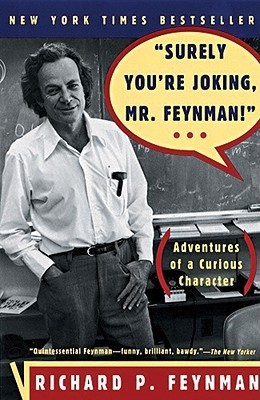
Surely You're Joking, Mr. Feynman!: Adventures of a Curious Character
by Richard P. Feynman
Rating: 4.3 ⭐
• 3 recommendations ❤️
Richard Feynman (1918-1988), winner of the Nobel Prize in physics, thrived on outrageous adventures. Here he recounts in his inimitable voice his experience trading ideas on atomic physics with Einstein and Bohr and ideas on gambling with Nick the Greek; cracking the uncrackable safes guarding the most deeply held nuclear secrets; painting a naked female toreador—and much else of an eyebrow-raising nature.In short, here is Feynman's life in all its eccentric glory—a combustible mixture of high intelligence, unlimited curiosity, and raging chutzpah.

To Rule the Waves: How the British Navy Shaped the Modern World
by Arthur Herman
Rating: 4.1 ⭐
• 2 recommendations ❤️
To Rule the Waves tells the extraordinary story of how Britain's Royal Navy allowed one nation to rise to power unprecedented in history. From its beginnings under Henry VIII and adventurers like John Hawkins and Francis Drake, the Royal Navy toppled one world eco-nomic system, built by Spain and Portugal after Christopher Columbus, and ushered in another -- the one in which we still live today. In the sixteenth century, such men as Hawkins, Drake, and Martin Frobisher were all seekers after their own fortunes as well as servants of their nation. But at the moment of crisis in 1588, they were able to come together to thwart Philip II of Spain and his supposedly invincible Armada. In the seventeenth century, the navy became the key to victory in the English Civil War and played a leading role on the world stage in the years of the Commonwealth and Oliver Cromwell's Protectorate. The navy's dominance allowed England's trade to boom and prosper. It sustained its colonies, reshaped its politics, and drew England, Scotland, and Ireland together into a single United Kingdom. It was this system that Napoleon had to break in order to make himself absolute master of Europe. And it was the Royal Navy, led by men like Horatio Nelson, that stopped him in his tracks and preserved the liberty of Europe and the rest of the world. That global order would survive the convulsions of the twentieth century and the downfall of the British Empire itself, as Britain passed its essential elements on to its successors, the United States and its navy. Illuminating and engrossing, To Rule the Waves is an epic journey from the age of the Reformation to the age of computer warfare and special ops. Arthur Herman tells the spellbinding tale of great battles at sea; of heroic sailors, admirals, and aviators; of violent conflict and personal tragedy; of the way one mighty institution forged a nation, an empire, and a new world.

The Measure of Reality: Quantification and Western Society, 1250-1600
by Alfred W. Crosby
Rating: 4.1 ⭐
• 2 recommendations ❤️
Western Europeans were among the first, if not the first, to invent mechanical clocks, geometrically precise maps, double-entry bookkeeping, precise algebraic and musical notations, and perspective painting. More people in Western Europe thought quantitatively in the sixteenth century than in any other part of the world, enabling them to become the world's leaders. With amusing detail and historical anecdote, Alfred Crosby discusses the shift from qualitative to quantitative perception that occurred during the late Middle Ages and Renaissance. Alfred W. Crosby is the author of five books, including the award-winning Ecological Imperialism: The Biological Expansion of Europe, 900-1900 (Cambridge, 1986)

The classic that exploded into public controversy, revolutionized the course of science, and continues to transform our views of the world.Few other books have created such a lasting storm of controversy as The Origin of Species. Darwin's theory that species derive from other species by a gradual evolutionary process and that the average level of each species is heightened by the "survival of the fittest" stirred up popular debate to a fever pitch. Its acceptance revolutionized the course of science.As Sir Julian Huxley, the noted biologist, points out in his illuminating introduction, the importance of Darwin's contribution to modern scientific knowledge is almost impossible to evaluate: "a truly great book, one which after a century of scientific progress can still be read with profit by professional biologists.""Darwin was one of history's towering geniuses and ranks with the greatest heroes of man's intellectual progress." -George Gaylord Simpson in The Meaning of Evolution

The Red Queen: Sex and the Evolution of Human Nature
by Matt Ridley
Rating: 4.0 ⭐
• 8 recommendations ❤️
The Red Queen compels us to rethink everything from the persistence of sexism to the endurance of romantic love.Referring to Lewis Carroll's Red Queen from Through the Looking-Glass, a character who has to keep running to stay in the same place, Matt Ridley demonstrates why sex is humanity's best strategy for outwitting its constantly mutating internal predators. The Red Queen answers dozens of other riddles of human nature and culture—including why men propose marriage, the method behind our maddening notions of beauty, and the disquieting fact that a woman is more likely to conceive a child by an adulterous lover than by her husband. The Red Queen offers an extraordinary new way of interpreting the human condition and how it has evolved.

This seminal work on political economy and the foundation of the modern market economy was originally published in 1776. Rich in historical background and acute observations of the 18th-century scene, Adam Smith's masterpiece of economic analysis is also an insightful work of political philosophy. Its revolutionary concepts, including the notion that self-interest stimulates the healthiest economic conditions for all, remain influential with politicians and economists alike.

The Origins of Virtue: Human Instincts and the Evolution of Cooperation
by Matt Ridley
Rating: 4.0 ⭐
• 6 recommendations ❤️
If, as Darwin suggests, evolution relentlessly encourages the survival of the fittest, why are humans compelled to live in cooperative, complex societies? In this fascinating examination of the roots of human trust and virtue, a zoologist and former American editor of the Economist reveals the results of recent studies that suggest that self-interest and mutual aid are not at all incompatible. In fact, he points out, our cooperative instincts may have evolved as part of mankind's natural selfish behavior—by exchanging favors we can benefit ourselves as well as others.Brilliantly orchestrating the newest findings of geneticists, psychologists, and anthropologists, The Origins of Virtue re-examines the everyday assumptions upon which we base our actions towards others, whether in our roles as parents, siblings, or trade partners. With the wit and brilliance of The Red Queen , his acclaimed study of human and animal sexuality, Matt Ridley shows us how breakthroughs in computer programming, microbiology, and economics have given us a new perspective on how and why we relate to each other.

The Columbian Exchange: Biological and Cultural Consequences of 1492
by Alfred W. Crosby
Rating: 3.9 ⭐
• 2 recommendations ❤️
Thirty years ago, Alfred Crosby published a small work that illuminated a simple point, that the most important changes brought on by the voyages of Columbus were not social or political, but biological in nature. The book told the story of how 1492 sparked the movement of organisms, both large and small, in both directions across the Atlantic. This Columbian exchange, between the Old World and the New, changed the history of our planet drastically and forever.The book The Columbian Exchange changed the field of history drastically and forever as well. It has become one of the foundational works in the burgeoning field of environmental history, and it remains one of the canonical texts for the study of world history. This 30th anniversary edition of The Columbian Exchange includes a new preface from the author, reflecting on the book and its creation, and a new foreword by J. R. McNeill that demonstrates how Crosby established a brand new perspective for understanding ecological and social events. As the foreword indicates, The Columbian Exchange remains a vital book, a small work that contains within the inspiration for future examinations into what happens when two peoples, separated by time and space, finally meet.

The Printing Revolution in Early Modern Europe
by Elizabeth L. Eisenstein
Rating: 3.8 ⭐
• 2 recommendations ❤️
In 1979 Elizabeth Eisenstein provided the first full-scale treatment of the fifteenth-century printing revolution in the West in her monumental two-volume work, The Printing Press as an Agent of Change. This abridged edition, after summarising the initial changes introduced by the establishment of printing shops, goes on to discuss how printing challenged traditional institutions and affected three major cultural movements: the Renaissance, the Reformation, and the rise of modern science. Also included is a later essay which aims to demonstrate that the cumulative processes created by printing are likely to persist despite the recent development of new communications technologies.

The million copy international bestseller, critically acclaimed and translated into over 25 languages. As influential today as when it was first published, The Selfish Gene has become a classic exposition of evolutionary thought. Professor Dawkins articulates a gene's eye view of evolution - a view giving centre stage to these persistent units of information, and in which organisms can be seen as vehicles for their replication. This imaginative, powerful, and stylistically brilliant work not only brought the insights of Neo-Darwinism to a wide audience, but galvanized the biology community, generating much debate and stimulating whole new areas of research. Forty years later, its insights remain as relevant today as on the day it was published. This 40th anniversary edition includes a new epilogue from the author discussing the continuing relevance of these ideas in evolutionary biology today, as well as the original prefaces and foreword, and extracts from early reviews. Oxford Landmark Science books are 'must-read' classics of modern science writing which have crystallized big ideas, and shaped the way we think.

Genome: The Autobiography of a Species in 23 Chapters
by Matt Ridley
Rating: 4.0 ⭐
• 8 recommendations ❤️
“Ridley leaps from chromosome to chromosome in a handy summation of our ever increasing understanding of the roles that genes play in disease, behavior, sexual differences, and even intelligence. . . . . He addresses not only the ethical quandaries faced by contemporary scientists but the reductionist danger in equating inheritability with inevitability.” — The New Yorker The genome's been mapped. But what does it mean? Matt Ridley’s Genome is the book that explains it what it is, how it works, and what it portends for the future Arguably the most significant scientific discovery of the new century, the mapping of the twenty-three pairs of chromosomes that make up the human genome raises almost as many questions as it answers. Questions that will profoundly impact the way we think about disease, about longevity, and about free will. Questions that will affect the rest of your life. Genome offers extraordinary insight into the ramifications of this incredible breakthrough. By picking one newly discovered gene from each pair of chromosomes and telling its story, Matt Ridley recounts the history of our species and its ancestors from the dawn of life to the brink of future medicine. From Huntington's disease to cancer, from the applications of gene therapy to the horrors of eugenics, Ridley probes the scientific, philosophical, and moral issues arising as a result of the mapping of the genome. It will help you understand what this scientific milestone means for you, for your children, and for humankind.

The Black Swan: The Impact of the Highly Improbable
by Nassim Nicholas Taleb
Rating: 4.0 ⭐
• 19 recommendations ❤️
A black swan is an event, positive or negative, that is deemed improbable yet causes massive consequences. In this groundbreaking and prophetic book, Taleb shows in a playful way that Black Swan events explain almost everything about our world, and yet we—especially the experts—are blind to them. In this second edition, Taleb has added a new essay, On Robustness and Fragility, which offers tools to navigate and exploit a Black Swan world.*2nd Edition, With a new essay: "On Robustness and Fragility"

A Splendid Exchange: How Trade Shaped the World
by William J. Bernstein
Rating: 4.1 ⭐
• 2 recommendations ❤️
A sweeping narrative history of world trade—from Sumer in 3000 BC to the firestorm over globalization today—that brilliantly explores trade’s colorful and contentious past and provides fresh insights into social, political, cultural, and economic history, as well as a timely assessment of trade’s future. Adam Smith wrote that man has an intrinsic “propensity to truck, barter, and exchange one thing for another.” But how did trade evolve to the point where we don’t think twice about biting into an apple from the other side of the world? In A Splendid Exchange , William J. Bernstein tells the extraordinary story of global commerce from its prehistoric origins to the myriad controversies surrounding it today. He transports readers from ancient sailing ships that brought the silk trade from China to Rome in the second century to the rise and fall of the Portuguese monopoly in spices in the sixteenth; from the rush for sugar that brought the British to Jamaica in 1655 to the American trade battles of the early twentieth century; from key innovations such as steam, steel, and refrigeration to the modern era of televisions from Taiwan, lettuce from Mexico, and T-shirts from China. Along the way, Bernstein examines how our age-old dependency on trade has contributed to our planet’s agricultural bounty, stimulated intellectual progress, and made us both prosperous and vulnerable. Although the impulse to trade often takes a backseat to xenophobia and war, Bernstein concludes that trade is ultimately a force for good among nations, and he argues that societies are far more successful and stable when they are involved in vigorous trade with their neighbors. Lively, authoritative, and astonishing in scope, A Splendid Exchange is a riveting narrative that views trade and globalization not in political terms, but rather as an evolutionary process as old as war and religion—a historical constant—that will continue to foster the growth of intellectual capital, shrink the world, and propel the trajectory of the human species.
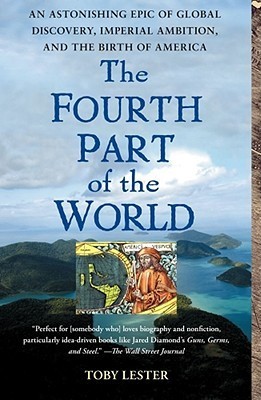
The Fourth Part of the World: An Astonishing Epic of Global Discovery, Imperial Ambition, and the Birth of America
by Toby Lester
Rating: 4.2 ⭐
• 2 recommendations ❤️
“Old maps lead you to strange and unexpected places, and none does so more ineluctably than the subject of this the giant, beguiling Waldseemüller world map of 1507.” So begins this remarkable story of the map that gave America its name.For millennia Europeans believed that the world consisted of three Europe, Africa, and Asia. They drew the three continents in countless shapes and sizes on their maps, but occasionally they hinted at the existence of a "fourth part of the world," a mysterious, inaccessible place, separated from the rest by a vast expanse of ocean. It was a land of myth—until 1507, that is, when Martin Waldseemüller and Matthias Ringmann, two obscure scholars working in the mountains of eastern France, made it real. Columbus had died the year before convinced that he had sailed to Asia, but Waldseemüller and Ringmann, after reading about the Atlantic discoveries of Columbus’s contemporary Amerigo Vespucci, came to a startling Vespucci had reached the fourth part of the world. To celebrate his achievement, Waldseemüller and Ringmann printed a huge map, for the first time showing the New World surrounded by water and distinct from Asia, and in Vespucci’s honor they gave this New World a America.The Fourth Part of the World is the story behind that map, a thrilling saga of geographical and intellectual exploration, full of outsize thinkers and voyages. Taking a kaleidoscopic approach, Toby Lester traces the origins of our modern worldview. His narrative sweeps across continents and centuries, zeroing in on different portions of the map to reveal strands of ancient legend, Biblical prophecy, classical learning, medieval exploration, imperial ambitions, and more. In Lester’s telling the map comes Marco Polo and the early Christian missionaries trek across Central Asia and China; Europe’s early humanists travel to monastic libraries to recover ancient texts; Portuguese merchants round up the first West African slaves; Christopher Columbus and Amerigo Vespucci make their epic voyages of discovery; and finally, vitally, Nicholas Copernicus makes an appearance, deducing from the new geography shown on the Waldseemüller map that the earth could not lie at the center of the cosmos. The map literally altered humanity’s worldview.One thousand copies of the map were printed, yet only one remains. Discovered accidentally in 1901 in the library of a German castle it was bought in 2003 for the unprecedented sum of $10 million by the Library of Congress, where it is now on permanent public display. Lavishly illustrated with rare maps and diagrams, The Fourth Part of the World is the story of that the dazzling story of the geographical and intellectual journeys that have helped us decipher our world.
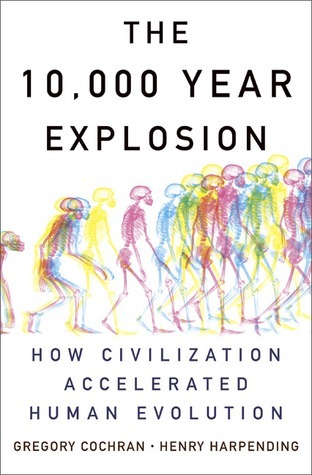
The 10,000 Year Explosion: How Civilization Accelerated Human Evolution
by Gregory Cochran
Rating: 4.1 ⭐
• 2 recommendations ❤️
A manifesto for and an example of a new kind of history, a biological history, and not just of the prehistoric era Scientists have long believed that the 'great leap forward' that occurred some 40,000 to 50,000 years ago in Europe marked the end of significant biological evolution in humans. In this stunning account of our evolutionary history, top scholars Gregory Cochran and Henry Harpending reject this conventional wisdom and reveal that the human species has undergone a storm of genetic change much more recently. Human evolution in fact accelerated after civilisation arose, they contend, and these ongoing changes have played a pivotal role in human history. They argue that biology explains the expansion of the Indo-Europeans, the European conquest of the Americas, and European Jews' rise to intellectual prominence. In each of these cases, the key was recent genetic change: adult milk tolerance in the early Indo-Europeans that allowed for a new way of life, increased disease resistance among the Europeans settling America, and new versions of neurological genes among European Jews. Ranging across subjects as diverse as human domestication, Neanderthal hybridization, and IQ tests, Cochran and Harpending's analysis demonstrates convincingly that human genetics have changed and can continue to change much more rapidly than scientists have previously believed. A provocative and fascinating look at human evolution, The 10,000 Year Explosion reveals the ongoing interplay between culture and biology in the making of the human race.

“Ridley writes with panache, wit, and humor and displays remarkable ingenuity in finding ways to present complicated materials for the lay reader.” — Los Angeles TimesIn a bold and provocative interpretation of economic history, Matt Ridley, the New York Times-bestselling author of Genome and The Red Queen, makes the case for an economics of hope, arguing that the benefits of commerce, technology, innovation, and change—what Ridley calls cultural evolution—will inevitably increase human prosperity. Fans of the works of Jared Diamond (Guns, Germs, and Steel), Niall Ferguson (The Ascent of Money), and Thomas Friedman (The World Is Flat) will find much to ponder and enjoy in The Rational Optimist.

The Most Powerful Idea in the World: A Story of Steam, Industry, and Invention
by William Rosen
Rating: 3.9 ⭐
• 4 recommendations ❤️
If all measures of human advancement in the last hundred centuries were plotted on a graph, they would show an almost perfectly flat line—until the eighteenth century, when the Industrial Revolution would cause the line to shoot straight up, beginning an almost uninterrupted march of progress. In The Most Powerful Idea in the World , William Rosen tells the story of the men responsible for the Industrial Revolution and the machine that drove it—the steam engine. In the process he tackles the question that has obsessed historians ever What made eighteenth-century Britain such fertile soil for inventors? Rosen’s answer focuses on a simple notion that had become enshrined in British law the century that people had the right to own and profit from their ideas. The result was a period of frantic innovation revolving particularly around the promise of steam power. Rosen traces the steam engine’s history from its early days as a clumsy but sturdy machine, to its coming-of-age driving the wheels of mills and factories, to its maturity as a transporter for people and freight by rail and by sea. Along the way we enter the minds of such inventors as Thomas Newcomen and James Watt, scientists including Robert Boyle and Joseph Black, and philosophers John Locke and Adam Smith—all of whose insights, tenacity, and ideas transformed first a nation and then the world. William Rosen is a masterly storyteller with a keen eye for the “aha!” moments of invention and a gift for clear and entertaining explanations of science. The Most Powerful Idea in the World will appeal to readers fascinated with history, science, and the hows and whys of innovation itself.

Masters of the Word: How Media Shaped History
by William J. Bernstein
Rating: 4.5 ⭐
• 2 recommendations ❤️
In his new book, William J. Bernstein, the celebrated author of A Splendid Exchange , chronicles the history of media, starting with the origin of writing thousands of years ago in Mesopotamia. The revolutionary tool gave rise to the world’s ancient empires. And when Phoenician traders took their alphabet to Greece, literacy’s first boom led to the birth of drama and democracy.But it’s not just new communication technologies that have changed the world—it’s access to them. Vernacular bibles gave rise to religious dissent, but it was only when the combination of cheaper paper and Gutenberg’s printing press drove down the cost of books by 97 percent that the fuse of Reformation was lit. The Industrial Revolution allowed information to move faster and farther than ever before, though it concentrated power in the hands of those who ran radio and TV stations, large newspapers, and then, totalitarian governments. With the twenty-first century boom of the mobile Internet, control of media has again spread, and the world is both more connected and freer than ever before. An utterly captivating, enlightening book, Masters of the Word will change the way you look at technology, human history, and power.

Money Changes Everything: How Finance Made Civilization Possible
by William N. Goetzmann
Rating: 4.1 ⭐
• 2 recommendations ❤️
"[A] magnificent history of money and finance."― New York Times Book Review"Convincingly makes the case that finance is a change-maker of change-makers."― Financial TimesIn the aftermath of recent financial crises, it's easy to see finance as a wrecking ball: something that destroys fortunes and jobs, and undermines governments and banks. In Money Changes Everything , leading financial historian William Goetzmann argues the exact opposite―that the development of finance has made the growth of civilizations possible. Goetzmann explains that finance is a time machine, a technology that allows us to move value forward and backward through time; and that this innovation has changed the very way we think about and plan for the future. He shows how finance was present at key moments in history: driving the invention of writing in ancient Mesopotamia, spurring the classical civilizations of Greece and Rome to become great empires, determining the rise and fall of dynasties in imperial China, and underwriting the trade expeditions that led Europeans to the New World. He also demonstrates how the apparatus we associate with a modern economy―stock markets, lines of credit, complex financial products, and international trade―were repeatedly developed, forgotten, and reinvented over the course of human history.Exploring the critical role of finance over the millennia, and around the world, Goetzmann details how wondrous financial technologies and institutions―money, bonds, banks, corporations, and more―have helped urban centers to expand and cultures to flourish. And it's not done reshaping our lives, as Goetzmann considers the challenges we face in the future, such as how to use the power of finance to care for an aging and expanding population.Money Changes Everything presents a fascinating look into the way that finance has steered the course of history.

A History of Western Technology (A History of Western Technology, The MIT Paperback Series)