12 Books Recommended

Martin Ferguson Smith's work on Lucretius is both well known and highly regarded. However, his 1969 translation of De Rerum Natura --long out of print--is virtually unknown. Readers will share our excitement in the discovery of this accurate and fluent prose rendering. For this edition, Professor Smith provides a revised translation, new Introduction, headnotes and bibliography.

Blue Trout and Black Truffles: The Peregrinations of an Epicure
by Joseph Wechsberg
Rating: 4.2 ⭐
• 3 recommendations ❤️
An earlier edition of ISBN 0897331346 is available here.There were, and still are, great restaurants all over Europe, but the greater part of Blue Trout and Black Truffles is devoted to the eating places and vineyards of France. It is a vicarious experience to read about the culinary wonders of the notable establishments of another era that have become the last epicurean haven in this materialistic, mechanized world of fast-food chains and frozen-food dinners. Mr. Wechsberg reaches back to the twilight days of the Habsburg monarchy, when those splendid monuments to the haute cuisine in central Europe, Meissl and Schadn of Vienna and Gundel's of Budapest, were in their prime.

Nobel laureate Bertrand Russell was a notable 20th century British philosopher, mathematician, historian, social critic, and political activist. Considered one of the founders of analytical philosophy, Russell was an iconoclast who helped lead the revolt against British idealism, a prominent philosophy in England at the end of the 19th century. First written in 1912, Bertrand Russell’s “The Problems of Philosophy” was an attempt by the author to create a guide that succinctly and comprehensibly outlined the difficulties he saw in the body of philosophical thought up to his time. In trying to do so, he concentrated on knowledge instead of metaphysics, hoping to spark discussion that was both productive and beneficial. This work also explains Russell’s famous distinction between ‘knowledge by acquaintance and knowledge by description’, which he first posited in 1910. Finally, “The Problems of Philosophy” draws upon the important theories of famous philosophers from Plato to Hegel in order to create a foundation for philosophical inquiry, not only for scholars but for the general public as well. While Russell does not necessarily solve the problems he sets forth, his work is still quite relevant in its scope and object for philosophers today. This edition is printed on premium acid-free paper.
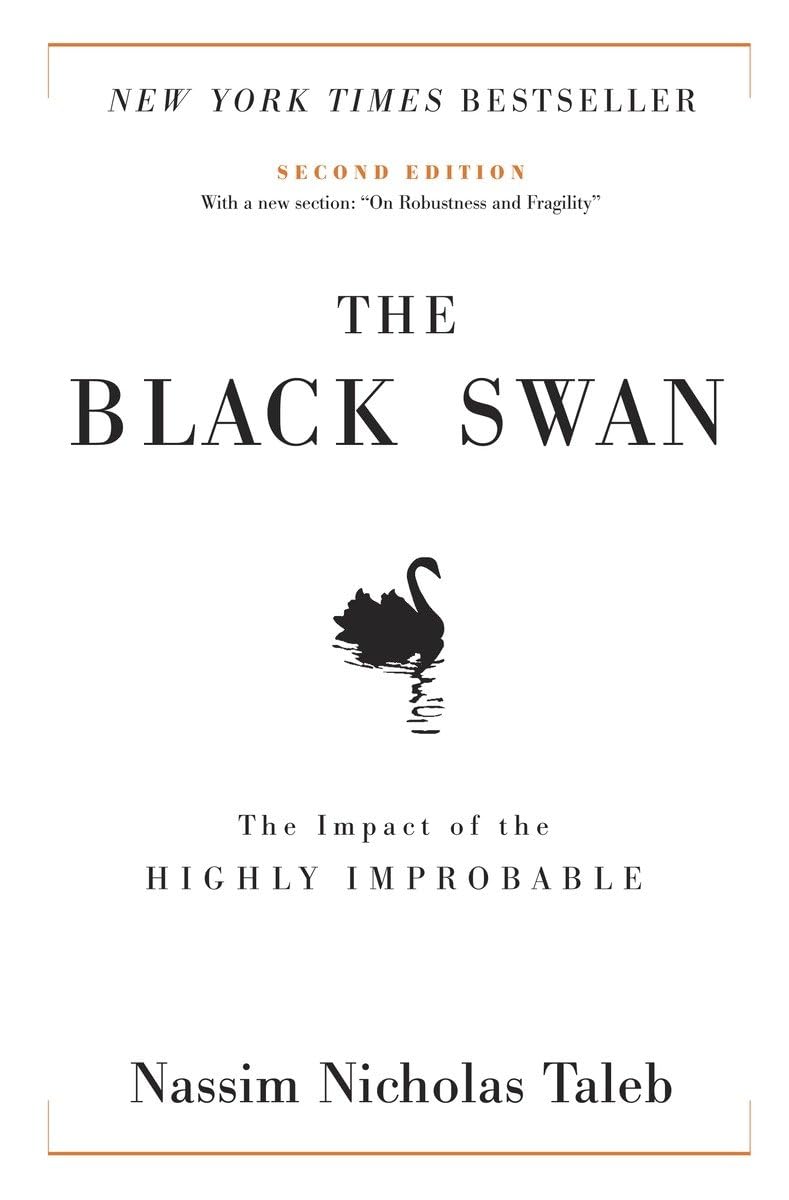
The Black Swan: The Impact of the Highly Improbable
by Nassim Nicholas Taleb
Rating: 4.0 ⭐
• 3 recommendations ❤️
The most influential book of the past seventy-five years: a groundbreaking exploration of everything we know about what we don’t know, now with a new section called “On Robustness and Fragility.”A black swan is a highly improbable event with three principal characteristics: It is unpredictable; it carries a massive impact; and, after the fact, we concoct an explanation that makes it appear less random, and more predictable, than it was. The astonishing success of Google was a black swan; so was 9/11. For Nassim Nicholas Taleb, black swans underlie almost everything about our world, from the rise of religions to events in our own personal lives. Why do we not acknowledge the phenomenon of black swans until after they occur? Part of the answer, according to Taleb, is that humans are hardwired to learn specifics when they should be focused on generalities. We concentrate on things we already know and time and time again fail to take into consideration what we don’t know. We are, therefore, unable to truly estimate opportunities, too vulnerable to the impulse to simplify, narrate, and categorize, and not open enough to rewarding those who can imagine the “impossible.” For years, Taleb has studied how we fool ourselves into thinking we know more than we actually do. We restrict our thinking to the irrelevant and inconsequential, while large events continue to surprise us and shape our world. In this revelatory book, Taleb will change the way you look at the world, and this second edition features a new philosophical and empirical essay, “On Robustness and Fragility,” which offers tools to navigate and exploit a Black Swan world.Taleb is a vastly entertaining writer, with wit, irreverence, and unusual stories to tell. He has a polymathic command of subjects ranging from cognitive science to business to probability theory. Elegant, startling, and universal in its applications, The Black Swan is a landmark book—itself a black swan.

From A to Z, the Penguin Drop Caps series collects 26 unique hardcovers—featuring cover art by Jessica Hische It all begins with a letter. Fall in love with Penguin Drop Caps, a new series of twenty-six collectible and hardcover editions, each with a type cover showcasing a gorgeously illustrated letter of the alphabet. In a design collaboration between Jessica Hische and Penguin Art Director Paul Buckley, the series features unique cover art by Hische, a superstar in the world of type design and illustration, whose work has appeared everywhere from Tiffany & Co. to Wes Anderson's recent film Moonrise Kingdom to Penguin's own bestsellers Committed and Rules of Civility. With exclusive designs that have never before appeared on Hische's hugely popular Daily Drop Cap blog, the Penguin Drop Caps series launches with six perennial favorites to give as elegant gifts, or to showcase on your own shelves.G is for Golding. At the dawn of the next world war, a plane crashes on an uncharted island, stranding a group of schoolboys. At first, with no adult supervision, their freedom is something to celebrate; this far from civilization the boys can do anything they want. Anything. They attempt to forge their own society, failing, however, in the face of terror, sin and evil. And as order collapses, as strange howls echo in the night, as terror begins its reign, the hope of adventure seems as far from reality as the hope of being rescued. Labeled a parable, an allegory, a myth, a morality tale, a parody, a political treatise, even a vision of the apocalypse, Lord of the Flies is perhaps our most memorable tale about “the end of innocence, the darkness of man’s heart.”
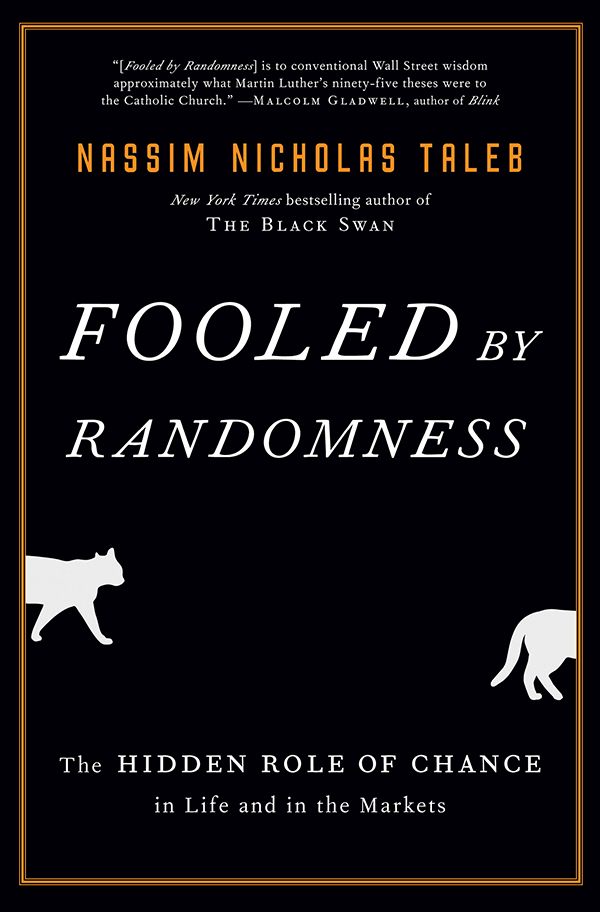
Fooled by Randomness: The Hidden Role of Chance in Life and in the Markets
by Nassim Nicholas Taleb
Rating: 4.1 ⭐
• 3 recommendations ❤️
Fooled by Randomness is a standalone book in Nassim Nicholas Taleb’s landmark Incerto series, an investigation of opacity, luck, uncertainty, probability, human error, risk, and decision-making in a world we don’t understand. The other books in the series are The Black Swan, Antifragile, and The Bed of Procrustes.Now in a striking new hardcover edition, Fooled by Randomness is the word-of-mouth sensation that will change the way you think about business and the world. Nassim Nicholas Taleb–veteran trader, renowned risk expert, polymathic scholar, erudite raconteur, and New York Times bestselling author of The Black Swan–has written a modern classic that turns on its head what we believe about luck and skill.This book is about luck–or more precisely, about how we perceive and deal with luck in life and business. Set against the backdrop of the most conspicuous forum in which luck is mistaken for skill–the world of trading–Fooled by Randomness provides captivating insight into one of the least understood factors in all our lives. Writing in an entertaining narrative style, the author tackles major intellectual issues related to the underestimation of the influence of happenstance on our lives. The book is populated with an array of characters, some of whom have grasped, in their own way, the significance of chance: the baseball legend Yogi Berra; the philosopher of knowledge Karl Popper; the ancient world’s wisest man, Solon; the modern financier George Soros; and the Greek voyager Odysseus. We also meet the fictional Nero, who seems to understand the role of randomness in his professional life but falls victim to his own superstitious foolishness.However, the most recognizable character of all remains unnamed–the lucky fool who happens to be in the right place at the right time–he embodies the “survival of the least fit.” Such individuals attract devoted followers who believe in their guru’s insights and methods. Unfortunately, what has been obtained by chance cannot be replicated.Are we capable of distinguishing the fortunate charlatan from the genuine visionary? Must we always try to uncover nonexistent messages in random events? It may be impossible to guard ourselves against the vagaries of the goddess Fortuna, but after reading Fooled by Randomness we can be a little better prepared.

Poor Charlie's Almanack: The Wit and Wisdom of Charles T. Munger
by Charles T. Munger
Rating: 4.6 ⭐
• 37 recommendations ❤️
EXPANDED THIRD EDITION includes Charlie's 2007 USC Law School Commencement address. Edited by Peter D. Kaufman. Brand New.

Hailed as one of the greatest novels of all time and a classic of world literature, War and Peace unfolds in the early nineteenth century during the turbulent years of the Napoleonic invasion of Russia. Tolstoy's epic ranges from stirring depictions of historical events to intimate portraits of family life, moving between public spectacles and private lives to offer a tale of both panoramic scope and closely observed detail.From the breathless excitement of 16-year-old Natasha Rostov's first ball, to Prince Andrei Bolkonsky's epiphany on the battlefield at Austerlitz, the novel abounds in memorable incidents, particularly those involving Pierre Bezukhov. A seeker after moral and spiritual truths, Pierre and his search for life's deeper meaning stand at the heart of this monumental book. A tale of strivers in a world fraught with conflict, social and political change, and spiritual confusion, Tolstoy's magnificent work continues to entertain, enlighten, and inspire readers around the world.

The #1 New York Times bestseller: "It is the work of our greatest financial journalist, at the top of his game. And it's essential reading."—Graydon Carter, Vanity FairThe real story of the crash began in bizarre feeder markets where the sun doesn't shine and the SEC doesn't dare, or bother, to tread: the bond and real estate derivative markets where geeks invent impenetrable securities to profit from the misery of lower- and middle-class Americans who can't pay their debts. The smart people who understood what was or might be happening were paralyzed by hope and fear; in any case, they weren't talking.Michael Lewis creates a fresh, character-driven narrative brimming with indignation and dark humor, a fitting sequel to his #1 bestseller Liar's Poker. Out of a handful of unlikely-really unlikely-heroes, Lewis fashions a story as compelling and unusual as any of his earlier bestsellers, proving yet again that he is the finest and funniest chronicler of our time.

Life, on the Line: A Chef's Story of Chasing Greatness, Facing Death, and Redefining the Way We Eat
by Grant Achatz
Rating: 4.2 ⭐
• 1 recommendation ❤️
"One of America's great chefs" ( Vogue ), Grant Achatz, shares how his drive to cook immaculate food fueled his miraculous triumph over tongue cancer. By 2007 chef Grant Achatz had been named one of the best new chefs in America by Food & Wine, he had received the James Beard Foundation Rising Star Chef of the Year Award, and he and Nick Kokonas had opened the conceptually radical restaurant Alinea, which was named Best Restaurant in America by Gourmet magazine. Then, positioned firmly in the world's culinary spotlight, Achatz was diagnosed with stage IV squamous cell carcinoma-tongue cancer. The prognosis grim, Grant undertook an alternative treatment of aggressive chemotherapy and radiation that ravaged his body and left him without a sense of taste. Tapping into his profound discipline and passion, he trained his chefs to mimic his palate and learned how to cook with his other senses. As Kokonas was able to attest, the food was never better. Five months later, Grant was declared cancer-free and went on to achieve some of the highest honors in the culinary world. Life, on the Line is not only a chef's memoir, it is also a book about survival, about nurturing creativity, and about profound friendship.

One of the world's most celebrated scholars, Stephen Greenblatt has crafted both an innovative work of history and a thrilling story of discovery, in which one manuscript, plucked from a thousand years of neglect, changed the course of human thought and made possible the world as we know it.Nearly six hundred years ago, a short, genial, cannily alert man in his late thirties took a very old manuscript off a library shelf, saw with excitement what he had discovered, and ordered that it be copied. That book was the last surviving manuscript of an ancient Roman philosophical epic, On the Nature of Things, by Lucretius—a beautiful poem of the most dangerous ideas: that the universe functioned without the aid of gods, that religious fear was damaging to human life, and that matter was made up of very small particles in eternal motion, colliding and swerving in new directions.The copying and translation of this ancient book—the greatest discovery of the greatest book-hunter of his age—fueled the Renaissance, inspiring artists such as Botticelli and thinkers such as Giordano Bruno; shaped the thought of Galileo and Freud, Darwin and Einstein; and had a revolutionary influence on writers such as Montaigne and Shakespeare and even Thomas Jefferson.

Skin in the Game: Hidden Asymmetries in Daily Life
by Nassim Nicholas Taleb
Rating: 4.1 ⭐
• 4 recommendations ❤️
#1 NEW YORK TIMES BESTSELLER - A bold work from the author of The Black Swan that challenges many of our long-held beliefs about risk and reward, politics and religion, finance and personal responsibilityIn his most provocative and practical book yet, one of the foremost thinkers of our time redefines what it means to understand the world, succeed in a profession, contribute to a fair and just society, detect nonsense, and influence others. Citing examples ranging from Hammurabi to Seneca, Antaeus the Giant to Donald Trump, Nassim Nicholas Taleb shows how the willingness to accept one's own risks is an essential attribute of heroes, saints, and flourishing people in all walks of life.As always both accessible and iconoclastic, Taleb challenges long-held beliefs about the values of those who spearhead military interventions, make financial investments, and propagate religious faiths. Among his insights:- For social justice, focus on symmetry and risk sharing. You cannot make profits and transfer the risks to others, as bankers and large corporations do. You cannot get rich without owning your own risk and paying for your own losses. Forcing skin in the game corrects this asymmetry better than thousands of laws and regulations. - Ethical rules aren't universal. You're part of a group larger than you, but it's still smaller than humanity in general. - Minorities, not majorities, run the world. The world is not run by consensus but by stubborn minorities imposing their tastes and ethics on others. - You can be an intellectual yet still be an idiot. "Educated philistines" have been wrong on everything from Stalinism to Iraq to low-carb diets. - Beware of complicated solutions (that someone was paid to find). A simple barbell can build muscle better than expensive new machines. - True religion is commitment, not just faith. How much you believe in something is manifested only by what you're willing to risk for it.The phrase "skin in the game" is one we have often heard but rarely stopped to truly dissect. It is the backbone of risk management, but it's also an astonishingly rich worldview that, as Taleb shows in this book, applies to all aspects of our lives. As Taleb says, "The symmetry of skin in the game is a simple rule that's necessary for fairness and justice, and the ultimate BS-buster," and "Never trust anyone who doesn't have skin in the game. Without it, fools and crooks will benefit, and their mistakes will never come back to haunt them."