
Neil Gaiman Recommended Books
English writer (born 1960)
14 Books Recommended

Post-life citizensBreath challengedVertically disadvantaged(buried, not short) Johnny Maxwell's new friends not appreciate the term "ghosts," but they are, well, dead . The town council wants to sell the cemetery, and its inhabitants aren't about to take that lying down! Johnny is the only one who can see them, and and the previously alive need his help to save their home and their history. Johnny didn't mean to become the voice for the lifeless, but if he doesn't speak up, who will? In Johnny Maxwell's second adventure, Carnegie Medalist Terry Pratchett explores the bonds between the living and the dead and proves that it's never too late to have the time of your life -- even if it is your afterlife!

Lud-in-the-Mist - a prosperous country town situated where two rivers meet: the Dawl and the Dapple. The latter, which has its source in the land of Faerie, is a great trial to Lud, which had long rejected anything 'other', preferring to believe only in what is known, what is solid.Nathaniel Chanticleer is a somewhat dreamy, slightly melancholy man, not one for making waves, who is deliberately ignoring a vital part of his own past; a secret he refuses even to acknowledge. But with the disappearance of his own daughter, and a long-overdue desire to protect his young son, he realises that something is changing in Lud - and something must be done.Lud-in-the-Mist is a true classic, an adult fairy tale exploring the need to embrace what we fear and to come to terms with 'the shadows' - those sweet and dark impulses that our public selves ignore or repress.Featuring a foreword read by Neil Gaiman.
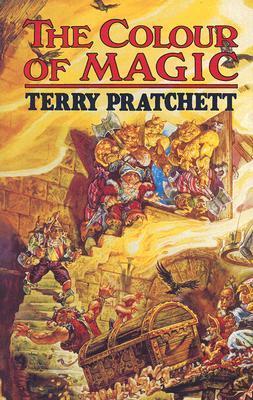
Terry Pratchett's profoundly irreverent novels are consistent number one bestsellers in England, where they have garnered him a revered position in the halls of parody next to Mark Twain, Kurt Vonnegut, Douglas Adams, and Carl Hiaasen.The Color of Magic is Terry Pratchett's maiden voyage through the now-legendary land of Discworld. This is where it all beginswith the tourist Twoflower and his wizard guide, Rincewind.

From The Man Who Was Thursday ""Moderate strength is shown in violence; supreme strength is shown in levity."" ""The poor have sometimes objected to being governed badly; the rich have always objected to being governed at all."" ""There is your precious

Here's a book for lovers of all things Italian. This city on the Adriatic has always tantalized Jan Morris with its moodiness and changeability. After visiting Trieste for more than half a century, she has come to see it as a touchstone for her interests and preoccupations: cities, seas, empires. It has even come to reflect her own life in its loves, disillusionments, and memories. Her meditation on the place is characteristically layered with history and sprinkled with stories of famous visitors from James Joyce to Sigmund Freud. A lyrical travelogue, Trieste and the Meaning of Nowhere is also superb cultural history and the culmination of a singular career-"an elegant and bittersweet farewell" (Boston Globe).

The first two volumes chronicling the unique art and design of Roger Dean met with huge critical and popular success. Views (1975) went straight to number one in the Sunday Times bestseller list and went on to sell over a million copies. Magnetic Storm (1984) sold over 650,000 copies. These new editions, reworked to accompany the publication of the third book in the trilogy, Dragon's Dream , showcase the instantly recognizable work of Roger Dean. Views showcases the first seven years of Roger Dean's work after his graduation from the Royal College of Art in 1968. It includes paintings and graphics; branding such as the Yes typography and the first Virgin Records logo; groundbreaking stage sets; and album art including iconic early Yes covers such as the award-winning Tales From Topographic Oceans . The new edition streamlines the original square format and retains the combination of concept sketches and brilliantly displayed finished work. Featuring a new foreword, revised typography, and graphic openers and identifying icons, Views showcases and celebrates the art that defined an era.

Now in paperbackOnce upon a time, in a gloomy castle on a lonely hill, where there were thirteen clocks that wouldn’t go, there lived a cold, aggressive Duke, and his niece, the Princess Saralinda. She was warm in every wind and weather, but he was always cold. His hands were as cold as his smile and almost as cold as his heart. He wore gloves when he was asleep, and he wore gloves when he was awake, which made it difficult for him to pick up pins or coins or the kernels of nuts, or to tear the wings from nightingales.So begins James Thurber's sublimely revamped fairy tale, The 13 Clocks , in which a wicked Duke who imagines he has killed time, and the Duke’s beautiful niece, for whom time seems to have run out, both meet their match, courtesy of an enterprising and very handsome prince in disguise. Readers young and old will take pleasure in this tale of love forestalled but ultimately fulfilled, admiring its upstanding hero ( “who yearned to find in a far land the maiden of his dreams, singing as he went…and possibly slaying a dragon here and there” ) and unapologetic villain ( “We all have flaws,” the Duke said. “Mine is being wicked” ), while wondering at the enigmatic Golux, the mysterious stranger whose unpredictable interventions speed the story to its necessarily happy end.

In the fog of London, lawyers enrich themselves with endless litigation over a dwindling inheritance. A sterling example of Dickens's genius for character, dramatic construction, and social satire, this novel was hailed by Edmund Wilson as a "masterpiece".

For the first time ever, the pioneering autobiographical comics of master cartoonist Eddie Campbell (From Hell) are collected in a single volume Brilliantly observed and profoundly expressed, the ALEC stories present a version of Campbell's own life, filtered through the alter ego of "Alec MacGarry." Over many years, we witness Alec's (and Eddie's) progression "from beer to wine" - wild nights at the pub, existential despair, the hunt for love, the quest for art, becoming a "responsible breadwinner," feeling lost at his own movie premiere, and much more Eddie's outlandish fantasies and metafictional tricks convert life into art, while staying fully grounded in his own absurdity. This Life-Size Omnibus edition of ALEC includes all the stories from The King Canute Crowd, Three-Piece Suit, How to be an Artist, and After the Snooter, as well as the very early, out-of-print ALEC stories and a staggering amount of bonus material.

'There is no harm in a man's cub.'Best known for the 'Mowgli' stories, Rudyard Kipling's The Jungle Book expertly interweaves myth, morals, adventure and powerful story-telling. Set in Central India, Mowgli is raised by a pack of wolves. Along the way he encounters memorable characters such as the foreboding tiger Shere Kahn, Bagheera the panther and Baloo the bear. Including other stories such as that of Rikki-Tikki-Tavi, a heroic mongoose and Toomai, a young elephant handler, Kipling's fables remain as popular today as they ever were.

Internationally bestselling author of The Time Traveler’s Wife , Audrey Niffenegger, and graphic artist Eddie Campbell, of such seminal works as From Hell by Alan Moore, collaborate on a wonderfully bizarre collection that celebrates and satirizes love of all kinds. With 16 different stories told through illustrated prose or comic panels, the couple explores the idiosyncratic nature of relationships in a variety of genres from fractured fairy tales to historical fiction to paper dolls. W ith Niffenegger’s sharp, imaginative prose and Campbell’s diverse comic styles, Bizarre Romance is the debut collection by two of the most important storytellers of our time.

Rising a kilometre out of the storm-scoured waters around Scotland’s Isle of Skye is a dark battlement of pinnacles and ridgelines: the Cuillin.Plagued by ferocious weather and built from rock that tears skin and confounds compasses, a crossing of the Cuillin is the toughest mountaineering expedition in the British Isles. But the traverse is only part of its lure. Hewn from the innards of an ancient volcano, this mountain range stands like a crown on an island drenched in intrigue. While nineteenth-century climbers flocked to the Alps, the ridge lay untrodden and unyielding. When a generation of mountaineers did come, they found a remarkable prize: the last peaks of Britain to be climbed – peaks that would be named after those who climbed them. Along the way, many others, from artists and poets to mystics and wanderers, have been lured by the Cuillin’s haunting beauty and magic. Those who have been seduced by the deadly magic of these mountains attest to the complexity of humans’ relationship with the intrigue of our wildest, most dangerous places.The Black Ridge is a journey through the history and into the heights of the Cuillin of Skye – from the ridge’s violent birth to the tales of its pioneers, its thrills, its myths and its monsters. From a night spent in a cave beneath its highest peak to the ascent of its most infamous pinnacle, this is an adventure on foot through all seasons across the most mesmerising mountain range in Britain.

Anime master Hayao Miyazaki’s favorite childhood book, in English for the first time. First published in 1937, Genzaburō Yoshino’s How Do You Live? has long been acknowledged in Japan as a crossover classic for young readers. Academy Award–winning animator Hayao Miyazaki (Spirited Away, My Neighbor Totoro, Howl’s Moving Castle) has called it his favorite childhood book and announced plans to emerge from retirement to make it the basis of a final film. How Do You Live? is narrated in two voices. The first belongs to Copper, fifteen, who after the death of his father must confront inevitable and enormous change, including his own betrayal of his best friend. In between episodes of Copper’s emerging story, his uncle writes to him in a journal, sharing knowledge and offering advice on life’s big questions as Copper begins to encounter them. Over the course of the story, Copper, like his namesake Copernicus, looks to the stars, and uses his discoveries about the heavens, earth, and human nature to answer the question of how he will live. This first-ever English-language translation of a Japanese classic about finding one’s place in a world both infinitely large and unimaginably small is perfect for readers of philosophical fiction like The Alchemist and The Little Prince, as well as Miyazaki fans eager to understand one of his most important influences.

A fantasy following a boy journeying away from the only home he’s ever known and into the magical realm of the dead in order to fulfill a bargain for his people.Osmo Unknown hungers for the world beyond his small town. With the life that Littlebridge society has planned for him, the only taste Osmo will ever get are his visits to the edge of the Fourpenny Woods where his mother hunts. Until the unthinkable happens: his mother accidentally kills a Quidnunk, a fearsome and intelligent creature that lives deep in the forest. None of this should have anything to do with poor Osmo, except that a strange treaty was once formed between the Quidnunx and the people of Littlebridge to ensure that neither group would harm the other. Now that a Quidnunk is dead, as the firstborn child of the hunter who killed her, Osmo must embark on a quest to find the Eightpenny Woods—the mysterious kingdom where all wild forest creatures go when they die—and make amends. Accompanied by a very rude half-badger, half-wombat named Bonk and an antisocial pangolin girl called Never, it will take all of Osmo’s bravery and cleverness to survive the magic of the Eightpenny Woods to save his town…and make it out alive.