
Naval Ravikant Recommended Books
Indian American entrepreneur and investor
144 Books Recommended

This book covers the basic truths about economics in less than 200 pages.

Alternate cover edition can be found here Roger Zelazny's chronicles of Amber have earned their place as all-time classics of imaginative literature. Now, here are all ten novels, together in one magnificent omnibus volume. Witness the titanic battle for supremacy waged on Earth, in the Courts of Chaos, and on a magical world of mystery, adventure and romance.--back cover
![Perfectly Reasonable Deviations from the Beaten Track [First Printing]](https://m.media-amazon.com/images/S/compressed.photo.goodreads.com/books/1348044468i/223459.jpg)
Perfectly Reasonable Deviations from the Beaten Track [First Printing]
by Richard P. Feynman
Rating: 4.2 ⭐
• 2 recommendations ❤️
A Nobel Prize-winning physicist, a loving husband and father, an enthusiastic teacher, a surprisingly accomplished bongo player, and a genius of the highest caliber---Richard P. Feynman was all these and more. Perfectly Reasonable Deviations From the Beaten Track--collecting over forty years' worth of Feynman's letters--offers an unprecedented look at the writer and thinker whose scientific mind and lust for life made him a legend in his own time. Containing missives to and from such scientific luminaries as Victor Weisskopf, Stephen Wolfram, James Watson, and Edward Teller, as well as a remarkable selection of letters to and from fans, students, family, and people from around the world eager for Feynman's advice and counsel, Perfectly Reasonable Deviations From the Beaten Track not only illuminates the personal relationships that underwrote the key developments in modern science, but also forms the most intimate look at Feynman yet available. Feynman was a man many felt close to but few really knew, and this collection reveals the full wisdom and private passion of a personality that captivated everyone it touched. Perfectly Reasonable Deviations From the Beaten Track is an eloquent testimony to the virtue of approaching the world with an inquiring eye; it demonstrates the full extent of the Feynman legacy like never before. Edited and with additional commentary by his daughter Michelle, it's a must-read for Feynman fans everywhere, and for anyone seeking to better understand one of the towering figures--and defining personalities--of the twentieth century.

‘The material contained in this volume was originally presented in the form of talks to students, teachers and parents in India, but its keen penetration and lucid simplicity will be deeply meaningful to thoughtful people everywhere, of all ages, and in every walk of life. Krishnamurti examines with characteristic objectivity and insight the expressions of what we are pleased to call our culture, our education, religion, politics and tradition; and he throws much light on such basic emotions as ambition, greed and envy, the desire for security and the lust for power – all of which he shows to be deteriorating factors in human society.’ From the Editor’s Note‘Krishnamurti’s observations and explorations of modern man’s estate are penetrating and profound, yet given with a disarming simplicity and directness. To listen to him or to read his thoughts is to face oneself and the world with an astonishing morning freshness.’ -- Anne Marrow Lindbergh

Influence, the classic book on persuasion, explains the psychology of why people say "yes"—and how to apply these understandings. Dr. Robert Cialdini is the seminal expert in the rapidly expanding field of influence and persuasion. His thirty-five years of rigorous, evidence-based research along with a three-year program of study on what moves people to change behavior has resulted in this highly acclaimed book.You'll learn the six universal principles, how to use them to become a skilled persuader—and how to defend yourself against them. Perfect for people in all walks of life, the principles of Influence will move you toward profound personal change and act as a driving force for your success.

In the cloud-washed airspace between the cornfields of Illinois and blue infinity, a man puts his faith in the propeller of his biplane. For disillusioned writer and itinerant barnstormer Richard Bach, belief is as real as a full tank of gas and sparks firing in the cylinders . . . until he meets Donald Shimoda--former mechanic and self-described messiah who can make wrenches fly and Richard's imagination soar. . . .In Illusions, the unforgettable follow-up to his phenomenal bestseller Jonathan Livingston Seagull, Richard Bach takes to the air to discover the ageless truths that give our souls wings: that people don't need airplanes to soar . . . that even the darkest clouds have meaning once we lift ourselves above them . . . and that messiahs can be found in the unlikeliest places--like hay fields, one-traffic-light midwestern towns, and most of all, deep within ourselves.

One of the world's most famous and influential books, Meditations, by the Roman emperor Marcus Aurelius (A.D. 121–180), incorporates the stoic precepts he used to cope with his life as a warrior and administrator of an empire. Ascending to the imperial throne in A.D. 161, Aurelius found his reign beset by natural disasters and war. In the wake of these challenges, he set down a series of private reflections, outlining a philosophy of commitment to virtue above pleasure and tranquility above happiness.Reflecting the emperor's own noble and self-sacrificing code of conduct, this eloquent and moving work draws and enriches the tradition of Stoicism, which stressed the search for inner peace and ethical certainty in an apparently chaotic world. Serenity was to be achieved by emulating in one's personal conduct the underlying orderliness and lawfulness of nature. And in the face of inevitable pain, loss, and death — the suffering at the core of life — Aurelius counsels stoic detachment from the things that are beyond one's control and a focus on one's own will and perception.Presented here in a specially modernized version of the classic George Long translation, this updated and revised edition is easily accessible to contemporary readers. It not only provides a fascinating glimpse into the mind and personality of a highly principled Roman of the second century but also offers today's readers a practical and inspirational guide to the challenges of everyday life.

Don't Shoot the Dog!: The New Art of Teaching and Training
by Karen Pryor
Rating: 4.3 ⭐
• 4 recommendations ❤️
A Better Way to Better BehaviorKaren Pryor's clear and entertaining explanation of behavioral training methods made Don't Shoot the Dog! a bestselling classic. Now this revised edition presents more of her insights into animal—and human—behavior.A groundbreaking behavioral scientist and dynamic animal trainer, Karen Pryor is a powerful proponent of the principles and practical uses of positive reinforcement in teaching new behaviors. Here are the secrets of changing behavior in pets, kids—even yourself—without yelling, threats, force, punishment, guilt trips...or shooting the •The principles of the revolutionary "clicker training" method, which owes its phenomenal success to its immediacy of response—so there is no question what action you are rewarding•8 methods of ending undesirable habits—from furniture-clawing cats to sloppy roommates•The 10 laws of "shaping" behavior–for results without strain or pain through "affection training"•Tips for house-training the dog, improving your tennis game, or dealing with an impossible teen•Explorations of exciting new uses for reinforcement trainingLearn why pet owners rave, "This book changed our lives!" and how these pioneering techniques can work for you too.
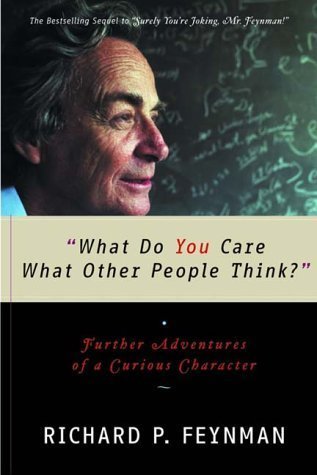
What Do You Care What Other People Think? Further Adventures of a Curious Character
by Richard P. Feynman
Rating: 4.2 ⭐
• 2 recommendations ❤️
The New York Times best-selling sequel to "Surely You’re Joking, Mr. Feynman!" One of the greatest physicists of the twentieth century, Richard Feynman possessed an unquenchable thirst for adventure and an unparalleled ability to tell the stories of his life. "What Do You Care What Other People Think?" is Feynman’s last literary legacy, prepared with his friend and fellow drummer, Ralph Leighton. Among its many tales―some funny, others intensely moving―we meet Feynman’s first wife, Arlene, who taught him of love’s irreducible mystery as she lay dying in a hospital bed while he worked nearby on the atomic bomb at Los Alamos. We are also given a fascinating narrative of the investigation of the space shuttle Challenger ’s explosion in 1986, and we relive the moment when Feynman revealed the disaster’s cause by an elegant dropping a ring of rubber into a glass of cold water and pulling it out, misshapen.

This valuable book provides a complete manual for the study and practice of Raja Yoga, the path of concentration and meditation. This new edition of these timeless teachings is a treasure to be read and referred to again and again by seekers treading the spiritual path. The classic Sutras (thought-threads), at least 4,000 years old, cover the yogic teachings on ethics, meditation, and physical postures, and provide directions for dealing with situations in daily life. The Sutras are presented here in the purest form, with the original Sanskrit and with translation, transliteration, and commentary by Sri Swami Satchidananda, one of the most respected and revered contemporary Yoga masters. In this classic context, Sri Swamiji offers practical advice based on his own experience for mastering the mind and achieving physical, mental and emotional harmony.

Who am I? Why am I here? What is the nature of the world around me?Alan Watts (1915 – 1973)—noted professor, graduate-school dean, Harvard University research fellow, and Episcopal priest—examines these fundamental questions from a Taoist perspective, learning to appreciate not just the bowl but the empty space within it. With down-to-earth writing he reveals our direct connection to the natural world and reminds us that we are not so much born into this world as grown out of it. This collection of eight of Watts' unique philosophical essays and an early piece written in 1953 has a brief introduction by Alan's son, Mark Watts, which gives the background of these pieces and their place in Alan Watts' life and work.
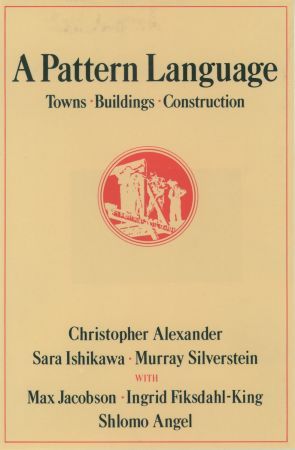
A Pattern Language: Towns, Buildings, Construction
by Christopher W. Alexander
Rating: 4.4 ⭐
• 11 recommendations ❤️
At the core of A Pattern Language is the philosophy that in designing their environments people always rely on certain ‘languages,’ which, like the languages we speak, allow them to articulate and communicate an infinite variety of designs within a formal system which gives them coherence.This book provides a language of this kind. It will enable making a design for almost any kind of building, or any part of the built environment. ‘Patterns,’ the units of this language, are answers to design problems: how high should a window sill be?; how many stories should a building have?; how much space in a neighborhood should be devoted to grass and trees?More than 250 of the patterns in this language are outlined, each consisting of a problem statement, a discussion of the problem with an illustration, and a solution. As the authors say in their introduction, many of the patterns are archetypal, so deeply rooted in the nature of things that it seems likely that they will be a part of human nature and human action as much in five hundred years as they are today.A Pattern Language is related to Alexander’s other works in the Center for Environmental Structure series: The Timeless Way of Building (introductory volume) and The Oregon Experiment.

Francis Crick, who died at the age of eighty-eight in 2004, will be bracketed with Galileo, Darwin, and Einstein as one of the great scientists of all time. Between 1953 and 1966 he made and led a revolution in biology by discovering, quite literally, the secret of life: the digital cipher at the heart of heredity that distinguishes living from non-living things -- the genetic code. His own discoveries -- though he always worked with one other partner and did much of his thinking in conversation -- include not only the double helix but the whole mechanism of protein synthesis, the three-letter nature of the code, and much of the code itself. Matt Ridley's biography traces Crick's life from middle-class mediocrity in the English Midlands, through a lackluster education and six years designing magnetic mines for the Royal Navy, to his leap into biology at the age of thirty-one. While at Cambridge, he suddenly began to display the unique visual imagination and intense tenacity of thought that would allow him to see the solutions to several great scientific conundrums -- and to see them long before most biologists had even conceived of the problems. Having set out to determine what makes living creatures alive and having succeeded, he immigrated at age sixty to California and turned his attention to the second question that had fascinated him since his youth: What makes conscious creatures conscious? Time ran out before he could find the answer.

The Sovereign Individual: Mastering the Transition to the Information Age
by James Dale Davidson
Rating: 4.2 ⭐
• 14 recommendations ❤️
Two renowned investment advisors and authors of the bestseller The Great Reckoning bring to light both currents of disaster and the potential for prosperity and renewal in the face of radical changes in human history as we move into the next century.The Sovereign Individual details strategies necessary for adapting financially to the next phase of Western civilization.Few observers of the late twentieth century have their fingers so presciently on the pulse of the global political and economic realignment ushering in the new millennium as do James Dale Davidson and Lord William Rees-Mogg. Their bold prediction of disaster on Wall Street in Blood in the Streets was borne out by Black Tuesday. In their ensuing bestseller, The Great Reckoning, published just weeks before the coup attempt against Gorbachev, they analyzed the pending collapse of the Soviet Union and foretold the civil war in Yugoslavia and other events that have proved to be among the most searing developments of the past few years.In The Sovereign Individual, Davidson and Rees-Mogg explore the greatest economic and political transition in centuries—the shift from an industrial to an information-based society. This transition, which they have termed "the fourth stage of human society," will liberate individuals as never before, irrevocably altering the power of government. This outstanding book will replace false hopes and fictions with new understanding and clarified values.

Awareness: The Perils and Opportunities of Reality
by Anthony de Mello
Rating: 4.3 ⭐
• 19 recommendations ❤️
The heart of Anthony de Mello's bestselling spiritual message is awareness. Mixing Christian spirituality, Buddhist parables, Hindu breathing exercises, and psychological insight, de Mello's words of hope come together in Awareness in a grand synthesis.In short chapters for reading in quiet moments at home or at the office, he cajoles and challenges: We must leave this go-go-go world of illusion and become aware. And this only happens, he insists, by becoming alive to the needs and potential of others, whether at home or in the workplace.Here, then, is a masterful book of the spirit, challenging us to wake up in every aspect of our lives.

An indispensable work for understanding the life and teachings of one of the most unusual mystics and philosophers of our time.Ten years have past since, in the words of his attending physician, Osho prepared for his departure from the body that had served him for fifty-nine years "as calmly as though he were packing for a weekend in the country." This volume is recognition that the time has come to provide a historical and biographical context for understanding Osho and his work. Who was this man, known as the Sex Guru, the "self-appointed bhagwan" (Rajneesh), the Rolls-Royce Guru, the Rich Man's Guru, and simply the Master?Drawn from nearly five thousand hours of Osho's recorded talks, this is the story of his youth and education, his life as a professor of philosophy and years of travel teaching the importance of meditation, and the true legacy he sought to leave behind: a religionless religion centered on individual awareness and responsibility and the teaching of "Zorba the Buddha," a celebration of the whole human being.

Like the Meditations of Marcus Aurelius, Seneca’s Letters are a treasure of practical wisdom on how to live and enjoy life. The focus is on living a simple, stress-free life thorough the use of rationalism. The letters provide practical steps for people to deal with the human suffering that comes with life’s problems. Topics featured range from discussions on the shortness of life and anger to immortality and death. The Letters are part of the foundation of Stoic thought making Seneca one of the indispensable thinkers from Ancient Roman philosophy. Although Stoicism is not now as widely practiced as it once was, many people can still find wisdom and inspiration through Seneca's words and letters. “In the last three years, I’ve begun to explore one philosophical system in particular: Stoicism. Through my preferred Stoic writer, Lucius Seneca, I’ve found it to be a simple and immensely practical set of rules for better results with less effort.” Timothy Ferriss, author of Four Hour Workweek. *Includes link to free audio recording of the Letters. *Image gallery. *Special low price.

The bestselling, widely acclaimed translation from Stephen MitchellIn eighty-one brief chapters, Lao-tzu's Tao Te Ching, or Book of the Way, provides advice that imparts balance and perspective, a serene and generous spirit, and teaches us how to work for the good with the effortless skill that comes from being in accord with the Tao—the basic principle of the universe.

The Way to Love: The Last Meditations of Anthony de Mello
by Anthony de Mello
Rating: 4.2 ⭐
• 1 recommendation ❤️
From the international bestselling author of Awareness, a pocket-sized guide that will bring you to new levels of spiritual awareness.The Way To Love contains the final flowering of Anthony de Mello's thought, and in it he grapples with the ultimate question of love. In thirty-one meditations, he implores his readers with his usual pithiness to break through illusion, the great obstacle to love. "Love springs from awareness," de Mello insists, saying that it is only when we see others as they are that we can begin to really love. But not only must we seek to see others with clarity, we must examine ourselves without misconception. The task, however, is not easy. "The most painful act," de Mello says, "is the act of seeing. But in that act of seeing that love is born." Anthony De Mello was the director of the Sadhana Institute of Pastoral Counseling in Poona, India, and authored several books. The Way To Love is his last.

Counted among his admirers are Jonas Salk, Aldous Huxley, David Hockney, and Van Morrison, along with countless other philosophers, artist, writers and students of the spiritual path. Now the trustees of Krishnamurti’s work have gathered his very best and most illuminating writings and talks to present in one volume the truly essential ideas of this great spiritual thinker.Total Freedom includes selections from Krishnamurti’s early works, his ‘Commentaries on Living’, and his discourses on life, the self, meditation, sex and love. These writings reveal Krishnamuri’s core teachings in their full eloquence and power: the nature of personal freedom; the mysteries of life and death; and the ‘pathless land’, the personal search for truth and peace. Warning readers away from blind obedience to creeds or teachers – including himself – Krishnamurti celebrated the individual quest for truth, and thus became on of the most influential guides for independent-minded seekers of the twentieth century – and beyond.

The Book of Life: Daily Meditations with Krishnamurti
by J. Krishnamurti
Rating: 4.3 ⭐
• 5 recommendations ❤️
365 daily meditations on freedom, personal transformation, living fully, and much more, from the man the Dalai Lama described as "one of the greatest thinkers of the age."

“All right. He’s dead. Go ahead and talk to him.”It is the year 2055, and the battle of the sexes has seven combatants rather than two. “The illusion of empathy” has been dispensed with, and a few idealistic souls try to create a utopia with pirated technology.But a wired journalist, Andrew Worth, doesn’t want any part of the pop “Frankenscience” regularly dished out to the masses. Burned-out after completing a documentary on controversial developments in biotechnology, he turns down a chance to report on a baffling new mental disorder known as Distress and instead takes an assignment covering the Einstein Centenary Conference on the artificial island of Stateless. There, a young South African physicist, Violet Mosala, is expected to unveil her candidate for a Theory of Everything.But the assignment is not the tropical respite Worth was expecting. Unfortunately academia’s facade of civility is dangerously cracked with a seething maelstrom of plotting, assassination attempts, and rebellion, and Worth is dragged down into the nightmare. The world’s only hope for survival lies in Violet Mosala’s development of a final Theory of Everything, but whether it will lead to the total destruction of life as we know it or the complete remaking of the universe may be a risk too dangerous to take.Greg Egan’s audacious voice and literary scope create a fragmented futuristic world where technology and bioengineering threaten humanity’s very existence.

What is Life?: With Mind and Matter and Autobiographical Sketches
by Erwin Schrödinger
Rating: 4.2 ⭐
• 2 recommendations ❤️
¿Qué es la vida? se publicó por primera vez en 1944, y es fruto de una serie de conferencias dictadas por el autor en el Institute for Advanced Studies del Trinity College de Dublín, en febrero de 1943. El revuelo que levantó en su momento entre científicos y pensadores todavía no ha cesado, por lo que ya es considerado, unánimamente, un clásico en la materia.
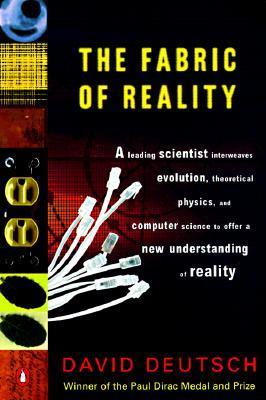
The Fabric of Reality: The Science of Parallel Universes--and Its Implications
by David Deutsch
Rating: 4.1 ⭐
• 9 recommendations ❤️
For David Deutsch, a young physicist of unusual originality, quantum theory contains our most fundamental knowledge of the physical world. Taken literally, it implies that there are many universes “parallel” to the one we see around us. This multiplicity of universes, according to Deutsch, turns out to be the key to achieving a new worldview, one which synthesizes the theories of evolution, computation, and knowledge with quantum physics. Considered jointly, these four strands of explanation reveal a unified fabric of reality that is both objective and comprehensible, the subject of this daring, challenging book. The Fabric of Reality explains and connects many topics at the leading edge of current research and thinking, such as quantum computers (which work by effectively collaborating with their counterparts in other universes), the physics of time travel, the comprehensibility of nature and the physical limits of virtual reality, the significance of human life, and the ultimate fate of the universe. Here, for scientist and layperson alike, for philosopher, science-fiction reader, biologist, and computer expert, is a startlingly complete and rational synthesis of disciplines, and a new, optimistic message about existence.

An illuminating portrayal of Richard Feynman—a giant of twentieth century physics—from his childhood tinkering with radios, to his vital work on the Manhattan Project and beyond Raised in Depression-era Rockaway Beach, physicist Richard Feynman was irreverent, eccentric, and childishly enthusiastic—a new kind of scientist in a field that was in its infancy. His quick mastery of quantum mechanics earned him a place at Los Alamos working on the Manhattan Project under J. Robert Oppenheimer, where the giddy young man held his own among the nation’s greatest minds. There, Feynman turned theory into practice, culminating in the Trinity test, on July 16, 1945, when the Atomic Age was born. He was only twenty-seven. And he was just getting started. In this sweeping biography, James Gleick captures the forceful personality of a great man, integrating Feynman’s work and life in a way that is accessible to laymen and fascinating for the scientists who follow in his footsteps.

What if men built a tower from Earth to Heaven-and broke through to Heaven's other side? What if we discovered that the fundamentals of mathematics were arbitrary and inconsistent? What if there were a science of naming things that calls life into being from inanimate matter? What if exposure to an alien language forever changed our perception of time? What if all the beliefs of fundamentalist Christianity were literally true, and the sight of sinners being swallowed into fiery pits were a routine event on city streets? These are the kinds of outrageous questions posed by the stories of Ted Chiang. Stories of your life . . . and others.
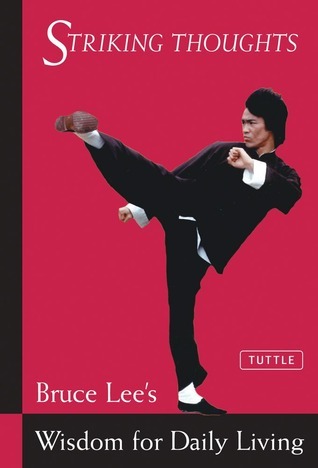
Striking Thoughts: Bruce Lee's Wisdom for Daily Living
by Bruce Lee
Rating: 4.3 ⭐
• 4 recommendations ❤️
"A teacher is never a giver of truth—he is a guide, a pointer to the truth that each student must find for himself. A good teacher is merely a catalyst."—Bruce LeeWithin the pages of Striking Thoughts, you will find the secrets of Bruce Lee's amazing success— as an actor, martial artist, and inspiration to the world. Consisting of eight sections, Striking Thoughts covers 72 topics and 825 aphorisms—from spirituality to personal liberation and from family life to filmmaking—all of which Bruce lived by.His ideas helped energize his life and career, and made it possible for him to live a happy and assured life, overcoming difficult obstacles with seeming ease. His ideas also inspired his family, friends, students, and colleagues to achieve success in their own lives and this personal collection will help you in your journey too.Sections include:On First Principles—including life, existence, time, and deathOn Being Human—including the mind, happiness, fear, and dreamsOn Matters of Existence—health, love, marriage, raising children, ethics, racism, and adversityOn Achievement—work, goals, faith, success, money, and fameOn Art and Artists—art, filmmaking, and actingOn Personal Liberation—conditioning, Zen Buddhism, meditation, and freedomOn the Process of Becoming—self-actualization, self-help, self-expression, and growthOn Ultimate (Final) Principles—Yin-yang, totality, Tao, and the truthThis Bruce Lee Book is part of the Bruce Lee Library which also features:Bruce Lee: The Celebrated Life of the Golden DragonBruce Lee: The Tao of Gung FuBruce Lee: Artist of LifeBruce Lee: Letters of the DragonBruce Lee: The Art of Expressing the Human BodyBruce Lee: Jeet Kune Do
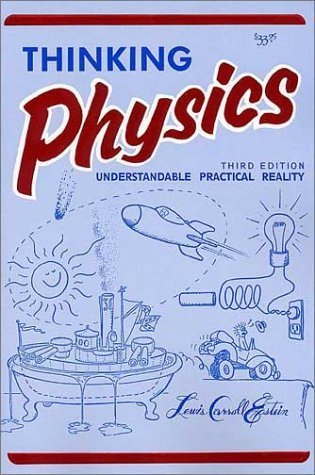
Lewis Carroll Epstein explains deep ideas in physics in an easy-to-understand way. Thinking Physics is a perfect beginner’s guide to an amazingly wide range of physics-related questions. The book targets topics that science teachers and students spend time wondering about, like wing lift. Epstein elucidates the familiar but misunderstood — such as how tides work — along with more obscure but fascinating phenomena like the “Bernoulli sub” and the “artificial aurora” created by hydrogen bombs. Broken into many short sections and peppered with Epstein’s own playful hand-drawn illustrations, the book does not simply give the right answer: It also goes into the answers that seem right but are wrong and shows why they are wrong — a rarity in science books. Thinking Physics is a rigorously correct, lighthearted, and cleverly designed Q and A book for physicists of all ages.

The Hagakure is one of the most influential of all Japanese texts — written by Yamamoto Tsunetomo nearly 300 years ago to summarize the essence of the Japanese samurai spirit. Its influence has been felt throughout the world and yet its existence is scarcely known to most Westerners. This is the first translation to include the complete first two books of the Hagakure and the most reliable and authentic passages of the third book. All other English translations are extremely fragmentary and incomplete.Alex Bennett’s new and extremely readable translation of this essential work includes extensive footnotes that serve to fill in many cultural and historical gaps in the previous translations. This unique combination of readability and scholarship gives Bennett’s translation a distinct advantage over all previous English editions.

The Compleat Strategyst: Being a Primer on the Theory of Games of Strategy
by J.D. Williams
Rating: 3.5 ⭐
• 2 recommendations ❤️
When J. D. Williams wrote this entertaining, witty introduction for the nonscientist, game theory was still a somewhat mysterious subject familiar to very few scientists beyond those researchers, like himself, working for the military. Now, over thirty years after its original publication as a Rand Corporation research study, his light-hearted though thoroughly effective primer is the recognized classic introduction to an increasingly applicable discipline. Used by amateurs, professionals, and students throughout the world in the classroom, on the job, and for personal amusement, the book has been through ten printings, and has been translated into at least five languages (including Russian and Japanese).Revised, updated, and available for the first time in an inexpensive paperback edition, The Compleat Strategyst is a highly entertaining text essential for anyone interested in this provocative and engaging area of modern mathematics. In fully illustrated chapters complete with everyday examples and word problems, Williams offers readers a working understanding of the possible methods for selecting strategies in a variety of situations, simple to complex. With just a basic understanding of arithmetic, anyone can grasp all necessary aspects of two-, three-, four-, and larger strategy games with two or more sets of inimical interests and a limitless array of zero-sum payoffs.As research and study continues not only in this new discipline but in the related areas of statistics, probability and behavioral science, understanding of games, decision making, and the development of strategies will be increasingly important. In the areas of economics, sociology, politics, and the military, game theory is sure to have an even wider impact. For students and amateurs fascinated by game theory's implications there is no better, immediately applicable, or more entertaining introduction to the subject than this engaging text by the late J. D. Williams, Professor of Mathematics at Princeton University and a member of the Research Council of The Rand Corporation.

When he was 26, Chip Conley broke the two cardinal rules of starting a he invested in an industry about which he knew nothing and he ignored the mantra "location, location, location." He bought a notorious "pay-by-the-hour" motel in a seedy San Francisco neighborhood.A dozen years later, Chip is the "boy wonder" of the American travel industry, famous for his entrepreneurial genius, creativity, and sense of fun.In The Rebel Rules, Conley shares his success secrets. He focuses on the primary traits -- vision, passion, instinct, and agility -- that characterize today's fast company leaders. His guidebook doubles as a toolbox for anyone -- whether a virgin entrepreneur or a corporate manager -- who wants to walk in step with today's business innovators.The Rebel Rules will show you how

At Home in the Universe: The Search for the Laws of Self-Organization and Complexity
by Stuart A. Kauffman
Rating: 4.0 ⭐
• 2 recommendations ❤️
A major scientific revolution has begun, a new paradigm that rivals Darwin's theory in importance. At its heart is the discovery of the order that lies deep within the most complex of systems, from the origin of life, to the workings of giant corporations, to the rise and fall of great civilizations. And more than anyone else, this revolution is the work of one man, Stuart Kauffman, a MacArthur Fellow and visionary pioneer of the new science of complexity. Now, in At Home in the Universe , Kauffman brilliantly weaves together the excitement of intellectual discovery and a fertile mix of insights to give the general reader a fascinating look at this new science--and at the forces for order that lie at the edge of chaos.We all know of instances of spontaneous order in nature--an oil droplet in water forms a sphere, snowflakes have a six-fold symmetry. What we are only now discovering, Kauffman says, is that the range of spontaneous order is enormously greater than we had supposed. Indeed, self-organization is a great undiscovered principle of nature. But how does this spontaneous order arise? Kauffman contends that complexity itself triggers self-organization, or what he calls "order for free," that if enough different molecules pass a certain threshold of complexity, they begin to self-organize into a new entity--a living cell. Kauffman uses the analogy of a thousand buttons on a rug--join two buttons randomly with thread, then another two, and so on. At first, you have isolated pairs; later, small clusters; but suddenly at around the 500th repetition, a remarkable transformation occurs--much like the phase transition when water abruptly turns to ice--and the buttons link up in one giant network.Likewise, life may have originated when the mix of different molecules in the primordial soup passed a certain level of complexity and self-organized into living entities (if so, then life is not a highly improbable chance event, but almost inevitable). Kauffman uses the basic insight of "order for free" to illuminate a staggering range of phenomena. We see how a single-celled embryo can grow to a highly complex organism with over two hundred different cell types. We learn how the science of complexity extends Darwin's theory of evolution by natural that self-organization, selection, and chance are the engines of the biosphere. And we gain insights into biotechnology, the stunning magic of the new frontier of genetic engineering--generating trillions of novel molecules to find new drugs, vaccines, enzymes, biosensors, and more. Indeed, Kauffman shows that ecosystems, economic systems, and even cultural systems may all evolve according to similar general laws, that tissuesand terra cotta evolve in similar ways. And finally, there is a profoundly spiritual element to Kauffman's thought. If, as he argues, life were bound to arise, not as an incalculably improbable accident, but as an expected fulfillment of the natural order, then we truly are at home in the universe.Kauffman's earlier volume, The Origins of Order , written for specialists, received lavish praise. Stephen Jay Gould called it "a landmark and a classic." And Nobel Laureate Philip Anderson wrote that "there are few people in this world who ever ask the right questions of science, and they are the ones who affect its future most profoundly. Stuart Kauffman is one of these." In At Home in the Universe , this visionary thinker takes you along as he explores new insights into the nature of life.

This outstanding anthology of short verse offers poetry lovers an impressive sampling of more than 150 masterpieces spanning over 400 years of English and American literary history. Although short in length (the longest are 24 lines, most 16 lines or less), these poems are long on beauty, power, imagination, and originality.Included are such memorable compositions as John Donne's "Death Be Not Proud," Shakespeare's "When, in Disgrace with Fortune and Men's Eyes," "On His Blindness" by John Milton, William Blake's "The Tyger," Wordsworth's "I Wandered Lonely as a Cloud," Byron's "She Walks in Beauty," Shelley's "Ozymandias," as well as works by Alfred Lord Tennyson, Walt Whitman, Emily Dickinson, Gerard Manly Hopkins, Amy Lowell, William Butler Yeats, Robert Frost, Edna St. Vincent Millay, Langston Hughes, Dylan Thomas, Paul Laurence Dunbar, and many others.Attractive and inexpensive, this compilation of carefully chosen verse contains many of the most loved, most anthologized poems in the English language. Students, teachers, and any lover of great poetry will treasure this splendid collection. Includes 3 selections from the Common Core State Standards Initiative: "The Road Not Taken," "Loveliest of Trees," and "Ozymandias."
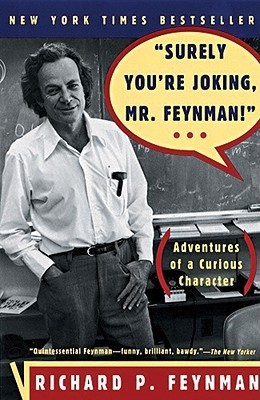
Surely You're Joking, Mr. Feynman!: Adventures of a Curious Character
by Richard P. Feynman
Rating: 4.3 ⭐
• 3 recommendations ❤️
Richard Feynman (1918-1988), winner of the Nobel Prize in physics, thrived on outrageous adventures. Here he recounts in his inimitable voice his experience trading ideas on atomic physics with Einstein and Bohr and ideas on gambling with Nick the Greek; cracking the uncrackable safes guarding the most deeply held nuclear secrets; painting a naked female toreador—and much else of an eyebrow-raising nature.In short, here is Feynman's life in all its eccentric glory—a combustible mixture of high intelligence, unlimited curiosity, and raging chutzpah.

The Evolution of Cooperation provides valuable insights into the age-old question of whether unforced cooperation is ever possible. Widely praised and much-discussed, this classic book explores how cooperation can emerge in a world of self-seeking egoists—whether superpowers, businesses, or individuals—when there is no central authority to police their actions. The problem of cooperation is central to many different fields. Robert Axelrod recounts the famous computer tournaments in which the “cooperative” program Tit for Tat recorded its stunning victories, explains its application to a broad spectrum of subjects, and suggests how readers can both apply cooperative principles to their own lives and teach cooperative principles to others.

Q.E.D. presents some of the most famous mathematical proofs in a charming book that will appeal to nonmathematicians and math experts alike. Grasp in an instant why Pythagoras's theorem must be correct. Follow the ancient Chinese proof of the volume formula for the frustrating frustum, and Archimedes' method for finding the volume of a sphere. Discover the secrets of pi and why, contrary to popular belief, squaring the circle really is possible. Study the subtle art of mathematical domino tumbling, and find out how slicing cones helped save a city and put a man on the moon.

A new trade paperback edition of the graphic novel that inspired the hit movie!A powerful story about loss of freedom and individuality, V FOR VENDETTA takes place in a totalitarian England following a devastating war that changed the face of the planet.In a world without political freedom, personal freedom and precious little faith in anything comes a mysterious man in a white porcelain mask who fights political oppressors through terrorism and seemingly absurd acts. It's a gripping tale of the blurred lines between ideological good and evil.This new trade paperback edition features the improved production values and coloring from the 2005 hardcover.

Here are some of the most-loved poems in the English language, chosen not merely for their popularity, but for their literary quality as well. Dating from the Middle Ages to the 20th century, these splendid poems remain evergreen in their capacity to engage our minds and refresh our spirits. Among them are "The Passionate Shepherd to His Love"; "Sonnet XVIII" ("Shall I compare thee to a summer's day?"); "Holy Sonnet X" ("Death, be not proud"); "To His Coy Mistress"; "I Wandered Lonely as a Cloud"; "Ode to the West Wind"; "The Children's Hour"; "The Raven"; "The Charge of the Light Brigade"; "O Captain! My Captain!"; "This Is My Letter to the World"; "When You Are Old"; "The Road Not Taken"; "First Fig."Works by many other poets — Milton, Blake, Burns, Coleridge, Byron, Keats, Emerson, the Brownings, Hardy, Housman, Kipling, Pound, and Auden among them — are included in this treasury, a perfect companion for quiet moments of reflection.

Nature Via Nurture: Genes, Experience, and What Makes Us Human
by Matt Ridley
Rating: 3.9 ⭐
• 2 recommendations ❤️
Following his highly praised and bestselling book Genome: The Autobiography of a Species in 23 Chapters, Matt Ridley has written a brilliant and profound book about the roots of human behavior. Nature via Nurture explores the complex and endlessly intriguing question of what makes us who we are.In February 2001 it was announced that the human genome contains not 100,000 genes, as originally postulated, but only 30,000. This startling revision led some scientists to conclude that there are simply not enough human genes to account for all the different ways people behave: we must be made by nurture, not nature. Yet again biology was to be stretched on the Procrustean bed of the nature-nurture debate. Matt Ridley argues that the emerging truth is far more interesting than this myth. Nurture depends on genes, too, and genes need nurture. Genes not only predetermine the broad structure of the brain, they also absorb formative experiences, react to social cues, and even run memory. They are consequences as well as causes of the will.Published fifty years after the discovery of the double helix of DNA, Nature via Nurture chronicles a revolution in our understanding of genes. Ridley recounts the hundred years' war between the partisans of nature and nurture to explain how this paradoxical creature, the human being, can be simultaneously free-willed and motivated by instinct and culture. Nature via Nurture is an enthralling,up-to-the-minute account of how genes build brains to absorb experience.

The publication of Darwin’s The Origin of Species in 1859 marked a dramatic turning point in scientific thought. The volume had taken Darwin more than twenty years to publish, in part because he envisioned the storm of controversy it was certain to unleash. Indeed, selling out its first edition on its first day, The Origin of Species revolutionized science, philosophy, and theology.Darwin’s reasoned, documented arguments carefully advance his theory of natural selection and his assertion that species were not created all at once by a divine hand but started with a few simple forms that mutated and adapted over time. Whether commenting on his own poor health, discussing his experiments to test instinct in bees, or relating a conversation about a South American burrowing rodent, Darwin’s monumental achievement is surprisingly personal and delightfully readable. Its profound ideas remain controversial even today, making it the most influential book in the natural sciences ever written—an important work not just to its time but to the history of humankind.

In reality, Hiro Protagonist delivers pizza for Uncle Enzo's CosoNostra Pizza Inc., but in the Metaverse he's a warrior prince. Plunging headlong into the enigma of a new computer virus that's striking down hackers everywhere, he races along the neon-lit streets on a search-and-destroy mission for the shadowy virtual villain threatening to bring about infocalypse. Snow Crash is a mind-altering romp through a future America so bizarre, so outrageous… you'll recognize it immediately.
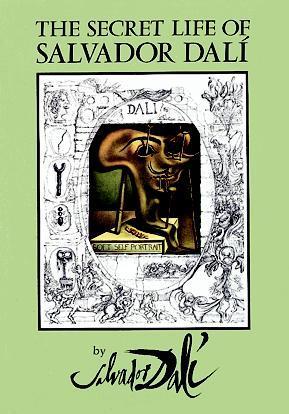
This early autobiography, which takes Dalí through his late thirties, is as startling and unpredictable as his art. On its first publication, the reviewer of Books observed: "It is impossible not to admire this painter as writer ... (Dalí) succeeds in doing exactly what he sets out to do ... communicates the snobbishness, self-adoration, comedy, seriousness, fanaticism, in short the concept of life and the total picture of himself he sets out to portray." Superbly illustrated with over eighty photographs of Dalí and his works, and scores of Dalí drawings and sketches.
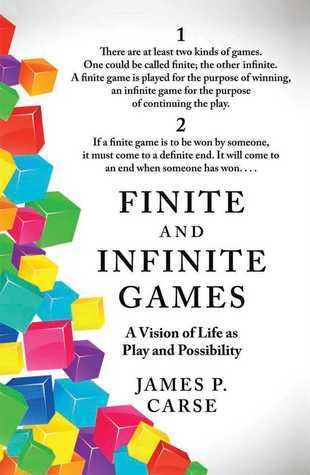
“There are at least two kinds of games,” states James P. Carse as he begins this extraordinary book. “One could be called finite; the other infinite. A finite game is played for the purpose of winning, an infinite game for the purpose of continuing the play.”Finite games are the familiar contests of everyday life; they are played in order to be won, which is when they end. But infinite games are more mysterious. Their object is not winning, but ensuring the continuation of play. The rules may change, the boundaries may change, even the participants may change—as long as the game is never allowed to come to an end.What are infinite games? How do they affect the ways we play our finite games? What are we doing when we play—finitely or infinitely? And how can infinite games affect the ways in which we live our lives?Carse explores these questions with stunning elegance, teasing out of his distinctions a universe of observation and insight, noting where and why and how we play, finitely and infinitely. He surveys our world—from the finite games of the playing field and playing board to the infinite games found in culture and religion—leaving all we think we know illuminated and transformed. Along the way, Carse finds new ways of understanding everything, from how an actress portrays a role to how we engage in sex, from the nature of evil to the nature of science. Finite games, he shows, may offer wealth and status, power and glory, but infinite games offer something far more subtle and far grander.Carse has written a book rich in insight and aphorism. Already an international literary event, Finite and Infinite Games is certain to be argued about and celebrated for years to come. Reading it is the first step in learning to play the infinite game.

Undercover Economist: Exposing Why the Rich Are Rich, the Poor Are Poor--and Why You Can Never Buy a Decent Used Car!
by Tim Harford
Rating: 3.8 ⭐
• 2 recommendations ❤️
With over one million copies sold, The Undercover Economist has been hailed worldwide as a fantastic guide to the fundamental principles of economics. An economist's version of The Way Things Work, this engaging volume is part Economics 101 and part expose of the economic principles lurking behind daily events, explaining everything from traffic jams to high coffee prices.New to this edition This revised edition, newly updated to consider the banking crisis and economic turbulence of the last four years, is essential for anyone who has wondered why the gap between rich and poor nations is so great, or why they can't seem to find a decent second-hand car, or how to outwit Starbucks. Senior columnist for the Financial Times Tim Harford brings his experience and insight as he ranges from Africa, Asia, Europe, and the United States to reveal how supermarkets, airlines, and coffee chains--to name just a few--are vacuuming money from our wallets. Harford punctures the myths surrounding some of today's biggest controversies, including the high cost of health-care; he reveals why certain environmental laws can put a smile on a landlord's face; and he explains why some industries can have high profits for innocent reasons, while in other industries something sinister is going on.Covering an array of economic concepts including scarce resources, market power, efficiency, price gouging, market failure, inside information, and game theory, Harford sheds light on how these forces shape our day-to-day lives, often without our knowing it. Showing us the world through the eyes of an economist, Tim Harford reveals that everyday events are intricate games of negotiations, contests of strength, and battles of wits. Written with a light touch and sly wit, The Undercover Economist turns "the dismal science" into a true delight.

Six Easy Pieces: Essentials of Physics Explained by Its Most Brilliant Teacher
by Richard P. Feynman
Rating: 4.2 ⭐
• 2 recommendations ❤️
Learn how to think like a physicist from a Nobel laureate and "one of the greatest minds of the twentieth century" ( New York Review of Books ) with these six classic and beloved lessons It was Richard Feynman's outrageous and scintillating method of teaching that earned him legendary status among students and professors of physics. From 1961 to 1963, Feynman delivered a series of lectures at the California Institute of Technology that revolutionized the teaching of physics around the world. Six Easy Pieces , taken from these famous Lectures on Physics, represent the most accessible material from the series. In these classic lessons, Feynman introduces the general reader to the following topics: atoms, basic physics, energy, gravitation, quantum mechanics, and the relationship of physics to other topics. With his dazzling and inimitable wit, Feynman presents each discussion with a minimum of jargon. Filled with wonderful examples and clever illustrations, Six Easy Pieces is the ideal introduction to the fundamentals of physics by one of the most admired and accessible physicists of modern times. "If one book was all that could be passed on to the next generation of scientists it would undoubtedly have to be Six Easy Pieces. "- John Gribbin, New Scientist

Krishnamurti shows how people can free themselves radically and immediately from the tyranny of the expected, no matter what their age--opening the door to transforming society and their relationships.
Calculus Made Easy by Silvanus P. Thompson and Martin Gardner has long been the most popular calculus primer.This major revision of the classic math text makes the subject at hand still more comprehensible to readers of all levels. With a new introduction, three new chapters, modernized language and methods throughout, and an appendix of challenging and enjoyable practice problems, Calculus Made Easy has been thoroughly updated for the modern reader.

The Salmon of Doubt: Hitchhiking the Galaxy One Last Time
by Douglas Adams
Rating: 3.9 ⭐
• 2 recommendations ❤️
Douglas Adams changed the face of science fiction (to a uniquely and irresistible funny one) with his cosmically comic novel The Hitchhiker's Guide to the x, and its classic sequels. Sadly for his countless admirers, he hitched his own ride to the great beyond much too soon. But for anyone who ever laughed out loud at the absurdist adventures of Arthur Dent and Ford Prefect, chuckled knowingly at the daffy definitions in The Meaning of Liff, or experienced the wonders of encountering endangered species in Last Chance to See, here's a wonderful opportunity to revel in the droll wit, off-the-wall humor, and keenly inquiring mind of Douglas Adams just one more time.Culled posthumously from Adams's fleet of beloved Macintosh computers, this selection of essays, articles, anecdotes, and stories offers a fascinating and intimate portrait of the multifaceted artist--as a devout Beatles and Bach fan, radical atheist, enthusiastic technophobe, crusading conservationist, and of course delightful wordsmith.Join him on an excursion to climb Kilimanjaro...dressed in a rhino costume; peek into the private life of Genghis Khan--warrior, conqueror, and world-class neurotic; root for the harried author's efforts to get a Hitchhiker movie off the ground in Hollywood; thrill to (and laugh at) the further exploits of private eye Dirk Gently and two-headed alien Zaphod Beeblebrox. In the immortal words of The Hitchhiker's Guide, "Don't panic!"--though our friend Douglas Adams is hone, he's left us something very special to remember him by. Without a doubt.

The Power of Now: A Guide to Spiritual Enlightenment
by Eckhart Tolle
Rating: 4.2 ⭐
• 17 recommendations ❤️
An alternative cover edition for this ISBN can be found here.To make the journey into the Now we will need to leave our analytical mind and its false created self, the ego, behind. From the very first page of Eckhart Tolle's extraordinary book, we move rapidly into a significantly higher altitude where we breathe a lighter air. We become connected to the indestructible essence of our Being, “The eternal, ever present One Life beyond the myriad forms of life that are subject to birth and death.” Although the journey is challenging, Eckhart Tolle uses simple language and an easy question-and-answer format to guide us.A word-of-mouth phenomenon since its first publication, The Power of Now is one of those rare books with the power to create an experience in readers, one that can radically change their lives for the better.

Gödel, Escher, Bach: An Eternal Golden Braid
by Douglas R. Hofstadter
Rating: 4.3 ⭐
• 16 recommendations ❤️
Douglas Hofstadter's book is concerned directly with the nature of “maps” or links between formal systems. However, according to Hofstadter, the formal system that underlies all mental activity transcends the system that supports it. If life can grow out of the formal chemical substrate of the cell, if consciousness can emerge out of a formal system of firing neurons, then so too will computers attain human intelligence. Gödel, Escher, Bach is a wonderful exploration of fascinating ideas at the heart of cognitive science: meaning, reduction, recursion, and much more.

Here is a handsome edition of one of Borges' "ficciones," in a translation first published in Labyrinths in 1962. It's an important story in the Borges' canon, incorporating most of the author's philosophical and esthetic preoccupations in a typically brief compass. With great solemnity and a convincing array of scholarly detail (including annotated references to imaginary books and articles), Borges concocts a fable of an alternate world and its infiltration of our own. The reality of Tlön is idealist: material objects have no existence; language has no nouns; its principal discipline is psychology, since its inhabitants see the universe as nothing but a series of mental processes. A series of 24 illustrations accompanies the text. Their disturbing resemblances to our reality make them appropriate reflections of Borges's imaginative constructs.' —The Kingston Whig-Standard

Doctor Impossible—evil genius, diabolical scientist, wannabe world dominator—languishes in a federal detention facility. He's lost his freedom, his girlfriend, and his hidden island fortress. Over the years he's tried to take over the world in every way imaginable: doomsday devices of all varieties (nuclear, thermonuclear, nanotechnological) and mass mind control. He's traveled backwards in time to change history, forward in time to escape it. He's commanded robot armies, insect armies, and dinosaur armies. Fungus army. Army of fish. Of rodents. Alien invasions. All failures. But not this time. This time it's going to be different... Fatale is a rookie superhero on her first day with the Champions, the world's most famous superteam. She's a patchwork woman of skin and chrome, a gleaming technological marvel built to be the next generation of warfare. Filling the void left by a slain former member, Fatale joins a team struggling with a damaged past, trying to come together in the face of unthinkable evil. Soon I Will Be Invincible is a thrilling first novel; a fantastical adventure that gives new meaning to the notions of power, glory, responsibility, and (of course) good and evil.

The Power Of Myth launched an extraordinary resurgence of interest in Joseph Campbell and his work. A preeminent scholar, writer, and teacher, he has had a profound influence on millions of people. To him, mythology was the "song of the universe, the music of the spheres." With Bill Moyers, one of America's most prominent journalists, as his thoughtful and engaging interviewer, The Power Of Myth touches on subjects from modern marriage to virgin births, from Jesus to John Lennon, offering a brilliant combination of intelligence and wit.
Classic account of basic methodology and psychology of scientific discovery explains how scientists analyze and choose their working facts and explores the nature of experimentation, theory, and the mind. 1914 edition.

A quantum Brave New World from the boldest and most wildly speculative writer of his generation.Since the Introdus in the twenty-first century, humanity has reconfigured itself drastically. Most chose immortality, joining the polises to become conscious software. Others opted for gleisners: disposable, renewable robotic bodies that remain in contact with the physical world of force and friction. Many of these have left the solar system forever in fusion-drive starships.And there are the holdouts: the fleshers left behind in the muck and jungle of Earth—some devolved into dream apes, others cavorting in the seas or the air—while the statics and bridgers try to shape out a roughly human destiny.But the complacency of the citizens is shattered when an unforeseen disaster ravages the fleshers and reveals the possibility that the polises themselves might be at risk from bizarre astrophysical processes that seem to violate fundamental laws of nature. The orphan Yatima, a digital being grown from a mind seed, joins a group of citizens and flesher refugees in a search for the knowledge that will guarantee their safety—a search that puts them on the trail of the ancient and elusive Transmuters, who have the power to reshape subatomic particles, and to cross into the macrocosmos, where the universe we know is nothing but a speck in the higher-dimensional vacuum.

Exupery was a prize-winning novelist, professional mail pilot, airborne adventurer, war correspondent, commercial test pilot, and the author of a popular children's book The Little Prince. Wind, Sand, and Stars more than all the others is a synthesis of his skill as a writer and his life as a flier. It is a collage of anecdotes, speculations and peotic reflections the earth and its inhabitants as seen from the air, all glued together by one basic them: that the airplane has broght man into confrontation with the elemnets of the univeerse, and thus has given him a new perspective on his own nature.

The Red Queen: Sex and the Evolution of Human Nature
by Matt Ridley
Rating: 4.0 ⭐
• 8 recommendations ❤️
The Red Queen compels us to rethink everything from the persistence of sexism to the endurance of romantic love.Referring to Lewis Carroll's Red Queen from Through the Looking-Glass, a character who has to keep running to stay in the same place, Matt Ridley demonstrates why sex is humanity's best strategy for outwitting its constantly mutating internal predators. The Red Queen answers dozens of other riddles of human nature and culture—including why men propose marriage, the method behind our maddening notions of beauty, and the disquieting fact that a woman is more likely to conceive a child by an adulterous lover than by her husband. The Red Queen offers an extraordinary new way of interpreting the human condition and how it has evolved.
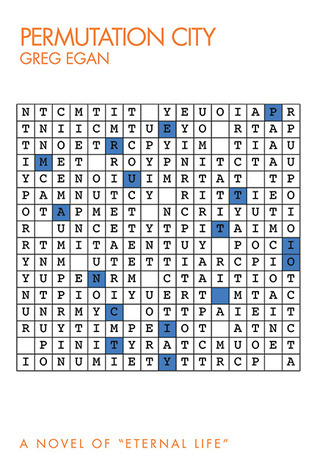
What happens when your digital self overpowers your physical self?A life in Permutation City is unlike any life to which you’re accustomed. You have Eternal Life, the power to live forever. Immortality is a real thing, just not the thing you’d expect.Life is just electronic code. You have been digitized, scanned, and downloaded into a virtual reality program. A Copy of a Copy. For Paul Durham, he keeps making Copies of himself, but the issue is that his Copies keep changing their minds and shutting themselves down.You also have Maria Deluca, who is nothing but an Autoverse addict. She spends every waking minute with the cellular automaton known as the Autoverse, a world that lives by the mathematical “laws of physics.”Paul makes Maria an offer to design and drop a seed into the Autoverse that will allow her to indulge in her obsession. There is, however, one catch: you can no longer terminate, bail out, and remove yourself. You will never be your normal flesh-and-blood life again. The question then becomes: Is this what she really wants? Is this what we really want?From the brilliant mind of Greg Egan, Permutation City, first published in 1994, comes a world of wonder that makes you ask if you are you, or is the Copy of you the real you?

Fear and Loathing in Las Vegas: A Savage Journey to the Heart of the American Dream
by Hunter S. Thompson
Rating: 4.1 ⭐
• 7 recommendations ❤️
Fear and Loathing in Las Vegas is the best chronicle of drug-soaked, addle-brained, rollicking good times ever committed to the printed page. It is also the tale of a long weekend road trip that has gone down in the annals of American pop culture as one of the strangest journeys ever undertaken.

The Origin of Consciousness in the Breakdown of the Bicameral Mind
by Julian Jaynes
Rating: 4.3 ⭐
• 8 recommendations ❤️
At the heart of this classic, seminal book is Julian Jaynes's still-controversial thesis that human consciousness did not begin far back in animal evolution but instead is a learned process that came about only three thousand years ago and is still developing. The implications of this revolutionary scientific paradigm extend into virtually every aspect of our psychology, our history and culture, our religion -- and indeed our future.

Miyamoto Musashi's Go Rin no Sho or the book of five rings, is considered a classic treatise on military strategy, much like Sun Tzu's The Art of War and Chanakya's Arthashastra. The five "books" refer to the idea that there are different elements of battle, just as there are different physical elements in life, as described by Buddhism, Shinto, and other Eastern religions. Through the book Musashi defends his thesis: a man who conquers himself is ready to take it on on the world, should need arise.

This seminal work on political economy and the foundation of the modern market economy was originally published in 1776. Rich in historical background and acute observations of the 18th-century scene, Adam Smith's masterpiece of economic analysis is also an insightful work of political philosophy. Its revolutionary concepts, including the notion that self-interest stimulates the healthiest economic conditions for all, remain influential with politicians and economists alike.

This is a one-of-a-kind reference for anyone with a serious interest in mathematics. Edited by Timothy Gowers, a recipient of the Fields Medal, it presents nearly two hundred entries, written especially for this book by some of the world's leading mathematicians, that introduce basic mathematical tools and vocabulary; trace the development of modern mathematics; explain essential terms and concepts; examine core ideas in major areas of mathematics; describe the achievements of scores of famous mathematicians; explore the impact of mathematics on other disciplines such as biology, finance, and musi—and much, much more.Unparalleled in its depth of coverage, The Princeton Companion to Mathematics surveys the most active and exciting branches of pure mathematics. Accessible in style, this is an indispensable resource for undergraduate and graduate students in mathematics as well as for researchers and scholars seeking to understand areas outside their specialties.- Features nearly 200 entries, organized thematically and written by an international team of distinguished contributors- Presents major ideas and branches of pure mathematics in a clear, accessible style- Defines and explains important mathematical concepts, methods, theorems, and open problems- Introduces the language of mathematics and the goals of mathematical research- Covers number theory, algebra, analysis, geometry, logic, probability, and more- Traces the history and development of modern mathematics- Profiles more than ninety-five mathematicians who influenced those working today- Explores the influence of mathematics on other disciplines- Includes bibliographies, cross-references, and a comprehensive indexContributors include:Graham Allan, Noga Alon, George Andrews, Tom Archibald, Sir Michael Atiyah, David Aubin, Joan Bagaria, Keith Ball, June Barrow-Green, Alan Beardon, David D. Ben-Zvi, Vitaly Bergelson, Nicholas Bingham, Béla Bollobás, Henk Bos, Bodil Branner, Martin R. Bridson, John P. Burgess, Kevin Buzzard, Peter J. Cameron, Jean-Luc Chabert, Eugenia Cheng, Clifford C. Cocks, Alain Connes, Leo Corry, Wolfgang Coy, Tony Crilly, Serafina Cuomo, Mihalis Dafermos, Partha Dasgupta, Ingrid Daubechies, Joseph W. Dauben, John W. Dawson Jr., Francois de Gandt, Persi Diaconis, Jordan S. Ellenberg, Lawrence C. Evans, Florence Fasanelli, Anita Burdman Feferman, Solomon Feferman, Charles Fefferman, Della Fenster, José Ferreirós, David Fisher, Terry Gannon, A. Gardiner, Charles C. Gillispie, Oded Goldreich, Catherine Goldstein, Fernando Q. Gouvêa, Timothy Gowers, Andrew Granville, Ivor Grattan-Guinness, Jeremy Gray, Ben Green, Ian Grojnowski, Niccolò Guicciardini, Michael Harris, Ulf Hashagen, Nigel Higson, Andrew Hodges, F. E. A. Johnson, Mark Joshi, Kiran S. Kedlaya, Frank Kelly, Sergiu Klainerman, Jon Kleinberg, Israel Kleiner, Jacek Klinowski, Eberhard Knobloch, János Kollár, T. W. Körner, Michael Krivelevich, Peter D. Lax, Imre Leader, Jean-François Le Gall, W. B. R. Lickorish, Martin W. Liebeck, Jesper Lützen, Des MacHale, Alan L. Mackay, Shahn Majid, Lech Maligranda, David Marker, Jean Mawhin, Barry Mazur, Dusa McDuff, Colin McLarty, Bojan Mohar, Peter M. Neumann, Catherine Nolan, James Norris, Brian Osserman, Richard S. Palais, Marco Panza, Karen Hunger Parshall, Gabriel P. Paternain, Jeanne Peiffer, Carl Pomerance, Helmut Pulte, Bruce Reed, Michael C. Reed, Adrian Rice, Eleanor Robson, Igor Rodnianski, John Roe, Mark Ronan, Edward Sandifer, Tilman Sauer, Norbert Schappacher, Andrzej Schinzel, Erhard Scholz, Reinhard Siegmund-Schultze, Gordon Slade, David J. Spiegelhalter, Jacqueline Stedall, Arild Stubhaug, Madhu Sudan, Terence Tao, Jamie Tappenden, C. H. Taubes, Rüdiger Thiele, Burt Totaro, Lloyd N. Trefethen, Dirk van Dalen, Richard Weber, Dominic Welsh, Avi Wigderson, Herbert Wilf, David Wilkins, B. Yandell, Eric Zaslow, Doron Zeilberger

The Mahabharata incorporates Bhagavad-Gita, a sacred Hindu text that takes the form of a philosophical dialogue in which Krishna instructs Arjuna, the prince, in ethical matters and the nature of God. Krishna expounds the nature and the way that humans can come to know God to Arjuna, the warrior prince in the Bhagavad-Gita. Mahabharata, a Sanskrit epic, contains the text of the Bhagavad-Gita. This early epic poem recounts the conversation between the warrior and his charioteer, the divine manifestation. It sets out the important lessons to learn to change the outcome of the war in the moments before a great battle that the warrior fights, and culminates in revealing the true cosmic warrior and counselling him to search for the universal perfection of life. This most important work ranges from yoga postures to dense moral discussion and serves as a practical guide to living well.

Briefly looks at the development of the Macintosh computer, explains how the Apple Computer company is managed, and discusses the computer software industry

The Origins of Virtue: Human Instincts and the Evolution of Cooperation
by Matt Ridley
Rating: 4.0 ⭐
• 6 recommendations ❤️
If, as Darwin suggests, evolution relentlessly encourages the survival of the fittest, why are humans compelled to live in cooperative, complex societies? In this fascinating examination of the roots of human trust and virtue, a zoologist and former American editor of the Economist reveals the results of recent studies that suggest that self-interest and mutual aid are not at all incompatible. In fact, he points out, our cooperative instincts may have evolved as part of mankind's natural selfish behavior—by exchanging favors we can benefit ourselves as well as others.Brilliantly orchestrating the newest findings of geneticists, psychologists, and anthropologists, The Origins of Virtue re-examines the everyday assumptions upon which we base our actions towards others, whether in our roles as parents, siblings, or trade partners. With the wit and brilliance of The Red Queen , his acclaimed study of human and animal sexuality, Matt Ridley shows us how breakthroughs in computer programming, microbiology, and economics have given us a new perspective on how and why we relate to each other.

A stunning new translation of the classic book—and basis for the beloved Oscar-winning film—brings the clarity and beauty of Kazantzakis’s language and story alive.First published in 1946, Zorba the Greek , is, on one hand, the story of a Greek working man named Zorba, a passionate lover of life, the unnamed narrator who he accompanies to Crete to work in a lignite mine, and the men and women of the town where they settle. On the other hand it is the story of God and man, The Devil and the Saints; the struggle of men to find their souls and purpose in life and it is about love, courage and faith.Zorba has been acclaimed as one of the truly memorable creations of literature—a character created on a huge scale in the tradition of Falstaff and Sancho Panza. His years have not dimmed the gusto and amazement with which he responds to all life offers him, whether he is working in the mine, confronting mad monks in a mountain monastery, embellishing the tales of his life or making love to avoid sin. Zorba’s life is rich with all the joys and sorrows that living brings and his example awakens in the narrator an understanding of the true meaning of humanity. This is one of the greatest life-affirming novels of our time.Part of the modern literary canon, Zorba the Greek , has achieved widespread international acclaim and recognition. This new edition translated, directly from Kazantzakis’s Greek original, is a more faithful rendition of his original language, ideas, and story, and presents Zorba as the author meant him to be.
*** OVER 13 MILLION COPIES SOLD ***Time and again, the work performed at The Institutes for the Achievement of Human Potential has demonstrated that children from birth to age six are capable of learning better and faster than older children. How To Teach Your Baby To Read shows just how easy it is to teach a young child to read, while How To Teach Your Baby Math presents the simple steps for teaching mathematics through the development of thinking and reasoning skills. Both books explain how to begin and expand each program, how to make and organize necessary materials, and how to more fully develop your child’s reading and math potential.How to Give Your Baby Encyclopedic Knowledge shows how simple it is to develop a program that cultivates a young child’s awareness and understanding of the arts, science, and nature―to recognize the insects in the garden, to learn about the countries of the world, to discover the beauty of a Van Gogh painting, and much more. How To Multiply Your Baby’s Intelligence provides a comprehensive program for teaching your young child how to read, to understand mathematics, and to literally multiply his or her overall learning potential in preparation for a lifetime of success.The Gentle Revolution Series :The Institutes for the Achievement of Human Potential has been successfully serving children and teaching parents for five decades. Its goal has been to significantly improve the intellectual, physical, and social development of all children. The groundbreaking methods and techniques of The Institutes have set the standards in early childhood education. As a result, the books written by Glenn Doman, founder of this organization, have become the all-time best-selling parenting series in the United States and the world.

Many consider the tragedy of "Hamlet" to be Shakespeare's masterpiece and one of the greatest plays of all time. It has entertained audiences for centuries and the role of Hamlet is one of the most sought after by actors. It is the story of Hamlet, the Prince of Denmark who learns of the death of his father at the hands of his uncle, Claudius. Claudius murders Hamlet's father, his own brother, to take the throne of Denmark and to marry Hamlet's widowed mother. Hamlet is sunk into a state of great despair as a result of discovering the murder of his father and the infidelity of his mother. Hamlet is torn between his great sadness and his desire for the revenge of his father's murder. "Hamlet" is a work of great complexity and as such has drawn many different critical interpretations. Hamlet has been seen as a victim of circumstance, as an impractical idealist, as the sufferer of an Oedipus complex, as an opportunist wishing to kill his Uncle not for revenge but to ascend to the throne, as the sufferer of a great melancholy, and as a man blinded by his desire for revenge. The true motivations of Hamlet are complex and enigmatic and have been debated for centuries. Read this classic tragedy and decide for yourself where Hamlet's true motivations lie and how they influence his ultimate demise.

The Enchiridion by Epictetus

This is Swami Venkatesananda's longer Yoga Vasiṣṭha. His two volume book is here offered between two covers. Its purpose is to provide a means to eliminate psychological conditioning and to attain liberation. Containing the instructions of the sage Vasiṣṭha to Lord Rama, this scripture is full of intricately woven tales, the kind a great teacher might tell to hold the interest of a student.

The Untethered Soul: The Journey Beyond Yourself
by Michael A. Singer
Rating: 4.4 ⭐
• 17 recommendations ❤️
The chapters of this book are nothing but mirrors for seeing your "self" from different angles. And though the journey we are about to embark on is an inner one, it will draw upon every aspect of your life. The only requirement asked of you is the willingness to honestly look at yourself in the most natural, intuitive manner. Remember, if we are seeking the root of "self," what we are actually seeking is you. As you read through these pages, you will find that you know much more than you thought you did about some very deep subjects. The fact is, you already know how to find yourself; you have just gotten distracted and disoriented. Once refocused, you will realize that you not only have the ability to find yourself, you have the ability to free yourself. Whether you choose to do so or not is entirely up to you. But upon completion of your journey through these chapters, there will be no more confusion, no more lack of empowerment, and no more blaming others. You will know exactly what must be done. And should you choose to devote yourself to the ongoing journey of self-realization, you will develop a tremendous sense of respect for who you really are. It is only then that you will come to appreciate the full depth of meaning in the advice: "This above all: to thine own self be true." ---- Introduction

Genome: The Autobiography of a Species in 23 Chapters
by Matt Ridley
Rating: 4.0 ⭐
• 8 recommendations ❤️
“Ridley leaps from chromosome to chromosome in a handy summation of our ever increasing understanding of the roles that genes play in disease, behavior, sexual differences, and even intelligence. . . . . He addresses not only the ethical quandaries faced by contemporary scientists but the reductionist danger in equating inheritability with inevitability.” — The New Yorker The genome's been mapped. But what does it mean? Matt Ridley’s Genome is the book that explains it what it is, how it works, and what it portends for the future Arguably the most significant scientific discovery of the new century, the mapping of the twenty-three pairs of chromosomes that make up the human genome raises almost as many questions as it answers. Questions that will profoundly impact the way we think about disease, about longevity, and about free will. Questions that will affect the rest of your life. Genome offers extraordinary insight into the ramifications of this incredible breakthrough. By picking one newly discovered gene from each pair of chromosomes and telling its story, Matt Ridley recounts the history of our species and its ancestors from the dawn of life to the brink of future medicine. From Huntington's disease to cancer, from the applications of gene therapy to the horrors of eugenics, Ridley probes the scientific, philosophical, and moral issues arising as a result of the mapping of the genome. It will help you understand what this scientific milestone means for you, for your children, and for humankind.

God's Debris is the first non-humor book by best-selling author Scott Adams. Adams describes God's Debris as a thought experiment wrapped in a story. It's designed to make your brain spin around inside your skull. Imagine that you meet a very old man who you eventually realize knows literally everything. Imagine that he explains for you the great mysteries of life: quantum physics, evolution, God, gravity, light psychic phenomenon, and probability in a way so simple, so novel, and so compelling that it all fits together and makes perfect sense. What does it feel like to suddenly understand everything? You may not find the final answer to the big question, but God's Debris might provide the most compelling vision of reality you will ever read. The thought experiment is this: Try to figure out what's wrong with the old man's explanation of reality. Share the book with your smart friends, then discuss it later while enjoying a beverage.

Librarian note: an alternate cover for this edition can be found here.In this stunning debut, Scott Lynch delivers the thrilling tale of an audacious criminal and his tightly knit band of tricksters. Set in a fantastic city pulsing with the lives of decadent nobles and daring thieves, here is a story of adventure, loyalty, and survival that is one part "Robin Hood," one part Ocean's Eleven, and entirely enthralling....An orphan's life is harsh--and often short--in the mysterious island city of Camorr. But young Locke Lamora dodges death and slavery, becoming a thief under the tutelage of a gifted con artist. As leader of the band of light-fingered brothers known as the Gentleman Bastards, Locke is soon infamous, fooling even the underworld's most feared ruler. But in the shadows lurks someone still more ambitious and deadly.Faced with a bloody coup that threatens to destroy everyone and everything that holds meaning in his mercenary life, Locke vows to beat the enemy at his own brutal game--or die trying....

The Diamond Age: Or, a Young Lady's Illustrated Primer
by Neal Stephenson
Rating: 4.2 ⭐
• 10 recommendations ❤️
The Diamond Age: Or, a Young Lady's Illustrated Primer is a postcyberpunk novel by Neal Stephenson. It is to some extent a science fiction coming-of-age story, focused on a young girl named Nell, and set in a future world in which nanotechnology affects all aspects of life. The novel deals with themes of education, social class, ethnicity, and the nature of artificial intelligence.

Too Soon Old, Too Late Smart: Thirty True Things You Need to Know Now
by Gordon Livingston
Rating: 4.1 ⭐
• 2 recommendations ❤️
After service in Vietnam, as a surgeon for the 11th Armored Cavalry Regiment in 1968-69, at the height of the war, Dr. Gordon Livingston returned to the U.S. and began work as a psychiatrist. In that capacity, he has listened to people talk about their lives-what works, what doesn’t, and the limitless ways (many of them self-inflicted) that people find to be unhappy. He is also a parent twice bereaved; in one thirteen-month period, he lost his eldest son to suicide, his youngest to leukemia. Out of a lifetime of experience, Gordon Livingston has extracted thirty bedrock truths: We are what we do. Any relationship is under the control of the person who cares the least. The perfect is the enemy of the good. Only bad things happen quickly. Forgiveness is a form of letting go, but they are not the same thing. The statute of limitations has expired on most of our childhood traumas. Livingston illuminates these and twenty-four others in a series of carefully hewn, perfectly calibrated essays, many of which focus on our closest relationships and the things that we do to impede or, less frequently, enhance them. Again and again, these essays underscore that “we are what we do,” and that while there may be no escaping who we are, we have the capacity to face loss, misfortune, and regret and to move beyond them-that it is not too late. Full of things we may know but have not articulated to ourselves, Too Soon Old, Too Late Smart offers solace, guidance, and hope to everyone ready to become the person they’d most like to be.

The Gay Science: With a Prelude in Rhymes and an Appendix of Songs
by Friedrich Nietzsche
Rating: 4.3 ⭐
• 4 recommendations ❤️
"[This book] mirrors all of Nietzsche's thought and could be related in hundreds of ways to his other books, his notes, and his letters. And yet it is complete in itself. For it is a work of art." —Walter Kaufmann in the IntroductionNietzsche called The Gay Science "the most personal of all my books." It was here that he first proclaimed the death of God—to which a large part of the book is devoted—and his doctrine of the eternal recurrence.Walter Kaufmann's commentary, with its many quotations from previously untranslated letters, brings to life Nietzsche as a human being and illuminates his philosophy. The book contains some of Nietzsche's most sustained discussions of art and morality, knowledge and truth, the intellectual conscience and the origin of logic.Most of the book was written just before Thus Spoke Zarathustra, the last part five years later, after Beyond Good and Evil. We encounter Zarathustra in these pages as well as many of Nietzsche's most interesting philosophical ideas and the largest collection of his own poetry that he himself ever published.Walter Kaufmann's English versions of Nietzsche represent one of the major translation enterprises of our time. He is the first philosopher to have translated Nietzsche's major works, and never before has a single translator given us so much of Nietzsche.

Self-described war nerd Gary Brecher knows he’s not alone, that there’s a legion of fat, lonely Americans, stuck in stupid, paper-pushing desk jobs, who get off on reading about war because they hate their lives. But Brecher writes about war, too. War Nerd collects his most opinionated, enraging, enlightening, and entertaining pieces. Part war commentator, part angry humorist àla Bill Hicks, Brecher inveighs against pieties of all stripes — Liberian generals, Dick Cheney, U.N. peacekeepers, the neo-cons — and the massive incompetence of military powers. A provocative free thinker, he finds much to admire in the most unlikely places, and not always for the most pacifistic reasons: the Tamil Tigers, the Lebanese Hezbollah, the Danes of 1,000 years ago, and so on, across the globe and through the centuries. Crude, scatological, un-P.C., yet deeply informed, Brecher provides a radically different, completely unvarnished perspective on the nature of warfare.

Challenging the Conventional Wisdom on Diet, Weight, and DiseaseIn this groundbreaking book, the result of seven years of research in every science connected with the impact of nutrition on health, award-winning science writer Gary Taubes shows us that almost everything we believe about the nature of a healthy diet is wrong.For decades we have been taught that fat is bad for us, carbohydrates better, and that the key to a healthy weight is eating less and exercising more. Yet with more and more people acting on this advice, we have seen unprecedented epidemics of obesity and diabetes. Taubes argues persuasively that the problem lies in refined carbohydrates (white flour, sugar, easily digested starches) and sugars–via their dramatic and longterm effects on insulin, the hormone that regulates fat accumulation–and that the key to good health is the kind of calories we take in, not the number. There are good calories, and bad ones.Good CaloriesThese are from foods without easily digestible carbohydrates and sugars. These foods can be eaten without restraint.Meat, fish, fowl, cheese, eggs, butter, and non-starchy vegetables. Bad CaloriesThese are from foods that stimulate excessive insulin secretion and so make us fat and increase our risk of chronic disease—all refined and easily digestible carbohydrates and sugars. The key is not how much vitamins and minerals they contain, but how quickly they are digested. (So apple juice or even green vegetable juices are not necessarily any healthier than soda.) Bread and other baked goods, potatoes, yams, rice, pasta, cereal grains, corn, sugar (sucrose and high fructose corn syrup), ice cream, candy, soft drinks, fruit juices, bananas and other tropical fruits, and beer. Taubes traces how the common assumption that carbohydrates are fattening was abandoned in the 1960s when fat and cholesterol were blamed for heart disease and then –wrongly–were seen as the causes of a host of other maladies, including cancer. He shows us how these unproven hypotheses were emphatically embraced by authorities in nutrition, public health, and clinical medicine, in spite of how well-conceived clinical trials have consistently refuted them. He also documents the dietary trials of carbohydrate-restriction, which consistently show that the fewer carbohydrates we consume, the leaner we will be. With precise references to the most significant existing clinical studies, he convinces us that there is no compelling scientific evidence demonstrating that saturated fat and cholesterol cause heart disease, that salt causes high blood pressure, and that fiber is a necessary part of a healthy diet. Based on the evidence that does exist, he leads us to conclude that the only healthy way to lose weight and remain lean is to eat fewer carbohydrates or to change the type of the carbohydrates we do eat, and, for some of us, perhaps to eat virtually none at all.The 11 Critical Conclusions of Good Calories, Bad Calories: 1. Dietary fat, whether saturated or not, does not cause heart disease. 2. Carbohydrates do, because of their effect on the hormone insulin. The more easily-digestible and refined the carbohydrates and the more fructose they contain, the greater the effect on our health, weight, and well-being. 3. Sugars—sucrose (table sugar) and high fructose corn syrup specifically—are particularly harmful. The glucose in these sugars raises insulin levels; the fructose they contain overloads the liver.4. Refined carbohydrates, starches, and sugars are also the most likely dietary causes of cancer, Alzheimer’s Disease, and the other common chronic diseases of modern times. 5. Obesity is a disorder of excess fat accumulation, not overeating and not sedentary behavior. 6. Consuming excess calories does not cause us to grow fatter any more than it causes a child to grow taller. 7. Exercise does not make us lose excess fat; it makes us hungry. 8. We get fat because of an imbalance—a disequilibrium—in the hormonal regulation of fat tissue and fat metabolism. More fat is stored in the fat tissue than is mobilized and used for fuel. We become leaner when the hormonal regulation of the fat tissue reverses this imbalance. 9. Insulin is the primary regulator of fat storage. When insulin levels are elevated, we stockpile calories as fat. When insulin levels fall, we release fat from our fat tissue and burn it for fuel. 10. By stimulating insulin secretion, carbohydrates make us fat and ultimately cause obesity. By driving fat accumulation, carbohydrates also increase hunger and decrease the amount of energy we expend in metabolism and physical activity.11. The fewer carbohydrates we eat, the leaner we will be. Good Calories, Bad Calories is a tour de force of scientific...
My name is Kvothe. I have stolen princesses back from sleeping barrow kings. I burned down the town of Trebon. I have spent the night with Felurian and left with both my sanity and my life. I was expelled from the University at a younger age than most people are allowed in. I tread paths by moonlight that others fear to speak of during day. I have talked to Gods, loved women, and written songs that make the minstrels weep. You may have heard of me. So begins a tale unequaled in fantasy literature--the story of a hero told in his own voice. It is a tale of sorrow, a tale of survival, a tale of one man's search for meaning in his universe, and how that search, and the indomitable will that drove it, gave birth to a legend.

A concise survey of the culture and civilization of mankind, The Lessons of History is the result of a lifetime of research from Pulitzer Prize–winning historians Will and Ariel Durant.With their accessible compendium of philosophy and social progress, the Durants take us on a journey through history, exploring the possibilities and limitations of humanity over time. Juxtaposing the great lives, ideas, and accomplishments with cycles of war and conquest, the Durants reveal the towering themes of history and give meaning to our own.

Glenn Doman has demonstrated time and time again that very young children are far more capable of learning than we ever imagined. He has taken his remarkable work - work that explores why children from birth to age six learn better and faster than older children do - and given it practical application. As the founder of The Institutes for the Achievement of Human Potential, he has created home programs that any parent can follow.How To Teach Your Baby To Read shows just how easy and pleasurable it is to teach a young child to read by providing skills that are basic to academic success. It explains how to begin and expand the reading program, how to make and organize necessary materials, and how to more fully develop your child’s reading potential.By following the simple daily program in a relaxed and loving way, you will enable your child to experience the joy of learning--as have millions of children the world over. With How To Teach Your Baby To Read, you can give your baby a powerful advantage that will last a lifetime.

2019 Reprint of 1923 Edition. Kahlil Gibran's masterpiece, The Prophet , is one of the most beloved classics of our time. Published in 1923, it has been translated into more than twenty languages, and the American editions alone have sold more than nine million copies. It is a collection of poetic essays that are philosophical, spiritual, and, above all, inspirational. Gibran's musings are divided into twenty-eight chapters covering such sprawling topics as love, marriage, children, giving, eating and drinking, work, joy and sorrow, housing, clothes, buying and selling, crime and punishment, laws, freedom, reason and passion, pain, self-knowledge, teaching, friendship, talking, time, good and evil, prayer, pleasure, beauty, religion, and death. Illustrated with small vign.ettes

Alternative cover editions of isbn 9780345418913 can be found here and hereA beautifully illustrated edition of the New York Times bestselling classic, timed to celebrate the pivotal 42nd anniversary of the original publication--with never-before-seen illustrations by award winner Chris Riddell Seconds before Earth is demolished to make way for a galactic freeway, Arthur Dent is plucked off the planet by his friend Ford Prefect, a researcher for the revised edition of The Hitchhiker's Guide to the Galaxy who, for the last fifteen years, has been posing as an out-of-work actor.Together, this dynamic pair begin a journey through space aided by a galaxyful of fellow travelers: Zaphod Beeblebrox--the two-headed, three-armed ex-hippie and totally out-to-lunch president of the galaxy; Trillian (formerly Tricia McMillan), Zaphod's girlfriend, whom Arthur tried to pick up at a cocktail party once upon a time zone; Marvin, a paranoid, brilliant, and chronically depressed robot; and Veet Voojagig, a former graduate student obsessed with the disappearance of all the ballpoint pens he's bought over the years.Where are these pens? Why are we born? Why do we die? For all the answers, stick your thumb to the stars!

For Alessandro Giullani, the young son of a prosperous Roman Lawyer, golden trees shimmer in the sun beneath a sky of perfect blue. At night the moon is amber and the city of Rome seethes with light. He races horses across the country to the sea, and in the Alps he practices the precise and sublime art of mountain climbing. At the ancient university in Bologna he is a student of painting and the science of beauty. And he falls in love. His is a world of adventure and dreams, of music, storm, and the spirit. Then the Great War intervenes. Half a century later, in August of 1964, Alessandro, a white-haired professor, still tall and proud, finds himself unexpectedly on the road with an illiterate young factory worker. As they walk toward Monte Prato, a village seventy kilometers distant, the old man tells the story of his life. How he became a soldier. A hero. A prisoner. A deserter. A wanderer in the hell that claimed Europe. And how he tragically lost one family and gained another. The boy is dazzled by the action and envious of the richness and color of the story, and realizes that the old man's magnificent tale of love and war is more than a it is the recapitulation of his life, his reckoning with mortality, and above all, a love song for his family.

Charlie Gordon is about to embark upon an unprecedented journey. Born with an unusually low IQ, he has been chosen as the perfect subject for an experimental surgery that researchers hope will increase his intelligence - a procedure that has already been highly successful when tested on a lab mouse named Algernon.As the treatment takes effect, Charlie's intelligence expands until it surpasses that of the doctors who engineered his metamorphosis. The experiment appears to be a scientific breakthrough of paramount importance, until Algernon suddenly deteriorates. Will the same happen to Charlie?

Man's Search for Meaning has riveted generations of readers with its descriptions of life in Nazi death camps and its lessons for spiritual survival. Between 1942 and 1945 psychiatrist Viktor Frankl labored in four different camps, including Auschwitz, while his parents, brother, and pregnant wife perished. Based on his own experience and the stories of his many patients, Frankl argues that we cannot avoid suffering but we can choose how to cope with it, find meaning in it, and move forward with renewed purpose. Frankl's theory—known as logotherapy, from the Greek word logos ("meaning")—holds that our primary drive in life is not pleasure, as Freud maintained, but the discovery and pursuit of what we personally find meaningful. In the decades since its first publication in 1959, Man's Search for Meaning has become a classic, with more than twelve million copies in print around the world. A 1991 Library of Congress survey that asked readers to name a "book that made a difference in your life" found Man's Search for Meaning among the ten most influential books in America. At once a memoir, a meditation, a treatise, and a history, it continues to inspire us all to find significance in the very act of living.(back cover)

Poor Charlie's Almanack: The Wit and Wisdom of Charles T. Munger
by Charles T. Munger
Rating: 4.6 ⭐
• 37 recommendations ❤️
EXPANDED THIRD EDITION includes Charlie's 2007 USC Law School Commencement address. Edited by Peter D. Kaufman. Brand New.
Mastering the Core Teachings of the Buddha: An Unusually Hardcore Dharma Book
by Daniel M. Ingram
Rating: 4.4 ⭐
• 2 recommendations ❤️
The very idea that Buddhist teachings can be mastered will arouse controversy within Buddhist circles. Even so, Daniel Ingram insists that enlightenment is an attainable goal, once our fanciful notions of it are stripped away, and we have learned to use meditation as a method for examining reality rather than an opportunity to wallow in self-absorbed mind-noise.This book sets out concisely the difference between concentration-based and insight meditation. This is a revised and much expanded edition. (Replaces ISBN 9781904658405)

Watchmen (Absolute Edition) by Alan Moore and Dave Gibbons, published by DC Comics [Hardcover in Slipcase]

Moving beyond the usual interpretations of this classic Chinese text — that of using it as an indicator of what to do next or attempting to predict the future — Osho is using the Tao Te Ching as Lao Tzu to ignite the flame of individual awareness and insight.His commentaries on these seven verses burn through every idea we may hold about ourselves until we can see with the same crystal clear light as Lao Tzu.

Herman Hesse's classic novel has delighted, inspired, and influenced generations of readers, writers, and thinkers. In this story of a wealthy Indian Brahmin who casts off a life of privilege to seek spiritual fulfillment. Hesse synthesizes disparate philosophies--Eastern religions, Jungian archetypes, Western individualism--into a unique vision of life as expressed through one man's search for true meaning.

"This is a novel, but it is about a real proof claimed by Kurt Gödel, Einstein's closest friend. ... The shy Gödel feared ridicule. He probably told Einstein about his God Proof, but he told nobody else until 1970, and he never went public. After Gödel's death, his papers were found in careful order. We know what is missing and what is not. Everything was there, with two exceptions: the notebooks with his work on the God Proof."--P. [4] pbk. cover.

Sex at Dawn: How We Mate, Why We Stray & What It Means for Modern Relationships
by Christopher Ryan
Rating: 4.1 ⭐
• 11 recommendations ❤️
A controversial, idea-driven book that challenges everything you (think you) know about sex, monogamy, marriage, and family. In the words of Steve Taylor (The Fall, Waking From Sleep), Sex at Dawn is “a wonderfully provocative and well-written book which completely re-evaluates human sexual behavior and gets to the root of many of our social and psychological ills.”

“Ridley writes with panache, wit, and humor and displays remarkable ingenuity in finding ways to present complicated materials for the lay reader.” — Los Angeles TimesIn a bold and provocative interpretation of economic history, Matt Ridley, the New York Times-bestselling author of Genome and The Red Queen, makes the case for an economics of hope, arguing that the benefits of commerce, technology, innovation, and change—what Ridley calls cultural evolution—will inevitably increase human prosperity. Fans of the works of Jared Diamond (Guns, Germs, and Steel), Niall Ferguson (The Ascent of Money), and Thomas Friedman (The World Is Flat) will find much to ponder and enjoy in The Rational Optimist.
What's the best way to create artificial intelligence? In 1950, Alan Turing wrote, "Many people think that a very abstract activity, like the playing of chess, would be best. It can also be maintained that it is best to provide the machine with the best sense organs that money can buy, and then teach it to understand and speak English. This process could follow the normal teaching of a child. Things would be pointed out and named, etc. Again I do not know what the right answer is, but I think both approaches should be tried."The first approach has been tried many times in both science fiction and reality. In this new novella, at over 30,000 words, his longest work to date, Ted Chiang offers a detailed imagining of how the second approach might work within the contemporary landscape of startup companies, massively-multiplayer online gaming, and open-source software. It's a story of two people and the artificial intelligences they helped create, following them for more than a decade as they deal with the upgrades and obsolescence that are inevitable in the world of software. At the same time, it's an examination of the difference between processing power and intelligence, and of what it means to have a real relationship with an artificial entity.

Falling into Grace: Insights on the End of Suffering
by Adyashanti
Rating: 4.3 ⭐
• 2 recommendations ❤️
In the same way that we fall into the arms of a loved one or drop our heads on the pillow before sleep, we can let go into the beauty and truth of who and what we really are. Falling into Grace presents Adyashanti's response to anyone looking for a way out of suffering and into the freedom of spiritual awakening. With his first introductory book, he offers what he considers the fundamental teachings on "seeing life with clear eyes" to transcend the illusions that lead to unhappiness. Readers join this sought-after teacher to explore: . The concept of a separate self as the root of all suffering- and how to stop believing the thoughts that perpetuate our self-image . How to take "the backward step" into the pure potential of the present moment . Giving up the control we only think we have . The essential invitation of spirituality: wake up from the dream to embrace what is "When we realize that there is grace in every moment, our minds will open, our hearts will expand, and we'll be able to express the peace and the love that all beings aspire to," teaches Adyashanti. Here is an opportunity to welcome a revolution in the way that we perceive life through Falling into Grace.

The New York Times bestseller: A provocative, imaginative exploration of the nature and progress of knowledge"Dazzling." - Steven Pinker, The GuardianIn this groundbreaking book, award-winning physicist David Deutsch argues that explanations have a fundamental place in the universe--and that improving them is the basic regulating principle of all successful human endeavor. Taking us on a journey through every fundamental field of science, as well as the history of civilization, art, moral values, and the theory of political institutions, Deutsch tracks how we form new explanations and drop bad ones, explaining the conditions under which progress--which he argues is potentially boundless--can and cannot happen. Hugely ambitious and highly original, The Beginning of Infinity explores and establishes deep connections between the laws of nature, the human condition, knowledge, and the possibility for progress.
Major New York Times bestsellerWinner of the National Academy of Sciences Best Book Award in 2012Selected by the New York Times Book Review as one of the best books of 2011A Globe and Mail Best Books of the Year 2011 TitleOne of The Economist's 2011 Books of the Year One of The Wall Street Journal's Best Nonfiction Books of the Year 20112013 Presidential Medal of Freedom RecipientIn the international bestseller, Thinking, Fast and Slow, Daniel Kahneman, the renowned psychologist and winner of the Nobel Prize in Economics, takes us on a groundbreaking tour of the mind and explains the two systems that drive the way we think. System 1 is fast, intuitive, and emotional; System 2 is slower, more deliberative, and more logical. The impact of overconfidence on corporate strategies, the difficulties of predicting what will make us happy in the future, the profound effect of cognitive biases on everything from playing the stock market to planning our next vacation—each of these can be understood only by knowing how the two systems shape our judgments and decisions. Engaging the reader in a lively conversation about how we think, Kahneman reveals where we can and cannot trust our intuitions and how we can tap into the benefits of slow thinking. He offers practical and enlightening insights into how choices are made in both our business and our personal lives—and how we can use different techniques to guard against the mental glitches that often get us into trouble. Winner of the National Academy of Sciences Best Book Award and the Los Angeles Times Book Prize and selected by The New York Times Book Review as one of the ten best books of 2011, Thinking, Fast and Slow is destined to be a classic.

As it was in Anna Karenina, Madame Bovary, and Othello, so it is in life. Most forms of private vice and public evil are kindled and sustained by lies. Acts of adultery and other personal betrayals, financial fraud, government corruption—even murder and genocide—generally require an additional moral defect: a willingness to lie.In Lying , best-selling author and neuroscientist Sam Harris argues that we can radically simplify our lives and improve society by merely telling the truth in situations where others often lie. He focuses on "white" lies—those lies we tell for the purpose of sparing people discomfort—for these are the lies that most often tempt us. And they tend to be the only lies that good people tell while imagining that they are being good in the process.

The Power of Habit: Why We Do What We Do in Life and Business
by Charles Duhigg
Rating: 4.3 ⭐
• 21 recommendations ❤️
NEW YORK TIMES BESTSELLER • This instant classic explores how we can change our lives by changing our habits.NAMED ONE OF THE BEST BOOKS OF THE YEAR BY The Wall Street Journal • Financial TimesIn The Power of Habit, award-winning business reporter Charles Duhigg takes us to the thrilling edge of scientific discoveries that explain why habits exist and how they can be changed. Distilling vast amounts of information into engrossing narratives that take us from the boardrooms of Procter & Gamble to the sidelines of the NFL to the front lines of the civil rights movement, Duhigg presents a whole new understanding of human nature and its potential. At its core, The Power of Habit contains an exhilarating argument: The key to exercising regularly, losing weight, being more productive, and achieving success is understanding how habits work. As Duhigg shows, by harnessing this new science, we can transform our businesses, our communities, and our lives.With a new Afterword by the author “Sharp, provocative, and useful.” —Jim Collins “Few [books] become essential manuals for business and living. The Power of Habit is an exception. Charles Duhigg not only explains how habits are formed but how to kick bad ones and hang on to the good.” — Financial Times “A flat-out great read.” —David Allen, bestselling author of Getting Things Done: The Art of Stress-Free Productivity“You’ll never look at yourself, your organization, or your world quite the same way.” —Daniel H. Pink, bestselling author of Drive and A Whole New Mind“Entertaining . . . enjoyable . . . fascinating . . . a serious look at the science of habit formation and change.” — The New York Times Book Review

While the physical sciences are a continuously evolving source of technology and of understanding about our world, they have become so specialized and rely on so much prerequisite knowledge that for many people today the divide between the sciences and the humanities seems even greater than it was when C. P. Snow delivered his famous 1959 lecture, "The Two Cultures." In A Cultural History of Physics , Hungarian scientist and educator Károly Simonyi succeeds in bridging this chasm by describing the experimental methods and theoretical interpretations that created scientific knowledge, from ancient times to the present day, within the cultural environment in which it was formed. Unlike any other work of its kind, Simonyi’s seminal opus explores the interplay of science and the humanities to convey the wonder and excitement of scientific development throughout the ages. These pages contain an abundance of excerpts from original resources, a wide array of clear and straightforward explanations, and an astonishing wealth of insight, revealing the historical progress of science and inviting readers into a dialogue with the great scientific minds that shaped our current understanding of physics. Beautifully illustrated, accurate in its scientific content and broad in its historical and cultural perspective, this book will be a valuable reference for scholars and an inspiration to aspiring scientists and humanists who believe that science is an integral part of our culture.

For the first time ever, Bill Willingham's acclaimed, Eisner Award-winning series FABLES is presented in a deluxe hardcover edition collecting issues #1-10. When a savage creature known only as the Adversary conquered the fabled lands of legends and fairy tales, all of the infamous inhabitants of folklore were forced into exile. Disguised among the normal citizens of modern-day New York, these magical characters have created their own peaceful and secret society within an exclusive luxury apartment building called Fabletown. When Snow White's party-girl sister, Rose Red, is apparently murdered, it's up to Fabletown's sheriff, the reformed and pardoned Big Bad Wolf, to find the killer. Meanwhile, trouble of a different sort brews at the Fables' upstate farm where non-human inhabitants are preaching revolution – and threatening Fabletown's carefully nurtured secrecy.

From a renowned historian comes a groundbreaking narrative of humanity’s creation and evolution—a #1 international bestseller—that explores the ways in which biology and history have defined us and enhanced our understanding of what it means to be “human.”One hundred thousand years ago, at least six different species of humans inhabited Earth. Yet today there is only one—homo sapiens. What happened to the others? And what may happen to us?Most books about the history of humanity pursue either a historical or a biological approach, but Dr. Yuval Noah Harari breaks the mold with this highly original book that begins about 70,000 years ago with the appearance of modern cognition. From examining the role evolving humans have played in the global ecosystem to charting the rise of empires, Sapiens integrates history and science to reconsider accepted narratives, connect past developments with contemporary concerns, and examine specific events within the context of larger ideas.Dr. Harari also compels us to look ahead, because over the last few decades humans have begun to bend laws of natural selection that have governed life for the past four billion years. We are acquiring the ability to design not only the world around us, but also ourselves. Where is this leading us, and what do we want to become?Featuring 27 photographs, 6 maps, and 25 illustrations/diagrams, this provocative and insightful work is sure to spark debate and is essential reading for aficionados of Jared Diamond, James Gleick, Matt Ridley, Robert Wright, and Sharon Moalem.
Winner of the 2014 Prometheus AwardMankind gets an upgradeIn the near future, the experimental nano-drug Nexus can link humans together, mind to mind. There are some who want to improve it. There are some who want to eradicate it. And there are others who just want to exploit it.When a young scientist is caught improving Nexus, he’s thrust over his head into a world of danger and international espionage – for there is far more at stake than anyone realizes.From the halls of academe to the halls of power, from the headquarters of an elite US agency in Washington DC to a secret lab beneath a top university in Shanghai, from the underground parties of San Francisco to the illegal biotech markets of Bangkok, from an international neuroscience conference to a remote monastery in the mountains of Thailand – Nexus is a thrill ride through a future on the brink of explosion.File Science Fiction [Humanity 2.0 | Mind Matters | Hive | This Will Happen]

Love Yourself Like Your Life Depends on It: The positive self-help phenomenon
by Kamal Ravikant
Rating: 3.8 ⭐
• 4 recommendations ❤️
In December of 2011, I gave a talk to an audience of scientists, Pentagon officials, politicians, and CEO's on the secret of life and how I'd figured it out the previous summer. Afterwards, people came up individually and told me how much what I'd shared meant to them. This book is based on the truth I spoke about.It's something I learned from within myself, something I believed saved me. And more than that, the way I set about to do it. This is a collection of thoughts on what I learned, what worked, what didn't. Where I succeed and importantly, where I fail daily.The truth is to love yourself with the same intensity you would use to pull yourself up if you were hanging off a cliff with your fingers. As if your life depended upon it. Once you get going, it's not hard to do. Just takes commitment and I'll share how I did it. It's been transformative for me. I know it will be transformative for you as well.

A systematic introduction into the mimetic theory of the French-American literary theorist and philosophical anthropologist René Girard, this essential text explains its three main pillars (mimetic desire, the scapegoat mechanism, and the Biblical “difference”) with the help of examples from literature and philosophy. This book also offers an overview of René Girard’s life and work, showing how much mimetic theory results from existential and spiritual insights into one’s own mimetic entanglements. Furthermore it examines the broader implications of Girard’s theories, from the mimetic aspect of sovereignty and wars to the relationship between the scapegoat mechanism and the question of capital punishment. Mimetic theory is placed within the context of current cultural and political debates like the relationship between religion and modernity, terrorism, the death penalty, and gender issues. Drawing textual examples from European literature (Cervantes, Shakespeare, Goethe, Kleist, Stendhal, Storm, Flaubert, Dostoevsky, Proust) and philosophy (Plato, Camus, Sartre, Lévi-Strauss, Derrida, Vattimo), Palaver uses mimetic theory to explore the themes they present. A highly accessible book, this text is complemented by bibliographical references to Girard’s widespread work and secondary literature on mimetic theory and its applications, comprising a valuable bibliographical archive that provides the reader with an overview of the development and discussion of mimetic theory until the present day.

Often calculus and mechanics are taught as separate subjects. It shouldn't be like that. Learning calculus without mechanics is incredibly boring. Learning mechanics without calculus is missing the point. This textbook integrates both subjects and highlights the profound connections between them.This is the deal. Give me 350 pages of your attention, and I'll teach you everything you need to know about functions, limits, derivatives, integrals, vectors, forces, and accelerations. This book is the only math book you'll need for the first semester of undergraduate studies in science.With concise, jargon-free lessons on topics in math and physics, each section covers one concept at the level required for a first-year university course. Anyone can pick up this book and become proficient in calculus and mechanics, regardless of their mathematical background.Visit http://minireference.com for more details.
How to Fail at Almost Everything and Still Win Big: Kind of the Story of My Life
by Scott Adams
Rating: 4.2 ⭐
• 6 recommendations ❤️
Scott Adams has likely failed at more things than anyone you’ve ever met or anyone you’ve even heard of. So how did he go from hapless office worker and serial failure to the creator of Dilbert, one of the world’s most famous syndicated comic strips, in just a few years? In How to Fail at Almost Everything and Still Win Big, Adams shares the strategy he has used since he was a teen to invite failure in, to embrace it, then pick its pocket. No career guide can offer advice for success that works for everyone. As Adams explains, your best bet is to study the ways of others who made it big and try to glean some tricks and strategies that make sense for you. Adams pulls back the covers on his own unusual life and shares what he learned for turning one failure after another into something good and lasting. Adams reveals that he failed at just about everything he’s tried, including his corporate career, his inventions, his investments, and his two restaurants. But there’s a lot to learn from his personal story, and a lot of humor along the way. While it’s hard for anyone to recover from a personal or professional failure, Adams discovered some unlikely truths that helped to propel him forward. For instance:• Goals are for losers. Systems are for winners.• "Passion" is bull. What you need is personal energy.• A combination of mediocre skills can make you surprisingly valuable.• You can manage your odds in a way that makes you look lucky to others.

We don't stumble accidentally into an amazing life. It takes a conscious commitment to figuring out what we stand for - finding our truth. It begins by looking inside ourselves, because when it rises from within, we have no choice but to express it, to live it. That is when magic fulfillment, happiness, relationships and success. The question How? With meditations on love, healing, entrepreneurship, overcoming failure, vulnerability, fear, the nature of the mind and the rhythm of life, "Live Your Truth" is a guide to this crucial journey of self-exploration and personal discovery. The follow up to his runaway bestseller "Love Yourself Like Your Life Depends On It," Kamal Ravikant takes you on his journey, in the hope that it will help you find your truth and inspire you to live it. Prepare to be your best self.

For the millions of Americans who want spirituality without religion, Sam Harris’s latest New York Times bestseller is a guide to meditation as a rational practice informed by neuroscience and psychology.From Sam Harris, neuroscientist and author of numerous New York Times bestselling books, Waking Up is for the twenty percent of Americans who follow no religion but who suspect that important truths can be found in the experiences of such figures as Jesus, the Buddha, Lao Tzu, Rumi, and the other saints and sages of history. Throughout this book, Harris argues that there is more to understanding reality than science and secular culture generally allow, and that how we pay attention to the present moment largely determines the quality of our lives.Waking Up is part memoir and part exploration of the scientific underpinnings of spirituality. No other book marries contemplative wisdom and modern science in this way, and no author other than Sam Harris—a scientist, philosopher, and famous skeptic—could write it.

#1 New York Times Bestseller — With a new AfterwordIn Michael Lewis's game-changing bestseller, a small group of Wall Street iconoclasts realize that the U.S. stock market has been rigged for the benefit of insiders. They band together—some of them walking away from seven-figure salaries—to investigate, expose, and reform the insidious new ways that Wall Street generates profits. If you have any contact with the market, even a retirement account, this story is happening to you.
Reality Is Not What It Seems: The Journey to Quantum Gravity
by Carlo Rovelli
Rating: 4.4 ⭐
• 2 recommendations ❤️
"The man who makes physics sexy . . . the scientist they're calling the next Stephen Hawking." --The Times Magazine From the New York Times-bestselling author of Seven Brief Lessons on Physics and the forthcoming The Order of Time, a closer look at the mind-bending nature of the universe.What are the elementary ingredients of the world? Do time and space exist? And what exactly is reality? In elegant and accessible prose, theoretical physicist Carlo Rovelli leads us on a wondrous journey from Democritus to Einstein, from Michael Faraday to gravitational waves, and from classical physics to his own work in quantum gravity. As he shows us how the idea of reality has evolved over time, Rovelli offers deeper explanations of the theories he introduced so concisely in Seven Brief Lessons on Physics. Rovelli invites us to imagine a marvelous world where space breaks up into tiny grains, time disappears at the smallest scales, and black holes are waiting to explode--a vast universe still largely undiscovered.


Fallen Leaves: Last Words on Life, Love, War, and God
by Will Durant
Rating: 5.0 ⭐
• 2 recommendations ❤️
Praised as a “revelatory” book by The Wall Street Journal , this is the last and most personal work of Pulitzer Prize–winning author and historian Will Durant, discovered thirty-two years after his death.The culmination of Will Durant’s sixty-plus years spent researching the philosophies, religions, arts, sciences, and civilizations from across the world, Fallen Leaves is the distilled wisdom of one of the world’s greatest minds, a man with a renowned talent for rendering the insights of the past accessible. Over the course of Durant’s career he received numerous letters from “curious readers who have challenged me to speak my mind on the timeless questions of human life and fate.” With Fallen Leaves , his final book, he at last accepted their challenge.In twenty-two short chapters, Durant addresses everything from youth and old age to religion, morals, sex, war, politics, and art. Fallen Leaves is “a thought-provoking array of opinions” ( Publishers Weekly ), offering elegant prose, deep insights, and Durant’s revealing conclusions about the perennial problems and greatest joys we face as a species. In Durant’s singular voice, here is a message of insight for everyone who has ever sought meaning in life or the counsel of a learned friend while navigating life’s journey.

The Surrender Experiment: My Journey into Life's Perfection
by Mickey A. Singer
Rating: 4.4 ⭐
• 4 recommendations ❤️
The Surrender Experiment is now a New York Times bestseller!From the author of the New York Times #1 bestseller The Untethered Soul comes the astonishing true-life story about what happens when you just let go. A thriving spiritual community on over six hundred acres of pristine forest and meadows in Florida, a cutting-edge software package that transformed the medical practice management industry, a billion-dollar public company whose achievements are archived in the Smithsonian Institution, a book that became a New York Times bestseller and an Oprah favorite, and a massive raid by the FBI that would lead to unfounded accusations by the U.S. government—how could all of this spring from a man who had decided to live alone in the middle of the woods, let go of himself, and embrace a life of solitude? But this man had made a radical decision—one that would unwittingly lead him to both the pinnacle of success and the brink of disaster. Michael A. Singer, author of The Untethered Soul, tells the extraordinary story of what happened when, after a deep spiritual awakening, he decided to let go of his personal preferences and simply let life call the shots. As Singer takes you on this great experiment and journey into life’s perfection, the events that transpire will both challenge your deepest assumptions about life and inspire you to look at your own life in a radically different way.From the Trade Paperback edition.

All the beauty of modern physics in fewer than a hundred pages.This is a book about the joy of discovery. A playful, entertaining, and mind-bending introduction to modern physics, it's already a major bestseller in Italy and the United Kingdom. Carlo Rovelli offers surprising—and surprisingly easy to grasp—explanations of general relativity, quantum mechanics, elementary particles, gravity, black holes, the complex architecture of the universe, and the role humans play in this weird and wonderful world. He takes us to the frontiers of our knowledge: to the most minute reaches of the fabric of space, back to the origins of the cosmos, and into the workings of our minds. “Here, on the edge of what we know, in contact with the ocean of the unknown, shines the mystery and the beauty of the world,” Rovelli writes. “And it’s breathtaking.”

The Truth about Carbs: How to Eat Just the Right Amount of Carbs to Slash Fat, Look Great Naked, & Live Lean Year-Round
by Nate Miyaki
Rating: 4.0 ⭐
• 2 recommendations ❤️
Free Yourself From Carbophobia Carbs. The very word strikes fear in the heart of many these days. They make you fat, right? And they lead to diabetes and a host of other ailments…right? Chances are, if you’re trying to lose weight, you’ve probably tried a low-carb diet. But did it work for you long-term? If you’re still stuck in the yo-yo diet rut, still struggling with a muffin top, still reluctant to attend that high school reunion or beach vacation, then you need to get your facts straight. Wouldn’t it be nice to finally get your diet ducks in a row and be lean for life? Carbs Aren’t the Devil Did you know that both high-carb diets and low-carb diets can help you lose fat? The trick is figuring out which diet will work for you. Up until now, that was a guessing game that involved a lot of self-experimentation with a host of possible negative side effects if you chose incorrectly—fatigue, depression, anxiety, sexual dysfunction. This happens a lot if your diet doesn’t match your lifestyle. But how do you know which diet will work for you? How many carbs should you be eating? After all, you want all the benefits of eating carbs—sound sleep, better performance, improved mood (and help “below the belt”)—but you don’t want to run the risk of gaining body fat or losing muscle. Finally, a Sane Weight Loss Plan Whether you’re looking to get ripped or simply looking to get off the couch, Nate Miyaki has the diet plan for you. The Truth About Carbs is way more than a book about carbohydrates; it’s a complete, step-by-step fat loss system that can fit any lifestyle and help you attain whatever goals you’ve set for yourself. This book contains everything you need to know to slash fat and build muscle, whether you’re an office worker or an elite athlete. No more guessing games. No more excuses. Do some simple calculations and head out to the grocery store, then get ready to get lean for life. It’s really that simple.

What is economic growth? And why, historically, has it occurred in only a few places? Previous efforts to answer these questions have focused on institutions, geography, finances, and psychology. But according to MIT's antidisciplinarian César Hidalgo, understanding the nature of economic growth demands transcending the social sciences and including the natural sciences of information, networks, and complexity. To understand the growth of economies, Hidalgo argues, we first need to understand the growth of order.At first glance, the universe seems hostile to order. Thermodynamics dictates that over time, order-or information-disappears. Whispers vanish in the wind just like the beauty of swirling cigarette smoke collapses into disorderly clouds. But thermodynamics also has loopholes that promote the growth of information in pockets. Although cities are all pockets where information grows, they are not all the same. For every Silicon Valley, Tokyo, and Paris, there are dozens of places with economies that accomplish little more than pulling rocks out of the ground. So, why does the US economy outstrip Brazil's, and Brazil's that of Chad? Why did the technology corridor along Boston's Route 128 languish while Silicon Valley blossomed? In each case, the key is how people, firms, and the networks they form make use of information.Seen from Hidalgo's vantage, economies become distributed computers, made of networks of people, and the problem of economic development becomes the problem of making these computers more powerful. By uncovering the mechanisms that enable the growth of information in nature and society, Why Information Grows lays bear the origins of physical order and economic growth. Situated at the nexus of information theory, physics, sociology, and economics, this book propounds a new theory of how economies can do not just more things, but more interesting things.

“Mr. Ridley’s best and most important work to date…there is something profoundly democratic and egalitarian—even anti-elitist—in this bottom-up Everyone can have a role in bringing about change.” — Wall Street Journal The New York Times bestselling author of The Rational Optimist and Genome returns with a fascinating argument for evolution that definitively dispels a dangerous, widespread that we can command and control our world Human society evolves. Change in technology, language, morality, and society is incremental, inexorable, gradual, and spontaneous. It follows a narrative, going from one stage to the next, and it largely happens by trial and error—a version of natural selection. Much of the human world is the result of human action but not of human it emerges from the interactions of millions, not from the plans of a few. Drawing on fascinating evidence from science, economics, history, politics, and philosophy, Matt Ridley demolishes conventional assumptions that the great events and trends of our day are dictated by those on high. On the contrary, our most important achievements develop from the bottom up. The Industrial Revolution, cell phones, the rise of Asia, and the Internet were never planned; they happened. Languages emerged and evolved by a form of natural selection, as did common law. Torture, racism, slavery, and pedophilia—all once widely regarded as acceptable—are now seen as immoral despite the decline of religion in recent decades. In this wide-ranging, erudite book, Ridley brilliantly makes the case for evolution, rather than design, as the force that has shaped much of our culture, our technology, our minds, and that even now is shaping our future.
Thing Explainer: Complicated Stuff in Simple Words
by Randall Munroe
Rating: 4.1 ⭐
• 4 recommendations ❤️
In Thing Explainer: Complicated Stuff in Simple Words, things are explained in the style of Up Goer Five, using only drawings and a vocabulary of the 1,000 (or "ten hundred") most common words. Explore computer buildings (datacenters), the flat rocks we live on (tectonic plates), the things you use to steer a plane (airliner cockpit controls), and the little bags of water you're made of (cells).

Official U.S. edition with full color illustrations throughout. NEW YORK TIMES BESTSELLER Yuval Noah Harari, author of the critically-acclaimed New York Times bestseller and international phenomenon Sapiens , returns with an equally original, compelling, and provocative book, turning his focus toward humanity’s future, and our quest to upgrade humans into gods. Over the past century humankind has managed to do the impossible and rein in famine, plague, and war. This may seem hard to accept, but, as Harari explains in his trademark style—thorough, yet riveting—famine, plague and war have been transformed from incomprehensible and uncontrollable forces of nature into manageable challenges. For the first time ever, more people die from eating too much than from eating too little; more people die from old age than from infectious diseases; and more people commit suicide than are killed by soldiers, terrorists and criminals put together. The average American is a thousand times more likely to die from binging at McDonalds than from being blown up by Al Qaeda. What then will replace famine, plague, and war at the top of the human agenda? As the self-made gods of planet earth, what destinies will we set ourselves, and which quests will we undertake? Homo Deus explores the projects, dreams and nightmares that will shape the twenty-first century—from overcoming death to creating artificial life. It asks the fundamental Where do we go from here? And how will we protect this fragile world from our own destructive powers? This is the next stage of evolution. This is Homo Deus. With the same insight and clarity that made Sapiens an international hit and a New York Times bestseller, Harari maps out our future.
The Third Wave: An Entrepreneur's Vision of the Future
by Steve Case
Rating: 3.8 ⭐
• 2 recommendations ❤️
The #1 New York Times and Wall Street Journal bestseller from Steve Case—the co-founder of AOL—presents “a compelling roadmap for the future…that can help us make sense of the technological changes reshaping our economy and the world. A fascinating read” (Sheryl Sandberg, Facebook COO and founder of LeanIn.org).Steve Case—a pioneer who made the Internet part of everyday life—was on the leading edge of a revolution in 1985 when he co-founded AOL, the first Internet company to go public and the most successful business of the 1990s. Back then Case was an entrepreneur in an industry that hadn’t really been invented yet, but he had a sense how dramatically the Internet would transform business and society. In The Third Wave, he uses his insights garnered from nearly four decades of working as an innovator, investor, and businessman to argue the importance of entrepreneurship and to chart a path for future innovators.We are entering, as Case explains, the “Third Wave” of the Internet. The first wave saw AOL and other companies lay the foundation for consumers to connect to the Internet. The second wave saw companies like Google and Facebook build on top of the Internet to create search and social networking capabilities, while apps like Snapchat and Instagram leveraged the smartphone revolution. Now, Case argues, we’re entering the Third Wave: a period in which entrepreneurs will vastly transform major “real world” sectors such as health, education, transportation, energy, and food—and in the process change the way we live our daily lives.Part memoir, part manifesto, and part playbook for the future, The Third Wave explains the ways in which newly emerging technology companies will have to rethink their relationships with customers, with competitors, and with governments; and offers advice for how entrepreneurs can make winning business decisions and strategies—and how all of us can make sense of this ever-changing digital age.

Dream Yoga: Illuminating Your Life Through Lucid Dreaming and the Tibetan Yogas of Sleep
by Andrew Holecek
Rating: 4.3 ⭐
• 2 recommendations ❤️
Lucid dreaming―waking up and becoming fully conscious in your dreams―has intrigued legions of those seeking to explore their vast inner worlds. Yet for many, "getting lucid" for the first time can be elusive. And for those who have, there are few resources that show us how to use this extraordinary state for the greater goal of awakening to all of reality, day or night.With Dream Yoga , Andrew Holecek brings us a practical guide for meditators, seasoned dream travelers wanting to go deeper, and total beginners eager to experience lucidity for the first time.Here, you’ll join this expert teacher of dream work and meditation to How to awaken in your dreams naturally by using modern scientific principles with the insights and practices of Tibetan dream and sleep yoga• Proven guidance to overcome common obstacles, enhance dream recall, focus and amplify awareness while dreaming, work with nightmares safely, resolve emotional blockages, and glean wisdom from your dreams• A wealth of practices and tips that have helped thousands enjoy successful dream-time exploration• Essential Buddhist teachings and tools for navigating the many realms of sleep (dreaming is just one of them)• Direct insights into the continuation of consciousness beyond the physical body and death• How to bring your skills together to engage with the hundreds of thousands of dream opportunities that most of us forget or dismissHave you ever wondered what happens when you sleep and dream? Desired to wake up in your dreams and have the time of your life? Or wanted to use your sleep hours to fully explore these dimensions, heal, and evolve? Dream Yoga answers these questions―not academically but directly―by showing you how to access this profound universe for yourself.

Pre-Suasion: A Revolutionary Way to Influence and Persuade
by Robert B. Cialdini
Rating: 4.1 ⭐
• 10 recommendations ❤️
The acclaimed New York Times and Wall Street Journal bestseller from Robert Cialdini—“the foremost expert on effective persuasion” (Harvard Business Review)—explains how it’s not necessarily the message itself that changes minds, but the key moment before you deliver that message.What separates effective communicators from truly successful persuaders? With the same rigorous scientific research and accessibility that made his Influence an iconic bestseller, Robert Cialdini explains how to prepare people to be receptive to a message before they experience it. Optimal persuasion is achieved only through optimal pre-suasion. In other words, to change “minds” a pre-suader must also change “states of mind.” Named a “Best Business Books of 2016” by the Financial Times, and “compelling” by The Wall Street Journal, Cialdini’s Pre-Suasion draws on his extensive experience as the most cited social psychologist of our time and explains the techniques a person should implement to become a master persuader. Altering a listener’s attitudes, beliefs, or experiences isn’t necessary, says Cialdini—all that’s required is for a communicator to redirect the audience’s focus of attention before a relevant action. From studies on advertising imagery to treating opiate addiction, from the annual letters of Berkshire Hathaway to the annals of history, Cialdini outlines the specific techniques you can use on online marketing campaigns and even effective wartime propaganda. He illustrates how the artful diversion of attention leads to successful pre-suasion and gets your targeted audience primed and ready to say, “Yes.” His book is “an essential tool for anyone serious about science based business strategies…and is destined to be an instant classic. It belongs on the shelf of anyone in business, from the CEO to the newest salesperson” (Forbes).

New York Times best-selling series!Stories Are the Only Thing Worth Dying ForTom Taylor has spent his entire life as a hostage to his father s literary legacy. Wilson Taylor's wildly successful 13-volume series chronicling the adventures of a bespectacled boy wizard named Tommy Taylor made him the most popular author on Earth and destroyed his son's future. On the day that the 13th title was published, Wilson vanished, leaving young Tom alone beneath the shadow of his famous namesake.Years later, Tom is still struggling to build an identity independent of his magical doppelganger when disturbing new questions about his childhood suddenly arise. These revelations cast doubt upon his heritage, his memories – his very existence. Is it possible that nothing of his own past is actually true? That he is merely his father's imaginary character somehow brought to life?Desperate to disprove this horrifying idea, Tom embarks on an epic journey that takes him and a strangely improbable group of companions around the world and deep into the realms of fiction all while being hunted relentlessly by an ancient and sinister power determined to bring his story to a premature end.Mike Carey and Peter Gross masterpiece of metatextual storytelling is presented here for the first time in six definitive hardcover volumes.Collecting: The Unwritten 1-12

What does everyone in the modern world need to know? Renowned psychologist Jordan B. Peterson's answer to this most difficult of questions uniquely combines the hard-won truths of ancient tradition with the stunning revelations of cutting-edge scientific research.Humorous, surprising, and informative, Dr. Peterson tells us why skateboarding boys and girls must be left alone, what terrible fate awaits those who criticize too easily, and why you should always pet a cat when you meet one on the street.What does the nervous system of the lowly lobster have to tell us about standing up straight (with our shoulders back) and about success in life? Why did ancient Egyptians worship the capacity to pay careful attention as the highest of gods? What dreadful paths do people tread when they become resentful, arrogant, and vengeful? Dr. Peterson journeys broadly, discussing discipline, freedom, adventure, and responsibility, distilling the world's wisdom into 12 practical and profound rules for life. 12 Rules for Life shatters the modern commonplaces of science, faith, and human nature while transforming and ennobling the mind and spirit of its listeners.

Tor Classics are affordably-priced editions designed to attract the young reader. Original dynamic cover art enthusiastically represents the excitement of each story. Appropriate "reader friendly" type sizes have been chosen for each title―offering clear, accurate, and readable text. Life gets strange when Alice sees a white rabbit wearing a coat and gloves. thens he follows him down a hole. Suddenly she grows smaller, larger, smaller, larger, smaller--and almost drowns in her own tears-- She meets a Dodo, a Lizard, a smoking Caterpillar, a Duchess...a Cat without a grin. Then a grin without a Cat. She has a mad tea party with a Hatter and a Hare. And a madder croquet game with a King--where playing card soldiers are the hoops, flamingoes are the mallets, hedgehogs are the balls and the Queen of Hearts cries "Off with their heads!" Which lands Alice, the Mock Turtle, and a Gryphon (a what ?) at a trial without rules where death is the penalty! In Wonderland, anything can happen-- And probably anything will...

Time is a mystery that does not cease to puzzle us. Philosophers, artists and poets have long explored its meaning while scientists have found that its structure is different from the simple intuition we have of it. From Boltzmann to quantum theory, from Einstein to loop quantum gravity, our understanding of time has been undergoing radical transformations. Time flows at different speeds in different places, the past and the future differ far less than we might think and the very notion of the present evaporates in the vast universe. With his extraordinary charm and sense of wonder, bringing together science, philosophy and art, Carlo Rovelli unravels this mystery, inviting us to imagine a world where time is in us and we are not in time.

Courage is not the absence of fear, says Osho. It is, rather, the total presence of fear, with the courage to face it. This book provides a bird's-eye view of the whole terrain--where fears originate, how to understand them, and how to find the courage to face them. In the process, Osho proposes that whenever we are faced with uncertainty and change in our lives, it is actually a cause for celebration. Instead of trying to hang on to the familiar and the known, we can learn to enjoy these situations as opportunities for adventure and for deepening our understanding of ourselves and the world around us.The book begins with an in-depth exploration of the meaning of courage and how it is expressed in the everyday life of the individual. Unlike books that focus on heroic acts of courage in exceptional circumstances, the focus here is on developing the inner courage that enables us to lead authentic and fulfilling lives on a day-to-day basis. This is the courage to change when change is needed, the courage to stand up for our own truth, even against the opinions of others, and the courage to embrace the unknown in spite of our fears-in our relationships, in our careers, or in the ongoing journey of understanding who we are and why we are here.Courage also features a number of meditation techniques specifically designed by Osho to help people deal with their fears.

The Book of Why: The New Science of Cause and Effect
by Judea Pearl
Rating: 3.9 ⭐
• 6 recommendations ❤️
A Turing Award-winning computer scientist and statistician shows how understanding causality has revolutionized science and will revolutionize artificial intelligence"Correlation is not causation." This mantra, chanted by scientists for more than a century, has led to a virtual prohibition on causal talk. Today, that taboo is dead. The causal revolution, instigated by Judea Pearl and his colleagues, has cut through a century of confusion and established causality -- the study of cause and effect -- on a firm scientific basis. His work explains how we can know easy things, like whether it was rain or a sprinkler that made a sidewalk wet; and how to answer hard questions, like whether a drug cured an illness. Pearl's work enables us to know not just whether one thing causes another: it lets us explore the world that is and the worlds that could have been. It shows us the essence of human thought and key to artificial intelligence. Anyone who wants to understand either needs The Book of Why .

Ray Dalio, one of the world’s most successful investors and entrepreneurs, shares the unconventional principles that he’s developed, refined, and used over the past forty years to create unique results in both life and business—and which any person or organization can adopt to help achieve their goals.In 1975, Ray Dalio founded an investment firm, Bridgewater Associates, out of his two-bedroom apartment in New York City. Forty years later, Bridgewater has made more money for its clients than any other hedge fund in history and grown into the fifth most important private company in the United States, according to Fortune magazine. Dalio himself has been named to Time magazine’s list of the 100 most influential people in the world. Along the way, Dalio discovered a set of unique principles that have led to Bridgewater’s exceptionally effective culture, which he describes as “an idea meritocracy that strives to achieve meaningful work and meaningful relationships through radical transparency.” It is these principles, and not anything special about Dalio—who grew up an ordinary kid in a middle-class Long Island neighborhood—that he believes are the reason behind his success.In Principles, Dalio shares what he’s learned over the course of his remarkable career. He argues that life, management, economics, and investing can all be systemized into rules and understood like machines. The book’s hundreds of practical lessons, which are built around his cornerstones of “radical truth” and “radical transparency,” include Dalio laying out the most effective ways for individuals and organizations to make decisions, approach challenges, and build strong teams. He also describes the innovative tools the firm uses to bring an idea meritocracy to life, such as creating “baseball cards” for all employees that distill their strengths and weaknesses, and employing computerized decision-making systems to make believability-weighted decisions. While the book brims with novel ideas for organizations and institutions, Principles also offers a clear, straightforward approach to decision-making that Dalio believes anyone can apply, no matter what they’re seeking to achieve.Here is a rare opportunity to gain proven advice unlike anything you’ll find in the conventional business press.

Thermoinfocomplexity: A New Theory: Origin of Life and Evolution of Complex Adaptive Systems
by Behzad Mohit
• 2 recommendations ❤️
Thermoinfocomplexity combines the stochastic interplay of energy and information that leads to the emergence of complex adaptive systems. It is scale-free and applies to the emergence of molecules, man and society. The theory carefully develops the physico-chemical rationale behind the selection of complex systems based on their efficient extraction and utilization of energy from their environment. Thermoinfocomplexity also explains the scaling laws of metabolism from bacteria to amoeba, man, and human society. A good metaphor for this process (shown on the front cover) is the trajectory of a ball, (photon) that travels down a pinball machine. A bacteria provides a simple and human a very complex path for the pinball (Gibbs free-energy) to travel. Finally, the energy of the living matter dissipates as heat, increasing the entropy of the universe as per second law of thermodynamics.
![The Book of Limericks [Jan 01, 2018] Debroy, Bibek](https://m.media-amazon.com/images/S/compressed.photo.goodreads.com/books/1534782384i/41284550.jpg)
The Book of Limericks [Jan 01, 2018] Debroy, Bibek
by Bibek Debroy
Rating: 3.0 ⭐
• 13 recommendations ❤️
A compilation of witty verses based on current events, The Book of Limericks by Bibek Debroy is a brilliantly illustrated guide for anyone trying to understand what exactly happened last year.From economic issues to citizen concerns, these hilarious five-liners will take you on a roller coaster ride through the year 2017.

Direct Truth: Uncompromising, non-prescriptive Truths to the enduring questions of life
by Kapil Gupta
Rating: 4.3 ⭐
• 3 recommendations ❤️
Prescriptions, how-to’s, self-help, guru’s, mental hacks, psychology, motivation, and the like, are things that are fundamentally unserious. They are things that move humans away from Truth. For they approach all matters from the standpoint of a “fix." The Truth is a path away from all fixes. And away from all chases. It is for the one who is Serious. It is for the one who is Sincere. This book is for but a handful of individuals in the world. Those with a rarest form of DNA. The DNA to arrive at the Direct Truth in all things. So that they may put an end to all chases. So that they may walk life’s Final Mile. And come to possess the things that they have called by various other names.

In a future where consumerism, superficiality and corruption reign supreme, outlaw journalist Spider Jerusalem has decided to stop sitting by idly and watching the world crumble around him. Back in the saddle, no one in The City is safe.After years of self-imposed exile from a civilization rife with degradation and indecency, cynical journalist Spider Jerusalem is forced to return to a job that he hates and a city that he loathes. Working as an investigative reporter for the newspaper The Word , Spider attacks the injustices of his surreal 21st century surroundings.Combining black humor, life-threatening situations and moral ambiguity, Warren Ellis' legendary series is the first look into the mind of an outlaw journalist and the world he seeks to destroy. This new trade paperback recut seriesfeatures behind-the-scenes material, variant covers and scripts from the graphic novel series run. Collects issues #1-12.
an alternate cover for this ISBN can be found hereThe universe began as an enormous breath being held.From the acclaimed author of Stories of Your Life and Others — the basis for the Academy Award-nominated film Arrival — comes a ground-breaking new collection of short fiction: nine stunningly original, provocative, and poignant stories. These are tales that tackle some of humanity's oldest questions along with new quandaries only Ted Chiang could imagine.In "The Merchant and the Alchemist's Gate", a portal through time forces a fabric seller in ancient Baghdad to grapple with past mistakes and second chances. In "Exhalation", an alien scientist makes a shocking discovery with ramifications that are literally universal. In "Anxiety Is the Dizziness of Freedom" the ability to glimpse into alternate universes necessitates a radically new examination of the concepts of choice and free will.Including stories being published for the first time as well as some of his rare and classic uncollected work, Exhalation is Ted Chiang at his best: profound, sympathetic — revelatory.Contents:- The Merchant and the Alchemist's Gate (2007)- Exhalation (2008)- What's Expected of Us (2005)- The Lifecycle of Software Objects (2010)- Dacey's Patent Automatic Nanny (2011)- The Truth of Fact, the Truth of Feeling (2013)- The Great Silence (2015)- Omphalos (2018)- Anxiety Is the Dizziness of Freedom (2018)

How Innovation Works: Serendipity, Energy and the Saving of Time
by Matt Ridley
Rating: 3.7 ⭐
• 6 recommendations ❤️
‘Ridley is spot-on when it comes to the vital ingredients for success’ Sir James DysonBuilding on his bestseller The Rational Optimist, Matt Ridley chronicles the history of innovation, and how we need to change our thinking on the subject.Innovation is the main event of the modern age, the reason we experience both dramatic improvements in our living standards and unsettling changes in our society. It is innovation that will shape the twenty-first century. Yet innovation remains a mysterious process, poorly understood by policy makers and businessmen alike.Matt Ridley argues that we need to see innovation as an incremental, bottom-up, fortuitous process that happens as a direct result of the human habit of exchange, rather than an orderly, top-down process developing according to a plan. Innovation is crucially different from invention, because it is the turning of inventions into things of practical and affordable use to people. It speeds up in some sectors and slows down in others. It is always a collective, collaborative phenomenon, involving trial and error, not a matter of lonely genius. It still cannot be modelled properly by economists, but it can easily be discouraged by politicians. Far from there being too much innovation, we may be on the brink of an innovation famine.Ridley derives these and other lessons from the lively stories of scores of innovations – from steam engines to search engines – how they started and why they succeeded or failed.

This collection brings together two of Schopenhauer's most respected works, wherein the philosopher shares his views on life and what he believes to be follies of human behavior.Writing with incisive poise and a great sense of humor, Schopenhauer introduces the various ideas present in his pessimistic philosophy. Holding the usual goals of life - money, position, material and sexual pleasures - in low regard, he explains how the cultivation of one's individuality and mind are far better pursuits, albeit those that most people neglect.Rather than simply criticize the state of humanity, Schopenhauer uses wit and lively argument to convince the reader of the value in his outlook. The practice of an ordinary life and career is thereby demonstrated as spiritually draining, in contrast to concentration upon a wise mind and strong body, plus a moderated or even ascetic approach to material things.Many of Schopenhauer's most definitive pearls of wisdom are contained within this work, demonstrating the philosophy of life which he was renowned for living by. Scholars generally compare Schopenhauer's outlook to Buddhism, for his rejection of worldly pleasures and reverence of inner development. Although he speaks disparagingly of humanity, the philosopher has enough awareness to do so with entertaining eloquence.First published under the title of Aphorismen zur Lebensweisheit , Schopenhauer's warm and engaging style and profound substance is successfully expressed in the English translations of The Wisdom of Life and Counsels and Maxims , both of which are composed by Thomas Bailey Saunders.

The Art of Manipulation - 1979 Printing ISBN 0803707754. By R. B. Sparkman. Hardcover with jacket.


Mahatma Gandhi was a profound and original thinker as well as one of the most influential figures in the history of the twentieth century. A religious and social reformer, he became a notable leader in the Indian nationalist movement, made famous for his advocacy of non-violent civil resistance. His many and varied writings are essentially responses to the specific challenges he faced, and they show his maturing ideas and political will, as well as his spirituality and humanity, over several decades.This new selection demonstrates how his thinking was truly radical, dealing with problems from the roots upwards: in the lives of individuals, of societies, and of political structures. It underlines the supreme importance of non-violence, and Gandhi's unique and unrealized vision of a new India after the departure of the British.