42 Books Recommended

Since its hardcover publication in August of 1995, Buffett has appeared on the Wall Street Journal, New York Times, San Francisco Chronicle, Los Angeles Times, Seattle Times, Newsday and Business Week bestseller lists.Starting from scratch, simply by picking stocks and companies for investment, Warren Buffett amassed one of the epochal fortunes of the twentieth century—an astounding net worth of $10 billion, and counting. His awesome investment record has made him a cult figure popularly known for his seeming a billionaire who has a modest lifestyle, a phenomenally successful investor who eschews the revolving-door trading of modern Wall Street, a brilliant dealmaker who cultivates a homespun aura.Journalist Roger Lowenstein draws on three years of unprecedented access to Buffett’s family, friends, and colleagues to provide the first definitive, inside account of the life and career of this American original. Buffett explains Buffett’s investment strategy—a long-term philosophy grounded in buying stock in companies that are undervalued on the market and hanging on until their worth invariably surfaces—and shows how it is a reflection of his inner self.
The enhanced edition of Be Here Now Two guided video meditations, 30 minutes in length * Twenty minute video retrospective of Ram Dass' spiritual journey *The first chapter of Ram Dass' new book, Be Love Now

'All things end in the Tao just as the small streams and the largest rivers flow through the valleys to the sea.'The Tao Te Ching came into existence some 2,500 years ago, since when it has become the most influential text of Eastern philosophy. Best translated as The Classic of the Way and its Power (or Virtue), its teachings are of simplicity, humility, and 'non-action', and its cadenced poetry is at once spare and profound.This beautifully illustrated slipcase edition features exquisite Chinese images that bring out the timeless wisdom of the text and it subtle guidance on how to live well.
Drawing on the latest scientific research, Jason Zweig shows what happens in your brain when you think about money and tells investors how to take practical, simple steps to avoid common mistakes and become more successful.What happens inside our brains when we think about money? Quite a lot, actually, and some of it isn’t good for our financial health. In Your Money and Your Brain , Jason Zweig explains why smart people make stupid financial decisions—and what they can do to avoid these mistakes. Zweig, a veteran financial journalist, draws on the latest research in neuroeconomics, a fascinating new discipline that combines psychology, neuroscience, and economics to better understand financial decision making. He shows why we often misunderstand risk and why we tend to be overconfident about our investment decisions. Your Money and Your Brain offers some radical new insights into investing and shows investors how to take control of the battlefield between reason and emotion.Your Money and Your Brain is as entertaining as it is enlightening. In the course of his research, Zweig visited leading neuroscience laboratories and subjected himself to numerous experiments. He blends anecdotes from these experiences with stories about investing mistakes, including confessions of stupidity from some highly successful people. Then he draws lessons and offers original practical steps that investors can take to make wiser decisions.Anyone who has ever looked back on a financial decision and said, “How could I have been so stupid?” will benefit from reading this book.
More than one million hardcovers soldNow available for the first time in paperback!The Classic Text Annotated to Update Graham's Timeless Wisdom for Today's Market ConditionsThe greatest investment advisor of the twentieth century, Benjamin Graham taught and inspired people worldwide. Graham's philosophy of "value investing" -- which shields investors from substantial error and teaches them to develop long-term strategies -- has made The Intelligent Investor the stock market bible ever since its original publication in 1949.Over the years, market developments have proven the wisdom of Graham's strategies. While preserving the integrity of Graham's original text, this revised edition includes updated commentary by noted financial journalist Jason Zweig, whose perspective incorporates the realities of today's market, draws parallels between Graham's examples and today's financial headlines, and gives readers a more thorough understanding of how to apply Graham's principles.Vital and indispensable, this HarperBusiness Essentials edition of The Intelligent Investor is the most important book you will ever read on how to reach your financial goals.

As the world's population continues to grow at a frighteningly rapid rate, Malthus's classic warning against overpopulation gains increasing importance. An Essay on the Principle of Population (1798) examines the tendency of human numbers to outstrip their resources, and argues that checks in the form of poverty, disease, and starvation are necessary to keep societies from moving beyond their means of subsistence. Malthus's simple but powerful argument was controversial in his time; today his name has become a byword for active concern about humankind's demographic and ecological prospects.

In early 1968, desperate entrepreneur Donald Crowhurst was trying to sell a nautical navigation device he had developed when he saw that the Sunday Times would be sponsoring the Golden Globe Race, the first ever solo, round-the-world sailing competition. An avid amateur sailor, Crowhurst sensed a marketing opportunity and shocked the world by entering the competition using an untested trimaran of his own design. Shock soon turned to amazement when he quickly took the lead, checking in by radio message from locations far ahead of his seasoned competitors.But on July 10, 1969, roughly eight months after he had sailed from England--and less than two weeks from his expected triumphant return--his wife was informed that his boat, the Teignmouth Electron, had been discovered drifting quietly, abandoned in the middle of the Atlantic Ocean. Crowhurst was missing, assumed drowned. How did he come to such an end when his race had begun with such incredible promise?In this masterpiece of investigative journalism, Nicholas Tomalin and Ron Hall reconstruct one of the greatest modern stories of one man's descent into self-delusion, public deception, and madness. Based on in-depth interviews with Crowhurst's family and friends, combined with gripping excerpts from his logbooks that revealed (among other things) he had been falsifying his locations all along, Tomalin and Hall paint an unforgettable, haunting portrait of a complex, deeply troubled man and his final fateful journey.

The Power Broker: Robert Moses and the Fall of New York
by Robert A. Caro
Rating: 4.5 ⭐
• 15 recommendations ❤️
One of the most acclaimed books of our time, winner of both the Pulitzer and the Francis Parkman prizes, The Power Broker tells the hidden story behind the shaping (and mis-shaping) of twentieth-century New York (city and state) and makes public what few have known: that Robert Moses was, for almost half a century, the single most powerful man of our time in New York, the shaper not only of the city's politics but of its physical structure and the problems of urban decline that plague us today.In revealing how Moses did it--how he developed his public authorities into a political machine that was virtually a fourth branch of government, one that could bring to their knees Governors and Mayors (from La Guardia to Lindsay) by mobilizing banks, contractors, labor unions, insurance firms, even the press and the Church, into an irresistible economic force--Robert Caro reveals how power works in all the cities of the United States. Moses built an empire and lived like an emperor. He personally conceived and completed public works costing 27 billion dollars--the greatest builder America (and probably the world) has ever known. Without ever having been elected to office, he dominated the men who were--even his most bitter enemy, Franklin D. Roosevelt, could not control him--until he finally encountered, in Nelson Rockefeller, the only man whose power (and ruthlessness in wielding it) equalled his own.

Where the Money Was: The Memoirs of a Bank Robber
by Willie Sutton
Rating: 4.0 ⭐
• 2 recommendations ❤️
The Broadway Books Library of LarcenyLuc Sante, General EditorFor more than fifty years, Willie Sutton devoted his boundless energy and undoubted genius exclusively to two activities at which he became better than any man in history: breaking in and breaking out. The targets in the first instance were banks and in the second, prisons. Unarguably America’s most famous bank robber, Willie never injured a soul, but took on almost a hundred banks and departed three of America’s most escape-proof penitentiaries. This is the stuff of myth—rascally and cautionary by turns—yet true in every searing, diverting, and brilliantly recalled detail.

Bringing Down the House: The Inside Story of Six M.I.T. Students Who Took Vegas for Millions
by Ben Mezrich
Rating: 3.9 ⭐
• 2 recommendations ❤️
The #1 national bestseller, now a major motion picture, 21 —the amazing inside story about a gambling ring of M.I.T. students who beat the system in Vegas—and lived to tell how.Robin Hood meets the Rat Pack when the best and the brightest of M.I.T.’s math students and engineers take up blackjack under the guidance of an eccentric mastermind. Their small blackjack club develops from an experiment in counting cards on M.I.T.’s campus into a ring of card savants with a system for playing large and winning big. In less than two years they take some of the world’s most sophisticated casinos for more than three million dollars. But their success also brings with it the formidable ire of casino owners and launches them into the seedy underworld of corporate Vegas with its private investigators and other violent heavies.

What We Knew: Terror, Mass Murder, and Everyday Life in Nazi Germany
by Eric A. Johnson
Rating: 4.0 ⭐
• 1 recommendation ❤️
The horrors of the Nazi regime and the Holocaust still present some of the most disturbing questions in modern history: Why did Hitler's party appeal to millions of Germans, and how entrenched was anti-Semitism among the population? How could anyone claim, after the war, that the genocide of Europe's Jews was a secret? Did ordinary non-Jewish Germans live in fear of the Nazi state? In this unprecedented firsthand analysis of daily life as experienced in the Third Reich, What We Knew offers answers to these most important questions. Combining the expertise of Eric A. Johnson, an American historian, and Karl-Heinz Reuband, a German sociologist, What We Knew is the most startling oral history yet of everyday life in theThird Reich.

“Outstanding… social history at its best.” –The New York Times Book Review“An amazing, long-forgotten tale. A riveting history written with flair and precision.”—Bob WoodwardIn one of the most honored books of the year, David Von Drehle transports us to a beautiful spring day in March 1911 when 146 workers—most of them young immigrant women—lost their lives. Employees had just begun preparing to leave the Triangle shirtwaist factory in New York’s Greenwich Village when a fire broke out and within minutes consumed the building’s upper three stories. It was the worst workplace disaster in New York City history until 9/11. “Animated by vigorous, descriptive prose, Triangle carries the reader deep into a portrait of early-twentieth-century New York . . . when colorful machine politicians battled socialists, suffragists and upright progressive reformers for the soul of an increasingly immigrant city.” —Chicago Tribune “Von Drehle’s spellbinding and detailed reconstruction of the disaster is complemented by an equally gripping account of the factory owners’ subsequent manslaughter trial (they got off scot-free), drawing on court records he helped unearth.” —The New York Times“Behind the fire lay the extraordinary history of sweatshop labor and the fledgling beginnings of union organizing. The heart of Von Drehle’s book is its detailed, nuanced, mesmerizing description of the fire. The descriptions . . .leave a reader staring into space.” —Los Angeles Times Book Review Praise for David Von Drehle's Triangle: New York Times Extended List Best Seller • New York Times Book Review Notable Book •Washington Post Book World Rave of the Year • New York Public Library Book of the Year • New York Society Library Book of the Year • Fresh Air Critic’s Top Book of 2003 • Hadassah Top Ten Jewish Best Seller • ALA Notable Book of the Year • Winner of the 2004 Christopher Award • Winner of the 2004 Sidney Hillman Foundation Award •Amazon Top 50 Books of the Year • San Jose Mercury News Best Book • Rocky Mountain News Best Book • Providence Journal Critic’s ChoiceCover design by Marcia Salo and Charles Rue WoodsCover photograph courtesy of Culver PicturesPhoto imaging by Michael TedescoGrove Press books are distributed by Publishers Group West

A Man on the Moon: The Voyages of the Apollo Astronauts
by Andrew Chaikin
Rating: 4.5 ⭐
• 2 recommendations ❤️
"The authoritative masterpiece" ( L. A. Times ) on the Apollo space program and NASA's journey to the moonThis acclaimed portrait of heroism and ingenuity captures a watershed moment in human history. The astronauts themselves have called it the definitive account of their missions. On the night of July 20, 1969, our world changed forever when Neil Armstrong and Buzz Aldrin walked on the moon. Based on in-depth interviews with twenty-three of the twenty-four moon voyagers, as well as those who struggled to get the program moving, A Man on the Moon conveys every aspect of the Apollo missions with breathtaking immediacy and stunning detail.A Man on the Moon is also the basis for the acclaimed miniseries produced by Tom Hanks, From the Earth to the Moon , now airing and streaming again on HBO in celebration of the 50th anniversary of Apollo 11.

No Ordinary Time: Franklin and Eleanor Roosevelt: The Home Front in World War II
by Doris Kearns Goodwin
Rating: 4.2 ⭐
• 1 recommendation ❤️
Winner of the Pulitzer for History, No Ordinary Time is a chronicle of one of the most vibrant & revolutionary periods in US history. With an extraordinary collection of details, Goodwin weaves together a number of story lines—the Roosevelt’s marriage & partnership, Eleanor’s life as First Lady, & FDR’s White House & its impact on America as well as on a world at war. Goodwin melds these into an intimate portrait of Eleanor & Franklin Roosevelt & of the time during which a new, modern America was born.

The Snowball: Warren Buffett and the Business of Life
by Alice Schroeder
Rating: 4.3 ⭐
• 9 recommendations ❤️
The personally revealing and complete biography of the man known everywhere as “The Oracle of Omaha”—for fans of the HBO documentary Becoming Warren BuffettHere is the book recounting the life and times of one of the most respected men in the world, Warren Buffett. The legendary Omaha investor has never written a memoir, but now he has allowed one writer, Alice Schroeder, unprecedented access to explore directly with him and with those closest to him his work, opinions, struggles, triumphs, follies, and wisdom.Although the media track him constantly, Buffett himself has never told his full life story. His reality is private, especially by celebrity standards. Indeed, while the homespun persona that the public sees is true as far as it goes, it goes only so far. Warren Buffett is an array of paradoxes. He set out to prove that nice guys can finish first. Over the years he treated his investors as partners, acted as their steward, and championed honesty as an investor, CEO, board member, essayist, and speaker. At the same time he became the world’s richest man, all from the modest Omaha headquarters of his company Berkshire Hathaway. None of this fits the term “simple.”When Alice Schroeder met Warren Buffett she was an insurance industry analyst and a gifted writer known for her keen perception and business acumen. Her writings on finance impressed him, and as she came to know him she realized that while much had been written on the subject of his investing style, no one had moved beyond that to explore his larger philosophy, which is bound up in a complex personality and the details of his life. Out of this came his decision to cooperate with her on the book about himself that he would never write.Never before has Buffett spent countless hours responding to a writer’s questions, talking, giving complete access to his wife, children, friends, and business associates—opening his files, recalling his childhood. It was an act of courage, as The Snowball makes immensely clear. Being human, his own life, like most lives, has been a mix of strengths and frailties. Yet notable though his wealth may be, Buffett’s legacy will not be his ranking on the scorecard of wealth; it will be his principles and ideas that have enriched people’s lives. This book tells you why Warren Buffett is the most fascinating American success story of our time.Praise for The Snowball“Even people who don't care a whit about business will be intrigued by this portrait. . . . Schroeder, a former insurance-industry analyst, spent years interviewing Buffett, and the result is a side of the Oracle of Omaha that has rarely been seen.” — Time“Will mesmerize anyone interested in who Mr. Buffett is or how he got that way. The Snowball tells a fascinating story.” — New York Times“If the replication of any great achievement first requires knowledge of how it was done, then The Snowball , the most detailed glimpse inside Warren Buffett and his world that we likely will ever get, should become a Bible for capitalists.” — Washington Post“Riveting and encyclopedic.” — Wall Street Journal“A monumental biography . . . Schroeder got the best access yet of any Buffett biographer. . . . She deals out marvelously funny and poignant stories about Buffett and the conglomerate he runs, Berkshire Hathaway.” — Forbes“The most authoritative portrait of one of the most important American investors of our time.” — Los Angeles Times

The Year of Living Biblically: One Man's Humble Quest to Follow the Bible As Literally As Possible
by A.J. Jacobs
Rating: 3.8 ⭐
• 5 recommendations ❤️
What would it require for a person to live all the commandments of the Bible for an entire year? That is the question that animates this hilarious, quixotic, thought-provoking memoir from Jacobs (The Know-It-All). He didn't just keep the Bible's better-known moral laws (being honest, tithing to charity and trying to curb his lust), but also the obscure and unfathomable ones: not mixing wool with linen in his clothing; calling the days of the week by their ordinal numbers to avoid voicing the names of pagan gods; trying his hand at a 10-string harp; growing a ZZ Top beard; eating crickets; and paying the babysitter in cash at the end of each work day. (He considered some rules, such as killing magicians, too legally questionable to uphold.) In his attempts at living the Bible to the letter, Jacobs hits the road in highly entertaining fashion to meet other literalists, including Samaritans in Israel, snake handlers in Appalachia, Amish in Lancaster County, Pa., and biblical creationists in Kentucky. Throughout his journey, Jacobs comes across as a generous and thoughtful (and, yes, slightly neurotic) participant observer, lacing his story with absurdly funny cultural commentary as well as nuanced insights into the impossible task of biblical literalism.

Fortune's Children: The Fall of the House of Vanderbilt
by Arthur T. Vanderbilt II
Rating: 4.1 ⭐
• 1 recommendation ❤️
For fans of Downton Abbey, a real-life American version of the Crawley family--Fortune's Children is an enthralling true story that recreates the drama, splendor, and wealth of the legendary Vanderbilts.Vanderbilt: The very name is synonymous with the Gilded Age. The family patriarch, "the Commodore," built a fortune that made him the world's richest man by 1877. Yet, less than fifty years after his death, no Vanderbilt was counted among the world's richest people. Written by descendant Arthur T. Vanderbilt II, Fortune's Children traces the dramatic and amazingly colorful history of this great American family, from the rise of industrialist and philanthropist Cornelius Vanderbilt to the fall of his progeny--wild spendthrifts whose profligacy bankrupted a vast inheritance.

A concise survey of the culture and civilization of mankind, The Lessons of History is the result of a lifetime of research from Pulitzer Prize–winning historians Will and Ariel Durant.With their accessible compendium of philosophy and social progress, the Durants take us on a journey through history, exploring the possibilities and limitations of humanity over time. Juxtaposing the great lives, ideas, and accomplishments with cycles of war and conquest, the Durants reveal the towering themes of history and give meaning to our own.

The Science of Fear: How the Culture of Fear Manipulates Your Brain
by Daniel Gardner
Rating: 3.9 ⭐
• 1 recommendation ❤️
A timely and entertaining psychological look at why we're afraid and what to do about it From terror attacks to bursting real estate bubbles, from crystal meth epidemics to online sexual predators and poisonous toys from China, our list of fears seems to be exploding. Yet we are the safest and healthiest humans in history. Why are we so worried?The Science of Fear is an introduction to the new brain science of risk, dissecting the fears that misguide and manipulate us every day. Award-winning journalist Daniel Gardner demonstrates how irrational fear springs from the ways humans miscalculate risks based on our hunter-gatherer brains. With the exclusive cooperation of risk-science pioneer Paul Slovic and other leading experts, Gardner reveals how our "gut" reactions lead us astray. Understanding our irrational fears frees us from political and corporate manipulation, and makes our choices better, and our lives braver.

When the stock market crashed in 1929, Benjamin Roth was a young lawyer in Youngstown, Ohio. After he began to grasp the magnitude of what had happened to American economic life, he decided to set down his impressions in his diary. This collection of those entries reveals another side of the Great Depression—one lived through by ordinary, middle-class Americans, who on a daily basis grappled with a swiftly changing economy coupled with anxiety about the unknown future. Roth's depiction of life in time of widespread foreclosures, a schizophrenic stock market, political unrest and mass unemployment seem to speak directly to readers today.

More Money Than God: Hedge Funds and the Making of a New Elite (Council on Foreign Relations Books
by Sebastian Mallaby
Rating: 4.2 ⭐
• 9 recommendations ❤️
The New York Times bestseller“The bright light shed by More Money Than God is particularly welcome. Mr. Mallaby . . . brings a keen sense of financial theory to his subject and a vivid narrative style.” — Wall Street Journal“Splendid . . . the definitive history of the hedge fund history, a compelling narrative full of larger-than-life characters and dramatic tales of their financial triumphs and reversals.” — The Washington PostThe first authoritative history of hedge funds-from their rebel beginnings to their role in defining the future of finance, from the author of The Power LawWealthy, powerful, and potentially dangerous, hedge fund moguls have become the It Boys of twenty-first-century capitalism. Beating the market was long thought to be impossible, but hedge funds cracked its mysteries and made fortunes in the process. Drawing on his unprecedented access to the industry, esteemed financial writer Sebastian Mallaby tells the inside story of the hedge funds, from their origins in the 1960s to their role in the financial crisis of 2007 to 2009 — and explains why understanding the history of hedge funds is key to predicting the future of finance.
Major New York Times bestsellerWinner of the National Academy of Sciences Best Book Award in 2012Selected by the New York Times Book Review as one of the best books of 2011A Globe and Mail Best Books of the Year 2011 TitleOne of The Economist's 2011 Books of the Year One of The Wall Street Journal's Best Nonfiction Books of the Year 20112013 Presidential Medal of Freedom RecipientIn the international bestseller, Thinking, Fast and Slow, Daniel Kahneman, the renowned psychologist and winner of the Nobel Prize in Economics, takes us on a groundbreaking tour of the mind and explains the two systems that drive the way we think. System 1 is fast, intuitive, and emotional; System 2 is slower, more deliberative, and more logical. The impact of overconfidence on corporate strategies, the difficulties of predicting what will make us happy in the future, the profound effect of cognitive biases on everything from playing the stock market to planning our next vacation—each of these can be understood only by knowing how the two systems shape our judgments and decisions. Engaging the reader in a lively conversation about how we think, Kahneman reveals where we can and cannot trust our intuitions and how we can tap into the benefits of slow thinking. He offers practical and enlightening insights into how choices are made in both our business and our personal lives—and how we can use different techniques to guard against the mental glitches that often get us into trouble. Winner of the National Academy of Sciences Best Book Award and the Los Angeles Times Book Prize and selected by The New York Times Book Review as one of the ten best books of 2011, Thinking, Fast and Slow is destined to be a classic.
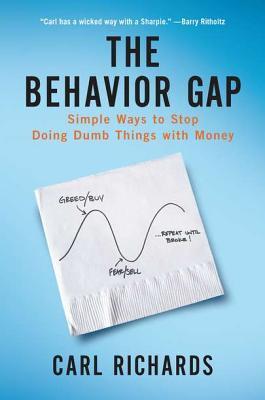
The Behavior Gap: Simple Ways to Stop Doing Dumb Things with Money
by Carl Richards
Rating: 3.7 ⭐
• 1 recommendation ❤️
Why do we lose money? It's easy to blame the economy or the financial markets-but the real trouble lies in the decisions we make.As a financial planner, Carl Richards grew frustrated watching people he cared about make the same mistakes over and over. They were letting emotion get in the way of smart financial decisions. He named this phenomenon-the distance between what we should do and what we actually do-"the behavior gap." Using simple drawings to explain the gap, he found that once people understood it, they started doing much better.Richards's way with words and images has attracted a loyal following to his blog posts for The New York Times, appearances on National Public Radio, and his columns and lectures. His book will teach you how to rethink all kinds of situations where your perfectly natural instincts (for safety or success) can cost you money and peace of mind.He'll help you to:avoid the tendency to buy high and sell low; avoid the pitfalls of generic financial advice; invest all of your assets-time and energy as well as savings-more wisely; quit spending money and time on things that don't matter; identify your real financial goals; start meaningful conversations about money; simplify your financial life; stop losing money!It's never too late to make a fresh financial start. As Richards writes: "We've all made mistakes, but now it's time to give yourself permission to review those mistakes, identify your personal behavior gaps, and make a plan to avoid them in the future. The goal isn't to make the 'perfect' decision about money every time, but to do the best we can and move forward. Most of the time, that's enough."

Empty Mansions: The Mysterious Life of Huguette Clark and the Spending of a Great American Fortune
by Bill Dedman
Rating: 4.0 ⭐
• 5 recommendations ❤️
When Pulitzer Prize–winning journalist Bill Dedman noticed in 2009 a grand home for sale, unoccupied for nearly sixty years, he stumbled through a surprising portal into American history. Empty Mansions is a rich mystery of wealth and loss, connecting the Gilded Age opulence of the nineteenth century with a twenty-first-century battle over a $300 million inheritance. At its heart is a reclusive heiress named Huguette Clark, a woman so secretive that, at the time of her death at age 104, no new photograph of her had been seen in decades. Though she owned palatial homes in California, New York, and Connecticut, why had she lived for twenty years in a simple hospital room, despite being in excellent health? Why were her valuables being sold off? Was she in control of her fortune, or controlled by those managing her money? Dedman has collaborated with Huguette Clark’s cousin, Paul Clark Newell, Jr., one of the few relatives to have frequent conversations with her. Dedman and Newell tell a fairy tale in reverse: the bright, talented daughter, born into a family of extreme wealth and privilege, who secrets herself away from the outside world. Huguette was the daughter of self-made copper industrialist W. A. Clark, nearly as rich as Rockefeller in his day, a controversial senator, railroad builder, and founder of Las Vegas. She grew up in the largest house in New York City, a remarkable dwelling with 121 rooms for a family of four. She owned paintings by Degas and Renoir, a world-renowned Stradivarius violin, a vast collection of antique dolls. But wanting more than treasures, she devoted her wealth to buying gifts for friends and strangers alike, to quietly pursuing her own work as an artist, and to guarding the privacy she valued above all else. The Clark family story spans nearly all of American history in three generations, from a log cabin in Pennsylvania to mining camps in the Montana gold rush, from backdoor politics in Washington to a distress call from an elegant Fifth Avenue apartment. The same Huguette who was touched by the terror attacks of 9/11 held a ticket nine decades earlier for a first-class stateroom on the second voyage of the Titanic. Empty Mansions reveals a complex portrait of the mysterious Huguette and her intimate circle. We meet her extravagant father, her publicity-shy mother, her star-crossed sister, her French boyfriend, her nurse who received more than $30 million in gifts, and the relatives fighting to inherit Huguette’s copper fortune. Richly illustrated with more than seventy photographs, Empty Mansions is an enthralling story of an eccentric of the highest order, a last jewel of the Gilded Age who lived life on her own terms.The No. 1 New York Times bestseller. Best nonfiction books of the year at Goodreads, Amazon.com, and Barnes & Noble. One of the New York Times critic Janet Maslin's 10 favorite books of 2013.

The long-awaited guide to writing long-form nonfiction by the legendary author and teacherDraft No. 4 is a master class on the writer's craft. In a series of playful, expertly wrought essays, John McPhee shares insights he has gathered over his career and has refined while teaching at Princeton University, where he has nurtured some of the most esteemed writers of recent decades. McPhee offers definitive guidance in the decisions regarding arrangement, diction, and tone that shape nonfiction pieces, and he presents extracts from his work, subjecting them to wry scrutiny. In one essay, he considers the delicate art of getting sources to tell you what they might not otherwise reveal. In another, he discusses how to use flashback to place a bear encounter in a travel narrative while observing that "readers are not supposed to notice the structure. It is meant to be about as visible as someone's bones." The result is a vivid depiction of the writing process, from reporting to drafting to revising--and revising, and revising.Draft No. 4 is enriched by multiple diagrams and by personal anecdotes and charming reflections on the life of a writer. McPhee describes his enduring relationships with The New Yorker and Farrar, Straus and Giroux, and recalls his early years at Time magazine. Throughout, Draft No. 4 is enlivened by his keen sense of writing as a way of being in the world.

The Hidden Life of Trees: What They Feel, How They Communicate: Discoveries from a Secret World
by Peter Wohlleben
Rating: 4.1 ⭐
• 8 recommendations ❤️
In The Hidden Life of Trees, Peter Wohlleben shares his deep love of woods and forests and explains the amazing processes of life, death, and regeneration he has observed in the woodland and the amazing scientific processes behind the wonders of which we are blissfully unaware. Much like human families, tree parents live together with their children, communicate with them, and support them as they grow, sharing nutrients with those who are sick or struggling and creating an ecosystem that mitigates the impact of extremes of heat and cold for the whole group. As a result of such interactions, trees in a family or community are protected and can live to be very old. In contrast, solitary trees, like street kids, have a tough time of it and in most cases die much earlier than those in a group. Drawing on groundbreaking new discoveries, Wohlleben presents the science behind the secret and previously unknown life of trees and their communication abilities; he describes how these discoveries have informed his own practices in the forest around him. As he says, a happy forest is a healthy forest, and he believes that eco-friendly practices not only are economically sustainable but also benefit the health of our planet and the mental and physical health of all who live on Earth.

The Subtle Art of Not Giving a F*ck: A Counterintuitive Approach to Living a Good Life
by Mark Manson
Rating: 3.9 ⭐
• 3 recommendations ❤️
New York Times BestsellerIn this generation-defining self-help guide, a superstar blogger cuts through the crap to show us how to stop trying to be "positive" all the time so that we can truly become better, happier people.For decades, we’ve been told that positive thinking is the key to a happy, rich life. "F**k positivity," Mark Manson says. "Let’s be honest, shit is f**ked and we have to live with it." In his wildly popular Internet blog, Manson doesn’t sugarcoat or equivocate. He tells it like it is—a dose of raw, refreshing, honest truth that is sorely lacking today. The Subtle Art of Not Giving a F**k is his antidote to the coddling, let’s-all-feel-good mindset that has infected modern society and spoiled a generation, rewarding them with gold medals just for showing up.Manson makes the argument, backed both by academic research and well-timed poop jokes, that improving our lives hinges not on our ability to turn lemons into lemonade, but on learning to stomach lemons better. Human beings are flawed and limited—"not everybody can be extraordinary, there are winners and losers in society, and some of it is not fair or your fault." Manson advises us to get to know our limitations and accept them. Once we embrace our fears, faults, and uncertainties, once we stop running and avoiding and start confronting painful truths, we can begin to find the courage, perseverance, honesty, responsibility, curiosity, and forgiveness we seek.There are only so many things we can give a f**k about so we need to figure out which ones really matter, Manson makes clear. While money is nice, caring about what you do with your life is better, because true wealth is about experience. A much-needed grab-you-by-the-shoulders-and-look-you-in-the-eye moment of real-talk, filled with entertaining stories and profane, ruthless humor, The Subtle Art of Not Giving a F**k is a refreshing slap for a generation to help them lead contented, grounded lives.

Tao of Charlie Munger: A Compilation of Quotes from Berkshire Hathaway's Vice Chairman on Life, Business, and the Pursuit of Wealth With Commentary by David Clark
by David Clark
Rating: 4.1 ⭐
• 3 recommendations ❤️
Words of wisdom from Charlie Munger—Warren Buffett’s longtime business partner and the visionary Vice Chairman of Berkshire Hathaway—collected and interpreted with an eye towards investing by David Clark, coauthor of the bestselling Buffettology series.Born in Omaha, Nebraska in 1924, Charlie Munger studied mathematics at the University of Michigan, trained as a meteorologist at Cal Tech Pasadena while in the Army, and graduated magna cum laude from Harvard Law School without ever earning an undergraduate degree. Today, Munger is one of America’s most successful investors, the Vice Chairman of Berkshire Hathaway, and Warren Buffett’s business partner for almost forty years. Buffett says “Berkshire has been built to Charlie’s blueprint. My role has been that of general contractor.” Munger is an intelligent, opinionated businessman whose ideas can teach professional and amateur investors how to be successful in finance and life.Like The Tao of Warren Buffett and The Tao of Te Ching, The Tao of Charlie Munger is a compendium of pithy quotes including, “Knowing what you don’t know is more useful than being brilliant” and “In my whole life, I have known no wise people who didn’t read all the time—none, zero.” This collection, culled from interviews, speeches, and questions and answers at the Berkshire Hathaway and Wesco annual meetings, offers insights into Munger’s amazing financial success and life philosophies. Described by Business Insider as “sharp in his wit and investing wisdom,” Charlie Munger’s investment tips, business philosophy, and rules for living are as unique as his life story, intelligent as he clearly is, and as successful as he has been.

A New York Times Bestseller“I’ll be forever changed by Dr. Eger’s story… The Choice is a reminder of what courage looks like in the worst of times and that we all have the ability to pay attention to what we’ve lost, or to pay attention to what we still have.”—Oprah“Dr. Eger’s life reveals our capacity to transcend even the greatest of horrors and to use that suffering for the benefit of others. She has found true freedom and forgiveness and shows us how we can as well.” —Desmond Tutu, Nobel Peace Prize Laureate“Dr. Edith Eva Eger is my kind of hero. She survived unspeakable horrors and brutality; but rather than let her painful past destroy her, she chose to transform it into a powerful gift—one she uses to help others heal.” —Jeannette Walls, New York Times bestselling author of The Glass CastleWinner of the National Jewish Book Award and Christopher AwardAt the age of sixteen, Edith Eger was sent to Auschwitz. Hours after her parents were killed, Nazi officer Dr. Josef Mengele, forced Edie to dance for his amusement and her survival. Edie was pulled from a pile of corpses when the American troops liberated the camps in 1945.Edie spent decades struggling with flashbacks and survivor’s guilt, determined to stay silent and hide from the past. Thirty-five years after the war ended, she returned to Auschwitz and was finally able to fully heal and forgive the one person she’d been unable to forgive—herself.Edie weaves her remarkable personal journey with the moving stories of those she has helped heal. She explores how we can be imprisoned in our own minds and shows us how to find the key to freedom. The Choice is a life-changing book that will provide hope and comfort to generations of readers.

American Moonshot: John F. Kennedy and the Great Space Race
by Douglas Brinkley
Rating: 4.3 ⭐
• 2 recommendations ❤️
Instant New York Times BestsellerAs the fiftieth anniversary of the first lunar landing approaches, the award winning historian and perennial New York Times bestselling author takes a fresh look at the space program, President John F. Kennedy’s inspiring challenge, and America’s race to the moon.“We choose to go to the Moon in this decade and do the other things, not because they are easy, but because they are hard; because that goal will serve to organize and measure the best of our energies and skills, because that challenge is one that we are willing to accept, one we are unwilling to postpone, and one we intend to win.”—President John F. KennedyOn May 25, 1961, JFK made an astonishing announcement: his goal of putting a man on the moon by the end of the decade. In this engrossing, fast-paced epic, Douglas Brinkley returns to the 1960s to recreate one of the most exciting and ambitious achievements in the history of humankind. American Moonshot brings together the extraordinary political, cultural, and scientific factors that fueled the birth and development of NASA and the Mercury, Gemini and Apollo projects, which shot the United States to victory in the space race against the Soviet Union at the height of the Cold War.Drawing on new primary source material and major interviews with many of the surviving figures who were key to America’s success, Brinkley brings this fascinating history to life as never before. American Moonshot is a portrait of the brilliant men and women who made this giant leap possible, the technology that enabled us to propel men beyond earth’s orbit to the moon and return them safely, and the geopolitical tensions that spurred Kennedy to commit himself fully to this audacious dream. Brinkley’s ensemble cast of New Frontier characters include rocketeer Wernher von Braun, astronaut John Glenn and space booster Lyndon Johnson.A vivid and enthralling chronicle of one of the most thrilling, hopeful, and turbulent eras in the nation’s history, American Moonshot is an homage to scientific ingenuity, human curiosity, and the boundless American spirit.

The Molecule of More: How a Single Chemical in Your Brain Drives Love, Sex, and Creativity--and Will Determine the Fate of the Human Race
by Daniel Z. Lieberman
Rating: 4.3 ⭐
• 3 recommendations ❤️
Why are we obsessed with the things we want and bored when we get them? Why is addiction "perfectly logical" to an addict? Why does love change so quickly from passion to indifference? Why are some people diehard liberals and others hardcore conservatives? Why are we always hopeful for solutions even in the darkest times--and so good at figuring them out? The answer is found in a single chemical in your brain: dopamine. Dopamine ensured the survival of early man. Thousands of years later, it is the source of our most basic behaviors and cultural ideas--and progress itself. Dopamine is the chemical of desire that always asks for more--more stuff, more stimulation, and more surprises. In pursuit of these things, it is undeterred by emotion, fear, or morality. Dopamine is the source of our every urge, that little bit of biology that makes an ambitious business professional sacrifice everything in pursuit of success, or that drives a satisfied spouse to risk it all for the thrill of someone new. Simply put, it is why we seek and succeed; it is why we discover and prosper. Yet, at the same time, it's why we gamble and squander. From dopamine's point of view, it's not the having that matters. It's getting something--anything--that's new. From this understanding--the difference between possessing something versus anticipating it--we can understand in a revolutionary new way why we behave as we do in love, business, addiction, politics, religion - and we can even predict those behaviors in ourselves and others. In The Molecule of More: How a Single Chemical in Your Brain Drives Love, Sex, and Creativity--and will Determine the Fate of the Human Race, George Washington University professor and psychiatrist Daniel Z. Lieberman, MD, and Georgetown University lecturer Michael E. Long present a potentially life-changing proposal: Much of human life has an unconsidered component that explains an array of behaviors previously thought to be unrelated, including why winners cheat, why geniuses often suffer with mental illness, why nearly all diets fail, and why the brains of liberals and conservatives really are different.

Atomic Habits: An Easy & Proven Way to Build Good Habits & Break Bad Ones
by James Clear
Rating: 4.4 ⭐
• 9 recommendations ❤️
The instant New York Times bestseller. Over 1 million copies sold! Tiny Changes, Remarkable Results No matter your goals, Atomic Habits offers a proven framework for improving--every day. James Clear, one of the world's leading experts on habit formation, reveals practical strategies that will teach you exactly how to form good habits, break bad ones, and master the tiny behaviors that lead to remarkable results.If you're having trouble changing your habits, the problem isn't you. The problem is your system. Bad habits repeat themselves again and again not because you don't want to change, but because you have the wrong system for change. You do not rise to the level of your goals. You fall to the level of your systems. Here, you'll get a proven system that can take you to new heights.Clear is known for his ability to distill complex topics into simple behaviors that can be easily applied to daily life and work. Here, he draws on the most proven ideas from biology, psychology, and neuroscience to create an easy-to-understand guide for making good habits inevitable and bad habits impossible. Along the way, readers will be inspired and entertained with true stories from Olympic gold medalists, award-winning artists, business leaders, life-saving physicians, and star comedians who have used the science of small habits to master their craft and vault to the top of their field.Learn how to: - make time for new habits (even when life gets crazy); - overcome a lack of motivation and willpower; - design your environment to make success easier; - get back on track when you fall off course;...and much more.Atomic Habits will reshape the way you think about progress and success, and give you the tools and strategies you need to transform your habits--whether you are a team looking to win a championship, an organization hoping to redefine an industry, or simply an individual who wishes to quit smoking, lose weight, reduce stress, or achieve any other goal.
Doing well with money isn't necessarily about what you know. It's about how you behave. And behavior is hard to teach, even to really smart people. Money--investing, personal finance, and business decisions--is typically taught as a math-based field, where data and formulas tell us exactly what to do. But in the real world people don't make financial decisions on a spreadsheet. They make them at the dinner table, or in a meeting room, where personal history, your own unique view of the world, ego, pride, marketing, and odd incentives are scrambled together. In The Psychology of Money, award-winning author Morgan Housel shares 19 short stories exploring the strange ways people think about money and teaches you how to make better sense of one of life's most important topics.

From the two-time Pulitzer Prize-winning author of The Power Broker and The Years of Lyndon Johnson an unprecedented gathering of vivid, candid, deeply revealing recollections about his experiences researching and writing his acclaimed books.Now in paperback, Robert Caro gives us a glimpse into his own life and work in these evocatively written, personal pieces. He describes what it was like to interview the mighty Robert Moses and to begin discovering the extent of the political power Moses wielded; the combination of discouragement and exhilaration he felt confronting the vast holdings of the Lyndon B. Johnson Library in Austin, Texas; his encounters with witnesses, including longtime residents wrenchingly displaced by the construction of Moses' Cross-Bronx Expressway and Lady Bird Johnson acknowledging the beauty and influence of one of LBJ's mistresses. He gratefully remembers how, after years of working in solitude, he found a writers' community at the New York Public Library, and details the ways he goes about planning and composing his books. Caro recalls the moments at which he came to understand that he wanted to write not just about the men who wielded power but about the people and the politics that were shaped by that power. And he talks about the importance to him of the writing itself, of how he tries to infuse it with a sense of place and mood to bring characters and situations to life on the page. Taken together, these reminiscences--some previously published, some written expressly for this book--bring into focus the passion, the wry self-deprecation, and the integrity with which this brilliant historian has always approached his work.

NEW YORK TIMES BESTSELLER • A must-read owner’s manual for every body. Take a head-to-toe tour of the marvel that is the human body in this “delightful, anecdote-propelled read” ( The Boston Globe ) from the author of A Short History of Nearly Everything . With a new Afterword.“You will marvel at the brilliance and vast weirdness of your design." — The Washington Post Bill Bryson once again proves himself to be an incomparable companion as he guides us through the human body—how it functions, its remarkable ability to heal itself, and (unfortunately) the ways it can fail. Full of extraordinary facts (your body made a million red blood cells since you started reading this) and irresistible Brysonesque anecdotes, The Body will lead you to a deeper understanding of the miracle that is life in general and you in particular.As Bill Bryson writes, “We pass our existence within this wobble of flesh and yet take it almost entirely for granted.” The Body will cure that indifference with generous doses of wondrous, compulsively readable facts and information. As addictive as it is comprehensive, this is Bryson at his very best.

The Man Who Solved the Market: How Jim Simons Launched the Quant Revolution
by Gregory Zuckerman
Rating: 4.2 ⭐
• 6 recommendations ❤️
Gregory Zuckerman, the bestselling author of The Greatest Trade Ever and The Frackers, answers the question investors have been asking for decades: How did Jim Simons do it?Shortlisted for the Financial Times/McKinsey Business Book of the Year AwardJim Simons is the greatest money maker in modern financial history. No other investor--Warren Buffett, Peter Lynch, Ray Dalio, Steve Cohen, or George Soros--can touch his record. Since 1988, Renaissance's signature Medallion fund has generated average annual returns of 66 percent. The firm has earned profits of more than $100 billion; Simons is worth twenty-three billion dollars.Drawing on unprecedented access to Simons and dozens of current and former employees, Zuckerman, a veteran Wall Street Journal investigative reporter, tells the gripping story of how a world-class mathematician and former code breaker mastered the market. Simons pioneered a data-driven, algorithmic approach that's sweeping the world.As Renaissance became a market force, its executives began influencing the world beyond finance. Simons became a major figure in scientific research, education, and liberal politics. Senior executive Robert Mercer is more responsible than anyone else for the Trump presidency, placing Steve Bannon in the campaign and funding Trump's victorious 2016 effort. Mercer also impacted the campaign behind Brexit.The Man Who Solved the Market is a portrait of a modern-day Midas who remade markets in his own image, but failed to anticipate how his success would impact his firm and his country. It's also a story of what Simons's revolution means for the rest of us.

Die With Zero: Getting All You Can from Your Money and Your Life
by Bill Perkins
Rating: 4.0 ⭐
• 6 recommendations ❤️
A common-sense guide to living rich . . . instead of dying richImagine if by the time you died, you did everything you were told to. You worked hard, saved your money, and looked forward to financial freedom when you retired. The only thing you wasted along the way was . . . your life. Die with Zero presents a startling new and provocative philosophy as well as practical guide on how to get the most out of your money— and out of your life. It’s intended for those who place lifelong memorable experiences far ahead of simply making and accumulating money for one’s so-called “golden years.” In short, Bill Perkins wants to rescue you from over-saving and under-living. Regardless of your age, Die with Zero will teach you Perkins’s plan for optimizing your life, stage by stage, so you’re fully engaged and enjoying what you’ve worked and saved for. You’ll discover how to maximize your lifetime memorable moments with “time-bucketing,” how to convert your earnings into priceless memories by following your “net worth curve,” and how to navigate decisions about whether to invest in, or delay, a meaningful adventure with your “fulfillment curve” and “personal interest rate.” Using his own life experiences as well as the inspiring stories and cautionary tales of others—and drawing on eye-opening insights about time, money, and happiness from psychological science and behavioral finance—Perkins makes a timely, convincing, and contrarian case for living large.

Bubble in the Sun: The Florida Boom of the 1920s and How It Brought on the Great Depression
by Christopher Knowlton
Rating: 3.9 ⭐
• 4 recommendations ❤️
Christopher Knowlton, author of Cattle Kingdom and former Fortune writer, takes an in-depth look at the spectacular Florida land boom of the 1920s and shows how it led directly to the Great Depression.The 1920s in Florida was a time of incredible excess, immense wealth, and precipitous collapse. The decade there produced the largest human migration in American history, far exceeding the settlement of the West, as millions flocked to the grand hotels and the new cities that rose rapidly from the teeming wetlands. The boom spawned a new subdivision civilization—and the most egregious large-scale assault on the environment in the name of “progress.” Nowhere was the glitz and froth of the Roaring Twenties more excessive than in Florida. Here was Vegas before there was a gambling was condoned and so was drinking, since prohibition was not enforced. Tycoons, crooks, and celebrities arrived en masse to promote or exploit this new and dazzling American frontier in the sunshine. Yet, the import and deep impact of these historical events have never been explored thoroughly until now.In Bubble in the Sun Christopher Knowlton examines the grand artistic and entrepreneurial visions behind Coral Gables, Boca Raton, Miami Beach, and other storied sites, as well as the darker side of the frenzy. For while giant fortunes were being made and lost and the nightlife raged more raucously than anywhere else, the pure beauty of the Everglades suffered wanton ruination and the workers, mostly black, who built and maintained the boom, endured grievous abuses.Knowlton breathes dynamic life into the forces that made and wrecked Florida during the the real estate moguls Carl Fisher, George Merrick, and Addison Mizner, and the once-in-a-century hurricane whose aftermath triggered the stock market crash. This essential account is a revelatory—and riveting—history of an era that still affects our country today.

Vanderbilt: The Rise and Fall of an American Dynasty
by Anderson Cooper
Rating: 3.9 ⭐
• 1 recommendation ❤️
Now in paperback, the #1 New York Times bestselling chronicle of the rise and fall of a legendary American dynasty, from CNN anchor and journalist Anderson Cooper and historian and novelist Katherine Howe.One of the Washington Post's Notable Works of NonfictionWhen eleven-year-old Cornelius Vanderbilt began to work on his father's small boat ferrying supplies in New York Harbor at the beginning of the nineteenth century, no one could have imagined that one day he would, through ruthlessness, cunning, and a pathological desire for money, build two empires--one in shipping and another in railroads--that would make him the richest man in America. His staggering fortune was fought over by his heirs after his death in 1877, sowing familial discord that would never fully heal. Though his son Billy doubled the money left by "the Commodore," subsequent generations competed to find new and ever more extraordinary ways of spending it. By 2018, when the last Vanderbilt was forced out of The Breakers--the seventy-room summer estate in Newport, Rhode Island, that Cornelius's grandson and namesake had built--the family would have been unrecognizable to the tycoon who started it all.Now, the Commodore's great-great-great-grandson Anderson Cooper, joins with historian Katherine Howe to explore the story of his legendary family and their outsized influence. Cooper and Howe breathe life into the ancestors who built the family's empire, basked in the Commodore's wealth, hosted lavish galas, and became synonymous with unfettered American capitalism and high society. Moving from the hardscrabble wharves of old Manhattan to the lavish drawing rooms of Gilded Age Fifth Avenue, from the ornate summer palaces of Newport to the courts of Europe, and all the way to modern-day New York, Cooper and Howe wryly recount the triumphs and tragedies of an American dynasty unlike any other.Written with a unique insider's viewpoint, this is a rollicking, quintessentially American history as remarkable as the family it so vividly captures.

Just Keep Buying: Proven Ways to Save Money and Build Your Wealth
by Nick Maggiulli
Rating: 4.0 ⭐
• 2 recommendations ❤️
Everyone faces big questions when it comes to money: questions about saving, investing, and whether you’re getting it right with your finances.Unfortunately, many of the answers provided by the financial industry have been based on belief and conjecture rather than data and evidence—until now.In Just Keep Buying, hugely popular finance blogger Nick Maggiulli crunches the numbers to answer the biggest questions in personal finance and investing, while providing you with proven ways to build your wealth right away.You will learn why you need to save less than you think; why saving up cash to buy market dips isn’t a good idea; how to survive (and thrive) during a market crash; and much more. By following the strategies revealed here, you can act smarter and live richer each and every day. It’s time to take the next step in your wealth-building journey. It’s time to Just Keep Buying.
From the author of Steve Jobs and other bestselling biographies, this is the astonishingly intimate story of the most fascinating and controversial innovator of our era—a rule-breaking visionary who helped to lead the world into the era of electric vehicles, private space exploration, and artificial intelligence. Oh, and took over Twitter.When Elon Musk was a kid in South Africa, he was regularly beaten by bullies. One day a group pushed him down some concrete steps and kicked him until his face was a swollen ball of flesh. He was in the hospital for a week. But the physical scars were minor compared to the emotional ones inflicted by his father, an engineer, rogue, and charismatic fantasist.His father’s impact on his psyche would linger. He developed into a tough yet vulnerable man-child, prone to abrupt Jekyll-and-Hyde mood swings, with an exceedingly high tolerance for risk, a craving for drama, an epic sense of mission, and a maniacal intensity that was callous and at times destructive.At the beginning of 2022—after a year marked by SpaceX launching thirty-one rockets into orbit, Tesla selling a million cars, and him becoming the richest man on earth—Musk spoke ruefully about his compulsion to stir up dramas. “I need to shift my mindset away from being in crisis mode, which it has been for about fourteen years now, or arguably most of my life,” he said.It was a wistful comment, not a New Year’s resolution. Even as he said it, he was secretly buying up shares of Twitter, the world’s ultimate playground. Over the years, whenever he was in a dark place, his mind went back to being bullied on the playground. Now he had the chance to own the playground.For two years, Isaacson shadowed Musk, attended his meetings, walked his factories with him, and spent hours interviewing him, his family, friends, coworkers, and adversaries. The result is the revealing inside story, filled with amazing tales of triumphs and turmoil, that addresses the are the demons that drive Musk also what it takes to drive innovation and progress?

AN INSTANT NEW YORK TIMES BESTSELLERFrom the author of the international blockbuster, THE PSYCHOLOGY OF MONEY, a powerful new tool to unlock one of life’s most challenging puzzles.Every investment plan under the sun is, at best, an informed speculation of what may happen in the future, based on a systematic extrapolation from the known past.Same as Ever reverses the process, inviting us to identify the many things that never, ever change.With his usual elan, Morgan Housel presents a master class on optimizing risk, seizing opportunity, and living your best life. Through a sequence of engaging stories and pithy examples, he shows how we can use our newfound grasp of the unchanging to see around corners, not by squinting harder through the uncertain landscape of the future, but by looking backwards, being more broad-sighted, and focusing instead on what is permanently true. By doing so, we may better anticipate the big stuff, and achieve the greatest success, not merely financial comforts, but most importantly, a life well lived.