
68 Books Recommended

From the inventor of the PalmPilot comes a new and compelling theory of intelligence, brain function, and the future of intelligent machinesJeff Hawkins, the man who created the PalmPilot, Treo smart phone, and other handheld devices, has reshaped our relationship to computers. Now he stands ready to revolutionize both neuroscience and computing in one stroke, with a new understanding of intelligence itself.Hawkins develops a powerful theory of how the human brain works, explaining why computers are not intelligent and how, based on this new theory, we can finally build intelligent machines.The brain is not a computer, but a memory system that stores experiences in a way that reflects the true structure of the world, remembering sequences of events and their nested relationships and making predictions based on those memories. It is this memory-prediction system that forms the basis of intelligence, perception, creativity, and even consciousness.In an engaging style that will captivate audiences from the merely curious to the professional scientist, Hawkins shows how a clear understanding of how the brain works will make it possible for us to build intelligent machines, in silicon, that will exceed our human ability in surprising ways.Written with acclaimed science writer Sandra Blakeslee, On Intelligence promises to completely transfigure the possibilities of the technology age. It is a landmark book in its scope and clarity.

The Art of the Start: The Time-Tested, Battle-Hardened Guide for Anyone Starting Anything
by Guy Kawasaki
Rating: 3.9 ⭐
• 4 recommendations ❤️
A new product, a new service, a new company, a new division, a new organization, a new anything—where there’s a will, here’s the way. It begins with a dream that just won’t quit, the once-in-a-lifetime thunderbolt of pure inspiration, the obsession, the world-beater, the killer app, the next big thing. Everyone who wants to make the world a better place becomes possessed by a grand idea.But what does it take to turn your idea into action? Whether you are an entrepreneur, intrapreneur, or not-for-profit crusader, there’s no shortage of advice available on issues such as writing a business plan, recruiting, raising capital, and branding. In fact, there are so many books, articles, and Web sites that many startups get bogged down to the point of paralysis. Or else they focus on the wrong priorities and go broke before they discover their mistakes. In The Art of the Start, Guy Kawasaki brings two decades of experience as one of business’s most original and irreverent strategists to offer the essential guide for anyone starting anything, from a multinational corporation to a church group. At Apple in the 1980s, he helped lead one of the great companies of the century, turning ordinary consumers into evangelists. As founder and CEO of Garage Technology Ventures, a venture capital firm, he has field-tested his ideas with dozens of newly hatched companies. And as the author of bestselling business books and articles, he has advised thousands of people who are making their startup dreams real. From raising money to hiring the right people, from defining your positioning to creating a brand, from creating buzz to buzzing the competition, from managing a board to fostering a community, this book will guide you through an adventure that’s more art than science—the art of the start.

Revolution in The Valley: The Insanely Great Story of How the Mac Was Made
by Andy Hertzfeld
Rating: 4.5 ⭐
• 2 recommendations ❤️
There was a time, not too long ago, when the typewriter and notebook ruled, and the computer as an everyday tool was simply a vision. Revolution in the Valley traces this vision back to its earliest roots: the hallways and backrooms of Apple, where the groundbreaking Macintosh computer was born. The book traces the development of the Macintosh, from its inception as an underground skunkworks project in 1979 to its triumphant introduction in 1984 and beyond.The stories in Revolution in the Valley come on extremely good authority. That's because author Andy Hertzfeld was a core member of the team that built the Macintosh system software, and a key creator of the Mac's radically new user interface software. One of the chosen few who worked with the mercurial Steve Jobs, you might call him the ultimate insider.When Revolution in the Valley begins, Hertzfeld is working on Apple's first attempt at a low-cost, consumer-oriented computer: the Apple II. He sees that Steve Jobs is luring some of the company's most brilliant innovators to work on a tiny research effort the Macintosh. Hertzfeld manages to make his way onto the Macintosh research team, and the rest is history.Through lavish illustrations, period photos, and Hertzfeld's vivid first-hand accounts, Revolution in the Valley reveals what it was like to be there at the birth of the personal computer revolution. The story comes to life through the book's portrait of the talented and often eccentric characters who made up the Macintosh team. Now, over 20 years later, millions of people are benefiting from the technical achievements of this determined and brilliant group of people.
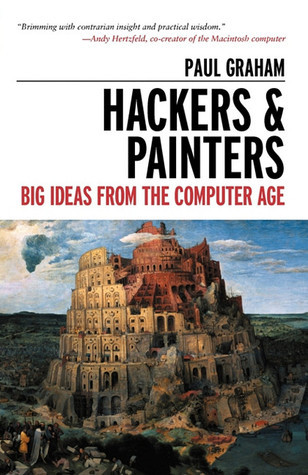
Hackers & Painters: Big Ideas from the Computer Age
by Paul Graham
Rating: 4.2 ⭐
• 14 recommendations ❤️
"The computer world is like an intellectual Wild West, in which you can shoot anyone you wish with your ideas, if you're willing to risk the consequences. " --from Hackers & Big Ideas from the Computer Age , by Paul Graham We are living in the computer age, in a world increasingly designed and engineered by computer programmers and software designers, by people who call themselves hackers. Who are these people, what motivates them, and why should you care? Consider these Everything around us is turning into computers. Your typewriter is gone, replaced by a computer. Your phone has turned into a computer. So has your camera. Soon your TV will. Your car was not only designed on computers, but has more processing power in it than a room-sized mainframe did in 1970. Letters, encyclopedias, newspapers, and even your local store are being replaced by the Internet. Hackers & Big Ideas from the Computer Age , by Paul Graham, explains this world and the motivations of the people who occupy it. In clear, thoughtful prose that draws on illuminating historical examples, Graham takes readers on an unflinching exploration into what he calls "an intellectual Wild West." The ideas discussed in this book will have a powerful and lasting impact on how we think, how we work, how we develop technology, and how we live. Topics include the importance of beauty in software design, how to make wealth, heresy and free speech, the programming language renaissance, the open-source movement, digital design, internet startups, and more.

The Vision of the Anointed: Self-Congratulation as a Basis for Social Policy
by Thomas Sowell
Rating: 4.4 ⭐
• 4 recommendations ❤️
One of America’s pre-eminent economists offers a provocative critique of the failures of liberalismIn The Vision of the Anointed , Thomas Sowell presents a devastating critique of the mind-set behind the failed social policies of the past thirty years. Sowell sees what has happened during that time not as a series of isolated mistakes but as a logical consequence of a tainted vision whose defects have led to crises in education, crime, and family dynamics, and to other social pathologies. In this book, he describes how elites—the anointed—have replaced facts and rational thinking with rhetorical assertions, thereby altering the course of our social policy.

The Innovator's Solution: Creating and Sustaining Successful Growth
by Clayton M. Christensen
Rating: 4.2 ⭐
• 2 recommendations ❤️
A seminal work by bestselling author Clayton M. Christensen, now updated with fresh examples.In the international bestseller The Innovator’s Dilemma, Clayton Christensen exposed the Achilles’ heel of many companies: by ignoring the disruptive technologies that evolve to displace them, they help initiate their own demise. In The Innovator’s Solution, Christensen and Michael Raynor take the idea of disruption one step further—explaining how companies can and should become disruptors themselves.Now with several new chapters and updated cases, this revised and expanded edition shows how timely and relevant these ideas continue to be in today’s hyper-accelerated business environment. Christensen (author of the award-winning Harvard Business Review article, “How Will You Measure Your Life?”), Raynor, and new coauthor Derek van Bever give advice on the business decisions crucial to achieving truly disruptive growth and propose guidelines for developing your own disruptive growth engine.Citing in-depth research and theories tested in hundreds of companies across many industries, The Innovator’s Solution is an important addition to any innovation library and an essential read for entrepreneurs and business builders.Published by Harvard Business Review Press.

The Little Kingdom: The Private Story of Apple Computer
by Michael Moritz
Rating: 4.4 ⭐
• 2 recommendations ❤️
Recounts the eight-year growth of Apple Computer, Inc., from garage workshop to international business leader and spotlights the personalities behind Apple's remarkable successes

Originally published in 1993, this is the story of Steve Jobs’s ambitious attempts after he left Apple in 1985 to create a new company, NeXT Computer. This period was the nadir of Jobs’s professional life, as NeXT’s products failed to find a welcome in the marketplace. The company burned through more than $250 million without managing to eke out a profit. It would eventually be rescued by Apple and Jobs would return there after the close of the book’s narrative. When he did, he took with him lessons learned during his NeXT years in how not to manage a company.

The United States Marine Corps is the largest such force on the planet, and yet it is the smallest, most elite section of the U.S. military, one with a long and storied history. Here, in the most current version of the manual used by the Corps itself, is an explanation of the philosophy that makes the Marine Corps unique-here are the concepts and values behind how the Corps fights. Topics discussed include: . war defined . the science, art, and dynamic of war . war as an act of policy . styles of warfare . professional military education . the philosophy of command . and more. Military buffs, war-gamers, and anyone seeking to understand the increasingly complicated global stage will find this a fascinating and informative document.

Andy Grove: The Life and Times of an American
by Richard S. Tedlow
Rating: 3.9 ⭐
• 4 recommendations ❤️
Traces the life and career of the enigmatic former CEO of Intel, drawing on private papers and interviews with his closest friends and associates to discuss such topics as the persecution he survived as a Jewish Hungarian in the 1930s, his relationships with such figures as Gordon Moore and Robert Noyce, and his management talents.

In this legendary business book and Silicon Valley staple, the former chairman and CEO of Intel shares his perspective on how to build and run a company. A practical handbook for navigating real-life business scenarios and a powerful management manifesto with the ability to revolutionize the way we work. The essential skill of creating and maintaining new businesses—the art of the entrepreneur—can be summed up in a single word: managing. Born of Grove’s experiences at one of America’s leading technology companies (as CEO and employee number three at Intel), High Output Management is equally appropriate for sales managers, accountants, consultants, and teachers, as well as CEOs and startup founders. Grove covers techniques for creating highly productive teams, demonstrating methods of motivation that lead to peak performance. "Generous enough with advice and observations to be required reading." — The Wall Street Journal

The Internet Revolution, like all great industrial changes, has made the world's elephantine media companies tremble that their competitors-whether small and nimble mice or fellow elephants-will get to new terrain first and seize its commanding heights. In a climate in which fear and insecurity are considered healthy emotions, corporate violence becomes commonplace. In the blink of an eye-or the time it has taken slogans such as "The Internet changes everything" to go from hyperbole to banality-"creative destruction" has wracked the global economy on an epic scale.No one has been more powerful or felt more fear or reacted more violently than Bill Gates and Microsoft. Afraid that any number of competitors might outflank them-whether Netscape or Sony or AOL Time Warner or Sun or AT&T or Linux-based companies that champion the open-source movement or some college student hacking in his dorm room-Microsoft has waged holy war on all foes, leveraging its imposing strengths.In World War 3.0 , Ken Auletta chronicles this fierce conflict from the vantage of its most important theater of operations: the devastating second front opened up against Bill Gates's empire by the United States government. The book's narrative spine is United States v. Microsoft, the government's massive civil suit against Microsoft for allegedly stifling competition and innovation on a broad scale. With his superb writerly gifts and extraordinary access to all the principal parties, Ken Auletta crafts this landmark confrontation into a tight, character- and incident-filled courtroom drama featuring the best legal minds of our time, including David Boies and Judge Richard Posner. And with the wisdom gleaned from covering the converging media, software, and communications industries for The New Yorker for the better part of a decade, Auletta uses this pivotal battle to shape a magisterial reckoning with the larger war and the agendas, personalities, and prospects of its many combatants.
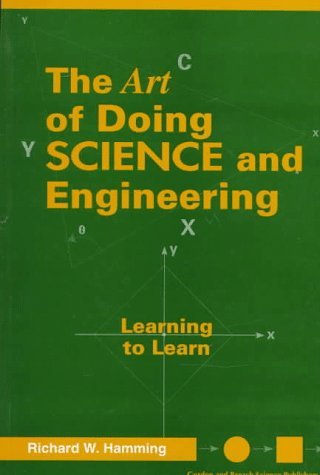
The Art of Doing Science and Engineering: Learning to Learn
by Richard Hamming
Rating: 4.1 ⭐
• 7 recommendations ❤️
Highly effective thinking is an art that engineers and scientists can be taught to develop. By presenting actual experiences and analyzing them as they are described, the author conveys the developmental thought processes employed and shows a style of thinking that leads to successful results is something that can be learned. Along with spectacular successes, the author also conveys how failures contributed to shaping the thought processes.Provides the reader with a style of thinking that will enhance a person's ability to function as a problem-solver of complex technical issues. Consists of a collection of stories about the author's participation in significant discoveries, relating how those discoveries came about and, most importantly, provides analysis about the thought processes and reasoning that took place as the author and his associates progressed through engineering problems.

The City in History: Its Origins, Its Transformations, and Its Prospects
by Lewis Mumford
Rating: 4.1 ⭐
• 4 recommendations ❤️
The city’s development from ancient times to the modern age. Winner of the National Book Award. “One of the major works of scholarship of the twentieth century” (Christian Science Monitor). Index; illustrations.

The Monk and the Riddle: The Art of Creating a Life While Making a Living
by Randy Komisar
Rating: 3.8 ⭐
• 4 recommendations ❤️
What would you be willing to do for the rest of your life? It's a question most of us consider only hypothetically, opting instead to "do what we have to do" to earn a living. But in the critically acclaimed bestseller The Monk and the Riddle, entrepreneurial sage Randy Komisar asks us to answer it for real. The book's timeless advice - to make work pay not just in cash, but in experience, satisfaction, and joy - will be embraced by anyone who wants success to come, not just from what they do, but from who they are. At once a fictional tale of Komisar's encounters with a would-be entrepreneur, and a personal account of how Komisar found meaning not in work's rewards but in work itself, the book illustrates what's wrong with the mainstream thinking that we should sacrifice our lives to make a living. Described by Fortune.com as "part personal essay, part fictional narrative, and part meditation on the nature of work and life," The Monk and the Riddle is essential reading on the art of creating a life while making a living.
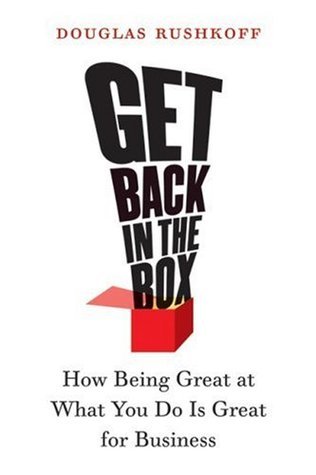
Get Back in the Box: How Being Great at What You Do Is Great for Business
by Douglas Rushkoff
Rating: 4.1 ⭐
• 4 recommendations ❤️
Douglas Rushkoff was one of the first social commentators to identify the new culture around the internet. He has spent nearly a decade advising companies on the ways they can re-orient their businesses to the transformations the internet has caused. Through his speaking and consulting, Rushkoff has discovered an important and unrecognized shift in American business. Too many companies are panicked and operating in survival mode when the worst of the crisis has already passed. Likening the internet transformation to the intellectual and technological ferment of the Enlightment, Rushkoff suggests we have a remarkable opportunity to re-integrate our new perspective with the work we actually do. Instead of running around trying to "think out of the box," Rushkoff demonstrates, now is the time to "get back in the box" and improve the way we do our jobs, run our operations and drive innovation from the ground up. Combining stories gleaned from his consulting with a thrilling tour of history's dramatic moments and clever readings of cultural shift we've just experienced, Rushkoff offers a compelling vision of the simple and effective ways businesses can re-invigorate themselves.

Barbarians at the Gate: The Inside Story of America’s Most Notorious Corporate Takeover
by Bryan Burrough
Rating: 4.4 ⭐
• 10 recommendations ❤️
#1 New York Times bestseller and arguably the best business narrative ever written, Barbarians at the Gate is the classic account of the fall of RJR Nabisco at the hands of a buyout from investment firm KKR. A book that stormed both the bestseller list and the public imagination, a book that created a genre of its own, and a book that gets at the heart of Wall Street and the '80s culture it helped define, Barbarians at the Gate is a modern classic—a masterpiece of investigatory journalism and a rollicking book of corporate derring-do and financial swordsmanship. The fight to control RJR Nabisco during October and November of 1988 was more than just the largest takeover in Wall Street history. Marked by brazen displays of ego not seen in American business for decades, it became the high point of a new gilded age and its repercussions are still being felt. The tale remains the ultimate story of greed and glory—a story and a cast of characters that determined the course of global business and redefined how deals would be done and fortunes made in the decades to come. Barbarians at the Gate is the gripping account of these two frenzied months, of deal makers and publicity flaks, of an old-line industrial powerhouse (home of such familiar products a Oreos and Camels) that became the victim of the ruthless and rapacious style of finance in the 1980s. As reporters for The Wall Street Journal , Burrough and Helyar had extensive access to all the characters in this drama. They take the reader behind the scenes at strategy meetings and society dinners, into boardrooms and bedrooms, providing an unprecedentedly detailed look at how financial operations at the highest levels are conducted but also a richly textured social history of wealth at the twilight of the Reagan era. At the center of the huge power struggle is RJR Nabisco's president, the high-living Ross Johnson. It's his secret plan to buy out the company that sets the frenzy in motion, attracting the country's leading takeover Henry Kravis, the legendary leveraged-buyout king of investment firm KKR, whose entry into the fray sets off an acquisitive commotion; Peter Cohen, CEO of Shearson Lehman Hutton and Johnson's partner, who needs a victory to propel his company to an unchallenged leadership in the lucrative mergers and acquisitions field; the fiercely independent Ted Forstmann, motivated as much by honor as by his rage at the corruption he sees taking over the business he cherishes; Jim Maher and his ragtag team, struggling to regain credibility for the decimated ranks at First Boston; and an army of desperate bankers, lawyers, and accountants, all drawn inexorably to the greatest prize of their careers—and one of the greatest prizes in the history of American business. Written with the bravado of a novel and researched with the diligence of a sweeping cultural history, Barbarians at the Gate is present at the front line of every battle of the campaign. Here is the unforgettable story of that takeover in all its brutality. In a new afterword specially commissioned for the story's 20th anniversary, Burrough and Helyar return to visit the heroes and villains of this epic story, tracing the fallout of the deal, charting the subsequent success and failure of those involved, and addressing the incredible impact this story—and the book itself—made on the world.

Go To: The Story of the Math Majors, Bridge Players, Engineers, Chess Wizards, Maverick Scientists, and Iconoclasts-- the Programmers Who Created the Software Revolution
by Steve Lohr
Rating: 3.7 ⭐
• 2 recommendations ❤️
In Go To , Steve Lohr chronicles the history of software from the early days of complex mathematical codes mastered by a few thousand to today's era of user-friendly software and over six million professional programmers worldwide. Lohr maps out the unique seductions of programming, and gives us an intimate portrait of the peculiar kind of genius that is drawn to this blend of art, science, and engineering, introducing us to the movers and shakers of the 1950s and the open-source movement of today. With original reporting and deft storytelling, Steve Lohr shows us how software transformed the world, and what it holds in store for our future.
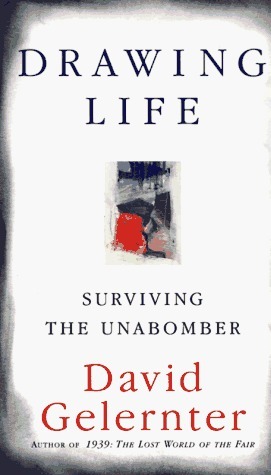
On June 24, 1993, David Gelernter opened a package that exploded, blowing off most of his right hand and damaging his hearing, eyesight, and chest. Ironically, the perpetrator, the technology-phobic "mad genius" we know as the Unabomber, managed to punish one of the very few people who are deeply skeptical about computers and openly critical of technology. Perhaps the greater irony is that the bomb meant to destroy a man's life remade it, and the wounds meant to break his spirit only strengthened it. Now, in this haunting memoir, Gelernter makes a metaphor of himself, seeing in his own near-death and recovery the same disfigurement and promise for American society as a whole. As he ponders his own spiritual condition and the healing power he found in family, religion, community, and art, he critiques the American soul and its devaluing of these very treasures. Instead of teaching and lauding the virtues of courage, critical thinking, and good judgment, Americans have made a media circus out of crime. We are so busy peeking pruriently into the twisted minds of madmen that we have forgotten the acts of violence are not significant because they tickle our bloodlust, but because they force us to rethink our priorities. In a power analysis of the media's response to his experience, for example, Gelernter points out that the Unabomber was described as a "genius, " as "sick, " as "fascinating, " but never as evil. Gelernter asks the chilling question: What does it mean when a culture no longer believes in evil? What happens to a society that has lost its ability to react morally in a crisis? After all, when a man is blown up by a bomb, we should question, not gawk; learn the deeper lessons, not bask in the lurid details. A gripping and poignant narrative as well as a thought-provoking analysis of our culture and where it's headed, Drawing Life is about the resurrection of an extremely thoughtful human being and the extraordinary power of one man's will to live.

The Search: How Google and Its Rivals Rewrote the Rules of Business and Transformed Our Culture
by John Battelle
Rating: 3.9 ⭐
• 4 recommendations ❤️
If you pick your books by their popularity--how many and which other people are reading them--then know this about The Search: it's probably on Bill Gates' reading list, and that of almost every venture capitalist and startup-hungry entrepreneur in Silicon Valley. In its sweeping survey of the history of Internet search technologies, its gossip about and analysis of Google, and its speculation on the larger cultural implications of a Web-connected world, it will likely receive attention from a variety of businesspeople, technology futurists, journalists, and interested observers of mid-2000s zeitgeist. This ambitious book comes with a strong pedigree. Author John Battelle was a founder of The Industry Standard and then one of the original editors of Wired, two magazines which helped shape our early perceptions of the wild world of the Internet. Battelle clearly drew from his experience and contacts in writing The Search. In addition to the sure-handed historical perspective and easy familiarity with such dot-com stalwarts as AltaVista, Lycos, and Excite, he speckles his narrative with conversational asides from a cast of fascinating characters, such Google's founders, Larry Page and Sergey Brin; Yahoo's, Jerry Yang and David Filo; key executives at Microsoft and different VC firms on the famed Sandhill road; and numerous other insiders, particularly at the company which currently sits atop the search world, Google. The Search is not exactly the corporate history of Google. At the book's outset, Battelle specifically indicates his desire to understand what he calls the cultural anthropology of search, and to analyze search engines' current role as the "database of our intentions"--the repository of humanity's curiosity, exploration, and expressed desires. Interesting though that beginning is, though, Battelle's story really picks up speed when he starts dishing inside scoop on the darling business story of the decade, Google. To Battelle's credit, though, he doesn't stop just with historical retrospective: the final part of his book focuses on the potential future directions of Google and its products' development. In what Battelle himself acknowledges might just be a "digital fantasy train", he describes the possibility that Google will become the centralizing platform for our entire lives and quotes one early employee on the weightiness of Google's potential impact: "Sometimes I feel like I am on a bridge, twenty thousand feet up in the air. If I look down I'm afraid I'll fall. I don't feel like I can think about all the implications." Some will shrug at such words; after all, similar hype has accompanied other technologies and other companies before. Many others, though, will search Battelle's story for meaning--and fast. --Peter Han

Architects of the Web: 1,000 Days That Built the Future of Business
by Rob Reid
Rating: 3.8 ⭐
• 2 recommendations ❤️
"A terrific book that captures the explosion of creativity and business evolution at the center of the Internet phenomenon. A tantalizing mix of diverse players with utopian visions, animated by equal parts aggression and delight. A true saga of our time."-James F. Moore author, The Death of Competition; Chairman, Geo Partners Research Inc.Architects of the Web presents the dynamic history of the Web's creation and evolution-as well as its emergence as a dynamic business tool-through revealing profiles of its architects, the brilliant minds who have helped thrust the Web onto desktops and corporate agendas around the world. A diverse, ambitious group, the architects of the Web are:* Marc Andreessen, Netscape* Ariel Poler, I/PRO* Rob Glaser, Progressive Networks Andrew Anker, HotWired* Kim Polese, Marimba* Halsey Minor, C/NET* Mark Pesce, VRML* Jerry Yang, Yahoo!
In the weird glow of the dying millennium, Michael Lewis set out on a safari through Silicon Valley to find the world’s most important technology entrepreneur. He found this in Jim Clark, a man whose achievements include the founding of three separate billion-dollar companies. Lewis also found much more, and the result—the best-selling book The New New Thing—is an ingeniously conceived history of the Internet revolution.
Amusing Ourselves to Death: Public Discourse in the Age of Show Business
by Neil Postman
Rating: 4.2 ⭐
• 13 recommendations ❤️
Television has conditioned us to tolerate visually entertaining material measured out in spoonfuls of time, to the detriment of rational public discourse and reasoned public affairs. In this eloquent, persuasive book, Neil Postman alerts us to the real and present dangers of this state of affairs, and offers compelling suggestions as to how to withstand the media onslaught. Before we hand over politics, education, religion, and journalism to the show business demands of the television age, we must recognize the ways in which the media shape our lives and the ways we can, in turn, shape them to serve out highest goals.

Predictably Irrational: The Hidden Forces That Shape Our Decisions
by Dan Ariely
Rating: 4.1 ⭐
• 9 recommendations ❤️
Why do our headaches persist after we take a one-cent aspirin but disappear when we take a fifty-cent aspirin? Why do we splurge on a lavish meal but cut coupons to save twenty-five cents on a can of soup? When it comes to making decisions in our lives, we think we're making smart, rational choices. But are we? In this newly revised and expanded edition of the groundbreaking New York Times bestseller, Dan Ariely refutes the common assumption that we behave in fundamentally rational ways. From drinking coffee to losing weight, from buying a car to choosing a romantic partner, we consistently overpay, underestimate, and procrastinate. Yet these misguided behaviors are neither random nor senseless. They're systematic and predictable—making us predictably irrational.

Set in the cruel years of Hungary's Nazi occupation and subsequent communist regime, the bestselling "Swimming Across" is the stunning childhood memoir of one of the leading thinkers of our time, legendary Intel chairman, Andrew S. Grove. Photos throughout.

Planet Google: One Company's Audacious Plan to Organize Everything We Know
by Randall E. Stross
Rating: 3.4 ⭐
• 2 recommendations ❤️
"In this spellbinding behind-the-scenes look, S tross leads readers through Google’s evolution…the unfolding narrative reads like a suspense novel" ( Publishers Weekly , starred review).Based on unprecedented access to the "Googleplex," Planet Google goes deep inside the company to unveil the extraordinary scope and scale of its ambition to become the master gate-keeper of "all the world’s information," including its users’ most personal information. New York Times columnist Randall Stross provides a lively tour through Google’s flurry of new information gathering initiatives. Will Google stay true to its famous "Don’t Be Evil" mantra? Will it protect all of the personal information it collects? Planet Google is a much-needed wake-up call about how powerful the Google juggernaut has become.

A leading evolutionary psychologist probes the unconscious instincts behind American consumer cultureIlluminating the hidden reasons for why we buy what we do, Spent applies evolutionary psychology to the sensual wonderland of marketing and perceived status that is American consumer culture. Geoffrey Miller starts with the theory that we purchase things to advertise ourselves to others, and then examines other factors that dictate what we spend money on. With humor and insight, Miller analyzes an array of product choices and deciphers what our decisions say about ourselves, giving us access to a new way of understanding-and improving-our behaviors to become happier consumers.

The Score Takes Care of Itself: My Philosophy of Leadership
by Bill Walsh
Rating: 4.3 ⭐
• 16 recommendations ❤️
The last lecture on leadership by the NFL's greatest coach: Bill Walsh Bill Walsh is a towering figure in the history of the NFL. His advanced leadership transformed the San Francisco 49ers from the worst franchise in sports to a legendary dynasty. In the process, he changed the way football is played.Prior to his death, Walsh granted a series of exclusive interviews to bestselling author Steve Jamison. These became his ultimate lecture on leadership.Additional insights and perspective are provided by Hall of Fame quarterback Joe Montana and others.Bill Walsh taught that the requirements of successful leadership are the same whether you run an NFL franchise, a fortune 500 company, or a hardware store with 12 employees. These final words of 'wisdom by Walsh' will inspire, inform, and enlighten leaders in all professions.

"The fullest account yet of the rise of one of the most profitable, most powerful, and oddest businesses the world has ever seen."- San Francisco ChronicleJust eleven years old, Google has profoundly transformed the way we live and work-we've all been Googled. Esteemed media writer Ken Auletta uses the story of Google's rise to explore the future of media at large. This book is based on the most extensive cooperation ever granted a journalist, including access to closed-door meetings and interviews with industry legends, including Google founders Larry Page and Sergey Brin, Marc Andreessen, and media guru "Coach" Bill Campbell. Auletta's unmatched analysis, vivid details, and rich anecdotes illuminate how the Google wave grew, how it threatens to drown media institutions, and where it's taking us next.

Behind the Cloud: The Untold Story of How Salesforce.com Went from Idea to Billion-Dollar Company-and Revolutionized an Industry
by Marc Benioff
Rating: 3.8 ⭐
• 12 recommendations ❤️
How did salesforce.com grow from a start up in a rented apartment into the world's fastest growing software company in less than a decade? For the first time, Marc Benioff, the visionary founder, chairman and CEO of salesforce.com, tells how he and his team created and used new business, technology, and philanthropic models tailored to this time of extraordinary change. Showing how salesforce.com not only survived the dotcom implosion of 2001, but went on to define itself as the leader of the cloud computing revolution and spark a $46-billion dollar industry, Benioff's story will help business leaders and entrepreneurs stand out, innovate better, and grow faster in any economic climate. In Behind the Cloud , Benioff shares the strategies that have inspired employees, turned customers into evangelists, leveraged an ecosystem of partners, and allowed innovation to flourish.

Trade-Off: Why Some Things Catch On, and Others Don't
by Kevin Maney
Rating: 3.9 ⭐
• 2 recommendations ❤️
A Fresh and Important New Way to Understand Why We BuyWhy did the RAZR ultimately ruin Motorola? Why does Wal-Mart dominate rural and suburban areas but falter in large cities? Why did Starbucks stumble just when it seemed unstoppable?The answer lies in the ever-present tension between fidelity (the quality of a consumer’s experience) and convenience (the ease of getting and paying for a product). In Trade-Off, Kevin Maney shows how these conflicting forces determine the success, or failure, of new products and services in the marketplace. He shows that almost every decision we make as consumers involves a trade-off between fidelity and convenience–between the products we love and the products we need. Rock stars sell out concerts because the experience is high in fidelity-–it can’t be replicated in any other way, and because of that, we are willing to suffer inconvenience for the experience. In contrast, a downloaded MP3 of a song is low in fidelity, but consumers buy music online because it’s superconvenient. Products that are at one extreme or the other–those that are high in fidelity or high in convenience–-tend to be successful. The things that fall into the middle-–products or services that have moderate fidelity and convenience-–fail to win an enthusiastic audience. Using examples from Amazon and Disney to People Express and the invention of the ATM, Maney demonstrates that the most successful companies skew their offerings to either one extreme or the other-–fidelity or convenience-–in shaping products and building brands.From the Hardcover edition.

In his latest bestseller, Atul Gawande shows what the simple idea of the checklist reveals about the complexity of our lives and how we can deal with it. The modern world has given us stupendous know-how. Yet avoidable failures continue to plague us in health care, government, the law, the financial industry—in almost every realm of organized activity. And the reason is the volume and complexity of knowledge today has exceeded our ability as individuals to properly deliver it to people—consistently, correctly, safely. We train longer, specialize more, use ever-advancing technologies, and still we fail. Atul Gawande makes a compelling argument that we can do better, using the simplest of the checklist. In riveting stories, he reveals what checklists can do, what they can’t, and how they could bring about striking improvements in a variety of fields, from medicine and disaster recovery to professions and businesses of all kinds. And the insights are making a difference. Already, a simple surgical checklist from the World Health Organization designed by following the ideas described here has been adopted in more than twenty countries as a standard for care and has been heralded as “the biggest clinical invention in thirty years” ( The Independent ).
Viral Loop: From Facebook to Twitter, How Today's Smartest Businesses Grow Themselves
by Adam L. Penenberg
Rating: 3.7 ⭐
• 6 recommendations ❤️
"Adam Penenberg's lively book opens a window to all of our futures..."--Ken Auletta, author of The End of the World as We Know It "If you want to understand all things viral, this is the place to start. Penenberg's reporting gives us a ringside seat for some of the biggest viral success stories in history, from Tupperware to Ning."--Dan Heath, co-author of Made to Why Some Ideas Survive and Others Die? "One of the most astounding things about the Web age is how the best advertising is often no advertising at all. Penenberg masterfully explains how this works with case studies of products that were designed to spread. Every product can use a dose of this technique; this is the book to get to learn how."--Chris Anderson, author of The Future of a Radical Price "In tight, engaging prose, Adam captures the essence of the ever-scaling power of the virus. It's not just for geeks anymore."--Seth Godin, author of Tribes "Penenberg discovers the perpetual motion machine for business and marketing... Buy this book. Catch a virus. Make a fortune."--Jeff Jarvis "Penenberg has unlocked the secret to the most successful digital businesses. An indispensable read."--Robert Safian, Editor-in-Chief, Fast Company "Instead of entrusting your business to a guru with an agenda and a ghostwriter, you should be turning to a pro journalist like Adam Penenberg, who understands the way media and money interact, has the critical faculty to engage with these phenomena in an unbiased fashion, and the technical facility to explain them to you in an entirely engaging, informative, and actionable way."--Douglas Rushkoff, author of Media Virus and Life How the world became a corporation and how to take it back. Here's something you may not know about today's Internet. Simply by designing your product the right way, you can build a flourishing business from scratch. No advertising or marketing budget, no need for a sales force, and venture capitalists will flock to throw money at you. Many of the most successful Web 2.0 companies, including MySpace, YouTube, eBay, and rising stars like Twitter and Flickr, are prime examples of what journalist Adam L. Penenberg calls a "viral loop"--to use it, you have to spread it. After all, what's the sense of being on Facebook if none of your friends are The Never before has there been the potential to create wealth this fast, on this scale, and starting with so little. In this game-changing must-read, Penenberg tells the fascinating story of the entrepreneurs who first harnessed the unprecedented potential of viral loops to create the successful online businesses--some worth billions of dollars--that we have all grown to rely on. The trick is that they created something people really want, so much so that their customers happily spread the word about their product for them. All kinds of businesses--from the smallest start-ups to nonprofit organizations to the biggest multinational corporations--can use the paradigm-busting power of viral loops to enable their business through technology. Viral Loop is a must-read for any entrepreneur or business interested in uncorking viral loops to benefit their bottom line.

Return to the Little Kingdom: Steve Jobs and the Creation of Apple
by Michael Moritz
Rating: 3.4 ⭐
• 2 recommendations ❤️
Now Moritz revisits his classic biography in light of what Apple has become, offering for the first time in paperback the only from the ground up account of Apple's early years.

The Curse of the Mogul: What's Wrong with the World's Leading Media Companies
by Jonathan A. Knee
Rating: 4.4 ⭐
• 2 recommendations ❤️
If Rupert Murdoch and Sumner Redstone are so smart, why are their stocks long-term losers?We live in the age of big Media, with the celebrity moguls telling us that "content is king." But for all the excitement, glamour, drama, and publicity they produce, why can't these moguls and their companies manage to deliver better returns than you'd get from closing your eyes and throwing a dart? The Curse of the Mogul lays bare the inexcusable financial performance beneath big Media's false veneer of power.By rigorously examining individual media businesses, the authors reveal the difference between judging a company by how many times its CEO is seen in SunValley and by whether it generates consistently superior profits. The book is packed with enough sharp-edged data to bring the most high-flying, hot-air filled mogul balloon crashing down to earth.

Red Star Over the Pacific: China's Rise and the Challenge to U.S. Maritime Strategy
by Toshi Yoshihara
Rating: 4.3 ⭐
• 2 recommendations ❤️
Combining a close knowledge of Asia and an ability to tap Chinese-language sources with naval combat experience and expertise in sea-power theory, the authors assess how the rise of Chinese sea power will affect U.S. maritime strategy in Asia. They argue that China is laying the groundwork for a sustained challenge to American primacy in maritime Asia, and to defend this hypothesis they look back to Alfred Thayer Mahan s sea-power theories, now popular with the Chinese. The book considers how strategic thought about the sea shapes Beijing s deliberations and compares China s geostrategic predicament to that of the Kaiser s Germany a century ago. It examines the Chinese navy s operational concepts, tactics, and capabilities and appraises China s ballistic-missile submarine fleet. The authors conclude that unless Washington adapts, China will present a challenge to America s strategic position.

Cultural Strategy: Using Innovative Ideologies to Build Breakthrough Brands
by Douglas B. Holt
Rating: 4.0 ⭐
• 2 recommendations ❤️
How do we explain the breakthrough market success of businesses like Nike, Starbucks, Ben & Jerry's, and Jack Daniel's? Conventional models of strategy and innovation simply don't work. The most influential ideas on innovation are shaped by the worldview of engineers and economists - build a better mousetrap and the world will take notice. Holt and Cameron challenge this conventional wisdom and take an entirely different champion a better ideology and the world will take notice as well. Holt and Cameron build a powerful new theory of cultural innovation. Brands in mature categories get locked into a form of cultural mimicry, what the authors call a cultural orthodoxy. Historical changes in society create demand for new culture - ideological opportunities that upend this orthodoxy. Cultural innovations repurpose cultural content lurking in subcultures to respond to this emerging demand, leapfrogging entrenched incumbents.Cultural Strategy guides managers and entrepreneurs on how to leverage ideological - How managers can use culture to out-innovate their competitors- How entrepreneurs can identify new market opportunities that big companies miss- How underfunded challengers can win against category Goliaths- How technology businesses can avoid commoditization- How social entrepreneurs can develop businesses that appeal to more than just fellow activists- How subcultural brands can break out of the 'cultural chasm' to mass market success- How global brands can pursue cross-cultural strategies to succeed in local markets- How organizations can maximize their innovation capabilities by avoiding the brand bureaucracy trapWritten by leading authorities on branding in the world today, along with one of the advertising industry's leading visionaries, Cultural Strategy transforms what has always been treated as the "intuitive" side of market innovation into a systematic strategic discipline.

The Method Method: Seven Obsessions That Helped Our Scrappy Start-up Turn an Industry Upside Down
by Eric Ryan
Rating: 4.2 ⭐
• 2 recommendations ❤️
An inspiring case study for the next generation of start-ups by the unconventional founders of Method.Founded ten years ago by childhood pals Eric Ryan and Adam Lowry, Method has been making headlines and profits with a revolutionary blend of culture and commerce, style and substance. Today, Method's ecofriendly soaps, detergents, and cleaners are ubiquitous in stores, capturing valuable shelf space long dominated by the tired old products of giants P&G and Unilever.Ryan and Lowry obsess over seven principles at the heart of Method's business philosophy, *Kick Ass at Use small size to your advantage; by bringing innovations to market faster, you can stay out in front of larger rivals.*Inspire Rather than getting caught up in costly battles for market share, foster deeper relationships with fewer customers in pursuit of greater wallet share.*Win on Product Beyond satisfying your customers' rational needs, design experiences for them.The Method Method is an irreverent, candid, firsthand case study. Readers will learn how today's consumers behave, how today's companies compete, and how both groups are acting together to drive profound global change.
Insanely Simple: The Obsession That Drives Apple's Success
by Ken Segall
Rating: 3.9 ⭐
• 4 recommendations ❤️
Simplicity isn’t just a design principle at Apple—it’s a value that permeates every level of the organization. It’s what helped Apple recover from near death in 1997 to become the most valuable company on earth in 2012. As ad agency creative director, Ken Segall played a key role in Apple’s resurrection, helping to create such critical marketing campaigns as “Think Different” and naming the iMac. This book makes you a fly on the wall inside a conference room with Steve Jobs, and on the receiving end of his midnight phone calls. You’ll understand how his obsession with Simplicity helped Apple perform better and faster, sometimes saving millions in the process. Segall brings Apple’s quest for Simplicity to life using fascinating (and previously untold) stories from behind the scenes. Through his insight and wit, you’ll discover how companies that leverage this power can stand out from competitors—and individuals who master it can become critical assets to their organizations.

A Summer Reading Pick for President Barack Obama, Bill Gates, and Mark Zuckerberg From a renowned historian comes a groundbreaking narrative of humanity’s creation and evolution—a #1 international bestseller—that explores the ways in which biology and history have defined us and enhanced our understanding of what it means to be “human.”One hundred thousand years ago, at least six different species of humans inhabited Earth. Yet today there is only one—homo sapiens. What happened to the others? And what may happen to us?Most books about the history of humanity pursue either a historical or a biological approach, but Dr. Yuval Noah Harari breaks the mold with this highly original book that begins about 70,000 years ago with the appearance of modern cognition. From examining the role evolving humans have played in the global ecosystem to charting the rise of empires, Sapiens integrates history and science to reconsider accepted narratives, connect past developments with contemporary concerns, and examine specific events within the context of larger ideas.Dr. Harari also compels us to look ahead, because over the last few decades humans have begun to bend laws of natural selection that have governed life for the past four billion years. We are acquiring the ability to design not only the world around us, but also ourselves. Where is this leading us, and what do we want to become?Featuring 27 photographs, 6 maps, and 25 illustrations/diagrams.

En toda actividad que desarrollemos los resultados son iguales a las habilidades más la suerte. Hay un componente de previsibilidad y de imprevisibilidad en todo lo que hacemos. El autor busca a través de la ecuación del éxito medir la proporción que la suerte y los elementos imprevisibles tienen en la consecución de un resultado. Si logramos saber esto, podremos analizar con eficiencia la calidad de las acciones que tomamos en relación a los resultados obtenidos. De esta forma podemos adoptar mejores decisiones y mejorar nuestra productividad y el retorno de nuestras inversiones, logrando disminuir considerablemente la importancia de la suerte y demás imprevistos en los resultados obtenidos.

Naked Statistics: Stripping the Dread from the Data
by Charles Wheelan
Rating: 4.0 ⭐
• 2 recommendations ❤️
Once considered tedious, the field of statistics is rapidly evolving into a discipline Hal Varian, chief economist at Google, has actually called “sexy.” From batting averages and political polls to game shows and medical research, the real-world application of statistics continues to grow by leaps and bounds. How can we catch schools that cheat on standardized tests? How does Netflix know which movies you’ll like? What is causing the rising incidence of autism? As best-selling author Charles Wheelan shows us in Naked Statistics, the right data and a few well-chosen statistical tools can help us answer these questions and more.For those who slept through Stats 101, this book is a lifesaver. Wheelan strips away the arcane and technical details and focuses on the underlying intuition that drives statistical analysis. He clarifies key concepts such as inference, correlation, and regression analysis, reveals how biased or careless parties can manipulate or misrepresent data, and shows us how brilliant and creative researchers are exploiting the valuable data from natural experiments to tackle thorny questions.And in Wheelan’s trademark style, there’s not a dull page in sight. You’ll encounter clever Schlitz Beer marketers leveraging basic probability, an International Sausage Festival illuminating the tenets of the central limit theorem, and a head-scratching choice from the famous game show Let’s Make a Deal—and you’ll come away with insights each time. With the wit, accessibility, and sheer fun that turned Naked Economics into a bestseller, Wheelan defies the odds yet again by bringing another essential, formerly unglamorous discipline to life.

Zero to One: Notes on Startups, or How to Build the Future
by Peter Thiel
Rating: 4.2 ⭐
• 48 recommendations ❤️
If you want to build a better future, you must believe in secrets.The great secret of our time is that there are still uncharted frontiers to explore and new inventions to create. In Zero to One, legendary entrepreneur and investor Peter Thiel shows how we can find singular ways to create those new things. Thiel begins with the contrarian premise that we live in an age of technological stagnation, even if we’re too distracted by shiny mobile devices to notice. Information technology has improved rapidly, but there is no reason why progress should be limited to computers or Silicon Valley. Progress can be achieved in any industry or area of business. It comes from the most important skill that every leader must master: learning to think for yourself.Doing what someone else already knows how to do takes the world from 1 to n, adding more of something familiar. But when you do something new, you go from 0 to 1. The next Bill Gates will not build an operating system. The next Larry Page or Sergey Brin won’t make a search engine. Tomorrow’s champions will not win by competing ruthlessly in today’s marketplace. They will escape competition altogether, because their businesses will be unique. Zero to One presents at once an optimistic view of the future of progress in America and a new way of thinking about innovation: it starts by learning to ask the questions that lead you to find value in unexpected places.

The 80/20 Principle and 92 Other Powerful Laws of Nature: The Science of Success
by Richard Koch
Rating: 4.0 ⭐
• 4 recommendations ❤️
In this follow-up to his best-selling The 80/20 Principle, the power law that helped hundreds of thousands achieve more by doing less, Richard Koch puts science to work, applying ninety-two other natural laws to promote the "science of success" within the ever-changing world of business. What does Charles Darwin's theory of natural selection prove about developing a niche product line? How can Isaac Newton's laws of motion and gravity help in a crowded marketplace? This is a must-have book for business leaders looking for clear, evidence-based reasoning that explains why some companies seem to find success everywhere they turn, while others don't make progress.Richard Koch is a British author, speaker, and investor, and a former management consultant and entrepreneur. He has written over twenty books on business and ideas, including The 80/20 Principle about how to apply the Pareto principle in management and life. Koch got an MBA from The Wharton School of the University of Pennsylvania, worked as a consultant at The Boston Consulting Group, and at Bain & Company from 1980 to 1983. In 1983 he co-founded The LEK Partnership, an international strategy consulting firm, with headquarters in London.

The Hard Thing About Hard Things: Building a Business When There Are No Easy Answers―Straight Talk on the Challenges of Entrepreneurship
by Ben Horowitz
Rating: 4.2 ⭐
• 60 recommendations ❤️
A lot of people talk about how great it is to start a business, but only Ben Horowitz is brutally honest about how hard it is to run one.In The Hard Thing About Hard Things, Ben Horowitz, cofounder of Andreessen Horowitz and one of Silicon Valley's most respected and experienced entrepreneurs, draws on his own story of founding, running, selling, buying, managing, and investing in technology companies to offer essential advice and practical wisdom for navigating the toughest problems business schools don't cover. His blog has garnered a devoted following of millions of readers who have come to rely on him to help them run their businesses. A lifelong rap fan, Horowitz amplifies business lessons with lyrics from his favorite songs and tells it straight about everything from firing friends to poaching competitors, from cultivating and sustaining a CEO mentality to knowing the right time to cash in.His advice is grounded in anecdotes from his own hard-earned rise—from cofounding the early cloud service provider Loudcloud to building the phenomenally successful Andreessen Horowitz venture capital firm, both with fellow tech superstar Marc Andreessen (inventor of Mosaic, the Internet's first popular Web browser). This is no polished victory lap; he analyzes issues with no easy answers through his trials, including demoting (or firing) a loyal friend;whether you should incorporate titles and promotions, and how to handle them;if it's OK to hire people from your friend's company; how to manage your own psychology, while the whole company is relying on you; what to do when smart people are bad employees; why Andreessen Horowitz prefers founder CEOs, and how to become one; whether you should sell your company, and how to do it.Filled with Horowitz's trademark humor and straight talk, and drawing from his personal and often humbling experiences, The Hard Thing About Hard Things is invaluable for veteran entrepreneurs as well as those aspiring to their own new ventures.

The Intel Trinity: How Robert Noyce, Gordon Moore, and Andy Grove Built the World's Most Important Company
by Michael S. Malone
Rating: 4.2 ⭐
• 4 recommendations ❤️
Based on unprecedented access to the corporation’s archives, The Intel Trinity is the first full history of Intel Corporation—the essential company of the digital age— told through the lives of the three most important figures in the company’s history: Robert Noyce, Gordon Moore, and Andy Grove.Often hailed the “most important company in the world,” Intel remains, more than four decades after its inception, a defining company of the global digital economy. The legendary inventors of the microprocessor-the single most important product in the modern world-Intel today builds the tiny “engines” that power almost every intelligent electronic device on the planet.But the true story of Intel is the human story of the trio of geniuses behind it. Michael S. Malone reveals how each brought different things to Intel, and at different times. Noyce, the most respected high tech figure of his generation, brought credibility (and money) to the company’s founding; Moore made Intel the world’s technological leader; and Grove, has relentlessly driven the company to ever-higher levels of success and competitiveness. Without any one of these figures, Intel would never have achieved its historic success; with them, Intel made possible the personal computer, Internet, telecommunications, and the personal electronics revolutions.The Intel Trinity is not just the story of Intel’s legendary past; it also offers an analysis of the formidable challenges that lie ahead as the company struggles to maintain its dominance, its culture, and its legacy.With eight pages of black-and-white photos.
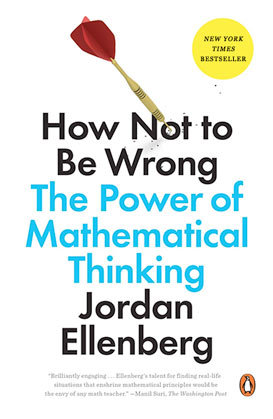
How Not to Be Wrong: The Power of Mathematical Thinking
by Jordan Ellenberg
Rating: 4.0 ⭐
• 6 recommendations ❤️
“Witty, compelling, and just plain fun to read . . ." — Evelyn Lamb, Scientific AmericanThe Freakonomics of math—a math-world superstar unveils the hidden beauty and logic of the world and puts its power in our handsThe math we learn in school can seem like a dull set of rules, laid down by the ancients and not to be questioned. In How Not to Be Wrong , Jordan Ellenberg shows us how terribly limiting this view is: Math isn’t confined to abstract incidents that never occur in real life, but rather touches everything we do—the whole world is shot through with it.Math allows us to see the hidden structures underneath the messy and chaotic surface of our world. It’s a science of not being wrong, hammered out by centuries of hard work and argument. Armed with the tools of mathematics, we can see through to the true meaning of information we take for granted: How early should you get to the airport? What does “public opinion” really represent? Why do tall parents have shorter children? Who really won Florida in 2000? And how likely are you, really, to develop cancer?How Not to Be Wrong presents the surprising revelations behind all of these questions and many more, using the mathematician’s method of analyzing life and exposing the hard-won insights of the academic community to the layman—minus the jargon. Ellenberg chases mathematical threads through a vast range of time and space, from the everyday to the cosmic, encountering, among other things, baseball, Reaganomics, daring lottery schemes, Voltaire, the replicability crisis in psychology, Italian Renaissance painting, artificial languages, the development of non-Euclidean geometry, the coming obesity apocalypse, Antonin Scalia’s views on crime and punishment, the psychology of slime molds, what Facebook can and can’t figure out about you, and the existence of God.Ellenberg pulls from history as well as from the latest theoretical developments to provide those not trained in math with the knowledge they need. Math, as Ellenberg says, is “an atomic-powered prosthesis that you attach to your common sense, vastly multiplying its reach and strength.” With the tools of mathematics in hand, you can understand the world in a deeper, more meaningful way. How Not to Be Wrong will show you how.

Becoming Steve Jobs: The Evolution of a Reckless Upstart into a Visionary Leader
by Brent Schlender
Rating: 4.4 ⭐
• 16 recommendations ❤️
The #1 New York Times bestselling biography of how Steve Jobs became the most visionary CEO in history. Becoming Steve Jobs breaks down the conventional, one-dimensional view of Steve Jobs that he was half-genius, half-jerk from youth, an irascible and selfish leader who slighted friends and family alike. Becoming Steve Jobs answers the central question about the life and career of the Apple cofounder and How did a young man so reckless and arrogant that he was exiled from the company he founded become the most effective visionary business leader of our time, ultimately transforming the daily life of billions of people?Drawing on incredible and sometimes exclusive access, Schlender and Tetzeli tell a different story of a real human being who wrestled with his failings and learned to maximize his strengths over time. Their rich, compelling narrative is filled with stories never told before from the people who knew Jobs best, including his family, former inner circle executives, and top people at Apple, Pixar and Disney, most notably Tim Cook, Jony Ive, Eddy Cue, Ed Catmull, John Lasseter, Robert Iger and many others. In addition, Schlender knew Jobs personally for 25 years and draws upon his many interviews with him, on and off the record, in writing the book. He and Tetzeli humanize the man and explain, rather than simply describe, his behavior. Along the way, the book provides rich context about the technology revolution we've all lived through, and the ways in which Jobs changed our world.A rich and revealing account, Becoming Steve Jobs shows us how one of the most colorful and compelling figures of our times was able to combine his unchanging, relentless passion with an evolution in management style to create one of the most valuable and beloved companies on the planet.

Red Notice: A True Story of High Finance, Murder, and One Man’s Fight for Justice
by Bill Browder
Rating: 4.6 ⭐
• 10 recommendations ❤️
A real-life political thriller about an American financier in the Wild East of Russia, the murder of his principled young tax attorney, and his dangerous mission to expose the Kremlin’s corruption.Bill Browder’s journey started on the South Side of Chicago and moved through Stanford Business School to the dog-eat-dog world of hedge fund investing in the 1990s. It continued in Moscow, where Browder made his fortune heading the largest investment fund in Russia after the Soviet Union’s collapse. But when he exposed the corrupt oligarchs who were robbing the companies in which he was investing, Vladimir Putin turned on him and, in 2005, had him expelled from Russia. In 2007, a group of law enforcement officers raided Browder’s offices in Moscow and stole $230 million of taxes that his fund’s companies had paid to the Russian government. Browder’s attorney Sergei Magnitsky investigated the incident and uncovered a sprawling criminal enterprise. A month after Sergei testified against the officials involved, he was arrested and thrown into pre-trial detention, where he was tortured for a year. On November 16, 2009, he was led to an isolation chamber, handcuffed to a bedrail, and beaten to death by eight guards in full riot gear. Browder glimpsed the heart of darkness, and it transformed his he embarked on an unrelenting quest for justice in Sergei’s name, exposing the towering cover-up that leads right up to Putin. A financial caper, a crime thriller, and a political crusade, Red Notice is the story of one man taking on overpowering odds to change the world

Both Eric Schmidt and Jonathan Rosenberg came to Google as seasoned Silicon Valley business executives, but over the course of a decade they came to see the wisdom in Coach John Wooden's observation that 'it's what you learn after you know it all that counts'. As they helped grow Google from a young start-up to a global icon, they relearned everything they knew about management. How Google Works is the sum of those experiences distilled into a fun, easy-to-read primer on corporate culture, strategy, talent, decision-making, communication, innovation, and dealing with disruption.The authors explain how the confluence of three seismic changes - the internet, mobile, and cloud computing - has shifted the balance of power from companies to consumers. The companies that will thrive in this ever-changing landscape will be the ones that create superior products and attract a new breed of multifaceted employees whom the authors dub 'smart creatives'. The management maxims ('Consensus requires dissension', 'Exile knaves but fight for divas', 'Think 10X, not 10%') are illustrated with previously unreported anecdotes from Google's corporate history.'Back in 2010, Eric and I created an internal class for Google managers,' says Rosenberg. 'The class slides all read 'Google confidential' until an employee suggested we uphold the spirit of openness and share them with the world. This book codifies the recipe for our secret sauce: how Google innovates and how it empowers employees to succeed.'

The Upside of Stress: Why Stress Is Good for You, and How to Get Good at It
by Kelly McGonigal
Rating: 4.1 ⭐
• 4 recommendations ❤️
The author of The Willpower Instinct delivers a controversial and groundbreaking new book that overturns long-held beliefs about stress. More than forty-four percent of Americans admit to losing sleep over stress. And while most of us do everything we can to reduce it, Stanford psychologist and bestselling author Kelly McGonigal, Ph.D., delivers a startling message: Stress isn’t bad. In The Upside of Stress, McGonigal highlights new research indicating that stress can, in fact, make us stronger, smarter, and happier—if we learn how to embrace it. The Upside of Stress is the first book to bring together cutting-edge discoveries on the correlation between resilience—the human capacity for stress-related growth—and mind-set, the power of beliefs to shape reality. As she did in The Willpower Instinct, McGonigal combines science, stories, and exercises into an engaging and practical book that is both entertaining and life-changing, showing you:how to cultivate a mind-set to embrace stresshow stress can provide focus and energyhow stress can help people connect and strengthen close relationshipswhy your brain is built to learn from stress, and how to increase its ability to learn from challenging experiences McGonigal’s TED talk on the subject has already received more than 7 million views. Her message resonates with people who know they can’t eliminate the stress in their lives and want to learn to take advantage of it. The Upside of Stress is not a guide to getting rid of stress, but a guide to getting better at stress, by understanding it, embracing it, and using it.

In this must-read book for anyone striving to succeed, pioneering psychologist Angela Duckworth shows parents, educators, students, and business people both seasoned and new that the secret to outstanding achievement is not talent but a focused persistence called grit.Why do some people succeed and others fail? Sharing new insights from her landmark research on grit, Angela Duckworth explains why talent is hardly a guarantor of success. Rather, other factors can be even more crucial such as identifying our passions and following through on our commitments.Drawing on her own powerful story as the daughter of a scientist who frequently bemoaned her lack of smarts, Duckworth describes her winding path through teaching, business consulting, and neuroscience, which led to the hypothesis that what really drives success is not genius, but a special blend of passion and long-term perseverance. As a professor at the University of Pennsylvania, Duckworth created her own character lab and set out to test her theory.Here, she takes readers into the field to visit teachers working in some of the toughest schools, cadets struggling through their first days at West Point, and young finalists in the National Spelling Bee. She also mines fascinating insights from history and shows what can be gleaned from modern experiments in peak performance. Finally, she shares what she's learned from interviewing dozens of high achievers; from JP Morgan CEO Jamie Dimon to the cartoon editor of The New Yorker to Seattle Seahawks Coach Pete Carroll.Winningly personal, insightful, and even life-changing, Grit is a book about what goes through your head when you fall down, and how that not talent or luck makes all the difference.

The Seventh Sense: Power, Fortune, and Survival in the Age of Networks
by Joshua Cooper Ramo
Rating: 3.6 ⭐
• 6 recommendations ❤️
Endless terror. Refugee waves. An unfixable global economy. Surprising election results. New billion-dollar fortunes. Miracle medical advances. What if they were all connected? What if you could understand why?The Seventh Sense is the story of what all of today's successful figures see and the forces that are invisible to most of us but explain everything from explosive technological change to uneasy political ripples. The secret to power now is understanding our new age of networks. Not merely the Internet, but also webs of trade, finance, and even DNA. Based on his years of advising generals, CEOs, and politicians, Ramo takes us into the opaque heart of our world's rapidly connected systems and teaches us what the losers are not yet seeing -- and what the victors of this age already know.
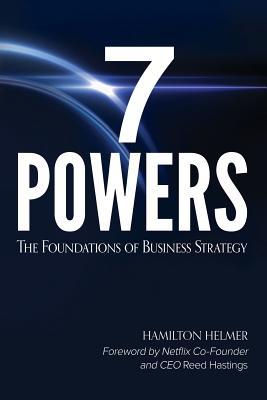
7 Powers: The Foundations of Business Strategy
by Hamilton Wright Helmer
Rating: 4.2 ⭐
• 12 recommendations ❤️
7 Powers breaks fresh ground by constructing a comprehensive strategy toolset that is easy for you to learn, communicate and quickly apply.Drawing on his decades of experience as a business strategy advisor, active equity investor and Stanford University teacher, Hamilton Helmer develops from first principles a practical theory of Strategy rooted in the notion of Power, those conditions which create the potential for persistent differential returns.Using rich real-world examples, Helmer rigorously characterizes exactly what your business must achieve to create Power. And create Power it must, for without it your business is at risk. He explains why invention always comes first and then develops the Power Progression to enable you to target when your Power must be in the origination, take-off or stability phases of your business. Every business faces a do-or-die strategy a crux directional choice made amidst swirling uncertainty. To get this right you need at your fingertips a real-time strategy compass to discern your true north. 7 Powers is that compass.

Life 3.0: Being Human in the Age of Artificial Intelligence
by Max Tegmark
Rating: 3.9 ⭐
• 12 recommendations ❤️
In this authoritative and eye-opening book, Max Tegmark describes and illuminates the recent, path-breaking advances in Artificial Intelligence and how it is poised to overtake human intelligence. How will AI affect crime, war, justice, jobs, society and our very sense of being human? The rise of AI has the potential to transform our future more than any other technology--and there's nobody better qualified or situated to explore that future than Max Tegmark, an MIT professor who's helped mainstream research on how to keep AI beneficial.How can we grow our prosperity through automation without leaving people lacking income or purpose? What career advice should we give today's kids? How can we make future AI systems more robust, so that they do what we want without crashing, malfunctioning or getting hacked? Should we fear an arms race in lethal autonomous weapons? Will machines eventually outsmart us at all tasks, replacing humans on the job market and perhaps altogether? Will AI help life flourish like never before or give us more power than we can handle?What sort of future do you want? This book empowers you to join what may be the most important conversation of our time. It doesn't shy away from the full range of viewpoints or from the most controversial issues--from superintelligence to meaning, consciousness and the ultimate physical limits on life in the cosmos.

Why We Sleep: Unlocking the Power of Sleep and Dreams
by Matthew Walker
Rating: 4.4 ⭐
• 16 recommendations ❤️
“Why We Sleep is an important and fascinating book…Walker taught me a lot about this basic activity that every person on Earth needs. I suspect his book will do the same for you.” —Bill Gates A New York Times bestseller and international sensation, this “stimulating and important book” (Financial Times) is a fascinating dive into the purpose and power of slumber.With two appearances on CBS This Morning and Fresh Air's most popular interview of 2017, Matthew Walker has made abundantly clear that sleep is one of the most important but least understood aspects of our life. Until very recently, science had no answer to the question of why we sleep, or what good it served, or why we suffer such devastating health consequences when it is absent. Compared to the other basic drives in life—eating, drinking, and reproducing—the purpose of sleep remains more elusive. Within the brain, sleep enriches a diversity of functions, including our ability to learn, memorize, and make logical decisions. It recalibrates our emotions, restocks our immune system, fine-tunes our metabolism, and regulates our appetite. Dreaming creates a virtual reality space in which the brain melds past and present knowledge, inspiring creativity. In this “compelling and utterly convincing” (The Sunday Times) book, preeminent neuroscientist and sleep expert Matthew Walker provides a revolutionary exploration of sleep, examining how it affects every aspect of our physical and mental well-being. Charting the most cutting-edge scientific breakthroughs, and marshalling his decades of research and clinical practice, Walker explains how we can harness sleep to improve learning, mood and energy levels, regulate hormones, prevent cancer, Alzheimer’s and diabetes, slow the effects of aging, and increase longevity. He also provides actionable steps towards getting a better night’s sleep every night. Clear-eyed, fascinating, and accessible, Why We Sleep is a crucial and illuminating book. Written with the precision of Atul Gawande, Andrew Solomon, and Sherwin Nuland, it is “recommended for night-table reading in the most pragmatic sense” (The New York Times Book Review).

The narrative of the Silicon Valley generation that launched five major high-tech industries in seven years, laying the foundation for today’s technology-driven world.At a time when the five most valuable companies on the planet are high-tech firms and nearly half of Americans say they cannot live without their cell phones, Troublemakers reveals the untold story of how we got here. This is the gripping tale of seven exceptional men and women, pioneers of Silicon Valley in the 1970s and early 1980s. Together, they worked across generations, industries, and companies to bring technology from Pentagon offices and university laboratories to the rest of us. In doing so, they changed the world. In Troublemakers, historian Leslie Berlin introduces the people and stories behind the birth of the Internet and the microprocessor, as well as Apple, Atari, Genentech, Xerox PARC, ROLM, ASK, and the iconic venture capital firms Sequoia Capital and Kleiner Perkins Caufield & Byers. In the space of only seven years and thirty-five miles, five major industries—personal computing, video games, biotechnology, modern venture capital, and advanced semiconductor logic—were born.During these same years, the first ARPANET transmission came into a Stanford lab, the university began licensing faculty innovations to businesses, and the Silicon Valley tech community began mobilizing to develop the lobbying clout and influence that have become critical components of modern American politics. In other words, these were the years when one of the most powerful pillars of our modern innovation and political systems was first erected.Featured among well-known Silicon Valley innovators like Steve Jobs, Regis McKenna, Larry Ellison, and Don Valentine are Mike Markkula, the underappreciated chairman of Apple who owned one-third of the company; Bob Taylor, who kick-started the Arpanet and masterminded the personal computer; software entrepreneur Sandra Kurtzig, the first woman to take a technology company public; Bob Swanson, the cofounder of Genentech; Al Alcorn, the Atari engineer behind the first wildly successful video game; Fawn Alvarez, who rose from an assembler on a factory line to the executive suite; and Niels Reimers, the Stanford administrator who changed how university innovations reach the public. Together, these troublemakers rewrote the rules and invented the future.

Quirky: The Remarkable Story of the Traits, Foibles, and Genius of Breakthrough Innovators Who Changed the World
by Melissa A. Schilling
Rating: 4.2 ⭐
• 2 recommendations ❤️
The science behind the traits and quirks that drive creative geniuses to make spectacular breakthroughs What really distinguishes the people who literally change the world -- those creative geniuses who give us one breakthrough after another? What differentiates Marie Curie or Elon Musk from the merely creative, the many one-hit wonders among us? Melissa Schilling, one of the world's leading experts on innovation, invites us into the lives of eight people -- Albert Einstein, Benjamin Franklin, Elon Musk, Dean Kamen, Nikola Tesla, Marie Curie, Thomas Edison, and Steve Jobs -- to identify the traits and experiences that drove them to make spectacular breakthroughs, over and over again. While all innovators possess incredible intellect, intellect alone, she shows, does not create a breakthrough innovator. It was their personal, social, and emotional quirkiness that enabled true genius to break through--not just once but again and again. Nearly all of the innovators, for example, exhibited high levels of social detachment that enabled them to break with norms, an almost maniacal faith in their ability to overcome obstacles, and a passionate idealism that pushed them to work with intensity even in the face of criticism or failure. While these individual traits would be unlikely to work in isolation -- being unconventional without having high levels of confidence, effort, and goal directedness might, for example, result in rebellious behavior that does not lead to meaningful outcomes -- together they can fuel both the ability and drive to pursue what others deem impossible. Schilling shares the science behind the convergence of traits that increases the likelihood of success. And, as Schilling also reveals, there is much to learn about nurturing breakthrough innovation in our own lives -- in, for example, the way we run organizations, manage people, and even how we raise our children.

From the New York Times bestselling author of The Black Swan, a bold new work that challenges many of our long-held beliefs about risk and reward, politics and religion, finance and personal responsibility In his most provocative and practical book yet, one of the foremost thinkers of our time redefines what it means to understand the world, succeed in a profession, contribute to a fair and just society, detect nonsense, and influence others. Citing examples ranging from Hammurabi to Seneca, Antaeus the Giant to Donald Trump, Nassim Nicholas Taleb shows how the willingness to accept one’s own risks is an essential attribute of heroes, saints, and flourishing people in all walks of life. As always both accessible and iconoclastic, Taleb challenges long-held beliefs about the values of those who spearhead military interventions, make financial investments, and propagate religious faiths. Among his insights: • For social justice, focus on symmetry and risk sharing. You cannot make profits and transfer the risks to others, as bankers and large corporations do. You cannot get rich without owning your own risk and paying for your own losses. Forcing skin in the game corrects this asymmetry better than thousands of laws and regulations. • Ethical rules aren’t universal. You’re part of a group larger than you, but it’s still smaller than humanity in general. • Minorities, not majorities, run the world. The world is not run by consensus but by stubborn minorities imposing their tastes and ethics on others. • You can be an intellectual yet still be an idiot. “Educated philistines” have been wrong on everything from Stalinism to Iraq to low-carb diets. • Beware of complicated solutions (that someone was paid to find). A simple barbell can build muscle better than expensive new machines. • True religion is commitment, not just faith. How much you believe in something is manifested only by what you’re willing to risk for it.The phrase “skin in the game” is one we have often heard but rarely stopped to truly dissect. It is the backbone of risk management, but it’s also an astonishingly rich worldview that, as Taleb shows in this book, applies to all aspects of our lives. As Taleb says, “The symmetry of skin in the game is a simple rule that’s necessary for fairness and justice, and the ultimate BS-buster,” and “Never trust anyone who doesn’t have skin in the game. Without it, fools and crooks will benefit, and their mistakes will never come back to haunt them.”

The Book of Why: The New Science of Cause and Effect
by Judea Pearl
Rating: 3.9 ⭐
• 6 recommendations ❤️
A Turing Award-winning computer scientist and statistician shows how understanding causality has revolutionized science and will revolutionize artificial intelligence"Correlation is not causation." This mantra, chanted by scientists for more than a century, has led to a virtual prohibition on causal talk. Today, that taboo is dead. The causal revolution, instigated by Judea Pearl and his colleagues, has cut through a century of confusion and established causality -- the study of cause and effect -- on a firm scientific basis. His work explains how we can know easy things, like whether it was rain or a sprinkler that made a sidewalk wet; and how to answer hard questions, like whether a drug cured an illness. Pearl's work enables us to know not just whether one thing causes another: it lets us explore the world that is and the worlds that could have been. It shows us the essence of human thought and key to artificial intelligence. Anyone who wants to understand either needs The Book of Why .

Powerful: Building a Culture of Freedom and Responsibility
by Patty McCord
Rating: 4.0 ⭐
• 6 recommendations ❤️
When it comes to recruiting, motivating, and creating great teams, Patty McCord says most companies have it all wrong. McCord helped create the unique and high-performing culture at Netflix, where she was chief talent officer. In her new book, Powerful: Building a Culture of Freedom and Responsibility, she shares what she learned there and elsewhere in Silicon Valley.McCord advocates practicing radical honesty in the workplace, saying good-bye to employees who don’t fit the company’s emerging needs, and motivating with challenging work, not promises, perks, and bonus plans. McCord argues that the old standbys of corporate HR―annual performance reviews, retention plans, employee empowerment and engagement programs―often end up being a colossal waste of time and resources. Her road-tested advice, offered with humor and irreverence, provides readers a different path for creating a culture of high performance and profitability.Powerful will change how you think about work and the way a business should be run.

Creative Selection: Inside Apple's Design Process During the Golden Age of Steve Jobs
by Ken Kocienda
Rating: 4.0 ⭐
• 4 recommendations ❤️
An insider's account of Apple's creative process during the golden years of Steve Jobs.Hundreds of millions of people use Apple products every day; several thousand work on Apple's campus in Cupertino, California; but only a handful sit at the drawing board. Creative Selection recounts the life of one of the few who worked behind the scenes, a highly-respected software engineer who worked in the final years the Steve Jobs era--the Golden Age of Apple.Ken Kocienda offers an inside look at Apple's creative process. For fifteen years, he was on the ground floor of the company as a specialist, directly responsible for experimenting with novel user interface concepts and writing powerful, easy-to-use software for products including the iPhone, the iPad, and the Safari web browser. His stories explain the symbiotic relationship between software and product development for those who have never dreamed of programming a computer, and reveal what it was like to work on the cutting edge of technology at one of the world's most admired companies.Kocienda shares moments of struggle and success, crisis and collaboration, illuminating each with lessons learned over his Apple career. He introduces the essential elements of innovation--inspiration, collaboration, craft, diligence, decisiveness, taste, and empathy--and uses these as a lens through which to understand productive work culture.An insider's tale of creativity and innovation at Apple, Creative Selection shows readers how a small group of people developed an evolutionary design model, and how they used this methodology to make groundbreaking and intuitive software which countless millions use every day.

The Extended Mind: The Power of Thinking Outside the Brain
by Annie Murphy Paul
Rating: 4.1 ⭐
• 4 recommendations ❤️
A bold new book reveals how we can tap the intelligence that exists beyond our brains—in our bodies, our surroundings, and our relationships.Use your head.That’s what we tell ourselves when facing a tricky problem or a difficult project. But a growing body of research indicates that we’ve got it exactly backwards. What we need to do, says acclaimed science writer Annie Murphy Paul, is think outside the brain. A host of “extra-neural” resources—the feelings and movements of our bodies, the physical spaces in which we learn and work, and the minds of those around us—can help us focus more intently, comprehend more deeply, and create more imaginatively.The Extended Mind outlines the research behind this exciting new vision of human ability, exploring the findings of neuroscientists, cognitive scientists, and psychologists, and examining the practices of educators, managers, and leaders who are already reaping the benefits of thinking outside the brain. She excavates the untold history of how artists, scientists, and authors—from Jackson Pollock to Jonas Salk to Robert Caro—have used mental extensions to solve problems, make discoveries, and create new works. In the tradition of Howard Gardner’s Frames of Mind or Daniel Goleman’s Emotional Intelligence , The Extended Mind offers a dramatic new view of how our minds work, with practical advice on how we can all think better.

Deep Medicine: How Artificial Intelligence Can Make Healthcare Human Again
by Eric J. Topol
Rating: 4.1 ⭐
• 4 recommendations ❤️
A Science Friday pick for book of the year, 2019One of America's top doctors reveals how AI will empower physicians and revolutionize patient care Medicine has become inhuman, to disastrous effect. The doctor-patient relationship--the heart of medicine--is doctors are too distracted and overwhelmed to truly connect with their patients, and medical errors and misdiagnoses abound. In Deep Medicine, leading physician Eric Topol reveals how artificial intelligence can help. AI has the potential to transform everything doctors do, from notetaking and medical scans to diagnosis and treatment, greatly cutting down the cost of medicine and reducing human mortality. By freeing physicians from the tasks that interfere with human connection, AI will create space for the real healing that takes place between a doctor who can listen and a patient who needs to be heard.Innovative, provocative, and hopeful, Deep Medicine shows us how the awesome power of AI can make medicine better, for all the humans involved.

Own it, you've lost everything you claim to hold dear.White is Bret Easton Ellis's first work of nonfiction. Already the bad boy of American literature, from Less Than Zero to American Psycho, Ellis has also earned the wrath of right-thinking people everywhere with his provocations on social media, and here he escalates his admonishment of received truths as expressed by today's version of "the left." Eschewing convention, he embraces views that will make many in literary and media communities cringe, as he takes aim at the relentless anti-Trump fixation, coastal elites, corporate censorship, Hollywood, identity politics, Generation Wuss, "woke" cultural watchdogs, the obfuscation of ideals once both cherished and clear, and the fugue state of American democracy. In a young century marked by hysterical correctness and obsessive fervency on both sides of an aisle that's taken on the scale of the Grand Canyon, White is a clarion call for freedom of speech and artistic freedom. "The central tension in Ellis's art—or his life, for that matter—is that while [his] aesthetic is the cool reserve of his native California, detachment over ideology, he can't stop generating heat.... He's hard-wired to break furniture."—Karen Heller, The Washington Post "Sweating with rage . . . humming with paranoia."—Anna Leszkiewicz, The Guardian "Snowflakes on both coasts in withdrawal from Rachel Maddow's nightly Kremlinology lesson can purchase a whole book to inspire paroxysms of rage . . . a veritable thirst trap for the easily microaggressed. It's all here. Rants about Trump derangement syndrome; MSNBC; #MeToo; safe spaces."—Bari Weiss, The New York Times Look for Bret Easton Ellis’s new novel, The Shards!

An Elegant Defense: The Extraordinary New Science of the Immune System: A Tale in Four Lives
by Matt Richtel
Rating: 4.0 ⭐
• 6 recommendations ❤️
A magnificently reported and soulfully crafted exploration of the human immune system–the key to health and wellness, life and death. An epic, first-of-its-kind book, entwining leading-edge scientific discovery with the intimate stories of four individual lives, by the Pulitzer Prize–winning New York Times journalist.A terminal cancer patient rises from the grave. A medical marvel defies HIV. Two women with autoimmunity discover their own bodies have turned against them. Matt Richtel's An Elegant Defense uniquely entwines these intimate stories with science’s centuries-long quest to unlock the mysteries of sickness and health, and illuminates the immune system as never before.The immune system is our body’s essential defense network, a guardian vigilantly fighting illness, healing wounds, maintaining order and balance, and keeping us alive. Its legion of microscopic foot soldiers—from T cells to “natural killers”—patrols our body, linked by a nearly instantaneous communications grid. It has been honed by evolution over millennia to face an almost infinite array of threats.For all its astonishing complexity, however, the immune system can be easily compromised by fatigue, stress, toxins, advanced age, and poor nutrition—hallmarks of modern life—and even by excessive hygiene. Paradoxically, it is a fragile wonder weapon that can turn on our own bodies with startling results, leading today to epidemic levels of autoimmune disorders.Richtel effortlessly guides readers on a scientific detective tale winding from the Black Plague to twentieth-century breakthroughs in vaccination and antibiotics, to the cutting-edge laboratories that are revolutionizing immunology—perhaps the most extraordinary and consequential medical story of our time. The foundation that Richtel builds makes accessible revelations about cancer immunotherapy, the microbiome, and autoimmune treatments that are changing millions of lives. An Elegant Defense also captures in vivid detail how these powerful therapies, along with our behavior and environment, interact with the immune system, often for the good but always on a razor’s edge that can throw this remarkable system out of balance.Drawing on his groundbreaking reporting for the New York Times and based on extensive new interviews with dozens of world-renowned scientists, Matt Richtel has produced a landmark book, equally an investigation into the deepest riddles of survival and a profoundly human tale that is movingly brought to life through the eyes of his four main characters, each of whom illuminates an essential facet of our “elegant defense.”

Radical Uncertainty: Decision-Making Beyond the Numbers
by John Kay
Rating: 4.1 ⭐
• 2 recommendations ❤️
Some uncertainties are resolvable. The insurance industry’s actuarial tables and the gambler’s roulette wheel both yield to the tools of probability theory. Most situations in life, however, involve a deeper kind of uncertainty, a radical uncertainty for which historical data provide no useful guidance to future outcomes. Radical uncertainty concerns events whose determinants are insufficiently understood for probabilities to be known or forecasting possible. Before President Barack Obama made the fateful decision to send in the Navy Seals, his advisers offered him wildly divergent estimates of the odds that Osama bin Laden would be in the Abbottabad compound. In 2000, no one—not least Steve Jobs—knew what a smartphone was; how could anyone have predicted how many would be sold in 2020? And financial advisers who confidently provide the information required in the standard retirement planning package—what will interest rates, the cost of living, and your state of health be in 2050?—demonstrate only that their advice is worthless.The limits of certainty demonstrate the power of human judgment over artificial intelligence. In most critical decisions there can be no forecasts or probability distributions on which we might sensibly rely. Instead of inventing numbers to fill the gaps in our knowledge, we should adopt business, political, and personal strategies that will be robust to alternative futures and resilient to unpredictable events. Within the security of such a robust and resilient reference narrative, uncertainty can be embraced, because it is the source of creativity, excitement, and profit.

The Splendid and the Vile: A Saga of Churchill, Family, and Defiance During the Blitz
by Erik Larson
Rating: 4.3 ⭐
• 6 recommendations ❤️
"The #1 New York Times bestselling author of The Devil in the White City and Dead Wake delivers a fresh and compelling portrait of Winston Churchill and London during the Blitz. On Winston Churchill's first day as prime minister, Hitler invaded Holland and Belgium. Poland and Czechoslovakia had already fallen, and the Dunkirk evacuation was just two weeks away. For the next twelve months, Hitler would wage a relentless bombing campaign, killing 45,000 Britons. It was up to Churchill to hold the country together and persuade President Franklin Roosevelt that Britain was a worthy ally-and willing to fight to the end. In The Splendid and the Vile, Erik Larson shows, in cinematic detail, how Churchill taught the British people "the art of being fearless." It is a story of political brinkmanship, but it's also an intimate domestic drama set against the backdrop of Churchill's prime-ministerial country home, Chequers; his wartime retreat, Ditchley, where he and his entourage go when the moon is brightest and the bombing threat is highest; and of course 10 Downing Street in London. Drawing on diaries, original archival documents, and once-secret intelligence reports-some released only recently-Larson provides a new lens on London's darkest year through the day-to-day experience of Churchill and his wife, Clementine; their youngest daughter, Mary, who chafes against her parents' wartime protectiveness; their son, Randolph, and his beautiful, unhappy wife, Pamela; Pamela's illicit lover, a dashing American emissary; and the cadre of close advisers who comprised Churchill's "Secret Circle," including his lovestruck private secretary, John Colville; newspaper baron Lord Beaverbrook; and the Rasputin-like Frederick Lindemann. The Splendid and the Vile takes readers out of today's political dysfunction and back to a time of true leadership, when-in the face of unrelenting horror-Churchill's eloquence, courage, and perseverance bound a country, and a family, together."--