
8 Books Recommended
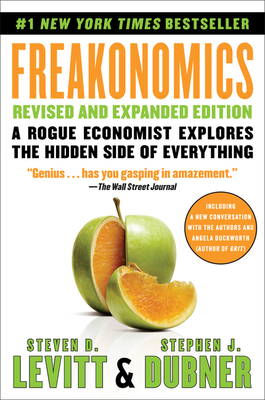
Freakonomics Revised and Expanded Edition: A Rogue Economist Explores the Hidden Side of Everything―A Groundbreaking Exploration of Hidden Incentives, Behavioral Economics, and Unconventional Wisdom
by Steven D. Levitt
Rating: 4.0 ⭐
• 1 recommendation ❤️
The legendary bestseller that made millions look at the world in a radically different way returns in a new edition, now including an exclusive discussion between the authors and bestselling professor of psychology Angela Duckworth.Which is more dangerous, a gun or a swimming pool? Which should be feared more: snakes or french fries? Why do sumo wrestlers cheat? In this groundbreaking book, leading economist Steven Levitt—Professor of Economics at the University of Chicago and winner of the American Economic Association’s John Bates Clark medal for the economist under 40 who has made the greatest contribution to the discipline—reveals that the answers. Joined by acclaimed author and podcast host Stephen J. Dubner, Levitt presents a brilliant—and brilliantly entertaining—account of how incentives of the most hidden sort drive behavior in ways that turn conventional wisdom on its head.

Written in 1759 by Scottish philosopher and political economist Adam Smith, "The Theory of Moral Sentiments" provides much of the foundation for the ideas in his later works, most notably in "The Wealth of Nations." Through this initial text, Smith expresses his general system of morals, exploring the propriety of action, reward and punishment, sense of duty, and the effect of numerous factors on moral sentiment. In so doing, Smith devised innovative theories on virtues, conscience, and moral judgment that are still relevant and accessible today. Though somewhat surprising to find a philosopher of Smith's abilities discussing aspects such as luck and sympathy and how they affect self-image or relationships, "The Theory of Moral Sentiments" never loses its critical excellence in its good-natured understanding of the human exploration for the meaning of being good. This edition is printed on premium acid-free paper and includes an introduction by Herbert W. Schneider.

Billy Beane, general manager of MLB's Oakland A's and protagonist of Michael Lewis's Moneyball, had a problem: how to win in the Major Leagues with a budget that's smaller than that of nearly every other team. Conventional wisdom long held that big name, highly athletic hitters and young pitchers with rocket arms were the ticket to success. But Beane and his staff, buoyed by massive amounts of carefully interpreted statistical data, believed that wins could be had by more affordable methods such as hitters with high on-base percentage and pitchers who get lots of ground outs. Given this information and a tight budget, Beane defied tradition and his own scouting department to build winning teams of young affordable players and inexpensive castoff veterans. Lewis was in the room with the A's top management as they spent the summer of 2002 adding and subtracting players and he provides outstanding play-by-play. In the June player draft, Beane acquired nearly every prospect he coveted (few of whom were coveted by other teams) and at the July trading deadline he engaged in a tense battle of nerves to acquire a lefty reliever. Besides being one of the most insider accounts ever written about baseball, Moneyball is populated with fascinating characters. We meet Jeremy Brown, an overweight college catcher who most teams project to be a 15th round draft pick (Beane takes him in the first). Sidearm pitcher Chad Bradford is plucked from the White Sox triple-A club to be a key set-up man and catcher Scott Hatteberg is rebuilt as a first baseman. But the most interesting character is Beane himself. A speedy athletic can't-miss prospect who somehow missed, Beane reinvents himself as a front-office guru, relying on players completely unlike, say, Billy Beane. Lewis, one of the top nonfiction writers of his era (Liar's Poker, The New New Thing), offers highly accessible explanations of baseball stats and his roadmap of Beane's economic approach makes Moneyball an appealing reading experience for business people and sports fans alike. --John Moe

Bringing Down the House: The Inside Story of Six M.I.T. Students Who Took Vegas for Millions
by Ben Mezrich
Rating: 3.9 ⭐
• 2 recommendations ❤️
The #1 national bestseller, now a major motion picture, 21 —the amazing inside story about a gambling ring of M.I.T. students who beat the system in Vegas—and lived to tell how.Robin Hood meets the Rat Pack when the best and the brightest of M.I.T.’s math students and engineers take up blackjack under the guidance of an eccentric mastermind. Their small blackjack club develops from an experiment in counting cards on M.I.T.’s campus into a ring of card savants with a system for playing large and winning big. In less than two years they take some of the world’s most sophisticated casinos for more than three million dollars. But their success also brings with it the formidable ire of casino owners and launches them into the seedy underworld of corporate Vegas with its private investigators and other violent heavies.

Introduction by Robert ReichCommentary by R. H. Campbell and A. S. Skinner Adam Smith’s masterpiece, first published in 1776, is the foundation of modern economic thought and remains the single most important account of the rise of, and the principles behind, modern capitalism. Written in clear and incisive prose, The Wealth of Nations articulates the concepts indispensable to an understanding of contemporary society; and Robert Reich’s Introduction both clarifies Smith’s analyses and illuminates his overall relevance to the world in which we live. As Reich writes, “Smith’s mind ranged over issues as fresh and topical today as they were in the late eighteenth century—jobs, wages, politics, government, trade, education, business, and ethics.” Includes a Modern Library Reading Group Guide From the Trade Paperback edition.

The must-have Pevear and Volokhonsky translation of one of the greatest Russian novels ever writtenDescribed by William Faulkner as the best novel ever written and by Fyodor Dostoevsky as “flawless,” Anna Karenina tells of the doomed love affair between the sensuous and rebellious Anna and the dashing officer, Count Vronsky. Tragedy unfolds as Anna rejects her passionless marriage and thereby exposes herself to the hypocrisies of society. Set against a vast and richly textured canvas of nineteenth-century Russia, the novel's seven major characters create a dynamic imbalance, playing out the contrasts of city and country life and all the variations on love and family happiness.While previous versions have softened the robust and sometimes shocking qualities of Tolstoy's writing, Pevear and Volokhonsky have produced a translation true to his powerful voice. This authoritative edition, which received the PEN Translation Prize and was an Oprah Book Club™ selection, also includes an illuminating introduction and explanatory notes. Beautiful, vigorous, and eminently readable, this Anna Karenina will be the definitive text for fans of the film and generations to come. This Penguin Classics Deluxe Edition also features French flaps and deckle-edged paper.

Now a SHOWTIME® original series starring Emmy winners Joseph Gordon-Levitt and Kyle Chandler and Academy Award nominee Uma Thurman. Now streaming – Only on SHOWTIME.Named one of the best books of the year by NPR, Fortune , Bloomberg , Sunday TimesA New York Times Book Review Editor’s Choice“If you want to understand modern-day Silicon Valley, you need to read this book.” ―John Carreyrou, New York Times best-selling author of Bad Blood Hailed as the definitive book on Uber and Silicon Valley, Super Pumped is an epic story of ambition and deception, obscene wealth, and bad behavior that explores how blistering technological and financial innovation culminated in one of the most catastrophic twelve-month periods in American corporate history. Backed by billions in venture capital dollars and led by a brash and ambitious founder, Uber promised to revolutionize the way we move people and goods through the world. What followed would become a corporate cautionary tale about the perils of startup culture and a vivid example of how blind worship of startup founders can go wildly wrong.

The Voltage Effect: How to Make Good Ideas Great and Great Ideas Scale
by John A. List
Rating: 3.9 ⭐
• 1 recommendation ❤️
A leading economist answers one of today’s trickiest questions: Why do some great ideas make it big while others fail to take off? “Brilliant, practical, and grounded in the very latest research, this is by far the best book I’ve ever read on the how and why of scaling.”—Angela Duckworth, CEO of Character Lab and New York Times bestselling author of Grit“Scale” has become a favored buzzword in the startup world. But scale isn't just about accumulating more users or capturing more market share. It's about whether an idea that takes hold in a small group can do the same in a much larger one—whether you’re growing a small business, rolling out a diversity and inclusion program, or delivering billions of doses of a vaccine. Translating an idea into widespread impact, says University of Chicago economist John A. List, depends on one thing only: whether it can achieve “high voltage”—the ability to be replicated at scale. In The Voltage Effect, List explains that scalable ideas share a common set of attributes, while any number of attributes can doom an unscalable idea. Drawing on his original research, as well as fascinating examples from the realms of business, policymaking, education, and public health, he identifies five measurable vital signs that a scalable idea must possess, and offers proven strategies for avoiding voltage drops and engineering voltage gains. You’ll learn: • How celebrity chef Jamie Oliver expanded his restaurant empire by focusing on scalable “ingredients” (until it collapsed because talent doesn’t scale) • Why the failure to detect false positives early on caused the Reagan-era drug-prevention program to backfire at scale • How governments could deliver more services to more citizens if they focused on the last dollar spent • How one education center leveraged positive spillovers to narrow the achievement gap across the entire community • Why the right set of incentives, applied at scale, can boost voter turnout, increase clean energy use, encourage patients to consistently take their prescribed medication, and more. By understanding the science of scaling, we can drive change in our schools, workplaces, communities, and society at large. Because a better world can only be built at scale.