
6 Books Recommended

Natural Capitalism: Creating the Next Industrial Revolution
by Paul Hawken
Rating: 4.0 ⭐
• 4 recommendations ❤️
This groundbreaking book reveals how today's global businesses can be both environmentally responsible and highly profitable.

All Marketers Are Liars: The Underground Classic That Explains How Marketing Really Works--and Why Authenticity Is the Best Marketing of All
by Seth Godin
Rating: 3.9 ⭐
• 2 recommendations ❤️
Seth Godin’s three essential questions for every marketer: “What’s your story?” “Will the people who need to hear this story believe it?” “Is it true?” All marketers tell stories. And if they do it right, we believe them. We believe that wine tastes better in a $20 glass than a $1 glass. We believe that an $80,000 Porsche is vastly superior to a $36,000 Volkswagen that’s virtually the same car. We believe that $125 sneakers make our feet feel better—and look cooler—than a $25 brand. And believing it makes it true. As Seth Godin showed in this controversial book, great marketers don’t talk about features or even benefits. Instead, they tell a story—a story we want to believe, whether it’s factual or not. In a world where most people have an infinite number of choices and no time to make them, every organization is a marketer, and all marketing is about telling stories. Marketers succeed when they tell us a story that fits our worldview, a story that we intuitively embrace and then share with our friends. Think of the Dyson vacuum cleaner, or Fiji water, or the iPod. But beware: If your stories are inauthentic, you cross the line from fib to fraud. Marketers fail when they are selfish and scurrilous, when they abuse the tools of their trade and make the world worse. That’s a lesson learned the hard way by telemarketers, cigarette companies, and sleazy politicians. But for the rest of us, it’s time to embrace the power of the story. As Godin writes, “Stories make it easier to understand the world. Stories are the only way we know to spread an idea. Marketers didn’t invent storytelling. They just perfected it.”

Purple Cow: Transform Your Business by Being Remarkable
by Seth Godin
Rating: 4.0 ⭐
• 11 recommendations ❤️
You're either a Purple Cow or you're not. You're either remarkable or invisible. Make your choice. What do Starbucks and JetBlue and KrispyKreme and Apple and DutchBoy and Kensington and Zespri and Hard Candy have that you don't? How do they continue to confound critics and achieve spectacular growth, leaving behind former tried-and true brands to gasp their last? Face it, the checklist of tired 'P's marketers have used for decades to get their product noticed -Pricing, Promotion, Publicity, to name a few-aren't working anymore. There's an exceptionally important 'P' that has to be added to the list. It's Purple Cow. Cows, after you've seen one, or two, or ten, are boring. A Purple Cow, though...now that would be something. Purple Cow describes something phenomenal, something counterintuitive and exciting and flat out unbelievable. Every day, consumers come face to face with a lot of boring stuff-a lot of brown cows-but you can bet they won't forget a Purple Cow. And it's not a marketing function that you can slap on to your product or service. Purple Cow is inherent. It's built right in, or it's not there. Period. In Purple Cow, Seth Godin urges you to put a Purple Cow into everything you build, and everything you do, to create something truly noticeable. It's a manifesto for marketers who want to help create products that are worth marketing in the first place.

Cradle to Cradle: Remaking the Way We Make Things
by William McDonough
Rating: 4.1 ⭐
• 2 recommendations ❤️
"Reduce, reuse, recycle," urge environmentalists; in other words, do more with less in order to minimize damage. But as architect William McDonough and chemist Michael Braungart point out in this provocative, visionary book, such an approach only perpetuates the one-way, "cradle to grave" manufacturing model, dating to the Industrial Revolution, that creates such fantastic amounts of waste and pollution in the first place. Why not challenge the belief that human industry must damage the natural world? In fact, why not take nature itself as our model for making things? A tree produces thousands of blossoms in order to create another tree, yet we consider its abundance not wasteful but safe, beautiful, and highly effective.Waste equals food. Guided by this principle, McDonough and Braungart explain how products can be designed from the outset so that, after their useful lives, they will provide nourishment for something new. They can be conceived as "biological nutrients" that will easily reenter the water or soil without depositing synthetic materials and toxins. Or they can be "technical nutrients" that will continually circulate as pure and valuable materials within closed-loop industrial cycles, rather than being "recycled" -- really, downcycled -- into low-grade materials and uses. Drawing on their experience in (re)designing everything from carpeting to corporate campuses, McDonough and Braungart make an exciting and viable case for putting eco-effectiveness into practice, and show how anyone involved with making anything can begin to do as well.

Teenage Mutant Ninja Turtles: The Ultimate Collection, Vol. 1
by Kevin Eastman
Rating: 4.4 ⭐
• 2 recommendations ❤️
A thorough look back at the TMNT comic book roots with the original stories plus insightful annotations from co-creators Kevin Eastman and Peter Laird .Rediscover the underground roots of Teenage Mutant Ninja Turtles , with this special collection of Mirage Studios' issues #1–7 along with the Raphael one-shot by creators Kevin Eastman and Peter Laird! With over 300 pages of mutated-martial arts action along with annotations following each issue, this volume is perfect for fans to relive the glorious days of the Turtles' origins as well as an excellent place for new readers to see where the TMNT phenomena began.
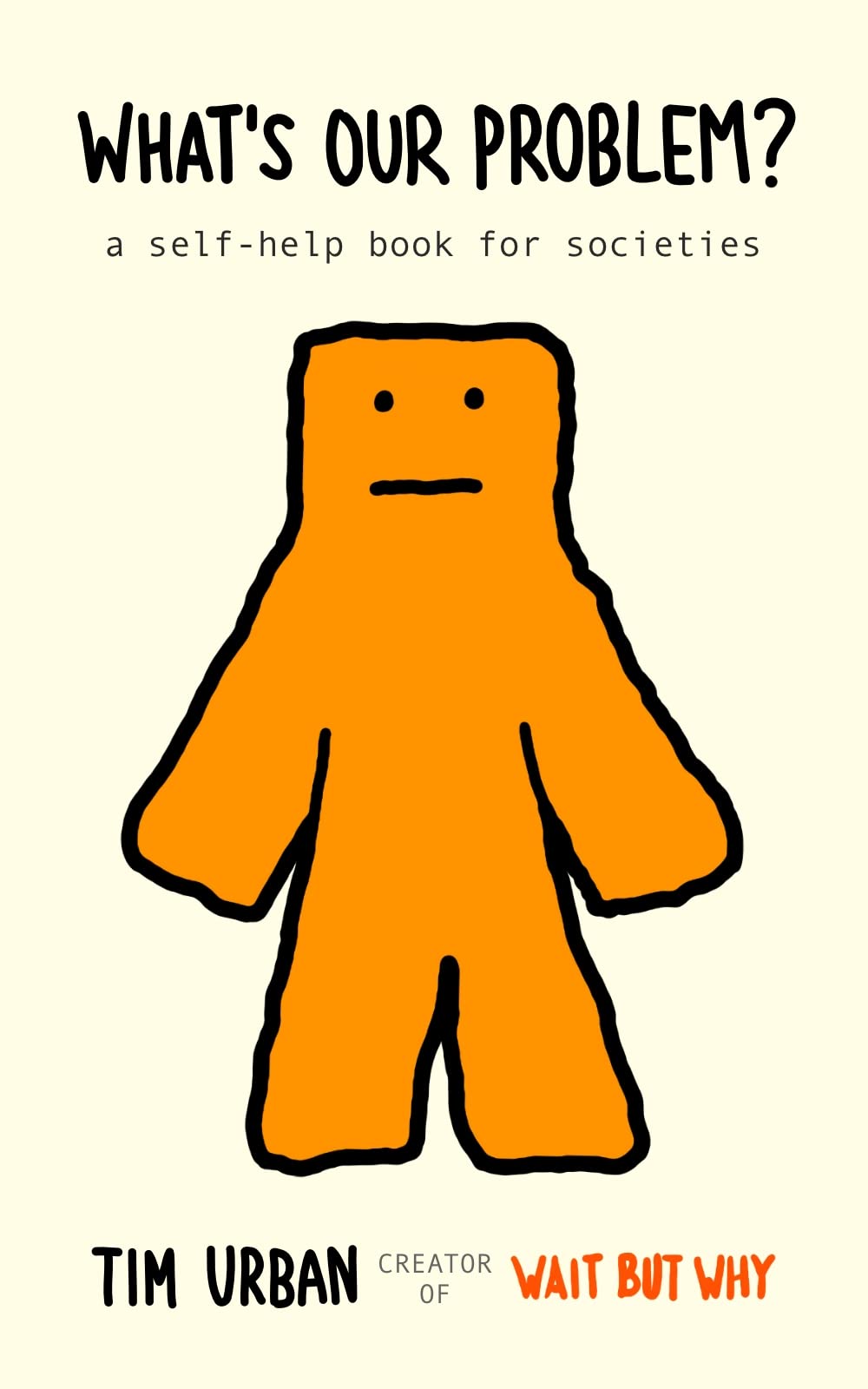
From the creator of the wildly popular blog Wait But Why, a fun and fascinating deep dive into what the hell is going on in our strange, unprecedented modern times.Between 2013 and 2016, Tim Urban became one of the world’s most popular bloggers, writing dozens of viral, long-form articlesabout everything from AI to colonizing Mars to procrastination. Then, he turned his attention to a new topic: the society around him. Why was everything such a mess? Why was everyone acting like such a baby? When did things get so tribal? Why do humans do this stuff?This massive topic sent Tim tumbling down his deepest rabbit hole yet, through mountains of history, evolutionary psychology, political theory, neuroscience, and modern-day political movements, as he tried to figure out the answer to a simple question: What’s our problem?Six years later, he emerged from the hole holding this book. What’s Our Problem? is a deep and expansive analysis of our modern times, in the classic style of Wait But Why, packed with original concepts, sticky metaphors, and 300 drawings. The book provides an entirely new framework and language for thinking and talking about today’s complex world. Instead of focusing on the usual left-center-right horizontal political axis, which is all about what we think, the book introduces a verticalaxis that explores how we think, as individuals and as groups. Readers will find themselves on a delightful and fascinating journey that will ultimately change the way they see the world around them.Anyway he wanted to say a lot more about all of this but there was a word limit on this book description so just go read the book.