
Jeff Atwood Recommended Books
American software developer, author, blogger and entrepreneur
19 Books Recommended
Straight from the programming trenches, The Pragmatic Programmer cuts through the increasing specialization and technicalities of modern software development to examine the core process--taking a requirement and producing working, maintainable code that delights its users. It covers topics ranging from personal responsibility and career development to architectural techniques for keeping your code flexible and easy to adapt and reuse. Read this book, and you'll learn how toFight software rot; Avoid the trap of duplicating knowledge; Write flexible, dynamic, and adaptable code; Avoid programming by coincidence; Bullet-proof your code with contracts, assertions, and exceptions; Capture real requirements; Test ruthlessly and effectively; Delight your users; Build teams of pragmatic programmers; and Make your developments more precise with automation. Written as a series of self-contained sections and filled with entertaining anecdotes, thoughtful examples, and interesting analogies, The Pragmatic Programmer illustrates the best practices and major pitfalls of many different aspects of software development. Whether you're a new coder, an experienced programmer, or a manager responsible for software projects, use these lessons daily, and you'll quickly see improvements in personal productivity, accuracy, and job satisfaction. You'll learn skills and develop habits and attitudes that form the foundation for long-term success in your career. You'll become a Pragmatic Programmer.

Code Complete: A Practical Handbook of Software Construction
by Steve McConnell
Rating: 4.3 ⭐
• 2 recommendations ❤️
Widely considered one of the best practical guides to programming, Steve McConnell’s original code complete has been helping developers write better software for more than a decade. Now this classic book has been fully updated and revised with leading-edge practices—and hundreds of new code samples—illustrating the art and science of software construction. Capturing the body of knowledge available from research, academia, and everyday commercial practice, McConnell synthesizes the most effective techniques and must-know principles into clear, pragmatic guidance. No matter what your experience level, development environment, or project size, this book will inform and stimulate your thinking—and help you build the highest quality code.Discover the timeless techniques and strategies that help you:
Even the smartest among us can feel inept as we fail to figure out which light switch or oven burner to turn on, or whether to push, pull, or slide a door. The fault, argues this ingenious—even liberating—book, lies not in ourselves, but in product design that ignores the needs of users and the principles of cognitive psychology. The problems range from ambiguous and hidden controls to arbitrary relationships between controls and functions, coupled with a lack of feedback or other assistance and unreasonable demands on memorization. The Design of Everyday Things shows that good, usable design is possible. The rules are simple: make things visible, exploit natural relationships that couple function and control, and make intelligent use of constraints. The goal: guide the user effortlessly to the right action on the right control at the right time.In this entertaining and insightful analysis, cognitive scientist Don Norman hails excellence of design as the most important key to regaining the competitive edge in influencing consumer behavior. Now fully expanded and updated, with a new introduction by the author, The Design of Everyday Things is a powerful primer on how—and why—some products satisfy customers while others only frustrate them.

Science and art have in common intense seeing, the wide-eyed observing that generates visual information. Beautiful Evidence is about how seeing turns into showing, how data and evidence turn into explanation. The book identifies excellent and effective methods for showing nearly every kind of information, suggests many new designs (including sparklines), and provides analytical tools for assessing the credibility of evidence presentations (which are seen from both sides: how to produce and how to consume presentations). For alert consumers of presentations, there are chapters on diagnosing evidence corruption and PowerPoint pitches. Beautiful Evidence concludes with two chapters that leave the world of pixel and paper flatland representations - and move onto seeing and thinking in space land, the real-land of three-space and time.

The celebrated design professor here tackles the question of how best to communicate real-life experience in a two-degree format, whether on the printed page or the computer screen. The Whole Earth Review called Envisioning Information a "passionate, elegant revelation."
Visual Explanations: Images and Quantities, Evidence and Narrative
by Edward R. Tufte
Rating: 4.3 ⭐
• 4 recommendations ❤️
Few would disagree: Life in the information age can be overwhelming. Through computers, the Internet, the media, and even our daily newspapers, we are awash in a seemingly endless stream of charts, maps, infographics, diagrams, and data. Visual Explanations is a navigational guide through this turbulent sea of information. The book is an essential reference for anyone involved in graphic, web, or multimedia design, as well as for educators and lecturers who use graphics in presentations or classes.Jacket design: Dmitry Krasny.Other artwork by Bonnie Scranton, Dmitry Krasny, and Weilin Wu.
Users experience the usability of a web site before they have committed to using it and before making any purchase decisions. The web is the ultimate environment for empowerment, and he or she who clicks the mouse decides everything. Designing Web Usability is the definitive guide to usability from Jakob Nielsen, the world's leading authority. Over 250,000 Internet professionals around the world have turned to this landmark book, in which Nielsen shares the full weight of his wisdom and experience. From content and page design to designing for ease of navigation and users with disabilities, he delivers complete direction on how to connect with any web user, in any situation. Nielsen has arrived at a series of principles that work in support of his findings: 1. That web users want to find what they're after quickly; 2. If they don't know what they're after, they nevertheless want to browse quickly and access information they come across in a logical manner. This book is a must-have for anyone who thinks seriously about the web.

The Inmates Are Running the Asylum: Why High Tech Products Drive Us Crazy and How to Restore the Sanity
by Alan Cooper
Rating: 4.1 ⭐
• 6 recommendations ❤️
Technology isn't only the way of the future, but also the way of today. With electronics, computer chips, transmitters, and so on finding their into the most common of household and office environments, most people find that they really don't know very much about the technological advances they use. They need their phones, cameras, computers, and cars to work the way they think - with common sense. Alan Cooper offers up the revelation.

"The first edition of Programming Pearls was one of the most influential books I read early in my career, and many of the insights I first encountered in that book stayed with me long after I read it. Jon has done a wonderful job of updating the material. I am very impressed at how fresh the new examples seem." - Steve McConnell, author, Code CompleteWhen programmers list their favorite books, Jon Bentley's collection of programming pearls is commonly included among the classics. Just as natural pearls grow from grains of sand that irritate oysters, programming pearls have grown from real problems that have irritated real programmers. With origins beyond solid engineering, in the realm of insight and creativity, Bentley's pearls offer unique and clever solutions to those nagging problems. Illustrated by programs designed as much for fun as for instruction, the book is filled with lucid and witty descriptions of practical programming techniques and fundamental design principles. It is not at all surprising that Programming Pearls has been so highly valued by programmers at every level of experience. In this revision, the first in 14 years, Bentley has substantially updated his essays to reflect current programming methods and environments. In addition, there are three new essays on (1) testing, debugging, and timing; (2) set representations; and (3) string problems. All the original programs have been rewritten, and an equal amount of new code has been generated. Implementations of all the programs, in C or C++, are now available on the Web.What remains the same in this new edition is Bentley's focus on the hard core of programming problems and his delivery of workable solutions to those problems. Whether you are new to Bentley's classic or are revisiting his work for some fresh insight, this book is sure to make your own list of favorites.

Peopleware asserts that most software development projects fail because of failures within the team running them. This strikingly clear, direct book is written for software development-team leaders and managers, but it's filled with enough commonsense wisdom to appeal to anyone working in technology. Authors Tom DeMarco and Timothy Lister include plenty of illustrative, often amusing anecdotes; their writing is light, conversational, and filled with equal portions of humor and wisdom, and there is a refreshing absence of "new age" terms and multistep programs. The advice is presented straightforwardly and ranges from simple issues of prioritization to complex ways of engendering harmony and productivity in your team. Peopleware is a short read that delivers more than many books on the subject twice its size.

Rapid Development: Taming Wild Software Schedules
by Steve McConnell
Rating: 4.0 ⭐
• 2 recommendations ❤️
A fundamental software engineering project management guide based on the practical requirements of "Taming Wild Software Schedules". Emphasizes possible, realistic and "best practice" approaches for managers, technical leads and self-managed teams. The author emphasizes efficient development concepts with an examination of rapid development strategies and a study of classic mistakes, within the context of software-development fundamentals and risk management. Dissects the core issues of rapid development, lifecycle planning, estimation and scheduling. Contains very good and practical discussions of customer-oriented development, motivation and teamwork. Explains such fundamental requirements as team structure, feature-set control (the dreaded feature creep in every project), availability and use of productivity tools and project recovery options. Relevant case studies are analyzed and discussed within the context of specific software development problems. Over 200 pages in this publication are devoted to a summary of best practices, everything from the daily build and smoke test, through prototyping, model selection, measurement, reuse, and the top-10 risks list. This publication is definitely recommended and will become a classic in the field, just as the author's prior publication, "Code Complete" already is.

Masters of Doom: How Two Guys Created an Empire and Transformed Pop Culture
by David Kushner
Rating: 4.3 ⭐
• 15 recommendations ❤️
Masters of Doom is the amazing true story of the Lennon and McCartney of video John Carmack and John Romero. Together, they ruled big business. They transformed popular culture. And they provoked a national controversy. More than anything, they lived a unique and rollicking American Dream, escaping the broken homes of their youth to co-create the most notoriously successful game franchises in history—Doom and Quake—until the games they made tore them apart.Americans spend more money on video games than on movie tickets. Masters of Doom is the first book to chronicle this industry’s greatest story, written by one of the medium’s leading observers. David Kushner takes readers inside the rags-to-riches adventure of two rebellious entrepreneurs who came of age to shape a generation. The vivid portrait reveals why their games are so violent and why their immersion in their brilliantly designed fantasy worlds offered them solace. And it shows how they channeled their fury and imagination into products that are a formative influence on our culture, from MTV to the Internet to Columbine. This is a story of friendship and betrayal, commerce and artistry—a powerful and compassionate account of what it’s like to be young, driven, and wildly creative.“To my taste, the greatest American myth of cosmogenesis features the maladjusted, antisocial, genius teenage boy who, in the insular laboratory of his own bedroom, invents the universe from scratch. Masters of Doom is a particularly inspired rendition. Dave Kushner chronicles the saga of video game virtuosi Carmack and Romero with terrific brio. This is a page-turning, mythopoeic cyber-soap opera about two glamorous geek geniuses—and it should be read while scarfing down pepperoni pizza and swilling Diet Coke, with Queens of the Stone Age cranked up all the way.”—Mark Leyner, author of I Smell Esther Williams

The three editions of "About Face" have shaped and evolved the landscape of interaction design, bringing it from the research labs into every day lexicon and development. The fourth edition of this groundbreaking book will be no less game changing.The 4th edition of "About Face "is the most significant revision yet, with a new unique design and 4-color interior, dedicated web site, and classroom ancillaries. The revision takes into account the worldwide shift to smartphones and tablets on the consumer and enterprise level and how designing for these devices is not as easy as just downsizing a website.The new edition includes: Dynamic 4-color interiorUpdates to reflect new thinking in interface, interaction and product design methodsNew content relevant to the popularization of mobile platforms and differing screen sizesEvolving design in platforms such as consumer electronics and other ubiquitous devicesUpdated examples to reflect current state-of-the-art interfaces and up to date case studiesUpdates to Cooper's immensely popular Goal-Directed Design methodologyFull training and classroom materials for corporate trainings or university textsDedicated website created by Cooper to complement the examples and instruction in the book
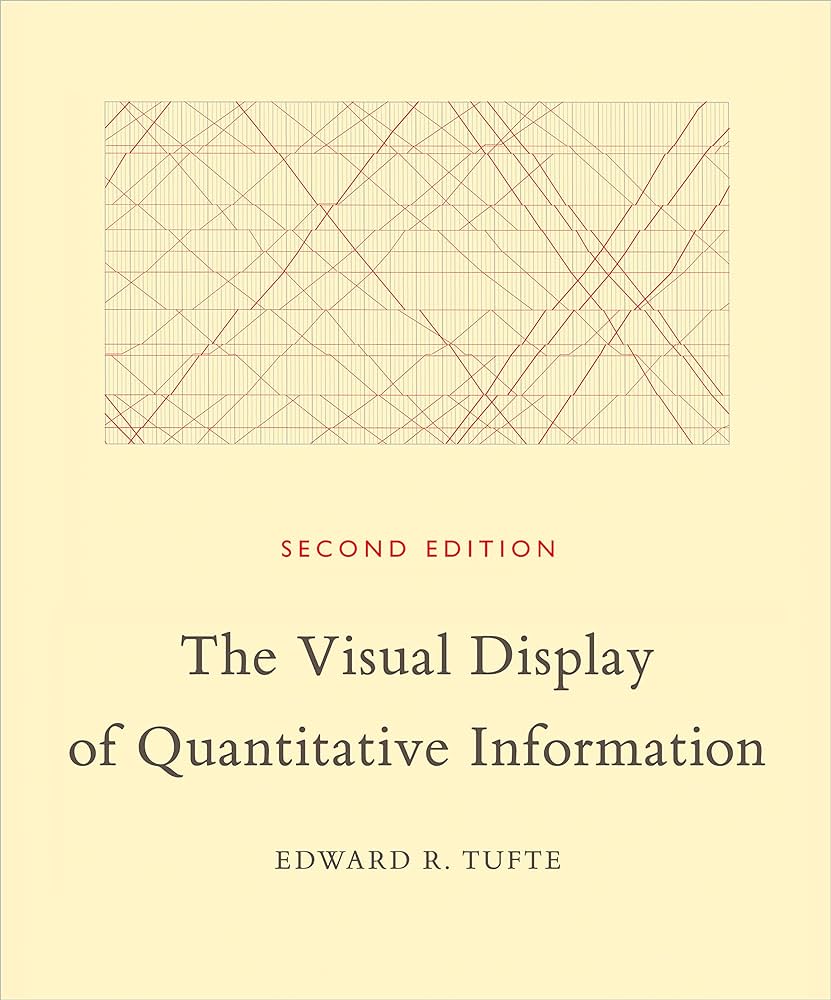
The classic book on statistical graphics, charts, tables. Theory and practice in the design of data graphics, 250 illustrations of the best (and a few of the worst) statistical graphics, with detailed analysis of how to display data for precise, effective, quick analysis. Design of the high-resolution displays, small multiples. Editing and improving graphics. The data-ink ratio. Time-series, relational graphics, data maps, multivariate designs. Detection of graphical deception: design variation vs. data variation. Sources of deception. Aesthetics and data graphical displays. This is the second edition of The Visual Display of Quantitative Information. Recently published, this new edition provides excellent color reproductions of the many graphics of William Playfair, adds color to other images, and includes all the changes and corrections accumulated during 17 printings of the first edition.
Don't Make Me Think, Revisited: A Common Sense Approach to Web Usability
by Steve Krug
Rating: 4.2 ⭐
• 8 recommendations ❤️
Since Don’t Make Me Think was first published in 2000, over 400,000 Web designers and developers have relied on Steve Krug’s guide to help them understand the principles of intuitive navigation and information design.In this 3rd edition, Steve returns with fresh perspective to reexamine the principles that made Don’t Make Me Think a classic-–with updated examples and a new chapter on mobile usability. And it’s still short, profusely illustrated…and best of all–fun to read.If you’ve read it before, you’ll rediscover what made Don’t Make Me Think so essential to Web designers and developers around the world. If you’ve never read it, you’ll see why so many people have said it should be required reading for anyone working on Web sites.
The Mythical Man-Month: Essays on Software Engineering
by Frederick P. Brooks Jr.
Rating: 4.0 ⭐
• 10 recommendations ❤️
Few books on software project management have been as influential and timeless as The Mythical Man-Month. With a blend of software engineering facts and thought-provoking opinions, Fred Brooks offers insight for anyone managing complex projects. These essays draw from his experience as project manager for the IBM System/360 computer family and then for OS/360, its massive software system. Now, 45 years after the initial publication of his book, Brooks has revisited his original ideas and added new thoughts and advice, both for readers already familiar with his work and for readers discovering it for the first time.The added chapters contain (1) a crisp condensation of all the propositions asserted in the original book, including Brooks' central argument in The Mythical Man-Month: that large programming projects suffer management problems different from small ones due to the division of labor; that the conceptual integrity of the product is therefore critical; and that it is difficult but possible to achieve this unity; (2) Brooks' view of these propositions a generation later; (3) a reprint of his classic 1986 paper "No Silver Bullet"; and (4) today's thoughts on the 1986 assertion, "There will be no silver bullet within ten years."

Regular Expressions Cookbook: Detailed Solutions in Eight Programming Languages
by Jan Goyvaerts
Rating: 4.3 ⭐
• 2 recommendations ❤️
Take the guesswork out of using regular expressions. With more than 140 practical recipes, this cookbook provides everything you need to solve a wide range of real-world problems. Novices will learn basic skills and tools, and programmers and experienced users will find a wealth of detail. Each recipe provides samples you can use right away. This revised edition covers the regular expression flavors used by C#, Java, JavaScript, Perl, PHP, Python, Ruby, and VB.NET. You’ll learn powerful new tricks, avoid flavor-specific gotchas, and save valuable time with this huge library of practical solutions.

59 Seconds: Change Your Life in Under a Minute
by Richard Wiseman
Rating: 3.8 ⭐
• 10 recommendations ❤️
A psychologist and best-selling author gives us a myth-busting response to the self-help movement, with tips and tricks to improve your life that come straight from the scientific community.Richard Wiseman has been troubled by the realization that the self-help industry often promotes exercises that destroy motivation, damage relationships, and reduce creativity: the opposite of everything it promises. Now, in 59 Seconds, he fights back, bringing together the diverse scientific advice that can help you change your life in under a minute, and guides you toward becoming more decisive, more imaginative, more engaged, and altogether more happy.From mood to memory, persuasion to procrastination, resilience to relationships, Wiseman outlines the research supporting the new science of “rapid change” and, with clarity and infectious enthusiasm, describes how these quirky, sometimes counterintuitive techniques can be effortlessly incorporated into your everyday life. Or, as he likes to say: “Think a little, change a lot.”

YOUR MIND IS NOW THE ULTIMATE GAMING ENGINE.Top 10 Games You Can Play In Your Head, By Yourself, is a collection of visionary author J. Theophrastus Bartholomew's most cherished mind-games, edited and updated by filmmaker and storyteller Sam Gorski and author D.F. Lovett. No peripherals needed. No controllers. No pens. No dice or boards. Everything you need to experience the forefront of game design is right here between these pages. What is a mind-game? Great Question! A mind-game is a game where you control the characters, the world, and every thing in between - a breathing, living story. A story that you can create on your own, and come back to time after time. A story with surprises that you will plant for yourself to find later, and never be the wiser!What will happen in your game? It's up to you to find out!