14 Books Recommended

Winning the Loser's Game: Timeless Strategies for Successful Investing, Eighth Edition
by Charles D. Ellis
Rating: 4.1 ⭐
• 2 recommendations ❤️
The definitive guide to long-term investing success―fully updated to address the realities of today’s marketsTechnology, information overload, and increasing market dominance by expert investors and computers make it harder than ever to produce investing results that overcome operating costs and fees. Winning the Loser’s Game reveals everything you need to know to reduce costs, fees, and taxes, and focus on long-term policies that are right for you.Candid, short, and super easy to read, Winning the Loser’s Game walks you through the process of developing and implementing a powerful investing strategy that generates solid profits year after year. In this eagerly awaited new edition, Charles D. Ellis applies the expertise developed over his long, illustrious career. This updated edition Companies change, and markets and economies go up and down―sometimes a lot.But the core principles of successful investing never change―and never will. That’s why, when you’ve read this book, you’ll know all you really need to know to be successful in investing.With Winning the Loser’s Game , you have everything you need to identify your unique investment objectives, develop a realistic and powerful investment program, and drive superior results.

Against the Gods: The Remarkable Story of Risk
by Peter L. Bernstein
Rating: 4.0 ⭐
• 8 recommendations ❤️
With the stock market breaking records almost daily, leaving longtime market analysts shaking their heads and revising their forecasts, a study of the concept of risk seems quite timely. Peter Bernstein has written a comprehensive history of man's efforts to understand risk and probability, beginning with early gamblers in ancient Greece, continuing through the 17th-century French mathematicians Pascal and Fermat and up to modern chaos theory. Along the way he demonstrates that understanding risk underlies everything from game theory to bridge-building to winemaking.

Warren Buffett is the most famous investor of all time and one of today's most admired business leaders. He became a billionaire and investment sage by looking at companies as businesses rather than prices on a stock screen. The first two editions of The Warren Buffett Way gave investors their first in-depth look at the innovative investment and business strategies behind Buffett's spectacular success. The new edition updates readers on the latest investments by Buffett. And, more importantly, it draws on the new field of behavioral finance to explain how investors can overcome the common obstacles that prevent them from investing like Buffett. New material includes:How to think like a long-term investor - just like Buffett Why "loss aversion," the tendency of most investors to overweight the pain of losing money, is one of the biggest obstacles that investors must overcome. Why behaving rationally in the face of the ups and downs of the market has been the key to Buffett's investing success Analysis of Buffett's recent acquisition of H.J. Heinz and his investment in IBM stock The greatest challenge to emulating Buffett is not in the selection of the right stocks, Hagstrom writes, but in having the fortitude to stick with sound investments in the face of economic and market uncertainty. The new edition explains the psychological foundations of Buffett's approach, thus giving readers the best roadmap yet for mastering both the principles and behaviors that have made Buffett the greatest investor of our generation.

Bringing Down the House: The Inside Story of Six M.I.T. Students Who Took Vegas for Millions
by Ben Mezrich
Rating: 4.0 ⭐
• 3 recommendations ❤️
It's Friday night and you're on a red-eye to the city of sin. Strapped to your chest is half a million dollars; in your overnight bag is another twenty-five thousand in blackjack chips; and your wallet holds ten fake IDs. As soon as you land in Las Vegas, you are positive you are being investigated and followed. To top it all off, the IRS is auditing you, someone has been going through your mail -- and you have a multivariable calculus exam on Monday morning. Welcome to the world of an exclusive group of audacious MIT math geniuses who legally took the casinos for over three million dollars -- while still finding time for college keg parties, football games, and final exams. In the midst of the go-go eighties and nineties, a group of overachieving, anarchistic MIT students joined a decades-old underground blackjack club dedicated to counting cards and beating the system at major casinos around the world. While their classmates were working long hours in labs and libraries, the blackjack team traveled weekly to Las Vegas and other glamorous gambling locales, with hundreds of thousands of dollars duct-taped to their bodies. Underwritten by shady investors they would never meet, these kids bet fifty thousand dollars a hand, enjoyed VIP suites and other upscale treats, and partied with showgirls and celebrities. Handpicked by an eccentric mastermind -- a former MIT professor and an obsessive player who had developed a unique system of verbal cues, body signals, and role-playing -- this one ring of card savants earned more than three million dollars from corporate Vegas, making them the object of the casinos' wrath and eventually targets of revenge. Here is their inside story, revealing their secrets for the first time. Master storyteller Ben Mezrich takes you from the ivory towers of academia to the Technicolor world of Las Vegas, where anything can happen -- and often does. Bringing Down the House launches you into the seedy underworld of corporate Vegas -- deep into the realm of back rooms, ever-present video cameras, private investigators, and the threats and tactics of pit bosses and violent heavies. Equipped with twenty different aliases and disguises, the group of young card counters struggles around these roadblocks to live the high life -- until one fateful day when Vegas violently follows them home to Boston. Suddenly, there can be no more hiding behind false identities; the high life folds like a bad hand of cards. Filled with tense action and incredibly close calls, Bringing Down the House is a real-life mix of Liar's Poker and Ocean's Eleven -- and it's a story Vegas doesn't want you to read.

The world-renowned economist offers "dourly irreverent analyses of financial debacle from the tulip craze of the seventeenth century to the recent plague of junk bonds." — The Atlantic .With incomparable wisdom, skill, and wit, world-renowned economist John Kenneth Galbraith traces the history of the major speculative episodes in our economy over the last three centuries. Exposing the ways in which normally sane people display reckless behavior in pursuit of profit, Galbraith asserts that our "notoriously short" financial memory is what creates the conditions for market collapse. By recognizing these signs and understanding what causes them we can guard against future recessions and have a better hold on our country's (and our own) financial destiny.
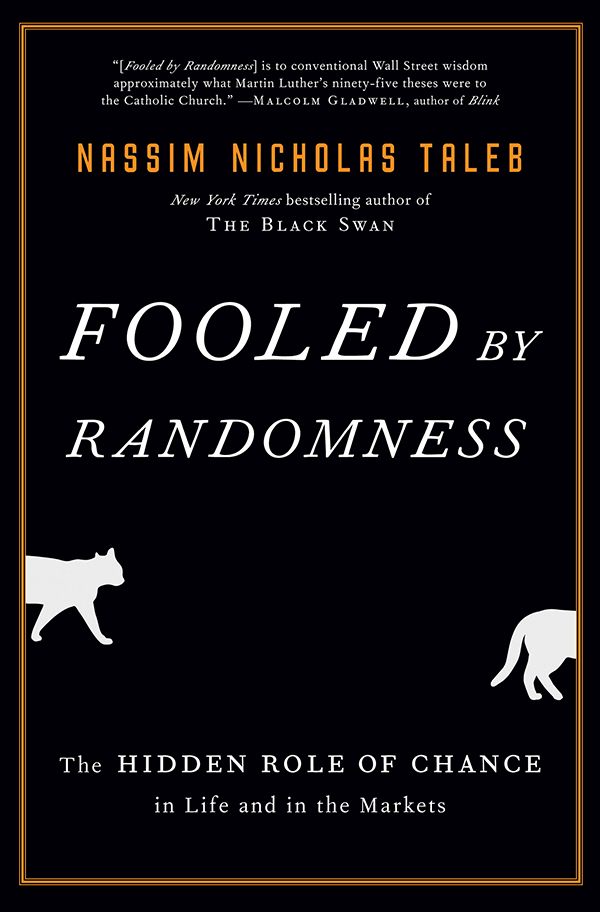
Fooled by Randomness: The Hidden Role of Chance in Life and in the Markets
by Nassim Nicholas Taleb
Rating: 4.1 ⭐
• 3 recommendations ❤️
Fooled by Randomness is a standalone book in Nassim Nicholas Taleb’s landmark Incerto series, an investigation of opacity, luck, uncertainty, probability, human error, risk, and decision-making in a world we don’t understand. The other books in the series are The Black Swan, Antifragile, and The Bed of Procrustes.Now in a striking new hardcover edition, Fooled by Randomness is the word-of-mouth sensation that will change the way you think about business and the world. Nassim Nicholas Taleb–veteran trader, renowned risk expert, polymathic scholar, erudite raconteur, and New York Times bestselling author of The Black Swan–has written a modern classic that turns on its head what we believe about luck and skill.This book is about luck–or more precisely, about how we perceive and deal with luck in life and business. Set against the backdrop of the most conspicuous forum in which luck is mistaken for skill–the world of trading–Fooled by Randomness provides captivating insight into one of the least understood factors in all our lives. Writing in an entertaining narrative style, the author tackles major intellectual issues related to the underestimation of the influence of happenstance on our lives. The book is populated with an array of characters, some of whom have grasped, in their own way, the significance of chance: the baseball legend Yogi Berra; the philosopher of knowledge Karl Popper; the ancient world’s wisest man, Solon; the modern financier George Soros; and the Greek voyager Odysseus. We also meet the fictional Nero, who seems to understand the role of randomness in his professional life but falls victim to his own superstitious foolishness.However, the most recognizable character of all remains unnamed–the lucky fool who happens to be in the right place at the right time–he embodies the “survival of the least fit.” Such individuals attract devoted followers who believe in their guru’s insights and methods. Unfortunately, what has been obtained by chance cannot be replicated.Are we capable of distinguishing the fortunate charlatan from the genuine visionary? Must we always try to uncover nonexistent messages in random events? It may be impossible to guard ourselves against the vagaries of the goddess Fortuna, but after reading Fooled by Randomness we can be a little better prepared.

Poor Charlie's Almanack: The Wit and Wisdom of Charles T. Munger
by Charles T. Munger
Rating: 4.6 ⭐
• 37 recommendations ❤️
EXPANDED THIRD EDITION includes Charlie's 2007 USC Law School Commencement address. Edited by Peter D. Kaufman. Brand New.

Factfulness: Ten Reasons We're Wrong About the World – and Why Things Are Better Than You Think
by Hans Rosling
Rating: 4.4 ⭐
• 10 recommendations ❤️
Factfulness: The stress-reducing habit of only carrying opinions for which you have strong supporting facts.When asked simple questions about global trends—what percentage of the world’s population live in poverty; why the world’s population is increasing; how many girls finish school—we systematically get the answers wrong. So wrong that a chimpanzee choosing answers at random will consistently outguess teachers, journalists, Nobel laureates, and investment bankers.In Factfulness, Professor of International Health and global TED phenomenon Hans Rosling, together with his two long-time collaborators, Anna and Ola, offers a radical new explanation of why this happens. They reveal the ten instincts that distort our perspective—from our tendency to divide the world into two camps (usually some version of us and them) to the way we consume media (where fear rules) to how we perceive progress (believing that most things are getting worse).Our problem is that we don’t know what we don’t know, and even our guesses are informed by unconscious and predictable biases.It turns out that the world, for all its imperfections, is in a much better state than we might think. That doesn’t mean there aren’t real concerns. But when we worry about everything all the time instead of embracing a worldview based on facts, we can lose our ability to focus on the things that threaten us most.Inspiring and revelatory, filled with lively anecdotes and moving stories, Factfulness is an urgent and essential book that will change the way you see the world and empower you to respond to the crises and opportunities of the future.

Thinking in Bets: Making Smarter Decisions When You Don't Have All the Facts
by Annie Duke
Rating: 3.8 ⭐
• 19 recommendations ❤️
In Super Bowl XLIX, Seahawks coach Pete Carroll made one of the most controversial calls in football history: With 26 seconds remaining, and trailing by four at the Patriots' one-yard line, he called for a pass instead of a hand off to his star running back. The pass was intercepted and the Seahawks lost. Critics called it the dumbest play in history. But was the call really that bad? Or did Carroll actually make a great move that was ruined by bad luck?Even the best decision doesn't yield the best outcome every time. There's always an element of luck that you can't control, and there is always information that is hidden from view. So the key to long-term success (and avoiding worrying yourself to death) is to think in bets: How sure am I? What are the possible ways things could turn out? What decision has the highest odds of success? Did I land in the unlucky 10% on the strategy that works 90% of the time? Or is my success attributable to dumb luck rather than great decision making?Annie Duke, a former World Series of Poker champion turned business consultant, draws on examples from business, sports, politics, and (of course) poker to share tools anyone can use to embrace uncertainty and make better decisions. For most people, it's difficult to say "I'm not sure" in a world that values and, even, rewards the appearance of certainty. But professional poker players are comfortable with the fact that great decisions don't always lead to great outcomes and bad decisions don't always lead to bad outcomes.By shifting your thinking from a need for certainty to a goal of accurately assessing what you know and what you don't, you'll be less vulnerable to reactive emotions, knee-jerk biases, and destructive habits in your decision making. You'll become more confident, calm, compassionate and successful in the long run.

Ray Dalio, one of the world’s most successful investors and entrepreneurs, shares the unconventional principles that he’s developed, refined, and used over the past forty years to create unique results in both life and business—and which any person or organization can adopt to help achieve their goals.In 1975, Ray Dalio founded an investment firm, Bridgewater Associates, out of his two-bedroom apartment in New York City. Forty years later, Bridgewater has made more money for its clients than any other hedge fund in history and grown into the fifth most important private company in the United States, according to Fortune magazine. Dalio himself has been named to Time magazine’s list of the 100 most influential people in the world. Along the way, Dalio discovered a set of unique principles that have led to Bridgewater’s exceptionally effective culture, which he describes as “an idea meritocracy that strives to achieve meaningful work and meaningful relationships through radical transparency.” It is these principles, and not anything special about Dalio—who grew up an ordinary kid in a middle-class Long Island neighborhood—that he believes are the reason behind his success.In Principles, Dalio shares what he’s learned over the course of his remarkable career. He argues that life, management, economics, and investing can all be systemized into rules and understood like machines. The book’s hundreds of practical lessons, which are built around his cornerstones of “radical truth” and “radical transparency,” include Dalio laying out the most effective ways for individuals and organizations to make decisions, approach challenges, and build strong teams. He also describes the innovative tools the firm uses to bring an idea meritocracy to life, such as creating “baseball cards” for all employees that distill their strengths and weaknesses, and employing computerized decision-making systems to make believability-weighted decisions. While the book brims with novel ideas for organizations and institutions, Principles also offers a clear, straightforward approach to decision-making that Dalio believes anyone can apply, no matter what they’re seeking to achieve.Here is a rare opportunity to gain proven advice unlike anything you’ll find in the conventional business press.

Mastering The Market Cycle: Getting the Odds on Your Side
by Howard Marks
Rating: 4.0 ⭐
• 6 recommendations ❤️
The legendary investor shows how to identify and master the cycles that govern the markets.We all know markets rise and fall, but when should you pull out, and when should you stay in? The answer is never black or white, but is best reached through a keen understanding of the reasons behind the rhythm of cycles. Confidence about where we are in a cycle comes when you learn the patterns of ups and downs that influence not just economics, markets and companies, but also human psychology and the investing behaviors that result. If you study past cycles, understand their origins and remain alert for the next one, you will become keenly attuned to the investment environment as it changes. You’ll be aware and prepared while others get blindsided by unexpected events or fall victim to emotions like fear and greed. By following Marks’s insights — drawn in part from his iconic memos over the years to Oaktree’s clients — you can master these recurring patterns to have the opportunity to improve your results.

The Psychology of Money: Timeless Lessons on Wealth, Greed, and Happiness
by Morgan Housel
Rating: 4.5 ⭐
• 11 recommendations ❤️
Doing well with money isn't necessarily about what you know. It's about how you behave. And behavior is hard to teach, even to really smart people. Money--investing, personal finance, and business decisions--is typically taught as a math-based field, where data and formulas tell us exactly what to do. But in the real world people don't make financial decisions on a spreadsheet. They make them at the dinner table, or in a meeting room, where personal history, your own unique view of the world, ego, pride, marketing, and odd incentives are scrambled together. In The Psychology of Money, award-winning author Morgan Housel shares 19 short stories exploring the strange ways people think about money and teaches you how to make better sense of one of life's most important topics.

Wealth of Wisdom: The Top 50 Questions Wealthy Families Ask
by Tom McCullough
Rating: 4.1 ⭐
• 2 recommendations ❤️
A critical resource for families managing significant wealth Wealth of Wisdom offers essential guidance and tools to help high-net-worth families successfully manage significant wealth. By compiling the 50 most common questions surrounding protection and growth, this book provides a compendium of knowledge from experts around the globe and across disciplines. Deep insight and thoughtful answers put an end to uncertainty, and help lay to rest the issues you have been wrestling with for years; by divulging central lessons and explaining practical actions you can take today, this book gives you the critical information you need to make more informed decisions about your financial legacy. Vital charts, graphics, questionnaires, worksheets and other tools help you get organised, develop a strategy and take real control of your family's wealth, while case studies show how other families have handled the very dilemmas you may be facing today. Managing significant wealth is a complex affair, and navigating the financial world at that level involves making decisions that can have major ramifications ― these are not decisions to make lightly. This book equips you to take positive action, be proactive and make the tough decisions to protect and grow your family's wealth. When your family's wealth is at stake, knowledge is critical ― and uncertainty can be dangerous. Drawn from interactions with hundreds ofwealthy individuals and families, Wealth of Wisdom provides a definitive resource of practical solutions from the world's best financial minds.

The Little Book of Investing Like the Pros: Five Steps for Picking Stocks
by Joshua Pearl
Rating: 3.5 ⭐
• 2 recommendations ❤️
As you have probably noticed, there are quite a few investing books out there. Many of them were written by some of the world's greatest investors. So, why should you read our book?Stock investing is more prevalent than ever, whether directly or indirectly through brokerage accounts, exchange-traded funds, mutual funds, or retirement plans. Despite this, the vast majority of individual investors have no training on how to pick stocks. And, until now, there hasn't been a truly accessible, easy-to-understand resource available to help them. The Little Book of Investing Like the Pros was written to fill this void.We believe the simplicity and accessibility of our stock picking framework is truly unique. Using real-world examples and actual Wall Street models used by the pros, we teach you how to pick stocks in a highly accessible, step-by-step manner. Our goal is straightforward--to impart the skills necessary for finding high-quality stocks while protecting your portfolio with risk management best practices.Our practical approach is designed to help demystify the investing process, which can be intimidating. This training will help set you apart from others who are largely flying blind.Pilots require extensive training before receiving a license. Doctors must graduate medical school, followed by a multi-year residency. Even those providing professional investment advice require certification. But, anyone can buy a stock without any training whatsoever. While buying stocks on a hunch and a prayer may not endanger your life, it can certainly put your finances at risk.