
Fareed Zakaria Recommended Books
Indian-American journalist and author
23 Books Recommended

The World Is Flat: A Brief History of the Twenty-First Century
by Thomas L. Friedman
Rating: 3.6 ⭐
• 8 recommendations ❤️
A New Edition of the Phenomenal #1 Bestseller"One mark of a great book is that it makes you see things in a new way, and Mr. Friedman certainly succeeds in that goal," the Nobel laureate Joseph E. Stiglitz wrote in The New York Times reviewing The World Is Flat in 2005. In this new edition, Thomas L. Friedman includes fresh stories and insights to help us understand the flattening of the world. Weaving new information into his overall thesis, and answering the questions he has been most frequently asked by parents across the country, this third edition also includes two new chapters—on how to be a political activist and social entrepreneur in a flat world; and on the more troubling question of how to manage our reputations and privacy in a world where we are all becoming publishers and public figures.The World Is Flat 3.0 is an essential update on globalization, its opportunities for individual empowerment, its achievements at lifting millions out of poverty, and its drawbacks—environmental, social, and political, powerfully illuminated by the Pulitzer Prize—winning author of The Lexus and the Olive Tree.

The Professor and the Madman: A Tale of Murder, Insanity and the Making of the Oxford English Dictionary
by Simon Winchester
Rating: 3.8 ⭐
• 2 recommendations ❤️
The Professor and the Madman, masterfully researched and eloquently written, is an extraordinary tale of madness, genius, and the incredible obsessions of two remarkable men that led to the making of the Oxford English Dictionary -- and literary history. The compilation of the OED, begun in 1857, was one of the most ambitious projects ever undertaken. As definitions were collected, the overseeing committee, led by Professor James Murray, discovered that one man, Dr. W. C. Minor, had submitted more than ten thousand. When the committee insisted on honoring him, a shocking truth came to light: Dr. Minor, an American Civil War veteran, was also an inmate at an asylum for the criminally insane.
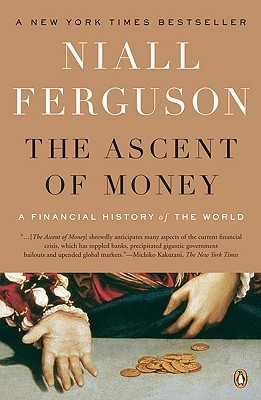
The Ascent of Money: A Financial History of the World: 10th Anniversary Edition
by Niall Ferguson
Rating: 3.9 ⭐
• 5 recommendations ❤️
The 10th anniversary edition, with new chapters on the crash, Chimerica, and cryptocurrency"[An] excellent, just in time guide to the history of finance and financial crisis." — The Washington Post"Fascinating." —Fareed Zakaria, NewsweekIn this updated edition, Niall Ferguson brings his classic financial history of the world up to the present day, tackling the populist backlash that followed the 2008 crisis, the descent of "Chimerica" into a trade war, and the advent of cryptocurrencies, such as Bitcoin, with his signature clarity and expert lens. The Ascent of Money reveals finance as the backbone of history, casting a new light on familiar events: the Renaissance enabled by Italian foreign exchange dealers, the French Revolution traced back to a stock market bubble, the 2008 crisis traced from America's bankruptcy capital, Memphis, to China's boomtown, Chongqing. We may resent the plutocrats of Wall Street but, as Ferguson argues, the evolution of finance has rivaled the importance of any technological innovation in the rise of civilization. Indeed, to study the ascent and descent of money is to study the rise and fall of Western power itself.

Lee Kuan Yew: The Grand Master's Insights on China, the United States, and the World
by Graham Allison
Rating: 4.3 ⭐
• 4 recommendations ❤️
Grand strategist and founder of modern Singapore offers key insights and controversial opinions on globalization, geopolitics, economic growth, and democracy.When Lee Kuan Yew speaks, presidents, prime ministers, diplomats, and CEOs listen. Lee, the founding father of modern Singapore and its prime minister from 1959 to 1990, has honed his wisdom during more than fifty years on the world stage. Almost single-handedly responsible for transforming Singapore into a Western-style economic success, he offers a unique perspective on the geopolitics of East and West. American presidents from Richard Nixon to Barack Obama have welcomed him to the White House; British prime ministers from Margaret Thatcher to Tony Blair have recognized his wisdom; and business leaders from Rupert Murdoch to Rex Tillerson, CEO of Exxon Mobil, have praised his accomplishments. This book gathers key insights from interviews, speeches, and Lee's voluminous published writings and presents them in an engaging question and answer format.Lee offers his assessment of China's future, asserting, among other things, that "China will want to share this century as co-equals with the U.S." He affirms the United States' position as the world's sole superpower but expresses dismay at the vagaries of its political system. He offers strategic advice for dealing with China and goes on to discuss India's future, Islamic terrorism, economic growth, geopolitics and globalization, and democracy. Lee does not pull his punches, offering his unvarnished opinions on multiculturalism, the welfare state, education, and the free market. This little book belongs on the reading list of every world leader--including the one who takes the oath of office on January 20, 2013.

The Hundred-Year Marathon: China's Secret Strategy to Replace America as the Global Superpower
by Michael Pillsbury
Rating: 4.3 ⭐
• 3 recommendations ❤️
One of the U.S. government's leading China experts reveals the hidden strategy fueling that country's rise – and how Americans have been seduced into helping China overtake us as the world's leading superpower.For more than forty years, the United States has played an indispensable role helping the Chinese government build a booming economy, develop its scientific and military capabilities, and take its place on the world stage, in the belief that China's rise will bring us cooperation, diplomacy, and free trade. But what if the "China Dream" is to replace us, just as America replaced the British Empire, without firing a shot?Based on interviews with Chinese defectors and newly declassified, previously undisclosed national security documents, The Hundred-Year Marathon reveals China's secret strategy to supplant the United States as the world's dominant power, and to do so by 2049, the one-hundredth anniversary of the founding of the People's Republic. Michael Pillsbury, a fluent Mandarin speaker who has served in senior national security positions in the U.S. government since the days of Richard Nixon and Henry Kissinger, draws on his decades of contact with the "hawks" in China's military and intelligence agencies and translates their documents, speeches, and books to show how the teachings of traditional Chinese statecraft underpin their actions. He offers an inside look at how the Chinese really view America and its leaders – as barbarians who will be the architects of their own demise.Pillsbury also explains how the U.S. government has helped – sometimes unwittingly and sometimes deliberately – to make this "China Dream" come true, and he calls for the United States to implement a new, more competitive strategy toward China as it really is, and not as we might wish it to be. The Hundred-Year Marathon is a wake-up call as we face the greatest national security challenge of the twenty-first century.

Prisoners of Geography: Ten Maps That Explain Everything About the World
by Tim Marshall
Rating: 4.2 ⭐
• 2 recommendations ❤️
In this New York Times bestseller, updated for 2016, an award-winning journalist uses ten maps of crucial regions to explain the geo-political strategies of the world powers—“fans of geography, history, and politics (and maps) will be enthralled” (Fort Worth Star-Telegram).Maps have a mysterious hold over us. Whether ancient, crumbling parchments or generated by Google, maps tell us things we want to know, not only about our current location or where we are going but about the world in general. And yet, when it comes to geo-politics, much of what we are told is generated by analysts and other experts who have neglected to refer to a map of the place in question.All leaders of nations are constrained by geography. In “one of the best books about geopolitics” (The Evening Standard), now updated to include 2016 geopolitical developments, journalist Tim Marshall examines Russia, China, the US, Latin America, the Middle East, Africa, Europe, Japan, Korea, and Greenland and the Arctic—their weather, seas, mountains, rivers, deserts, and borders—to provide a context often missing from our political reportage: how the physical characteristics of these countries affect their strengths and vulnerabilities and the decisions made by their leaders.Offering “a fresh way of looking at maps” (The New York Times Book Review), Marshall explains the complex geo-political strategies that shape the globe. Why is Putin so obsessed with Crimea? Why was the US destined to become a global superpower? Why does China’s power base continue to expand? Why is Tibet destined to lose its autonomy? Why will Europe never be united? The answers are geographical. “In an ever more complex, chaotic, and interlinked world, Prisoners of Geography is a concise and useful primer on geopolitics” (Newsweek) and a critical guide to one of the major determining factors in world affairs.
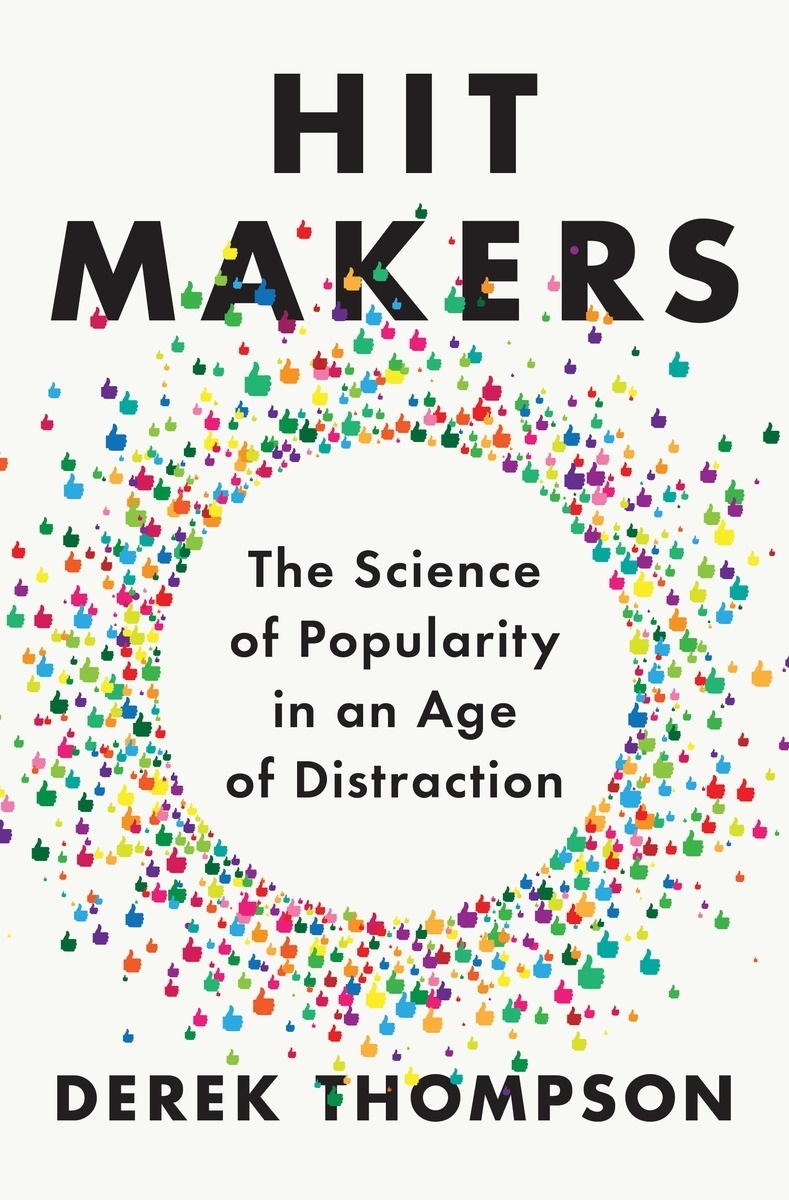
Hit Makers: The Science of Popularity in an Age of Distraction
by Derek Thompson
Rating: 3.9 ⭐
• 6 recommendations ❤️
Nothing "goes viral." If you think a popular movie, song, or app came out of nowhere to become a word-of-mouth success in today's crowded media environment, you're missing the real story. Each blockbuster has a secret history--of power, influence, dark broadcasters, and passionate cults that turn some new products into cultural phenomena. Even the most brilliant ideas wither in obscurity if they fail to connect with the right network, and the consumers that matter most aren't the early adopters, but rather their friends, followers, and imitators--the audience of your audience.In his groundbreaking investigation, The Atlantic senior editor Derek Thompson uncovers the hidden psychology of why we like what we like and reveals the economics of cultural markets that invisibly shape our lives. Shattering the sentimental myths of hit-making that dominate pop culture and business, Thompson shows that quality is insufficient for success; nobody has "good taste"; and some of the most popular products in history were one bad break away from utter failure. It may be a new world, but there are some enduring truths to what audiences and consumers want. People love a familiar surprise: a product that is bold yet sneakily recognizable.Every business, every artist, every person looking to promote themselves and their work wants to know what makes some works so successful while others disappear. Hit Makers is a magical mystery tour through the last century of pop culture blockbusters and the most valuable currency of the twenty-first century--people's attention. From the dawn of impressionist art to the future of Facebook, from small Etsy designers to the origin of Star Wars, Thompson leaves no Pet Rock unturned to tell the fascinating story of how culture happens and why things become popular.

In Sapiens, he explored our past. In Homo Deus, he looked to our future. Now, one of the most innovative thinkers on the planet turns to the present to make sense of today's most pressing issues.How do computers and robots change the meaning of being human? How do we deal with the epidemic of fake news? Are nations and religions still relevant? What should we teach our children?Yuval Noah Harari's 21 Lessons for the 21st Century is a probing and visionary investigation into today's most urgent issues as we move into the uncharted territory of the future. As technology advances faster than our understanding of it, hacking becomes a tactic of war, and the world feels more polarized than ever, Harari addresses the challenge of navigating life in the face of constant and disorienting change and raises the important questions we need to ask ourselves in order to survive.In twenty-one accessible chapters that are both provocative and profound, Harari builds on the ideas explored in his previous books, untangling political, technological, social, and existential issues and offering advice on how to prepare for a very different future from the world we now live in: How can we retain freedom of choice when Big Data is watching us? What will the future workforce look like, and how should we ready ourselves for it? How should we deal with the threat of terrorism? Why is liberal democracy in crisis?Harari's unique ability to make sense of where we have come from and where we are going has captured the imaginations of millions of readers. Here he invites us to consider values, meaning, and personal engagement in a world full of noise and uncertainty. When we are deluged with irrelevant information, clarity is power. Presenting complex contemporary challenges clearly and accessibly, 21 Lessons for the 21st Century is essential reading.

The Death of Truth: Notes on Falsehood in the Age of Trump
by Michiko Kakutani
Rating: 3.8 ⭐
• 2 recommendations ❤️
From the Pulitzer Prize–winning critic comes an impassioned critique of America’s retreat from reason.We live in a time when the very idea of objective truth is mocked and discounted by the occupants of the White House. Discredited conspiracy theories and ideologies have resurfaced, proven science is once more up for debate, and Russian propaganda floods our screens. The wisdom of the crowd has usurped research and expertise, and we are each left clinging to the beliefs that best confirm our biases. How did truth become an endangered species in contemporary America? This decline began decades ago, and in The Death of Truth, former New York Times critic Michiko Kakutani takes a penetrating look at the cultural forces that contributed to this gathering storm. In social media and literature, television, academia, and politics, Kakutani identifies the trends—originating on both the right and the left—that have combined to elevate subjectivity over factuality, science, and common values. And she returns us to the words of the great critics of authoritarianism, writers like George Orwell and Hannah Arendt, whose work is newly and eerily relevant. With remarkable erudition and insight, Kakutani offers a provocative diagnosis of our current condition and points toward a new path for our truth-challenged times.

Democracy and Dictatorship in Europe: From the Ancien Régime to the Present Day
by Sheri Berman
Rating: 4.1 ⭐
• 2 recommendations ❤️
At the end of the twentieth century, many believed the story of European political development had come to an end. Modern democracy began in Europe, but for hundreds of years it competed with various forms of dictatorship. Now, though, the entire continent was in the democratic camp for the first time in history. But within a decade, this story had already begun to unravel. Some of the continent's newer democracies slid back towards dictatorship, while citizens in many of its older democracies began questioning democracy's functioning and even its legitimacy.In Democracy and Dictatorship in Europe, Sheri Berman traces the long history of democracy in its cradle, Europe. She explains that in fact, just about every democratic wave in Europe initially failed, either collapsing in upon itself or succumbing to the forces of reaction. Yet even when democratic waves failed, there were always some achievements that lasted. Even the most virulently reactionary regimes could not suppress every element of democratic progress. Panoramic in scope, Berman takes readers through two centuries of turmoil: revolution, fascism, civil war, and-finally-the emergence of liberal democratic Europe in the postwar era.A magisterial retelling of modern European political history, Democracy and Dictatorship in Europe not explains how democracy actually develops, but how we should interpret the current wave of illiberalism sweeping Europe and the rest of the world.

The Guarded Gate: Bigotry, Eugenics and the Law That Kept Two Generations of Jews, Italians, and Other European Immigrants Out of America
by Daniel Okrent
Rating: 4.0 ⭐
• 4 recommendations ❤️
NAMED ONE OF THE “100 NOTABLE BOOKS OF THE YEAR” BY THE NEW YORK TIMES BOOK REVIEW“An extraordinary book, I can’t recommend it highly enough.” –Whoopi Goldberg, The ViewBy the widely celebrated New York Times bestselling author of Last Call —the powerful, definitive, and timely account of how the rise of eugenics helped America close the immigration door to “inferiors” in the 1920s.A forgotten, dark chapter of American history with implications for the current day, The Guarded Gate tells the story of the scientists who argued that certain nationalities were inherently inferior, providing the intellectual justification for the harshest immigration law in American history. Brandished by the upper class Bostonians and New Yorkers—many of them progressives—who led the anti-immigration movement, the eugenic arguments helped keep hundreds of thousands of Jews, Italians, and other unwanted groups out of the US for more than 40 years.Over five years in the writing, The Guarded Gate tells the complete story from its beginning in 1895, when Henry Cabot Lodge and other Boston Brahmins launched their anti-immigrant campaign. In 1921, Vice President Calvin Coolidge declared that “biological laws” had proven the inferiority of southern and eastern Europeans; the restrictive law was enacted three years later. In his characteristic style, both lively and authoritative, Okrent brings to life the rich cast of characters from this time, including Lodge’s closest friend, Theodore Roosevelt; Charles Darwin’s first cousin, Francis Galton, the idiosyncratic polymath who gave life to eugenics; the fabulously wealthy and profoundly bigoted Madison Grant, founder of the Bronx Zoo, and his best friend, H. Fairfield Osborn, director of the American Museum of Natural History; Margaret Sanger, who saw eugenics as a sensible adjunct to her birth control campaign; and Maxwell Perkins, the celebrated editor of Hemingway and Fitzgerald. A work of history relevant for today, The Guarded Gate is an important, insightful tale that painstakingly connects the American eugenicists to the rise of Nazism, and shows how their beliefs found fertile soil in the minds of citizens and leaders both here and abroad.

A Good Provider Is One Who Leaves: One Family and Migration in the 21st Century
by Jason DeParle
Rating: 4.4 ⭐
• 2 recommendations ❤️
"No matter your politics or home country this will change how you think about the movement of people between poor and rich countries...one of the best books on immigration written in a generation." --Matthew Desmond, author of Evicted The definitive chronicle of our new age of global migration, told through the multi-generational saga of a Filipino family, by a veteran New York Times reporter and two-time Pulitzer Prize finalist.When Jason DeParle moved into the Manila slums with Tita Comodas and her family three decades ago, he never imagined his reporting on them would span three generations and turn into the defining chronicle of a new age--the age of global migration. In a monumental book that gives new meaning to "immersion journalism," DeParle paints an intimate portrait of an unforgettable family as they endure years of sacrifice and separation, willing themselves out of shantytown poverty into a new global middle class. At the heart of the story is Tita's daughter, Rosalie. Beating the odds, she struggles through nursing school and works her way across the Middle East until a Texas hospital fulfills her dreams with a job offer in the States.Migration is changing the world--reordering politics, economics, and cultures across the globe. With nearly 45 million immigrants in the United States, few issues are as polarizing. But if the politics of immigration is broken, immigration itself--tens of millions of people gathered from every corner of the globe--remains an underappreciated American success. Expertly combining the personal and panoramic, DeParle presents a family saga and a global phenomenon. Restarting her life in Galveston, Rosalie brings her reluctant husband and three young children with whom she has rarely lived. They must learn to become a family, even as they learn a new country. Ordinary and extraordinary at once, their journey is a twenty-first-century classic, rendered in gripping detail.

The Meritocracy Trap: How America's Foundational Myth Feeds Inequality, Dismantles the Middle Class, and Devours the Elite
by Daniel Markovits
Rating: 3.8 ⭐
• 2 recommendations ❤️
A revolutionary new argument from eminent Yale Law professor Daniel Markovits attacking the false promise of meritocracy It is an axiom of American life that advantage should be earned through ability and effort. Even as the country divides itself at every turn, the meritocratic ideal – that social and economic rewards should follow achievement rather than breeding – reigns supreme. Both Democrats and Republicans insistently repeat meritocratic notions. Meritocracy cuts to the heart of who we are. It sustains the American dream. But what if, both up and down the social ladder, meritocracy is a sham? Today, meritocracy has become exactly what it was conceived to a mechanism for the concentration and dynastic transmission of wealth and privilege across generations. Upward mobility has become a fantasy, and the embattled middle classes are now more likely to sink into the working poor than to rise into the professional elite. At the same time, meritocracy now ensnares even those who manage to claw their way to the top, requiring rich adults to work with crushing intensity, exploiting their expensive educations in order to extract a return. All this is not the result of deviations or retreats from meritocracy but rather stems directly from meritocracy’s successes. This is the radical argument that Daniel Markovits prosecutes with rare force. Markovits is well placed to expose the sham of meritocracy. Having spent his life at elite universities, he knows from the inside the corrosive system we are trapped within. Markovits also knows that, if we understand that meritocratic inequality produces near-universal harm, we can cure it. When The Meritocracy Trap reveals the inner workings of the meritocratic machine, it also illuminates the first steps outward, towards a new world that might once again afford dignity and prosperity to the American people.
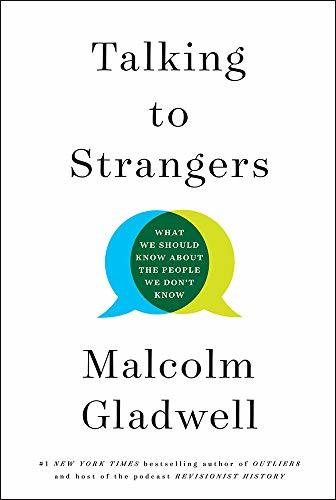
Talking to Strangers: What We Should Know About the People We Don't Know
by Malcolm Gladwell
Rating: 4.0 ⭐
• 8 recommendations ❤️
Malcolm Gladwell, host of the podcast Revisionist History and author of the #1 New York Times bestseller Outliers, offers a powerful examination of our interactions with strangers -- and why they often go wrong.How did Fidel Castro fool the CIA for a generation? Why did Neville Chamberlain think he could trust Adolf Hitler? Why are campus sexual assaults on the rise? Do television sitcoms teach us something about the way we relate to each other that isn't true?While tackling these questions, Malcolm Gladwell was not solely writing a book for the page. He was also producing for the ear. In the audiobook version of Talking to Strangers, you'll hear the voices of people he interviewed--scientists, criminologists, military psychologists. Court transcripts are brought to life with re-enactments. You actually hear the contentious arrest of Sandra Bland by the side of the road in Texas. As Gladwell revisits the deceptions of Bernie Madoff, the trial of Amanda Knox, and the suicide of Sylvia Plath, you hear directly from many of the players in these real-life tragedies. There's even a theme song - Janelle Monae's "Hell You Talmbout."Something is very wrong, Gladwell argues, with the tools and strategies we use to make sense of people we don't know. And because we don't know how to talk to strangers, we are inviting conflict and misunderstanding in ways that have a profound effect on our lives and our world.

The American Story: Conversations with Master Historians
by David M. Rubenstein
Rating: 4.4 ⭐
• 6 recommendations ❤️
Co-founder of The Carlyle Group and patriotic philanthropist David M. Rubenstein takes readers on a sweeping journey across the grand arc of the American story through revealing conversations with our greatest historians.In these lively dialogues, the biggest names in American history explore the subjects they’ve come to so intimately know and understand.— David McCullough on John Adams— Jon Meacham on Thomas Jefferson— Ron Chernow on Alexander Hamilton— Walter Isaacson on Benjamin Franklin— Doris Kearns Goodwin on Abraham Lincoln— A. Scott Berg on Charles Lindbergh— Taylor Branch on Martin Luther King— Robert Caro on Lyndon B. Johnson— Bob Woodward on Richard Nixon— And many others, including a special conversation with Chief Justice John RobertsThrough his popular program The David Rubenstein Show , David Rubenstein has established himself as one of our most thoughtful interviewers. Now, in The American Story, David captures the brilliance of our most esteemed historians, as well as the souls of their subjects. The book features introductions by Rubenstein as well a foreword by Librarian of Congress Carla Hayden, the first woman and the first African American to lead our national library. Richly illustrated with archival images from the Library of Congress, the book is destined to become a classic for serious readers of American history.Through these captivating exchanges, these bestselling and Pulitzer Prize–winning authors offer fresh insight on pivotal moments from the Founding Era to the late 20th century.

The Great Reversal: How America Gave Up on Free Markets
by Thomas Philippon
Rating: 4.2 ⭐
• 2 recommendations ❤️
In this much-anticipated book, a leading economist argues that many key problems of the American economy are due not to the flaws of capitalism or the inevitabilities of globalization but to the concentration of corporate power. By lobbying against competition, the biggest firms drive profits higher while depressing wages and limiting opportunities for investment, innovation, and growth.Why are cell-phone plans so much more expensive in the United States than in Europe? It seems a simple question. But the search for an answer took Thomas Philippon on an unexpected journey through some of the most complex and hotly debated issues in modern economics. Ultimately he reached his surprising conclusion: American markets, once a model for the world, are giving up on healthy competition. Sector after economic sector is more concentrated than it was twenty years ago, dominated by fewer and bigger players who lobby politicians aggressively to protect and expand their profit margins. Across the country, this drives up prices while driving down investment, productivity, growth, and wages, resulting in more inequality. Meanwhile, Europe―long dismissed for competitive sclerosis and weak antitrust―is beating America at its own game.Philippon, one of the world’s leading economists, did not expect these conclusions in the age of Silicon Valley start-ups and millennial millionaires. But the data from his cutting-edge research proved undeniable. In this compelling tale of economic detective work, we follow him as he works out the basic facts and consequences of industry concentration in the U.S. and Europe, shows how lobbying and campaign contributions have defanged antitrust regulators, and considers what all this means for free trade, technology, and innovation. For the sake of ordinary Americans, he concludes, government needs to return to what it once did best: keeping the playing field level for competition. It’s time to make American markets great―and free―again.

Erdogan's Empire: Turkey and the Politics of the Middle East
by Soner Çağaptay
Rating: 3.8 ⭐
• 2 recommendations ❤️
Gradually since 2003, Turkey's autocratic leader Recep Tayyip Erdogan has sought to make Turkey a great power -- in the tradition of past Turkish leaders from the late Ottoman sultans to Ataturk, the founder of modern Turkey. Here the leading authority Soner Cagaptay, author of The New Sultan -- the first biography of President Erdogan -- provides a masterful overview of the power politics in the Middle East and Turkey's place in it.Erdogan has picked an unorthodox model in the context of recent Turkish history, attempting to cast his country as a stand-alone Middle Eastern power. In doing so Turkey has broken ranks with its traditional Western allies, including the United States and has embraced an imperial-style foreign policy which has aimed to restore Turkey's Ottoman-era reach into the Arabian Middle East and the Balkans.Today, in addition to a domestic crackdown on dissent and journalistic freedoms, driven by Erdogan's style of governance, Turkey faces a hostile world. Ankara has nearly no friends left in the Middle East, and it faces a threat from resurgent historic Russia and Iran. Furthermore, Turkey cannot rely on the unconditional support of its traditional Western allies. Can Erdogan deliver Turkey back to safety? What are the risks that lie ahead for him, and his country? How can Turkey truly become a great power, fulfilling a dream shared by many Turks, the sultans, Ataturk, and Erdogan himself?

The Inevitability of Tragedy: Henry Kissinger and His World
by Barry Gewen
Rating: 4.0 ⭐
• 2 recommendations ❤️
The Inevitability of Tragedy is a fascinating intellectual biography of Henry Kissinger that examines his unique role in government through his ideas. It analyzes the continuing controversies surrounding Kissinger’s policies in such places as Vietnam and Chile by offering an understanding of his definition of realism; his seemingly amoral belief that foreign affairs must be conducted through a balance of power; and his “un-American” view that promoting democracy is most likely to result in repeated defeats for the United States.Barry Gewen places Kissinger’s ideas in a European context by tracing them through his experience as a refugee from Nazi Germany and exploring the links between his notions of power and those of his mentor, Hans Morgenthau, the father of realism, as well as those of two other German-Jewish émigrés who shared his concerns about the weaknesses of democracy: Leo Strauss and Hannah Arendt.

Blowout: Corrupted Democracy, Rogue State Russia, and the Richest, Most Destructive Industry on Earth
by Rachel Maddow
Rating: 4.3 ⭐
• 2 recommendations ❤️
In 2010, the words “earthquake swarm” entered the lexicon in Oklahoma. That same year, a trove of Michael Jackson memorabilia—including his iconic crystal-encrusted white glove—was sold at auction for over $1 million to a guy who was, officially, just the lowly forestry minister of the tiny nation of Equatorial Guinea. And in 2014, Ukrainian revolutionaries raided the palace of their ousted president and found a zoo of peacocks, gilded toilets, and a floating restaurant modeled after a Spanish galleon. Unlikely as it might seem, there is a thread connecting these events, and Rachel Maddow follows it to its crooked source: the unimaginably lucrative and equally corrupting oil and gas industry. With her trademark black humor, Maddow takes us on a switchback journey around the globe, revealing the greed and incompetence of Big Oil and Gas along the way, and drawing a surprising conclusion about why the Russian government hacked the 2016 U.S. election. She deftly shows how Russia’s rich reserves of crude have, paradoxically, stunted its growth, forcing Putin to maintain his power by spreading Russia’s rot into its rivals, its neighbors, the West’s most important alliances, and the United States. Chevron, BP, and a host of other industry players get their star turn, most notably ExxonMobil and the deceptively well-behaved Rex Tillerson. The oil and gas industry has weakened democracies in developed and developing countries, fouled oceans and rivers, and propped up authoritarian thieves and killers. But being outraged at it is, according to Maddow, “like being indignant when a lion takes down and eats a gazelle. You can’t really blame the lion. It’s in her nature.” Blowout is a call to contain the lion: to stop subsidizing the wealthiest businesses on earth, to fight for transparency, and to check the influence of the world’s most destructive industry and its enablers. The stakes have never been higher. As Maddow writes, “Democracy either wins this one or disappears.”

Trade Is Not a Four-Letter Word: How Six Everyday Products Make the Case for Trade
by Fred P. Hochberg
Rating: 4.0 ⭐
• 6 recommendations ❤️
From former Chairman and President of the Export-Import Bank of the United States Fred P. Hochberg comes an illuminating and engaging tutorial on the basics of modern trade. Trade—the exchange that powers the world—allows us to sell what we produce at home and purchase what we don’t. In the age of globalization, trade has joined together more people than ever before, providing access to major new markets and countless new products that have revolutionized our lives. However, for millions of people, global trade has become a popular target for blame and the frustrations of modern life. Much of the public only connects trade with unfathomable, high-level deals causing the fundamental principles to often seem inaccessible and confusing. Through the lens of six quintessential American goods, Fred P. Hochberg breaks down colorful and compelling real-world examples to dispel the widespread myths and confusions surrounding trade. By using six widely consumed American goods—the taco salad, the minivan, the banana, the iPhone, the college degree, and the HBO series Game of Thrones—Hochberg highlights the story of America’s most surprising trade relationships while sharing the essentials of trade that everyone should know.

The Narrow Corridor: States, Societies, and the Fate of Liberty
by Daron Acemoğlu
Rating: 4.2 ⭐
• 4 recommendations ❤️
From the authors of the international bestseller Why Nations Fail, a crucial new big-picture framework that answers the question of how liberty flourishes in some states but falls to authoritarianism or anarchy in others--and explains how it can continue to thrive despite new threats.Liberty is hardly the "natural" order of things. In most places and at most times, the strong have dominated the weak and human freedom has been quashed by force or by customs and norms. Either states have been too weak to protect individuals from these threats or states have been too strong for people to protect themselves from despotism. Liberty emerges only when a delicate and precarious balance is struck between state and society.There is a happy Western myth that political liberty is a durable construct, a steady state, arrived at by a process of "enlightenment." This static view is a fantasy, the authors argue; rather, the space to attain and maintain liberty stays open only via a fundamental and incessant struggle between state and society. The power of state institutions and the elites that control them has never gone uncontested in a free society. In fact, the capacity to contest them is the definition of liberty. State institutions have to evolve continuously as the nature of conflicts and needs of the society change, and thus society's ability to keep state and rulers accountable must intensify in tandem with the capabilities of the state. This struggle between state and society becomes self-reinforcing, inducing both to develop a richer array of capacities just to keep moving forward along the corridor. Yet this struggle also underscores the fragile nature of liberty. It is built on a delicate balance between state and society, between economic, political and social elites and citizens, between institutions and norms. One side of the balance gets too strong, and as it has often happened in history, liberty begins to wane. Liberty depends on the vigilant mobilization of society. But it also needs state institutions to continuously reinvent themselves in order to meet new economic and social challenges that can easily close the space liberty needs to survive.Today we are in the midst of a time of wrenching destabilization. We need liberty more than ever, and yet the corridor to liberty is getting narrower and more treacherous. The danger on the horizon is not "just" the loss of our political freedom, however grim that is in itself; it is also to the prosperity and safety that critically depend on liberty. The opposite of the corridor of liberty is the road to ruin.

Don't Be Evil: How Big Tech Betrayed Its Founding Principles -- and All of Us
by Rana Foroohar
Rating: 4.0 ⭐
• 2 recommendations ❤️
A penetrating indictment of how today’s largest tech companies are hijacking our data, our livelihoods, our social fabric, and our minds—from an acclaimed Financial Times columnist and CNN analyst WINNER OF THE PORCHLIGHT BUSINESS BOOK AWARD • NAMED ONE OF THE BEST BOOKS OF THE YEAR BY FOREIGN AFFAIRS AND EVENING STANDARD“Don’t be evil” was enshrined as Google’s original corporate mantra back in its early days, when the company’s cheerful logo still conveyed the utopian vision for a future in which technology would inevitably make the world better, safer, and more prosperous. Unfortunately, it’s been quite a while since Google, or the majority of the Big Tech companies, lived up to this founding philosophy. Today, the utopia they sought to create is looking more dystopian than from digital surveillance and the loss of privacy to the spreading of misinformation and hate speech to predatory algorithms targeting the weak and vulnerable to products that have been engineered to manipulate our desires. How did we get here? How did these once-scrappy and idealistic enterprises become rapacious monopolies with the power to corrupt our elections, co-opt all our data, and control the largest single chunk of corporate wealth—while evading all semblance of regulation and taxes? In Don’t Be Evil, Financial Times global business columnist Rana Foroohar tells the story of how Big Tech lost its soul—and ate our lunch. Through her skilled reporting and unparalleled access—won through nearly thirty years covering business and technology—she shows the true extent to which behemoths like Google, Facebook, Apple, and Amazon are monetizing both our data and our attention, without us seeing a penny of those exorbitant profits. Finally, Foroohar lays out a plan for how we can resist, by creating a framework that fosters innovation while also protecting us from the dark side of digital technology.Praise for Don’t Be Evil“At first sight, Don’t Be Evil looks like it’s doing for Google what muckraking journalist Ida Tarbell did for Standard Oil over a century ago. But this whip-smart, highly readable book’s scope turns out to be much broader. Worried about the monopolistic tendencies of big tech? The addictive apps on your iPhone? The role Facebook played in Donald Trump’s election? Foroohar will leave you even more worried, but a lot better informed.” —Niall Ferguson, Milbank Family Senior Fellow at the Hoover Institution, Stanford, and author of The Square and the Tower

Losing the Long Game: The False Promise of Regime Change in the Middle East
by Philip H. Gordon
Rating: 3.9 ⭐
• 2 recommendations ❤️
One of Foreign Affairs' Best of Books of 2021 and "Books For The Century"!"Book of the Week" on Fareed Zakaria GPSFinancial Times Best Books of 2020The definitive account of how regime change in the Middle East has proven so tempting to American policymakers for decades―and why it always seems to go wrong."It's a first-rate work, intelligently analyzing a complex issue, and learning the right lessons from history."― Fareed ZakariaSince the end of World War II, the United States has set out to oust governments in the Middle East on an average of once per decade ― in places as diverse as Iran, Iraq, Afghanistan (twice), Egypt, Libya, and Syria. The reasons for these interventions have also been extremely diverse, and the methods by which the United States pursued regime change have likewise been highly varied, ranging from diplomatic pressure alone to outright military invasion and occupation. What is common to all the operations, however, is that they failed to achieve their ultimate goals, produced a range of unintended and even catastrophic consequences, carried heavy financial and human costs, and in many cases left the countries in question worse off than they were before.Philip H. Gordon's Losing the Long Game is a thorough and riveting look at the U.S. experience with regime change over the past seventy years, and an insider’s view on U.S. policymaking in the region at the highest levels. It is the story of repeated U.S. interventions in the region that always started out with high hopes and often the best of intentions, but never turned out well. No future discussion of U.S. policy in the Middle East will be complete without taking into account the lessons of the past, especially at a time of intense domestic polarization and reckoning with America's standing in world.