
Ezra Klein Recommended Books
American journalist
37 Books Recommended

What if men built a tower from Earth to Heaven-and broke through to Heaven's other side? What if we discovered that the fundamentals of mathematics were arbitrary and inconsistent? What if there were a science of naming things that calls life into being from inanimate matter? What if exposure to an alien language forever changed our perception of time? What if all the beliefs of fundamentalist Christianity were literally true, and the sight of sinners being swallowed into fiery pits were a routine event on city streets? These are the kinds of outrageous questions posed by the stories of Ted Chiang. Stories of your life . . . and others.

This collection examines the foreign and domestic policies of President George W Bush's administration. The analysis begins with an account of how highly polarized--in terms of public opinion and electoral patterns--this presidency has proved to be. This is followed by chapters on the use of unilateral executive powers and pre-rogative powers. Because the policy choices of the Bush presidency have had such fundamental effects both in domestic policy and in US foreign policy, three contributors then address the processes of decision making especially in respect to the war against Iraq. How the administration governs by a recurring process of campaigning is examined in chapters on public opinion and war, the promotional presidency, mobilizing congressional support for war and the White House communications system. Finally the way in which the Bush White House relates to congress and the process of building congressional coalitions to enact laws is the subject of chapters on"executive style" of this administration and the failure to reform social security. It will be essential reading for anyone wishing to understand one of the most controversial administrations in recent years.

Stealth Democracy: Americans' Beliefs About How Government Should Work
by John R. Hibbing
Rating: 4.0 ⭐
• 2 recommendations ❤️
Examining how people want their democratic government to work, this study finds that Americans don't like many of the practices associated with democracy: the conflicts, the debates, the compromises. It finds that Americans don't want to have to see democracy in practice, nor do they want to be involved in politics. If American citizens had their way, political decisions would be made by unselfish decision-makers, lessening the need for monitoring government.

Why the Electoral College Is Bad for America
by George C. Edwards III
Rating: 3.7 ⭐
• 2 recommendations ❤️
Americans currently choose their president through the electoral college, an extraordinarily complex mechanism that may elect a candidate who does not receive the most votes. In this provocative book, George Edwards III argues that—contrary to what supporters of the electoral college claim—there is no real justification for a system that might violate majority rule.Drawing on systematic data, Edwards finds that the electoral college does not protect the interests of small states or racial minorities, does not provide presidents with effective coalitions for governing, and does little to protect the American polity from the alleged harms of direct election of the president. In fact, the electoral college distorts the presidential campaign so that candidates ignore most small states and some large ones and pay little attention to minorities, and it encourages third parties to run presidential candidates and discourages party competition in many states.Edwards demonstrates effectively that direct election of the president without a runoff maximizes political equality and eliminates the distortions in the political system caused by the electoral college.

On Deaf Ears: The Limits of the Bully Pulpit
by George C. Edwards III
Rating: 3.4 ⭐
• 2 recommendations ❤️
The typical legislative strategy for recent presidents has been to move Congress by winning public support. George Edwards analyzes hundreds of public opinion polls and finds that this strategy usually fails. He explains why presidents are frequently unable to move public opinion and suggests they use other means to achieve legislative success."That presidents use the ‘bully pulpit’ to exert influence in Washington is a truism of American Politics. What Edwards finds in this remarkable book is that the truism isn’t true, that presidents—even those at the top of their form—persistently fail to move public sentiment in preferred directions."—James A. Stimson, University of North Carolina at Chapel Hill"Every serious scholar and student of American politics should read this book."—Robert Y. Shapiro, Columbia University "Edwards has done it again! A bold, direct, convincing challenge to 30 years of literature."-Richard E. Neustadt, author of Presidential Power

An American Iliad in the guise of contemporary political reportage, What It Takes penetrates the mystery at the heart of all presidential campaigns: How do presumably ordinary people acquire that mixture of ambition, stamina, and pure shamelessness that makes a true candidate? As he recounts the frenzied course of the 1988 presidential race -- and scours the psyches of contenders from George Bush and Robert Dole to Michael Dukakis and Gary Hart -- Pulitzer Prize-winning journalist Richard Ben Cramer comes up with the answers, in a book that is vast, exhaustively researched, exhilarating, and sometimes appalling in its revelations.

The Shallows: What the Internet Is Doing to Our Brains
by Nicholas Carr
Rating: 3.9 ⭐
• 6 recommendations ❤️
“Is Google making us stupid?” When Nicholas Carr posed that question, in a celebrated Atlantic Monthly cover story, he tapped into a well of anxiety about how the Internet is changing us. He also crystallized one of the most important debates of our time: As we enjoy the Net’s bounties, are we sacrificing our ability to read and think deeply?Now, Carr expands his argument into the most compelling exploration of the Internet’s intellectual and cultural consequences yet published. As he describes how human thought has been shaped through the centuries by “tools of the mind”—from the alphabet to maps, to the printing press, the clock, and the computer—Carr interweaves a fascinating account of recent discoveries in neuroscience by such pioneers as Michael Merzenich and Eric Kandel. Our brains, the historical and scientific evidence reveals, change in response to our experiences. The technologies we use to find, store, and share information can literally reroute our neural pathways.Building on the insights of thinkers from Plato to McLuhan, Carr makes a convincing case that every information technology carries an intellectual ethic—a set of assumptions about the nature of knowledge and intelligence. He explains how the printed book served to focus our attention, promoting deep and creative thought. In stark contrast, the Internet encourages the rapid, distracted sampling of small bits of information from many sources. Its ethic is that of the industrialist, an ethic of speed and efficiency, of optimized production and consumption—and now the Net is remaking us in its own image. We are becoming ever more adept at scanning and skimming, but what we are losing is our capacity for concentration, contemplation, and reflection.Part intellectual history, part popular science, and part cultural criticism, The Shallows sparkles with memorable vignettes—Friedrich Nietzsche wrestling with a typewriter, Sigmund Freud dissecting the brains of sea creatures, Nathaniel Hawthorne contemplating the thunderous approach of a steam locomotive—even as it plumbs profound questions about the state of our modern psyche. This is a book that will forever alter the way we think about media and our minds.

Beyond Ideology: Politics, Principles, and Partisanship in the U. S. Senate
by Frances E. Lee
Rating: 4.1 ⭐
• 3 recommendations ❤️
The congressional agenda, Frances Lee contends, includes many issues about which liberals and conservatives generally agree. Even over these matters, though, Democratic and Republican senators tend to fight with each other. What explains this discord? Beyond Ideology argues that many partisan battles are rooted in competition for power rather than disagreement over the rightful role of government. The first book to systematically distinguish Senate disputes centering on ideological questions from the large proportion of them that do not, this volume foregrounds the role of power struggle in partisan conflict. Presidential leadership, for example, inherently polarizes legislators who can influence public opinion of the president and his party by how they handle his agenda. Senators also exploit good government measures and floor debate to embarrass opponents and burnish their own party’s image—even when the issues involved are broadly supported or low-stakes. Moreover, Lee contends, the congressional agenda itself amplifies conflict by increasingly focusing on issues that reliably differentiate the parties. With the new president pledging to stem the tide of partisan polarization, Beyond Ideology provides a timely taxonomy of exactly what stands in his way.

The Sabbath World: Glimpses of a Different Order of Time
by Judith Shulevitz
Rating: 3.9 ⭐
• 2 recommendations ❤️
What is the Sabbath, anyway? The holy day of rest? The first effort to protect the rights of workers? A smart way to manage stress in a world in which computers never get turned off and work never comes to an end? Or simply an oppressive, outmoded rite? In The Sabbath World, Judith Shulevitz explores the Jewish and Christian day of rest, from its origins in the ancient world to its complicated observance in the modern one. Braiding ideas together with memories, Shulevitz delves into the legends, history, and philosophy that have grown up around a custom that has lessons for all of us, not just the religious. The shared day of nonwork has built communities, sustained cultures, and connected us to the memory of our ancestors and to our better selves, but it has also aroused as much resentment as love. The Sabbath World tells this surprising story together with an account of Shulevitz’s own struggle to keep this difficult, rewarding day.

Overreach: Leadership in the Obama Presidency
by George C. Edwards III
Rating: 2.7 ⭐
• 2 recommendations ❤️
How Obama overestimated the power of rhetoric and persuasion during his presidencyWhen Barack Obama became president, many Americans embraced him as a transformational leader who would fundamentally change the politics and policy of the country. Yet, two years into his administration, the public resisted his calls for support and Congress was deadlocked over many of his major policy proposals. How could this capable new president have difficulty attaining his goals? Did he lack tactical skills?In Overreach , respected presidential scholar George Edwards argues that the problem was strategic, not tactical. He finds that in President Obama's first two years in office, Obama governed on the premise that he could create opportunities for change by persuading the public and some congressional Republicans to support his major initiatives. As a result, he proposed a large, expensive, and polarizing agenda in the middle of a severe economic crisis. The president's proposals alienated many Americans and led to a severe electoral defeat for the Democrats in the 2010 midterm elections, undermining his ability to govern in the remainder of his term.Edwards shows that the president's frustrations were predictable and the inevitable result of misunderstanding the nature of presidential power. The author demonstrates that the essence of successful presidential leadership is recognizing and exploiting existing opportunities, not in creating them through persuasion. When Obama succeeded in passing important policies, it was by mobilizing Democrats who were already predisposed to back him. Thus, to avoid overreaching, presidents should be alert to the limitations of their power to persuade and rigorously assess the possibilities for obtaining public and congressional support in their environments.

The Gamble: Choice and Chance in the 2012 Presidential Election
by John Sides
Rating: 3.9 ⭐
• 3 recommendations ❤️
A unique "moneyball" look at the 2012 U.S. presidential contest between Barack Obama and Mitt Romney"Game changer." We heard it so many times during the 2012 U.S. presidential election. But what actually made a difference in the contest-and what was just hype? In this groundbreaking book, John Sides and Lynn Vavreck tell the dramatic story of the election-with a big difference. Using an unusual "moneyball" approach and drawing on extensive quantitative data, they look beyond the anecdote, folklore, and conventional wisdom that often pass for election analysis to separate what was truly important from what was irrelevant. The Gamble combines this data with the best social science research and colorful on-the-ground reporting, providing the most accurate and precise account of the election yet written-and the only book of its kind.In a new preface, the authors reflect on the place of The Gamble in the tradition of presidential election studies, its reception to date, and possible paths for future social science research.
Creativity, Inc.: Overcoming the Unseen Forces That Stand in the Way of True Inspiration
by Ed Catmull
Rating: 4.2 ⭐
• 2 recommendations ❤️
“What does it mean to manage well?”From Ed Catmull, co-founder (with Steve Jobs and John Lasseter) of Pixar Animation Studios, comes an incisive book about creativity in business—sure to appeal to readers of Daniel Pink, Tom Peters, and Chip and Dan Heath. Creativity, Inc. is a book for managers who want to lead their employees to new heights, a manual for anyone who strives for originality, and the first-ever, all-access trip into the nerve center of Pixar Animation—into the meetings, postmortems, and “Braintrust” sessions where some of the most successful films in history are made. It is, at heart, a book about how to build a creative culture—but it is also, as Pixar co-founder and president Ed Catmull writes, “an expression of the ideas that I believe make the best in us possible.” For nearly twenty years, Pixar has dominated the world of animation, producing such beloved films as the Toy Story trilogy, Monsters, Inc., Finding Nemo, The Incredibles, Up, and WALL-E, which have gone on to set box-office records and garner thirty Academy Awards. The joyousness of the storytelling, the inventive plots, the emotional authenticity: In some ways, Pixar movies are an object lesson in what creativity really is. Here, in this book, Catmull reveals the ideals and techniques that have made Pixar so widely admired—and so profitable. As a young man, Ed Catmull had a dream: to make the first computer-animated movie. He nurtured that dream as a Ph.D. student at the University of Utah, where many computer science pioneers got their start, and then forged a partnership with George Lucas that led, indirectly, to his founding Pixar with Steve Jobs and John Lasseter in 1986. Nine years later, Toy Story was released, changing animation forever. The essential ingredient in that movie’s success—and in the thirteen movies that followed—was the unique environment that Catmull and his colleagues built at Pixar, based on philosophies that protect the creative process and defy convention, such as: • Give a good idea to a mediocre team, and they will screw it up. But give a mediocre idea to a great team, and they will either fix it or come up with something better. • If you don’t strive to uncover what is unseen and understand its nature, you will be ill prepared to lead. • It’s not the manager’s job to prevent risks. It’s the manager’s job to make it safe for others to take them. • The cost of preventing errors is often far greater than the cost of fixing them. • A company’s communication structure should not mirror its organizational structure. Everybody should be able to talk to anybody. • Do not assume that general agreement will lead to change—it takes substantial energy to move a group, even when all are on board.

Janet Lansbury is unique among parenting experts. As a RIE teacher and student of pioneering child specialist Magda Gerber, her advice is not based solely on formal studies and the research of others, but also on her twenty years of hands-on experience guiding hundreds of parents and their toddlers. “No Bad Kids” is a collection of Janet's most popular and widely read articles pertaining to common toddler behaviors and how respectful parenting practices can be applied to benefit both parents and children. It covers such common topics as punishment, cooperation, boundaries, testing, tantrums, hitting, and more. “No Bad Kids” provides a practical, indispensable tool for parents who are anticipating or experiencing those critical years when toddlers are developmentally obliged to test the limits of our patience and love. Armed with knowledge and a clearer sense of the world through our children’s eyes, this period of uncertainty can afford a myriad of opportunities to forge unbreakable bonds of trust and respect.

Adrian Tchaikovksy's award-winning novel Children of Time , is the epic story of humanity's battle for survival on a terraformed planet.Who will inherit this new Earth?The last remnants of the human race left a dying Earth, desperate to find a new home among the stars. Following in the footsteps of their ancestors, they discover the greatest treasure of the past age -- a world terraformed and prepared for human life.But all is not right in this new Eden. In the long years since the planet was abandoned, the work of its architects has borne disastrous fruit. The planet is not waiting for them, pristine and unoccupied. New masters have turned it from a refuge into mankind's worst nightmare.Now two civilizations are on a collision course, both testing the boundaries of what they will do to survive. As the fate of humanity hangs in the balance, who are the true heirs of this new Earth? Span

Predicting the Presidency: The Potential of Persuasive Leadership
by George C. Edwards III
Rating: 5.0 ⭐
• 2 recommendations ❤️
Millions of Americans―including many experienced politicians―viewed Barack Obama through a prism of high expectations, based on a belief in the power of presidential persuasion. Yet many who were inspired by candidate Obama were disappointed in what he was able to accomplish once in the White House. They could not understand why he often was unable to leverage his position and political skills to move the public and Congress to support his initiatives. Predicting the Presidency explains why Obama had such difficulty bringing about the change he promised, and challenges the conventional wisdom about presidential leadership.In this incisive book, George Edwards shows how we can ask a few fundamental questions about the context of a presidency―the president's strategic position or opportunity structure―and use the answers to predict a president's success in winning support for his initiatives. If presidential success is largely determined by a president's strategic position, what role does persuasion play? Almost every president finds that a significant segment of the public and his fellow partisans in Congress are predisposed to follow his lead. Others may support the White House out of self-interest. Edwards explores the possibilities of the president exploiting such support, providing a more realistic view of the potential of presidential persuasion.Written by a leading presidential scholar, Predicting the Presidency sheds new light on the limitations and opportunities of presidential leadership.

The Gardener and the Carpenter: What the New Science of Child Development Tells Us About the Relationship Between Parents and Children
by Alison Gopnik
Rating: 3.9 ⭐
• 2 recommendations ❤️
In The Gardener and the Carpenter, Alison Gopnik, one of the world's leading child psychologists, illuminates the paradoxes of parenthood from a scientific perspective and shatters the myth of "good parenting".Caring deeply about our children is part of what makes us human. Yet the thing we call “parenting” is a surprisingly new invention. In the past thirty years, the concept of parenting and the multibillion-dollar industry surrounding it have transformed child care into obsessive, controlling, and goal-oriented labor intended to create a particular kind of child and therefore a particular kind of adult.In The Gardener and the Carpenter , the pioneering developmental psychologist and philosopher Alison Gopnik argues that the familiar twenty-first-century picture of parents and children is profoundly wrong―it’s not just based on bad science, it’s bad for kids and parents, too.Drawing on the study of human evolution and her own cutting-edge scientific research into how children learn, Gopnik shows that although caring for children is profoundly important, it is not a matter of shaping them to turn out a particular way. Children are designed to be messy and unpredictable, playful and imaginative―and to be very different both from their parents and from each other.

In his long-awaited first novel, American master George Saunders delivers his most original, transcendent, and moving work yet. Unfolding in a graveyard over the course of a single night, narrated by a dazzling chorus of voices, Lincoln in the Bardo is a literary experience unlike any other—for no one but Saunders could conceive it. February 1862. The Civil War is less than one year old. The fighting has begun in earnest, and the nation has begun to realize it is in for a long, bloody struggle. Meanwhile, President Lincoln's beloved eleven-year-old son, Willie, lies upstairs in the White House, gravely ill. In a matter of days, despite predictions of a recovery, Willie dies and is laid to rest in a Georgetown cemetery. "My poor boy, he was too good for this earth," the president says at the time. "God has called him home." Newspapers report that a grief-stricken Lincoln returned to the crypt several times alone to hold his boy's body. From that seed of historical truth, George Saunders spins an unforgettable story of familial love and loss that breaks free of its realistic, historical framework into a thrilling, supernatural realm both hilarious and terrifying. Willie Lincoln finds himself in a strange purgatory, where ghosts mingle, gripe, commiserate, quarrel, and enact bizarre acts of penance. Within this transitional state—called, in the Tibetan tradition, the bardo—a monumental struggle erupts over young Willie's soul. Lincoln in the Bardo is an astonishing feat of imagination and a bold step forward from one of the most important and influential writers of his generation. Formally daring, generous in spirit, deeply concerned with matters of the heart, it is a testament to fiction's ability to speak honestly and powerfully to the things that really matter to us. Saunders has invented a thrilling new form that deploys a kaleidoscopic, theatrical panorama of voices—living and dead, historical and invented—to ask a timeless, profound question: How do we live and love when we know that everything we love must end?

'Everyone should read Down Girl. It should be distributed in schools and every board room, athletic department and legislative space' - Soraya ChemalyA powerful, lucid analysis of how misogyny works from a remarkable philosopherMisogyny is a hot topic, yet it's often misunderstood. What is misogyny exactly? Who deserves to be called a misogynist? How does misogyny contrast with sexism, and why is it prone to persist - or increase - even when sexist gender roles are waning?In Down Girl moral philosopher Kate Manne argues that misogyny should not be understood primarily in terms of the hatred or hostility some men feel toward all or most women. Rather, it is primarily about controlling, policing, punishing and exiling the "bad" women who challenge male dominance. And it is compatible with rewarding "the good ones" and singling out other women to serve as warnings to those who are out of order.An incredibly forensic analysis of the logic of misogyny from a brilliant thinker, Down Girl is essential reading for the #MeToo era.

Locking Up Our Own: Crime and Punishment in Black America
by James Forman Jr.
Rating: 4.4 ⭐
• 2 recommendations ❤️
In recent years, America’s criminal justice system has become the subject of an increasingly urgent debate. Critics have assailed the rise of mass incarceration, emphasizing its disproportionate impact on people of color. As James Forman, Jr., points out, however, the war on crime that began in the 1970s was supported by many African American leaders in the nation’s urban centers. In Locking Up Our Own, he seeks to understand why.Forman shows us that the first substantial cohort of black mayors, judges, and police chiefs took office amid a surge in crime and drug addiction. Many prominent black officials, including Washington, D.C. mayor Marion Barry and federal prosecutor Eric Holder, feared that the gains of the civil rights movement were being undermined by lawlessness—and thus embraced tough-on-crime measures, including longer sentences and aggressive police tactics. In the face of skyrocketing murder rates and the proliferation of open-air drug markets, they believed they had no choice. But the policies they adopted would have devastating consequences for residents of poor black neighborhoods.A former D.C. public defender, Forman tells riveting stories of politicians, community activists, police officers, defendants, and crime victims. He writes with compassion about individuals trapped in terrible dilemmas—from the men and women he represented in court to officials struggling to respond to a public safety emergency. Locking Up Our Own enriches our understanding of why our society became so punitive and offers important lessons to anyone concerned about the future of race and the criminal justice system in this country.

Give People Money: How a Universal Basic Income Would End Poverty, Revolutionize Work, and Remake the World
by Annie Lowrey
Rating: 3.9 ⭐
• 4 recommendations ❤️
A brilliantly reported, global look at universal basic income--a stipend given to every citizen--and why it might be necessary in an age of rising inequality, persistent poverty, and dazzling technology. Imagine if every month the government deposited $1,000 into your bank account, with nothing expected in return. It sounds crazy. But it has become one of the most influential and hotly debated policy ideas of our time. Futurists, radicals, libertarians, socialists, union representatives, feminists, conservatives, Bernie supporters, development economists, child-care workers, welfare recipients, and politicians from India to Finland to Canada to Mexico--all are talking about UBI.In this sparkling and provocative book, economics writer Annie Lowrey examines the UBI movement from many angles. She travels to Kenya to see how a UBI is lifting the poorest people on earth out of destitution, India to see how inefficient government programs are failing the poor, South Korea to interrogate UBI's intellectual pedigree, and Silicon Valley to meet the tech titans financing UBI pilots in expectation of a world with advanced artificial intelligence and little need for human labor.Lowrey explores the potential of such a sweeping policy and the challenges the movement faces, among them contradictory aims, uncomfortable costs, and, most powerfully, the entrenched belief that no one should get something for nothing. In the end, she shows how this arcane policy has the potential to solve some of our most intractable economic problems, while offering a new vision of citizenship and a firmer foundation for our society in this age of turbulence and marvels.

Two time-traveling agents from warring futures, working their way through the past, begin to exchange letters—and fall in love in this thrilling and romantic book from award-winning authors Amal-El Mohtar and Max Gladstone.Among the ashes of a dying world, an agent of the Commandant finds a letter. It reads: Burn before reading. Thus begins an unlikely correspondence between two rival agents hellbent on securing the best possible future for their warring factions. Now, what began as a taunt, a battlefield boast, grows into something more. Something epic. Something romantic. Something that could change the past and the future.Except the discovery of their bond would mean death for each of them. There’s still a war going on, after all. And someone has to win that war. That’s how war works. Right?Cowritten by two beloved and award-winning sci-fi writers, This Is How You Lose the Time War is an epic love story spanning time and space.

The Extended Mind: The Power of Thinking Outside the Brain
by Annie Murphy Paul
Rating: 4.1 ⭐
• 4 recommendations ❤️
A bold new book reveals how we can tap the intelligence that exists beyond our brains—in our bodies, our surroundings, and our relationships.Use your head.That’s what we tell ourselves when facing a tricky problem or a difficult project. But a growing body of research indicates that we’ve got it exactly backwards. What we need to do, says acclaimed science writer Annie Murphy Paul, is think outside the brain. A host of “extra-neural” resources—the feelings and movements of our bodies, the physical spaces in which we learn and work, and the minds of those around us—can help us focus more intently, comprehend more deeply, and create more imaginatively.The Extended Mind outlines the research behind this exciting new vision of human ability, exploring the findings of neuroscientists, cognitive scientists, and psychologists, and examining the practices of educators, managers, and leaders who are already reaping the benefits of thinking outside the brain. She excavates the untold history of how artists, scientists, and authors—from Jackson Pollock to Jonas Salk to Robert Caro—have used mental extensions to solve problems, make discoveries, and create new works. In the tradition of Howard Gardner’s Frames of Mind or Daniel Goleman’s Emotional Intelligence , The Extended Mind offers a dramatic new view of how our minds work, with practical advice on how we can all think better.
Something Deeply Hidden: Quantum Worlds and the Emergence of Spacetime
by Sean Carroll
Rating: 4.1 ⭐
• 4 recommendations ❤️
As you read these words, copies of you are being created. Sean Carroll, theoretical physicist and one of this world’s most celebrated writers on science, rewrites the history of 20th century physics. Already hailed as a masterpiece, Something Deeply Hidden shows for the first time that facing up to the essential puzzle of quantum mechanics utterly transforms how we think about space and time. His reconciling of quantum mechanics with Einstein’s theory of relativity changes, well, everything. Most physicists haven’t even recognized the uncomfortable truth: physics has been in crisis since 1927. Quantum mechanics has always had obvious gaps—which have come to be simply ignored. Science popularizers keep telling us how weird it is, how impossible it is to understand. Academics discourage students from working on the "dead end" of quantum foundations. Putting his professional reputation on the line with this audacious yet entirely reasonable book, Carroll says that the crisis can now come to an end. We just have to accept that there is more than one of us in the universe. There are many, many Sean Carrolls. Many of every one of us. Copies of you are generated thousands of times per second. The "many worlds theory" of quantum behavior says that every time there is a quantum event, a world splits off with everything in it the same, except in that other world the quantum event didn't happen. Step by step in Carroll's uniquely lucid way, he tackles the major objections to this otherworldly revelation until his case is inescapably established. Rarely does a book so fully reorganize how we think about our place in the universe. We are on the threshold of a new understanding—of where we are in the cosmos, and what we are made of.

Lillian and Madison were unlikely roommates and yet inseparable friends at their boarding school. But then Lillian had to leave the school unexpectedly in the wake of a scandal, and they’ve barely spoken since. Until now, more than ten years later, when Lillian gets a letter from Madison pleading for her help.Madison’s twin stepkids are moving in with her family and she wants Lillian to be their caretaker. However, there’s a catch: the twins spontaneously combust when they get agitated, flames igniting from their skin in a startling but beautiful way. Lillian is convinced Madison is pulling her leg, but it’s the truth.Thinking of her dead-end life at home, the life that has consistently disappointed her, Lillian figures she has nothing to lose. Over the course of one humid, demanding summer, Lillian and the twins learn to trust each other—and stay cool—while also staying out of the way of Madison’s buttoned-up politician husband. Surprised by her own ingenuity yet unused to the intense feelings of protectiveness she feels for them, Lillian ultimately begins to accept that she needs these strange children as much as they need her—urgently and fiercely. Couldn’t this be the start of the amazing life she’d always hoped for?With white-hot wit and a big, tender heart, Kevin Wilson has written his best book yet—a most unusual story of parental love.
When the technologies we use every day collapse our experiences into 24/7 availability, platforms for personal branding, and products to be monetized, nothing can be quite so radical as… doing nothing. Here, Jenny Odell sends up a flare from the heart of Silicon Valley, delivering an action plan to resist capitalist narratives of productivity and techno-determinism, and to become more meaningfully connected in the process.

Breaking the Two-Party Doom Loop: The Case for Multiparty Democracy in America
by Lee Drutman
Rating: 4.0 ⭐
• 2 recommendations ❤️
A compelling case for large-scale electoral reform.American democracy is at an impasse. After years of zero-sum partisan trench warfare, our political institutions are deteriorating. Our norms are collapsing. Democrats and Republicans no longer merely argue; they cut off contact with each other. In short, the two-party system is breaking our democracy, and driving us all crazy.Deftly weaving together history, democratic theory, and cutting edge political science research, Drutman tells the story of how American politics became so toxic, why the country is trapped in a doom loop of escalating two-party warfare, and why it is destroying the shared sense of fairness and legitimacy on which democracy depends. He argues that the only way out is to have more partisanship-more parties, to short-circuit the zero-sum nature of binary partisan conflict. American democracy was once stable because the two parties held within them multiple factions, which made it possible to assemble flexible majorities and kept the temperature of political combat from overheating. But as conservative Southern Democrats and liberal Northeastern Republicans disappeared, partisan conflict flattened and pulled apart. Once the parties fully separated, toxic partisanship took over. With the two parties divided over competing visions of national identity, Democrats and Republicans no longersee each other as opponents, but as enemies. And the more the conflict escalates, the shakier our democracy feels.Breaking the Two-Party Doom Loop makes a compelling case for large-scale electoral reform--importantly, reform not requiring a constitutional amendment-that would give America more parties, making American democracy more representative, more responsive, and ultimately more stable.

"People have been arguing against the Electoral College from the beginning. But no one has laid out the case as comprehensively and as readably as Jesse Wegman." ―Josh Chafetz, New York Times Book ReviewNow in an ironclad argument for eliminating the Electoral College.The framers of the Constitution battled over it. Lawmakers have tried to amend or abolish it more than 700 times. To this day, millions of voters, and even members of Congress, misunderstand how it works. It deepens our national divide and distorts the core democratic principles of political equality and majority rule. How can we tolerate the Electoral College when every vote does not count the same, and the candidate who gets the most votes can lose?Now, with political passions at a boiling point, the message from the American people is The way we vote for the only official whose job it is to represent all Americans is neither fair nor just. Major reform is needed―now. Isn't it time to let the people pick the president?In this thoroughly researched and engaging call to arms, Supreme Court journalist and New York Times editorial board member Jesse Wegman draws upon the history of the founding era, as well as information gleaned from campaign managers, field directors, and other officials from twenty-first-century Democratic and Republican presidential campaigns, to make a powerful case for abolishing the antiquated and antidemocratic Electoral College. In Let the People Pick the President he shows how we can at long last make every vote in the United States count―and restore belief in our democratic system.

Jane Hirshfield's urgent new collection is a book of personal, ecological and political reckoning. Her poems inscribe a ledger personal and communal, a registry of our time's and lives' dilemmas as well as a call to action on climate change, social justice and the plight of refugees. The poems of Ledger record riches, both abiding and squandered, and mourn our failures. They confirm, too, the continually renewing gift of the present moment, summoning our responsibility as moral beings to sustain one another and the earth's continuance. Finally, it is the human spirit and the language of poetry - loyal instruments of recognition, humility and praise - that triumph in this stunned, stunning accounting, set forth by a master poet whose voice is tonic and essential, whose breadth of inclusion and fierce awareness rivet attention. Hers is a poetry of clarity and hybrid vigour, drawing deeply on English and American traditions but also those of world poetry. The poetries of modern and classical Greece, of Horace and Catullus, of classical China and Japan and Eastern Europe all resonate in Jane Hirshfield's structures of thought and in her sensibilities. Indelibly of our time yet seated in the lineage of poetic discovery, these poems are meant to endure.

The Price of Peace: Money, Democracy, and the Life of John Maynard Keynes
by Zachary D. Carter
Rating: 4.4 ⭐
• 4 recommendations ❤️
A page-turning biography of world-changing economist John Maynard Keynes and the big ideas that outlived him.In the spring of 1934, Virginia Woolf sketched an affectionate biographical portrait of her great friend John Maynard Keynes. Writing a full two years before Keynes would revolutionize the economics world with the publication of The General Theory, Woolf nevertheless found herself unable to condense her friend's already-extraordinary life into anything less than twenty-five themes, which she jotted down at the opening of her homage: "Politics. Art. Dancing. Letters. Economics. Youth. The Future. Glands. Genealogies. Atlantis. Mortality. Religion. Cambridge. Eton. The Drama. Society. Truth. Pigs. Sussex. The History of England. America. Optimism. Stammer. Old Books. Hume."Keynes was not only an economist, as he is remembered today, but the preeminent anti-authoritarian thinker of the twentieth century, a man who devoted his life to the belief that art and ideas could conquer war and deprivation. A moral philosopher, political theorist, and statesman, Keynes immersed himself in a creative milieu filled with ballerinas and literary icons as he developed his own innovative and at times radical thought, reinventing Enlightenment liberalism for the harrowing crises of his day--which included two world wars and an economic collapse that challenged the legitimacy of democratic government itself. The Price of Peace follows Keynes from intimate turn-of-the-century parties in London's riotous Bloomsbury art scene to the fevered negotiations in Paris that shaped the Treaty of Versailles, through stock market crashes and currency crises to diplomatic breakthroughs in the mountains of New Hampshire and wartime ballet openings at Covent Garden.In this riveting biography, veteran journalist Zachary D. Carter unearths the lost legacy of one of history's most important minds. John Maynard Keynes's vibrant, deeply human vision of democracy, art, and the good life has been obscured by technical debates, but in The Price of Peace, Carter revives a forgotten set of ideas with the power to reinvent national government and reframe the principles of international diplomacy in our own time.

A New York Times Notable Book of 2020A Bloomberg Best Non-Fiction Book of 2020A Behavioral Scientist Notable Book of 2020A Human Behavior & Evolution Society Must-Read Popular Evolution Book of 2020A bold, epic account of how the co-evolution of psychology and culture created the peculiar Western mind that has profoundly shaped the modern world.Perhaps you are raised in a society that is Western, Educated, Industrialized, Rich, and Democratic. If so, you’re rather psychologically peculiar.Unlike much of the world today, and most people who have ever lived, WEIRD people are highly individualistic, self-obsessed, control-oriented, nonconformist, and analytical. They focus on themselves―their attributes, accomplishments, and aspirations―over their relationships and social roles. How did WEIRD populations become so psychologically distinct? What role did these psychological differences play in the industrial revolution and the global expansion of Europe during the last few centuries?In The WEIRDest People in the World , Joseph Henrich draws on cutting-edge research in anthropology, psychology, economics, and evolutionary biology to explore these questions and more. He illuminates the origins and evolution of family structures, marriage, and religion, and the profound impact these cultural transformations had on human psychology. Mapping these shifts through ancient history and late antiquity, Henrich reveals that the most fundamental institutions of kinship and marriage changed dramatically under pressure from the Roman Catholic Church. It was these changes that gave rise to the WEIRD psychology that would coevolve with impersonal markets, occupational specialization, and free competition―laying the foundation for the modern world.Provocative and engaging in both its broad scope and its surprising details, The WEIRDest People in the World explores how culture, institutions, and psychology shape one another, and explains what this means for both our most personal sense of who we are as individuals and also the large-scale social, political, and economic forces that drive human history.Includes black-and-white illustrations.
The Alignment Problem: Machine Learning and Human Values
by Brian Christian
Rating: 4.3 ⭐
• 2 recommendations ❤️
A jaw-dropping exploration of everything that goes wrong when we build AI systems and the movement to fix them. Today’s “machine-learning” systems, trained by data, are so effective that we’ve invited them to see and hear for us―and to make decisions on our behalf. But alarm bells are ringing. Recent years have seen an eruption of concern as the field of machine learning advances. When the systems we attempt to teach will not, in the end, do what we want or what we expect, ethical and potentially existential risks emerge. Researchers call this the alignment problem. Systems cull résumés until, years later, we discover that they have inherent gender biases. Algorithms decide bail and parole―and appear to assess Black and White defendants differently. We can no longer assume that our mortgage application, or even our medical tests, will be seen by human eyes. And as autonomous vehicles share our streets, we are increasingly putting our lives in their hands. The mathematical and computational models driving these changes range in complexity from something that can fit on a spreadsheet to a complex system that might credibly be called “artificial intelligence.” They are steadily replacing both human judgment and explicitly programmed software. In best-selling author Brian Christian’s riveting account, we meet the alignment problem’s “first-responders,” and learn their ambitious plan to solve it before our hands are completely off the wheel. In a masterful blend of history and on-the ground reporting, Christian traces the explosive growth in the field of machine learning and surveys its current, sprawling frontier. Readers encounter a discipline finding its legs amid exhilarating and sometimes terrifying progress. Whether they―and we―succeed or fail in solving the alignment problem will be a defining human story. The Alignment Problem offers an unflinching reckoning with humanity’s biases and blind spots, our own unstated assumptions and often contradictory goals. A dazzlingly interdisciplinary work, it takes a hard look not only at our technology but at our culture―and finds a story by turns harrowing and hopeful.

ONE OF BARACK OBAMA’S FAVORITE BOOKS OF THE YEAR“The best science-fiction nonfiction novel I’ve ever read.” —Jonathan Lethem "If I could get policymakers, and citizens, everywhere to read just one book this year, it would be Kim Stanley Robinson’s The Ministry for the Future. " —Ezra Klein ( Vox )The Ministry for the Future is a masterpiece of the imagination, using fictional eyewitness accounts to tell the story of how climate change will affect us all. Its setting is not a desolate, postapocalyptic world, but a future that is almost upon us. Chosen by Barack Obama as one of his favorite books of the year, this extraordinary novel from visionary science fiction writer Kim Stanley Robinson will change the way you think about the climate crisis."One hopes that this book is read widely—that Robinson’s audience, already large, grows by an order of magnitude. Because the point of his books is to fire the imagination."― New York Review of Books"If there’s any book that hit me hard this year, it was Kim Stanley Robinson’s The Ministry for the Futur e, a sweeping epic about climate change and humanity’s efforts to try and turn the tide before it’s too late." ― Polygon (Best of the Year) "Masterly." — New Yorker"[ The Ministry for the Future ] struck like a mallet hitting a gong, reverberating through the year ... it’s terrifying, unrelenting, but ultimately hopeful. Robinson is the SF writer of my lifetime, and this stands as some of his best work. It’s my book of the year." — Locus"Science-fiction visionary Kim Stanley Robinson makes the case for quantitative easing our way out of planetary doom." ― Bloomberg Green

Klara and the Sun is a magnificent new novel from the Nobel laureate Kazuo Ishiguro--author of Never Let Me Go and the Booker Prize-winning The Remains of the Day.Klara and the Sun, the first novel by Kazuo Ishiguro since he was awarded the Nobel Prize in Literature, tells the story of Klara, an Artificial Friend with outstanding observational qualities, who, from her place in the store, watches carefully the behavior of those who come in to browse, and of those who pass on the street outside. She remains hopeful a customer will soon choose her.Klara and the Sun is a thrilling book that offers a look at our changing world through the eyes of an unforgettable narrator, and one that explores the fundamental question: what does it mean to love?In its award citation in 2017, the Nobel committee described Ishiguro's books as novels of great emotional force and said he has uncovered the abyss beneath our illusory sense of connection with the world.

The Pulitzer Prize–winning author of The Sixth Extinction returns to humanity’s transformative impact on the environment, now asking: After doing so much damage, can we change nature, this time to save it?That man should have dominion “over all the earth, and over every creeping thing that creepeth upon the earth” is a prophecy that has hardened into fact. So pervasive are human impacts on the planet that it’s said we live in a new geological epoch: the Anthropocene. In Under a White Sky, Elizabeth Kolbert takes a hard look at the new world we are creating. She meets scientists who are trying to preserve the world’s rarest fish, which lives in a single, tiny pool in the middle of the Mojave. She visits a lava field in Iceland, where engineers are turning carbon emissions to stone; an aquarium in Australia, where researchers are trying to develop “super coral” that can survive on a hotter globe; and a lab at Harvard, where physicists are contemplating shooting tiny diamonds into the stratosphere in order to reflect sunlight back to space and cool the earth. One way to look at human civilization, says Kolbert, is as a ten-thousand-year exercise in defying nature. In The Sixth Extinction, she explored the ways in which our capacity for destruction has reshaped the natural world. Now she examines how the very sorts of interventions that have imperiled our planet are increasingly seen as the only hope for its salvation. By turns inspiring, terrifying, and darkly comic, Under a White Sky is an utterly original examination of the challenges we face.

An alternative cover edition for this ISBN can be found here.A heartrending new novel from the Pulitzer Prize–winning and #1 New York Times best-selling author of The Overstory.The astrobiologist Theo Byrne searches for life throughout the cosmos while single-handedly raising his unusual nine-year-old, Robin, following the death of his wife. Robin is a warm, kind boy who spends hours painting elaborate pictures of endangered animals. He’s also about to be expelled from third grade for smashing his friend in the face. As his son grows more troubled, Theo hopes to keep him off psychoactive drugs. He learns of an experimental neurofeedback treatment to bolster Robin’s emotional control, one that involves training the boy on the recorded patterns of his mother’s brain…With its soaring descriptions of the natural world, its tantalizing vision of life beyond, and its account of a father and son’s ferocious love, Bewilderment marks Richard Powers’s most intimate and moving novel. At its heart lies the question: How can we tell our children the truth about this beautiful, imperiled planet?

Lauren Groff returns with her exhilarating first new novel since the groundbreaking Fates and Furies.Cast out of the royal court by Eleanor of Aquitaine, deemed too coarse and rough-hewn for marriage or courtly life, 17-year-old Marie de France is sent to England to be the new prioress of an impoverished abbey, its nuns on the brink of starvation and beset by disease.At first taken aback by the severity of her new life, Marie finds focus and love in collective life with her singular and mercurial sisters. In this crucible, Marie steadily supplants her desire for family, for her homeland, for the passions of her youth with something new to her: devotion to her sisters, and a conviction in her own divine visions. Marie, born the last in a long line of women warriors and crusaders, is determined to chart a bold new course for the women she now leads and protects. But in a world that is shifting and corroding in frightening ways, one that can never reconcile itself with her existence, will the sheer force of Marie's vision be bulwark enough?Equally alive to the sacred and the profane, Matrix gathers currents of violence, sensuality, and religious ecstasy in a mesmerizing portrait of consuming passion, aberrant faith, and a woman that history moves both through and around. Lauren Groff's new novel, her first since Fates and Furies, is a defiant and timely exploration of the raw power of female creativity in a corrupted world.
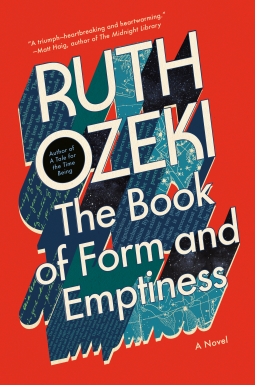
A brilliantly inventive new novel about loss, growing up, and our relationship with things, by the Booker Prize-finalist author of A Tale for the Time Being After the tragic death of his beloved musician father, fourteen-year-old Benny Oh begins to hear voices. The voices belong to the things in his house--a sneaker, a broken Christmas ornament, a piece of wilted lettuce. Although Benny doesn't understand what these things are saying, he can sense their emotional tone; some are pleasant, a gentle hum or coo, but others are snide, angry and full of pain. When his mother, Annabelle, develops a hoarding problem, the voices grow more clamorous.At first, Benny tries to ignore them, but soon the voices follow him outside the house, onto the street and at school, driving him at last to seek refuge in the silence of a large public library, where objects are well-behaved and know to speak in whispers. There, Benny discovers a strange new world, where "things happen." He falls in love with a mesmerizing street artist with a smug pet ferret, who uses the library as her performance space. He meets a homeless philosopher-poet, who encourages him to ask important questions and find his own voice amongst the many.And he meets his very own Book--a talking thing--who narrates Benny's life and teaches him to listen to the things that truly matter.With its blend of sympathetic characters, riveting plot, and vibrant engagement with everything from jazz, to climate change, to our attachment to material possessions, The Book of Form and Emptiness is classic Ruth Ozeki--bold, wise, poignant, playful, humane and heartbreaking.