22 Books Recommended
Ever since its first publication in 1992, The End of History and the Last Man has provoked controversy and debate. Francis Fukuyama's prescient analysis of religious fundamentalism, politics, scientific progress, ethical codes, and war is as essential for a world fighting fundamentalist terrorists as it was for the end of the Cold War. Now updated with a new afterword, The End of History and the Last Man is a modern classic.

Mathemagics: How to Look Like a Genius Without Really Trying
by Arthur T. Benjamin
Rating: 4.5 ⭐
• 2 recommendations ❤️
Secrets of lightning calculation and how to perform mind-boggling mental feats.
The Lonely Crowd: A Study of the Changing American Character, Abridged and Revised Edition
by David Riesman
Rating: 4.0 ⭐
• 1 recommendation ❤️
Considered by many to be one of the most influential books of the twentieth century, The Lonely Crowd opened exciting new dimensions in our understanding of the problems confronting the individual in twentieth-century America. Richard Sennett’s new introduction illuminates the ways in which Riesman’s analysis of a middle class obsessed with how others lived still resonates in the age of social media. “Indispensable reading for anyone who wishes to understand American society. After half a century, this book has lost none of its capacity to make sense of how we live.”—Todd Gitlin

2013 Reprint of 1959 Edition. Exact facsimile of the original edition, not reproduced with Optical Recognition Software. This is the publication of the influential 1959 Rede Lecture by British scientist and novelist C. P. Snow. Its thesis was that "the intellectual life of the whole of western society" was split into the titular two cultures - namely the sciences and the humanities - and that this was a major hindrance to solving the world's problems. Published in book form, Snow's lecture was widely read and discussed on both sides of the Atlantic, leading him to write a 1963 follow-up, "The Two Cultures: And a Second Look: An Expanded Version of The Two Cultures and the Scientific Revolution."

Librarian note: An alternative cover edition for this ASIN can be found here.Discover Joseph Heller's hilarious and tragic satire on military madness, and the tale of one man's efforts to survive it.It's the closing months of World War II and Yossarian has never been closer to death. Stationed in an American bomber squadron off the coast of Italy, each flight mission introduces him to thousands of people determined to kill him.But the enemy above is not Yossarian's problem - it is his own army intent on keeping him airborne, and the maddening 'Catch-22' that allows for no possibility of escape.The greatest satirical work in the English language' Observer

Beat the Dealer: A Winning Strategy for the Game of Twenty-One
by Edward O. Thorp
Rating: 4.2 ⭐
• 4 recommendations ❤️
The Book That Made Las Vegas Change the RulesOver 1,000,000 Copies in PrintEdward O. Thorp is the father of card counting, and in this classic guide he shares the revolutionary point system that has been successfully used by professional and amateur card players for generations. This book o an overview of the basic rules of the gameo proven winning strategies ranging from simple to advancedo methods to overcome casino counter measureso ways to spot cheating o charts and tables that clearly illustrate key conceptsA fascinating read and an indispensable resource for winning big, Beat the Dealer is the bible for players of this game of chance. **Bring these strategies into the Perforated cards included in the book**

Beat the Market: A Scientific Stock Market System
by Edward O. Thorp
Rating: 4.1 ⭐
• 2 recommendations ❤️
The book offers step-by-step instructions, with explanatory, charts and tables, whereby anyone with 2000.00$ brokerage account can conduct his own investment program. Details are given of actual investments made by the authors, one of whom more then doubled $100,000 in five years.

Discovering what you ought to do with your live; what you need to do for a living

Aerobics Program For Total Well-Being: Exercise, Diet , And Emotional Balance
by Kenneth H. Cooper
Rating: 4.2 ⭐
• 1 recommendation ❤️
From the medical authority, whose previous bestsellers ( Aerobics, The New Aerobics, The Aerobics Way, and Aerobics for Women ) have sold more than 12 million copies, comes an exciting, new and comprehensive concept for total fitness. . . . Millions have benefited from Dr. Cooper’s famous aerobic exercise programs. He has revolutionized the way Americans get in shape and stay in shape. Now, he presents a complete program for total well-being—physically, nutritionally, emotionally. Discover for yourself why it is the most effective, enjoyable and medically sound approach to a lifetime of energy and good health.A program designed to bring physical and emotional health and vitality to every area of your life, • the 7 benefits of integrated aerobic exercise, including reduced risk of heart disease• the 4 types of exercise that have been most radically re-evaluated in terms of aerobic exercise• the 3 dozen ways to stay fit, and the 4 steps to making it fun• 3 complete weeks of nutritious menus• guidelines for the 22 components of a comprehensive medical exam, so you can work with your doctor to evaluate your level of fitness• plus, the aerobics way to diminish physical and emotional stress, enhance your sex life, and more

The Unthinkable: Who Survives When Disaster Strikes - and Why
by Amanda Ripley
Rating: 4.2 ⭐
• 1 recommendation ❤️
Discover how human beings react to danger–and what makes the difference between life and deathToday, nine out of ten Americans live in places at significant risk of earthquakes, hurricanes, tornadoes, terrorism, or other disasters. Tomorrow, some of us will have to make split-second choices to save ourselves and our families. How will we react? What will it feel like? Will we be heroes or victims?In her quest to answer these questions, award-winning journalist Amanda Ripley traces human responses to some of recent history’s epic disasters, from the explosion of the Mont Blanc munitions ship in 1917–one of the biggest explosions before the invention of the atomic bomb–to the journeys of the 15,000 people who found their way out of the World Trade Center on September 11, 2001. To understand the science behind the stories, Ripley turns to leading brain scientists, trauma psychologists, and other disaster experts. She even has her own brain examined by military researchers and experiences, through realistic simulations, what it might be like to survive a plane crash into the ocean or to escape a raging fire.Ripley comes back with precious wisdom about the surprising humanity of crowds, the elegance of the brain’s fear circuits, and the stunning inadequacy of many of our evolutionary responses. Most unexpectedly, she discovers the brain’s ability to do much, much better–with just a little help.

Have you ever wondered how one day the media can assert that alcohol is bad for us and the next unashamedly run a story touting the benefits of daily alcohol consumption? Or how a drug that is pulled off the market for causing heart attacks ever got approved in the first place? How can average readers, who aren't medical doctors or Ph.D.s in biochemistry, tell what they should be paying attention to and what's, well, just more bullshit?Ben Goldacre has made a point of exposing quack doctors and nutritionists, bogus credentialing programs, and biased scientific studies. He has also taken the media to task for its willingness to throw facts and proof out the window. But he's not here just to tell you what's wrong. Goldacre is here to teach you how to evaluate placebo effects, double-blind studies, and sample sizes, so that you can recognize bad science when you see it. You're about to feel a whole lot better.

Poor Charlie's Almanack: The Wit and Wisdom of Charles T. Munger
by Charles T. Munger
Rating: 4.6 ⭐
• 37 recommendations ❤️
EXPANDED THIRD EDITION includes Charlie's 2007 USC Law School Commencement address. Edited by Peter D. Kaufman. Brand New.

More Money Than God: Hedge Funds and the Making of a New Elite (Council on Foreign Relations Books
by Sebastian Mallaby
Rating: 4.2 ⭐
• 9 recommendations ❤️
The New York Times bestseller“The bright light shed by More Money Than God is particularly welcome. Mr. Mallaby . . . brings a keen sense of financial theory to his subject and a vivid narrative style.” — Wall Street Journal“Splendid . . . the definitive history of the hedge fund history, a compelling narrative full of larger-than-life characters and dramatic tales of their financial triumphs and reversals.” — The Washington PostThe first authoritative history of hedge funds-from their rebel beginnings to their role in defining the future of finance, from the author of The Power LawWealthy, powerful, and potentially dangerous, hedge fund moguls have become the It Boys of twenty-first-century capitalism. Beating the market was long thought to be impossible, but hedge funds cracked its mysteries and made fortunes in the process. Drawing on his unprecedented access to the industry, esteemed financial writer Sebastian Mallaby tells the inside story of the hedge funds, from their origins in the 1960s to their role in the financial crisis of 2007 to 2009 — and explains why understanding the history of hedge funds is key to predicting the future of finance.
Major New York Times bestsellerWinner of the National Academy of Sciences Best Book Award in 2012Selected by the New York Times Book Review as one of the best books of 2011A Globe and Mail Best Books of the Year 2011 TitleOne of The Economist's 2011 Books of the Year One of The Wall Street Journal's Best Nonfiction Books of the Year 20112013 Presidential Medal of Freedom RecipientIn the international bestseller, Thinking, Fast and Slow, Daniel Kahneman, the renowned psychologist and winner of the Nobel Prize in Economics, takes us on a groundbreaking tour of the mind and explains the two systems that drive the way we think. System 1 is fast, intuitive, and emotional; System 2 is slower, more deliberative, and more logical. The impact of overconfidence on corporate strategies, the difficulties of predicting what will make us happy in the future, the profound effect of cognitive biases on everything from playing the stock market to planning our next vacation—each of these can be understood only by knowing how the two systems shape our judgments and decisions. Engaging the reader in a lively conversation about how we think, Kahneman reveals where we can and cannot trust our intuitions and how we can tap into the benefits of slow thinking. He offers practical and enlightening insights into how choices are made in both our business and our personal lives—and how we can use different techniques to guard against the mental glitches that often get us into trouble. Winner of the National Academy of Sciences Best Book Award and the Los Angeles Times Book Prize and selected by The New York Times Book Review as one of the ten best books of 2011, Thinking, Fast and Slow is destined to be a classic.

Political Order and Political Decay: From the Industrial Revolution to the Globalization of Democracy
by Francis Fukuyama
Rating: 4.4 ⭐
• 6 recommendations ❤️
The second volume of the bestselling landmark work on the history of the modern stateWriting in The Wall Street Journal , David Gress called Francis Fukuyama's Origins of Political Order "magisterial in its learning and admirably immodest in its ambition." In The New York Times Book Review , Michael Lind described the book as "a major achievement by one of the leading public intellectuals of our time." And in The Washington Post , Gerard DeGrott exclaimed "this is a book that will be remembered. Bring on volume two."Volume two is finally here, completing the most important work of political thought in at least a generation. Taking up the essential question of how societies develop strong, impersonal, and accountable political institutions, Fukuyama follows the story from the French Revolution to the so-called Arab Spring and the deep dysfunctions of contemporary American politics. He examines the effects of corruption on governance, and why some societies have been successful at rooting it out. He explores the different legacies of colonialism in Latin America, Africa, and Asia, and offers a clear-eyed account of why some regions have thrived and developed more quickly than others. And he boldly reckons with the future of democracy in the face of a rising global middle class and entrenched political paralysis in the West.A sweeping, masterful account of the struggle to create a well-functioning modern state, Political Order and Political Decay is destined to be a classic.

A Man for All Markets: From Las Vegas to Wall Street, How I Beat the Dealer and the Market
by Edward O. Thorp
Rating: 4.2 ⭐
• 2 recommendations ❤️
The incredible true story of the card-counting mathematics professor who taught the world how to beat the dealer and, as the first of the great quantitative investors, ushered in a revolution on Wall Street.A child of the Great Depression, legendary mathematician Edward O. Thorp invented card counting, proving the seemingly impossible: that you could beat the dealer at the blackjack table. As a result he launched a gambling renaissance. His remarkable success--and mathematically unassailable method--caused such an uproar that casinos altered the rules of the game to thwart him and the legions he inspired. They barred him from their premises, even put his life in jeopardy. Nonetheless, gambling was forever changed.Thereafter, Thorp shifted his sights to "the biggest casino in the world" Wall Street. Devising and then deploying mathematical formulas to beat the market, Thorp ushered in the era of quantitative finance we live in today. Along the way, the so-called godfather of the quants played bridge with Warren Buffett, crossed swords with a young Rudy Giuliani, detected the Bernie Madoff scheme, and, to beat the game of roulette, invented, with Claude Shannon, the world's first wearable computer.Here, for the first time, Thorp tells the story of what he did, how he did it, his passions and motivations, and the curiosity that has always driven him to disregard conventional wisdom and devise game-changing solutions to seemingly insoluble problems. An intellectual thrill ride, replete with practical wisdom that can guide us all in uncertain financial waters, A Man for All Markets is an instant classic--a book that challenges its readers to think logically about a seemingly irrational world.Praise for A Man for All Markets"In A Man for All Markets, [Thorp] delightfully recounts his progress (if that is the word) from college teacher to gambler to hedge-fund manager. Along the way we learn important lessons about the functioning of markets and the logic of investment."--The Wall Street Journal"[Thorp] gives a biological summation (think Richard Feynman's Surely You're Joking, Mr. Feynman!) of his quest to prove the aphorism 'the house always wins' is flawed. . . . Illuminating for the mathematically inclined, and cautionary for would-be gamblers and day traders"-- Library Journal

The Man Who Solved the Market: How Jim Simons Launched the Quant Revolution
by Gregory Zuckerman
Rating: 4.2 ⭐
• 6 recommendations ❤️
Gregory Zuckerman, the bestselling author of The Greatest Trade Ever and The Frackers, answers the question investors have been asking for decades: How did Jim Simons do it?Shortlisted for the Financial Times/McKinsey Business Book of the Year AwardJim Simons is the greatest money maker in modern financial history. No other investor--Warren Buffett, Peter Lynch, Ray Dalio, Steve Cohen, or George Soros--can touch his record. Since 1988, Renaissance's signature Medallion fund has generated average annual returns of 66 percent. The firm has earned profits of more than $100 billion; Simons is worth twenty-three billion dollars.Drawing on unprecedented access to Simons and dozens of current and former employees, Zuckerman, a veteran Wall Street Journal investigative reporter, tells the gripping story of how a world-class mathematician and former code breaker mastered the market. Simons pioneered a data-driven, algorithmic approach that's sweeping the world.As Renaissance became a market force, its executives began influencing the world beyond finance. Simons became a major figure in scientific research, education, and liberal politics. Senior executive Robert Mercer is more responsible than anyone else for the Trump presidency, placing Steve Bannon in the campaign and funding Trump's victorious 2016 effort. Mercer also impacted the campaign behind Brexit.The Man Who Solved the Market is a portrait of a modern-day Midas who remade markets in his own image, but failed to anticipate how his success would impact his firm and his country. It's also a story of what Simons's revolution means for the rest of us.

The Wolf at the Door: The Menace of Economic Insecurity and How to Fight It
by Michael J. Graetz
Rating: 4.1 ⭐
• 1 recommendation ❤️
The acclaimed authors of Death by a Thousand Cuts argue that Americans care less about inequality than about their own insecurity. Michael Graetz and Ian Shapiro propose realistic policies and strategies to make lives and communities more secure.This is an age of crisis. That much we can agree on. But a crisis of what? And how do we get out of it? Many on the right call for tax cuts and deregulation. Others on the left rage against the top 1 percent and demand wholesale economic change. Voices on both sides line up against globalization: restrict trade to protect jobs. In The Wolf at the Door, two leading political analysts argue that these views are badly mistaken.Michael Graetz and Ian Shapiro focus on what really worries people: not what the rich are making but rather their own insecurity and that of people close to them. Americans are concerned about losing what they have, whether jobs, status, or safe communities. They fear the wolf at the door. The solution is not protectionism or class warfare but a return to the hard work of building coalitions around realistic goals and pursuing them doggedly through the political system. This, Graetz and Shapiro explain, is how earlier reformers achieved meaningful changes, from the abolition of the slave trade to civil rights legislation. The authors make substantial recommendations for increasing jobs, improving wages, protecting families suffering from unemployment, and providing better health insurance and child care, and they guide us through the strategies needed to enact change.These are achievable reforms that would make Americans more secure. The Wolf at the Door is one of those rare books that not only diagnose our problems but also show us how we can address them.
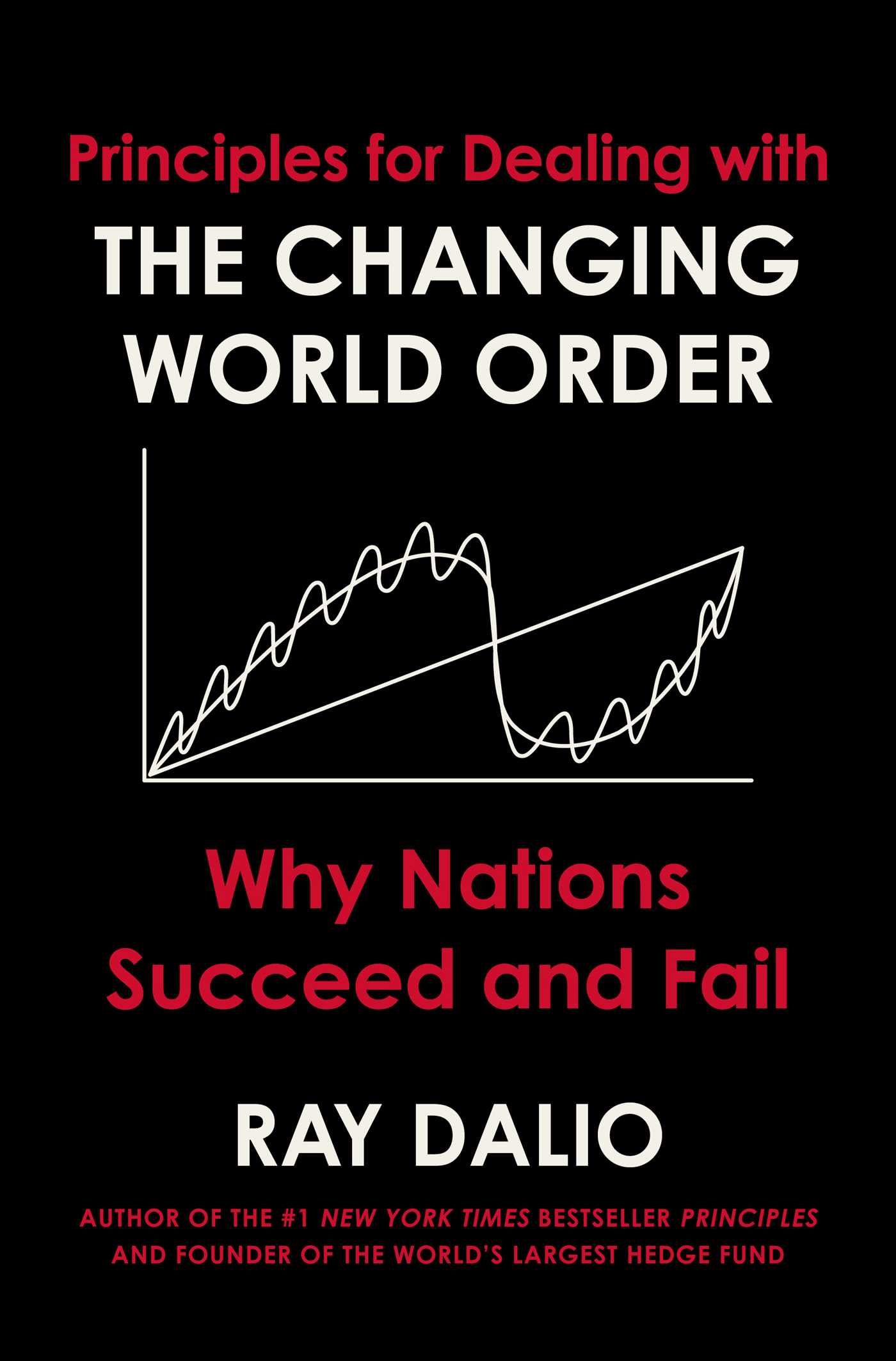
Principles for Dealing with the Changing World Order: Why Nations Succeed and Fail
by Ray Dalio
Rating: 4.3 ⭐
• 21 recommendations ❤️
From legendary investor Ray Dalio, author of the #1 New York Times bestseller Principles, who has spent half a century studying global economies and markets, Principles for Dealing with the Changing World Order examines history’s most turbulent economic and political periods to reveal why the times ahead will likely be radically different from those we’ve experienced in our lifetimes—and to offer practical advice on how to navigate them well.A few years ago, Ray Dalio noticed a confluence of political and economic conditions he hadn’t encountered before. They included huge debts and zero or near-zero interest rates that led to massive printing of money in the world’s three major reserve currencies; big political and social conflicts within countries, especially the US, due to the largest wealth, political, and values disparities in more than 100 years; and the rising of a world power (China) to challenge the existing world power (US) and the existing world order. The last time that this confluence occurred was between 1930 and 1945. This realization sent Dalio on a search for the repeating patterns and cause/effect relationships underlying all major changes in wealth and power over the last 500 years.In this remarkable and timely addition to his Principles series, Dalio brings readers along for his study of the major empires—including the Dutch, the British, and the American—putting into perspective the “Big Cycle” that has driven the successes and failures of all the world’s major countries throughout history. He reveals the timeless and universal forces behind these shifts and uses them to look into the future, offering practical principles for positioning oneself for what’s ahead.

Incerto: Fooled by Randomness, The Black Swan, The Bed of Procrustes, Antifragile, Skin in the Game
by Nassim Nicholas Taleb
Rating: 4.4 ⭐
• 5 recommendations ❤️
The landmark five-book series—all together in one boxed setThe Incerto is an investigation of opacity, luck, uncertainty, probability, human error, risk, and decision making when we don’t understand the world, expressed in the form of a personal essay with autobiographical sections, stories, parables, and philosophical, historical, and scientific discussions, in non-overlapping volumes that can be accessed in any order. The main thread is that while there is inordinate uncertainty about what is going on, there is great certainty as to what one should do about it.This boxed set includes:FOOLED BY RANDOMNESSTHE BLACK SWANTHE BED OF PROCRUSTESANTIFRAGILESKIN IN THE GAME

The Power Law: Venture Capital and the Making of the New Future
by Sebastian Mallaby
Rating: 4.4 ⭐
• 12 recommendations ❤️
Shortlisted for the Financial Times Business Book of the Year Named a Best Book of 2022 by The Economist“A gripping fly-on-the-wall story of the rise of this unique and important industry based on extensive interviews with some of the most successful venture capitalists.” - Daniel Rasmussen, Wall Street Journal“A must-read for anyone seeking to understand modern-day Silicon Valley and even our economy writ large.” -Bethany McLean, The Washington Post"A rare and unsettling look inside a subculture of unparalleled influence.” —Jane Mayer"A classic...A book of exceptional reporting, analysis and storytelling.” —Charles DuhiggFrom the New York Times bestselling author of More Money Than God comes the astonishingly frank and intimate story of Silicon Valley’s dominant venture-capital firms—and how their strategies and fates have shaped the path of innovation and the global economyInnovations rarely come from “experts.” Elon Musk was not an “electric car person” before he started Tesla. When it comes to improbable innovations, a legendary tech VC told Sebastian Mallaby, the future cannot be predicted , it can only be discovered . It is the nature of the venture-capital game that most attempts at discovery fail, but a very few succeed at such a scale that they more than make up for everything else. That extreme ratio of success and failure is the power law that drives the VC business, all of Silicon Valley, the wider tech sector, and, by extension, the world. In The Power Law , Sebastian Mallaby has parlayed unprecedented access to the most celebrated venture capitalists of all time—the key figures at Sequoia, Kleiner Perkins, Accel, Benchmark, and Andreessen Horowitz, as well as Chinese partnerships such as Qiming and Capital Today—into a riveting blend of storytelling and analysis that unfurls the history of tech incubation, in the Valley and ultimately worldwide. We learn the unvarnished truth, often for the first time, about some of the most iconic triumphs and infamous disasters in Valley history, from the comedy of errors at the birth of Apple to the avalanche of venture money that fostered hubris at WeWork and Uber. VCs’ relentless search for grand slams brews an obsession with the ideal of the lone entrepreneur-genius, and companies seen as potential “unicorns” are given intoxicating amounts of power, with sometimes disastrous results. On a more systemic level, the need to make outsized bets on unproven talent reinforces bias, with women and minorities still represented at woefully low levels. This does not just have social justice as Mallaby relates, China’s homegrown VC sector, having learned at the Valley’s feet, is exploding and now has more women VC luminaries than America has ever had. Still, Silicon Valley VC remains the top incubator of business innovation anywhere—it is not where ideas come from so much as where they go to become the products and companies that create the future. By taking us so deeply into the VCs’ game, The Power Law helps us think about our own future through their eyes.

The world's leading economist of inequality presents a short but sweeping and surprisingly optimistic history of human progress toward equality despite crises, disasters, and backsliding. A perfect introduction to the ideas developed in his monumental earlier books.It's easy to be pessimistic about inequality. We know it has increased dramatically in many parts of the world over the past two generations. No one has done more to reveal the problem than Thomas Piketty. Now, in this surprising and powerful new work, Piketty reminds us that the grand sweep of history gives us reasons to be optimistic. Over the centuries, he shows, we have been moving toward greater equality.Piketty guides us with elegance and concision through the great movements that have made the modern world for better and worse: the growth of capitalism, revolutions, imperialism, slavery, wars, and the building of the welfare state. It's a history of violence and social struggle, punctuated by regression and disaster. But through it all, Piketty shows, human societies have moved fitfully toward a more just distribution of income and assets, a reduction of racial and gender inequalities, and greater access to health care, education, and the rights of citizenship. Our rough march forward is political and ideological, an endless fight against injustice. To keep moving, Piketty argues, we need to learn and commit to what works, to institutional, legal, social, fiscal, and educational systems that can make equality a lasting reality. At the same time, we need to resist historical amnesia and the temptations of cultural separatism and intellectual compartmentalization. At stake is the quality of life for billions of people. We know we can do better, Piketty concludes. The past shows us how. The future is up to us.