
5 Books Recommended

Benjamin Franklin is the Founding Father who winks at us. An ambitious urban entrepreneur who rose up the social ladder, from leather-aproned shopkeeper to dining with kings, he seems made of flesh rather than of marble. In bestselling author Walter Isaacson's vivid and witty full-scale biography, we discover why Franklin seems to turn to us from history's stage with eyes that twinkle from behind his new-fangled spectacles. By bringing Franklin to life, Isaacson shows how he helped to define both his own time and ours.He was, during his 84-year life, America's best scientist, inventor, diplomat, writer, and business strategist, and he was also one of its most practical—though not most profound—political thinkers. He proved by flying a kite that lightning was electricity, and he invented a rod to tame it. He sought practical ways to make stoves less smoky and commonwealths less corrupt. He organized neighborhood constabularies and international alliances, local lending libraries and national legislatures. He combined two types of lenses to create bifocals and two concepts of representation to foster the nation's federal compromise. He was the only man who shaped all the founding documents of America: the Albany Plan of Union, the Declaration of Independence, the treaty of alliance with France, the peace treaty with England, and the Constitution. And he helped invent America's unique style of homespun humor, democratic values, and philosophical pragmatism.But the most interesting thing that Franklin invented, and continually reinvented, was himself. America's first great publicist, he was, in his life and in his writings, consciously trying to create a new American archetype. In the process, he carefully crafted his own persona, portrayed it in public, and polished it for posterity.Through it all, he trusted the hearts and minds of his fellow "leather-aprons" more than he did those of any inbred elite. He saw middle-class values as a source of social strength, not as something to be derided. His guiding principle was a "dislike of everything that tended to debase the spirit of the common people." Few of his fellow founders felt this comfort with democracy so fully, and none so intuitively.In this colorful and intimate narrative, Isaacson provides the full sweep of Franklin's amazing life, from his days as a runaway printer to his triumphs as a statesman, scientist, and Founding Father. He chronicles Franklin's tumultuous relationship with his illegitimate son and grandson, his practical marriage, and his flirtations with the ladies of Paris. He also shows how Franklin helped to create the American character and why he has a particular resonance in the twenty-first century.

How did Einstein's mind work? What made him a genius? Isaacson's biography shows how his scientific imagination sprang from the rebellious nature of his personality. His fascinating story is a testament to the connection between creativity and freedom.Based on the newly released personal letters of Albert Einstein, Walter Isaacson explores how an imaginative, impertinent patent clerk -- a struggling father in a difficult marriage who couldn't get a teaching job or a doctorate -- became the mind reader of the creator of the cosmos, the locksmith of the mysteries of the atom and the universe. His success came from questioning conventional wisdom and marveling at mysteries that struck others as mundane. This led him to embrace a morality and politics based on respect for free minds, free spirits, and free individuals.These traits are just as vital for this new century of globalization, in which our success will depend on our creativity, as they were for the beginning of the last century, when Einstein helped usher in the modern age.

Walter Isaacson’s “enthralling” ( The New Yorker ) worldwide bestselling biography of Apple cofounder Steve Jobs.Based on more than forty interviews with Steve Jobs conducted over two years—as well as interviews with more than 100 family members, friends, adversaries, competitors, and colleagues—Walter Isaacson has written a riveting story of the roller-coaster life and searingly intense personality of a creative entrepreneur whose passion for perfection and ferocious drive revolutionized six personal computers, animated movies, music, phones, tablet computing, and digital publishing. Isaacson’s portrait touched millions of readers.At a time when America is seeking ways to sustain its innovative edge, Jobs stands as the ultimate icon of inventiveness and applied imagination. He knew that the best way to create value in the twenty-first century was to connect creativity with technology. He built a company where leaps of the imagination were combined with remarkable feats of engineering.Although Jobs cooperated with the author, he asked for no control over what was written. He put nothing off-limits. He encouraged the people he knew to speak honestly. He himself spoke candidly about the people he worked with and competed against.His friends, foes, and colleagues offer an unvarnished view of the passions, perfectionism, obsessions, artistry, devilry, and compulsion for control that shaped his approach to business and the innovative products that resulted.His tale is instructive and cautionary, filled with lessons about innovation, character, leadership, and values.Steve Jobs is the inspiration for the movie of the same name starring Michael Fassbender, Kate Winslet, Seth Rogen, and Jeff Daniels, directed by Danny Boyle with a screenplay by Aaron Sorkin.

On a winter day in 1903, on the remote Outer Banks of North Carolina, two brothers changed history. But it would take the world some time to believe that The age of flight had begun, with the first heavier-than-air powered machine carrying a pilot.Far more than a couple of Dayton bicycle mechanics who happened to hit on success, Wilbur and Orville Wright were men of exceptional ability, unyielding determination, and far-ranging intellectual interest and curiosity. Two-time Pulitzer Prize winner David McCullough tells the dramatic story of how these courageous brothers taught the world how to fly - and how their devoted sister, Katherine, played a far more important role than has been generally understood.
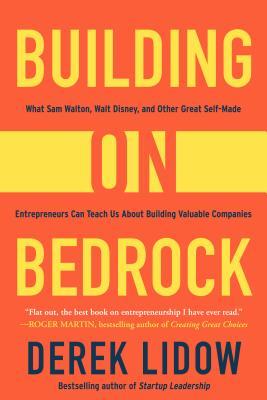
From Startup Leadership author, global CEO, and entrepreneurship expert Derek Lidow comes the new, foundational guide to entrepreneurial success. Here’s an astounding fact: Over half the working population will try their hand at being an entrepreneur during their working career.We all dream about achieving some combination of the fortune, fame, and control over our lives we associate with successful entrepreneurs. Those are admirable aspirations in a society that counts on entrepreneurs to innovate and create new jobs. Our work-driven culture encourages us to take the entrepreneurial bait, but how can you know whether being an entrepreneur will end as a dream come true or a nightmare from which you cannot wake?Building on Bedrock helps answer that question. Based upon research, but told through the stories of American entrepreneurs Sam Walton, Walt Disney, Estée Lauder, Ray Kroc, and others, Building on Bedrock will help you understand the elements most essential to taking the entrepreneurial leap. Was it luck, talent, passion, charm, a rich uncle, or something else that was the key to this person’s success? Which might be the key to your success? What you learn may surprise you.