
35 Books Recommended

The Happiness Hypothesis: Finding Modern Truth in Ancient Wisdom
by Jonathan Haidt
Rating: 4.1 ⭐
• 10 recommendations ❤️
In his widely praised book, award-winning psychologist Jonathan Haidt examines the world’s philosophical wisdom through the lens of psychological science, showing how a deeper understanding of enduring maxims-like Do unto others as you would have others do unto you, or What doesn’t kill you makes you stronger-can enrich and even transform our lives.
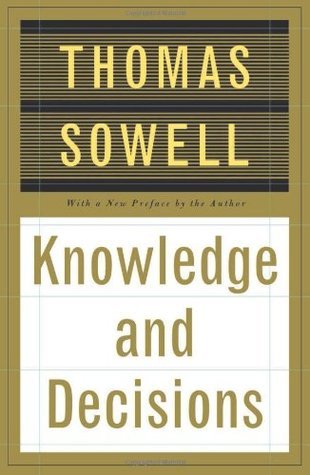
This reissue of Thomas Sowell's classic study of decision making, which includes a preface by the author, updates his seminal work in the context of The Vision of the Anointed. Sowell, one of America's most celebrated public intellectuals, describes in concrete detail how knowledge is shared and disseminated throughout modern society. He warns that society suffers from an ever-widening gap between firsthand knowledge and decision making--a gap that threatens not only our economic and political efficiency but our very freedom. This is because actual knowledge is being replaced by assumptions based on an abstract and elitist social vision of what ought to be. Knowledge and Decisions, a winner of the 1980 Law and Economics Center Prize, was heralded as a landmark work and selected for this prize "because of its cogent contribution to our understanding of the differences between the market process and the process of government." In announcing the award, the center acclaimed that the "contribution to our understanding of the process of regulation alone would make the book important, but in reemphasizing the diversity and efficiency that the market makes possible, [this] work goes deeper and becomes even more significant."

A Conflict of Visions: Ideological Origins of Political Struggles
by Thomas Sowell
Rating: 4.3 ⭐
• 4 recommendations ❤️
In this classic work, Thomas Sowell analyzes the two competing visions that shape our debates about the nature of reason, justice, equality, and power: the “constrained” vision, which sees human nature as unchanging and selfish, and the “unconstrained” vision, in which human nature is malleable and perfectible. He describes how these two radically opposed views have manifested themselves in the political controversies of the past two centuries, including such contemporary issues as welfare reform, social justice, and crime. Updated to include sweeping political changes since its first publication in 1987, this revised edition of A Conflict of Visions offers a convincing case that ethical and policy disputes circle around the disparity between both outlooks.

Conjectures and Refutations: The Growth of Scientific Knowledge
by Karl Popper
Rating: 4.2 ⭐
• 4 recommendations ❤️
Conjectures and Refutations is one of Karl Popper's most wide-ranging and popular works, notable not only for its acute insight into the way scientific knowledge grows, but also for applying those insights to politics and to history. It provides one of the clearest and most accessible statements of the fundamental idea that guided his work: not only our knowledge, but our aims and our standards, grow through an unending process of trial and error.

The Forgotten Man: A New History of the Great Depression
by Amity Shlaes
Rating: 4.1 ⭐
• 4 recommendations ❤️
It's difficult today to imagine how America survived the Great Depression. Only through the stories of the common people who struggled during that era can we really understand how the nation endured. These are the people at the heart of Amity Shlaes's insightful and inspiring history of one of the most crucial events of the twentieth century.In The Forgotten Man, Amity Shlaes, one of the nation's most respected economic commentators, offers a striking reinterpretation of the Great Depression. Rejecting the old emphasis on the New Deal, she turns to the neglected and moving stories of individual Americans, and shows how through brave leadership they helped establish the steadfast character we developed as a nation. Some of those figures were well known, at least in their day—Andrew Mellon, the Greenspan of the era; Sam Insull of Chicago, hounded as a scapegoat. But there were also unknowns: the Schechters, a family of butchers in Brooklyn who dealt a stunning blow to the New Deal; Bill W., who founded Alcoholics Anonymous in the name of showing that small communities could help themselves; and Father Divine, a black charismatic who steered his thousands of followers through the Depression by preaching a Gospel of Plenty.Shlaes also traces the mounting agony of the New Dealers themselves as they discovered their errors. She shows how both Presidents Hoover and Roosevelt failed to understand the prosperity of the 1920s and heaped massive burdens on the country that more than offset the benefit of New Deal programs. The real question about the Depression, she argues, is not whether Roosevelt ended it with World War II. It is why the Depression lasted so long. From 1929 to 1940, federal intervention helped to make the Depression great—in part by forgetting the men and women who sought to help one another.Authoritative, original, and utterly engrossing, The Forgotten Man offers an entirely new look at one of the most important periods in our history. Only when we know this history can we understand the strength of American character today.

An unimpeachable classic work in political philosophy, intellectual and cultural history, and economics, The Road to Serfdom has inspired and infuriated politicians, scholars, and general readers for half a century. Originally published in 1944—when Eleanor Roosevelt supported the efforts of Stalin, and Albert Einstein subscribed lock, stock, and barrel to the socialist program— The Road to Serfdom was seen as heretical for its passionate warning against the dangers of state control over the means of production. For F. A. Hayek, the collectivist idea of empowering government with increasing economic control would lead not to a utopia but to the horrors of Nazi Germany and Fascist Italy.First published by the University of Chicago Press on September 18, 1944, The Road to Serfdom garnered immediate, widespread attention. The first printing of 2,000 copies was exhausted instantly, and within six months more than 30,000 books were sold. In April 1945, Reader’s Digest published a condensed version of the book, and soon thereafter the Book-of-the-Month Club distributed this edition to more than 600,000 readers. A perennial best seller, the book has sold 400,000 copies in the United States alone and has been translated into more than twenty languages, along the way becoming one of the most important and influential books of the century.With this new edition, The Road to Serfdom takes its place in the series The Collected Works of F. A. Hayek. The volume includes a foreword by series editor and leading Hayek scholar Bruce Caldwell explaining the book's origins and publishing history and assessing common misinterpretations of Hayek's thought. Caldwell has also standardized and corrected Hayek's references and added helpful new explanatory notes. Supplemented with an appendix of related materials ranging from prepublication reports on the initial manuscript to forewords to earlier editions by John Chamberlain, Milton Friedman, and Hayek himself, this new edition of The Road to Serfdom will be the definitive version of Hayek's enduring masterwork.

Hayek gives the main arguments for the free-market case and presents his manifesto on the "errors of socialism." Hayek argues that socialism has, from its origins, been mistaken on factual, and even on logical, grounds and that its repeated failures in the many different practical applications of socialist ideas that this century has witnessed were the direct outcome of these errors. He labels as the "fatal conceit" the idea that "man is able to shape the world around him according to his wishes.""The achievement of The Fatal Conceit is that it freshly shows why socialism must be refuted rather than merely dismissed—then refutes it again."—David R. Henderson, Fortune."Fascinating. . . . The energy and precision with which Mr. Hayek sweeps away his opposition is impressive."—Edward H. Crane, Wall Street JournalF. A. Hayek is considered a pioneer in monetary theory, the preeminent proponent of the libertarian philosophy, and the ideological mentor of the Reagan and Thatcher "revolutions."

50th ANNIVERSARY EDITION—WITH A NEW INTRODUCTION BY FRANCIS FORD COPPOLAMario Puzo’s classic saga of an American crime family that became a global phenomenon—nominated as one of America’s best-loved novels by PBS’s The Great American Read.With its brilliant and brutal portrayal of the Corleone family, The Godfather burned its way into our national consciousness. This unforgettable saga of crime and corruption, passion and loyalty continues to stand the test of time, as the definitive novel of the Mafia underworld.A #1 New York Times bestseller in 1969, Mario Puzo’s epic was turned into the incomparable film of the same name, directed by Francis Ford Coppola, which won the Academy Award for Best Picture. It is the original classic that has been often imitated, but never matched. A tale of family and society, law and order, obedience and rebellion, it reveals the dark passions of human nature played out against a backdrop of the American dream.With a Note from Anthony Puzo and an Afterword by Robert J. Thompson

Personal Knowledge: Towards a Post-Critical Philosophy
by Michael Polanyi
Rating: 3.8 ⭐
• 2 recommendations ❤️
The publication of Personal Knowledge in 1958 shook the science world, as Michael Polanyi took aim at the long-standing ideals of rigid empiricism and rule-bound logic. Today, Personal Knowledge remains one of the most significant philosophy of science books of the twentieth century, bringing the crucial concepts of “tacit knowledge” and “personal knowledge” to the forefront of inquiry.In this remarkable treatise, Polanyi attests that our personal experiences and ways of sharing knowledge have a profound effect on scientific discovery. He argues against the idea of the wholly dispassionate researcher, pointing out that even in the strictest of sciences, knowing is still an art, and that personal commitment and passion are logically necessary parts of research. In our technological age where fact is split from value and science from humanity, Polanyi’s work continues to advocate for the innate curiosity and scientific leaps of faith that drive our most dazzling ingenuity.For this expanded edition, Polyani scholar Mary Jo Nye set the philosopher-scientist’s work into contemporary context, offering fresh insights and providing a helpful guide to critical terms in the work. Used in fields as diverse as religious studies, chemistry, economics, and anthropology, Polanyi’s view of knowledge creation is just as relevant to intellectual endeavors today as when it first made waves more than fifty years ago.

Respected author, scholar, and columnist Charles Murray has long challenged accepted notions of public and social policy issues. In this volume, originally published in 1988, Murray presents a persuasive and practical argument that reconsiders commonly held beliefs of what constitutes success in social policy by examining the scope of government and its role in people’s pursuit of happiness. In Of Happiness and Good Government begins by examining James Madison’s “A good government implies two things; first, fidelity to the object of government, which is the happiness of the people; secondly, a knowledge of the means by which that object can best be attained.” Murray exhibits a thoughtful, accessible writing style as he considers such basic, important questions as whether individual efforts or government reform should be responsible for dealing with society’s problems. Drawing from his minimalist-government viewpoint, Murray proposes that government not try to force happiness on the people with federal policies or programs but, rather, that it provide conditions that enable people to pursue happiness on their own. Murray also proposes that the pursuit of happiness be used as a framework for analyzing the efficacy of public policy, and he comes to the conclusion that Jeffersonian democracy is still the best way to run society, even today’s complex society. Charles Murray is the W. H. Brady Scholar at the American Enterprise Institute for Public Policy Research. He has written numerous books, including Coming Apart, Losing Ground, Real Education , and Human Accomplishment . He is perhaps best known for coauthoring the 1994 New York Times bestseller The Bell Curve with the late Richard J. Herrnstein.

How the West Grew Rich: The Economic Transformation Of The Industrial World
by Nathan Rosenberg
Rating: 3.7 ⭐
• 2 recommendations ❤️
How did the West—Europe, Canada, and the United States—escape from immemorial poverty into sustained economic growth and material well-being when other societies remained trapped in an endless cycle of birth, hunger, hardship, and death? In this elegant synthesis of economic history, two scholars argue that it is the political pluralism and the flexibility of the West's institutions—not corporate organization and mass production technology—that explain its unparalleled wealth.

Revised EditionThe history of the 20th century is marked by two great narratives: nations locked in savage wars over ideology and territory, and scientists overturning the received wisdom of preceding generations. For Paul Johnson, the modern era begins with one of the second types of revolutions, in 1919, when English astronomer Sir Arthur Eddington translated observations from a solar eclipse into proof of Albert Einstein's general theory of relativity, which turned Newtonian physics on its head. Eddington's research became an international cause célèbre: "No exercise in scientific verification, before or since, has ever attracted so many headlines or become a topic of universal conversation," Johnson writes, and it made Einstein into science's first real folk hero. Einstein looms large over Johnson's narrative, as do others who sought to harness the forces of nature and society: men like Mao Zedong, "a big, brutal, earthy and ruthless peasant," and Adolf Hitler, creator of "a brutal, secure, conscience-less, successful, and, for most Germans, popular regime." Johnson takes a contentious conservative viewpoint throughout: he calls the 1960s "America's suicide attempt," deems the Watergate affair "a witch-hunt ... run by liberals in the media," and deems the rise of Margaret Thatcher a critical element in Western civilization's "recovery of freedom"--arguable propositions all, but ones advanced in a stimulating and well-written narrative that provides much food for thought in the course of its more than 800 pages. --Gregory McNamee

One of William Faulkner's finest novels, As I Lay Dying was originally published in 1930, and remains a captivating and stylistically innovative work. The story revolves around a grim yet darkly humorous pilgrimage, as Addie Bundren's family sets out to fulfill her last wish: to be buried in her native Jefferson, Mississippi, far from the miserable backwater surroundings of her married life. Told through multiple voices, it vividly brings to life Faulkner's imaginary South, one of the great invented landscapes in all of literature, and is replete with the poignant, impoverished, violent, and hypnotically fascinating characters that were his trademark.

The quintessential novel of the Lost Generation, The Sun Also Rises is one of Ernest Hemingway's masterpieces and a classic example of his spare but powerful writing style. A poignant look at the disillusionment and angst of the post-World War I generation, the novel introduces two of Hemingway's most unforgettable characters: Jake Barnes and Lady Brett Ashley. The story follows the flamboyant Brett and the hapless Jake as they journey from the wild nightlife of Paris to the brutal bullfighting rings of Spain with a motley group of expatriates. It is an age of moral bankruptcy, spiritual dissolution, unrealized love, and vanishing illusions. The Sun Also Rises helped to establish Hemingway as one of the greatest writers of the twentieth century.

Originally published by Yale University Press in 1944, Bureaucracy is a classic fundamental examination of the nature of bureaucracies and free markets in juxtaposition to various political systems. Bureaucracy contrasts the two forms of economic management—that of a free market economy and that of a bureaucracy. In the market economy entrepreneurs are driven to serve consumers by their desire to earn profits and to avoid losses. In a bureaucracy, the managers must comply with orders issued by the legislative body under which they operate; they may not spend without authorization and they may not deviate from the path prescribed by law.Writing in an age of exuberant socialism, Ludwig von Mises here lucidly demonstrates how the efficiencies of private ownership and control of public good production ultimately trump the guesswork of publicly administered “planning” through codes and “officialdom.” Although Mises aptly critiques bureaucracy and expounds thoroughly upon the immense power of law-like codes of commissions and administrations, he does not condemn nor dismiss bureaucracy but rather frames its proper bounds within constitutional democratic governments.Ludwig von Mises (1881–1973) was the leading spokesman of the Austrian School of Economics throughout most of the twentieth century. He earned his doctorate in law and economics from the University of Vienna in 1906. In 1926, Mises founded the Austrian Institute for Business Cycle Research. From 1909 to 1934, he was an economist for the Vienna Chamber of Commerce. Before the Anschluss, in 1934 Mises left for Geneva, where he was a professor at the Graduate Institute of International Studies until 1940, when he emigrated to New York City. From 1948 to 1969, he was a visiting professor at New York University.Bettina Bien Greaves is a former resident scholar, trustee, and longtime staff member of the Foundation for Economic Education. She has written and lectured extensively on topics of free market economics. Her articles have appeared in such journals as Human Events, Reason, and The Freeman: Ideas on Liberty. A student of Mises, Greaves has become an expert on his work in particular and that of the Austrian School of economics in general. She has translated several Mises monographs, compiled an annotated bibliography of his work, and edited collections of papers by Mises and other members of the Austrian School.

by Don Lavoie; George Mason University. Ballinger Publishing Company, Cambridge, Massachusetts, A Subsidiary of Harper & Row, Publishers, Inc.

Don't Miss the Original Series Tom Clancy's Jack Ryan Starring John Krasinski! The #1 New York Times bestseller that launched the phenomenal career of Tom Clancy--the gripping military thriller that introduced the world to his unforgettable hero, Jack Ryan.Somewhere under the freezing Atlantic, a Soviet sub commander has just made a fateful decision. The Red October is heading west. The Americans want her. The Russians want her back. The chase for the highly advanced nuclear submarine is on--and there's only one man who can find her...Brilliant CIA analyst Jack Ryan has little interest in fieldwork, but when covert photographs of Red October land on his desk, Ryan soon finds himself in the middle of a high-stakes game of hide-and-seek played by two world powers--a game that could end in all-out war.

In this classic, John le Carre's third novel and the first to earn him international acclaim, he created a world unlike any previously experienced in suspense fiction. With unsurpassed knowledge culled from his years in British Intelligence, le Carre brings to light the shadowy dealings of international espionage in the tale of a British agent who longs to end his career but undertakes one final, bone-chilling assignment. When the last agent under his command is killed and Alec Leamas is called back to London, he hopes to come in from the cold for good. His spymaster, Control, however, has other plans. Determined to bring down the head of East German Intelligence and topple his organization, Control once more sends Leamas into the fray -- this time to play the part of the dishonored spy and lure the enemy to his ultimate defeat.

Heaven on Earth: The Rise, Fall, and Afterlife of Socialism
by Joshua Muravchik
Rating: 4.3 ⭐
• 2 recommendations ❤️
Socialism was man's most ambitious attempt to supplant religion with a doctrine claiming to ground itself in "science." Each failure to create societies of abundance or give birth to "the New Man" inspired more searching for the path to the promised land: revolution, communes, social democracy, communism, fascism, Arab socialism, African socialism. None worked, and some exacted a staggering human toll. Then, after two centuries of wishful thinking and bitter disappointment, socialism imploded in a fin de si�cle drama of falling walls and collapsing regimes. It was an astonishing denouement but what followed was no less astonishing. After the hiatus of a couple of decades, new voices were raised, as if innocent of all that had come before, proposing to try it all over again.Joshua Muravchik traces the pursuit of this phantasm, presenting sketches of the thinkers and leaders who developed the theory, led it to power, and presided over its collapse, as well as those who are trying to revive it today. Heaven on Earth is a story filled with character and event while at the same time giving us an epic chronicle of a movement that tried to turn the world upside down--and for a time succeeded.

A spellbinding amalgam of murder mystery, family saga, love story, and financial intrigue.It's about the disappearance forty years ago of Harriet Vanger, a young scion of one of the wealthiest families in Sweden...and about her octogenarian uncle, determined to know the truth about what he believes was her murder.It's about Mikael Blomkvist, a crusading journalist recently at the wrong end of a libel case, hired to get to the bottom of Harriet's disappearance...and about Lisbeth Salander, a twenty-four-year old pierced and tattooed genius hacker possessed of the hard-earned wisdom of someone twice her age, who assists Blomkvist with the investigation. This unlikely team discovers a vein of nearly unfathomable iniquity running through the Vanger family, astonishing corruption in the highest echelons of Swedish industrialism, and an unexpected connection between themselves.(front flap)

2012 Reprint of 1949 Edition. Exact facsimile of the original edition, not reproduced with Optical Recognition Software. "Human Action: A Treatise on Economics" is the first comprehensive treatise on economics written by a leading member of the modern Austrian school of economics. Von Mises contribution was very simple, yet at the same time extremely profound: he pointed out that the whole economy is the result of what individuals do. Individuals act, choose, cooperate, compete, and trade with one another. In this way Mises explained how complex market phenomena develop. Mises did not simply describe economic phenomena - prices, wages, interest rates, money, monopoly and even the trade cycle - he explained them as the outcomes of countless conscious, purposive actions, choices, and preferences of individuals, each of whom was trying as best as he or she could under the circumstances to attain various wants and ends and to avoid undesired consequences. Hence the title Mises chose for his economic treatise, "Human Action."

In Paris, a physicist dies after performing a laboratory experiment for a beautiful visitor. In the jungles of Malaysia, a mysterious buyer purchases deadly cavitation technology, built to his specifications. In Vancouver, a small research submarine is leased for use in the waters off New Guinea. And in Tokyo, an intelligence agent tries to understand what it all means. Thus begins Michael Crichton's exciting and provocative technothriller, State of Fear . Only Michael Crichton's unique ability to blend science fact and pulse-pounding fiction could bring such disparate elements to a heart-stopping conclusion. This is Michael Crichton's most wide-ranging thriller. State of Fear takes the reader from the glaciers of Iceland to the volcanoes of Antarctica, from the Arizona desert to the deadly jungles of the Solomon Islands, from the streets of Paris to the beaches of Los Angeles. The novel races forward, taking the reader on a rollercoaster thrill ride, all the while keeping the brain in high gear. Gripping and thought-provoking, State of Fear is Michael Crichton at his very best.

The setting is Atlanta, Georgia — a racially mixed, late-century boomtown full of fresh wealth and wily politicians. The protagonist is Charles Croker, once a college football star, now a late-middle-aged Atlanta conglomerate king whose outsize ego has at last hit up against reality. Charlie has a 29,000 acre quail-shooting plantation, a young and demanding second wife, and a half-empty office complex with a staggering load of debt.Meanwhile, Conrad Hensley, idealistic young father of two, is laid off from his job at the Croker Global Foods warehouse near Oakland and finds himself spiraling into the lower depths of the American legal system.And back in Atlanta, when star Georgia Tech running back Fareek “the Canon” Fanon, a homegrown product of the city’s slums, is accused of date-raping the daughter of a pillar of the white establishment, upscale black lawyer Roger White II is asked to represent Fanon and help keep the city’s delicate racial balance from blowing sky-high.Networks of illegal Asian immigrants crisscrossing the continent, daily life behind bars, shady real estate syndicates — Wolfe shows us contemporary America with all the verve, wit, and insight that have made him our most admired novelist. Charlie Croker’s deliverance from his tribulations provides an unforgettable denouement to the most widely awaited, hilarious and telling novel America has seen in ages — Tom Wolfe’s most outstanding achievement to date.

Frames of Mind: The Theory of Multiple Intelligences
by Howard Gardner
Rating: 4.0 ⭐
• 2 recommendations ❤️
The book that revolutionized our understanding of human intelligence.Howard Gardner's theory of multiple intelligences has been hailed by educators for decades and applied in hundreds of schools worldwide. In Frames of Mind , Gardner challenges the widely held notion that intelligence is a single general capacity possessed by every individual to a greater or lesser extent. Amassing a wealth of evidence, Gardner posits the existence of eight different intelligences, each as important as the next, that comprise a unique cognitive profile for each person. In this updated edition, the author reflects on thirty years of work on Multiple Intelligences theory and practice.

The Law was originally published in 1850, and considered the work for which Bastiat is best known. This is an unabridged edition -

The wellsprings of desire and the impediments to love come brilliantly into focus in Evelyn Waugh's masterpiece -- a novel that immerses us in the glittering and seductive world of English aristocracy in the waning days of the empire.Through the story of Charles Ryder's entanglement with the Flytes, a great Catholic family, Evelyn Waugh charts the passing of the privileged world he knew in his own youth and vividly recalls the sensuous pleasures denied him by wartime austerities. At once romantic, sensuous, comic, and somber, Brideshead Revisited transcends Waugh's early satiric explorations and reveals him to be an elegiac, lyrical novelist of the utmost feeling and lucidity."A genuine literary masterpiece." --Time "Heartbreakingly beautiful...The twentieth century's finest English novel." --Los Angeles TimesSelected by Modern Library as one of the 100 best novels of the century and called "Evelyn Waugh's finest achievement" by the New York Times, Brideshead Revisited is a stunning exploration of desire, duty, and memory.

A love story, an adventure, and an epic of the frontier, Larry McMurtry’s Pulitzer Prize— winning classic, Lonesome Dove, the third book in the Lonesome Dove tetralogy, is the grandest novel ever written about the last defiant wilderness of America. Journey to the dusty little Texas town of Lonesome Dove and meet an unforgettable assortment of heroes and outlaws, whores and ladies, Indians and settlers. Richly authentic, beautifully written, always dramatic, Lonesome Dove is a book to make us laugh, weep, dream, and remember.

Leather Binding on Spine and Corners with Golden Leaf Printing on round Spine (extra customization on request like complete leather, Golden Screen printing in Front, Color Leather, Colored book etc.) Reprinted in 2018 with the help of original edition published long back [1957]. This book is printed in black & white, sewing binding for longer life, Printed on high quality Paper, re-sized as per Current standards, professionally processed without changing its contents. As these are old books, we processed each page manually and make them readable but in some cases some pages which are blur or missing or black spots. If it is multi volume set, then it is only single volume, if you wish to order a specific or all the volumes you may contact us. We expect that you will understand our compulsion in these books. We found this book important for the readers who want to know more about our old treasure so we brought it back to the shelves. Hope you will like it and give your comments and suggestions. - English, Pages 130. EXTRA 10 DAYS APART FROM THE NORMAL SHIPPING PERIOD WILL BE REQUIRED FOR LEATHER BOUND BOOKS. COMPLETE LEATHER WILL COST YOU EXTRA US$ 25 APART FROM THE LEATHER BOUND BOOKS. {FOLIO EDITION IS ALSO AVAILABLE.} Complete Why wages rise. 1957 Harper, F. A. -.

The Science of Liberty: Democracy, Reason and the Laws of Nature
by Timothy Ferris
Rating: 3.9 ⭐
• 2 recommendations ❤️
“Ferris is a master analogist who conveys his insights on the history of cosmology with a lyrical flair.” — The New York Times Book Review In The Science of Liberty , award-winning author Timothy Ferris—called “the best popular science writer in the English language today” by the Christian Science Monitor and “the best science writer of his generation” by the Washington Post —makes a passionate case for science as the inspiration behind the rise of liberalism and democracy. In the grand tradition of such luminaries of the field as Bill Bryson, Richard Dawkins, and Oliver Sacks—as well as his own The Whole Shebang and Coming of Age in the Milky Way —Ferris has written a brilliant chronicle of how science sparked the spread of liberal democracy and transformed today’s world.

The #1 New York Times bestselling novel that picks up where the “tight, right, and dynamite” ( Star Tribune , Minneapolis) The Last Man left off, The Survivor is a no-holds-barred race to save America…and Mitch Rapp’s finest battle.When Joe “Rick” Rickman, former golden boy of the CIA, steals a massive amount of the Agency’s most classified documents in an elaborate betrayal of his country, CIA director Irene Kennedy has no choice but to send her most dangerous weapon after elite covert operative Mitch Rapp.Rapp quickly dispatches with the traitor, but Rickman proves to be a deadly threat to America even from beyond the grave. In fact, mysterious tip-offs are appearing all over the world, linking to the potentially devastating data that Rickman managed to store somewhere only he knew.It’s a deadly race to the finish as both the Pakistanis and the Americans search desperately for Rickman’s accomplices, and for the confidential documents they are slowly leaking to the world. To save his country from being held hostage to a country set on becoming the world’s newest nuclear superpower, Mitch Rapp must outrun, outthink, and outgun his deadliest enemies yet in this heart-pounding adventure that proves that Vince Flynn “is a master—maybe the master—of thrillers in which the pages seem to turn themselves” ( Bookreporter ).

The Upright Thinkers: The Human Journey from Living in Trees to Understanding the Cosmos
by Leonard Mlodinow
Rating: 3.9 ⭐
• 4 recommendations ❤️
How did a near-extinct species, eking out a meager existence with stone axes, become the dominant power on earth, able to harness a knowledge of nature ranging from tiny atoms to the vast structures of the universe? Leonard Mlodinow takes us on an enthralling tour of the history of human progress, from our time on the African savannah through the invention of written language, all the way to modern quantum physics. Along the way, he explores the colorful personalities of the great philosophers, scientists, and thinkers, and traces the cultural conditions—and the elements of chance—that influenced scientific discovery.Deeply informed, accessible, and infused with the author’s trademark humor and insight, The Upright Thinkers is a stunning tribute to humanity’s intellectual curiosity and an important book for any reader with an interest in the scientific issues of our day.

“Mr. Ridley’s best and most important work to date…there is something profoundly democratic and egalitarian—even anti-elitist—in this bottom-up Everyone can have a role in bringing about change.” — Wall Street Journal The New York Times bestselling author of The Rational Optimist and Genome returns with a fascinating argument for evolution that definitively dispels a dangerous, widespread that we can command and control our world Human society evolves. Change in technology, language, morality, and society is incremental, inexorable, gradual, and spontaneous. It follows a narrative, going from one stage to the next, and it largely happens by trial and error—a version of natural selection. Much of the human world is the result of human action but not of human it emerges from the interactions of millions, not from the plans of a few. Drawing on fascinating evidence from science, economics, history, politics, and philosophy, Matt Ridley demolishes conventional assumptions that the great events and trends of our day are dictated by those on high. On the contrary, our most important achievements develop from the bottom up. The Industrial Revolution, cell phones, the rise of Asia, and the Internet were never planned; they happened. Languages emerged and evolved by a form of natural selection, as did common law. Torture, racism, slavery, and pedophilia—all once widely regarded as acceptable—are now seen as immoral despite the decline of religion in recent decades. In this wide-ranging, erudite book, Ridley brilliantly makes the case for evolution, rather than design, as the force that has shaped much of our culture, our technology, our minds, and that even now is shaping our future.

America's War for the Greater Middle East: A Military History
by Andrew J. Bacevich
Rating: 4.3 ⭐
• 2 recommendations ❤️
LONGLISTED FOR THE NATIONAL BOOK AWARD - A searing reassessment of U.S. military policy in the Middle East over the past four decades from retired army colonel and New York Times bestselling author Andrew J. Bacevich From the end of World War II until 1980, virtually no American soldiers were killed in action while serving in the Greater Middle East. Since 1990, virtually no American soldiers have been killed in action anywhere else. What caused this shift? Andrew J. Bacevich, one of the country's most respected voices on foreign affairs, offers an incisive critical history of this ongoing military enterprise--now more than thirty years old and with no end in sight.During the 1980s, Bacevich argues, a great transition occurred. As the Cold War wound down, the United States initiated a new conflict--a War for the Greater Middle East--that continues to the present day. The long twilight struggle with the Soviet Union had involved only occasional and sporadic fighting. But as this new war unfolded, hostilities became persistent. From the Balkans and East Africa to the Persian Gulf and Central Asia, U.S. forces embarked upon a seemingly endless series of campaigns across the Islamic world. Few achieved anything remotely like conclusive success. Instead, actions undertaken with expectations of promoting peace and stability produced just the opposite. As a consequence, phrases like "permanent war" and "open-ended war" have become part of everyday discourse.Connecting the dots in a way no other historian has done before, Bacevich weaves a compelling narrative out of episodes as varied as the Beirut bombing of 1983, the Mogadishu firefight of 1993, the invasion of Iraq in 2003, and the rise of ISIS in the present decade. Understanding what America's costly military exertions have wrought requires seeing these seemingly discrete events as parts of a single war. It also requires identifying the errors of judgment made by political leaders in both parties and by senior military officers who share responsibility for what has become a monumental march to folly. This Bacevich unflinchingly does.A twenty-year army veteran who served in Vietnam, Andrew J. Bacevich brings the full weight of his expertise to this vitally important subject. America's War for the Greater Middle East is a bracing after-action report from the front lines of history. It will fundamentally change the way we view America's engagement in the world's most volatile region.Praise for America's War for the Greater Middle East"Bacevich is thought-provoking, profane and fearless. . . . [His] call for Americans to rethink their nation's militarized approach to the Middle East is incisive, urgent and essential."--The New York Times Book Review"Bacevich's magnum opus . . . a deft and rhythmic polemic aimed at America's failures in the Middle East from the end of Jimmy Carter's presidency to the present."--Robert D. Kaplan, The Wall Street Journal"A critical review of American policy and military involvement . . . Those familiar with Bacevich's work will recognize the clarity of expression, the devastating directness and the coruscating wit that characterize the writing of one of the most articulate and incisive living critics of American foreign policy."--The Washington Post"[A] monumental new work."--The Huffington Post"An unparalleled historical tour de force certain to affect the formation of future U.S. foreign policy."--Lieutenant General Paul K. Van Riper, U.S. Marine Corps (Ret.)

The Politics Industry: How Political Innovation Can Break Partisan Gridlock and Save Our Democracy
by Katherine M. Gehl
Rating: 4.3 ⭐
• 6 recommendations ❤️
Leading political innovation activist Katherine Gehl and world-renowned business strategist Michael Porter bring fresh perspective, deep scholarship, and a real and actionable solution, Final Five Voting, to the grand challenge of our broken political and democratic system. Final Five Voting has already been adopted in Alaska and is being advanced in states across the country. The truth is, the American political system is working exactly how it is designed to work, and it isn't designed or optimized today to work for us—for ordinary citizens. Most people believe that our political system is a public institution with high-minded principles and impartial rules derived from the Constitution. In reality, it has become a private industry dominated by a textbook duopoly—the Democrats and the Republicans—and plagued and perverted by unhealthy competition between the players. Tragically, it has therefore become incapable of delivering solutions to America's key economic and social challenges. In fact, there's virtually no connection between our political leaders solving problems and getting reelected. In The Politics Industry , business leader and path-breaking political innovator Katherine Gehl and world-renowned business strategist Michael Porter take a radical new approach. They ingeniously apply the tools of business analysis—and Porter's distinctive Five Forces framework—to show how the political system functions just as every other competitive industry does, and how the duopoly has led to the devastating outcomes we see today. Using this competition lens, Gehl and Porter identify the most powerful lever for change—a strategy comprised of a clear set of choices in two key how our elections work and how we make our laws. Their bracing assessment and practical recommendations cut through the endless debate about various proposed fixes, such as term limits and campaign finance reform. The true political innovation. The Politics Industry is an original and completely nonpartisan guide that will open your eyes to the true dynamics and profound challenges of the American political system and provide real solutions for reshaping the system for the benefit of all. THE INSTITUTE FOR POLITICAL INNOVATIONThe authors will donate all royalties from the sale of this book to the Institute for Political Innovation.

The republic of science, its political and economic theory;: A lecture delivered at Roosevelt University, January, 11, 1962
by Michael Polanyi
• 2 recommendations ❤️
A lecture delivered at Roosevelt University January 11, 1962. A favorite of Charles Koch; according to the Charles Koch Institute web site, it "is the text that best illustrates what Koch is trying to do with his massive personal fortune."