6 Books Recommended

A new edition of a classic stock market guide offers clear explanations and reasonable and understandable advice on investments, updating information to cover new regulations and new opportunities. Simultaneous. 30,000 first printing.

This short treatise looks at how we construct a social reality from our sense impressions; at how, for example, we construct a 'five-pound note' with all that implies in terms of value and social meaning, from the printed piece of paper we see and touch. "John Searle has a distinctive intellectual style. It combines razor-sharp analysis with a swaggering chip-on-the-shoulder impudence that many of his opponents might find intolerably abrasive were it not for the good humour that pervades all he writes. This is a man who likes a good philosophical brawl." --New Scientist

Trading Bases: How a Wall Street Trader Made a Fortune Betting on Baseball
by Joe Peta
Rating: 4.1 ⭐
• 4 recommendations ❤️
An ex–Wall Street trader improved on Moneyball’s famed sabermetrics and beat the Vegas odds with his own betting methods. Here is the story of how Joe Peta turned fantasy baseball into a dream come true. Joe Peta turned his back on his Wall Street trading career to pursue an ingenious—and incredibly risky—dream. He would apply his risk-analysis skills to Major League Baseball, and treat the sport like the S&P 500. In Trading Bases, Peta takes us on his journey from the ballpark in San Francisco to the trading floors and baseball bars of New York and the sportsbooks of Las Vegas, telling the story of how he created a baseball “hedge fund” with an astounding 41 percent return in his first year. And he explains the unique methods he developed. Along the way, Peta provides insight into the Wall Street crisis he managed to escape: the fragility of the midnineties investment model; the disgraced former CEO of Lehman Brothers, who recruited Peta; and the high-adrenaline atmosphere where million-dollar sports-betting pools were common.

The Sports Gene: Inside the Science of Extraordinary Athletic Performance
by David Epstein
Rating: 4.2 ⭐
• 9 recommendations ❤️
The New York Times bestseller – with a new afterword about early specialization in youth sports – from the author of Range: Why Generalists Triumph in a Specialized World .The debate is as old as physical competition. Are stars like Usain Bolt, Michael Phelps, and Serena Williams genetic freaks put on Earth to dominate their respective sports? Or are they simply normal people who overcame their biological limits through sheer force of will and obsessive training? In this controversial and engaging exploration of athletic success and the so-called 10,000-hour rule, David Epstein tackles the great nature vs. nurture debate and traces how far science has come in solving it. Through on-the-ground reporting from below the equator and above the Arctic Circle, revealing conversations with leading scientists and Olympic champions, and interviews with athletes who have rare genetic mutations or physical traits, Epstein forces us to rethink the very nature of athleticism.
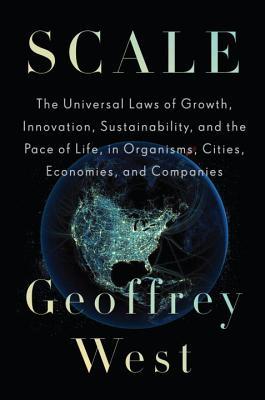
Scale: The Universal Laws of Growth, Innovation, Sustainability, and the Pace of Life in Organisms, Cities, Economies, and Companies
by Geoffrey B. West
Rating: 4.1 ⭐
• 10 recommendations ❤️
The former head of the Sante Fe Institute, visionary physicist Geoffrey West is a pioneer in the field of complexity science, the science of emergent systems and networks. The term “complexity” can be misleading, however, because what makes West’s discoveries so beautiful is that he has found an underlying simplicity that unites the seemingly complex and diverse phenomena of living systems, including our bodies, our cities and our businesses. Fascinated by issues of aging and mortality, West applied the rigor of a physicist to the biological question of why we live as long as we do and no longer. The result was astonishing, and changed science, creating a new understanding of energy use and metabolism: West found that despite the riotous diversity in the sizes of mammals, they are all, to a large degree, scaled versions of each other. If you know the size of a mammal, you can use scaling laws to learn everything from how much food it eats per day, what its heart-rate is, how long it will take to mature, its lifespan, and so on. Furthermore, the efficiency of the mammal’s circulatory systems scales up precisely based on weight: if you compare a mouse, a human and an elephant on a logarithmic graph, you find with every doubling of average weight, a species gets 25% more efficient—and lives 25% longer. This speaks to everything from how long we can expect to live to how many hours of sleep we need. Fundamentally, he has proven, the issue has to do with the fractal geometry of the networks that supply energy and remove waste from the organism's body. West's work has been game-changing for biologists, but then he made the even bolder move of exploring his work's applicability to cities. Cities, too, are constellations of networks and laws of scalability relate with eerie precision to them. For every doubling in a city's size, the city needs 15% less road, electrical wire, and gas stations to support the same population. More amazingly, for every doubling in size, cities produce 15% more patents and more wealth, as well as 15% more crime and disease. This broad pattern lays the groundwork for a new science of cities. Recently, West has applied his revolutionary work on cities and biological life to the business world. This investigation has led to powerful insights into why some companies thrive while others fail. The implications of these discoveries are far-reaching, and are just beginning to be explored. Scale is a thrilling scientific adventure story about the elemental natural laws that bind us together in simple but profound ways. Through the brilliant mind of Geoffrey West, we can envision how cities, companies and biological life alike are dancing to the same simple, powerful tune, however diverse and unrelated they are to each other.From the Hardcover edition.

Down to Earth: Politics in the New Climatic Regime
by Bruno Latour
Rating: 3.8 ⭐
• 2 recommendations ❤️
The present ecological mutation has organized the whole political landscape for the last thirty years. This could explain the deadly cocktail of exploding inequalities, massive deregulation, and conversion of the dream of globalization into a nightmare for most people.What holds these three phenomena together is the conviction, shared by some powerful people, that the ecological threat is real and that the only way for them to survive is to abandon any pretense at sharing a common future with the rest of the world. Hence their flight offshore and their massive investment in climate change denial.The Left has been slow to turn its attention to this new situation. It is still organized along an axis that goes from investment in local values to the hope of globalization and just at the time when, everywhere, people dissatisfied with the ideal of modernity are turning back to the protection of national or even ethnic borders.This is why it is urgent to shift sideways and to define politics as what leads toward the Earth and not toward the global or the national. Belonging to a territory is the phenomenon most in need of rethinking and careful redescription; learning new ways to inhabit the Earth is our biggest challenge. Bringing us down to earth is the task of politics today.