10 Books Recommended

The Fifties is a sweeping social, political, economic, and cultural history of the ten years that Halberstam regards as seminal in determining what our nation is today. Halberstam offers portraits of not only the titans of the age: Eisenhower Dulles, Oppenheimer, MacArthur, Hoover, and Nixon, but also of Harley Earl, who put fins on cars; Dick and Mac McDonald and Ray Kroc, who mass-produced the American hamburger; Kemmons Wilson, who placed his Holiday Inns along the nation's roadsides; U-2 pilot Gary Francis Powers; Grace Metalious, who wrote Peyton Place; and "Goody" Pincus, who led the team that invented the Pill.A NEW YORK TIMES BESTSELLER

The Big Change: America Transforms Itself, 1900-50
by Frederick Lewis Allen
Rating: 3.8 ⭐
• 2 recommendations ❤️
Frederick Lewis Allen was one of the pioneers in social history. Best known as the author of Only Yesterday, Allen originated a model of what is sometimes called instant history, the reconstruction of past eras through vivid commentary on the news, fashions, customs, and artifacts that altered the pace and forms of American life. The Big Change was Allen's last and most ambitious book. In it he attempted to chart and explain the progressive evolution of American life over half a century. Written at a time of unprecedented optimism and prosperity, The Big Change defines a transformative moment in American history and provides an implicit and illuminating perspective on what has taken place in the second half of the twentieth century.Allen's theme is the realization, in large measure, of the promise of democracy. As against the strain of social criticism that saw America as enfeebled by affluence and conformity, Allen wrote in praise of an economic system that had ushered in a new age of well being for the American people. He divides his inquiry into three major sections. The first, 'The Old Order,' portrays the turn-of-the-century plutocracy in which the federal government was largely subservient to business interests and the gap between rich and poor portended a real possibility of bloody rebellion. 'The Momentum of Change' graphically describes the various forces that gradually transformed the country in the new mass production, the automobile, the Great Depression and the coming of big government, World War II and America's emergence as a world power. Against this background, Allen shows how the economic system was reformed without being ruined, and how social gaps began to steadily close.The concluding section, 'The New America,' is a hopeful assessment of postwar American culture. Allen's analysis takes critical issue with many common perceptions, both foreign and domestic, of American life and places remaining social problems in careful perspective. As William O'Neill remarks in his introduction to this new edition, The Big Change is both a deep and wonderfully readable work of social commentary, a book that gains rather than loses with the years.

In this engagingly witty, wise, and heartfelt memoir, Martin Short tells the tale of how a showbiz- obsessed kid from Canada transformed himself into one of Hollywood's favorite funnymen, known to his famous peers as the "comedian's comedian."Short takes the reader on a rich, hilarious, and occasionally heartbreaking ride through his life and times, from his early years in Toronto as a member of the fabled improvisational troupe Second City to the all-American comic big time of Saturday Night Live, and from memorable roles in such movies as ¡Three Amigos! and Father of the Bride to Broadway stardom in Fame Becomes Me and the Tony-winning Little Me.He reveals how he created his most indelible comedic characters, among them the manic man-child Ed Grimley, the slimy corporate lawyer Nathan Thurm, and the bizarrely insensitive interviewer Jiminy Glick. Throughout, Short freely shares the spotlight with friends, colleagues, and collaborators, among them Steve Martin, Tom Hanks, Gilda Radner, Mel Brooks, Nora Ephron, Eugene Levy, Catherine O'Hara, Paul Shaffer, and David Letterman.But there is another side to Short's life that he has long kept private. He lost his eldest brother and both parents by the time he turned twenty, and, more recently, he lost his wife of thirty years to cancer. In I Must Say, Short talks for the first time about the pain that these losses inflicted and the upbeat life philosophy that has kept him resilient and carried him through.In the grand tradition of comedy legends, Martin Short offers a show-business memoir densely populated with boldface names and rife with retellable tales: a hugely entertaining yet surprisingly moving self-portrait that will keep you laughing—and crying—from the first page to the last.

The Great Beanie Baby Bubble: The Amazing Story of How America Lost Its Mind Over a Plush Toy - and the Eccentric Genius Behind It
by Zac Bissonnette
Rating: 4.0 ⭐
• 2 recommendations ❤️
“Fascinating, strange, sad, funny, and entirely engrossing, The Great Beanie Baby Bubble is a smart, engaging book that’s as much about the odd saga of these plush toys as it is about the nature of obsession and desire.”—SUSAN ORLEAN, author of Rin Tin Tin New York Times bestselling author Zac Bissonnette explores what happened when a $5 stuffed animal took over America and turned a college dropout into a billionaire. Now a major motion picture starring Elizabeth Banks and Zach Galifianakis, The Great Beanie Baby Bubble tells the story of the most extraordinary craze of the 1990s. In the history of consumer crazes, nothing compares to Beanie Babies. With no advertising or big-box distribution, creator Ty Warner – an eccentric college dropout – became a billionaire in just three years. But the end of the fad was just as swift and extremely devastating, with "rare" Beanie Babies deemed worthless as quickly as they'd once been deemed priceless. Bissonnette explains how and why the Beanie Baby craze rose and fell, and explores the rise of ecommerce and eBay. Through first-ever interviews with former Ty Inc. employees, Warner's sister, and the two ex-girlfriends who were by his side as he became the richest man in the history of toys, The Great Beanie Baby Bubble tells the inspiring yet tragic story of one of America's most enigmatic self-made tycoons. Perfect for collectors, investors, and fans of marketing and business books, The Great Beanie Baby Bubble explores the mass hysteria that captivated America.

The Geography of Madness: Penis Thieves, Voodoo Death, and the Search for the Meaning of the World's Strangest Syndromes
by Frank Bures
Rating: 3.4 ⭐
• 4 recommendations ❤️
Jon Ronson meets David Grann in this fascinating, wildly entertaining adventure and travel story about how culture can make us go totally insaneThe Geography of Madness is an investigation of "culture-bound" syndromes, which are far stranger than they sound. Why is it, for example, that some men believe, against all reason, that vandals stole their penises, even though they're in good physical shape? In The Geography of Madness, acclaimed magazine writer Frank Bures travels around the world to trace culture-bound syndromes to their sources—and in the process, tells a remarkable story about the strange things all of us believe.Book Club Discussion Questions: For the paperback edition, a list of book club discussion questions is also being issued. If you’d like to add the The Geography of Madness to your group’s reading list, here are several conversation starters:1) One main themes of The Geography of Madness is that stories (about the world, about our lives, about our bodies) are contagious. Can you think of a story, or an experience, that changed what you believed was possible?2) Do you believe the brain and the mind are the same thing? If not, what is the difference? 3) The stories in The Geography of Madness raise the question of free will: How much do you choose the life you live? How much do you learn (or catch) you life choices from those around you? 4) Have you ever found yourself immersed in a situation where you did not know the rules? What was that like?5) In The Geography of Madness, the author argues that our mindset and our expectations have biological consequences. Does that resemble your experience? If so, how?6) Try to imagine living in a world where it was possible to have your genitals stolen, either by magic or by ghosts. How would you protect yourself?7) In The Geography of Madness, the author argues that a strong sense of self—of your story— can help to activate your endogenous (internal) healing systems and vice versa. Do you remember a time when a stressful or difficult period seemed to be followed by a health problem or sickness? 8) In The Geography of Madness, did anyone’s genital actually disappear? If not, what happened? Does it matter?9) Is there a belief that everyone around you holds, but that you don’t share? How did you come to doubt this?10) The Handbook of Depression points to a genetic marker associated with greater vulnerability to depression. Yet this link only holds true in Western cultures. Why would that be?11) Have you ever had a health problem you were afraid to talk about, or that others didn’t believe in?12) In The Geography of Madness, the author argues that cultural syndromes are “real” syndromes, but that their causes might not lie where we think they do. Do you think they are “real” or “imaginary”? 13) Over the last few years, gluten intolerance has been rising. This rise occurs at a time of increasing anxiety about the relationship between food, health and identity. What’s changed: our bodies or our culture?14) After reading The Geography of Madness, how would you describe what culture is?15) How much does a your culture create you? How much do you create your culture?16) Have you ever had a cultural syndrome?

The Rise and Fall of American Growth: The U.S. Standard of Living since the Civil War
by Robert J. Gordon
Rating: 4.3 ⭐
• 2 recommendations ❤️
How America's high standard of living came to be and why future growth is under threatIn the century after the Civil War, an economic revolution improved the American standard of living in ways previously unimaginable. Electric lighting, indoor plumbing, motor vehicles, air travel, and television transformed households and workplaces. But has that era of unprecedented growth come to an end? Weaving together a vivid narrative, historical anecdotes, and economic analysis, The Rise and Fall of American Growth challenges the view that economic growth will continue unabated, and demonstrates that the life-altering scale of innovations between 1870 and 1970 cannot be repeated. Robert Gordon contends that the nation's productivity growth will be further held back by the headwinds of rising inequality, stagnating education, an aging population, and the rising debt of college students and the federal government, and that we must find new solutions. A critical voice in the most pressing debates of our time, The Rise and Fall of American Growth is at once a tribute to a century of radical change and a harbinger of tougher times to come.
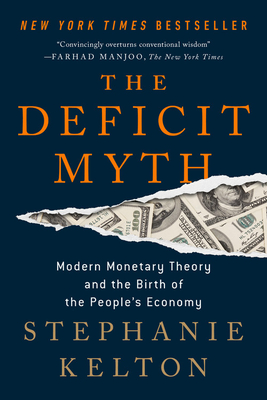
The Deficit Myth: Modern Monetary Theory and the Birth of the People's Economy
by Stephanie Kelton
Rating: 4.1 ⭐
• 4 recommendations ❤️
A New York Times BestsellerThe leading thinker and most visible public advocate of modern monetary theory -- the freshest and most important idea about economics in decades -- delivers a radically different, bold, new understanding for how to build a just and prosperous society.Stephanie Kelton's brilliant exploration of modern monetary theory (MMT) dramatically changes our understanding of how we can best deal with crucial issues ranging from poverty and inequality to creating jobs, expanding health care coverage, climate change, and building resilient infrastructure. Any ambitious proposal, however, inevitably runs into the buzz saw of how to find the money to pay for it, rooted in myths about deficits that are hobbling us as a country.Kelton busts through the myths that prevent us from taking that the federal government should budget like a household, that deficits will harm the next generation, crowd out private investment, and undermine long-term growth, and that entitlements are propelling us toward a grave fiscal crisis.MMT, as Kelton shows, shifts the terrain from narrow budgetary questions to one of broader economic and social benefits. With its important new ways of understanding money, taxes, and the critical role of deficit spending, MMT redefines how to responsibly use our resources so that we can maximize our potential as a society. MMT gives us the power to imagine a new politics and a new economy and move from a narrative of scarcity to one of opportunity.

Bubble in the Sun: The Florida Boom of the 1920s and How It Brought on the Great Depression
by Christopher Knowlton
Rating: 3.9 ⭐
• 4 recommendations ❤️
Christopher Knowlton, author of Cattle Kingdom and former Fortune writer, takes an in-depth look at the spectacular Florida land boom of the 1920s and shows how it led directly to the Great Depression.The 1920s in Florida was a time of incredible excess, immense wealth, and precipitous collapse. The decade there produced the largest human migration in American history, far exceeding the settlement of the West, as millions flocked to the grand hotels and the new cities that rose rapidly from the teeming wetlands. The boom spawned a new subdivision civilization—and the most egregious large-scale assault on the environment in the name of “progress.” Nowhere was the glitz and froth of the Roaring Twenties more excessive than in Florida. Here was Vegas before there was a gambling was condoned and so was drinking, since prohibition was not enforced. Tycoons, crooks, and celebrities arrived en masse to promote or exploit this new and dazzling American frontier in the sunshine. Yet, the import and deep impact of these historical events have never been explored thoroughly until now.In Bubble in the Sun Christopher Knowlton examines the grand artistic and entrepreneurial visions behind Coral Gables, Boca Raton, Miami Beach, and other storied sites, as well as the darker side of the frenzy. For while giant fortunes were being made and lost and the nightlife raged more raucously than anywhere else, the pure beauty of the Everglades suffered wanton ruination and the workers, mostly black, who built and maintained the boom, endured grievous abuses.Knowlton breathes dynamic life into the forces that made and wrecked Florida during the the real estate moguls Carl Fisher, George Merrick, and Addison Mizner, and the once-in-a-century hurricane whose aftermath triggered the stock market crash. This essential account is a revelatory—and riveting—history of an era that still affects our country today.

Alright, Alright, Alright: The Oral History of Richard Linklater's Dazed and Confused
by Melissa Maerz
Rating: 4.4 ⭐
• 4 recommendations ❤️
“Melissa Maerz’s brilliant oral history is the definitive account of a cult-classic movie that took a slow ride into the Seventies and defined the Nineties.” –Rob Sheffield, Rolling StoneThe definitive oral history of the cult classic Dazed and Confused , featuring behind-the-scenes stories from the cast, crew, and Oscar-nominated director Richard Linklater.Dazed and Confused not only heralded the arrival of filmmaker Richard Linklater, it introduced a cast of unknowns who would become the next generation of movie stars. Embraced as a cultural touchstone, the 1993 film would also make Matthew McConaughey’s famous phrase—alright, alright, alright—ubiquitous. But it started with a simple idea: Linklater thought people might like to watch a movie about high school kids just hanging out and listening to music on the last day of school in 1976. To some, that might not even sound like a movie. But to a few studio executives, it sounded enough like the next American Graffiti to justify the risk. Dazed and Confused underperformed at the box office and seemed destined to disappear. Then something weird happened: Linklater turned out to be right. This wasn’t the kind of movie everybody liked, but it was the kind of movie certain people loved, with an intensity that felt personal. No matter what their high school experience was like, they thought Dazed and Confused was about them.Alright, Alright, Alright is the story of how this iconic film came together and why it worked. Combining behind-the-scenes photos and insights from nearly the entire cast, including Matthew McConaughey, Parker Posey, Ben Affleck, Joey Lauren Adams, and many others, and with full access to Linklater’s Dazed archives, it offers an inside look at how a budding filmmaker and a cast of newcomers made a period piece that would feel timeless for decades to come.

From the Academy Award®–winning actor, an unconventional memoir filled with raucous stories, outlaw wisdom, and lessons learned the hard way about living with greater satisfaction. I’ve been in this life for fifty years, been trying to work out its riddle for forty-two, and been keeping diaries of clues to that riddle for the last thirty-five. Notes about successes and failures, joys and sorrows, things that made me marvel, and things that made me laugh out loud. How to be fair. How to have less stress. How to have fun. How to hurt people less. How to get hurt less. How to be a good man. How to have meaning in life. How to be more me. Recently, I worked up the courage to sit down with those diaries. I found stories I experienced, lessons I learned and forgot, poems, prayers, prescriptions, beliefs about what matters, some great photographs, and a whole bunch of bumper stickers. I found a reliable theme, an approach to living that gave me more satisfaction, at the time, and still: If you know how, and when, to deal with life’s challenges - how to get relative with the inevitable - you can enjoy a state of success I call “catching greenlights.” So I took a one-way ticket to the desert and wrote this book: an album, a record, a story of my life so far. This is fifty years of my sights and seens, felts and figured-outs, cools and shamefuls. Graces, truths, and beauties of brutality. Getting away withs, getting caughts, and getting wets while trying to dance between the raindrops. Hopefully, it’s medicine that tastes good, a couple of aspirin instead of the infirmary, a spaceship to Mars without needing your pilot’s license, going to church without having to be born again, and laughing through the tears. It’s a love letter. To life. It’s also a guide to catching more greenlights - and to realizing that the yellows and reds eventually turn green too. Good luck.