Aaron Stupple Recommended Books
7 Books Recommended

The Scientist in the Crib: What Early Learning Tells Us About the Mind
by Alison Gopnik
Rating: 3.8 ⭐
• 3 recommendations ❤️
This exciting book by three pioneers in the new field of cognitive science discusses important discoveries about how much babies and young children know and learn, and how much parents naturally teach them. It argues that evolution designed us both to teach and learn, and that the drive to learn is our most important instinct. It also reveals as fascinating insights about our adult capacities and how even young children -- as well as adults -- use some of the same methods that allow scientists to learn so much about the world. Filled with surprise at every turn, this vivid, lucid, and often funny book gives us a new view of the inner life of children and the mysteries of the mind.
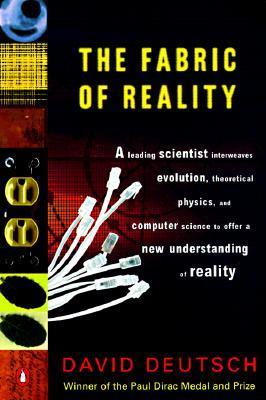
The Fabric of Reality: The Science of Parallel Universes--and Its Implications
by David Deutsch
Rating: 4.1 ⭐
• 9 recommendations ❤️
For David Deutsch, a young physicist of unusual originality, quantum theory contains our most fundamental knowledge of the physical world. Taken literally, it implies that there are many universes “parallel” to the one we see around us. This multiplicity of universes, according to Deutsch, turns out to be the key to achieving a new worldview, one which synthesizes the theories of evolution, computation, and knowledge with quantum physics. Considered jointly, these four strands of explanation reveal a unified fabric of reality that is both objective and comprehensible, the subject of this daring, challenging book. The Fabric of Reality explains and connects many topics at the leading edge of current research and thinking, such as quantum computers (which work by effectively collaborating with their counterparts in other universes), the physics of time travel, the comprehensibility of nature and the physical limits of virtual reality, the significance of human life, and the ultimate fate of the universe. Here, for scientist and layperson alike, for philosopher, science-fiction reader, biologist, and computer expert, is a startlingly complete and rational synthesis of disciplines, and a new, optimistic message about existence.

Originally published in 1960, Summerhill became an instant bestseller and a classic volume of education for an entire generation. Now, this thoroughly expanded and revised version of the original Summerhill reinstates the revolutionary "free school" traditions begun by Summerhill's founder A.S. Neill.As American education lags behind the rest of the world, this new edition is more timely than ever. The children of today face struggles far greater than any previous generation and we, as parents and teachers, must teach them now to make choices for themselves and to learn from the outcome of their decisions.This classic work yet again invites a new view of childhood and presents an essential treatise that challenges us to rethink our approach to education.

The Nurture Assumption: Why Children Turn Out the Way They Do, Revised and Updated
by Judith Rich Harris
Rating: 4.1 ⭐
• 2 recommendations ❤️
This groundbreaking book, a Pulitzer Prize finalist and New York Times notable pick, rattled the psychological establishment when it was first published in 1998 by claiming that parents have little impact on their children's development. In this tenth anniversary edition of The Nurture Assumption , Judith Harris has updated material throughout and provided a fresh introduction.Combining insights from psychology, sociology, anthropology, primatology, and evolutionary biology, she explains how and why the tendency of children to take cues from their peers works to their evolutionary advantage. This electrifying book explodes many of our unquestioned beliefs about children and parents and gives us a radically new view of childhood.

Librarian's note: Alternate cover editions can be found here, here, here and here.When a plane crashes on a remote island, a small group of schoolboys are the sole survivors. From the prophetic Simon and virtuous Ralph to the lovable Piggy and brutish Jack, each of the boys attempts to establish control as the reality - and brutal savagery - of their situation sets in.The boys' struggle to find a way of existing in a community with no fixed boundaries invites readers to evaluate the concepts involved in social and political constructs and moral frameworks. Ideas of community, leadership, and the rule of law are called into question as the reader has to consider who has a right to power, why, and what the consequences of the acquisition of power may be. Often compared to Catcher in the Rye, Lord of the Flies also represents a coming-of-age story of innocence lost.

The New York Times bestseller: A provocative, imaginative exploration of the nature and progress of knowledge"Dazzling." - Steven Pinker, The GuardianIn this groundbreaking book, award-winning physicist David Deutsch argues that explanations have a fundamental place in the universe--and that improving them is the basic regulating principle of all successful human endeavor. Taking us on a journey through every fundamental field of science, as well as the history of civilization, art, moral values, and the theory of political institutions, Deutsch tracks how we form new explanations and drop bad ones, explaining the conditions under which progress--which he argues is potentially boundless--can and cannot happen. Hugely ambitious and highly original, The Beginning of Infinity explores and establishes deep connections between the laws of nature, the human condition, knowledge, and the possibility for progress.

The Sovereign Child: How a Forgotten Philosophy Can Liberate Kids and Their Parents
by Aaron Stupple
Rating: 3.7 ⭐
• 1 recommendation ❤️
Could it really be okay to let kids eat whatever they want? Sleep whenever they want? Watch whatever they want? If kids are completely free to make their own choices, they’ll develop damaging habits that will haunt them into adulthood. Surely parents have a duty to set a few limits.But what if this conventional wisdom is wrong? What if our deepest ideas of how learning works, how knowledge grows, and the nature of personhood all point to the brute fact that parenting philosophies have missed a critical detail?In The Sovereign Child, Aaron Stupple explains Taking Children Seriously, the only parenting philosophy that accounts for the fact that children are people—their reasons, desires, emotions, and creativity all work precisely the same way that those of adults do. Because of this, much of the conventional wisdom simply cannot work as intended.Using examples gleaned from his years as a father of five, Aaron takes a close look at the unavoidable harms of rule enforcement and the startling alternatives available when parents never give up on treating children as if their reasons for their choices matter as much as anyone else's.