Loading genres...
Explore the best books about Terrorism genre.

"Allison's comprehensive but accessible treatment of this vital subject is a major contribution to public understanding." -The New York Times Book ReviewAmericans in the twenty-first century are keenly aware of the many forms of hijackings, biological attacks, chemical weapons. But the deadliest form is almost too scary to think about-a terrorist group exploding a nuclear device in an American city.In this urgent call to action, Graham Allison, one of America's leading experts on nuclear weapons and national security, presents the evidence for two provocative, compelling conclusions. First, if policy makers in Washington keep doing what they are currently doing about the threat, a nuclear terrorist attack on America is inevitable. Second, the surprising and largely unrecognized good news is that nuclear terrorism is, in fact, preventable. In these pages, Allison offers an ambitious but feasible blueprint for eliminating the possibility of nuclear terrorist attacks, if we are willing to face the issue squarely.


"For my money, John Robb, a former Air Force officer and tech guru, is the futurists' futurist."Slate The counterterrorism expert John Robb reveals how the same technology that has enabled globalization also allows terrorists and criminals to join forces against larger adversaries with relative ease and to carry out small, inexpensive actionslike sabotaging an oil pipelinethat generate a huge return. He shows how combating the shutdown of the worlds oil, high-tech, and financial markets could cost us the thing weve come to value the mostworldwide economic and cultural integrationand what we must do now to safeguard against this new method of warfare.

A devastating expose of U.S. foreign policy which separates the myth of an "international terrorist conspiracy" from the reality.

Jason Burke has produced the definitive account of Islamic militancy - revolutionising our understanding of Al-Qaeda, retelling its history from scratch and critically exploding the myths that form the very foundations of the 'War on Terror'. Fully updated with new material on Iraq and Afghanistan.

First published in 1989, just before the Gulf War broke out, Republic of Fear was the only book that explained the motives of the Saddam Hussein regime in invading and annexing Kuwait. This edition, updated in 1998, has a substantial introduction focusing on the changes in Hussein's regime since the Gulf War.In 1968 a coup d'état brought into power an extraordinary regime in Iraq, one that stood apart from other regimes in the Middle East. Between 1968 and 1980, this new regime, headed by the Arab Ba'th Socialist party, used ruthless repression and relentless organization to transform the way Iraqis think and react to political questions. In just twelve years, a party of a few thousand people grew to include nearly ten percent of the Iraqi population.This book describes the experience of Ba'thism from 1968 to 1980 and analyzes the kind of political authority it engendered, culminating in the personality cult around Saddam Hussein. Fear, the author argues, is at the heart of Ba'thi politics and has become the cement for a genuine authority, however bizarre.Examining Iraqi history in a search for clues to understanding contemporary political affairs, the author illustrates how the quality of Ba'thi pan-Arabism as an ideology, the centrality of the first experience of pan-Arabism in Iraq, and the interaction between the Ba'th and communist parties in Iraq from 1958 to 1968 were crucial in shaping the current regime.Saddam Hussein's decision to launch all-out war against Iran in September 1980 marks the end of the first phase of this re-shaping of modern Iraqi politics. The Iraq-Iran war is a momentous event in its own right, but for Iraq, the author argues, the war diverts dissent against the Ba'thi regime by focusing attention on the specter of an enemy beyond Iraq's borders, thus masking a hidden potential for even greater violence inside Iraq.

Access a Comprehensive BibliographyThough U.S. leaders try to convince the world of their success in fighting al Qaeda, one member of the U.S. intelligence community would like to inform the public that we are, in fact, losing the war on terror. Further, until U.S. leaders recognize the errant path they have irresponsibly chosen, he says, our enemies will only grow stronger.According to the author Michael Scheuer, the greatest danger for Americans confronting the Islamist threat is to believe—at the urging of U.S. leaders—that Muslims attack us for what we are and what we think rather than for what we do. Blustering political rhetoric “informs” the public that the Islamists are offended by the Western world’s democratic freedoms, civil liberties, inter-mingling of genders, and separation of church and state. However, although aspects of the modern world may offend conservative Muslims, no Islamist leader has fomented jihad to destroy participatory democracy, for example, the national association of credit unions, or coed universities. Instead, a growing segment of the Islamic world strenuously disapproves of specific U.S. policies and their attendant military, political, and economic implications.Capitalizing on growing anti-U.S. animosity, Osama bin Laden’s genius lies not simply in calling for jihad, but in articulating a consistent and convincing case that Islam is under attack by America. Al Qaeda’s public statements condemn America’s protection of corrupt Muslim regimes, unqualified support for Israel, the occupation of Iraq and Afghanistan, and a further litany of real-world grievances. Bin Laden’s supporters thus identify their problem and believe their solution lies in war. Scheuer contends they will go to any length, not to destroy our secular, democratic way of life, but to deter what they view as specific attacks on their lands, their communities, and their religion. Unless U.S. leaders recognize this fact and adjust their policies abroad accordingly, even moderate Muslims will join the bin Laden camp.

Writing with access to thousands of recently released official documents, new interviews & perspectives coming from a decade of research & reflection, Anthony Summers & Robbyn Swan deliver the 1st panoramic, authoritative look at 9/11. For many Americans, 9/11/2001, is the darkest date in the nation's history. What exactly happened? Could it have been prevented? How & why did so much acrimony & bad information arise from the ashes of the World Trade Center, the Pentagon & a Pennsylvania field? What remains unresolved? What is certain: Discord & dissent continue to this day. Beginning with the 1st brutal actions of the hijackers of American Airlines Flight 11, The Eleventh Day tracks the sequence of events & introduces the players: pilots, terrorists, passengers & those who died on the ground. Drawing on previously classified records & raw transcripts, Summers & Swan investigate the response of President Bush & the military that day, & the failure to intercept the hijacked airliners. They document the untruths told afterward by US officials &, as counterpoint, consider the contentions of the 9/11 Truth movement. With meticulous research, they examine the personalities of those behind the onslaught, analyze their motives & expose the US intelligence blunders preceding the attacks. They note how afterward--without good evidence--the Bush administration tried to link 9/11 to Iraq. Finally, they confront the question the 9/11 Commission's report blurred: Were the terrorists backed by powerful figures in a foreign nation long viewed as a friend? Riveting, revelatory, thoroughly sourced & complete with extensive endnotes, The Eleventh Day is the essential one-volume work on a pivotal event.

From the bestselling author of Public Enemies & The Big Rich , an account of the battle between the FBI & revolutionary movements of the '70s: Weathermen, The Symbionese Liberation Army, The FALN, The Black Liberation Army. The names seem quaint now, but then bombings by domestic underground groups were daily occurrences. The FBI combated these & other groups as nodes of a single revolutionary underground dedicated to the violent overthrow of the USA. Burrough's Days of Rage recreates an atmosphere almost unbelievable decades later, conjuring a time of native-born radicals, often nice middle-class kids, smuggling bombs into skyscrapers & detonating them inside the Pentagon & the Capitol, at a Boston courthouse & a Wall Street restaurant. The FBI’s response included the formation of a secret task force, Squad 47, dedicated to hunting the groups down. But Squad 47 itself broke laws in its attempts to bring the revolutionaries to justice. Its efforts ended in fiasco. Drawing on interviews about their experiences with members of the underground & the FBI, Days of Rage is a look into the hearts & minds of homegrown terrorists & federal agents alike, weaving their stories into a secret history of the '70s.

Brand New Deliver In 6-18 Working Days

WINNER OF THE 2016 PULITZER PRIZE FOR GENERAL NONFICTION A Best Book of 2015 "The New York Times," "The Washington Post," "People" Magazine, "San Francisco Chronicle," "Kansas City Star," and "Kirkus Reviews" ""In a thrilling dramatic narrative, awarded the 2016 Pulitzer Prize for General Nonfiction, Joby Warrick"traces how the strain of militant Islam behind ISIS first arose in a remote Jordanian prison and spread with the unwitting aid of two American presidents." When the government of Jordan granted amnesty to a group of political prisoners in 1999, it little realized that among them was Abu Musab al-Zarqawi, a terrorist mastermind and soon the architect of an Islamist movement bent on dominating the Middle East. In "Black Flags, " an unprecedented character-driven account of the rise of ISIS, Pulitzer Prize-winning reporter Joby Warrickshows how the zeal of this one man and the strategic mistakes of Presidents Bush and Obama led to the banner of ISIS being raised over huge swaths of Syria and Iraq.Zarqawi began by directing terror attacks from a base in northern Iraq, but it was the American invasion in 2003 that catapulted him to the head of a vast insurgency. By falsely identifying him as the link between Saddam and bin Laden, U.S. officials inadvertently spurred like-minded radicals to rally to his cause. Their wave of brutal beheadings and suicide bombings persisted until American and Jordanian intelligence discovered clues that led to a lethal airstrike on Zarqawi s hideout in 2006.His movement, however, endured. First calling themselves al-Qaeda in Iraq, then Islamic State of Iraq and Syria, or ISIS, his followers sought refuge in unstable, ungoverned pockets on the Iraq-Syria border. When the Syrian civil war broke out in 2011, and as the U.S. largely stood by, ISIS seized its chance to pursue Zarqawi s dream of an ultra-conservative Islamic caliphate.Drawing on unique high-level access to CIA and Jordanian sources, Warrick weaves gripping, moment-by-moment operational details with the perspectives of diplomats and spies, generals and heads of state, many of whom foresaw a menace worse than al Qaeda and tried desperately to stop it. "Black Flags" is a brilliant and definitive history that reveals the long arc of today s most dangerous extremist threat. "From the Hardcover edition.""

Lambeau, subst. masc. 1. Morceau d’étoffe, de papier, de matière souple, déchiré ou arraché, détaché du tout ou y attenant en partie. 2. Par analogie : morceau de chair ou de peau arrachée volontairement ou accidentellement. Lambeau sanglant ; lambeaux de chair et de sang. Juan, désespéré, le mordit à la joue, déchira un lambeau de chair qui découvrait sa mâchoire (Borel, Champavert, 1833, p. 55). 3. Chirurgie : segment de parties molles conservées lors de l’amputation d’un membre pour recouvrir les parties osseuses et obtenir une cicatrice souple. Il ne restait plus après l’amputation qu’à rabattre le lambeau de chair sur la plaie, ainsi qu’une épaulette à plat (Zola, Débâcle, 1892, p. 338). (Définitions extraites du Trésor de la Langue Française).

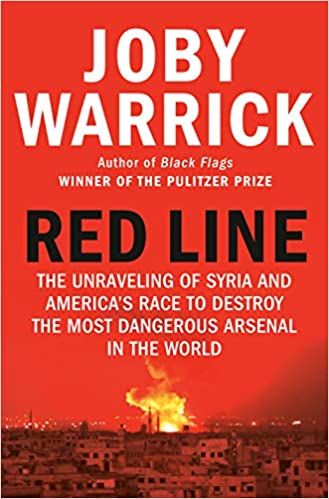
From the Pulitzer Prize–winning author of Black Flags comes the thrilling unknown story of America’s mission in to find and destroy Syria’s chemical weapons and keep them out of the hands of the Islamic State In August 2012, Syrian president Bashar al-Assad was clinging to power in a vicious civil war. When secret intelligence revealed that the dictator might resort to using chemical weapons, President Obama warned that doing so would cross “a red line.” Assad did it anyway, bombing the Damascus suburb of Ghouta with sarin gas, killing hundreds of civilians and forcing Obama to decide if he would mire America in another unpopular Middle Eastern war. When Russia offered to broker the removal of Syria’s chemical weapons, Obama leapt at the out.So begins an electrifying race to find, remove, and destroy 1,300 tons of chemical weapons in the midst of a raging civil war. The extraordinary little-known effort is a triumph for the Americans, but soon Russia’s long game becomes it will do anything to preserve Assad’s rule. As America’s ability to control events in Syria shrinks, the White House learns that ISIS, building its caliphate in Syria’s war-tossed territory, is seeking chemical weapons for itself, with an eye to attacking the West.Red Line is a classic Joby Warrick true-life a character-driven narrative with a cast of heroes and villains, including weapons hunters, politicians, doctors, diplomats, and spies. Drawing on astonishing original reporting, Warrick reveals how the United States embarked on a bold adventure to prevent one catastrophe but could not avoid a tragic chain of events that empowered America’s enemies.

The definitive account of the 1995 Oklahoma City bombing and the enduring legacy of Timothy McVeigh, leading to the January 6 insurrection—from acclaimed journalist Jeffrey Toobin.Timothy McVeigh wanted to start a movement.Speaking to his lawyers days after the Oklahoma City bombing, the Gulf War veteran expressed no regrets: killing 168 people was his patriotic duty. He cited the Declaration of Independence from “Whenever any Form of Government becomes destructive of these ends, it is the Right of the People to alter or to abolish it.” He had obsessively followed the siege of Waco and seethed at the imposition of President Bill Clinton’s assault weapons ban. A self-proclaimed white separatist, he abhorred immigration and wanted women to return to traditional roles. As he watched the industrial decline of his native Buffalo, McVeigh longed for when America was great.New York Times bestselling author Jeffrey Toobin traces the dramatic history and profound legacy of Timothy McVeigh, who once declared, “I believe there is an army out there, ready to rise up, even though I never found it.” But that doesn’t mean his army wasn’t there. With news-breaking reportage, Toobin details how McVeigh’s principles and tactics have flourished in the decades since his death in 2001, reaching an apotheosis on January 6 when hundreds of rioters stormed the Capitol. Based on nearly a million previously unreleased tapes, photographs, and documents, including detailed communications between McVeigh and his lawyers, as well as interviews with such key figures as Bill Clinton, Homegrown reveals how the story of Timothy McVeigh and the Oklahoma City bombing is not only a powerful retelling of one of the great outrages of our time, but a warning for our future.