
Willy Hendriks
7 Books Written
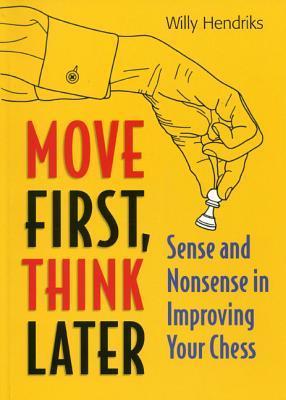
Move First, Think Later: Sense and Nonsense in Improving Your Chess
by Willy Hendriks
Rating: 4.1 ⭐
• 2 recommendations ❤️
The chess instruction establishment claims that all you need to do is concentrate on the characteristics of a position. Stick to some rules of thumb and good moves will pop up more or less automatically. But that is not how it works, finds International Master Willy Hendriks. Chess players, both weak and strong, don't first make a plan before looking at candidate moves. Trial and error is a very common and in fact highly effective way to get to the best move. In his journey into the chessplaying mind, Hendriks uses recent scientific insights in the working of our brain. He raises a number of intriguing questions: Can you, too (whether you are talented or not), become a grandmaster? Why does a chess trainer's advice often sound like a horoscope? Can you find strong moves by ticking off a todo list? Is it possible to reach master level without ever making a plan? Presents a wealth of valuable, nononsense training material. In this refreshing, entertaining and highly instructive book, Willy Hendriks shows how you can travel light on the road to chess improvement!"

On the Origin of Good Moves: A Skeptic's Guide at Getting Better at Chess
by Willy Hendriks
Rating: 4.5 ⭐
The way a beginner develops into a strong chess player closely resembles the progress of the game of chess itself. This popular idea is the reason why many renowned chess instructors such as former World Champions Garry Kasparov and Max Euwe, emphasize the importance of studying the history of chess. Willy Hendriks agrees that there is much to be learned from the pioneers of our game. He challenges, however, the conventional view on what the stages in the advancement of chess actually have been. Among the various articles of faith that Hendriks questions is Wilhelm Steinitz's reputation as the discoverer of the laws of positional chess. In The Origin of Good Moves Hendriks undertakes a groundbreaking investigative journey into the history of chess. He explains what actually happened, creates fresh perspectives, finds new heroes, and reveals the real driving force behind improvement in chess: evolution. This thought-provoking book is full of beautiful and instructive 'new' material from the old days. With plenty of exercises, the reader is invited to put themselves in the shoes of the old masters. Never before has the study of the history of chess been so entertaining and rewarding.

For the first 100 customers who order a hardcover edition, this copy will be signed by author IM Willy Hendriks himself.The rivalry between William Steinitz and Johannes Zukertort, the world's strongest chess players in the late nineteenth century, became so fierce that it was eventually named The Ink War. They fought their battle on the chessboard and in various chess magazines and columns. It was not only about who was the strongest player but also about who had the best ideas on how to play the game.In 1872, Johannes Zukertort moved from Berlin to London to continue his chess career. Ten years earlier, William Steinitz had moved from Vienna to London for the same purpose; meanwhile, he had become the uncrowned champion of the chess world. Their verbal war culminated in the first match for the World Championship in 1886.Zukertort is certainly the tragic protagonist of this book, but is he also a romantic hero? He has often been depicted as a representative of romantic chess, solely focusing on attacking the king. Steinitz is said to have put an end to this lopsided chess style with his modern scientific school. This compelling story shakes up the traditional version of chess history and answers the question which of them can claim to be the captain of the modern school.With his first book, Move First, Think Later, International Master Willy Hendriks caused a minor revolution in the general view on chess improvement. His second book, On the Origin of Good Moves, presented a refreshing new outlook on chess history. In The Ink War, Hendriks once again offers his unique perspective in a well-researched story that continues to captivate until the tragic outcome. It gives a wonderful impression of the 19th-century chess world and the birth of modern chess. Hendriks invites the reader to actively think along with the beautiful, instructive and entertaining chess fragments with many chess exercises.

Siegbert Tarrasch and Aron Nimzowitsch could be called the two vainest chess players in history. This book tells the fascinating story of their lifelong rivalry. They clashed as personalities, as players and as chess writers, both searching for the truth in chess, but with very different perspectives.Tarrasch is seen as the dogmatic theorist and, according to Nimzowitsch, didn't offer much more than the well-meaning advice of a housewife. Nimzowitsch is the philosopher, the designer of a complete ‘system’ that explains everything there is to know about chess to future generations of students.Does chess history treat these giants fairly or are they mere caricatures? And what was the role of the third protagonist in this debate, Semyon Alapin, whom Nimzowitsch condescendingly called ‘an artist of variations’? These questions, and these different viewpoints, are at the heart of this in-depth investigation.Hendriks offers a wonderful and often highly entertaining look at this great controversy. The many chess fragments nicely illustrate how our expertise has evolved in this turbulent period of chess history.

Ink War: Romanticism versus Modernity in Chess
by Willy Hendriks
The rivalry between William Steinitz and Johannes Zukertort, the world's strongest chess players in the late nineteenth century, became so fierce that it was eventually named The Ink War. They fought their battle on the chessboard and in various chess magazines and columns. It was not only about who was the strongest player but also about who had the best ideas on how to play the game.In 1872, Johannes Zukertort moved from Berlin to London to continue his chess career. Ten years earlier, William Steinitz had moved from Vienna to London for the same purpose; meanwhile, he had become the uncrowned champion of the chess world. Their verbal war culminated in the first match for the World Championship in 1886. Zukertort is certainly the tragic protagonist of this book, but is he also a romantic hero? He has often been depicted as a representative of romantic chess, solely focusing on attacking the king. Steinitz is said to have put an end to this lopsided chess style with his modern scientific school. This compelling story shakes up the traditional version of chess history and answers the question which of them can claim to be the captain of the modern school. With his first book, Move First, Think Later, International Master Willy Hendriks caused a minor revolution in the general view on chess improvement. His second book, On the Origin of Good Moves, presented a refreshing new outlook on chess history. In The Ink War, Hendriks once again offers his unique perspective in a well-researched story that continues to captivate until the tragic outcome. It gives a wonderful impression of the 19th-century chess world and the birth of modern chess. Hendriks invites the reader to actively think along with the beautiful, instructive and entertaining chess fragments with many chess exercises.

Erst ziehen, dann denken: Sinn und Unsinn im Schachtraining
by Willy Hendriks
In der Schachlehre wird allgemein behauptet, dass man sich nur auf die Merkmale einer Stellung zu konzentrieren braucht. Bei Beachtung einiger Faustregeln wird man mehr oder weniger automatisch gute Züge produzieren.So läuft die Sache aber nicht, wie der internationale Meister Willy Hendriks feststellt.Weder schwache noch starke Spieler schmieden zuerst einen Plan, bevor sie Kandidatenzüge betrachten.Die Trial-and-Error-Methode ist eine sehr gebräuchliche und in der Tat sehr effektive Weise, den besten Zug zu finden.Auf seiner Reise in den Schachspielerverstand bedient sich Hendriks jüngster wissenschaftlicher Erkenntnisse über das Funktionieren des Gehirns.Er wirft einige interessante Fragen * Kann jeder (ob talentiert oder nicht) Großmeister werden?* Warum klingt der Rat eines Schachtrainers häufig wie ein Horoskop?* Kann man starke Züge finden, indem man eine To-do-Liste abarbeitet?* Kann man Meisterstärke erreichen, ohne jemals einen Plan ausgearbeitet zu haben?In diesem erfrischenden, unterhaltsamen und äußerst lehrreichen Buch zeigt Willy Hendriks, wie man den Weg zur schachlichen Verbesserung mit wenig Gepäck beschreiten kann!Enthält eine Fülle von wertvollem Trainingsmaterial.

The Philosopher And The Housewife: Tarrasch, Nimzowitsch and the Evolution of Chess
by Willy Hendriks
Siegbert Tarrasch and Aron Nimzowitsch could be called the two vainest chess players in history. This book tells the fascinating story of their lifelong rivalry. They clashed as personalities, as players and as chess writers, both searching for the truth in chess, but with very different perspectives. Tarrasch is seen as the dogmatic theorist and, according to Nimzowitsch, didn't offer much more than the well-meaning advice of a housewife. Nimzowitsch is the philosopher, the designer of a complete system; that explains everything there is to know about chess to future generations of students. Does chess history treat these giants fairly or are they mere caricatures? And what was the role of the third protagonist in this debate, Semyon Alapin, whom Nimzowitsch condescendingly called ‘an artist of variations’? These questions, and these different viewpoints, are at the heart of this in-depth investigation.Hendriks offers a wonderful and often highly entertaining look at this great controversy. The many chess fragments nicely illustrate how our expertise has evolved in this turbulent period of chess history.