
William S. Burroughs
William Seward Burroughs II, (also known by his pen name William Lee) was an American novelist, short story writer, essayist, painter, and spoken word performer. A primary figure of the Beat Generation and a major postmodernist author, he is considered to be "one of the most politically trenchant, culturally influential, and innovative artists of the 20th century". His influence is considered to have affected a range of popular culture as well as literature. Burroughs wrote 18 novels and novellas, six collections of short stories and four collections of essays. Five books have been published of his interviews and correspondences. He also collaborated on projects and recordings with numerous performers and musicians, and made many appearances in films. He was born to a wealthy family in St. Louis, Missouri, grandson of the inventor and founder of the Burroughs Corporation, William Seward Burroughs I, and nephew of public relations manager Ivy Lee. Burroughs began writing essays and journals in early adolescence. He left home in 1932 to attend Harvard University, studied English, and anthropology as a postgraduate, and later attended medical school in Vienna. After being turned down by the Office of Strategic Services and U.S. Navy in 1942 to serve in World War II, he dropped out and became afflicted with the drug addiction that affected him for the rest of his life, while working a variety of jobs. In 1943 while living in New York City, he befriended Allen Ginsberg and Jack Kerouac, the mutually influential foundation of what became the countercultural movement of the Beat Generation. Much of Burroughs's work is semi-autobiographical, primarily drawn from his experiences as a heroin addict, as he lived throughout Mexico City, London, Paris, Berlin, the South American Amazon and Tangier in Morocco. Finding success with his confessional first novel, Junkie (1953), Burroughs is perhaps best known for his third novel Naked Lunch (1959), a controversy-fraught work that underwent a court case under the U.S. sodomy laws. With Brion Gysin, he also popularized the literary cut-up technique in works such as The Nova Trilogy (1961–64). In 1983, Burroughs was elected to the American Academy and Institute of Arts and Letters, and in 1984 was awarded the Ordre des Arts et des Lettres by France. Jack Kerouac called Burroughs the "greatest satirical writer since Jonathan Swift", a reputation he owes to his "lifelong subversion" of the moral, political and economic systems of modern American society, articulated in often darkly humorous sardonicism. J. G. Ballard considered Burroughs to be "the most important writer to emerge since the Second World War", while Norman Mailer declared him "the only American writer who may be conceivably possessed by genius". Burroughs had one child, William Seward Burroughs III (1947-1981), with his second wife Joan Vollmer. Vollmer died in 1951 in Mexico City. Burroughs was convicted of manslaughter in Vollmer's death, an event that deeply permeated all of his writings. Burroughs died at his home in Lawrence, Kansas, after suffering a heart attack in 1997.
30 Books Written

Naked Lunch is one of the most important novels of the twentieth century, a book that redefined literature. A startling tale of a narcotics addict unmoored in New York, Tangier, and ultimately a nightmarish wasteland known as Interzone, its formal innovation, taboo subject matter, and virtuoso style have exerted a significant influence on authors like Thomas Pynchon, J. G. Ballard, William Gibson, and Will Self, as well as on music, film, and the media generally. This restored edition incorporates Burroughs’s notes on the text, several essays he wrote about the book, and an appendix of new material and alternate drafts from the original manuscript. For the Burroughs enthusiast and the neophyte, this volume is a definitive and fresh experience of this classic of our culture.

The Yage an early epistolary novel by William S. Burroughs, whose 1952 account of himself as Junkie, published under the pseudonym William Lee, ended "Yage may be the final fix." In letters to Allen Ginsberg, an unknown young poet in New York, his journey to the Amazon jungle is recorded, detailing picaresque incidents of search for telepathic-hallucinogenic-mind-expanding drug Yage (Ayahuasca, or Banisteriopsis Caapé) used by Amazon Indian doctors for finding lost objects, mostly bodies and souls. Author and recipient of these letters met again in New York, Xmas 1953, pruned and edited the writings to form a single book. Correspondence contains first seeds of later Burroughsian fantasy in Naked Lunch. Seven years later Ginsberg in Peru writes his old guru an account of his own visions and terrors with the same drug, appealing for further counsel. Burroughs' mysterious reply is sent. The volume concludes with two a short note from Ginsberg on his return from the Orient years later reassuring Self that he is still here on earth, and a final poetic cut-up by Burroughs, "I Am Dying Meester?"

The definitive edition of Burroughs’s seminal first novel.Before his 1959 breakthrough, Naked Lunch, an unknown William S. Burroughs wrote Junky, his first novel. It is a candid eyewitness account of times and places that are now long gone, an unvarnished field report from the American post-war underground.Unafraid to portray himself in 1953 as a confirmed member of two socially-despised under classes (a narcotics addict and a homosexual), Burroughs was writing as a trained anthropologist when he unapologetically described a way of life - in New York, New Orleans, and Mexico City - that by the 1940s was already demonized by the artificial anti-drug hysteria of an opportunistic bureaucracy and a cynical, prostrate media.For this fiftieth-anniversary edition, eminent Burroughs scholar Oliver Harris has painstakingly recreated the author's original text, word by word, from archival typescripts and places the book's contents against a lively historical background in a comprehensive introduction. Here as well, for the first time, are Burroughs' own unpublished introduction and an entire omitted chapter, along with many “lost” passages, as well as auxiliary texts by Allen Ginsberg and others.

Queer is a love story – the account of William Lee’s painfully circular seduction of Eugene Allerton in Mexico City, and the romantic agonies he suffers. In his introduction Burroughs discusses frankly and courageously the shattering event that happened after the occurrences described in Queer, and how this event has haunted his life and affected his work.

On August 14, 1944, Lucien Carr, a friend of William S. Burroughs from St. Louis, stabbed a man named David Kammerer with a Boy Scout knife and threw his body in the Hudson River. For eight years, Kammerer had fawned over the younger Carr, but that night something happened: either Carr had had enough or he was forced to defend himself.The next day, his clothes stained with blood, Carr went to his friends Bill Burroughs and Jack Kerouac for help. Doing so, he involved them in the crime. A few months later, they were caught up in the crime in a different way. Something about the murder captivated the Beats, especially Kerouac and Burroughs, who decided to collaborate on a novel about the events of the previous summer. At the time, the two authors were still unknown, yet to write anything of note. Narrating alternating chapters, they pieced together a hard-boiled tale of bohemian New York during World War II, full of drugs and art, obsession and violence, with scenes and characters drawn from their own lives.They submitted their manuscript—called And the Hippos Were Boiled in Their Tanks after an absurd line from a radio bulletin about a circus fire—to publishers, but it was rejected and confined to a filing cabinet for decades. Finally published, at long last, And the Hippos Were Boiled in Their Tanks tells the story of Ramsay Allen and the object of his fixation, the charismatic, idealistic young Phillip Tourian. Phillip and his friends drink and dream in the bars and apartments of the West Village, until, with his friend Mike Ryko (Kerouac's narrator), he hatches a plan to ship out as a merchant marine. They'll catch a boat for France and jump ship, then make their way through the front to Paris. And the Hippos Were Boiled in Their Tanks is an engaging, fast-paced read that shows the two authors' developing styles. It is also an incomparable artifact, a legendary novel from the dawn of the Beat movement by two hugely influential writers.

In Naked Lunch, William S. Burroughs revealed his genius. In The Soft Machine he begins an adventure that will take us even further into the dark recesses of his imagination, a region where nothing is sacred, nothing taboo. Continuing his ferocious verbal assault on hatred, hype, poverty, war, bureaucracy, and addiction in all its forms, Burroughs gives us a surreal space odyssey through the wounded galaxies in a book only he could create.

While young men wage war against an evil empire of zealous mutants, the population of this modern inferno is afflicted with the epidemic of a radioactive virus. An opium-infused apocalyptic vision from the legendary author of Naked Lunch is the first of the trilogy with The Places of the Dead Roads and his final novel, The Western Plains .

The Wild Boys is a futuristic tale of global warfare in which a guerrilla gang of boys dedicated to freedom battles the organized armies of repressive police states. Making full use of his inimitable humor, wild imagination, and style, Burroughs creates a world that is as terrifying as it is fascinating.

Best known for the wild, phantasmagoric satire of works like Naked Lunch , William S. Burroughs reveals another, gentler side in The Cat Inside . Originally published as a limited-edition volume, this moving and witty discourse on cats combines deadpan routines and dream passages with a heartwarming account of Burroughs's unexpected friendships with the many cats he has known. It is also a meditation on the long, mysterious relationship between cats and their human hosts, which Burroughs traces back to the Egyptian cult of the "animal other." With its street sense and whiplash prose, The Cat Inside is a genuine revelation for Burroughs fans and cat lovers alike.

The Soft Machine introduced us to the conditions of a universe where endemic lusts of the mind and body pray upon men, hook them, and turn them into beasts. Nova Express takes William S. Burroughs’s nightmarish futuristic tale one step further. The diabolical Nova Criminals—Sammy The Butcher, Green Tony, Iron Claws, The Brown Artist, Jacky Blue Note, Izzy The Push, to name only a few—have gained control and plan on wreaking untold destruction. It’s up to Inspector Lee of the Nova Police to attack and dismantle the word and imagery machine of these “control addicts” before it’s too late. This surrealist novel is part sci-fi, part Swiftian parody, and always pure Burroughs.

A wity, rauchy, satrical novel from the Beat legend and author of Naked LunchConspirators plot to explode a train carrying nerve gas. A perfect servant suddenly reveals himself to be the insidious Dr. Fu Manchu. Science-fantasy wars, racism, corporate capitalism, drug addiction, and various medical and psychiatric horrors all play their parts in this mosaiclike, experimental novel. Here is William S. Burroughs at his coruscating and hilarious best.

A good old-fashioned shoot-out in the American West of the frontier days serves as the springboard for this hyperkinetic adventure in which gunslingers, led by Kim Carson, fight for galactic freedom. The Place of Dead Roads is the second novel in the trilogy with Cities of the Red Night and The Western Lands.

In The Ticket That Exploded, William S. Burroughs’s grand “cut-up” trilogy that starts with The Soft Machine and continues through Nova Express reaches its climax as inspector Lee and the Nova Police engage the Nova Mob in a decisive battle for the planet. Only Burroughs could make such a nightmare vision of scientists and combat troops, of ad men and con men whose deceitful language has spread like an incurable disease be at once so frightening and so enthralling.

The Western Lands is the eagerly awaited new novel by the most visionary American novelist of the twentieth century—a haunting Book of the Dead for the nuclear age. Every new work from the pen of William S. Burroughs is an important literary event. This is especially so in the case of The Western Lands. For in this novel, Burroughs completes a trilogy that began with Cities of the Red Night and The Place of Dead Roads, with a profound, revealing, and often astounding meditation on the themes of mortality, loneliness, nuclear peril—and the inextinguishable hope for an existence beyond bodily death. The symbolic vehicle Burroughs uses here is ancient Egyptian mythology, a long-standing interest of his. "The Western Lands" of the title are the territory to which the Egyptians believed the souls of the dead made a hazardous pilgrimage in their quest for true immortality. The questers—Joe the Dead, Kim Carsons, the scribe Neferti, Hassan i Sabbah, the Old Man of the Mountain—travel through an unmistakably Burroughs-esque universe of appalling danger and otherworldly beauty—now the back alleys of ancient Egypt, now bombed-out Berlin, now the Old West of the shootists. Their hallucinatory journeys express the author's belief that only through facing the most extreme dangers and testing the possibilities of biological mutation can man escape a dead-end world of blasted dreams and atomic finale. And presiding over all is the haunting figure of "the old writer," who shares in the fate of his characters in being finally unable to write himself out of Time, and into Space. The Western Lands continues and extends one of the great literary odysseys of our time, adding to Burroughs's awesome literary style and black humor chilling touches of elegy and autobiography. It is at once Burroughs's most personal and most universal work, yet another masterwork from the reigning genius of the American literary avant-garde.

In 1954 William Burroughs settled in Tangiers, finding a sanctuary of sorts in its shadowy streets, blind alleys, and lowlife decadence. It was this city that served as a catalyst for Burroughs as a writer, the backdrop for one of the most radical transformations of style in literary history. Burroughs's life during this period is limned in a startling collection of short stories, autobiographical sketches, letters, and diary entries, all of which showcase his trademark mordant humour, while delineating the addictions to drugs and sex that are the central metaphors of his work. But it is the extraordinary "WORD," a long, sexually wild and deliberately offensive tirade, that blends confession, routine, and fantasy and marks the true turning point of Burroughs as a writer-the breakthrough of his own characteristic voice that will find its full realization in Naked Lunch. James Grauerholz's incisive introduction sets the scene for this series of pieces, guiding the reader through Burroughs's literary evolution from the precise, laconic, and deadpan writer of Junky and Queer to the radical, uncompromising seer of Naked Lunch. Interzone is an indispensable addition to the canon of his works.

My Education is William S. Burroughs's final collection, first published two years before his death in 1997. It is a book of dreams, written over several decades and as personal and close to a memoir as we will see. The dreams cover themes from the mundane and ordinary -- conversations with his friends Allen Ginsberg or Ian Sommerville, feeding his cats, procuring drugs or sex -- to the erotic, bizarre, and visionary. Always a rich source of imagery in Burroughs's own fiction, in this book, dreams become a direct and powerful force in themselves."Mr. Burroughs has lost none of his irreverence or wit, but in recent years he has acquired an elegant, elegiac tone." – The New York Times

With the publication of Naked Lunch in 1959, William Burroughs abruptly brought international letters into the postmodern age. Beginning with his very early writing (including a chapter from his and Jack Kerouac's never-before-seen collaborative novel), Word Virus follows the arc of Burroughs's remarkable career, from his darkly hilarious "routines" to the experimental cut-up novels to Cities of the Red Night and The Cat Inside. Beautifully edited and complemented by James Grauerholz's illuminating biographical essays, Word Virus charts Burroughs's major themes and places the work in the context of the life. It is an excellent tool for the scholar and a delight for the general reader. Throughout a career that spanned half of the twentieth century, William S. Burroughs managed continually to be a visionary among writers. When he died in 1997, the world of letters lost its most elegant outsider.

The Job is William S. Burroughs at work, attacking our traditional values, condemning what he calls "the American nightmare," and expressing his often barbed views on Scientology, the police, orgone therapy, history, women, writing, politics, sex, drugs, and death. His conversation splices images of death-by-hanging with elevators and airports, the story of his drug addiction and cure with ideas on the use of hieroglyphs.

Ghost of Chance is an adventure story set in the jungle of Madagascar and filled with the obsessions that mark the work of the man who Norman Mailer once called, ‘the only American writer possessed by genius.’ While tripping through the author's trademark concerns—drugs, paranoia, and lemurs, this short novel tells an important story about environmental devastation in a way that only Burroughs can.Born in 1914, William S. Burroughs is the author of Junky, Naked Lunch and The Soft Machine and many other contemporary classics. A major figure of 20th century American literature, Burroughs died in 1997.

'He felt a sudden deep pity for the finger joint that lay there on the dresser, a few drops of blood gathering around the white bone.'A deliberately severed finger, a junky's Christmas miracle and a Tangier con-artist, among others, feature in these hallucinogenic sketches and stories from the infamous Beat legend.Penguin Modern: fifty new books celebrating the pioneering spirit of the iconic Penguin Modern Classics series, with each one offering a concentrated hit of its contemporary, international flavour. Here are authors ranging from Kathy Acker to James Baldwin, Truman Capote to Stanislaw Lem and George Orwell to Shirley Jackson; essays radical and inspiring; poems moving and disturbing; stories surreal and fabulous; taking us from the deep South to modern Japan, New York's underground scene to the farthest reaches of outer space.
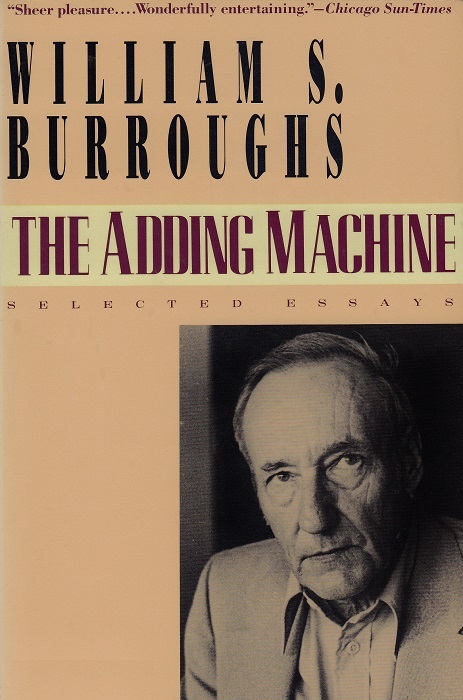
Acclaimed by Norman Mailer more than twenty years ago as "possibly the only American writer of genius," William S. Burroughs has produced a body of work unique in our time. In these scintillating essays, he writes wittily and wisely about himself, his interests, his influences, his friends and foes. He offers candid and not always flattering assessments of such diverse writers as Ernest Hemingway, F. Scott Fitzgerald, Joseph Conrad, Graham Greene, Jack Kerouac, Allen Ginsberg, Samuel Beckett, and Marcel Proust. He ruminates on science and the often dubious paths into which it seems intent on leading us, whether into outer or inner space. He reviews his reviewers, explains his famous “cut-up” method, and discusses the role coincidence has played in his life and work. As a satirist and parodist, William Burroughs has no peer, as these varied works, written over three decades, amply reveal.

Last Words: The Final Journals of William S. Burroughs is the most intimate book ever written by William S. Burroughs, author of Naked Lunch and one of the most celebrated literary outlaws of our time. Laid out as diary entries of the last nine months of Burroughs's life, Last Words spans the realms of cultural criticism, personal memoir, and fiction. Classic Burroughs concerns -- literature, U.S. drug policy, the state of humanity, his love for his cats -- permeate the book. Most significantly, Last Words contains some of the most personal work Burroughs has ever written, a final reckoning with his life and regrets, and his reflections on the deaths of his friends Allen Ginsberg and Timothy Leary. It is a poignant portrait of the man, his life, and his creative process -- one that never quit, not even in the shadow of death.

(The movie got its title from this earlier book) "In this futuristic screenplay vision of a strife-and-disease-plagued America in 1999, Burroughs finds the cure for a decaying civilization in the medicine practiced by underground physicians and surgeons. These heroic healers, in turn, are aided by 'blade runners,' teenagers who smuggle banned surgical instruments past the watchful eyes of fascistic police. The novel-cum-screenplay follows one of these runners during the course of a race riot and the transfer of instruments between embattled doctors. Above the drama in the streets of New York is a world 'taken over by hang-glider and autogyro gangs, mountaineers and steeplejacks. A sky boy steps off his penthouse into a parachute on guide wires that drop him to a street-level landing... Meanwhile, released animals and reptiles from the zoo and freed fish from the aquarium have control of the rovers and subways. The prose flashes with Burrough's own brand of outrageousness and fantasy." —L.A. Herald Examiner, July 29. 1979

A newly issued and reformatted, beautifully designed larger version of this bilingual German/English work, published in Germany by Pociao's Expanded Media Editions, featuring a photo of the author by Brion Gysin. "I have described here a number of weapons and tactics in the war game. Weapons that change consciousness could call the war game in question. All games are hostile. Basically there is only one game from here to eternity. . ."—William S. Burroughs.

Guru of the Beat generation, controversial eminence grise of the international avant-garde, dark prophet and blackest of black-humor satirists, William S. Burroughs has had a range of influence rivalled by few living writers. This meticulously assembled volume of his correspondence vividly documents the personal and cultural history through which Burroughs developed, revealing clues to illuminate his life and keys to open up his texts. More than that, they also show how in the period 1945-1959, letter-writing was itself integral to his life and to his fiction-making. These letters reveal the extraordinary route that took Burroughs from narrative to anti-narrative, from Junky to Naked Lunch and the discovery of cut-ups, a turbulent journey crossing two decades and three continents. The letters track the great shifts in Burroughs' crucial relationship with Allen Ginsberg, from lecturing wise man ("Watch your semantics young man") to total dependence ("Your absence causes me, at times, acute pain.") to near-estrangement ("I sometimes feel you have mixed me up with someone else doesn't live here anymore."). They show Burroughs' initial despair at the obscenity of his own letters, some of which became parts of Naked Lunch, and his gradual recognition of the work's true nature ("It's beginning to look like a modern Inferno.") They reveal the harrowing lows and ecstatic highs of his emotions, and lay bare the pain of coming to terms with a childhood trauma ("Such horror in bringing it out I was afraid my heart would stop."). It is a story as revealing of his fellow Beats as it is of Burroughs: he writes of Kerouac and Cassady in the midst of the journey immortalized as On the Road ("Neal is, of course, the very soul of this voyage into pure, abstract, meaningless motion."), and to Ginsberg as he was writing Howl ("I sympathize with your feelings of depression, beatness: 'We have seen the best of our time.'"). And throughout runs the unmistakable Burroughs voice, the u

Burroughs, the eccentric, brilliant artist who burned the bridge with logic and wrote the classic Naked Lunch, has a court recorder in Victor Bockris. Bockris has collected into a cogent whole the man's most brilliant moments of conversation, thinking, and interview repartee. This fascinating material, gleaned from the fertile time at Burroughs's New York headquarters, the Bunker (which was located on the Bowery, three blocks from CBGB), encompasses the years 1974 to 1980, and also includes a 1991 Burroughs interview from Interview magazine. The Beats' devotion to subjective experience has left readers with a profound amount of objective material to analyze and debate. Choice public and private utterances, hallucinatory and prescient diatribes such as these, remain rich sources of literary history. As Americans we find the Beats' approach to life romantic, even heroic. Tearing the walls down in the name of freedom and spirituality strikes a particularly pilgrimesque chord. With William Burroughs: A Report from the Bunker is a fascinating compendium of Burroughs-speak, so complete it can be considered a credo.

Trenchant writings by that sardonic "hombre invisible," William Seward Burroughs, perpetrator of Naked Lunch and other shockers. These malefic and beatific, mordant and hilarious straight-face reports on life are mostly from scatter-shot publications in obscure places, foreign and domestic. Including complete texts from White Subway, Cobblestone Gardens, and The Retreat Diaries, this collection delineates Burroughs' comprehensive world-view and his "insurrectionary sense of America's underside,” as Tom Carson epitomized it in The Village Voice.Also included are essays on Burroughs by Alan Ansen and Paul Bowles, and facsimile pages from the famous cut-up scrapbooks of the mid-century: The Book of Hours, John Brady's Book, and The Old Farmer's Almanac.

The Last Words of Dutch Schultz: A Fiction in the Form of a Film Script
by William S. Burroughs
Rating: 3.7 ⭐
Before he was gunned down in the Palace Chop House in Newark, New Jersey, in October 1935, Arthur Flegenheimer, alias Dutch Schultz, was generally considered New York's Number One racketeer. Taken to a hospital following the gangland shooting, he survived for two days. His room was guarded around the clock, and a police stenographer was stationed at his bedside in the hope of learning who his assailant or assailants were. Instead, what was recorded were Dutch's fevered fantasies, stemming from his childhood and youth, as well as his recent past. Taking these "last words" as his starting point, Burroughs has created his own fantasy of Dutch Schultz, casting his fiction in the form of a film script.

Burroughs and Gysin explore, document, and illustrate their "cut-up" method in a series of dazzling and often dizzying collaborations.

PORT OF SAINTS is the mind-boggling story of a man whose alternate selves take him on a fantastic journey through space, time, and sexuality. The last work written by Burroughs before his return to the United States in 1973, PORT OF SAINTS is partly experimental autobiography, partly profound exploration of the concept of personality, partly nightmare voyage through revolting alien sexual fantasy to the depths of the psyche: in short, an ultimate foray into that rich, savage landscape first depicted in Naked Lunch and The Wild Boys.