
William Poundstone
William Poundstone is the author of more than ten non-fiction books, including 'Fortune's Formula', which was the Amazon Editors' Pick for #1 non-fiction book of 2005. Poundstone has written for The New York Times, Psychology Today, Esquire, Harpers, The Economist, and Harvard Business Review. He has appeared on the Today Show, The David Letterman Show and hundreds of radio talk-shows throughout the world. Poundstone studied physics at MIT and many of his ideas concern the social and financial impact of scientific ideas. His books have sold over half a million copies worldwide.
2 Books Written

Prada stores carry a few obscenely expensive items in order to boost sales for everything else (which look like bargains in comparison). People used to download music for free, then Steve Jobs convinced them to pay. How? By charging 99 cents. That price has a hypnotic the profit margin of the 99 Cents Only store is twice that of Wal-Mart. Why do text messages cost money, while e-mails are free? Why do jars of peanut butter keep getting smaller in order to keep the price the "same"? The answer is prices are a collective hallucination.In Priceless , the bestselling author William Poundstone reveals the hidden psychology of value. In psychological experiments, people are unable to estimate "fair" prices accurately and are strongly influenced by the unconscious, irrational, and politically incorrect. It hasn't taken long for marketers to apply these findings. "Price consultants" advise retailers on how to convince consumers to pay more for less, and negotiation coaches offer similar advice for businesspeople cutting deals. The new psychology of price dictates the design of price tags, menus, rebates, "sale" ads, cell phone plans, supermarket aisles, real estate offers, wage packages, tort demands, and corporate buyouts. Prices are the most pervasive hidden persuaders of all. Rooted in the emerging field of behavioral decision theory, Priceless should prove indispensable to anyone who negotiates.
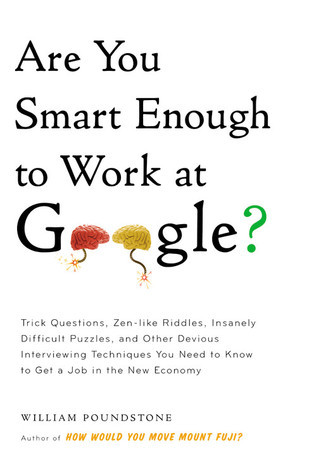
You are shrunk to the height of a nickel and thrown in a blender. The blades start moving in 60 seconds. What do you do?If you want to work at Google, or any of America's best companies, you need to have an answer to this and other puzzling questions. Are You Smart Enough to Work at Google? guides readers through the surprising solutions to dozens of the most challenging interview questions. The book covers the importance of creative thinking, ways to get a leg up on the competition, what your Facebook page says about you, and much more. Are You Smart Enough to Work at Google? is a must-read for anyone who wants to succeed in today's job market.