
William MacAskill
I'm Will MacAskill, an Associate Professor in Philosophy at Lincoln College, Oxford, and author of Doing Good Better (Gotham Books, 2015). I've also cofounded two non-profits: 80,000 Hours, which provides research and advice on how you can best make a difference through your career, and Giving What We Can, which encourages people to commit to give at least 10% of their income to the most effective charities. These organisations helped to spark the effective altruism movement.
7 Books Written

An Oxford philosopher makes the case for "longtermism"—that positively influencing the long-term future is a key moral priority of our time. The fate of the world is in our hands. Humanity’s written history spans only five thousand years. Our yet-unwritten future could last for millions more—or it could end tomorrow. Astonishing numbers of people could lead lives of great happiness or unimaginable suffering, or never live at all, depending on what we choose to do today. In What We Owe the Future, philosopher William MacAskill argues for longtermism, that idea that positively influencing the distant future is a key moral priority of our time. From this perspective, it’s not enough to reverse climate change or avert the next pandemic. We must ensure that civilization would rebound if it collapsed; counter the end of moral progress; and prepare for a planet where the smartest beings are digital, not human. If we make wise choices today, our grandchildren’s grandchildren will thrive, knowing we did everything we could to give them a world full of justice, hope and beauty.
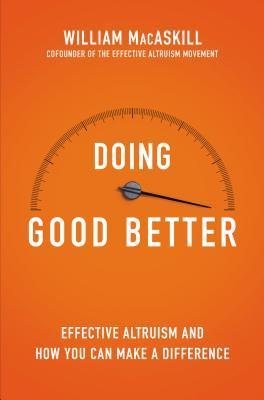
Doing Good Better: How Effective Altruism Can Help You Make a Difference
by William MacAskill
Rating: 4.2 ⭐
Most of us want to make a difference. We donate our time and money to charities and causes we deem worthy, choose careers we consider meaningful, and patronize businesses and buy products we believe make the world a better place. Unfortunately, we often base these decisions on assumptions and emotions rather than facts. As a result, even our best intentions often lead to ineffective—and sometimes downright harmful—outcomes. How can we do better?While a researcher at Oxford, trying to figure out which career would allow him to have the greatest impact, William MacAskill confronted this problem head on. He discovered that much of the potential for change was being squandered by lack of information, bad data, and our own prejudice. As an antidote, he and his colleagues developed effective altruism, a practical, data-driven approach that allows each of us to make a tremendous difference regardless of our resources. Effective altruists believe that it’s not enough to simply do good; we must do good better.At the core of this philosophy are five key questions that help guide our altruistic How many people benefit, and by how much? Is this the most effective thing I can do? Is this area neglected? What would have happened otherwise? What are the chances of success, and how good would success be? By applying these questions to real-life scenarios, MacAskill shows how many of our assumptions about doing good are misguided. For instance, he argues one can potentially save more lives by becoming a plastic surgeon rather than a heart surgeon; measuring overhead costs is an inaccurate gauge of a charity’s effectiveness; and, it generally doesn’t make sense for individuals to donate to disaster relief.MacAskill urges us to think differently, set aside biases, and use evidence and careful reasoning rather than act on impulse. When we do this—when we apply the head and the heart to each of our altruistic endeavors—we find that each of us has the power to do an astonishing amount of good.

This is an open access title available under the terms of a CC BY-NC-ND 4.0 International licence. It is free to read at Oxford Scholarship Online and offered as a free PDF download from OUP and selected open access locations.Very often we are uncertain about what we ought, morally, to do. We do not know how to weigh the interests of animals against humans, how strong our duties are to improve the lives of distant strangers, or how to think about the ethics of bringing new people into existence. But we still need to act. So how should we make decisions in the face of such uncertainty? Though economists and philosophers have extensively studied the issue of decision-making in the face of uncertainty about matters of fact, the question of decision-making given fundamental moral uncertainty has been neglected. In Moral Uncertainty , philosophers William MacAskill, Krister Bykvist, and Toby Ord try to fill this gap. They argue that there are distinctive norms that govern how one ought to make decisions and defend an information-sensitive account of how to make such decisions. They do so by developing an analogy between moral uncertainty and social choice, noting that different moral views provide different amounts of information regarding our reasons for action, and arguing that the correct account of decision-making under moral uncertainty must be sensitive to that. Moral Uncertainty also tackles the problem of how to make intertheoretic comparisons, and addresses the implications of their view for metaethics and practical ethics.

utilitarianism.netThis website aims to provide a concise, accessible and engaging introduction to modern utilitarianism, functioning as an online textbook targeted at the undergraduate level. There is a particular focus on classical utilitarianism, as we believe it remains the most convincing and compelling version of utilitarianism. The content of this website aims to be understandable to a broad audience, avoiding philosophical jargon where possible and providing definitions where necessary.Utilitarianism has important implications for how we should think about leading an ethical life. Because utilitarianism weighs the wellbeing of everyone equally, it implies that we should make helping others a very significant part of our lives. There are many pressing problems in the world today. Unfortunately, because our resources are scarce, we cannot solve all the world’s problems at once. Not all ways of helping others are equally effective. According to utilitarianism we should carefully choose which problems to work on and by what means, based on how we can most improve the lives of everyone, counted equally. This involves taking seriously the question of how we can best use our time and money to help others.A few moral problems appear especially pressing by utilitarian lights, such as fighting extreme poverty, reducing the suffering of animals on factory farms and, in particular, ensuring that the long-term future goes as well as possible. People who will exist in the future greatly outnumber those who are alive today, and we may be able to take actions that affect their wellbeing. Therefore, one key concern for utilitarians is to promote the wellbeing of not only the current generation but of all generations to come.Addressing these problems may involve donating generously to effective charities, choosing your career based on how to most help others, and encouraging other people to do the same.This website was written by William MacAskill and Darius Meissner. William is an Associate Professor in Philosophy and Senior Research Fellow at the Global Priorities Institute at the University of Oxford. Darius is a student in Philosophy, Politics and Economics at the University of Oxford. We are grateful to James Aung for editing and web design.

Collection Set: What We Owe the Future / Doing Good Better

