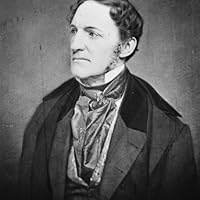
William Hickling Prescott
United States historian. Born to a prosperous family, Prescott graduated from Harvard University in 1814 but was prevented by poor health and eyesight from a career in law or business. His friends, including Washington Irving, led him to his life's work: recounting the history of 16th-century Spain and its colonies. He is best known for his History of the Conquest of Mexico (1843) and History of the Conquest of Peru (1847), for which he made rigorous use of original sources, and which earned him a reputation as the first scientific U.S. historian.
30 Books Written

William Hickling Prescott (May 4, 1796 – January 28, 1859) was an American historian and Hispanist, who is widely recognized by historiographers to have been the first American scientific historian. Despite suffering from serious visual impairment, which at times prevented him from reading or writing for himself, Prescott became one of the most eminent historians of 19th century America. He is also noted for his eidetic memory.After an extensive period of study, during which he sporadically contributed to academic journals, Prescott specialized in late Renaissance Spain and the early Spanish Empire. His works on the subject, The History of the Reign of Ferdinand and Isabella the Catholic (1837), The History of the Conquest of Mexico (1843), A History of the Conquest of Peru (1847) and the unfinished History of the Reign of Phillip II (1856–1858) have become classic works in the field, and have had a great impact on the study of both Spain and Mesoamerica. During his lifetime, he was upheld as one of the greatest living American intellectuals, and knew personally many of the leading political figures of the day, in both the United States and Britain. Prescott has become one of the most widely translated American historians, and was an important figure in the development of history as a rigorous academic discipline. Historians admire Prescott for his exhaustive, careful, and systematic use of archives, his accurate recreation of sequences of events, his balanced judgments and his lively writing style. He was primarily focused on political and military affairs, largely ignoring economic, social, intellectual, and cultural forces that in recent decades historians have focused on. Instead, he wrote narrative history, subsuming unstated causal forces in his driving storyline.

""The History of the Conquest of Peru"" is a comprehensive account of the Spanish conquest of the Inca Empire in the 16th century. Written by William H. Prescott, the book details the events leading up to the conquest, including the arrival of Spanish explorers and their interactions with the Incas. Prescott also explores the political and social structures of the Inca Empire, as well as the military tactics employed by both sides during the conflict. The book covers the major battles and key figures involved in the conquest, including Francisco Pizarro and Atahualpa, the last Inca emperor. Prescott's work is highly regarded for its detailed research and engaging writing style, making it a classic in the field of historical literature.But little is told of Francisco's early years, and that little not always deserving of credit. According to some, he was deserted by both his parents, and left as a foundling at the door of one of the principal churches of the city. It is even said that he would have perished, had he not been nursed by a sow.3 This is a more discreditable fountain of supply.This scarce antiquarian book is a facsimile reprint of the old original and may contain some imperfections such as library marks and notations. Because we believe this work is culturally important, we have made it available as part of our commitment for protecting, preserving, and promoting the world's literature in affordable, high quality, modern editions, that are true to their original work.

History of the Conquest of Mexico/History of the Conquest of Peru
by William Hickling Prescott
Rating: 4.0 ⭐
One of America's greatest and most highly regarded historians, William Hickling Prescott set a lofty literary standard for historical writing with his books on Spain's emperors and explorers. Prescott avoided the dry, names-and-dates style of standard histories and instead brought the past alive, telling with drama and vigor the stories of the men who came face to face with the unknown, and the numerous brushes with death they survived as they carved out an empire in the New World. History of the Conquest of Mexico & History of the Conquest of Peru unites in one volume for the first time two of Prescott's best known and most powerful works. The books detail with accuracy and emotional resonance the arrival of Spain's conquerors to Mexico and Peru, and the wars of conquest whose outcomes remain the cause of contention even in the present day. The History of the Conquest of Mexico focuses on Hernan Cortes, a notary from Spain's Extremadura region, arriving at the edge of the Aztec empire with 500 men, determined to spread Christianity and enlarge the domain of Charles V of Spain. Within the space of a few years Cortes found himself fending off rivals from Spain and warring against enraged Aztecs, against whose superior numbers Cortes struggled against the odds to maintain his garrisons. Prescott's biographer Harry Thurston Peck called The History of the Conquest of Mexico "one of the most brilliant examples which the English language possesses of literary art applied to historical narration." Conquistadors Pizarro and Almagro are the protagonists of The History of the Conquest of Peru. Prescott tells of their brutal overthrow of the Incas, and the wars between the two of them afterward. Another of Prescott's biographers, Donald G. Darnell, called the book, "an immensely readable history." Using a wealth of documentation as raw material, Prescott turned this blend of viewpoints into a heroic and tragic epic of Spain's efforts to dominate Central and South America. The Histories

History of the Reign of Ferdinand and Isabella, the Catholic - Volume I
by William Hickling Prescott
Rating: 3.9 ⭐
William Hickling Prescott (1796-1859) was an American historian. In 1838, he published History of the Regin of Ferdinand and Isabella, the Catholic in three volumes which at once gained for him a high place among historians. It was followed in 1843 by the History of the Conquest of Mexico and in 1847 by the Conquest of Peru. His last work was the History of Philip II, of which the third volume appeared in 1858, and which was left unfinished. In all his works he displayed great research, impartiality, and an admirable narrative power. Much of Prescott's work was based on his researches with unpublished documents in archives in Spain.

The Age of Philip II and the Supremacy of the Spanish Empire
by William Hickling Prescott
Rating: 4.1 ⭐
The history of Philip the Second is the history of Europe during the latter half of the sixteenth century. It covers the period when the doctrines of the Reformation were agitating the minds of men in so fearful a manner as to shake the very foundations of the Romish hierarchy in the fierce contest which divided Christendom. Philip, both from his personal character, and from his position as sovereign of the most potent monarchy in Europe, was placed at the head of the party which strove to uphold the fortunes of the ancient Church; and thus his policy led him perpetually to interfere in the internal affairs of the other European states…

The History of the Reign of Ferdinand and Isabella the Catholic (Vol. 1-3): Complete Edition
by William Hickling Prescott
Rating: 3.8 ⭐
PREFACECONTENTS INTRODUCTION.SECTION I. VIEW OF THE CASTILIAN MONARCHY BEFORE THE FIFTEENTH CENTURY.SECTION II. REVIEW OF THE CONSTITUTION OF ARAGON TO THE MIDDLE OF THE FIFTEENTH CENTURY.PART FIRST. 1406-1492.THE PERIOD WHEN THE DIFFERENT KINGDOMS OF SPAIN WERE FIRST UNITED UNDER ONE MONARCHY, AND A THOROUGH REFORM WAS INTRODUCED INTO THEIR INTERNAL ADMINISTRATION; OR THE PERIOD EXHIBITING MOST FULLY THE DOMESTIC POLICY OF FERDINAND AND ISABELLA.CHAPTER I. STATE OF CASTILE AT THE BIRTH OF ISABELLA.—REIGN OF JOHN II, OF CASTILE. 1406-1454.CHAPTER II. CONDITION OF ARAGON DURING THE MINORITY OF FERDINAND. REIGN OF JOHN II, OF ARAGON. 1452-1472.CHAPTER III. REIGN OF HENRY IV, OF CASTILE—CIVIL WAR.—MARRIAGE OF FERDINAND AND ISABELLA. 1454-1469.CHAPTER IV. FACTIONS IN CASTILE.—WAR BETWEEN FRANCE AND ARAGON.—DEATH OF HENRY IV, OF CASTILE. 1469-1474.CHAPTER V. ACCESSION OF FERDINAND AND ISABELLA.—WAR OF THE SUCCESSION.—BATTLE OF TORO. 1474-1476.CHAPTER VI. INTERNAL ADMINISTRATION OF CASTILE. 1475-1482.CHAPTER VII. ESTABLISHMENT OF THE MODERN INQUISITION.CHAPTER VIII. REVIEW OF THE POLITICAL AND INTELLECTUAL CONDITION OF THE SPANISH ARABS PREVIOUS TO THE WAR OF GRANADA.CHAPTER IX. WAR OF GRANADA.—SURPRISE OF ZAHARA.—CAPTURE OF ALHAMA. 1481-1482.CHAPTER X. WAR OF GRANADA.—UNSUCCESSFUL ATTEMPT ON LOJA.—DEFEAT IN THE AXARQUIA. 1482-1483.CHAPTER XI. WAR OF GRANADA.—GENERAL VIEW OF THE POLICY PURSUED IN THE CONDUCT OF THIS WAR. 1483-1487.CHAPTER XII. INTERNAL AFFAIRS OF THE KINGDOM.—INQUISITION IN ARAGON. 1483-1487.CHAPTER XIII. WAR OF GRANADA.—SURRENDER OF VELEZ MALAGA.—SIEGE AND CONQUEST OF MALAGA. 1487.CHAPTER XIV. WAR OF GRANADA.—CONQUEST OF BAZA.—SUBMISSION OF EL ZAGAL. 1487-1489.CHAPTER XV. WAR OF GRANADA.—SIEGE AND SURRENDER OF THE CITY OF GRANADA. 1490-1492.CHAPTER XVI. APPLICATION OF CHRISTOPHER COLUMBUS AT THE SPANISH COURT. 1492.CHAPTER XVII. EXPULSION OF THE JEWS FROM SPAIN. 1492.CHAPTER XVIII. ATTEMPTED ASSASSINATION OF FERDINAND.—RETURN AND SECOND VOYAGE OF COLUMBUS. 1492-1493.CHAPTER XIX. CASTILIAN LITERATURE.—CULTIVATION OF THE COURT.—CLASSICAL LEARNING.— SCIENCE.CHAPTER XX. CASTILIAN LITERATURE.—ROMANCES OF CHIVALRY.—LYRICAL POETRY.-THE DRAMA.PART SECOND. 1493-1517.THE PERIOD WHEN, THE INTERIOR ORGANIZATION OF THE MONARCHY HAVING BEEN COMPLETED, THE SPANISH NATION ENTERED ON ITS SCHEMES OF DISCOVERY AND CONQUEST; OR THE PERIOD ILLUSTRATING MORE PARTICULARLY THE FOREIGN POLICY OF FERDINAND AND ISABELLA.CHAPTER I. ITALIAN WARS.—GENERAL VIEW OF EUROPE.—INVASION OF ITALY BY CHARLES VIII. OF FRANCE. 1493-1495.CHAPTER II. ITALIAN WARS.—RETREAT OF CHARLES VIII.—CAMPAIGNS OF GONSALVO DE CORDOVA.—FINAL EXPULSION OF THE FRENCH. 1495-1496.CHAPTER III. ITALIAN WARS.—GONSALVO SUCCORS THE POPE.—TREATY WITH FRANCE.— ORGANIZATION OF THE SPANISH MILITIA. 1496-1498.CHAPTER IV. ALLIANCES OF THE ROYAL FAMILY.—DEATH OF PRINCE JOHN AND PRINCESS ISABELLA.CHAPTER V. DEATH OF CARDINAL MENDOZA.—RISE OF XIMENES.—ECCLESIASTICAL REFORM.CHAPTER VI. XIMENES IN GRANADA—PERSECUTION, INSURRECTION, AND CONVERSION OF THE MOORS. 1499-1500.CHAPTER VII. RISING IN THE ALPUXARRAS.—DEATH OF ALONSO DE AGUILAR.—EDICT AGAINST THE MOORS. 1500-1502.CHAPTER VIII. COLUMBUS.—PROSECUTION OF DISCOVERY.—HIS TREATMENT BY THE COURT. 1494-1503.CHAPTER IX. SPANISH COLONIAL POLICY.CHAPTER X. ITALIAN WARS.—PARTITION OF NAPLES.

The History of the Reign of Ferdinand and Isabella the Catholic — Volume 2
by William Hickling Prescott
Rating: 3.6 ⭐
This book was converted from its physical edition to the digital format by a community of volunteers. You may find it for free on the web. Purchase of the Kindle edition includes wireless delivery.

Book by Prescott, William H.

History of the Reign of Philip the Second, King of Spain, Vols. 1 and 2
by William Hickling Prescott
Rating: 3.7 ⭐
This book was converted from its physical edition to the digital format by a community of volunteers. You may find it for free on the web. Purchase of the Kindle edition includes wireless delivery.

The History of the Reign of Ferdinand and Isabella the Catholic — Volume 3
by William Hickling Prescott
Rating: 3.8 ⭐
This book was converted from its physical edition to the digital format by a community of volunteers. You may find it for free on the web. Purchase of the Kindle edition includes wireless delivery.

Primer libro de la obra The History of the Conquest of Mexico, with a Preliminary View of Ancient Mexican Civilization, & the Life of the Conqueror, Hernando Cortés (1843) For the first time, the very famous & exciting & classic text of William H. Prescott in a fully illustrated book. In this evocation of the Aztecs--by far the best-known people of the ancient Mexico--the author mentions the various pre-Aztec civilizations of the country.

Libero adattamento di P. Guillot dalla "History of the Conquest of Mexico" di William H. Prescott.

Prescott's Histories: The Rise and Decline of the Spanish Empire
by William Hickling Prescott
Rating: 4.0 ⭐
Here is what you get in this Selected and Edited edition Of History of the Reign of Ferdinand and Parts 1 and 2. History of the Conquest of Mexico. Books 2-3-4-5-6-7. History of the Conquest of Peru - Books 2-3-4. History of Philip the Second - Books 1-2-4-5-6.
This work has been selected by scholars as being culturally important, and is part of the knowledge base of civilization as we know it. This work was reproduced from the original artifact, and remains as true to the original work as possible. Therefore, you will see the original copyright references, library stamps (as most of these works have been housed in our most important libraries around the world), and other notations in the work. This work is in the public domain in the United States of America, and possibly other nations. Within the United States, you may freely copy and distribute this work, as no entity (individual or corporate) has a copyright on the body of the work.As a reproduction of a historical artifact, this work may contain missing or blurred pages, poor pictures, errant marks, etc. Scholars believe, and we concur, that this work is important enough to be preserved, reproduced, and made generally available to the public. We appreciate your support of the preservation process, and thank you for being an important part of keeping this knowledge alive and relevant.

Aztèques et Incas: Grandeur et Décadence de Deux Empires Fabuleux
by William Hickling Prescott
Rating: 5.0 ⭐
Aztèques et Incas : deux noms qui font rêver. Il fallut attendre les années 1S40 pour qu'un historien américain de Boston se penchât sur l'histoire de ces fabuleux empires qui disparurent dans un déluge de feu et de sang, sous les assauts des Conquistadores, à partir de 1519. Véritables best-sellers au XIXe siècle, admirablement traduits par Amédée Pichot et Hector Poret, l'Histoire de la Conquête du Mexique et l'Histoire de la Conquête du Pérou firent l'effet d'une bombe à leur parution en révélant des pans entiers de l'histoire du continent américain. D'emblée, l'oeuvre s'imposa comme un monument. Maîtrisant parfaitement toutes les sources disponibles à son époque, faisant preuve d'une érudition sans taille, William Hickling Prescott fut le premier historien à reconnaître le génie propre des civilisations précolombiennes. Cent cinquante ans après leur publication, ses deux ouvrages sont toujours considérés comme des oeuvres de référence. Ils font sans conteste de lui l'égal de Jules Michelet.

Many of the earliest books, particularly those dating back to the 1900s and before, are now extremely scarce and increasingly expensive. We are republishing these classic works in affordable, high quality, modern editions, using the original text and artwork.

With its vivid language and bold strokes, the magnificent History of the Conquest of Peru, first published in 1847, is one of historian William Prescott's landmark works. A masterly study of Spanish conquistador Francisco Pizarro's overthrow of the Inca Empire, this astonishing chronicle is considered a classic of Latin American history. Noted for its striking portrayal of the Spanish character, the book rings with a "fusion of courage, cruelty, pride, and gallows humor," says Darnell. "We seem to be overhearing dialogue and observing firsthand the interaction between the Spaniards as they struggle for control of an empire." He hails this as "an immensely readable history." Also available from Cosimo Classics: History of the Conquest of Mexico, Prescott's companion volume about Corts's subjugation of the Aztecs. Historian, writer, and scholar WILLIAM HICKLING PRESCOTT (1796-1859) was born in Salem, Massachusetts. A regular contributor to the prestigious Boston literary journal North American Review, he also authored numerous books of history, including 1837's The History of the Reign of Ferdinand and Isabella the Catholic, a critical and popular success in both America and Europe.
In a two volume study of the drama of historical writing, praised by Allan Nevins, C. Harvey Gardner brings us the personal record of more than 35 years of the American historian author of "The Conquest of Mexico" and "the Conquest of Peru"--notebooks, comments, reading lists, notes, and outlines Prescott used while writing his histories.

Excerpt from MolierOn the completion of his studies in 1641, he was required to accompany the king, then Louis the Thirteenth, in his capacity of valet dc chambre (his father being detained in Paris by his infirmi ties), on an excursion to the south of France. This journey afforded him the opportunity of be coming intimately acquainted with the habits of the court, as well as those of the provinces, of which he after-ward so repeatedly availed himself in his comedies. On his return he commenced the study of the law, and had completed it, it would appear, when his old passion for the theate1 revived with increased ardor, and, after some. Hesitation, he determined no longer to withstand the decided impulse of his genius. He associated himself with one of those city companies of players with which Paris had swarmed since the days of Richelieu - a minister who aspired after the same empire in the republic of letters which he had so long maintained over the state, and whose osten. Tatious patronage eminently contributed to develop that taste for dramatic exhibition which has dis tinguished his countrymen ever since.This book is a reproduction of an important historical work. Forgotten Books uses state-of-the-art technology to digitally reconstruct the work, preserving the original format whilst repairing imperfections present in the aged copy. In rare cases, an imperfection in the original, such as a blemish or missing page, may be replicated in our edition. We do, however, repair the vast majority of imperfections successfully; any imperfections that remain are intentionally left to preserve the state of such historical works.
Tells of Columbus' struggles with Ferdinand and Isabella in launching his various voyages

History of the Conquest of Mexico with a Preliminary View of the Ancient Mexican Civilization & the Life of the Conqueror, Hernando Cortez, Vol 3
by William Hickling Prescott
Rating: 4.5 ⭐
Michigan Historical Reprint SeriesThis volume is produced from digital images created through the University of Michigan University Library's preservation reformatting program.

History of the Conquest of Peru with a Preliminary View of the Civilization of the Incas, Vol 2
by William Hickling Prescott
Rating: 4.0 ⭐
This volume is produced from digital images created through the University of Michigan University Library's preservation reformatting program.

Pamplona. 20 cm. LXXXVIII, 142 p. retr. Encuadernación en tapa blanda de editorial ilustrada. Colección 'Colección Historiadores', numero coleccion(14). Prescott, William Hickling 1796-1859. The life of Charles the Fifth after his abdication. Prólogo de Iván Jaksi?. Índices. Título Account of the Emperor's life after his abdication. Carlos. Rey de España .. Este libro es de segunda mano y tiene o puede tener marcas y señales de su anterior propietario. 9788493746230

History of The Reign of Philip The Second King of Spain Volume The Third and Biographical & Critical Miscellanies
by William Hickling Prescott
Rating: 4.0 ⭐
This book was converted from its physical edition to the digital format by a community of volunteers. You may find it for free on the web. Purchase of the Kindle edition includes wireless delivery.

The History of the Conquest of Mexico by William Hickling Prescott
by William Hickling Prescott
Rating: 4.0 ⭐

The 1492 conquest of Granada in southern Spain is crucial to a proper understanding of the development of Western European warfare. The culmination of a long struggle between the Muslim and Christian cultures in Western Europe, it was the training ground for the armed forces that were to make Spain the dominant military power in Europe throughout the sixteenth century. It also set the stage for the discovery of the New World - it was the war that had to be won before Ferdinand and Isabella would agree to sponsor Columbus's momentous voyage. William Prescott's absorbing account of the War of Granada is now set in context by Albert D. McJoynt, who examines the role of the conquest of Granada in Spanish warfare and its influence on Western Europe. Military histories in English have tended to neglect Spain's experience in Granada, causing a critical gap in awareness of the factors that led to its military strength in Europe after the Italian Wars of the late fifteenth and early sixteenth centuries. Far from merely copying their adversaries' techniques during these wars, as has often been assumed, the Spanish armed forces had already adopted most of the advances that took Spanish warfare from the medieval to early modern stage.

History of the reign of Philip the Second, king of Spain. Volume 1 of 3
by William Hickling Prescott
Rating: 5.0 ⭐
History of the reign of Philip the Second, king of Spain. William Hickling Prescott Gale, Sabin AmericanaBased on Joseph Sabin's famed bibliography, Bibliotheca Americana, Sabin Americana, 1500--1926 contains a collection of books, pamphlets, serials and other works about the Americas, from the time of their discovery to the early 1900s. Sabin Americana is rich in original accounts of discovery and exploration, pioneering and westward expansion, the U.S. Civil War and other military actions, Native Americans, slavery and abolition, religious history and more.Sabin Americana offers an up-close perspective on life in the western hemisphere, encompassing the arrival of the Europeans on the shores of North America in the late 15th century to the first decades of the 20th century. Covering a span of over 400 years in North, Central and South America as well as the Caribbean, this collection highlights the society, politics, religious beliefs, culture, contemporary opinions and momentous events of the time. It provides access to documents from an assortment of genres, sermons, political tracts, newspapers, books, pamphlets, maps, legislation, literature and more.Now for the first time, these high-quality digital scans of original works are available via print-on-demand, making them readily accessible to libraries, students, independent scholars, and readers of all ages.++++The below data was compiled from various identification fields in the bibliographic record of this title. This data is provided as an additional tool in helping to insure edition ++++ Huntington Library SABCP02676501 CTRG98-B2308 18550101 Selected Americana from Sabin's Dictionary of books relating to America Vol. 3 published by Routledge, Warnes, and Routledge, 1859. 3 map, ports., facsim; 23 cm

About the William Hickling Prescott (May 4, 1796 – January 28, 1859) was an American historian and Hispanist, who is widely recognized by historiographers to have been the first American scientific historian. Despite suffering from serious visual impairment, which at times prevented him from reading or writing for himself, Prescott became one of the most eminent historians of 19th century America. He is also noted for his eidetic memory.After an extensive period of study, during which he sporadically contributed to academic journals, Prescott specialized in late Renaissance Spain and the early Spanish Empire. His works on the subject, The History of the Reign of Ferdinand and Isabella the Catholic (1837), The History of the Conquest of Mexico (1843), A History of the Conquest of Peru (1847) and the unfinished History of the Reign of Phillip II (1856–1858) have become classic works in the field, and have had a great impact on the study of both Spain and Mesoamerica. During his lifetime, he was upheld as one of the greatest living American intellectuals, and knew personally many of the leading political figures of the day, in both the United States and Britain. Prescott has become one of the most widely translated American historians, and was an important figure in the development of history as a rigorous academic discipline.[3][4] Historians admire Prescott for his exhaustive, careful, and systematic use of archives, his accurate recreation of sequences of events, his balanced judgments and his lively writing style. He was primarily focused on political and military affairs, largely ignoring economic, social, intellectual, and cultural forces that in recent decades historians have focused on. Instead, he wrote narrative history, subsuming unstated causal forces in his driving storyline.This book published in 1843 has been reformatted for the Kindle and may contain an occasional defect from the original publication or from the reformatting.

Historia de la Conquista del Perú, Precedida de una Ojeada Sobre la Civilización de los Incas, Vol. 1 (Classic Reprint)
by William Hickling Prescott
Rating: 5.0 ⭐
Excerpt from Historia de la Conquista del Perú, Precedida de una Ojeada Sobre la Civilización de los IncasA los materiales que he sacado de estas fuentes, he añadidº algunos manuscritºs im portantes de' la biblioteca del Escorial. Estos, que se miiÂ… principalm ente á la antigua of ganizaciºtr del Perú, formaban parte de la msg nitica colecciºn del Lord que por desgracia ha cºrridº la misma suerte que la mayor parte de las colecciones literarias, dis petsándose despues de la muerte de su» doble autºr. De ellos sºydeudnr al labºriºsº biblió grafº Mr. O'rich, que se halla ahora en La» dres. Pºr último, no debº concluir sin mani festar mi agradecimiento ¿pºr ºtra especie de auxiliº, á mi amigº el erudito biblioti def Ateneº debºstºn, Carlºs Fólsom, Esq., cuyº cºnºcimientº de las mas pequeñas pantiºulari dades de la eonstnicciºn gramatical, y de la verdadera indºle de nuestra lengua inglaa, me han prºporciºnadº el cºrnegir muchºs descui dos en que habia caidº, tantº en ezta obraco mº en las precedentes.